Introduction
Runtime Application Self-Protection (RASP) represents a fundamental shift in how modern organizations defend their software assets. Unlike traditional perimeter-based security, which monitors network traffic at the edge, RASP is integrated directly into the application’s runtime environment. It works by intercepting calls from the application to the operating system or database, analyzing the internal execution flow to detect and block malicious activity in real-time. By operating from within, RASP has the unique advantage of contextual awareness, allowing it to distinguish between legitimate user requests and sophisticated attacks like SQL injection, cross-site scripting, and unauthorized file access.
In the current landscape of rapid software delivery and cloud-native architectures, RASP has become an essential component of the DevSecOps lifecycle. As applications become increasingly decentralized through microservices and APIs, the traditional “moat and castle” defense strategy is no longer sufficient. RASP provides a “bodyguard” for each application, traveling with it regardless of where it is deployed—whether on-premises, in a container, or within a serverless function. When evaluating RASP solutions, technical leaders must prioritize low-latency performance, depth of language support, and the ability to provide actionable telemetry that integrates seamlessly with existing security operations centers.
Best for: Security engineers, DevOps teams, and enterprise organizations managing high-value web applications or APIs that require continuous protection against zero-day exploits and known vulnerabilities.
Not ideal for: Simple static websites with no back-end logic or organizations looking only for network-level filtering. If an application does not process dynamic data or interact with a database, a standard web application firewall may be more cost-effective.
Key Trends in Runtime Application Self-Protection
The evolution of RASP is currently driven by the widespread adoption of serverless and function-as-a-service models, where traditional security agents cannot be installed, leading to the rise of lightweight, library-based protection. There is a significant movement toward autonomous policy generation, where RASP tools use machine learning to map the “normal” behavioral patterns of an application and automatically block anything that deviates from that baseline. We are also seeing a deeper integration between RASP and Interactive Application Security Testing (IAST), creating a feedback loop where vulnerabilities discovered during testing are immediately shielded in production.
Another critical trend is the focus on API-specific protection, as APIs have become the primary attack vector for modern data breaches. Modern RASP solutions are now capable of deep inspection of JSON and XML payloads to prevent logic abuse. Furthermore, there is an increasing demand for “zero-touch” deployment, where RASP can be injected into the application at the container orchestration layer without requiring developers to modify a single line of source code. Finally, as data privacy regulations tighten globally, RASP is being utilized to provide granular data masking and redaction at the runtime level to ensure sensitive information never leaves the application memory unencrypted.
How We Selected These Tools
The selection of these top ten RASP providers involved a rigorous evaluation of their technical architecture and their ability to operate in high-scale production environments. We prioritized solutions that offer a broad range of language support, covering major stacks such as Java, .NET, Python, Node.js, and Go. Market adoption was a key indicator, as tools with extensive deployment history provide more reliable detection patterns and fewer false positives. We also analyzed the performance overhead of each tool, ensuring that the protection layer does not introduce latency that would degrade the end-user experience.
The integration ecosystem was another primary factor; we sought tools that offer native hooks into modern CI/CD pipelines and security orchestration platforms. We also examined the “observability” aspect of each tool, favoring those that provide detailed stack traces and attack context to help developers fix the underlying code vulnerabilities. Finally, we looked for a balance between “blocking” capabilities and “diagnostic” depth, ensuring that the selected tools serve both the immediate needs of the security team and the long-term goals of the development organization.
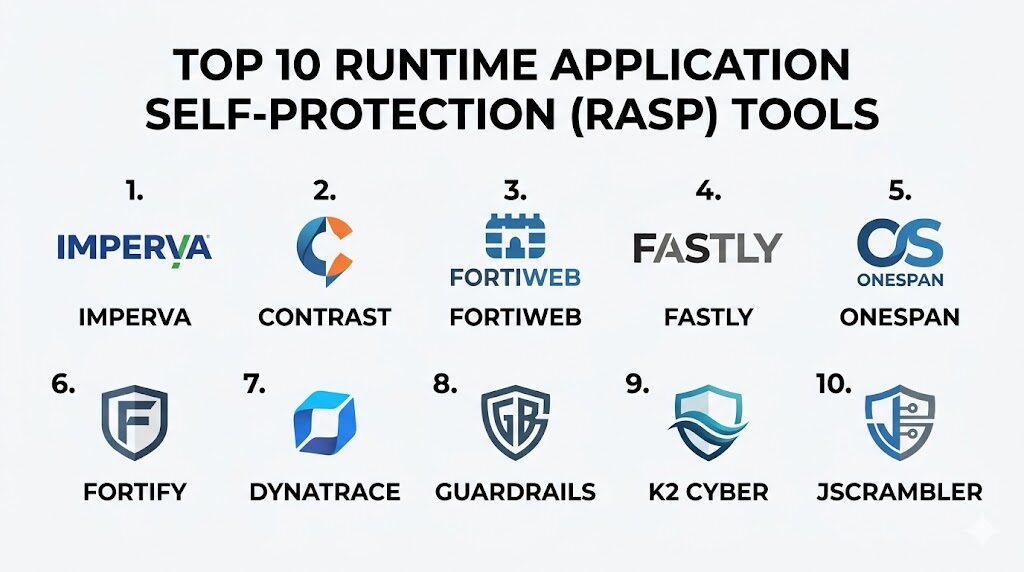
1. Imperva RASP
Imperva RASP, built on technology formerly known as Prevoty, is a market leader known for its deep integration into the application stack. It provides a highly granular level of protection by analyzing the intent of every call made within the application, ensuring that only valid execution paths are followed. It is particularly strong in preventing injection attacks and unauthorized database access.
Key Features
The platform utilizes LangSec (Language-Theoretic Security) to validate every input against the expected grammar of the application’s code. It offers a “blocking by default” mode that stops attacks without requiring a learning period or signatures. The tool provides detailed forensics, including the exact line of code where the attack was attempted. It supports a wide range of deployment models, from legacy on-premises servers to modern containerized environments. Additionally, it offers automated shielding for third-party libraries and open-source components that may contain unpatched vulnerabilities.
Pros
Extremely low false-positive rate due to its deep understanding of application logic. It provides some of the most detailed attack telemetry available in the RASP market.
Cons
The initial configuration can be complex for teams without deep application security expertise. Licensing costs are targeted toward enterprise-level budgets.
Platforms and Deployment
Supports Java, .NET, Node.js, and Python. Can be deployed on-premises, in the cloud, or in hybrid environments.
Security and Compliance
Supports FIPS 140-2 compliance and helps organizations meet PCI DSS and HIPAA requirements through robust data protection.
Integrations and Ecosystem
Integrates with major SIEM providers and fits into Jenkins and GitLab pipelines for automated security orchestration.
Support and Community
Offers 24/7 global enterprise support and maintains a comprehensive knowledge base for security practitioners.
2. Contrast Protect
Contrast Protect leverages a unique “binary instrumentation” approach that embeds security directly into the application code during runtime. It is part of a broader platform that combines testing and protection, allowing for a unified view of the application’s security posture from development to production.
Key Features
The tool uses patented deep security instrumentation to monitor the application from the inside out. It identifies when an attack successfully reaches a vulnerability and blocks it instantly. It provides an automated inventory of all open-source libraries used by the application, flagging those with known CVEs. The dashboard offers real-time visibility into the “attack surface” that is currently being targeted. It requires no changes to the network or the underlying operating system.
Pros
The “unified agent” approach simplifies the transition from security testing to production protection. It is highly effective at identifying “vulnerable but unreachable” code, reducing noise for developers.
Cons
The instrumentation process can occasionally conflict with other monitoring tools (APM) if not tuned correctly. Performance overhead can be slightly higher in very resource-constrained environments.
Platforms and Deployment
Supports Java, .NET, Node.js, PHP, Python, and Ruby. Cloud-native and container-ready.
Security and Compliance
Adheres to SOC 2 Type II standards and provides specific reporting for GDPR and CCPA compliance.
Integrations and Ecosystem
Excellent integrations with Slack, Jira, and Microsoft Teams for real-time alerting and incident management.
Support and Community
Provides extensive online training via Contrast University and has a strong presence in the DevSecOps community.
3. Fortinet FortiWeb (with RASP)
Fortinet has integrated RASP capabilities into its broader web application security portfolio, allowing organizations to combine the benefits of an external WAF with internal runtime protection. This multi-layered approach is designed for organizations that want a single vendor for their entire application security stack.
Key Features
The RASP module provides deep visibility into the application’s internal execution to stop zero-day exploits. It utilizes machine learning to build a baseline of normal application behavior. It provides protection for both web applications and APIs against the OWASP Top 10 threats. The tool is tightly integrated with the Fortinet Security Fabric, allowing for coordinated responses across the network. It features automated virtual patching to shield vulnerabilities while developers work on a permanent fix.
Pros
Ideal for organizations already invested in the Fortinet ecosystem. Provides a comprehensive view that links network-level attacks with runtime execution errors.
Cons
The RASP capabilities are often seen as an add-on to the WAF, rather than a standalone best-of-breed solution. Language support is more limited than specialized RASP vendors.
Platforms and Deployment
Primarily focused on Java and .NET environments. Supports physical, virtual, and cloud deployments.
Security and Compliance
ISO 27001 certified and helps meet strict regulatory requirements for financial and healthcare sectors.
Integrations and Ecosystem
Native integration with FortiGate and FortiSIEM for a unified security management experience.
Support and Community
Access to the global FortiGuard Labs research team and 24/7 technical assistance.
4. Signal Sciences (Fastly)
Signal Sciences, now part of Fastly, offers a flexible security platform that can be deployed as a RASP, a WAF, or an API gateway. It is known for its high-performance architecture and its ability to handle massive traffic loads without degrading latency.
Key Features
The “Smart-Cloud” engine analyzes traffic patterns across thousands of applications to identify new threats. It can be deployed as a language-specific agent that sits directly in the application code. It offers advanced rate-limiting and bot protection alongside its core RASP capabilities. The platform provides a unified management console for all deployment types. It features a “threshold-based” blocking system that reduces false positives by looking for patterns of malicious intent.
Pros
Extremely fast and lightweight, making it suitable for high-traffic consumer web applications. The flexibility of deployment allows it to follow the application through different architectural shifts.
Cons
The focus is slightly more toward the edge (WAF/WAAP), meaning its internal code instrumentation may not be as deep as Imperva or Contrast.
Platforms and Deployment
Supports over 30 different platforms including Java, Go, Node.js, Python, and Ruby. Cloud, hybrid, and on-premises.
Security and Compliance
PCI DSS Level 1 Service Provider and SOC 2 compliant.
Integrations and Ecosystem
Outstanding API support and native integrations with Datadog, Splunk, and PagerDuty.
Support and Community
Highly regarded for its customer success teams and active technical blog.
5. OneSpan (AppShield)
OneSpan AppShield is a specialized RASP solution focused primarily on mobile application security. It is designed to protect mobile apps against reverse engineering, code injection, and execution in untrusted environments (such as rooted or jailbroken devices).
Key Features
The tool provides robust code obfuscation to prevent attackers from understanding the application logic. It features anti-tampering technology that detects if the application’s binary has been modified. It monitors for screen-scraping and overlay attacks in real-time. It provides a secure storage environment for sensitive data and cryptographic keys within the mobile device. The solution can automatically shut down the application if a high-risk environment is detected.
Pros
The absolute gold standard for protecting mobile banking and high-security financial applications. Very easy to integrate into the mobile build process without manual coding.
Cons
Strictly limited to mobile (iOS and Android) environments; it does not protect web or server-side applications.
Platforms and Deployment
Native iOS and Android support. Delivered as a library to be included in the mobile app build.
Security and Compliance
Helps financial institutions comply with PSD2 and FIPS standards for mobile security.
Integrations and Ecosystem
Integrates with mobile CI/CD tools and OneSpan’s broader identity and authentication suite.
Support and Community
Specialized support for mobile developers and security architects in the banking sector.
6. Micro Focus (OpenText) Fortify Application Defender
Fortify Application Defender is part of the established Fortify security suite. It focuses on providing immediate protection for production applications, particularly those that have been scanned by Fortify’s static and dynamic analysis tools.
Key Features
It uses a lightweight agent that monitors the application’s execution without requiring source code changes. It provides “virtual patching” for vulnerabilities discovered during the development phase. The tool offers deep visibility into database queries to prevent SQL injection at the source. It includes built-in policies for the most common application threats. It integrates with the Fortify Software Security Center for a centralized view of all vulnerabilities and protected assets.
Pros
Excellent for enterprises that already use Fortify for static analysis (SAST). It bridges the gap between the “find” and “fix” phases of security.
Cons
The user interface can feel dated compared to newer, cloud-native startups. Performance overhead can be noticeable in high-throughput Java applications.
Platforms and Deployment
Primarily supports Java and .NET. Available for on-premises and cloud environments.
Security and Compliance
Provides mapping to DISA STIG and OWASP standards for federal and enterprise compliance.
Integrations and Ecosystem
Native integration with the broader OpenText (Micro Focus) security portfolio and major SIEMs.
Support and Community
Backed by a global support infrastructure and a large user base in the government and finance sectors.
7. Dynatrace (Application Security)
Dynatrace has expanded its world-class Observability platform to include RASP capabilities. By leveraging its “OneAgent” technology, it provides security that is fully aware of the application’s topology and dependencies.
Key Features
It uses the “Davis” AI engine to automatically detect and prioritize vulnerabilities based on their actual risk in production. It provides real-time protection against common injection attacks. The tool offers a complete map of how data flows through the application and its microservices. It automatically identifies all third-party libraries and their associated risks. It requires no manual configuration, as the security features are part of the standard observability agent.
Pros
Unrivaled visibility; security is seen in the context of performance and infrastructure. Since the agent is likely already installed for APM, turning on security is a “zero-effort” task.
Cons
Security is a relatively new addition to the platform and may lack the deep “blocking” granularity of dedicated RASP tools.
Platforms and Deployment
Supports nearly all modern languages including Java, .NET, Node.js, and Go. Optimized for Kubernetes and multi-cloud.
Security and Compliance
SOC 2 and GDPR compliant, with strong data privacy controls.
Integrations and Ecosystem
Seamlessly integrates with the entire Dynatrace ecosystem and all major cloud providers.
Support and Community
Excellent digital support, documentation, and a massive community of performance and security professionals.
8. GuardRails
GuardRails provides a modern, developer-centric approach to RASP that focuses on providing a seamless experience for engineering teams. It is designed to be low-noise and high-impact, helping teams move fast without compromising on security.
Key Features
The platform offers a unified security view across the entire development lifecycle. Its runtime protection is designed to be lightweight and non-intrusive. It provides automated remediation guidance for developers when a threat is detected. The tool focuses on the “critical few” vulnerabilities to prevent alert fatigue. It supports modern containerized workflows and can be easily integrated into GitHub and GitLab.
Pros
Extremely easy to set up for modern development teams. The focus on reducing noise makes it popular with developers who are often frustrated by security tools.
Cons
As a newer player, its feature set in the RASP space is not as mature as legacy enterprise solutions.
Platforms and Deployment
Supports JavaScript, Python, Ruby, and Go. Primarily cloud-delivered.
Security and Compliance
Focuses on helping teams achieve “Security by Design” and meeting basic compliance frameworks.
Integrations and Ecosystem
Deeply integrated into the Git workflow and modern developer toolchains.
Support and Community
Fast-growing community and responsive digital support.
9. K2 Cyber Security
K2 Cyber Security focuses on a “zero-drift” architecture that maps the application’s valid execution paths to prevent any unauthorized code execution. It is specifically designed to protect against advanced memory-based attacks that bypass traditional defenses.
Key Features
The tool uses “Optimized Control Flow Integrity” to ensure that the application only performs the actions it was designed to do. It provides deep protection against buffer overflows and memory corruption. It offers a very low false-positive rate because it does not rely on signatures or heuristics. The tool provides a detailed “vulnerability report” that includes the specific URI and the line of code responsible for the issue. It is designed to work in high-performance environments with minimal latency.
Pros
Particularly strong at stopping sophisticated attacks that target the application’s memory. Very low management overhead once the initial mapping is complete.
Cons
Language support is narrower than some of the larger platform vendors. It may require a more technical security team to interpret the control-flow data.
Platforms and Deployment
Supports Java, PHP, and Linux-based applications. Optimized for cloud and bare-metal servers.
Security and Compliance
Helps organizations achieve NIST and DISA compliance through rigorous runtime validation.
Integrations and Ecosystem
Integrates with popular CI/CD tools and provides clear telemetry for SIEM and SOAR platforms.
Support and Community
Direct technical support from security experts and a library of technical white papers.
10. Jscrambler
Jscrambler is a specialized RASP provider focused on the client-side (JavaScript) of web applications. It protects the application’s front-end code from being stolen, tampered with, or used for malicious purposes such as data exfiltration or supply chain attacks.
Key Features
The tool provides industry-leading JavaScript obfuscation and de-optimization to prevent reverse engineering. It features “self-defending” code that can detect if it is being debugged or tampered with in the browser. It monitors for DOM tampering and prevents unauthorized scripts from accessing sensitive data. It provides real-time alerts if a client-side attack is detected. The solution is highly effective at preventing “Magecart” style attacks and digital skimming.
Pros
The most effective solution for protecting high-stakes JavaScript logic in the browser. Essential for e-commerce and financial platforms with complex client-side applications.
Cons
Does not provide back-end/server-side protection; it must be used alongside a server-side RASP or WAF for full coverage.
Platforms and Deployment
Universal support for all JavaScript environments and frameworks (React, Angular, Vue, etc.).
Security and Compliance
Helps meet PCI DSS 4.0 requirements for client-side security and integrity.
Integrations and Ecosystem
Integrates into the build process (Webpack, Gulp) and provides detailed monitoring via a centralized dashboard.
Support and Community
Specialized support for front-end security and an active research team focused on client-side threats.
Comparison Table
| Tool Name | Best For | Platform(s) Supported | Deployment | Standout Feature | Public Rating |
| 1. Imperva RASP | Enterprise/VFX | Java, .NET, Node | Hybrid | LangSec Input Validation | 4.8/5 |
| 2. Contrast | Unified DevSecOps | Java, .NET, Python | Cloud/Local | Binary Instrumentation | 4.7/5 |
| 3. FortiWeb | Network+App Sec | Java, .NET | Virtual/HW | Security Fabric Link | 4.3/5 |
| 4. Fastly/SigSci | High Performance | 30+ Platforms | Cloud | Smart-Cloud Engine | 4.8/5 |
| 5. OneSpan | Mobile Banking | iOS, Android | Library | Mobile Anti-Tampering | 4.6/5 |
| 6. Fortify | Compliance-heavy | Java, .NET | On-Prem | Virtual Patching Hub | 4.2/5 |
| 7. Dynatrace | Observability-led | Java, Go, Node | SaaS | Zero-Config AI Davis | 4.7/5 |
| 8. GuardRails | Developer Ease | JS, Python, Go | SaaS | Low-Noise Scanning | 4.5/5 |
| 9. K2 Cyber | Memory Protection | Java, PHP | Hybrid | Control Flow Integrity | 4.4/5 |
| 10. Jscrambler | Client-side JS | Universal JS | Build-step | Self-Defending Code | 4.6/5 |
Evaluation & Scoring of RASP Software
The scoring below is a comparative model intended to help shortlisting. Each criterion is scored from 1–10, then a weighted total from 0–10 is calculated using the weights listed. These are analyst estimates based on typical fit and common workflow requirements, not public ratings.
Weights:
- Core features – 25%
- Ease of use – 15%
- Integrations & ecosystem – 15%
- Security & compliance – 10%
- Performance & reliability – 10%
- Support & community – 10%
- Price / value – 15%
| Tool Name | Core (25%) | Ease (15%) | Integrations (15%) | Security (10%) | Performance (10%) | Support (10%) | Value (15%) | Weighted Total |
| 1. Imperva | 10 | 6 | 9 | 10 | 9 | 9 | 7 | 8.65 |
| 2. Contrast | 10 | 7 | 10 | 9 | 8 | 9 | 8 | 8.75 |
| 3. FortiWeb | 7 | 8 | 8 | 8 | 8 | 8 | 9 | 7.85 |
| 4. Fastly | 9 | 9 | 10 | 8 | 10 | 9 | 8 | 9.05 |
| 5. OneSpan | 10 | 7 | 7 | 10 | 9 | 9 | 7 | 8.50 |
| 6. Fortify | 8 | 5 | 9 | 9 | 7 | 9 | 7 | 7.60 |
| 7. Dynatrace | 8 | 10 | 9 | 8 | 10 | 9 | 8 | 8.85 |
| 8. GuardRails | 7 | 10 | 9 | 7 | 9 | 8 | 9 | 8.30 |
| 9. K2 Cyber | 9 | 6 | 8 | 10 | 9 | 8 | 8 | 8.25 |
| 10. Jscrambler | 10 | 8 | 8 | 10 | 9 | 8 | 7 | 8.65 |
Which RASP Tool Is Right for You?
Solo / Freelancer
For individual developers or consultants, GuardRails or Dynatrace (if already using for monitoring) are the most practical choices. They offer a low-friction setup and provide immediate value without requiring a dedicated security team to manage the output.
SMB
Small to medium businesses should look for solutions like Fastly (Signal Sciences). Its ability to scale from a simple WAF to a more integrated RASP ensures that the organization doesn’t have to switch vendors as its security needs become more sophisticated.
Mid-Market
Organizations in the mid-market segment often benefit from Contrast Protect. The combination of automated testing and production protection provides a “force multiplier” for small security teams, allowing them to cover more ground with less manual effort.
Enterprise
For global enterprises with complex, legacy, and cloud-native applications, Imperva RASP or Fortify are the benchmarks. These tools offer the depth of forensics and the rigorous compliance reporting that large organizations require for audit and risk management.
Budget vs Premium
Budget: GuardRails and the free tiers of observability platforms offer the best “security per dollar.”
Premium: Imperva and Contrast represent the premium end of the market, offering specialized code-level instrumentation that justifies their higher price points for mission-critical apps.
Feature Depth vs Ease of Use
Depth: K2 Cyber Security and Imperva offer the deepest technical inspection of code execution.
Ease of Use: Dynatrace and Fastly win on usability, with near-automated deployments and intuitive dashboards.
Integrations & Scalability
If your infrastructure is heavily containerized or revolves around Kubernetes, Dynatrace and Fastly offer the most seamless scalability. For teams deeply embedded in the Atlassian or Microsoft ecosystems, Contrast provides superior integration.
Security & Compliance Needs
Financial institutions and healthcare providers should prioritize OneSpan (for mobile) and Imperva or K2 (for server-side). These tools provide the “Control Flow Integrity” and data masking features necessary to pass the most stringent security audits.
Frequently Asked Questions (FAQs)
1. How does RASP differ from a WAF?
A Web Application Firewall (WAF) sits at the edge and inspects incoming traffic for signatures of known attacks. RASP sits inside the application and watches how the code actually executes, allowing it to stop attacks that a WAF might miss, such as logic abuse.
2. Does RASP slow down the application?
While adding any security layer introduces some overhead, modern RASP tools are highly optimized. Most organizations see a latency increase of less than 2-5 milliseconds, which is typically imperceptible to the end-user.
3. Do I need to change my code to use RASP?
Most modern RASP solutions use “agents” or “libraries” that are injected at runtime. This means you do not need to modify your source code; you simply include the RASP agent in your application’s startup command or build process.
4. Can RASP stop zero-day attacks?
Yes, this is one of RASP’s greatest strengths. Because it monitors for “malicious behavior” (like an unexpected database command) rather than “known signatures,” it can stop attacks that have never been seen before.
5. Is RASP a replacement for SAST and DAST?
No, RASP is a complementary technology. Static (SAST) and Dynamic (DAST) testing help you find and fix bugs during development, while RASP protects you against the vulnerabilities you haven’t fixed yet or haven’t discovered.
6. Does RASP work in serverless environments like AWS Lambda?
Many modern RASP tools now offer library-based versions specifically designed for serverless. These are included as a dependency in the function, providing protection even when there is no underlying server to manage.
7. How does RASP handle false positives?
Because RASP has full context of the application’s execution, it has significantly fewer false positives than a WAF. It only alerts or blocks when it sees an actual malicious execution path being attempted.
8. Can RASP protect against supply chain attacks?
Yes, RASP monitors the behavior of all libraries, including third-party and open-source components. If a compromised library tries to exfiltrate data or access the file system, RASP will detect and block that behavior.
9. Is RASP difficult to maintain?
Once configured, RASP is generally “set and forget.” Unlike a WAF, which requires constant rule updates, RASP’s protection is tied to the application’s own code, so it adapts as the application changes.
10. What is virtual patching in the context of RASP?
Virtual patching is the ability of RASP to block an exploit for a known vulnerability instantly. This gives development teams time to write, test, and deploy a proper code fix without leaving the application exposed in the meantime.
Conclusion
In an era where software vulnerabilities are discovered daily, Runtime Application Self-Protection (RASP) has evolved from a luxury to a technical necessity for any organization operating in the cloud. The shift toward embedding security directly into the runtime environment allows for a level of precision and contextual awareness that external defenses simply cannot match. By prioritizing solutions that balance deep instrumentation with minimal performance impact, organizations can build a more resilient and self-defending digital infrastructure. The transition to RASP not only enhances immediate production security but also fosters a more mature DevSecOps culture where security is an intrinsic property of the code itself. As you evaluate your options, focus on the tools that offer the best integration with your specific development stack and provide the clearest path to automated remediation.