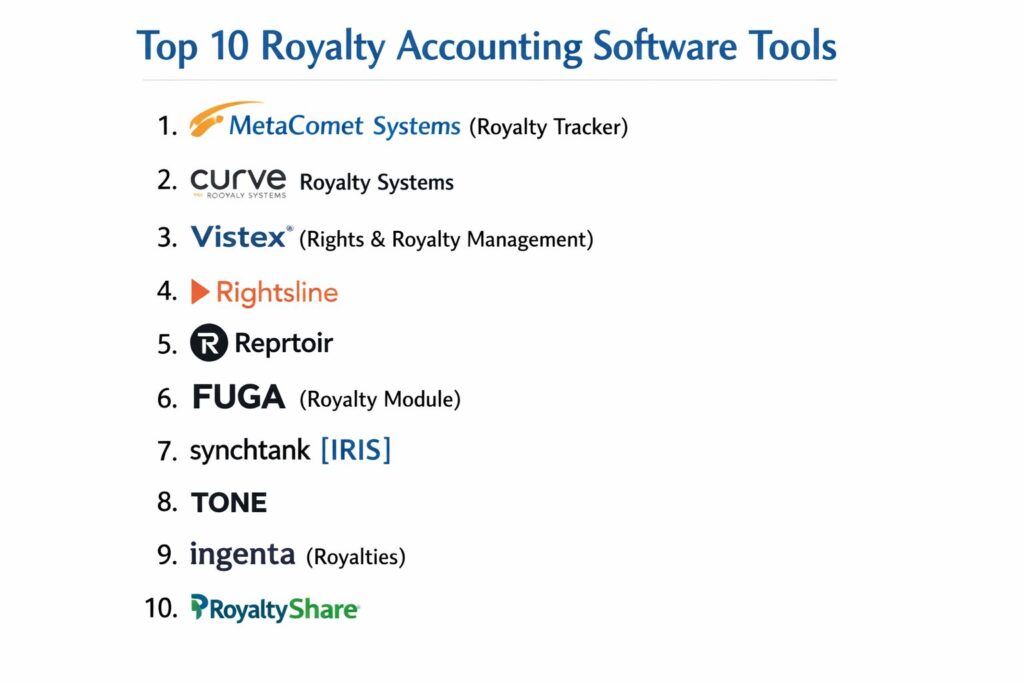
Introduction
Royalty accounting software is a specialized class of financial technology designed to manage the lifecycle of intellectual property (IP) agreements and the resulting payment obligations. Unlike general ledgers, these platforms are engineered to handle the “n-to-n” complexity of rights, where a single asset—be it a song, a book, or a patented component—may involve multiple stakeholders with varying percentage splits, recoupable advances, and territory-specific tax rules. These systems serve as a single source of truth, transforming raw sales data from global distributors into transparent, audit-ready statements. For organizations managing extensive catalogs, this automation is not merely a convenience but a critical necessity for maintaining legal compliance and partner trust.
In a globalized digital economy, the volume of micro-transactions from streaming, sub-licensing, and digital retail has made manual tracking mathematically impossible. Organizations now face the challenge of reconciling thousands of disparate data formats while ensuring that “sliding scale” royalties and cross-collateralization rules are applied with surgical precision. A robust royalty engine provides the analytical depth to identify revenue leakage, manage minimum guarantees, and forecast future liabilities. When selecting a platform, enterprise leaders must evaluate the software’s ability to integrate with existing ERP systems, its capacity for high-volume data ingestion, and the transparency of its participant portals, which directly impact the strength of creator relationships.
Best for: Record labels, book publishers, film distributors, patent holders, and franchisors who need to automate complex revenue splits and maintain transparent reporting for multiple payees.
Not ideal for: Simple service-based businesses with flat-fee structures, or small-scale hobbyists who can manage their few monthly transactions through standard bookkeeping tools without specialized rights tracking.
Key Trends in Royalty Accounting Software
The integration of artificial intelligence for automated data mapping is perhaps the most significant shift in the industry, allowing systems to recognize and normalize inconsistent sales reports from hundreds of global sources without human intervention. Real-time transparency has also become a non-negotiable demand; payees no longer accept semi-annual statements and instead expect cloud-based portals where they can track their earnings and recoupment status daily. This shift toward “on-demand” financial visibility is fundamentally changing the power dynamic between IP owners and their distribution partners.
Furthermore, we are seeing a move toward unified rights and royalty ecosystems, where the software not only calculates what is owed but also tracks the availability of rights across formats and territories. This “360-degree” view prevents the accidental over-licensing of assets and allows for more aggressive monetization of backlist catalogs. Security standards have also tightened, with SOC 2 compliance and encrypted participant portals becoming industry standards to protect sensitive financial data and personal identity information. Finally, the rise of blockchain-adjacent technologies is starting to influence how “smart contracts” are modeled, potentially paving the way for instantaneous, automated payouts in the future.
How We Selected These Tools
Our selection process focused on identifying platforms that demonstrate extreme reliability under the pressure of high-volume transaction cycles. We prioritized tools that offer specialized “domain logic”—software that understands the specific nuances of music, publishing, or film—rather than generic accounting plugins. A critical criterion was the robustness of the calculation engine, specifically its ability to handle “edge cases” such as complex recoupment, joint venture splits, and multi-currency conversions without manual workarounds.
We also analyzed the integration capabilities of each tool, favoring those that can sit at the center of a modern financial stack, connecting seamlessly with ERPs like SAP or NetSuite and various sales data aggregators. The quality of the user experience for the end-user—the author or artist—was also weighed heavily, as the self-service portal is often the primary point of interaction for a company’s most valuable partners. Finally, we looked for a track record of stability and professional support, ensuring that these companies have the infrastructure to assist with the complex data migrations and audit requirements typical of this sector.
1. MetaComet Systems
MetaComet is a cornerstone of the publishing and life sciences industries, known for its flagship Royalty Tracker platform. It is designed to replace the anxiety of royalty periods with a “one-button” processing philosophy. The tool excels at aggregating data from diverse global retailers and automating the entire flow from contract entry to final payment.
Key Features
The platform features a sophisticated “Recoupment Tracking” system that handles advances and production costs with ease. It offers a highly secure Author Portal where payees can view historical statements and current balances. The “Kit Explosion” feature allows for royalties to be calculated for individual components within a bundled product. It also includes a robust contract modeling engine that handles “sliding scale” tiers and complex subsidiary rights. Its reporting suite is designed for high-level management and detailed auditing.
Pros
The software is exceptionally reliable and has a long history of serving high-volume publishers. Their customer support team is deeply knowledgeable about the specific legal and financial nuances of the industry.
Cons
The interface, while functional and stable, can feel less modern than some of the newer, “creator-first” platforms. Customization of certain specialized reports can sometimes require support intervention.
Platforms and Deployment
Cloud-based SaaS accessible via any modern browser, with dedicated hosting environments for enterprise clients.
Security and Compliance
SOC 2 Type II compliant with end-to-end encryption. It provides detailed audit logs and role-based access to ensure data integrity.
Integrations and Ecosystem
Deep integrations with Microsoft Dynamics, NetSuite, and QuickBooks. It also connects with various industry-specific fulfillment and title management systems.
Support and Community
Offers dedicated implementation specialists, a comprehensive knowledge base, and highly responsive professional support tiers.
2. Curve Royalty Systems
Curve has quickly become a favorite in the independent music sector due to its modern architecture and intuitive design. It was built by industry veterans who understood the friction points of legacy systems, resulting in a platform that prioritizes speed and clarity for both labels and artists.
Key Features
It features a high-speed ingestion engine that can process millions of rows of streaming data in minutes. The “Dashboard Designer” allows labels to create custom visual reports for their internal teams. It provides an “Artist Portal” that is mobile-responsive and visually engaging, making financial data easy for creators to digest. The system supports complex “Mechanical” and “Performance” royalty splits natively. It also includes automated “Withholding Tax” calculations for international payees.
Pros
The user interface is arguably the best in the industry, making complex tasks feel straightforward. It is highly effective for streaming-heavy catalogs that generate massive amounts of data.
Cons
While it is expanding into other sectors, its core DNA is very music-centric, which might not fit the specific needs of a book publisher or patent office.
Platforms and Deployment
Native cloud application (SaaS) with global availability.
Security and Compliance
GDPR compliant and ISO 27001 certified data centers. It utilizes multi-factor authentication for all administrative accounts.
Integrations and Ecosystem
Direct API connections to major music distributors and digital service providers (DSPs). It also supports various export formats for general ledger accounting.
Support and Community
Strong community of independent labels and extensive video documentation for self-paced learning.
3. Rightsline
Rightsline is the powerhouse solution for the film, television, and gaming industries. It is unique because it combines comprehensive rights management—knowing what you own and where you can sell it—directly with the financial calculation of royalties.
Key Features
The platform offers a 360-degree view of IP, linking the “Chain of Title” to every financial transaction. It features a powerful “Availability Engine” that tells sales teams exactly what rights are free to be licensed. The royalty module handles complex “Participation” and “Residual” calculations common in Hollywood productions. It includes sophisticated tools for managing multi-territory and multi-language deals. The system also supports high-volume “Audit-Ready” reporting for union and guild compliance.
Pros
It is the most comprehensive tool for organizations where rights availability and royalty payments are deeply intertwined. Its scalability is proven across some of the world’s largest media conglomerates.
Cons
The sheer breadth of the platform leads to a significant learning curve. The implementation process is usually an enterprise-level project requiring substantial time and resources.
Platforms and Deployment
Cloud-native (SaaS) with flexible deployment options for enterprise security requirements.
Security and Compliance
Enterprise-grade security featuring SOC 2 compliance and granular role-based access control (RBAC).
Integrations and Ecosystem
Deep integrations with enterprise ERPs, media supply chain tools, and specialized financial systems used in the entertainment industry.
Support and Community
White-glove enterprise support with regular user group workshops and dedicated account management for large studios.
4. Vistex
Vistex is the heavyweight solution of choice for Fortune 500 companies and global enterprises. It is designed to sit at the absolute center of a corporate financial ecosystem, often integrated directly into an SAP environment to manage complex incentives and royalties.
Key Features
It provides an industrial-strength calculation engine capable of handling millions of global transactions across various business models. The software includes specialized modules for brand licensing, music, and pharmaceutical rebates. It features a “Margin Leak” detection system that uses AI to find discrepancies in payments. The “Contract Lifecycle Management” tool ensures every royalty rule is backed by a legal document. It also provides advanced predictive analytics for revenue forecasting.
Pros
Unrivaled for large-scale enterprise integration and handling the world’s most complex multi-layered agreements. It offers a level of depth and auditability that meets the highest corporate standards.
Cons
The cost of ownership is high, making it inaccessible for small or mid-sized labels and publishers. It often requires specialized consultants to maintain and configure.
Platforms and Deployment
Available as a cloud service or integrated directly into on-premise ERP environments (SAP, Oracle).
Security and Compliance
Complies with the most stringent global corporate security standards, including SOC 1/2 and regional financial regulations.
Integrations and Ecosystem
The gold standard for SAP integration, with robust links to other major enterprise software suites and business intelligence tools.
Support and Community
Global network of professional services and certified consultants to support massive enterprise deployments.
5. Fuga (Royalty Module)
Fuga, a division of Downtown Music, offers a distribution-centric royalty platform that is ideal for music companies that want a unified workflow. By combining the delivery of music to DSPs with the accounting of the resulting revenue, it eliminates the need for data transfers.
Key Features
The “One-Click” statement generation allows labels to close their royalty periods much faster. It features a “Cost Recoupment” system that automatically deducts marketing and production expenses before paying out splits. The platform supports “Joint Venture” accounting for complex partnerships between labels. It includes a white-label “Artist Portal” that labels can brand as their own. It also features automated “Global Tax” handling and withholding calculations.
Pros
Perfect for users already in the Fuga distribution ecosystem, as the data flows seamlessly into the accounting module. It is highly optimized for modern digital-first music businesses.
Cons
It is primarily a music tool and lacks the specific features needed for book publishing or patent management. Its best features are often tied to using Fuga for distribution.
Platforms and Deployment
Web-based SaaS platform.
Security and Compliance
Adheres to standard digital music industry security protocols and is GDPR compliant.
Integrations and Ecosystem
Integrated natively with Fuga’s distribution and marketing tools, with exports available for major accounting software.
Support and Community
Excellent technical support for existing distribution clients and a well-documented help center.
6. knkMedia
knkMedia is a specialized solution built on the Microsoft Dynamics 365 framework, specifically targeting book publishers who need a modern, scalable platform. It leverages the familiar Microsoft ecosystem to provide a powerful yet accessible rights and royalty environment.
Key Features
It offers “Chapter-Level” granularity, allowing publishers to track royalties for individual contributors within an anthology. The system integrates natively with Excel and Power BI for advanced data manipulation and visualization. It includes a “Manuscript Tracking” feature that connects the editorial process to the financial payout. The software automates contract generation based on pre-approved legal templates. It also leverages Microsoft’s AI for “Anomaly Detection” in sales data.
Pros
The integration with the Microsoft 365 suite makes it very easy for staff to adopt. It is one of the most feature-complete options specifically for the modern book publishing industry.
Cons
Since it is built on Dynamics 365, it requires a commitment to the Microsoft ecosystem, which might not appeal to teams using other platforms.
Platforms and Deployment
Cloud-based SaaS built on the Azure platform.
Security and Compliance
Inherits Microsoft’s enterprise-grade security certifications and provides robust audit trails for financial compliance.
Integrations and Ecosystem
Flawless integration with Outlook, Teams, and Excel. It also connects with various third-party fulfillment and digital asset management tools.
Support and Community
Professional enterprise support backed by a global network of Microsoft Dynamics partners and consultants.
7. Ingenta (Royalties)
Ingenta is a long-standing leader in the academic and trade publishing space. Their royalty module is famous for its “battle-tested” reliability and its ability to manage the massive, complex “backlist” catalogs of traditional publishing houses.
Key Features
The calculation engine is designed to handle the “weird” edge cases of print publishing, such as returns, damaged stock, and multi-format bundles. It provides a robust “Rights Mapping” system for tracking availability across languages and territories. The software features a detailed “Auditor’s View” that allows for a transparent walkthrough of every calculation. It supports high-volume processing for both digital and physical sales. It also offers professional services for data migration from legacy systems.
Pros
Extremely accurate and trusted by some of the oldest and most respected names in publishing. It is built to handle the long-tail complexity of backlist titles that other software might struggle with.
Cons
The user interface can feel dated compared to newer SaaS competitors. The platform is powerful but can be technical and less “user-friendly” for casual users.
Platforms and Deployment
Cloud-hosted or on-premise installations depending on the publisher’s requirements.
Security and Compliance
Meets industry standards for financial software security and provides comprehensive audit logging for external reviews.
Integrations and Ecosystem
Designed to integrate with Ingenta’s own suite of publishing tools as well as standard corporate accounting systems.
Support and Community
High-touch professional services and a dedicated support desk with deep industry expertise.
8. IRIS (by Synchtank)
IRIS is a high-performance royalty engine designed for music publishers and labels that deal with massive streaming datasets. Created by the team at Synchtank, it focuses on high-speed data processing and “clean” metadata management.
Key Features
It utilizes sophisticated “Matching Algorithms” to link messy sales data from DSPs to the correct assets in the catalog. The platform features a centralized “Hub” for rights, metadata, and financial sales. It includes a high-capacity engine built specifically for the scale of billions of streaming events. The API is extensive, allowing developers to build custom workflows around the core royalty data. It also features a modern, responsive interface for both administrators and creators.
Pros
Outstanding for organizations that struggle with “Data Fragmentation” and need a tool that can reconcile large volumes of inconsistent reports.
Cons
The platform is very focused on the music industry and may not be the right fit for industries with different licensing models like software or books.
Platforms and Deployment
Cloud-native SaaS.
Security and Compliance
Standard cloud encryption and SOC 2 alignment, with robust role-based permissions to protect financial sensitive data.
Integrations and Ecosystem
Deeply integrated with Synchtank’s broader rights management platform and compatible with major financial tools through its API.
Support and Community
Specialized technical support with a focus on high-scale music data management.
9. ZarMoney
ZarMoney offers a flexible, cloud-based approach that is popular among project-based businesses and smaller media entities. While it is a broader accounting tool, its features for tracking project profitability and revenue sharing make it a viable royalty option for SMBs.
Key Features
It features a “Project-Based” accounting model that allows for revenue and expenses to be tracked at the individual asset or production level. The software includes a “No-Code Rule Builder” for creating simple royalty and split logic. It provides real-time dashboards that can be shared with external partners. The system includes automated invoicing and payout workflows. It also offers native integration with major payment gateways for immediate settlement.
Pros
Much more affordable than specialized enterprise royalty suites. It is very easy to set up and provides a good balance between general accounting and royalty tracking.
Cons
It lacks the deep industry-specific logic (like “kit explosions” or “union residuals”) that high-end specialized tools provide. It is not built for high-volume streaming data.
Platforms and Deployment
Cloud-based SaaS.
Security and Compliance
Provides standard cloud security, role-based access, and detailed audit trails suitable for small to mid-sized operations.
Integrations and Ecosystem
Connects with major business tools like Salesforce and integrated payment processors.
Support and Community
Responsive customer service and an accessible online knowledge base for self-directed troubleshooting.
10. RoyaltyShare
RoyaltyShare is a dedicated data aggregation and royalty processing service that focuses on the music industry. It is designed to act as a “Managed Service” for labels that want to outsource the technical headache of data ingestion and statement generation.
Key Features
The platform features an automated “Data Aggregator” that collects sales reports from global digital retailers on behalf of the client. It uses advanced mapping tools to handle the wildly inconsistent formats used by different DSPs. The system provides a transparent “Reporting Engine” for both the label and the artist. It includes an integrated payout module to handle international distributions. The software also features a “Catalog Management” tool to ensure rights metadata is always accurate.
Pros
Ideal for labels that do not want to manage the software themselves and prefer a service-driven approach to royalty accounting. It significantly reduces the administrative burden on small teams.
Cons
As a managed service, it can be more expensive than a pure “self-service” SaaS tool. It offers less direct control over the underlying calculation engine.
Platforms and Deployment
Cloud-based managed platform.
Security and Compliance
Adheres to strict industry security protocols for handling third-party financial data and is GDPR compliant.
Integrations and Ecosystem
Built to aggregate data from almost every major digital retailer and DSP in the music industry.
Support and Community
Offers a high-touch service model with experienced account managers who handle the day-to-day data processing.
Comparison Table
| Tool Name | Best For | Platform(s) Supported | Deployment | Standout Feature | Public Rating |
|---|---|---|---|---|---|
| MetaComet Systems (Royalty Tracker) | Book publishers and life sciences firms | Web | Cloud | Advanced cross-collateralization and royalty portal | 4.8/5 |
| Curve Royalty Systems | Music labels and digital royalty teams | Web | Cloud | Ultra-fast royalty processing and transparent mapping | 4.7/5 |
| Vistex (Rights & Royalty Management) | Large enterprises with ERP-driven royalty operations | Web / SAP | Cloud / Hybrid | Deep SAP and enterprise finance integration | 4.5/5 |
| Rightsline | Film, TV, gaming, and media rights teams | Web | Cloud | Rights lifecycle and participation accounting | 4.6/5 |
| Reprtoir | Independent music publishers and record labels | Web | Cloud | All-in-one catalog and royalty workspace | 4.4/5 |
| Fuga (Royalty Module) | Labels using integrated distribution and royalty workflows | Web | Cloud | Direct sync with distribution data pipelines | 4.5/5 |
| Synchtank (IRIS) | Music publishing and sync licensing businesses | Web | Cloud | Strong metadata matching and contract depth | 4.6/5 |
| Tone | Modern labels needing speed and contract simulation | Web | Cloud | Contract simulator and fast recalculation engine | 4.7/5 |
| Ingenta (Royalties) | Legacy and academic publishers | Web / On-premise | Cloud / Hybrid | Backlist management and secondary rights handling | 4.2/5 |
| RoyaltyShare | Music and entertainment businesses handling large retailer data feeds | Web | Cloud | Broad retailer connectivity and aggregation engine | 4.3/5 |
Evaluation & Scoring of Royalty Accounting Software
The scoring below is a comparative model intended to help shortlisting. Each criterion is scored from 1–10, then a weighted total from 0–10 is calculated using the weights listed. These are analyst estimates based on typical fit and common workflow requirements, not public ratings.
Weights:
- Core features – 25%
- Ease of use – 15%
- Integrations & ecosystem – 15%
- Security & compliance – 10%
- Performance & reliability – 10%
- Support & community – 10%
- Price / value – 15%
| Tool Name | Core (25%) | Ease (15%) | Integrations (15%) | Security (10%) | Performance (10%) | Support (10%) | Value (15%) | Weighted Total |
|---|---|---|---|---|---|---|---|---|
| MetaComet Systems (Royalty Tracker) | 9 | 7 | 9 | 9 | 8 | 10 | 8 | 8.55 |
| Curve Royalty Systems | 8 | 9 | 8 | 8 | 10 | 8 | 8 | 8.45 |
| Vistex (Rights & Royalty Management) | 10 | 4 | 10 | 10 | 9 | 9 | 5 | 8.05 |
| Rightsline | 9 | 7 | 8 | 9 | 8 | 8 | 6 | 7.75 |
| Reprtoir | 8 | 8 | 7 | 8 | 8 | 8 | 9 | 8.00 |
| Fuga (Royalty Module) | 8 | 8 | 9 | 8 | 8 | 8 | 8 | 8.15 |
| Synchtank (IRIS) | 9 | 6 | 8 | 8 | 9 | 8 | 7 | 7.85 |
| Tone | 8 | 9 | 7 | 8 | 10 | 9 | 8 | 8.40 |
| Ingenta (Royalties) | 8 | 5 | 7 | 9 | 7 | 8 | 7 | 7.20 |
| RoyaltyShare | 7 | 7 | 10 | 8 | 8 | 7 | 7 | 7.50 |
How to interpret the scores:
- Use the weighted total to shortlist candidates, then validate with a pilot.
- A lower score can mean specialization, not weakness.
- Security and compliance scores reflect controllability and governance fit, because certifications are often not publicly stated.
- Actual outcomes vary with assembly size, team skills, templates, and process maturity.
Which Royalty Accounting Software Tool Is Right for You?
Solo / Freelancer
Independent creators who are starting to license their work should look for accessible, cloud-based tools that prioritize ease of setup. At this stage, a tool like ZarMoney or a basic plan from a music-focused SaaS provider can provide the necessary structure for tracking earnings without overwhelming you with enterprise features.
SMB
Small to medium labels and publishers need a tool that reduces administrative overhead. Curve Royalty Systems or Fuga are excellent choices here, as they automate the most time-consuming part of the job—data ingestion—and provide professional portals that build trust with your creators.
Mid-Market
Growing organizations that manage complex cross-industry rights need a tool that bridges the gap between accounting and legal. MetaComet and IRIS are designed for this scale, offering the depth required to manage hundreds of contracts while remaining accessible to a small accounting team.
Enterprise
For conglomerates managing global IP across multiple sectors, Vistex or Rightsline are the primary options. These systems are built for massive scale and provide the security and integration capabilities required to operate within a Fortune 500 environment.
Budget vs Premium
Budget-conscious teams should lean toward modern SaaS platforms that offer tiered pricing. While premium enterprise tools have a higher upfront cost, they often pay for themselves by identifying “revenue leakage” and preventing costly legal disputes that arise from accounting errors.
Feature Depth vs Ease of Use
If your contracts involve complex Hollywood-style participations or “sliding scales,” you must prioritize feature depth. However, if your business model is straightforward, a more user-friendly interface will lead to faster adoption and fewer errors among your staff.
Integrations & Scalability
Always consider the “future state” of your business. A tool that integrates natively with your current ERP and can handle a ten-fold increase in transaction volume will prevent the need for a painful software migration two years down the line.
Security & Compliance Needs
In an environment where audits are frequent, choose a platform that offers a “read-only” auditor view and keeps detailed logs of every change made to a contract. This transparency is your best defense during financial reviews.
Frequently Asked Questions (FAQs)
1. What is the main difference between royalty accounting and general accounting?
General accounting tracks the overall health of a business, while royalty accounting specifically tracks what is owed to third parties based on the usage or sale of intellectual property. It requires specialized logic for splits, recoupment, and rights tiers that standard software cannot handle.
2. How does the software handle advances?
Most professional royalty tools include a “Recoupment Engine.” When an advance is paid, it is logged as a negative balance against the artist. The software then automatically deducts future earnings until that advance is fully recovered before making any further payouts.
3. Can these tools process data from Spotify or Amazon?
Yes, most top-tier platforms have specialized ingestion tools designed to read the specific CSV or XML reports provided by major digital service providers and retailers, automatically mapping that data to the correct assets.
4. What is “cross-collateralization” in royalty accounting?
This is a rule where earnings from one project can be used to pay off debts or unrecouped balances from another project by the same artist. Professional software can automate these complex links across a performer’s entire catalog.
5. How often should royalty statements be generated?
This is usually determined by the legal contract, typically semi-annually or quarterly. However, modern cloud platforms allow you to process data as it arrives, providing “near real-time” visibility even if the final statement is only sent twice a year.
6. Do I need an accountant to run this software?
While these tools automate the math, they still require someone with a solid understanding of your contracts to set up the rules. Many SMBs have their office manager run the software, while larger firms have a dedicated royalty department.
7. Can royalty software handle different currencies?
Yes, professional-grade tools like MetaComet or Vistex have integrated exchange rate tools that can ingest sales in one currency and calculate payouts in another, maintaining a clear audit trail of the conversion.
8. Is my data safe in the cloud?
Look for platforms with SOC 2 compliance and ISO certification. These standards ensure that the provider follows strict protocols for data encryption, physical security, and disaster recovery.
9. Can I migrate my old data into a new royalty system?
Most providers offer data migration services. They will help you map your legacy spreadsheets or old database fields into their new system to ensure your historical recoupment and balance data remains accurate.
10. What happens if there is a dispute with an artist?
The “Audit Trail” feature in these tools is your most important asset during a dispute. It allows you to show exactly how a payment was calculated, which sales were included, and which recoupment rules were applied, providing a transparent basis for resolution.
Conclusion
Implementing a dedicated royalty accounting system is a strategic investment that safeguards an organization’s most valuable assets: its intellectual property and its professional reputation. By automating the technical complexities of revenue splits and recoupment, businesses can shift their focus from manual data entry to high-level portfolio management and creator relations. In the current digital landscape, where the volume of transactions continues to grow exponentially, the ability to provide transparent, accurate, and timely reporting is the primary differentiator for successful labels and publishers. Choosing the right tool requires a clear understanding of your specific industry’s logic and a commitment to maintaining high data integrity across your entire financial ecosystem.