Introduction
Route dispatch and scheduling software has transitioned from simple digital maps into complex “Delivery Orchestration” engines that serve as the brain of modern logistics. In 2026, the industry has moved beyond basic distance calculation, now integrating real-time variables such as traffic volatility, vehicle load capacity, driver hours-of-service, and precise delivery windows. These platforms are essential for reducing the “Last Mile” cost, which consistently accounts for over 50% of total shipping expenses. By automating the assignment of hundreds of stops across dozens of vehicles, dispatch software eliminates the manual errors of spreadsheets and provides a unified view of the entire mobile workforce.
Modern dispatching is no longer a static morning task but a dynamic, all-day process. Sophisticated algorithms now allow for “Agentic Delivery,” where the software autonomously reroutes drivers based on live exceptions, such as a vehicle breakdown or a high-priority on-demand order. As customer expectations for “Amazon-level” transparency grow, these tools bridge the communication gap by providing recipients with live tracking links and predictive ETAs. For any organization managing a fleet—whether it is five vans or five thousand trucks—this technology is the primary driver of fuel efficiency, driver retention, and customer loyalty.
Best for: Fleet managers, logistics coordinators, field service businesses, and e-commerce retailers who need to maximize vehicle utilization and ensure on-time delivery execution.
Not ideal for: Long-haul trucking with single-point-to-point routes that do not require multi-stop optimization, or very small businesses with only one driver and two or three daily stops.
Key Trends in Route Dispatch Software
Artificial Intelligence has moved from a marketing buzzword to a functional core of dispatching, seeing the rise of “Predictive Rerouting.” These AI models analyze years of historical traffic and weather patterns to anticipate delays before they happen, adjusting schedules in real-time. We are also witnessing the “Mixed Fleet” revolution, where software can seamlessly coordinate a company’s internal drivers alongside third-party carriers and crowdsourced gig workers in a single dashboard. This flexibility allows businesses to scale their delivery capacity instantly during peak seasons without purchasing more permanent assets.
Sustainability has also become a programmatic feature rather than an afterthought. Leading platforms now include “Green Routing” modules that prioritize EV-friendly paths and calculate carbon emission savings for corporate social responsibility reporting. Furthermore, video-integrated dispatching is surging, where telematics data is paired with AI dashcams to provide context to dispatchers during safety incidents or delivery disputes. Finally, “Zero-Touch Dispatching” is becoming the gold standard, where orders from an e-commerce platform are automatically grouped, optimized, and sent to the driver’s mobile app without a human dispatcher ever clicking a button.
How We Selected These Tools
Our selection process for the top dispatch and scheduling tools was rooted in operational reliability and the sophistication of the optimization engine. We prioritized platforms that demonstrate high “Uptime” and real-time synchronization between the office dashboard and the driver’s mobile application. A key metric was “Constraint Flexibility”—evaluating how well a tool handles complex real-world variables like vehicle height restrictions, specialized driver certifications, and narrow customer-requested time slots. We favored tools that could process thousands of stops in seconds, providing immediate ROI through reduced planning time.
Integration capability was a non-negotiable factor, as dispatch software must communicate effectively with existing ERP, CRM, and Telematics systems. We also looked for platforms with high “Driver Adoption” ratings, as the most powerful software is useless if the mobile interface is too difficult for people to use on the road. Security and compliance were heavily weighted, particularly for tools that handle Hours of Service (HOS) and Electronic Logging Device (ELD) data. Finally, we assessed the transparency of the pricing models and the quality of the technical support, ensuring that these tools offer a sustainable path for business growth.
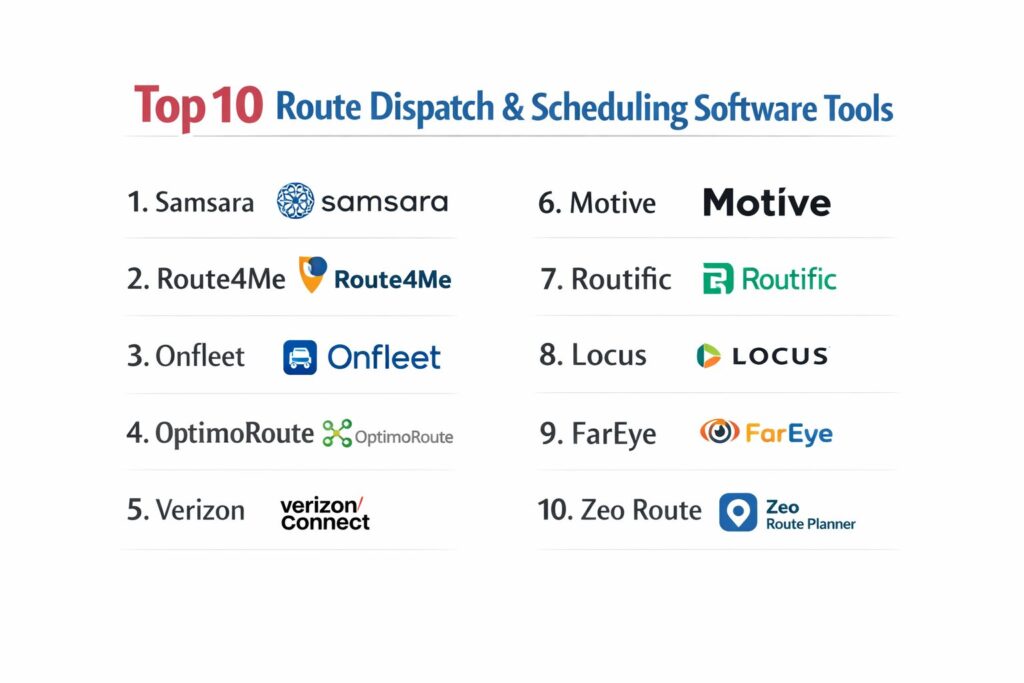
1. Samsara
Samsara is a premier “Connected Operations” platform that unifies fleet dispatching with real-time telematics and AI safety. It is the leading choice for large-scale enterprises that require a single source of truth for their vehicles, equipment, and driver behavior.
Key Features
The platform features an AI-driven route optimization engine that calculates the most efficient paths while accounting for real-time traffic. It includes “Live Map” technology that updates vehicle locations every second, providing the most accurate tracking in the industry. The system offers integrated AI dashcams that automatically link safety events to specific routes for coaching. It features a robust “App Marketplace” with hundreds of pre-built integrations for payroll and maintenance. Additionally, its driver mobile app handles everything from dispatch instructions to ELD compliance and digital document capture.
Pros
It provides an unmatched level of data visibility by combining hardware and software in one ecosystem. The “Helicopter View” allows dispatchers to provide precise turn-by-turn guidance to drivers in complex urban environments.
Cons
The pricing is at the premium end of the market and typically requires a multi-year commitment. The breadth of features can be overwhelming for smaller operations that only need basic routing.
Platforms and Deployment
Cloud-based SaaS with integrated plug-and-play hardware and top-rated mobile apps.
Security and Compliance
Industry-leading security with SOC 2 Type II compliance and full ELD/FMCSA certification.
Integrations and Ecosystem
Extensive API and integrations with platforms like Salesforce, SAP, and various fuel card providers.
Support and Community
Provides 24/7 technical support, a dedicated success manager for enterprise accounts, and a vast online knowledge base.
2. Route4Me
Route4Me is a highly customizable and mature routing platform designed for businesses that need to optimize high-volume, multi-stop routes. It is famous for its “plug-and-play” simplicity and its ability to handle extremely complex territory management.
Key Features
The platform features a modular “Marketplace” approach, allowing users to pay only for the specific features they need, such as voice-guided navigation or advanced territory mapping. It includes a powerful optimization engine that can sequence thousands of stops for hundreds of drivers in seconds. The system offers “Planned vs. Actual” analytics to show exactly where drivers deviated from their routes. It features a robust mobile app that works offline, ensuring drivers always have their schedule. It also provides specialized “Commercial Truck” routing that avoids weight-restricted bridges and low clearances.
Pros
The platform is exceptionally flexible, making it suitable for everything from field sales to waste management. It offers a very fast time-to-value with an interface that requires minimal training.
Cons
The modular pricing can become complex and expensive as you add more advanced features. The UI, while functional, can feel slightly less modern than some of its newer competitors.
Platforms and Deployment
Web-based SaaS with dedicated iOS and Android applications.
Security and Compliance
Fully GDPR and CCPA compliant with secure data encryption for customer address lists.
Integrations and Ecosystem
Integrates with major CRMs and e-commerce platforms like Shopify, WooCommerce, and Salesforce.
Support and Community
Offers a comprehensive help center, email support, and dedicated training sessions for new teams.
3. Onfleet
Onfleet is the “gold standard” for premium last-mile delivery, focusing heavily on the end-customer experience. It is the preferred choice for courier services, retailers, and food delivery companies that want a polished, Uber-like tracking experience for their clients.
Key Features
The platform features a beautiful “Customer Tracking” interface that allows recipients to see their driver’s location in real-time. It includes “Auto-Dispatch” logic that automatically assigns orders to the closest or most efficient driver. The system offers a “Chat” feature that allows dispatchers to communicate directly with drivers within the app. It features robust proof-of-delivery options, including photo capture, signatures, and barcode scanning. It also provides “Predictive ETAs” that alert customers via SMS when their delivery is just minutes away.
Pros
The driver app is widely considered the best in the industry for its stability and ease of use. The branded customer experience helps businesses build trust and reduce support calls.
Cons
The per-task pricing model can become prohibitively expensive for high-volume, low-margin businesses. The reporting tools are somewhat rigid compared to more data-heavy platforms.
Platforms and Deployment
Cloud-based SaaS with high-performance mobile apps for drivers.
Security and Compliance
Maintains high data privacy standards and is suitable for regulated deliveries like alcohol or pharmaceuticals.
Integrations and Ecosystem
Offers a powerful API and pre-built connectors for modern e-commerce and order management systems.
Support and Community
Provides responsive email support and a detailed “Onfleet University” for user onboarding.
4. OptimoRoute
OptimoRoute specializes in high-precision scheduling and route optimization for businesses with very strict constraints. It is particularly effective for field service and sales teams that need to manage multi-day schedules and specialized driver skills.
Key Features
The platform features “Weekly Planning,” allowing dispatchers to schedule routes up to five weeks in advance. It includes a “Driver Skills” module that ensures only the qualified technician is sent to a specific job. The system offers “Workload Balancing” to ensure no single driver is overworked while others are idle. It features automated “Live Tracking” and SMS notifications for customers. It also provides deep “Cost Modeling” features that calculate the profit and loss for every route planned.
Pros
It handles complex “time window” constraints better than almost any other tool in its price bracket. The “Breadcrumbs” feature allows for a precise comparison of the planned route versus the actual path taken.
Cons
The mobile app lacks some of the advanced communication features found in Onfleet or Samsara. The setup process for complex driver skills can take significant time.
Platforms and Deployment
Web-based platform with driver apps for iOS and Android.
Security and Compliance
Fully GDPR compliant with secure, cloud-based data storage.
Integrations and Ecosystem
Supports Excel/CSV imports and offers a flexible API for custom integrations.
Support and Community
Known for excellent one-on-one customer support and a very helpful onboarding team.
5. Verizon Connect
Verizon Connect is a massive, enterprise-grade fleet management and dispatching solution. It leverages the global power of the Verizon network to provide deep visibility into fleet operations for companies with hundreds or thousands of vehicles.
Key Features
The platform features “Interactive Route Replay,” allowing dispatchers to watch a visual playback of a driver’s entire day. It includes a comprehensive “Dispatch & Scheduling” module that links directly to vehicle telematics. The system offers “Asset Tracking” for non-powered equipment like trailers and generators. It features advanced “Driver Behavior” monitoring that scores drivers on safety and fuel efficiency. It also provides a robust “Maintenance” module that schedules service based on actual vehicle mileage.
Pros
The reliability of the GPS signal is best-in-class due to the underlying Verizon infrastructure. It offers the most comprehensive set of reporting and analytics tools for large-scale fleet optimization.
Cons
The platform requires a long-term contract (typically 3 years), which may not suit smaller, agile businesses. The interface is powerful but has a steeper learning curve than newer SaaS tools.
Platforms and Deployment
Enterprise cloud platform with specialized hardware for telematics and mobile apps.
Security and Compliance
Top-tier security certifications including ISO 27001 and full FMCSA ELD compliance.
Integrations and Ecosystem
Integrates deeply with enterprise financial and supply chain systems like SAP and Oracle.
Support and Community
Provides 24/7 phone support and dedicated account management for large fleets.
6. Motive (formerly KeepTruckin)
Motive is a leader in “Automated Compliance” and fleet safety, offering a dispatching solution that is tightly integrated with driver hours-of-service. it is ideal for heavy trucking and logistics firms that prioritize safety and regulatory adherence.
Key Features
The platform features an “AI Coach” that automatically delivers personalized safety training to drivers based on their real-world performance. It includes a “Spend Management” module with an integrated fleet card to track fuel and expenses in real-time. The system offers “Automated Dispatching” that checks driver eligibility and HOS status before assigning a load. It features high-definition AI dashcams with 360-degree visibility. It also provides a “Workforce Hub” for managing driver documents, timecards, and payroll in one place.
Pros
It unifies safety, operations, and finance in a way that few other platforms can match. The “Motive Card” integration significantly reduces the manual work of fuel reconciliation.
Cons
The focus on heavy trucking means some of the “last-mile” customer experience features are less developed. The high-end hardware can be a significant upfront investment.
Platforms and Deployment
Cloud-based SaaS with integrated hardware and a highly rated driver app.
Security and Compliance
A market leader in ELD and IFTA compliance, with robust data privacy protections.
Integrations and Ecosystem
Integrates with a wide range of TMS (Transportation Management Systems) and load boards.
Support and Community
Offers 24/7 support and a large community of fleet professionals.
7. Routific
Routific is a user-friendly route optimization platform built specifically for small to mid-sized delivery businesses. It is praised for its “Dispatcher First” design, making it the easiest tool for planning multiple routes simultaneously.
Key Features
The platform features a “Draw Route” tool that allows dispatchers to manually adjust AI-generated routes with a simple lasso gesture. It includes “Predictive Traffic” analysis to ensure ETAs are realistic even during rush hour. The system offers a “Timeline View” that shows all driver progress across the day in a single Gantt-style chart. It features a “Customer Notification” suite with SMS and email alerts. It also provides a “Proof of Delivery” module with signature and photo capture.
Pros
The route quality is exceptional, often producing routes that are 15% shorter than those of competitors. The interface is incredibly clean and requires almost zero training for new dispatchers.
Cons
It lacks the deep telematics and hardware integration found in enterprise tools like Samsara. It is not designed for on-demand “now” dispatching as well as Onfleet or GetSwift.
Platforms and Deployment
Web-based SaaS with a free driver mobile app.
Security and Compliance
Fully GDPR compliant with secure data handling protocols.
Integrations and Ecosystem
Offers a clean API and easy imports from Shopify, WooCommerce, and CSV files.
Support and Community
Provides a very helpful blog on delivery logistics and responsive email/chat support.
8. Locus
Locus is an AI-powered logistics orchestration platform designed for large retailers and enterprises with complex delivery networks. It focuses on high-level “Decision Intelligence” to optimize the entire supply chain.
Key Features
The platform features “Node-to-Node” optimization that manages the movement of goods from warehouses to cross-docks to the final customer. It includes an AI model that accounts for over 180 real-world constraints, including vehicle volume and weight. The system offers “Dynamic Rerouting” that responds to traffic disruptions in real-time. It features an “Insights Dashboard” that identifies bottlenecks in the delivery network. It also provides a “Control Tower” view for global visibility across multiple regions.
Pros
It is one of the most scalable platforms available, capable of handling millions of shipments per day. The AI depth allows for true “What-If” scenario modeling for strategic planning.
Cons
The implementation process is complex and usually requires a tailored approach. The pricing is volume-based and geared toward large enterprise budgets.
Platforms and Deployment
Enterprise cloud SaaS.
Security and Compliance
Enterprise-grade security with robust data anonymization and global privacy compliance.
Integrations and Ecosystem
Deeply integrates with WMS (Warehouse Management Systems) and ERPs like SAP and Microsoft Dynamics.
Support and Community
Offers high-touch professional services and 24/7 global support.
9. FarEye
FarEye is a global delivery management platform that specializes in “Last-Mile Excellence” and returns management. It is designed to help businesses improve delivery accuracy and enhance the customer post-purchase experience.
Key Features
The platform features “Dynamic Rescheduling” which allows customers to change their delivery time after the driver has already started their route. It includes a “Returns Management” module that optimizes the reverse logistics process. The system offers “Automated Carrier Selection” for businesses using a mix of internal and third-party fleets. It features real-time visibility with AI-driven “Exception Alerts.” It also provides a white-labeled customer portal for tracking and feedback.
Pros
It is exceptionally strong in handling the “Returns” side of e-commerce, which is often a major pain point. The platform offers great flexibility for hybrid fleets (own drivers + partners).
Cons
The vast number of features can make the initial configuration feel overwhelming. It is best suited for large-scale retail rather than small local businesses.
Platforms and Deployment
Cloud-based SaaS with cross-platform mobile apps.
Security and Compliance
ISO 27001 certified and fully compliant with international data privacy laws.
Integrations and Ecosystem
Extensive integrations with global carriers and major e-commerce platforms.
Support and Community
Provides dedicated project managers for implementation and 24/7 technical help.
10. Zeo Route Planner
Zeo Route Planner is a fast-growing, AI-driven tool that focuses on “Execution-Focused” routing. It is designed for growing teams that need professional-grade optimization without the operational friction of a heavy enterprise system.
Key Features
The platform features an “AI Stop Import” that can extract addresses from photos of manifest sheets or spreadsheets. It includes “Live Driver Tracking” with the ability for dispatchers to re-sequence stops on the fly. The system offers “Recurring Routes” for businesses with weekly or daily repeat customers. It features automated “Customer Updates” with live tracking links. It also provides a “Performance Analytics” dashboard to track on-time delivery rates.
Pros
The “Time to Value” is among the highest in the industry, as a team can be fully operational in under an hour. It offers a very balanced feature set that works for almost any industry.
Cons
It lacks the specialized “Commercial Truck” constraints (like bridge heights) found in Route4Me. The reporting, while good, is not as deep as enterprise solutions like Verizon Connect.
Platforms and Deployment
Web-based dashboard with highly intuitive iOS and Android apps.
Security and Compliance
Maintains standard cloud security protocols and is fully GDPR compliant.
Integrations and Ecosystem
Offers API access and integrates well with standard business tools via Zapier.
Support and Community
Known for very fast customer support response times and clear “How-To” documentation.
Comparison Table
| Tool Name | Best For | Platform(s) Supported | Deployment | Standout Feature | Public Rating |
| 1. Samsara | Enterprise Fleet | Web, iOS, Android | Cloud + Hardware | Real-time Telematics | 4.8/5 |
| 2. Route4Me | Multi-Stop Routes | Web, iOS, Android | Cloud SaaS | Modular Marketplace | 4.5/5 |
| 3. Onfleet | Last-Mile Delivery | Web, iOS, Android | Cloud SaaS | Driver App Stability | 4.7/5 |
| 4. OptimoRoute | Weekly Planning | Web, iOS, Android | Cloud SaaS | Advanced Constraints | 4.6/5 |
| 5. Verizon Connect | Fleet Visibility | Web, iOS, Android | Cloud + Hardware | Interactive Route Replay | 4.4/5 |
| 6. Motive | Safety & Compliance | Web, iOS, Android | Cloud + Hardware | AI Safety Coaching | 4.7/5 |
| 7. Routific | SMB Delivery | Web, iOS, Android | Cloud SaaS | Dispatcher Usability | 4.9/5 |
| 8. Locus | Enterprise AI | Web-Based | Enterprise Cloud | Supply Chain Orchestration | 4.4/5 |
| 9. FarEye | Returns / Hybrid | Web, iOS, Android | Cloud SaaS | Dynamic Rescheduling | 4.5/5 |
| 10. Zeo Route Planner | Fast Execution | Web, iOS, Android | Cloud SaaS | AI Manifest Scanning | 4.7/5 |
Evaluation & Scoring of Route Dispatch & Scheduling Software
The scoring below is a comparative model intended to help shortlisting. Each criterion is scored from 1–10, then a weighted total from 0–10 is calculated using the weights listed. These are analyst estimates based on typical fit and common workflow requirements, not public ratings.
Weights:
- Core features – 25%
- Ease of use – 15%
- Integrations & ecosystem – 15%
- Security & compliance – 10%
- Performance & reliability – 10%
- Support & community – 10%
- Price / value – 15%
| Tool Name | Core (25%) | Ease (15%) | Integrations (15%) | Security (10%) | Performance (10%) | Support (10%) | Value (15%) | Weighted Total |
| 1. Samsara | 10 | 7 | 10 | 10 | 10 | 9 | 6 | 8.85 |
| 2. Route4Me | 9 | 8 | 9 | 9 | 9 | 8 | 8 | 8.65 |
| 3. Onfleet | 8 | 10 | 9 | 9 | 9 | 9 | 7 | 8.65 |
| 4. OptimoRoute | 10 | 8 | 7 | 9 | 9 | 9 | 8 | 8.60 |
| 5. Verizon Connect | 9 | 6 | 9 | 10 | 9 | 9 | 6 | 8.20 |
| 6. Motive | 10 | 7 | 8 | 10 | 9 | 8 | 7 | 8.45 |
| 7. Routific | 8 | 10 | 8 | 9 | 9 | 9 | 9 | 8.75 |
| 8. Locus | 10 | 5 | 9 | 9 | 10 | 8 | 6 | 8.20 |
| 9. FarEye | 9 | 7 | 9 | 9 | 9 | 9 | 7 | 8.40 |
| 10. Zeo Route | 8 | 9 | 8 | 9 | 9 | 9 | 9 | 8.60 |
How to interpret the scores:
- Use the weighted total to shortlist candidates, then validate with a pilot.
- A lower score can mean specialization, not weakness.
- Security and compliance scores reflect controllability and governance fit, because certifications are often not publicly stated.
- Actual outcomes vary with assembly size, team skills, templates, and process maturity.
Which Route Dispatch & Scheduling Tool Is Right for You?
Solo / Freelancer
For the solo operator, the primary goal is to get on the road as quickly as possible. You need a platform that doesn’t require complex hardware installation or long-term contracts. Look for a tool that offers a “pay-per-driver” or “pay-per-order” model, allowing you to scale your costs exactly as your business grows. The ability to import addresses from a simple spreadsheet or even a photo of a written manifest is a massive time-saver for a one-person operation.
SMB
If you manage a small team of 2-5 drivers, your focus should be on “Route Quality” and “Ease of Use.” You likely don’t have a dedicated dispatcher, so the software must be intuitive enough for a business owner to use in 10-15 minutes each morning. A platform with a highly stable driver app is essential, as it reduces the number of phone calls you receive from drivers asking for directions or stop details.
Mid-Market / Growing Fleet
As you scale to 10 or more vehicles, you need better visibility into driver performance and customer communication. At this stage, automated customer notifications (SMS/Email) become critical to reducing the “Where is my order?” calls. You should look for platforms that offer better “Constraint Handling,” such as driver skill matching and specific vehicle load capacities, to ensure your operations remain efficient as they become more complex.
Enterprise / Global Logistics
For organizations with hundreds of vehicles, the priority shifts to “Data Governance” and “Telematics Integration.” You need a system that can unify routing data with actual vehicle health and safety metrics. This often means investing in a hardware-integrated platform that provides “Live Map” updates every second and deep analytics for long-term strategic planning. Compliance with global privacy laws and domestic transportation regulations is also a top-tier requirement.
Budget vs Premium
Budget-conscious operations can thrive on “SaaS-only” platforms that focus on route optimization without the need for onboard hardware. These tools provide excellent ROI by simply reducing fuel and labor costs. Premium solutions, while more expensive, provide “Total Fleet Awareness.” The extra cost is justified by the reduction in insurance premiums (via AI safety cameras) and the elimination of data silos between the shop floor, the dispatch office, and the finance department.
Feature Depth vs Ease of Use
If your dispatchers are logistics professionals, a tool with deep “What-If” scenario modeling and 180+ constraints will yield the most efficient results. However, if your team is less technical, a “Dispatcher-First” tool with drag-and-drop editing and a clean interface will lead to much better long-term adoption. Choose a tool that matches the technical comfort level of the person who will be using it for 8 hours every day.
Integrations & Scalability
Your dispatch software should not be an island. It must sit at the center of your operations, pulling orders from your e-commerce site and pushing proof-of-delivery data back to your CRM. Ensure the platform you choose has a well-documented API or a large marketplace of pre-built integrations. This prevents you from having to manually enter data twice and ensures that as you add new business tools, your dispatching core remains connected.
Security & Compliance Needs
In the transportation sector, compliance is often a legal barrier to entry. If you operate heavy commercial vehicles, you must select a platform that is FMCSA-certified for ELD and HOS tracking. For businesses handling sensitive consumer data, look for SOC 2 Type II or ISO 27001 certifications. A secure platform doesn’t just protect your data; it protects your business from the massive fines associated with regulatory non-compliance.
Frequently Asked Questions (FAQs)
1. What is the difference between route planning and route optimization?
Route planning is simply putting stops in a sequence, often manually. Route optimization uses complex mathematical algorithms to find the most efficient sequence by simultaneously considering traffic, distance, time windows, and vehicle capacity.
2. Can these tools handle time-sensitive delivery windows?
Yes, professional-grade dispatch software allows you to set specific “Time Windows” for each customer (e.g., 2:00 PM – 4:00 PM). The algorithm will then prioritize these stops to ensure you arrive within the requested period while still maintaining route efficiency.
3. Do I need to buy special GPS hardware for my trucks?
Not necessarily. Many modern platforms are “SaaS-only” and use the driver’s smartphone for tracking. However, larger fleets often choose to install dedicated hardware for more accurate telematics data and automated engine health monitoring.
4. How does the software handle “on-the-fly” changes?
Leading platforms offer “Dynamic Rerouting,” where a dispatcher can add or remove a stop while the driver is already on the road. The driver’s mobile app will instantly update and provide the new optimized path to follow.
5. Is proof of delivery (POD) included in most dispatch tools?
Yes, most modern dispatch apps include “Digital POD” features. This typically includes the ability to capture photos of the delivered item, collect digital signatures on the touchscreen, and scan barcodes to ensure the correct package was left.
6. Can the software account for different vehicle types?
Yes, advanced tools allow you to input “Vehicle Profiles.” This ensures that a large truck isn’t sent down a narrow residential street or under a low bridge, and that a refrigerated van is only assigned to deliveries requiring cold storage.
7. How much fuel can I realistically save?
On average, businesses moving from manual planning to optimized dispatch software see a 15% to 25% reduction in mileage. This directly translates to significant fuel savings and reduced vehicle wear and tear over time.
8. What happens if a driver loses internet connection?
Most professional driver apps have “Offline Modes.” The driver can still view their route and capture proof of delivery; the data will then automatically sync to the dispatch office once the mobile device regains a signal.
9. Can I track my own drivers and third-party contractors together?
Several “Orchestration” platforms allow you to manage a mixed fleet. You can send routes to your own drivers via their app while using a web portal or API to track the progress of external delivery partners.
10. Do these platforms help with ELD and IFTA compliance?
Telematics-focused platforms like Samsara and Motive are designed specifically to handle ELD (Electronic Logging Device) and IFTA (International Fuel Tax Agreement) reporting, automating what is usually a very manual and error-prone process.
Conclusion
The adoption of route dispatch and scheduling software is no longer a luxury but a fundamental requirement for any fleet-based operation. As the logistics landscape becomes increasingly complex and customer expectations continue to rise, these platforms provide the necessary intelligence to remain competitive and profitable. By automating the most difficult aspects of logistics—planning, tracking, and communication—businesses can focus on growth rather than operational fires. Whether you are an enterprise seeking total fleet awareness or a local courier looking for the fastest path to a customer’s door, the right dispatch tool is your most valuable asset in the field.