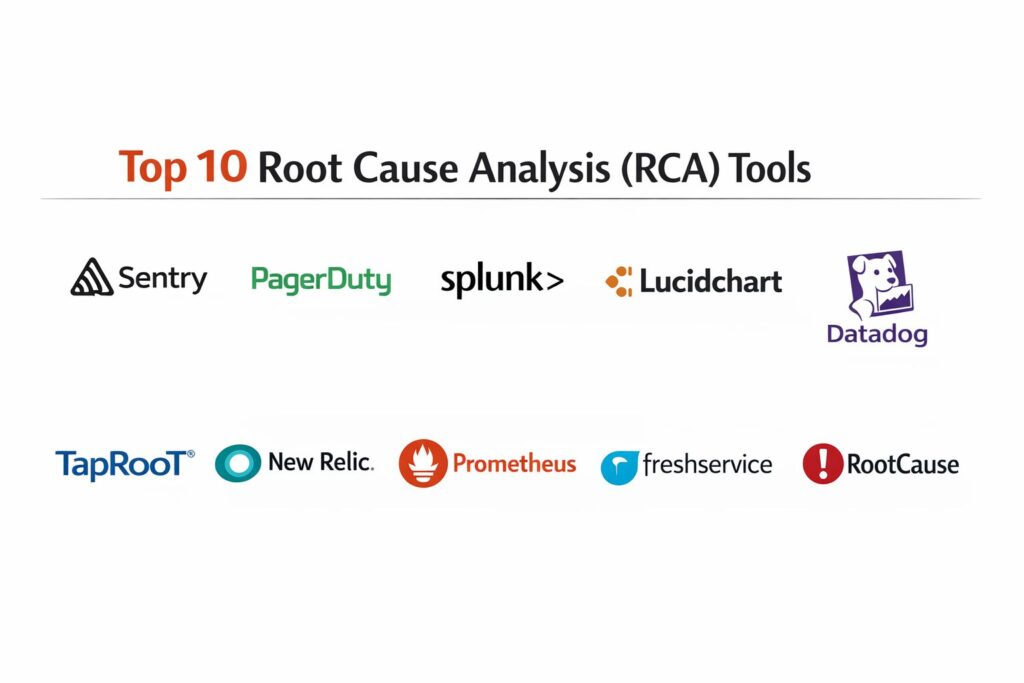
Introduction
Root Cause Analysis (RCA) tools represent a critical category of problem-solving software designed to move organizations beyond the treatment of superficial symptoms to the identification and elimination of the underlying “root” of an issue. In an era where system complexity is increasing across DevOps, manufacturing, and healthcare, these tools provide a structured methodology for forensic investigation and permanent resolution. Unlike standard troubleshooting, which often results in recurring failures, RCA platforms leverage logical frameworks and data visualization to map the causal chain of events. For modern high-performance organizations, this technology is the primary driver of operational reliability, safety compliance, and continuous improvement.
The current global landscape demands a shift from reactive fire-fighting to proactive “Site Reliability” and automated governance. Manual incident reports and fragmented spreadsheets often obscure the true origin of a failure, leading to “alert fatigue” and administrative burnout. A robust RCA tool enables automated incident timeline construction, precise fault tree analysis, and sophisticated “Five Whys” or Fishbone (Ishikawa) diagramming that satisfies the transparency demands of modern regulatory bodies and stakeholders. When selecting a platform, organizations must evaluate the technical depth of the diagramming engine, the seamlessness of integration with existing observability stacks, the strength of collaborative investigation features, and the scalability of the database to track recurring failure patterns over time.
Best for: SRE and DevOps teams, quality assurance managers, industrial engineers, safety officers, and IT service management professionals who require a rigorous, evidence-based approach to incident investigation and risk mitigation.
Not ideal for: Simple task tracking without causal relationship mapping, basic note-taking for minor one-off issues, or organizations looking for an automated monitoring tool without the analytical framework for human-led investigation.
Key Trends in Root Cause Analysis Tools
The integration of Artificial Intelligence (AI) and Machine Learning (ML) has transformed RCA from a manual retrospective exercise into a semi-automated “AIOps” function. Modern systems now offer “Auto-RCA” capabilities that correlate thousands of logs and metrics across distributed architectures to suggest potential root causes before the human investigation even begins. We are also seeing a significant move toward “Observability-driven RCA,” where the boundaries between monitoring tools and analysis tools are blurring, allowing investigators to jump directly from a metric spike to the specific line of code or configuration change that triggered it.
Real-time collaborative “war rooms” are another dominant trend, with platforms now supporting live multi-user editing of incident timelines and causal diagrams to cater to globally distributed engineering teams. There is a heightened focus on “Learning from Incidents” (LFI), where the goal is shifted from finding someone to blame to understanding the systemic “human factors” and organizational conditions that allowed a failure to occur. Furthermore, the “API-first” approach allows organizations to treat RCA data as code, enabling the automated triggering of remediation workflows or the updating of risk registers as soon as a root cause is identified.
How We Selected These Tools
Our selection process involved a rigorous assessment of methodological versatility and functional depth specifically within the engineering and industrial sectors. We prioritized platforms that support multiple industry-standard frameworks such as Fishbone, 5-Whys, Fault Tree Analysis (FTA), and Failure Mode and Effects Analysis (FMEA). A key criterion was “contextual intelligence,” evaluating how well each tool integrates with the broader ecosystem of APM (Application Performance Monitoring), ITSM (IT Service Management), and version control systems. We looked for a balance between sophisticated logic-mapping capabilities and a user interface that facilitates clear communication during high-pressure incidents.
Scalability was also a major factor; we selected tools that can grow alongside an organization, from managing single-server outages to complex, multi-system industrial accidents. Security certifications were scrutinized to ensure alignment with international standards like SOC 2 and GDPR, which are non-negotiable for organizations handling sensitive infrastructure and incident data. Finally, we assessed the total cost of ownership, including the ease of onboarding and the library of available templates, to ensure that the list provides viable options for various organizational maturities and budget levels.
1. Sentry
Sentry is an enterprise-grade developer-first error tracking and RCA platform that focuses on code-level visibility. It allows software teams to see exactly where an exception occurred in their source code, providing the immediate “root cause” for application failures. Its highly automated nature makes it the standard for modern SaaS companies that require rapid incident response.
Key Features
The platform features “Issue Grouping” which automatically aggregates thousands of similar errors into a single actionable ticket to reduce noise. It includes a robust “Stack Trace” view that reveals the specific line of code and variable state at the time of failure. The “Breadcrumbs” module provides a chronological trail of events leading up to an incident, such as user actions and network requests. Advanced “Performance Monitoring” allows for the correlation of slow transactions with underlying code bottlenecks. It also supports “Distributed Tracing,” enabling teams to track an error as it travels across various microservices.
Pros
The level of detail provided for software developers is unmatched, often identifying the exact commit that introduced a bug. It has a massive library of SDKs for nearly every programming language and framework.
Cons
The platform is primarily focused on software errors and is less suited for physical industrial or organizational RCA. The volume of data can become overwhelming without careful configuration of alert rules.
Platforms and Deployment
Web-based (SaaS) and self-hosted (Open Source) options available. It is cloud-native but supports hybrid architectures.
Security and Compliance
Features SOC 2 Type II compliance, GDPR adherence, and robust data scrubbing tools to protect PII in error logs.
Integrations and Ecosystem
Integrates with thousands of applications including GitHub, Slack, Jira, and various CI/CD pipelines.
Support and Community
Offers an extensive documentation library and a vibrant community forum where developers share custom integration scripts.
2. PagerDuty
PagerDuty is a sophisticated incident response and RCA coordination platform that serves as the “central nervous system” for digital operations. It is designed for mid-market and enterprise organizations that want to combine real-time alerting with an automated post-mortem and analysis workflow.
Key Features
The standout feature is “Event Intelligence,” which uses AI to correlate related alerts and suppress noise during a “storm.” It includes a built-in “Post-Mortem” builder that automatically pulls in incident timelines and chat logs for analysis. The system features “Service Graphs” that visually map dependencies to help investigators see how a failure in one component impacted others. It also offers “Visibility Consoles” for real-time tracking of incident impact across the organization. Interactive “Runbooks” allow for the automation of common diagnostic steps during the RCA process.
Pros
The interface is exceptionally focused on reducing “Time to Acknowledge” and “Time to Resolve.” It excels at coordinating human collaboration during the heat of an investigation.
Cons
It may lack the deep “Fishbone” or “Fault Tree” diagramming tools found in more specialized industrial RCA software. Pricing can scale quickly based on the number of users and advanced AI features.
Platforms and Deployment
Web-based (SaaS) with a powerful mobile app for on-call engineers.
Security and Compliance
Maintains high standards including SOC 2, HIPAA, and PCI DSS compliance for secure incident handling.
Integrations and Ecosystem
Offers over 700 native integrations with monitoring tools like Datadog, New Relic, and AWS CloudWatch.
Support and Community
Known for excellent 24/7 support and a wealth of educational resources on the “Full Service Ownership” methodology.
3. Splunk
Splunk is a long-standing leader in the data-to-everything space, specifically tailored for deep forensic investigation of machine data. It combines a powerful search engine with modern AI-driven insights to uncover root causes hidden within petabytes of log files.
Key Features
It includes “Splunk Observability Cloud” which provides real-time monitoring and RCA for cloud-native applications. The “Search Processing Language” (SPL) allows for highly sophisticated queries across unstructured data. It features “Incident Intelligence” which identifies anomalies and correlates them with known system changes. The platform offers “Log Observer” for quick, no-code troubleshooting of log data. It also provides advanced data visualization tools that can transform complex audit trails into actionable causal maps.
Pros
It is built specifically for security and IT professionals who need to “search” for a needle in a haystack of logs. The scalability of the platform to handle massive data volumes is industry-leading.
Cons
The software has a significant learning curve, especially for mastering the SPL query language. Pricing is often consumption-based and can be high for organizations with high log volumes.
Platforms and Deployment
Cloud-based SaaS and on-premises deployment options available.
Security and Compliance
Maintains rigorous security standards including ISO 27001, SOC 2, and FedRAMP for government-grade data protection.
Integrations and Ecosystem
Part of a massive ecosystem with “Splunkbase” offering thousands of apps for specific data sources and use cases.
Support and Community
Provides professional training programs and access to a massive network of “Splunkers” globally.
4. Lucidchart
Lucidchart is a versatile “visual reasoning” platform designed to help teams map out complex processes and causal relationships. It is the go-to tool for traditional RCA methodologies like Fishbone (Ishikawa) diagrams, 5-Whys, and Fault Tree Analysis.
Key Features
The platform features a dedicated “RCA Template Library” with pre-built structures for various logical frameworks. It features a robust real-time collaboration engine that allows multiple investigators to build a causal map simultaneously. The “Data Linking” tool allows users to connect diagram shapes to live data sources like Excel or Google Sheets. It includes “Conditional Formatting” to highlight high-risk nodes in a fault tree. The system also offers a specialized “Timeline” feature to reconstruct the chronological sequence of events.
Pros
The automation capabilities for layout and design are some of the most advanced in the diagramming sector. The user interface is modern, clean, and very intuitive for non-technical staff.
Cons
It is primarily a diagramming tool and does not ingest machine logs or metrics automatically for analysis. It requires manual input of data for the causal mapping process.
Platforms and Deployment
Cloud-based SaaS.
Security and Compliance
Full data encryption and SOC 2 Type II compliance, ensuring that sensitive organizational diagrams are protected.
Integrations and Ecosystem
Strong integrations with Microsoft 365, Google Workspace, Jira, and Confluence for embedding RCA diagrams into documentation.
Support and Community
Offers a dedicated customer success model and a vast library of templates for various industry-standard RCA techniques.
5. Datadog
Datadog is a comprehensive observability and security platform that provides a “single pane of glass” for cloud-scale RCA. It is known for its high level of automation and its ability to correlate metrics, traces, and logs in a unified view.
Key Features
The software includes “Watchdog,” an AI engine that automatically detects anomalies and identifies their root cause. It features “Incident Management” which streamlines the workflow from detection to post-mortem analysis. Users can create “Notebooks” that combine live graphs with narrative text to document an RCA investigation. It offers “Continuous Profiler” to identify code-level performance issues in production. The reporting engine is highly flexible, allowing for the creation of “Service Map” visualizations that show the flow of requests.
Pros
The “unified” nature of the data reduces the need for multiple disparate monitoring tools. It offers excellent value for organizations running complex microservices on Kubernetes or AWS.
Cons
The sheer volume of features can make the initial configuration and dashboard setup feel a bit overwhelming. Some users find the pricing structure for different modules complex to track.
Platforms and Deployment
Web-based SaaS.
Security and Compliance
SOC 2 compliant and HIPAA ready, adhering to standard cloud data protection regulations.
Integrations and Ecosystem
Offers over 600 native integrations with nearly every modern cloud service and infrastructure tool.
Support and Community
Provides a range of support tiers, including a dedicated help desk and an online training academy called Datadog Learning.
6. TapRooT
TapRooT is a highly specialized RCA software designed specifically for high-reliability industries like aviation, oil and gas, and nuclear power. It provides a patented, expert-driven system for investigating human performance and equipment failures.
Key Features
The platform features the “SnapCharT” tool for visually mapping the sequence of events and conditions leading to an incident. It includes the “Root Cause Tree,” a guided logical process that prevents “investigator bias” by asking specific diagnostic questions. Users can access a “Corrective Action Helper” that suggests proven strategies based on the identified root cause. The software offers robust “Trend Analysis” to identify recurring systemic issues across different sites. It also provides a mobile app for field-based evidence collection.
Pros
It is one of the most scientifically rigorous RCA systems on the market, used by safety professionals globally. The software is remarkably stable and follows a proven, repeatable methodology.
Cons
It lacks the real-time cloud “observability” features found in DevOps-focused tools. The interface is highly functional but follows a more traditional, “industrial” design aesthetic.
Platforms and Deployment
Web-based SaaS and local software options.
Security and Compliance
Maintains secure, encrypted servers and follows international industrial safety and data privacy standards.
Integrations and Ecosystem
Integrates with several popular EHS (Environment, Health, and Safety) and asset management platforms.
Support and Community
Known for having a world-class training program and an annual Global TapRooT Summit for RCA professionals.
7. New Relic
New Relic is a full-stack observability platform designed for enterprise organizations that want to consolidate their monitoring and RCA stack. It is particularly strong in “Applied Intelligence” and complex cloud infrastructure management.
Key Features
The system features “Errors Inbox,” which centralizes every error across the entire stack for easier triage. It includes “Looker” integrations for advanced business intelligence on incident data. The “NerdGraph” API allows for custom queries and automated data extraction for external RCA reports. It offers sophisticated “Vulnerability Management” to identify if a root cause was security-related. The platform also includes a full-featured “Service Maps” system for dependency visualization.
Pros
Having a single vendor for APM, infrastructure, and logs simplifies the correlation of data during an RCA. The “Data Plus” tier offers exceptionally long data retention for longitudinal analysis.
Cons
The setup and instrumentation process for complex legacy applications can be intensive. The interface can be complex due to the density of available metrics and diagnostic tools.
Platforms and Deployment
Web-based SaaS.
Security and Compliance
SOC 2 certified and GDPR compliant, providing high-tier security for both metric and log data.
Integrations and Ecosystem
Designed to be an open platform with hundreds of integrations and a powerful GraphQL API for custom development.
Support and Community
Offers dedicated account management for large organizations and a comprehensive “New Relic University” training program.
8. Prometheus & Grafana
Prometheus and Grafana are the leading open-source duo for monitoring and RCA in the cloud-native ecosystem. They offer unparalleled flexibility for organizations that have technical resources and want total control over their observability data.
Key Features
Because it is open-source, the feature set is nearly infinite, with a community-driven library of thousands of “Exporters” for different data sources. It includes deep “PromQL” querying for performing complex mathematical operations on time-series data. Grafana provides a highly customizable “Explore” mode for ad-hoc RCA investigations. It allows for the creation of “Status Dot” and “Heatmap” visualizations to identify patterns of failure. It also features a robust “Alertmanager” for routing incident data to the right teams.
Pros
There are no licensing fees, making it a very low-cost option for technically capable teams. You have 100% ownership and control of your data and the underlying infrastructure.
Cons
It requires significant technical expertise to install, scale, and maintain (e.g., managing a long-term storage backend like Thanos). Without a dedicated SRE team, the learning curve is very steep.
Platforms and Deployment
Self-hosted or managed via third-party providers. It runs primarily on Linux and Kubernetes.
Security and Compliance
Security depends heavily on the hosting environment and the expertise of the administrator, though the core code is regularly audited by the CNCF.
Integrations and Ecosystem
Has a massive ecosystem of community-developed dashboards and integrates natively with major cloud-native web platforms.
Support and Community
Supported by a global community of thousands of developers, with extensive documentation and “Grafana Play” sandboxes available for free.
9. Freshservice
Freshservice is a modern, AI-powered ITSM platform that includes a built-in “Problem Management” module for RCA. It is designed for IT teams that want to combine service desk tickets with a reliable root cause database.
Key Features
The platform features integrated “Incident-to-Problem” workflows, allowing for the easy promotion of a ticket to a full RCA investigation. It includes a built-in “Knowledge Base” to store “Known Errors” and workarounds discovered during analysis. The “Freddy AI” engine suggests potential root causes based on historical ticket data. It offers “Change Management” integration to help investigators see if a recent update caused the issue. The system also includes a simple “Timeline” view for tracking investigation progress.
Pros
The platform is exceptionally user-friendly and can be set up in hours. The integrated nature of the service desk and RCA module helps keep the IT team aligned.
Cons
The RCA functionality is not as deep as specialized relational databases or observability suites. It is primarily an ITSM tool with RCA capabilities added as a module.
Platforms and Deployment
Web-based SaaS and mobile app.
Security and Compliance
Uses industry-standard encryption and follows SOC 2 and GDPR standards for IT service data.
Integrations and Ecosystem
Strong native integration with Slack, Microsoft Teams, and several hundred other apps via the Freshworks Marketplace.
Support and Community
Known for being extremely user-friendly with a vibrant community and very fast customer support response times.
10. RootCause (by Vector)
RootCause is an “intelligence-driven” RCA software for manufacturing and industrial organizations that uses data science to help teams make better quality decisions. It provides a balanced suite of tools for CAPA (Corrective and Preventive Action) and incident investigation.
Key Features
The “Guided Analysis” tool uses industry templates to lead investigators through 5-Why and Fishbone exercises. It features a built-in “Action Tracking” system that links remediation tasks directly to incident records. Users can create “Impact Reports” to share the financial and operational cost of a failure with stakeholders. The platform includes integrated “Risk Assessment” using FMEA (Failure Mode and Effects Analysis). It also offers “Audit Trail” features to ensure compliance with quality standards like ISO 9001.
Pros
The combination of RCA and CAPA helps keep the quality management team aligned. The software provides professional-level industrial investigation tools to mid-market organizations.
Cons
The reporting tools can take some time to master for complex custom queries. It is less suited for real-time digital “observability” in a software development context.
Platforms and Deployment
Web-based SaaS.
Security and Compliance
Strong data privacy protocols and secure audit logs, adhering to standard industrial quality regulations.
Integrations and Ecosystem
Integrates with popular ERP and Quality Management Systems (QMS) like SAP and Oracle.
Support and Community
Offers a high-quality “Help Center” and a dedicated success team for professional onboarding.
Comparison Table
| Tool Name | Best For | Platform(s) Supported | Deployment | Standout Feature | Public Rating |
| 1. Sentry | Software Developers | Web, Linux, Cloud | Hybrid | Code-Level Trace | 4.7/5 |
| 2. PagerDuty | Incident Coordination | Web, iOS, Android | Cloud SaaS | Event Intelligence | 4.6/5 |
| 3. Splunk | Forensic Log Search | Web, Linux, Cloud | Hybrid | Search Language (SPL) | 4.4/5 |
| 4. Lucidchart | Visual Diagramming | Web-Based | Cloud SaaS | RCA Template Library | 4.8/5 |
| 5. Datadog | Cloud Observability | Web-Based | Cloud SaaS | Watchdog AI Engine | 4.6/5 |
| 6. TapRooT | Industrial Safety | Web, Windows | Hybrid | Root Cause Tree | 4.5/5 |
| 7. New Relic | Full-Stack Context | Web-Based | Cloud SaaS | Errors Inbox | 4.3/5 |
| 8. Prometheus | Open-Source Metrics | Linux / Kubernetes | On-Prem/Cloud | PromQL Querying | 4.7/5 |
| 9. Freshservice | IT Service Management | Web, iOS, Android | Cloud SaaS | ITSM Integration | 4.5/5 |
| 10. RootCause | Quality / Manufacturing | Web-Based | Cloud SaaS | Guided CAPA Analysis | 4.4/5 |
Evaluation & Scoring of Root Cause Analysis Tools
The scoring below is a comparative model intended to help shortlisting. Each criterion is scored from 1–10, then a weighted total from 0–10 is calculated using the weights listed. These are analyst estimates based on typical fit and common workflow requirements, not public ratings.
Weights:
- Core features – 25%
- Ease of use – 15%
- Integrations & ecosystem – 15%
- Security & compliance – 10%
- Performance & reliability – 10%
- Support & community – 10%
- Price / value – 15%
| Tool Name | Core (25%) | Ease (15%) | Integrations (15%) | Security (10%) | Performance (10%) | Support (10%) | Value (15%) | Weighted Total |
| 1. Sentry | 9 | 8 | 9 | 9 | 9 | 8 | 9 | 8.75 |
| 2. PagerDuty | 8 | 9 | 10 | 9 | 9 | 9 | 7 | 8.55 |
| 3. Splunk | 10 | 4 | 9 | 10 | 9 | 8 | 6 | 8.05 |
| 4. Lucidchart | 7 | 10 | 8 | 9 | 8 | 9 | 9 | 8.45 |
| 5. Datadog | 9 | 7 | 10 | 9 | 9 | 8 | 7 | 8.45 |
| 6. TapRooT | 10 | 6 | 6 | 9 | 8 | 9 | 7 | 7.95 |
| 7. New Relic | 9 | 7 | 9 | 9 | 9 | 8 | 7 | 8.30 |
| 8. Prometheus | 8 | 3 | 10 | 7 | 10 | 5 | 10 | 7.60 |
| 9. Freshservice | 6 | 10 | 8 | 9 | 8 | 9 | 8 | 8.10 |
| 10. RootCause | 8 | 8 | 7 | 9 | 8 | 8 | 8 | 7.95 |
How to interpret the scores:
- Use the weighted total to shortlist candidates, then validate with a pilot.
- A lower score can mean specialization, not weakness.
- Security and compliance scores reflect controllability and governance fit, because certifications are often not publicly stated.
- Actual outcomes vary with assembly size, team skills, templates, and process maturity.
Which Root Cause Analysis Tool Tool Is Right for You?
Solo / Freelancer
For very small startups or independent developers, a tool that offers a high degree of automation with a “free tier” is essential. You need something that points directly to the line of code that broke without requiring you to manually build a fishbone diagram. A platform that integrates directly with your GitHub repository will provide the fastest return on time.
SMB
Organizations with a small IT or engineering staff should prioritize ease of use and automated alerting. Your goal is to reduce the cognitive load during an incident so your team can focus on fixing the issue rather than managing the software. A platform with built-in post-mortem templates and simple timeline tracking is the most efficient choice here.
Mid-Market
Mid-sized organizations need to start thinking about cross-system correlation and preventing recurring issues. You should look for a tool that offers “Applied Intelligence” to help your growing team identify patterns across different services and infrastructures that might not be obvious to a single investigator.
Enterprise
Large, complex organizations require a system that acts as a “source of truth” for incident data. Security, custom RBAC, and the ability to handle massive volumes of logs across global data centers are the top priorities. You need a platform that can coordinate hundreds of investigators while maintaining a strict audit trail for compliance.
Budget vs Premium
If budget is the primary concern, open-source stacks provide professional-grade monitoring for zero licensing fees. Premium platforms, however, offer specialized “AI” and “Guided Investigation” features that can provide a much higher return on investment by significantly reducing the “Mean Time to Repair” (MTTR).
Feature Depth vs Ease of Use
Highly specialized industrial tools offer scientific rigor but can stall a fast-moving DevOps team. Often, a “hybrid” approach where you use a deep observability tool for technical triage and a simpler diagramming tool for organizational communication is the most effective strategy.
Integrations & Scalability
Your RCA tool must be able to talk to your version control, your chat platform, and your monitoring stack. As you grow, the ability to add new data sources and “exporters” without a total system migration is a vital consideration for long-term technical health.
Security & Compliance Needs
If you handle health data, financial records, or critical infrastructure logs, your RCA tool choice is a security decision. Ensure the provider has the specific certifications required for your industry (like HIPAA or FedRAMP) and offers features for redacting sensitive information from logs.
Frequently Asked Questions (FAQs)
1. What is the difference between troubleshooting and Root Cause Analysis?
Troubleshooting is the immediate process of identifying and fixing a symptom to restore service. RCA is a deeper, retrospective process focused on understanding why the problem happened in the first place and how to prevent it from ever happening again.
2. Can I use a general-purpose diagramming tool for RCA?
Yes, tools like Lucidchart are excellent for mapping out the logic of a failure. However, they lack the “machine data” integration of specialized tools like Splunk or Sentry, meaning you have to manually enter all the incident data.
3. Why is “5-Whys” so popular in RCA?
The 5-Whys is popular because of its simplicity and effectiveness at moving past obvious symptoms. By repeatedly asking “why,” investigators can often reach the systemic or human factor at the base of the causal chain without needing complex software.
4. How does AI help in the RCA process?
AI helps by processing thousands of events per second to find “correlations” that a human might miss. It can suggest a root cause by noticing that an error in one service happened exactly two milliseconds after a configuration change in another.
5. Is open-source software like Prometheus truly free?
While there are no licensing fees, the “cost” comes in the form of the engineering time required to build, secure, and maintain the system. For many organizations, a “paid” SaaS solution is actually cheaper when considering the total cost of human labor.
6. What is a “Fishbone” diagram?
Also known as an Ishikawa diagram, it is a visual tool that categorizes potential causes of a problem into different branches (like People, Process, Equipment, and Environment) to ensure a comprehensive investigation.
7. How do RCA tools help with compliance?
Many industries require a formal RCA for every major incident. These tools provide a standardized, timestamped audit trail of the investigation, the evidence collected, and the corrective actions taken, which is essential for passing regulatory audits.
8. Can I integrate RCA tools with Slack or Microsoft Teams?
Almost all modern RCA tools have native integrations with chat platforms. This allows teams to coordinate their investigation in real-time and automatically capture the chat history as part of the formal incident record.
9. What is “Mean Time to Repair” (MTTR)?
MTTR is a key performance metric that tracks the average time it takes to fix a system failure. One of the primary goals of an RCA tool is to lower the MTTR by helping investigators find the cause of a problem faster.
10. Do these platforms provide training on RCA methodologies?
Specialized industrial tools like TapRooT provide extensive methodological training. DevOps-focused tools generally provide technical training on how to use their software, but assume the user is already familiar with basic troubleshooting logic.
Conclusion
In the modern high-velocity landscape, a Root Cause Analysis tool is the fundamental bridge between reactive failure and proactive resilience. These systems allow organizations to transform every incident from a costly disruption into a valuable learning opportunity. Whether you are managing a global microservices architecture or a regional manufacturing plant, the ability to identify systemic vulnerabilities before they lead to catastrophic failure is a non-negotiable requirement. The ideal platform is one that not only automates the technical triage but also facilitates the human collaboration and organizational change needed to prevent a problem from recurring.