Introduction
Robotics fleet management tools help you operate, monitor, and optimize many robots at once from a single control layer. Instead of treating each robot like a separate device, you manage missions, maps, traffic rules, robot health, and performance data as a fleet. This matters because fleets are getting larger, sites are more dynamic, and downtime is expensive. Common use cases include warehouse AMRs moving totes and pallets, hospital delivery robots, retail floor-cleaning fleets, factory intralogistics, and multi-site operations that need consistent rules and reporting. When evaluating a platform, focus on mission orchestration, traffic and coordination, monitoring and alerting, map and zone management, vendor interoperability, APIs and integration with WMS/MES/ERP, reliability at scale, role-based access control, auditability, and how quickly teams can deploy and maintain it.
Best for: operations managers, robotics engineers, IT/OT teams, and 3PL or enterprise groups running AMR/AGV fleets across warehouses, factories, hospitals, and campuses.
Not ideal for: very small deployments with one or two robots and simple schedules, or teams that only need basic remote viewing without missions, integrations, or multi-robot coordination.
Key Trends in Robotics Fleet Management Tools
- More multi-vendor interoperability, where one layer coordinates different robot brands in the same facility
- Stronger “site digital twin” patterns: zones, lanes, priorities, and safety rules represented as a living map
- Better exception handling: automated recovery steps and guided workflows for human intervention
- Deeper integrations with WMS, MES, ERP, and ticketing to reduce manual dispatching
- Centralized observability: unified logs, events, and performance KPIs across fleets and sites
- Edge-plus-cloud designs to keep core operations running even during network instability
- Increased focus on security fundamentals: least-privilege access, audit trails, and secure remote support
- Standardization around messaging and coordination frameworks in ROS-based environments
- Mission optimization using utilization analytics, congestion insights, and route-aware scheduling
- Faster onboarding with templates for common workflows and pre-built connectors (quality varies)
How We Selected These Tools (Methodology)
- Selected tools recognized for fleet operations, orchestration, or mission control in real deployments
- Prioritized platforms that support multi-robot workflows and operational monitoring
- Looked for evidence of ecosystem readiness: APIs, partner integrations, and extensibility
- Considered fit across segments: single-site fleets through multi-site enterprise rollouts
- Included a mix of vendor-neutral platforms, vendor-specific fleet managers, and open frameworks
- Evaluated operational practicality: alerting, dashboards, incident workflows, and reporting
- Assessed scalability signals: multi-robot coordination patterns and multi-site support approaches
- Used a comparative scoring model based on practical buying criteria, not marketing claims
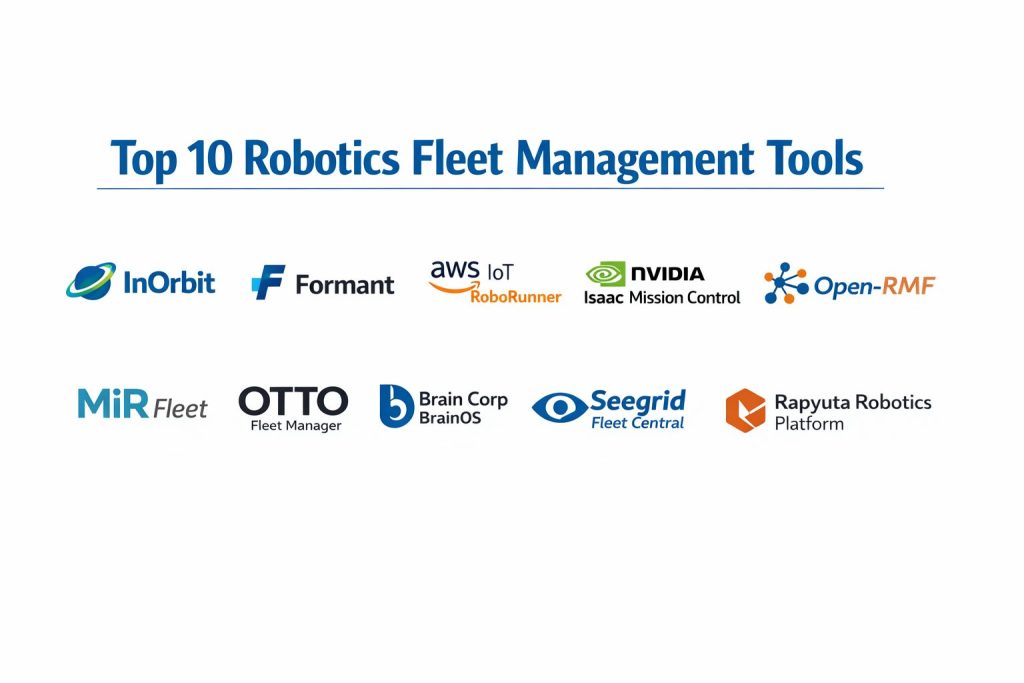
Top 10 Robotics Fleet Management Tools
1) InOrbit
A fleet operations platform focused on monitoring, observability, and operational control for robots in production. Often used to centralize fleet health, incidents, and performance across sites.
Key Features
- Fleet dashboards for robot status, availability, and utilization
- Alerts and incident workflows to reduce downtime and speed response
- Site and mission visibility patterns to track outcomes and bottlenecks
- Remote support tooling patterns for diagnosing issues (implementation varies)
- Analytics for reliability and operational performance over time
- API-first approach for connecting robot data streams and operations tools
- Multi-site views to standardize operations across locations
Pros
- Strong operational visibility that helps reduce “unknown unknowns” in fleet performance
- Useful for teams running mixed deployments that need a single pane of glass
Cons
- Exact orchestration depth depends on how it’s integrated with robot stacks
- Enterprise rollouts may require integration work and clear data standards
Platforms / Deployment
- Cloud / Hybrid (Varies by deployment design)
Security & Compliance
- SSO/SAML, MFA, encryption, audit logs, RBAC: Not publicly stated
- SOC 2, ISO 27001, GDPR, HIPAA: Not publicly stated
Integrations & Ecosystem
InOrbit typically connects into robot telemetry, mission systems, and enterprise operations tools so teams can monitor fleets and act quickly.
- APIs and webhooks for events and automation (Varies / N/A)
- Integration with ticketing and incident workflows (Varies / N/A)
- Data export to analytics tools (Varies / N/A)
- Robot vendor connectors or adapters (Varies / N/A)
Support & Community
Commercial support with onboarding patterns; community resources vary. Documentation depth depends on plan and integration scope.
2) Formant
A robot operations platform that emphasizes monitoring, teleoperation patterns, data capture, and fleet insights. Often used by teams that want strong observability plus tools for remote assistance.
Key Features
- Unified fleet monitoring with event timelines and operational dashboards
- Video and sensor data workflows to support remote diagnosis (where applicable)
- Remote assistance patterns for handling exceptions and edge cases
- Data capture and analytics to improve reliability and performance
- Role-based access patterns for operations and engineering teams
- Multi-site reporting views for standardizing KPIs
- Integration hooks for connecting to internal tools and workflows
Pros
- Strong for remote operations and incident-driven workflows
- Helpful for teams that need consistent fleet analytics across sites
Cons
- Orchestration depth can depend on robot stack integration choices
- Full value often requires deliberate instrumentation and data hygiene
Platforms / Deployment
- Cloud / Hybrid (Varies by deployment design)
Security & Compliance
- SSO/SAML, MFA, encryption, audit logs, RBAC: Not publicly stated
- SOC 2, ISO 27001, GDPR, HIPAA: Not publicly stated
Integrations & Ecosystem
Formant is commonly used as an operational layer connecting robot telemetry, remote support workflows, and enterprise systems.
- APIs for telemetry, events, and automation (Varies / N/A)
- Integration with ticketing and ops workflows (Varies / N/A)
- Data export for dashboards and analytics (Varies / N/A)
- Robot stack adapters and SDK usage (Varies / N/A)
Support & Community
Commercial support and onboarding; community presence varies by user segment and deployment type.
3) AWS IoT RoboRunner
A service approach aimed at coordinating robots and fleet systems with enterprise workflows, especially for facilities that already use AWS-based infrastructure patterns.
Key Features
- Connectivity patterns for robots, missions, and facility systems
- Data modeling to represent robots, tasks, and locations in a unified view
- Integration-friendly approach for connecting to other AWS services
- Event-driven workflows for dispatching and state tracking
- Multi-vendor coordination patterns when paired with proper adapters
- Operational visibility and reporting possibilities through AWS analytics stack
- Extensibility via APIs and integration tooling
Pros
- Strong fit for teams standardized on AWS who want integration-heavy workflows
- Scales well when you already have cloud governance and data tooling
Cons
- Requires AWS skills and architecture planning to implement effectively
- Not a single “out of the box” UI experience in all scenarios
Platforms / Deployment
- Cloud (with edge components depending on architecture)
Security & Compliance
- SSO/SAML, MFA, encryption, audit logs, RBAC: Varies / N/A
- SOC 2, ISO 27001, GDPR, HIPAA: Varies / N/A
Integrations & Ecosystem
Works best when integrated into AWS-native eventing, identity, and data services for a cohesive operations workflow.
- AWS service integrations for events, storage, and analytics (Varies / N/A)
- API integrations to WMS/MES/ERP systems (Varies / N/A)
- Robot vendor adapters (Varies / N/A)
- Observability integrations via AWS tooling (Varies / N/A)
Support & Community
Enterprise-grade support options through AWS plans; community resources are broader in AWS ecosystems than robotics-specific communities.
4) NVIDIA Isaac Mission Control
A mission orchestration approach in NVIDIA’s robotics ecosystem, oriented toward coordinating fleets and managing missions where NVIDIA robotics stacks are in play.
Key Features
- Mission scheduling and coordination patterns for multiple robots
- Map and zone concepts for safe operation and route planning (implementation varies)
- Integration patterns with robotics stacks in NVIDIA ecosystem (Varies / N/A)
- Telemetry and monitoring patterns for fleet awareness
- Extensibility for integrating facility workflows (Varies / N/A)
- Edge-oriented designs that support on-site responsiveness
- Alignment with simulation and development workflows in the broader Isaac ecosystem
Pros
- Strong fit for teams invested in NVIDIA robotics stack and acceleration workflows
- Useful when simulation-to-deployment continuity is part of the strategy
Cons
- Best fit is narrower if your robots are not aligned to the NVIDIA ecosystem
- Enterprise integration can require engineering effort and careful validation
Platforms / Deployment
- Hybrid / Self-hosted (Varies by architecture)
Security & Compliance
- SSO/SAML, MFA, encryption, audit logs, RBAC: Not publicly stated
- SOC 2, ISO 27001, GDPR, HIPAA: Not publicly stated
Integrations & Ecosystem
Often used alongside NVIDIA robotics components and extended through integration patterns that connect missions to facility systems.
- Integration with robotics stack components (Varies / N/A)
- APIs for task dispatch and state reporting (Varies / N/A)
- Facility system integrations via custom adapters (Varies / N/A)
- Data export to analytics platforms (Varies / N/A)
Support & Community
Support depends on commercial relationships and ecosystem adoption; community knowledge exists but may be more technical and developer-oriented.
5) Open-RMF
An open framework designed to enable fleet interoperability and coordination, especially in ROS-based environments. Often used when you need multi-vendor coordination and want control over the integration approach.
Key Features
- Interoperability patterns for multiple robot fleets in one facility
- Traffic scheduling and shared resource coordination concepts
- Facility map modeling and zone-based coordination workflows
- Integration approach that supports custom adapters per robot vendor
- Works well when you need an open foundation and customization control
- Extensible architecture for integrating doors, lifts, and building systems (implementation varies)
- Community-driven development model that encourages standardization
Pros
- Strong choice for multi-vendor coordination and long-term flexibility
- Avoids single-vendor lock-in when implemented thoughtfully
Cons
- Requires engineering effort and ROS ecosystem competence
- Operational tooling and UI polish can vary by deployment and integrators
Platforms / Deployment
- Self-hosted / Hybrid (Varies by implementation)
Security & Compliance
- SSO/SAML, MFA, encryption, audit logs, RBAC: Varies / N/A
- SOC 2, ISO 27001, GDPR, HIPAA: Not publicly stated
Integrations & Ecosystem
Open-RMF is designed for adapters and integrations, so most real-world value comes from how well you connect robots and facility systems.
- Robot vendor adapters (Varies / N/A)
- Integration with doors, lifts, and IoT systems (Varies / N/A)
- ROS-based middleware interoperability patterns
- Extensibility via open interfaces and community modules
Support & Community
Strong community in ROS ecosystems; professional support depends on integrators and vendors involved in your implementation.
6) MiR Fleet
A fleet manager oriented around Mobile Industrial Robots deployments, designed to coordinate MiR robot missions and provide operational oversight for MiR fleets.
Key Features
- Central mission dispatch and queueing for MiR robots
- Fleet monitoring with status views and mission outcomes
- Map and zone management workflows for safer navigation
- Traffic coordination patterns for multiple MiR units (capability varies by setup)
- User and role patterns for operations oversight (Varies / N/A)
- Integration options with warehouse systems (Varies / N/A)
- Operational logs and reporting views (Varies / N/A)
Pros
- Strong fit when your fleet is primarily MiR robots
- Typically simpler deployment than building a custom orchestration layer
Cons
- Less flexible for multi-vendor fleets unless paired with broader integration layers
- Advanced integrations may require additional tooling and effort
Platforms / Deployment
- Self-hosted / Hybrid (Varies by deployment model)
Security & Compliance
- SSO/SAML, MFA, encryption, audit logs, RBAC: Not publicly stated
- SOC 2, ISO 27001, GDPR, HIPAA: Not publicly stated
Integrations & Ecosystem
MiR Fleet is most valuable inside MiR-centric deployments and may integrate with facility systems through supported interfaces and partner solutions.
- WMS and workflow integrations: Varies / N/A
- APIs or connectors: Varies / N/A
- Site systems coordination: Varies / N/A
- Partner ecosystem support: Varies / N/A
Support & Community
Vendor support is typically available; community resources exist but are more niche than open ecosystems.
7) OTTO Fleet Manager
A fleet manager for OTTO Motors deployments, focused on coordinating OTTO robot missions and providing visibility and operational control for OTTO fleets.
Key Features
- Centralized mission management for OTTO robots
- Fleet monitoring and operational dashboards
- Zone and site configuration concepts for safe operation
- Traffic and mission coordination for multi-robot operations (Varies / N/A)
- Operational logs and reporting for continuous improvement
- Integration patterns for facility workflows (Varies / N/A)
- Tools for scaling within OTTO-centric deployments
Pros
- Purpose-built for OTTO fleets with operational controls that match typical AMR workflows
- Helpful for standardizing operations in OTTO-heavy sites
Cons
- Multi-vendor support is limited without additional orchestration layers
- Integration depth varies depending on facility systems and project scope
Platforms / Deployment
- Self-hosted / Hybrid (Varies by deployment model)
Security & Compliance
- SSO/SAML, MFA, encryption, audit logs, RBAC: Not publicly stated
- SOC 2, ISO 27001, GDPR, HIPAA: Not publicly stated
Integrations & Ecosystem
Typically connects to warehouse workflows and upstream scheduling systems through vendor-supported interfaces and partner integrations.
- WMS and task dispatch integration: Varies / N/A
- API access: Varies / N/A
- Partner ecosystem tools: Varies / N/A
- Monitoring export: Varies / N/A
Support & Community
Vendor support is the primary path; community is smaller and tied to OTTO deployments.
8) Brain Corp BrainOS
A platform commonly associated with large commercial robot deployments, especially in operational contexts like cleaning fleets. It focuses on managing robot operations, performance, and fleet consistency.
Key Features
- Central fleet oversight and operational performance monitoring
- Tools to manage deployment consistency across many robots (Varies / N/A)
- Exception handling workflows suitable for field operations (Varies / N/A)
- Reporting and utilization insights for large deployments
- Operational controls designed for repeatable tasks
- Scalable management patterns across many sites (Varies / N/A)
- Support for ongoing improvements through fleet data feedback loops
Pros
- Strong for large-scale deployments where consistency and reporting matter
- Well-suited to repeatable operational workflows and distributed sites
Cons
- Best fit depends on the robot ecosystem and supported models
- Integration flexibility varies by deployment type and commercial scope
Platforms / Deployment
- Cloud / Hybrid (Varies by deployment design)
Security & Compliance
- SSO/SAML, MFA, encryption, audit logs, RBAC: Not publicly stated
- SOC 2, ISO 27001, GDPR, HIPAA: Not publicly stated
Integrations & Ecosystem
Often used as an operational platform layer, with integrations depending on customer environment and deployment model.
- Enterprise reporting integrations: Varies / N/A
- Operational workflow integrations: Varies / N/A
- Data export options: Varies / N/A
- Partner ecosystem: Varies / N/A
Support & Community
Commercial support is typically central; community resources vary and may be less open than developer-first platforms.
9) Seegrid Fleet Central
A fleet management approach aligned with Seegrid robotic deployments, focused on operating and monitoring fleets for material movement and site logistics.
Key Features
- Central fleet monitoring and mission tracking
- Tools for coordinating robot tasks across a facility (Varies / N/A)
- Operational alerts and reporting patterns for uptime focus
- Site configuration options for stable fleet operation
- Utilization and performance insights to optimize throughput
- Integration patterns for facility workflows (Varies / N/A)
- Designed for industrial logistics and repeatable transport missions
Pros
- Good fit when Seegrid robots are the core fleet
- Operational focus helps teams measure improvement and throughput
Cons
- Multi-vendor flexibility is limited without an additional coordination layer
- Integration details and extensibility can vary by deployment
Platforms / Deployment
- Self-hosted / Hybrid (Varies by deployment model)
Security & Compliance
- SSO/SAML, MFA, encryption, audit logs, RBAC: Not publicly stated
- SOC 2, ISO 27001, GDPR, HIPAA: Not publicly stated
Integrations & Ecosystem
Typically integrates with logistics workflows and upstream scheduling through supported interfaces.
- WMS or workflow integration: Varies / N/A
- API availability: Varies / N/A
- Data export and reporting: Varies / N/A
- Partner tooling: Varies / N/A
Support & Community
Vendor support is the primary source; community is smaller and centered around Seegrid deployments.
10) Rapyuta Robotics Platform
A cloud robotics platform approach that can support fleet operations, deployment management, and integration patterns for robots in production environments, especially when cloud management is a priority.
Key Features
- Central management patterns for robot applications and fleet operations
- Tools to manage deployment and updates across fleets (Varies / N/A)
- Monitoring and telemetry pipelines for fleet visibility
- Integration-friendly patterns for connecting to enterprise systems
- Multi-site management concepts for consistent operations (Varies / N/A)
- Workflow support for mission orchestration depending on implementation
- Cloud-to-edge patterns for real deployments (Varies / N/A)
Pros
- Helpful when you want cloud-based fleet operations and deployment management
- Good fit for teams building repeatable rollout and update processes
Cons
- Exact capabilities depend on chosen modules and implementation approach
- Requires planning for network, edge reliability, and site governance
Platforms / Deployment
- Cloud / Hybrid (Varies by architecture)
Security & Compliance
- SSO/SAML, MFA, encryption, audit logs, RBAC: Not publicly stated
- SOC 2, ISO 27001, GDPR, HIPAA: Not publicly stated
Integrations & Ecosystem
Designed to connect robots with cloud operations patterns and enterprise workflows.
- APIs for telemetry and workflows: Varies / N/A
- Integration with analytics and monitoring stacks: Varies / N/A
- Enterprise workflow integration: Varies / N/A
- Robot stack integration patterns: Varies / N/A
Support & Community
Commercial support and onboarding; community resources vary depending on how widely your team uses the platform components.
Comparison Table
| Tool Name | Best For | Platform(s) Supported | Deployment | Standout Feature | Public Rating |
|---|---|---|---|---|---|
| InOrbit | Fleet monitoring and operations visibility | Varies / N/A | Cloud / Hybrid | Single pane of glass for fleet health | N/A |
| Formant | Remote operations and fleet analytics | Varies / N/A | Cloud / Hybrid | Data-driven ops and remote assistance patterns | N/A |
| AWS IoT RoboRunner | Integration-heavy orchestration in AWS ecosystems | Varies / N/A | Cloud | Facility and task modeling with cloud integration | N/A |
| NVIDIA Isaac Mission Control | Mission coordination in NVIDIA robotics ecosystems | Varies / N/A | Hybrid / Self-hosted | Mission orchestration aligned to Isaac workflows | N/A |
| Open-RMF | Multi-vendor coordination with open flexibility | Varies / N/A | Self-hosted / Hybrid | Interoperability and traffic scheduling concepts | N/A |
| MiR Fleet | Operating MiR robot fleets | Varies / N/A | Self-hosted / Hybrid | Vendor-native fleet coordination for MiR | N/A |
| OTTO Fleet Manager | Operating OTTO robot fleets | Varies / N/A | Self-hosted / Hybrid | Vendor-native mission control for OTTO fleets | N/A |
| Brain Corp BrainOS | Large operational fleets with consistent workflows | Varies / N/A | Cloud / Hybrid | Scaled fleet operations and performance reporting | N/A |
| Seegrid Fleet Central | Industrial logistics fleets in Seegrid deployments | Varies / N/A | Self-hosted / Hybrid | Logistics-focused fleet oversight | N/A |
| Rapyuta Robotics Platform | Cloud-managed robotics operations and deployments | Varies / N/A | Cloud / Hybrid | Cloud-to-edge fleet management patterns | N/A |
Evaluation & Scoring
Weights: Core features 25%, Ease 15%, Integrations 15%, Security 10%, Performance 10%, Support 10%, Value 15%.
| Tool Name | Core (25%) | Ease (15%) | Integrations (15%) | Security (10%) | Performance (10%) | Support (10%) | Value (15%) | Weighted Total |
|---|---|---|---|---|---|---|---|---|
| InOrbit | 9.0 | 8.0 | 8.0 | 7.0 | 8.0 | 8.0 | 7.0 | 8.00 |
| Formant | 9.0 | 8.0 | 8.0 | 7.0 | 8.0 | 8.0 | 7.0 | 8.00 |
| AWS IoT RoboRunner | 8.0 | 6.0 | 9.0 | 8.0 | 8.0 | 7.0 | 7.0 | 7.60 |
| NVIDIA Isaac Mission Control | 8.0 | 7.0 | 8.0 | 7.0 | 8.0 | 7.0 | 7.0 | 7.50 |
| Open-RMF | 7.0 | 6.0 | 8.0 | 6.0 | 7.0 | 7.0 | 9.0 | 7.20 |
| MiR Fleet | 8.0 | 8.0 | 7.0 | 6.0 | 8.0 | 7.0 | 7.0 | 7.40 |
| OTTO Fleet Manager | 8.0 | 7.0 | 7.0 | 6.0 | 8.0 | 7.0 | 7.0 | 7.25 |
| Brain Corp BrainOS | 8.0 | 7.0 | 7.0 | 7.0 | 8.0 | 7.0 | 7.0 | 7.35 |
| Seegrid Fleet Central | 8.0 | 7.0 | 7.0 | 6.0 | 8.0 | 7.0 | 7.0 | 7.25 |
| Rapyuta Robotics Platform | 8.0 | 7.0 | 8.0 | 7.0 | 7.0 | 7.0 | 7.0 | 7.40 |
How to interpret the scores:
- These scores are comparative within this list and reflect typical buying priorities for fleet operations.
- A higher total suggests broader strength across many scenarios, not a universal winner.
- If you are integration-heavy, prioritize Integrations and Core over raw Ease scores.
- If you are multi-vendor, prioritize interoperability and adapter maturity over vendor-native convenience.
- Always validate by running a pilot with real missions, real maps, and your real IT/OT constraints.
Which Tool Is Right for You?
Solo / Freelancer
If you are building robotics solutions for clients, start with a platform that makes demos and monitoring easy, then add orchestration depth later. Open-RMF can be valuable if you need an open base for interoperability, but be realistic about engineering effort. If you need faster client proof points, an operations platform like InOrbit or Formant can help you show visibility, incidents, and KPIs early.
SMB
If you run one site and one robot vendor, vendor-native fleet managers like MiR Fleet, OTTO Fleet Manager, or Seegrid Fleet Central can be simpler. If you plan to add a second robot vendor later, consider Open-RMF or an orchestration-friendly approach early so you do not rebuild your integration layer.
Mid-Market
Mid-market teams often need multi-site visibility, standardized KPIs, and integration to WMS or dispatch tools. InOrbit and Formant are typically strong for operational visibility and incident handling, while RoboRunner can fit well if your organization already has AWS governance and data pipelines.
Enterprise
Enterprises usually care about governance, repeatable rollouts, and consistent performance across many sites. RoboRunner can be a strong option in AWS-native enterprises. Open-RMF can be strategic if interoperability is mandatory and you can invest in adapters and standards. For large operational fleets with consistent workflows, BrainOS-style approaches may fit depending on the robot ecosystem and use case.
Budget vs Premium
Open-RMF can be cost-effective on licensing but requires engineering investment. Commercial platforms can reduce time-to-value but may increase recurring spend. Decide based on whether your main constraint is cash, engineering bandwidth, or speed.
Feature Depth vs Ease of Use
Vendor-native tools can be easier for single-vendor fleets. Cross-vendor coordination tends to trade simplicity for flexibility. Choose the tool that matches your operational maturity and the complexity you truly need.
Integrations & Scalability
If you must integrate WMS, ticketing, identity, and analytics, pick the platform with the clearest integration model for your environment. Integration maturity often matters more than UI polish once you scale.
Security & Compliance Needs
Most fleets become “IT systems” quickly. Plan for least-privilege access, audit-friendly workflows, secure remote support, and defined ownership between IT and robotics operations. Where compliance is not publicly stated, validate via procurement and internal review.
Frequently Asked Questions
1) What is a robotics fleet management tool used for?
It centralizes mission dispatch, monitoring, and operational control for many robots at once. It helps teams reduce downtime, track performance, and enforce consistent rules across a facility or multiple sites.
2) Do I need fleet management if I have only a few robots?
If tasks are simple and the fleet is small, you may not need a full platform. Once you have multiple missions, shared spaces, or multiple shifts, fleet tooling becomes valuable fast.
3) How do these tools integrate with WMS or MES systems?
Most integrations use APIs, events, and task models that connect orders to robot missions. The quality depends on connector maturity, data standards, and how your facility workflows are defined.
4) What is the biggest reason fleet projects fail after a successful pilot?
Lack of operational ownership and weak exception handling. If humans do not have clear playbooks for robot failures, small issues compound at scale.
5) Can one platform manage robots from different vendors?
Sometimes, but it depends on adapter maturity and interoperability design. Open-RMF is commonly used for multi-vendor coordination, while many vendor-native tools focus on their own fleets.
6) Should mission control run in the cloud or on-site?
Many teams use hybrid designs so core operations keep running if connectivity is unstable. Choose based on latency needs, site reliability, and your IT governance requirements.
7) What security controls should I insist on?
At minimum, strong identity controls, role-based access, audit trails, secure remote support, and encryption in transit. If details are not clearly stated, treat them as unknown and validate directly.
8) How do I measure whether fleet management is improving performance?
Track utilization, mission success rate, time-to-recovery, congestion hotspots, and throughput impact. Compare baseline operations before rollout to a stabilized period after rollout.
9) What is a practical pilot plan before full rollout?
Start with a limited zone, a small set of mission types, and clear success criteria. Validate dispatch, exception handling, integrations, and human workflows before scaling.
10) How do I avoid lock-in while still moving fast?
Standardize data models, use stable interchange interfaces, and keep mission definitions portable. If multi-vendor is likely, design adapters and coordination early rather than later.
Conclusion
Robotics fleet management tools become the operating system of your robot program once you move beyond a small demo fleet. The right choice depends on your vendor mix, integration needs, and how quickly you must scale. If your priority is operational visibility, incident handling, and consistent KPIs across sites, platforms like InOrbit and Formant can be strong starting points. If your organization is cloud-native and integration-heavy, AWS IoT RoboRunner can fit well when paired with solid adapters and workflow design. If interoperability across different robot brands is mandatory, Open-RMF can offer long-term flexibility, but it requires real engineering investment and strong standards. A smart next step is to shortlist two or three tools, run a pilot with real missions and failure cases, validate integrations and governance, then scale with clear operating playbooks.