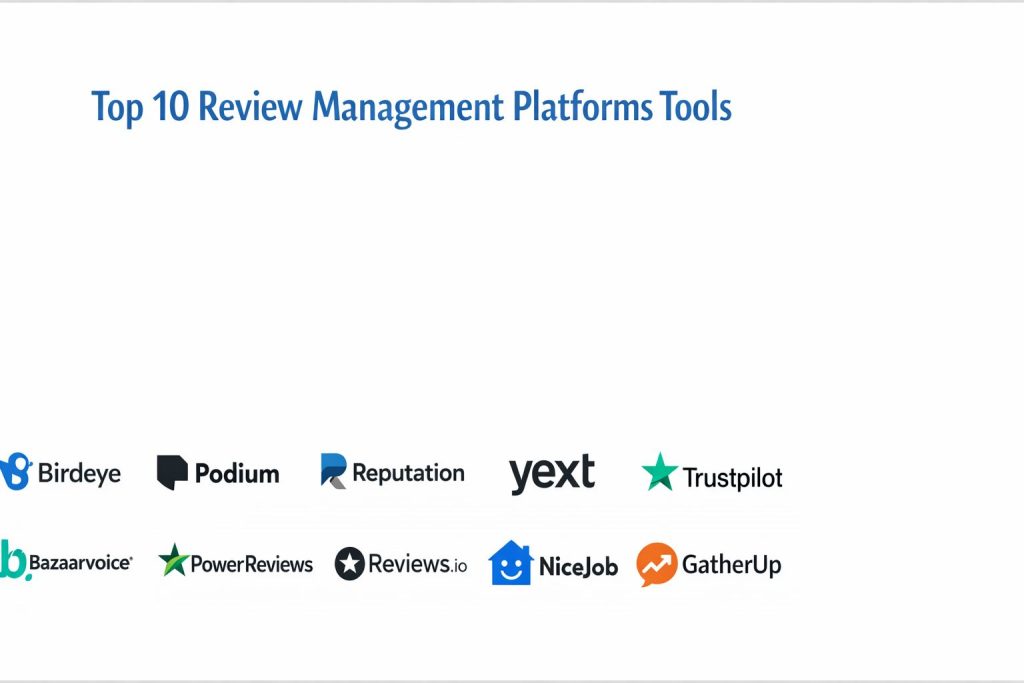
Introduction
Review management platforms have evolved into the digital frontline for brand credibility, providing the infrastructure necessary for businesses to capture, analyze, and act upon customer sentiment across a fragmented internet. In a landscape where consumer trust is the primary currency, these tools offer more than just a place to read feedback; they function as sophisticated listening posts that aggregate data from hundreds of third-party sites, social media channels, and direct surveys. By centralizing this data, organizations can protect their digital reputation, identify operational bottlenecks, and leverage positive social proof to drive customer acquisition. These platforms use advanced algorithms to categorize feedback, allowing stakeholders to distinguish between isolated incidents and systemic service issues.
For the modern enterprise, managing reviews is no longer a reactive task but a strategic necessity integrated into the broader customer experience (CX) and marketing stack. Organizations utilize these platforms to boost local SEO, as search engine visibility is increasingly tied to the frequency, recency, and quality of online ratings. Furthermore, these tools enable a closed-loop feedback system where a negative review can be instantly routed to the appropriate service department for resolution before it impacts the brand’s public standing. When selecting a platform, decision-makers must evaluate the breadth of its integration ecosystem, the precision of its sentiment analysis, and the robustness of its automated response workflows.
Best for: Multi-location retail brands, e-commerce giants, healthcare providers, and service-based franchises that require a centralized command center for public reputation and customer feedback.
Not ideal for: Personal blogs or very small hobbyist projects with low interaction volume. If your business does not yet have a verified presence on major review sites, the primary focus should be on basic listing setup before investing in a full management suite.
Key Trends in Review Management Platforms
The primary shift in the industry is the move toward “Agentic AI,” where autonomous systems no longer just notify you of a review but can draft personalized, context-aware responses based on your brand’s historical data and specific policy guidelines. We are also seeing a deep convergence between review management and customer relationship management (CRM) systems, allowing businesses to see a customer’s entire review history right next to their purchase data. This provides a 360-degree view that was previously siloed across different departments.
Hyper-local SEO optimization has become a core feature, with platforms now offering automated tools to ensure business information is consistent across every niche directory, which is vital for appearing in “near me” search results. There is also a significant rise in video-first testimonials, as platforms integrate tools to capture and edit video feedback directly from a mobile device. Finally, data privacy and compliance have moved to the forefront, with platforms now including built-in features to ensure all feedback collection methods comply with global regulations like GDPR and CCPA.
How We Selected These Tools
Our selection process focused on identifying platforms that offer the most comprehensive and scalable solutions for professional reputation management. We prioritized tools that provide a unified dashboard capable of pulling data from a vast array of sources, ensuring that no mention goes unnoticed. Technical reliability was a major factor, specifically how well the platforms handle high volumes of incoming data without lag or synchronization errors. We also looked for advanced analytical capabilities, such as the ability to perform deep-dive sentiment analysis across different regions or product lines.
Security and enterprise-grade compliance were non-negotiable criteria, as these platforms often handle sensitive customer contact information. We assessed the quality of the automated workflows, favoring tools that allow for sophisticated logic in how reviews are handled and escalated. The availability of high-quality mobile applications was also considered, as reputation management often requires quick action from field managers. Finally, we weighed the overall cost against the depth of features to determine which platforms offer the most sustainable value for various organizational sizes.
1. Birdeye
Birdeye is a comprehensive customer experience and reputation platform designed primarily for multi-location businesses. It excels at automating the entire lifecycle of a review, from the initial request via SMS or email to the final public response. The platform uses a sophisticated AI engine to summarize hundreds of reviews into actionable insights, helping managers understand exactly what is driving customer satisfaction or frustration at specific locations.
Key Features
The platform features automated review solicitation that triggers based on transaction data from your POS or CRM. It includes a centralized inbox that consolidates messages from reviews, social media, and webchat into one view. Its sentiment analysis tool automatically tags reviews with themes like “pricing” or “service quality.” It also offers a robust listing management tool to keep business data accurate across the web. Additionally, it provides competitive benchmarking to see how your ratings stack up against local rivals.
Pros
It offers one of the most complete feature sets on the market, covering reviews, listings, and even referral marketing in one place. The automation is highly reliable and significantly reduces the manual workload for large teams.
Cons
The pricing can be significantly higher than specialized point solutions, making it a heavy investment for smaller companies. The vast array of features can lead to a slightly complex setup process.
Platforms and Deployment
Web-based dashboard with native applications for iOS and Android. It is a cloud-native deployment.
Security and Compliance
The platform is SOC 2 Type II compliant and offers robust data encryption and role-based access controls to protect sensitive customer data.
Integrations and Ecosystem
It integrates with over 3,000 different software systems, including major CRMs like Salesforce and HubSpot, as well as various specialized industry platforms.
Support and Community
Offers 24/7 professional support through multiple channels and provides an extensive library of training resources through its dedicated university.
2. Podium
Podium focuses on “conversational” review management, built on the philosophy that reviews are an extension of the customer conversation. It is particularly strong for local service businesses that want to use text messaging as their primary channel for engagement and review generation. The platform streamlines the process of asking for a review by sending a simple text link immediately after a service is completed.
Key Features
The core of the platform is a unified text-based inbox that handles reviews, payments, and customer queries. It includes a mobile-first review request system that sees much higher open rates than traditional email. The software features an AI-powered lead drive that turns website visitors into text conversations. It also offers basic sentiment tracking and reporting to monitor brand health. A standout feature is the ability to collect payments directly through the same text thread used for review requests.
Pros
The text-heavy approach results in significantly higher response rates for review requests. It is exceptionally easy for non-technical staff to use on a daily basis.
Cons
Its feature set is more streamlined than enterprise-grade competitors, which might not satisfy the needs of very large corporations. The focus on SMS means it is most effective in regions where text messaging is the dominant form of communication.
Platforms and Deployment
Web and mobile-based cloud platform.
Security and Compliance
Adheres to strict telecommunications compliance and provides secure, encrypted messaging environments for all customer interactions.
Integrations and Ecosystem
Integrates well with common local business software, including various dental, automotive, and home service management systems.
Support and Community
Provides dedicated account management for higher tiers and a helpful community forum for sharing best practices.
3. Reputation
Reputation (formerly Reputation.com) is an enterprise-level platform that specializes in managing the complex needs of massive organizations with thousands of locations. It provides deep data science capabilities to translate millions of data points into a single “Reputation Score,” which serves as a high-level KPI for executive leadership.
Key Features
The platform offers a proprietary scoring algorithm that benchmarks your performance against industry standards. It includes advanced “Social Listening” tools to monitor brand mentions beyond just formal review sites. The software features complex routing logic to send reviews to specific local managers based on content or rating. It provides a full suite for managing local business listings and social media posts. The analytics engine is capable of uncovering deep correlations between review sentiment and actual business revenue.
Pros
It is built for massive scale, handling the complexity of large hierarchies with ease. The “Reputation Score” provides a very clear, quantifiable metric for tracking long-term progress.
Cons
The interface can be overwhelming due to the sheer volume of data and options. The implementation timeline is typically longer than more agile, SMB-focused tools.
Platforms and Deployment
Enterprise cloud platform with full mobile support for field managers.
Security and Compliance
Offers the highest levels of enterprise security, including HIPAA compliance for healthcare providers and advanced SSO integrations.
Integrations and Ecosystem
Deeply integrates with enterprise ERP and CRM systems, allowing for seamless data flow across large corporate infrastructures.
Support and Community
Provides high-level strategic consulting and dedicated support teams for its enterprise clients.
4. Yext
Yext is primarily a “Digital Knowledge Management” platform that treats reviews as a critical part of a brand’s factual data. It is the gold standard for ensuring that whenever a customer searches for your business, the information—and the reviews they see—are accurate and impactful. It focuses heavily on the technical side of how reviews impact search engine results.
Key Features
The platform features a “knowledge graph” that serves as the single source of truth for all business facts. Its review management module allows for direct responses to reviews across the Yext network from one dashboard. It includes AI-powered sentiment analysis that identifies emerging trends in customer feedback. The software offers specialized tools for generating reviews on first-party sites to improve on-site SEO. It also provides detailed “search-to-review” analytics to show how reviews are driving actual traffic.
Pros
It offers unparalleled control over how your brand appears in search engines and AI discovery tools. The platform is incredibly efficient at updating information across hundreds of sites simultaneously.
Cons
The review management features are part of a larger ecosystem, which can feel like overkill if you only need a basic feedback tool. The pricing structure can be complex as it is often tied to the number of listings managed.
Platforms and Deployment
Global cloud-based platform.
Security and Compliance
Strong focus on data integrity and security, with certifications suitable for global financial and retail institutions.
Integrations and Ecosystem
Has one of the largest integration networks in the industry, connecting directly to almost every significant search engine and directory globally.
Support and Community
Offers a robust certification program for users and high-quality technical support for its global client base.
5. Trustpilot Business
Trustpilot is a high-visibility, third-party review platform that focuses on building public trust through transparency. Unlike “closed” systems, Trustpilot is a destination site where customers go specifically to research brands, making a strong presence here a powerful marketing asset in itself.
Key Features
The business platform allows for the automated collection of verified reviews that carry the “Trustpilot” seal of authenticity. It features a powerful widget system to display your rating directly on your website to boost conversion. The software includes tools for identifying and flagging fraudulent reviews to maintain the integrity of your page. It offers AI-driven insights to categorize customer feedback by topic. Additionally, it provides a “Consumer Insights” dashboard to see how your brand perception is changing over time.
Pros
The Trustpilot brand is globally recognized, and having a high rating there provides immediate credibility. It is particularly effective for purely online e-commerce businesses.
Cons
Because it is a public forum, you have less control over the “closed” aspects of the feedback loop compared to private survey tools. The free version is quite limited, requiring a paid subscription for most professional features.
Platforms and Deployment
Cloud-hosted SaaS platform.
Security and Compliance
Adheres to strict transparency guidelines and provides secure data handling for all verified review invitations.
Integrations and Ecosystem
Integrates seamlessly with major e-commerce platforms like Shopify, Magento, and WooCommerce.
Support and Community
Offers extensive self-service documentation and professional support for its business subscribers.
6. Bazaarvoice
Bazaarvoice is a specialized platform focused on “User-Generated Content” (UGC) for brands and retailers. It is the industry leader for syndicating reviews, meaning it can take a review written on your brand’s website and push it out to the websites of the retailers that sell your products.
Key Features
The platform’s standout feature is its massive retail syndication network that connects brands with major global retailers. It includes sophisticated tools for collecting product-specific ratings and reviews. The software features a “Questions & Answers” module that allows brands to engage directly with shoppers on retail sites. It uses advanced moderation to ensure all content meets strict brand guidelines. It also offers tools for collecting and displaying social media photos and videos from customers.
Pros
It is the only choice for brands that need to manage their reputation across a large network of third-party retail sites. The impact on product-level conversion is measurable and significant.
Cons
It is a very high-end enterprise tool with a price point that reflects its power. It is generally too complex and expensive for businesses that don’t sell through multiple retail partners.
Platforms and Deployment
Enterprise cloud deployment.
Security and Compliance
Maintains rigorous standards for data privacy and content moderation, ensuring brand safety across the internet.
Integrations and Ecosystem
Integrates with the world’s largest retail networks and provides deep links into e-commerce analytics suites.
Support and Community
Provides extensive strategic services and a deep knowledge base for enterprise marketing teams.
7. PowerReviews
PowerReviews is a direct competitor to Bazaarvoice, offering a robust suite of tools for collecting and displaying ratings, reviews, and visual content. It is known for its ease of implementation and its focus on helping retailers maximize the SEO value of their user-generated content.
Key Features
The platform features a high-conversion review collection engine that works across mobile and desktop. It includes a “Social Curation” tool to pull in customer photos from Instagram and other platforms. The software provides a sophisticated moderation team to filter out spam and inappropriate content. It offers detailed analytics on how specific products are performing based on customer feedback. It also features a “Review Search” tool that lets shoppers find specific information within the reviews of a single product.
Pros
The implementation process is generally faster and more straightforward than other enterprise eCommerce tools. It offers excellent value for retailers looking to improve on-site trust and SEO.
Cons
While it does have a syndication network, it is not as expansive as the one offered by Bazaarvoice. Some of the advanced reporting features can require custom setup.
Platforms and Deployment
Cloud-based SaaS.
Security and Compliance
Fully compliant with global privacy standards and offers secure, moderated environments for all customer content.
Integrations and Ecosystem
Strong integrations with major e-commerce platforms and marketing automation tools.
Support and Community
Offers high-quality client success programs and a wealth of educational content for e-commerce marketers.
8. Reviews.io
Reviews.io is a modern, fast-growing platform that caters to mid-market and SMB e-commerce brands. It is designed to be highly visual and easy to set up, with a heavy emphasis on helping brands collect video reviews and display them through beautiful website widgets.
Key Features
The platform offers a unique “Video First” review collection tool that makes it easy for customers to record testimonials. It includes a robust system for collecting both company and product reviews. The software features a “Social Proof” widget that shows recent purchases and reviews to website visitors in real-time. It provides a direct integration with Google to display your ratings in search ads. It also includes a “NPS” (Net Promoter Score) tool to track overall customer loyalty.
Pros
It is one of the most cost-effective professional tools for e-commerce businesses. The visual widgets are among the best-designed in the industry, requiring no coding to look great.
Cons
It lacks the deep multi-location listing management features found in tools like Birdeye or Yext. The focus is heavily on e-commerce, making it less ideal for purely local service providers.
Platforms and Deployment
Cloud-based platform.
Security and Compliance
Provides secure, GDPR-compliant data processing and verified review invitation systems.
Integrations and Ecosystem
Excellent integrations with Shopify, Klaviyo, and other key components of the modern e-commerce stack.
Support and Community
Highly responsive support team and an easy-to-navigate help center for quick troubleshooting.
9. NiceJob
NiceJob is a focused, high-automation platform built specifically for small businesses and local service providers. It is designed to be a “set it and forget it” tool that automatically follows up with customers until they leave a review, using smart timing to maximize response rates.
Key Features
The platform features a “smart follow-up” system that automatically sends reminders across multiple channels. It includes a simple widget to show off your best reviews on your website. The software features a “Stories” tool that turns your reviews into social media posts automatically. It provides a simplified dashboard that focuses on the most important growth metrics. It also includes a referral tool to help turn happy reviewers into new leads.
Pros
It is incredibly simple to use and requires almost zero ongoing management once set up. The focus on automation makes it perfect for busy small business owners who don’t have time to manage a complex dashboard.
Cons
It lacks the deep analytical and multi-location governance features needed by larger enterprises. The customization options for widgets and emails are more limited than higher-tier competitors.
Platforms and Deployment
Web-based cloud platform with a mobile app.
Security and Compliance
Follows standard security practices for small business SaaS, ensuring safe handling of customer contact lists.
Integrations and Ecosystem
Integrates with popular small business software like QuickBooks, Jobber, and Housecall Pro.
Support and Community
Offers friendly, accessible support and a helpful library of tips for local business marketing.
10. GatherUp
GatherUp is a professional-grade platform that is a favorite among agencies and multi-location businesses that want a clean, data-focused approach to reputation. It emphasizes the “Customer Experience” aspect of reviews, providing tools to capture detailed feedback before it ever becomes a public review.
Key Features
The platform includes a “feedback-first” workflow that asks for a private rating before encouraging a public review. It features an “Auto-Reply” tool for Google reviews based on customizable logic. The software provides an “Impact Report” that shows how your reputation is directly affecting your search rankings. It offers a “Tagging” system to organize reviews by specific service lines or employee names. It also includes a robust “Social Sharing” tool to turn top reviews into branded images for marketing.
Pros
The focus on private feedback allows businesses to catch and resolve issues before they hurt their public score. It is highly regarded by SEO professionals for its clean data and insightful reporting.
Cons
The interface is more functional than flashy, which might not appeal to teams looking for a highly visual experience. It can take a bit more technical knowledge to fully utilize the advanced filtering and tagging features.
Platforms and Deployment
Cloud-based SaaS.
Security and Compliance
Maintains high standards for data privacy and offers secure management of large customer datasets across multiple accounts.
Integrations and Ecosystem
Integrates well with a wide variety of CRMs and professional marketing tools, including various specialized agency reporting platforms.
Support and Community
Offers excellent technical support and is well-known for providing high-value educational webinars for its users.
Comparison Table
| Tool Name | Best For | Platform(s) Supported | Deployment | Standout Feature | Public Rating |
| 1. Birdeye | Multi-location Enterprise | Web, iOS, Android | Cloud | AI-Powered BirdAI Agents | 4.9/5 |
| 2. Podium | Local Service Businesses | Web, iOS, Android | Cloud | Text-based Engagement | 4.6/5 |
| 3. Reputation | Enterprise Governance | Web, iOS, Android | Cloud | Proprietary Reputation Score | 4.5/5 |
| 4. Yext | Search & Listings | Web | Cloud | Knowledge Graph Listings | 4.4/5 |
| 5. Trustpilot | Public Trust Building | Web | Cloud | Verified Trust Seal | 4.3/5 |
| 6. Bazaarvoice | Retail Brand Syndication | Web | Cloud | Multi-Retailer Syndication | 4.7/5 |
| 7. PowerReviews | E-commerce Conversion | Web | Cloud | Review Search Analytics | 4.5/5 |
| 8. Reviews.io | Mid-market E-commerce | Web | Cloud | Video Review Collection | 4.8/5 |
| 9. NiceJob | SMB Automation | Web, iOS, Android | Cloud | Automated Review Stories | 4.9/5 |
| 10. GatherUp | Agency/CX Focus | Web | Cloud | Feedback-First Workflows | 4.7/5 |
Evaluation & Scoring of Review Management Platforms
The scoring below is a comparative model intended to help shortlisting. Each criterion is scored from 1–10, then a weighted total from 0–10 is calculated using the weights listed. These are analyst estimates based on typical fit and common workflow requirements, not public ratings.
Weights:
- Core features – 25%
- Ease of use – 15%
- Integrations & ecosystem – 15%
- Security & compliance – 10%
- Performance & reliability – 10%
- Support & community – 10%
- Price / value – 15%
| Tool Name | Core (25%) | Ease (15%) | Integrations (15%) | Security (10%) | Performance (10%) | Support (10%) | Value (15%) | Weighted Total |
| 1. Birdeye | 10 | 8 | 10 | 9 | 9 | 9 | 7 | 8.95 |
| 2. Podium | 8 | 10 | 8 | 8 | 9 | 8 | 8 | 8.55 |
| 3. Reputation | 10 | 6 | 9 | 10 | 9 | 9 | 6 | 8.50 |
| 4. Yext | 8 | 7 | 10 | 9 | 10 | 8 | 7 | 8.30 |
| 5. Trustpilot | 7 | 9 | 7 | 8 | 9 | 8 | 7 | 7.70 |
| 6. Bazaarvoice | 10 | 6 | 9 | 9 | 9 | 9 | 5 | 8.25 |
| 7. PowerReviews | 9 | 8 | 8 | 8 | 9 | 8 | 8 | 8.45 |
| 8. Reviews.io | 8 | 9 | 9 | 8 | 9 | 9 | 9 | 8.70 |
| 9. NiceJob | 7 | 10 | 7 | 7 | 8 | 8 | 10 | 8.05 |
| 10. GatherUp | 9 | 8 | 8 | 8 | 9 | 9 | 8 | 8.55 |
How to interpret the scores:
- Use the weighted total to shortlist candidates, then validate with a pilot.
- A lower score can mean specialization, not weakness.
- Security and compliance scores reflect controllability and governance fit, because certifications are often not publicly stated.
- Actual outcomes vary with assembly size, team skills, templates, and process maturity
Which Review Management Platform Tool Is Right for You?
Solo / Freelancer
For small, independent operators, simplicity is key. You need a tool that handles the heavy lifting of following up with customers so you can focus on your work. Look for platforms that offer high automation and low setup costs, ensuring you build a reputation without spending hours on a dashboard.
SMB
Small and medium businesses should prioritize tools that integrate directly with their primary communication channels, such as SMS. The ability to quickly turn a happy customer into a public advocate is the most direct way to grow your business at this scale.
Mid-Market
At the mid-market level, the ability to analyze trends and manage multiple locations becomes vital. You need a platform that provides deeper insights into why customers are happy or unhappy, allowing you to make operational changes that drive long-term growth.
Enterprise
For enterprise organizations, the focus is on governance, security, and data integration. You require a system that can manage thousands of users and locations while providing a single source of truth for the company’s reputation.
Budget vs Premium
Budget-conscious companies should look for tools that offer the most “bang for their buck” in terms of review generation. Premium options are worth the investment when you need advanced features like retail syndication or hyper-complex listing management across hundreds of directories.
Feature Depth vs Ease of Use
If you have a dedicated marketing team, feature depth is a priority. If your reviews are managed by busy store managers, choose a platform that offers the most intuitive interface and the highest level of automated assistance.
Integrations & Scalability
Your reputation management tool should not be an island. Ensure that whichever platform you choose can talk to your existing CRM and marketing stack, allowing you to trigger review requests and share feedback data across the whole organization.
Security & Compliance Needs
In industries like healthcare or finance, security is the top priority. Always choose a platform that offers the specific compliance certifications required for your industry to ensure customer data is handled with the highest level of care.
Frequently Asked Questions (FAQs)
1. How do these platforms handle fake or negative reviews?
While platforms cannot directly delete reviews, they provide tools to flag suspicious content that violates a site’s terms of service. For legitimate negative reviews, they provide response workflows that help you address the customer’s concerns publicly and professionally.
2. Can I manage all my social media comments through these tools?
Many higher-tier platforms include social media monitoring, allowing you to see and respond to comments on Facebook, Instagram, and LinkedIn from the same central dashboard used for reviews.
3. Does using these tools improve my Google ranking?
Yes, consistently generating fresh, high-quality reviews is a major signal for local SEO. These tools help you build the “Review Velocity” and “Rating Consistency” that search engines look for when ranking businesses.
4. What is review syndication?
Syndication allows a review written on one site (like your brand’s website) to be shared across a network of other partner sites (like major retailers), dramatically increasing the reach and impact of that single piece of feedback.
5. How much does a review management platform typically cost?
Pricing varies widely, from around $50 per month for basic SMB tools to several thousand dollars per month for enterprise-level suites with deep data integration and listing management.
6. Is SMS better than email for requesting reviews?
Generally, yes. SMS messages have significantly higher open and click-through rates than emails, making them the most effective way to generate a high volume of reviews quickly.
7. Can I use these tools if I have multiple business locations?
The best tools are built specifically for multi-location management, allowing you to see high-level data for the whole company while still giving local managers the ability to respond to their own reviews.
8. What is sentiment analysis?
Sentiment analysis uses AI to read the text of a review and determine the emotional tone and the specific topics being discussed, allowing you to quickly see trends across thousands of pieces of feedback.
9. Do I need to provide my own customer list?
Yes, you typically integrate your customer database or POS system with the platform, which then uses that information to send out review invitations according to your settings.
10. How long does it take to see results?
Most businesses see an increase in review volume and an improvement in their overall rating within the first 30 to 60 days of implementing a professional management tool.
Conclusion
Navigating the complexities of modern reputation management requires a strategic alignment between technology and customer-centricity. The platforms detailed above represent the pinnacle of current capabilities, offering diverse solutions for organizations of all sizes to protect and promote their digital presence. Whether your goal is to dominate local search through a high volume of SMS-driven reviews or to manage global product sentiment across an expansive retail network, the right tool acts as a powerful force multiplier for your brand’s credibility. By investing in a platform that prioritizes data integrity, real-time engagement, and advanced AI-driven insights, you ensure that your brand remains resilient and respected in an increasingly transparent digital marketplace. As the industry continues to move toward autonomous engagement, those who establish robust review workflows today will be the most successful in building long-term consumer trust.