Introduction
Reverse ETL tools move trusted data from your warehouse back into the business tools your teams use every day, like CRM, marketing automation, support platforms, ad platforms, and product engagement tools. In simple terms, your warehouse becomes the “source of truth,” and Reverse ETL becomes the delivery layer that activates that truth in the tools where action happens. This matters because most companies already centralize data in a warehouse, but teams still struggle with outdated fields in CRM, mismatched audiences in marketing tools, and inconsistent customer attributes across systems.
Common use cases include syncing warehouse customer segments into CRM for sales prioritization, pushing product usage signals into customer success tools for health scoring, sending clean audiences into ad platforms for better targeting, updating lifecycle stages in marketing automation, and keeping enrichment fields consistent across tools. When choosing a Reverse ETL tool, evaluate connector coverage, sync reliability, transformation flexibility, identity matching, governance controls, error handling, observability, performance at scale, security expectations, ease of setup, and how well it fits your warehouse and team workflow.
Best for: data teams that want warehouse-first activation, sales and marketing teams that need consistent customer fields, and product-led teams that rely on usage signals for lifecycle actions.
Not ideal for: teams that do not have a stable warehouse model yet, or those that only need a few lightweight automations where a simple workflow tool is enough.
Key Trends in Reverse ETL Tools
- Warehouse-first activation is replacing “tool-first” customer data, reducing duplicate logic across platforms.
- Identity resolution and matching rules are becoming core features, not add-ons.
- Teams want stronger observability: sync previews, drift detection, alerts, and replay controls.
- Governance expectations are rising: approvals, field-level controls, and clear audit trails.
- Incremental syncs and change-data approaches are used more to improve speed and reduce cost.
- More emphasis on operational data models that match business workflows, not just analytics.
- Better support for product usage data and event-based triggers to drive lifecycle automation.
- Connector depth matters more than connector count, especially for CRMs and ad platforms.
How We Selected These Tools (Methodology)
- Included widely adopted Reverse ETL specialists plus a few activation-focused platforms.
- Prioritized tools that align with modern warehouse-centered data practices.
- Considered connector coverage for common destinations like CRM, marketing, and ad platforms.
- Evaluated reliability signals: scheduling, retries, monitoring, and failure handling.
- Looked at governance posture: field mapping controls, approvals, and operational safeguards.
- Balanced ease of onboarding with flexibility for complex enterprise pipelines.
- Included at least one option for teams that prefer self-hosted control.
- Ensured the final list covers multiple segments: solo, SMB, mid-market, and enterprise.
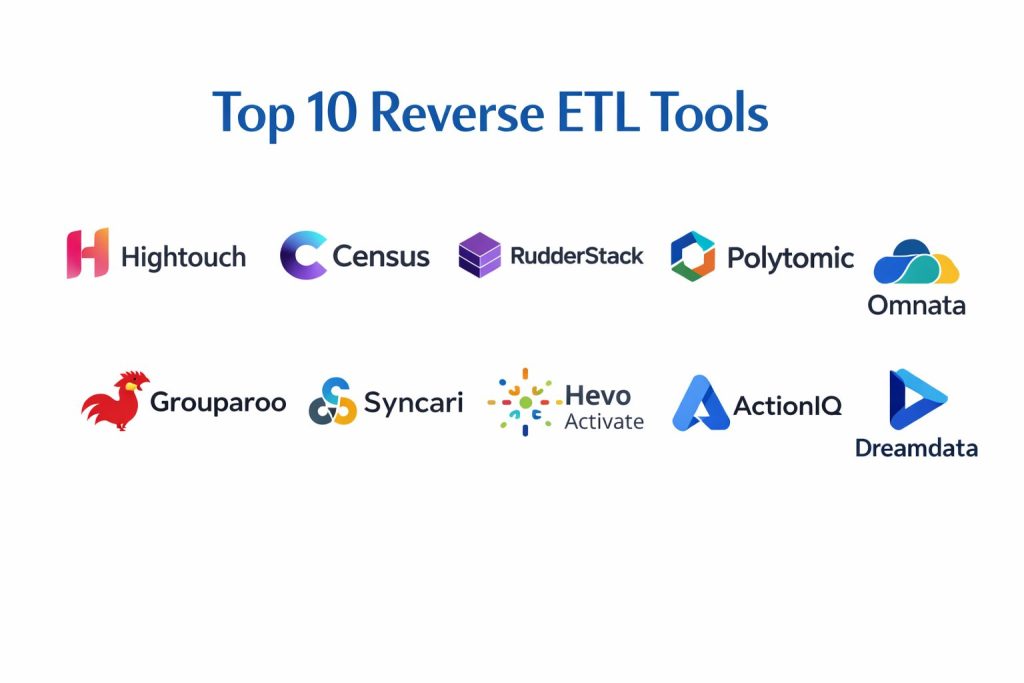
Top 10 Reverse ETL Tools
1 — Hightouch
A Reverse ETL platform focused on pushing warehouse data into business tools with strong mapping, sync controls, and activation workflows. It is commonly used for CRM enrichment, lifecycle audiences, and operational segmentation.
Key Features
- Warehouse-to-destination syncs with configurable schedules
- Flexible field mapping and transformation patterns
- Audience and segment syncing for marketing and ad tools
- Sync monitoring with error visibility and retries
- Identity and matching rules for operational consistency
Pros
- Strong warehouse-first approach and activation focus
- Good balance of usability and operational depth
Cons
- Some advanced governance needs may require additional process design
- Connector behavior can vary by destination, requiring testing
Platforms / Deployment
Web, Cloud
Security and Compliance
Not publicly stated
Integrations and Ecosystem
Hightouch typically connects your warehouse models to downstream tools where teams take action. It fits well when your organization already trusts warehouse tables as the canonical source.
- Common destinations include CRM, marketing automation, and ad platforms
- Field mapping patterns support lifecycle and segmentation workflows
- Works best with clean warehouse models and consistent identifiers
Support and Community
Strong documentation and onboarding guidance; support tiers vary.
2 — Census
A Reverse ETL tool designed to operationalize warehouse data by syncing modeled tables into business systems. It is frequently used for sales ops, marketing ops, and customer success activation.
Key Features
- Destination-focused mappings for operational systems
- Sync scheduling with incremental update patterns
- Field-level mapping controls and validation checks
- Operational workflows for audiences and enrichment fields
- Monitoring and failure handling for production syncs
Pros
- Strong fit for CRM and go-to-market activation workflows
- Good connector depth for common business destinations
Cons
- Requires well-defined warehouse models for best outcomes
- Some complex matching logic may need careful setup
Platforms / Deployment
Web, Cloud
Security and Compliance
Not publicly stated
Integrations and Ecosystem
Census fits best when teams want a structured approach to pushing warehouse truth into many downstream tools without rewriting logic inside each tool.
- Common usage: CRM field enrichment and lifecycle stage updates
- Mapping frameworks support consistent operational definitions
- Works well alongside warehouse modeling practices
Support and Community
Strong documentation and onboarding; community visibility varies.
3 — RudderStack
A data pipeline platform that includes warehouse activation capabilities, often positioned as part of a broader customer data and event pipeline approach. It can work well for teams combining event tracking with activation.
Key Features
- Warehouse and event pipeline orientation
- Activation patterns to push data into downstream tools
- Flexible routing and transformation options
- Real-time or near-real-time patterns depending on setup
- Strong developer and pipeline customization options
Pros
- Useful when you want both event pipeline and activation in one ecosystem
- Flexible for technical teams building custom workflows
Cons
- Can feel heavier than a pure Reverse ETL specialist if you only need activation
- Best results often require more technical ownership
Platforms / Deployment
Web, Cloud, Self-hosted, Hybrid
Security and Compliance
Not publicly stated
Integrations and Ecosystem
RudderStack is often selected when teams want a unified data movement approach: collect, route, model, and activate. This can reduce tool sprawl if you are already using it for pipeline needs.
- Common destinations include analytics, marketing, and product tools
- Supports data routing patterns suited to event-driven use cases
- Works best with clear ownership of data contracts and identifiers
Support and Community
Developer-focused documentation; community strength is generally solid; support tiers vary.
4 — Polytomic
A Reverse ETL platform focused on syncing warehouse data into operational tools, with attention to mapping usability, monitoring, and destination coverage. It is often used for marketing and sales activation.
Key Features
- Warehouse model syncing into operational tools
- Practical mapping UI for business-friendly workflows
- Sync monitoring and error visibility
- Segment and audience activation patterns
- Support for common go-to-market destinations
Pros
- Good fit for go-to-market activation use cases
- Mapping experience can be approachable for mixed teams
Cons
- Connector capabilities can differ by destination, requiring validation
- Advanced governance needs may require layered processes
Platforms / Deployment
Web, Cloud
Security and Compliance
Not publicly stated
Integrations and Ecosystem
Polytomic is typically used to operationalize warehouse-defined segments and attributes into systems where campaigns and outreach happen.
- Common use: audience syncing and enrichment updates
- Works best with consistent keys and stable model definitions
- Supports operational workflows across multiple tools
Support and Community
Documentation and support depend on plan; community visibility varies.
5 — Omnata
An activation-focused Reverse ETL tool that aims to help teams sync trusted warehouse data into downstream systems with practical controls and operational reliability.
Key Features
- Warehouse-to-destination data activation
- Field mapping and sync scheduling controls
- Monitoring and visibility for operational syncs
- Support for common destinations across go-to-market stacks
- Practical workflows for segmentation and enrichment
Pros
- Focused on activation outcomes and operational workflows
- Useful for teams that want straightforward syncing patterns
Cons
- Connector depth should be validated for your exact destinations
- Some advanced enterprise governance may require extra layers
Platforms / Deployment
Web, Cloud
Security and Compliance
Not publicly stated
Integrations and Ecosystem
Omnata is typically selected to connect modeled warehouse outputs into business tools with predictable updates and clear operational intent.
- Works well for enrichment and audience delivery
- Best results come from well-modeled warehouse tables
- Supports activation into common sales and marketing tools
Support and Community
Support tiers vary; documentation quality may vary by feature area.
6 — Grouparoo
A Reverse ETL option that is commonly recognized for self-hosted control and warehouse-to-destination syncing, often appealing to teams that want more ownership of execution and deployment.
Key Features
- Self-hosted control options for tighter governance
- Warehouse-centric syncing into operational destinations
- Flexible configuration patterns for segments and fields
- Developer-friendly customization approach
- Useful for teams with strong internal platform ownership
Pros
- Strong fit for teams that want self-hosted control
- Attractive for engineering-led data activation workflows
Cons
- Requires more technical ownership than many cloud-only tools
- Operational overhead can be higher depending on deployment
Platforms / Deployment
Web, Self-hosted, Hybrid
Security and Compliance
Not publicly stated
Integrations and Ecosystem
Grouparoo is generally chosen when a team wants warehouse-first activation but prefers hosting and control within their own environment.
- Useful for teams with strict data handling requirements
- Works well when engineering can own deployment and upgrades
- Integrations depend on chosen connectors and configuration
Support and Community
Community-driven support may be stronger than formal enterprise support; documentation quality varies by version.
7 — Syncari
A platform focused on data automation and operational data management, often used to keep customer and account data consistent across systems. It can serve Reverse ETL-like needs through syncing and data management workflows.
Key Features
- Operational data management and syncing workflows
- Field standardization and lifecycle automation patterns
- Matching and deduplication style workflows (varies by setup)
- Monitoring and workflow controls for operational reliability
- Useful for go-to-market data consistency programs
Pros
- Good fit for go-to-market ops teams focused on data consistency
- Can reduce fragmentation across CRM and related tools
Cons
- Not always a pure warehouse-first Reverse ETL posture depending on approach
- Requires careful data ownership decisions across systems
Platforms / Deployment
Web, Cloud
Security and Compliance
Not publicly stated
Integrations and Ecosystem
Syncari is typically used to keep operational systems aligned, which can complement warehouse activation when you need consistency beyond one-way pushes.
- Useful for lifecycle field consistency across tools
- Often used alongside CRM-centric workflows
- Best results come from clear source-of-truth decisions
Support and Community
Support tiers vary; onboarding often benefits from defined workflows and governance.
8 — Hevo Activate
An activation capability associated with broader data movement approaches, often positioned to help teams push warehouse-modeled data into business destinations for operational use.
Key Features
- Activation workflows from warehouse outputs
- Common destination syncing for go-to-market stacks
- Scheduling and incremental patterns (varies by setup)
- Monitoring and visibility for operational syncs
- Useful for teams already using the broader ecosystem
Pros
- Convenient if you want activation near existing data movement workflows
- Practical for standard warehouse-to-tool sync needs
Cons
- Feature depth and connector behavior should be validated per destination
- Advanced governance may require additional controls
Platforms / Deployment
Web, Cloud
Security and Compliance
Not publicly stated
Integrations and Ecosystem
Hevo Activate can fit organizations that want fewer moving parts across ingestion, transformation habits, and activation, as long as the connectors meet your target needs.
- Often used for enrichment and segment syncing
- Works best with stable warehouse models and identifiers
- Destination-specific behavior should be tested early
Support and Community
Support tiers vary; documentation and onboarding experience can vary by workflow.
9 — ActionIQ
An enterprise-focused customer data and activation platform often used for audience management and orchestration, enabling operational activation of customer data into downstream systems.
Key Features
- Enterprise-grade audience management workflows
- Activation into marketing and engagement destinations
- Governance and operational controls suited to larger teams
- Identity and segmentation workflows (varies by configuration)
- Designed for scaled customer activation programs
Pros
- Strong fit for enterprise audience activation programs
- Useful for organizations with complex segmentation needs
Cons
- May be heavier than needed for smaller teams
- Implementation effort can be higher depending on scope
Platforms / Deployment
Web, Cloud
Security and Compliance
Not publicly stated
Integrations and Ecosystem
ActionIQ commonly supports activation programs where marketing and engagement teams need controlled, repeatable segmentation delivered into multiple channels.
- Strong for audience workflows and orchestration patterns
- Works best with defined governance and ownership
- Integrations depend on destination priorities and configuration
Support and Community
Enterprise-oriented support approach; community visibility varies.
10 — Dreamdata
A revenue and marketing data platform often used to unify customer journey and revenue signals, with activation-oriented workflows that can support warehouse-to-tool syncing and audience actions.
Key Features
- Revenue and journey data consolidation patterns
- Activation and audience workflows for go-to-market use
- Practical marketing ops and attribution-style support (varies)
- Data consistency workflows across key tools
- Useful for teams aligning marketing, sales, and revenue signals
Pros
- Strong fit for revenue-focused teams needing consistent signals
- Can help operationalize unified customer journey data
Cons
- Not always positioned as a pure Reverse ETL specialist
- Feature fit depends on your revenue data scope and destinations
Platforms / Deployment
Web, Cloud
Security and Compliance
Not publicly stated
Integrations and Ecosystem
Dreamdata is often used where teams want a more unified picture of revenue and marketing journeys and then push consistent signals into downstream systems.
- Useful for revenue operations and marketing workflows
- Works best with agreed customer/account identifiers
- Destination coverage should be verified for your stack
Support and Community
Support tiers vary; onboarding often benefits from clear revenue data definitions.
Comparison Table
| Tool Name | Best For | Platform(s) Supported | Deployment | Standout Feature | Public Rating |
|---|---|---|---|---|---|
| Hightouch | Warehouse-first activation and CRM enrichment | Web | Cloud | Flexible mappings and activation workflows | N/A |
| Census | Operational syncs into go-to-market systems | Web | Cloud | Strong destination mapping patterns | N/A |
| RudderStack | Teams combining event pipelines and activation | Web | Cloud, Self-hosted, Hybrid | Pipeline flexibility with activation options | N/A |
| Polytomic | Go-to-market segmentation and audience syncing | Web | Cloud | Practical sync and mapping workflows | N/A |
| Omnata | Straightforward warehouse-to-tool activation | Web | Cloud | Activation-focused operational syncing | N/A |
| Grouparoo | Self-hosted Reverse ETL control | Web | Self-hosted, Hybrid | Self-hosted ownership for activation | N/A |
| Syncari | Operational data consistency across systems | Web | Cloud | Data automation for go-to-market consistency | N/A |
| Hevo Activate | Activation near broader data movement workflows | Web | Cloud | Convenient activation in a broader ecosystem | N/A |
| ActionIQ | Enterprise audience management and orchestration | Web | Cloud | Enterprise-grade segmentation and activation | N/A |
| Dreamdata | Revenue-focused signal unification and activation | Web | Cloud | Revenue journey signals for activation | N/A |
Evaluation and Scoring of Reverse ETL Tools
Weights
Core features 25 percent
Ease of use 15 percent
Integrations and ecosystem 15 percent
Security and compliance 10 percent
Performance and reliability 10 percent
Support and community 10 percent
Price and value 15 percent
| Tool Name | Core | Ease | Integrations | Security | Performance | Support | Value | Weighted Total |
|---|---|---|---|---|---|---|---|---|
| Hightouch | 9 | 8 | 9 | 7 | 8 | 8 | 7 | 8.15 |
| Census | 9 | 8 | 8 | 7 | 8 | 8 | 7 | 8.00 |
| RudderStack | 8 | 7 | 9 | 7 | 8 | 8 | 8 | 7.85 |
| Polytomic | 8 | 8 | 8 | 6 | 7 | 7 | 7 | 7.55 |
| Omnata | 7 | 8 | 7 | 6 | 7 | 7 | 8 | 7.30 |
| Grouparoo | 7 | 6 | 7 | 7 | 7 | 6 | 8 | 6.95 |
| Syncari | 7 | 7 | 8 | 6 | 7 | 7 | 7 | 7.05 |
| Hevo Activate | 7 | 8 | 7 | 6 | 7 | 7 | 8 | 7.30 |
| ActionIQ | 8 | 6 | 8 | 7 | 8 | 7 | 6 | 7.25 |
| Dreamdata | 7 | 7 | 7 | 6 | 7 | 7 | 7 | 6.95 |
How to interpret the scores
These scores are comparative and designed to help you shortlist tools for your needs. A lower total can still be the best choice if it matches your workflow, destinations, and operating model. Core features and integrations usually drive long-term success, while ease affects onboarding speed and adoption. Security is marked conservatively because public compliance details vary; validate directly with vendors. Use this table to narrow down options, then run a small pilot sync with real data.
Which Reverse ETL Tool Is Right for You
Solo or Freelancer
If you are a solo operator, the best choice is usually the one with the fastest setup and the fewest moving parts. Look for strong destination coverage, clear mapping, and predictable sync behavior. If you do not need enterprise governance, prioritize ease, value, and simple monitoring so you can fix issues quickly.
SMB
SMB teams often need reliable CRM enrichment, lifecycle updates, and audience syncing without creating a heavy data platform project. Choose tools that make identity matching and incremental syncs easy, with good monitoring. Also prioritize support responsiveness because SMB teams typically cannot afford long troubleshooting cycles.
Mid-Market
Mid-market teams need stronger governance and repeatability. Look for tools with better sync previews, rollback or replay options, and consistent mapping practices across destinations. This is where connector depth matters more than connector count, especially for CRM objects and ad platforms.
Enterprise
Enterprises should prioritize governance, auditability, and operational safety. You want clear controls around what fields can be written, approvals for sensitive mappings, and strong monitoring. Also consider how the tool fits into your broader data program: source-of-truth decisions, identity resolution, and cross-team ownership.
Budget vs Premium
Budget-focused teams should prioritize value and speed while keeping the scope tight. Premium choices are usually justified when the cost of bad data in downstream systems is high, or when multiple teams rely on consistent activation across many destinations.
Feature Depth vs Ease of Use
If you have a strong data team and want deep control, prioritize tools with flexible mappings, robust monitoring, and governance controls. If you need quick adoption by ops teams, prioritize simple setup, clear error messages, and easy-to-maintain workflows.
Integrations and Scalability
If your destination set is large or complex, validate connector depth early with a real pilot. Test how the tool handles upserts, deletes, partial failures, and rate limits. Scalability is less about raw speed and more about predictable operations under pressure.
Security and Compliance Needs
Most Reverse ETL outcomes depend on operational safety: who can write to CRM fields, how changes are audited, and how secrets and credentials are managed. If compliance is important, require clear documentation of access controls, logging expectations, and governance workflows. If details are unclear publicly, treat them as not publicly stated and validate directly.
Frequently Asked Questions
1. What is Reverse ETL in simple terms
Reverse ETL takes curated warehouse data and syncs it into business tools like CRM and marketing platforms. This helps teams act on consistent attributes and segments instead of rebuilding logic inside each tool.
2. How is Reverse ETL different from ETL
ETL moves data into a warehouse for analytics and reporting. Reverse ETL moves the trusted warehouse outputs back into operational systems so teams can use that data for actions and workflows.
3. What data should be synced first
Start with high-impact fields that improve daily workflows, like lifecycle stage, customer tier, health score, last activity date, and a small set of reliable segments. Avoid syncing too many fields until reliability is proven.
4. What are common mistakes teams make
Common mistakes include using unstable identifiers, syncing fields without ownership rules, and skipping monitoring. Another mistake is pushing incomplete data into CRM fields that sales teams rely on.
5. How do I handle identity matching
Define a primary key strategy, such as email, account ID, or a customer ID, and apply consistent matching rules. If your data has duplicates, fix the upstream model before scaling activation.
6. How often should syncs run
Run syncs as often as your business needs without creating operational noise. Many teams start with daily or hourly schedules, then increase frequency for high-value workflows after stability is confirmed.
7. What should I look for in monitoring
You want clear visibility into what changed, what failed, why it failed, and how to retry safely. Alerts and replay options matter more than a pretty dashboard when production issues happen.
8. Can Reverse ETL write back into CRM safely
Yes, but only with strong governance. Use controlled write permissions, limit the fields you write, document ownership, and ensure there is a rollback plan for mistakes or model changes.
9. How do I pilot a Reverse ETL tool
Choose one destination, one object, and a small set of fields. Run a pilot sync using real warehouse data, validate matching accuracy, test failure handling, and confirm that business users trust the results.
10. When should I consider self-hosted options
Consider self-hosted when data handling requirements are strict, when you need deeper infrastructure control, or when your organization prefers to own deployment and upgrades. Be ready for additional operational overhead.
Conclusion
Reverse ETL works best when you treat your warehouse as the single source of truth and use activation as a controlled delivery mechanism into business tools. The right tool depends on your destinations, your identity strategy, and how much governance you need around writes into systems like CRM and marketing platforms. Start by modeling clean customer and account tables, then activate only a few high-impact fields and segments. Run a pilot with real data, validate matching accuracy, and confirm that error handling is predictable. Once reliability is proven, scale to more destinations and workflows with clear ownership rules, monitoring, and change control so downstream teams can trust the data every day.