Introduction
Revenue recognition software helps finance teams record revenue correctly across contracts, subscriptions, milestones, and usage-based billing. Instead of manually managing spreadsheets, the software automates how revenue is scheduled, allocated, and recognized over time based on your accounting policy and contract terms. This matters because even small errors can create audit issues, delay closing, and reduce trust in financial reporting. It is especially important for subscription businesses, SaaS, services companies, marketplaces, and any firm handling complex customer contracts.
Common use cases include subscription revenue scheduling, contract modifications and renewals, multi-element arrangements, usage-based revenue recognition, and month-end close automation. When selecting a tool, buyers should evaluate rules and policy flexibility, contract handling, automation depth, audit trail quality, integrations with billing and ERP, reporting readiness, close acceleration, multi-entity support, scalability, and implementation effort.
Best for: finance teams, controllers, revenue accountants, and CFO organizations handling subscription or contract-driven revenue.
Not ideal for: very small businesses with simple invoicing and one-time sales where basic accounting rules cover the full need.
Key Trends in Revenue Recognition Software
- More companies are moving from spreadsheets to policy-driven automation to speed up monthly close.
- Subscription and usage-based billing are increasing the need for flexible allocation and recognition rules.
- Finance teams want stronger audit trails, change logs, and workflow approvals to reduce compliance risk.
- Integration quality is becoming a top priority because revenue data touches billing, CRM, ERP, and data warehouses.
- Multi-entity, multi-currency, and consolidated reporting needs are growing for global operations.
- Finance leaders are asking for better forecasting visibility across deferred revenue and upcoming recognition.
- Increasing demand for self-serve reporting dashboards built for finance, not only technical teams.
- More focus on controls: role-based access, segregation of duties, and repeatable close checklists.
How We Selected These Tools (Methodology)
- Focused on tools widely adopted by subscription, services, and enterprise finance teams.
- Selected solutions that support complex contracts, allocations, and change handling.
- Prioritized tools with strong automation for schedules, adjustments, and close workflows.
- Considered ecosystem fit with billing systems, ERPs, CRMs, and finance reporting workflows.
- Included a mix of enterprise-grade systems and modern billing-first platforms with rev rec modules.
- Looked for operational practicality: reporting quality, audit trails, and ease of adoption.
- Balanced feature depth with cost and implementation complexity for different business sizes.
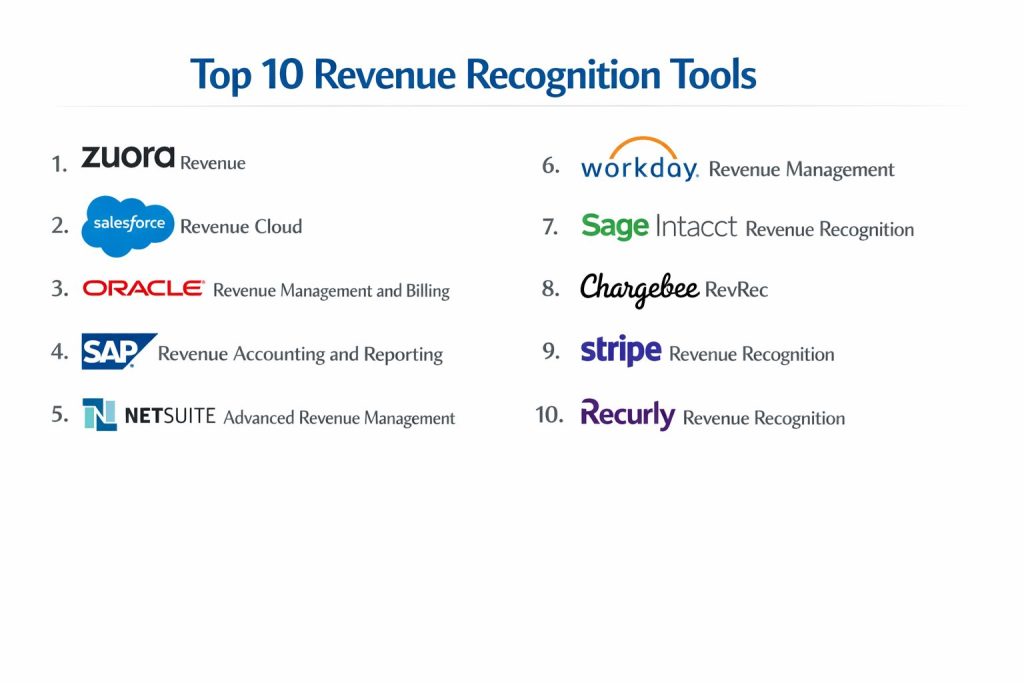
Top 10 Revenue Recognition Software Tools
1 — Zuora Revenue
A specialized revenue automation platform designed for subscription and complex contract businesses that need strong controls and policy flexibility.
Key Features
- Automated revenue schedules based on configurable policies
- Contract modifications, renewals, and proration handling
- Multi-element arrangements and allocation logic
- Strong audit trail with revenue event tracking
- Close support through approvals and workflow controls
Pros
- Strong fit for subscription-heavy and complex contract environments
- Good control and audit readiness for revenue teams
Cons
- Implementation can be heavy for smaller teams
- Requires clean upstream billing and contract data
Platforms / Deployment
Varies / N/A
Security and Compliance
Not publicly stated
Integrations and Ecosystem
Works best when tightly aligned with billing and ERP processes to reduce manual reconciliation.
- ERP integrations to streamline posting and close steps
- Billing data feeds to keep schedules accurate
- Reporting exports for BI and finance analytics
Support and Community
Varies / Not publicly stated
2 — Salesforce Revenue Cloud
A revenue platform connected to sales processes, often used by teams that want stronger alignment between quoting, contracting, billing, and revenue workflows.
Key Features
- Quote-to-cash workflow alignment with sales processes
- Contract lifecycle and amendment handling
- Structured product and pricing rules to reduce billing errors
- Workflow-driven approvals for revenue-impacting changes
- Reporting support for revenue visibility across systems
Pros
- Strong alignment between sales and finance workflows
- Good fit for teams already standardized on Salesforce
Cons
- Can be complex to configure across multiple product models
- Total cost and implementation effort can be high
Platforms / Deployment
Varies / N/A
Security and Compliance
Not publicly stated
Integrations and Ecosystem
Often used as part of a broader business stack that includes CRM, billing, and ERP posting.
- Works with common finance systems via connectors and integration tooling
- Strong ecosystem for workflow automation and extensions
- Best results require consistent product catalog governance
Support and Community
Strong ecosystem presence; support tiers vary.
3 — Oracle Revenue Management and Billing
An enterprise-grade solution designed for organizations that require strong rules, governance, and scale for high-volume revenue operations.
Key Features
- Rules-based revenue scheduling and allocation
- Strong support for complex contracts and adjustments
- Governance controls for approvals and revenue event history
- Enterprise reporting readiness for finance operations
- Multi-entity and global operational support
Pros
- Strong fit for large enterprises with complex revenue needs
- Good governance posture for regulated environments
Cons
- Implementation can be long and resource-heavy
- May be more than smaller teams need
Platforms / Deployment
Varies / N/A
Security and Compliance
Not publicly stated
Integrations and Ecosystem
Typically fits best when Oracle ERP and related finance tools are part of the environment.
- Strong alignment with enterprise finance workflows
- Integration projects often require expert setup
- Works best with consistent master data standards
Support and Community
Varies / Not publicly stated
4 — SAP Revenue Accounting and Reporting
A revenue accounting solution designed for policy-driven revenue recognition and enterprise controls, commonly used by larger organizations.
Key Features
- Policy-based revenue recognition logic and controls
- Contract change handling and revenue event tracking
- Strong audit and compliance support through traceability
- Designed for enterprise close and reporting processes
- Works well in structured ERP environments
Pros
- Strong control framework for enterprise finance teams
- Good fit where standardized ERP governance is important
Cons
- Setup complexity can be high
- Requires disciplined data and process governance
Platforms / Deployment
Varies / N/A
Security and Compliance
Not publicly stated
Integrations and Ecosystem
Often adopted where SAP finance environments and structured reporting are central.
- ERP-driven workflow alignment
- Clear audit traceability expectations
- Integration effort depends on existing SAP landscape
Support and Community
Varies / Not publicly stated
5 — NetSuite Advanced Revenue Management
A revenue recognition module designed for organizations using NetSuite that need automated schedules, allocations, and revenue reporting workflows.
Key Features
- Automated revenue schedules from sales and billing events
- Handling for multi-element arrangements and allocations
- Contract change workflows to adjust schedules cleanly
- Reporting support for deferred and recognized revenue
- Close assistance through structured postings
Pros
- Strong fit for organizations already on NetSuite
- Reduces spreadsheet dependency for rev rec schedules
Cons
- Works best when upstream order and item data is clean
- Complex contracts may require careful configuration
Platforms / Deployment
Varies / N/A
Security and Compliance
Not publicly stated
Integrations and Ecosystem
Best for teams standardizing on NetSuite as the finance system of record.
- Tight fit with ERP processes and postings
- Reporting depends on how well items and contracts are structured
- Works well with consistent close checklists and controls
Support and Community
Varies / Not publicly stated
6 — Workday Revenue Management
A revenue management solution designed for organizations that want revenue recognition aligned with enterprise finance operations and reporting discipline.
Key Features
- Revenue policy setup with structured business rules
- Workflow controls for approvals and audit traceability
- Contract change handling and schedule adjustments
- Support for enterprise reporting and finance governance
- Scales for multi-entity operations
Pros
- Strong fit for enterprises that want standardized finance workflows
- Helpful governance patterns for audit readiness
Cons
- Implementation and change management can be significant
- May be more complex than mid-sized teams require
Platforms / Deployment
Varies / N/A
Security and Compliance
Not publicly stated
Integrations and Ecosystem
Often used where Workday finance is central and revenue needs to align with broader reporting processes.
- Works best with consistent business process configuration
- Integration projects require careful data mapping
- Strong fit for structured finance environments
Support and Community
Varies / Not publicly stated
7 — Sage Intacct Revenue Recognition
A revenue module designed for finance teams that need straightforward automation, clear schedules, and clean reporting inside an accounting platform.
Key Features
- Automated schedules and recognition rules
- Handling for common subscription and services revenue patterns
- Clear reporting on deferred and recognized revenue
- Practical workflows to support close consistency
- Designed for finance usability and control
Pros
- Often easier to adopt than heavier enterprise suites
- Good fit for mid-sized finance teams that need structure
Cons
- Extremely complex contract models may need deeper tools
- Integration depth depends on surrounding systems
Platforms / Deployment
Varies / N/A
Security and Compliance
Not publicly stated
Integrations and Ecosystem
Best results come when billing and invoicing data is consistent and mapped cleanly into finance workflows.
- Connectors with common billing and payment systems vary
- Reporting readiness improves with structured item and contract data
- Good fit for finance-led operational processes
Support and Community
Varies / Not publicly stated
8 — Chargebee RevRec
A revenue recognition solution designed for subscription businesses that want revenue schedules closely tied to subscription billing and changes.
Key Features
- Revenue schedules aligned with subscription events
- Handling for upgrades, downgrades, renewals, and proration
- Automated adjustments for changes over time
- Reporting views for deferred and recognized revenue
- Workflow patterns for close consistency
Pros
- Strong for subscription businesses using Chargebee billing
- Helps reduce manual rev rec effort during rapid growth
Cons
- Best fit when Chargebee is your billing foundation
- Complex non-subscription contracts may require additional support
Platforms / Deployment
Varies / N/A
Security and Compliance
Not publicly stated
Integrations and Ecosystem
Works best when subscription lifecycle data is clean and connected to the accounting system reliably.
- Billing-to-finance alignment reduces reconciliation work
- ERP integration quality affects close speed
- Stronger outcomes with standardized product catalogs
Support and Community
Varies / Not publicly stated
9 — Stripe Revenue Recognition
A revenue recognition capability designed to help teams recognize revenue based on billing events and timing logic, especially where Stripe is central to payments.
Key Features
- Revenue schedules based on invoice timing and rules
- Automation for recurring billing recognition patterns
- Practical reporting for deferred and recognized revenue
- Designed to reduce spreadsheets for standard use cases
- Works best for straightforward recurring revenue models
Pros
- Helpful for teams already operating heavily on Stripe
- Simple workflows for common subscription scenarios
Cons
- Highly complex contract accounting may need specialized tools
- Fit depends on how billing and invoicing is structured
Platforms / Deployment
Varies / N/A
Security and Compliance
Not publicly stated
Integrations and Ecosystem
Most effective when Stripe billing and finance workflows are aligned and reconciled consistently.
- Works with accounting stacks through integration patterns that vary
- Best with consistent subscription and invoice setup
- Reporting needs may expand as contracts become more complex
Support and Community
Varies / Not publicly stated
10 — Recurly Revenue Recognition
A revenue recognition capability designed for subscription businesses using Recurly that need clean revenue schedules connected to subscription changes.
Key Features
- Subscription-driven revenue schedules and adjustments
- Handling for plan changes, renewals, and proration
- Reporting support for revenue timing and deferrals
- Practical workflow patterns for finance teams
- Designed to reduce manual corrections for subscription events
Pros
- Strong fit for Recurly-based subscription billing teams
- Helps improve accuracy during subscription change volume
Cons
- Best value depends on being standardized on Recurly billing
- Complex multi-product contract accounting may need deeper tools
Platforms / Deployment
Varies / N/A
Security and Compliance
Not publicly stated
Integrations and Ecosystem
Works best when subscription configuration is consistent and finance mappings are standardized.
- Clean subscription data improves schedule accuracy
- Accounting integration impacts close performance
- Stronger results with controlled product catalog governance
Support and Community
Varies / Not publicly stated
Comparison Table
| Tool Name | Best For | Platform(s) Supported | Deployment | Standout Feature | Public Rating |
|---|---|---|---|---|---|
| Zuora Revenue | Subscription and complex contracts | Varies / N/A | Varies / N/A | Strong policy control and automation | N/A |
| Salesforce Revenue Cloud | Quote-to-cash aligned revenue workflows | Varies / N/A | Varies / N/A | Sales and finance workflow alignment | N/A |
| Oracle Revenue Management and Billing | Enterprise-scale revenue operations | Varies / N/A | Varies / N/A | Governance at high volume | N/A |
| SAP Revenue Accounting and Reporting | Policy-driven enterprise rev rec | Varies / N/A | Varies / N/A | Audit traceability and controls | N/A |
| NetSuite Advanced Revenue Management | NetSuite-based finance teams | Varies / N/A | Varies / N/A | ERP-native rev rec automation | N/A |
| Workday Revenue Management | Workday-standardized enterprises | Varies / N/A | Varies / N/A | Enterprise finance process alignment | N/A |
| Sage Intacct Revenue Recognition | Mid-sized finance teams | Varies / N/A | Varies / N/A | Practical schedules and reporting | N/A |
| Chargebee RevRec | Chargebee subscription billing teams | Varies / N/A | Varies / N/A | Subscription event-driven revenue | N/A |
| Stripe Revenue Recognition | Stripe-centric billing teams | Varies / N/A | Varies / N/A | Simple automation for recurring revenue | N/A |
| Recurly Revenue Recognition | Recurly subscription billing teams | Varies / N/A | Varies / N/A | Subscription change handling | N/A |
Evaluation and Scoring of Revenue Recognition Software
Weights
Core features 25 percent
Ease of use 15 percent
Integrations and ecosystem 15 percent
Security and compliance 10 percent
Performance and reliability 10 percent
Support and community 10 percent
Price and value 15 percent
| Tool Name | Core | Ease | Integrations | Security | Performance | Support | Value | Weighted Total |
|---|---|---|---|---|---|---|---|---|
| Zuora Revenue | 9.0 | 7.0 | 8.5 | 6.5 | 8.0 | 7.5 | 6.5 | 7.92 |
| Salesforce Revenue Cloud | 8.5 | 7.0 | 8.5 | 6.5 | 7.5 | 7.5 | 6.0 | 7.60 |
| Oracle Revenue Management and Billing | 9.0 | 6.5 | 8.0 | 7.0 | 8.0 | 7.0 | 5.5 | 7.58 |
| SAP Revenue Accounting and Reporting | 8.8 | 6.5 | 7.8 | 7.0 | 7.8 | 7.0 | 5.5 | 7.46 |
| NetSuite Advanced Revenue Management | 8.0 | 7.5 | 7.5 | 6.5 | 7.5 | 7.0 | 7.0 | 7.53 |
| Workday Revenue Management | 8.5 | 6.5 | 7.8 | 7.0 | 7.8 | 7.0 | 5.8 | 7.34 |
| Sage Intacct Revenue Recognition | 7.5 | 8.0 | 7.0 | 6.5 | 7.2 | 7.0 | 7.8 | 7.43 |
| Chargebee RevRec | 7.8 | 8.0 | 7.5 | 6.0 | 7.5 | 7.0 | 7.5 | 7.55 |
| Stripe Revenue Recognition | 7.0 | 8.5 | 7.5 | 6.0 | 7.5 | 7.0 | 8.0 | 7.45 |
| Recurly Revenue Recognition | 7.2 | 8.0 | 7.2 | 6.0 | 7.2 | 6.8 | 7.5 | 7.22 |
How to interpret the scores
These scores are comparative and help you shortlist tools based on typical finance needs. A slightly lower score can still be the best choice if it matches your billing model and contract complexity. Core features and integrations often determine long-term fit, while ease impacts adoption speed. Security and support matter most during audits and close pressure. Value can change based on pricing, team size, and how much automation you actually use.
Which Revenue Recognition Software Tool Is Right for You
Solo or Freelancer
If you are a small operation with simple recurring invoices, lighter revenue recognition capabilities inside your accounting stack may be enough. Choose tools that reduce spreadsheet work without forcing heavy implementation. If your contracts are straightforward, prioritize ease and value.
SMB
For subscription-driven SMBs, billing-aligned tools like Chargebee RevRec or Recurly Revenue Recognition can reduce manual adjustments during upgrades and renewals. If you want accounting-led workflows, Sage Intacct Revenue Recognition can be a practical fit for structured close needs.
Mid-Market
Mid-market teams often face contract changes, multiple products, and scaling close cycles. NetSuite Advanced Revenue Management can work well for teams standardized on NetSuite. Zuora Revenue can be a strong choice when subscription complexity and allocations are central.
Enterprise
Large enterprises usually need governance, auditability, and multi-entity controls. Oracle Revenue Management and Billing, SAP Revenue Accounting and Reporting, and Workday Revenue Management often fit when finance processes and controls must remain consistent across business units.
Budget vs Premium
Budget-focused teams should prioritize tools that reduce manual work quickly with minimal setup, especially when contracts are not overly complex. Premium platforms tend to deliver more policy depth, more automation, and stronger governance, but they also require longer implementation.
Feature Depth vs Ease of Use
Zuora Revenue and enterprise suites lean toward depth and control. Billing-aligned tools often feel easier to adopt for subscription workflows. The best fit depends on whether finance needs strict policy control or fast operational simplicity.
Integrations and Scalability
If your billing system is the source of truth, choose a tool that connects cleanly to it and your ERP. If your ERP is the center, choose an ERP-native or enterprise-aligned module. Scalability improves when contract data is consistent and product catalogs are governed.
Security and Compliance Needs
Security details are often not publicly stated for every module, so treat compliance as something to validate during vendor review. Focus on role-based access, audit trails, approvals, and traceability of every revenue-impacting change.
Frequently Asked Questions
1. What problems does revenue recognition software solve
It automates revenue schedules, reduces spreadsheet work, and improves accuracy during contract changes. It also helps teams close faster with clearer reporting and audit trails.
2. Can these tools handle subscription upgrades and downgrades
Many can, but the quality depends on how well the tool models subscription events and proration. Always test plan changes and amendments during a pilot.
3. Do I need a separate rev rec tool if I already have an ERP
Not always. Some ERPs include rev rec modules that meet common needs. A separate tool becomes valuable when contracts, allocations, and changes become complex.
4. What is the biggest implementation risk
Poor upstream data quality. If product catalogs, invoices, and contract terms are inconsistent, automation becomes unreliable and manual corrections increase.
5. How do these tools support audit readiness
They typically help with traceability, revenue event logs, and consistent policy application. The strength of audit reporting varies, so validate it with real scenarios.
6. What is the best way to shortlist tools
Start by mapping your revenue patterns: subscription, usage, services, milestones, and bundles. Then shortlist tools that match those patterns and your ERP or billing foundation.
7. How long does onboarding usually take
It varies based on complexity and data readiness. Simple setups can be faster, while enterprise policy configurations and integrations can take longer.
8. What common mistakes do finance teams make
They skip pilots, underestimate contract edge cases, or fail to standardize product and contract data. Another mistake is not defining who owns revenue rules and approvals.
9. How important are integrations
Very important because rev rec relies on billing, CRM, and ERP data. Weak integrations create reconciliation work and slow the close.
10. When should I choose a billing-aligned rev rec tool
Choose it when subscription events drive most of your revenue complexity and your billing platform is the operational source of truth. It often reduces manual work for subscription changes.
Conclusion
Revenue recognition software is not just an accounting add-on; it becomes a control system for how your business reports revenue and proves accuracy under audit pressure. The best choice depends on contract complexity, billing model, and how your finance stack is organized. Enterprise suites like Oracle, SAP, and Workday tend to fit when governance, multi-entity controls, and standardized processes are mandatory. Tools like Zuora Revenue work well when subscription and allocation logic are complex and finance needs strong policy control. Billing-aligned options such as Chargebee, Stripe, and Recurly can reduce manual work for subscription events if your billing system is well-governed. A practical next step is to shortlist two or three tools, run a small pilot using real contract scenarios, validate integrations, and confirm reporting and audit workflows before committing.