Introduction
Retail category management tools help retailers plan, analyze, and optimize product categories so shelves, assortments, pricing signals, and promotions match what shoppers actually want. In simple terms, these tools turn scattered sales, inventory, loyalty, and market data into clear decisions like what to stock, where to place it, how deep the assortment should be, and how to measure success. They matter because retail margins are tight, shopper behavior changes fast, and omnichannel retail needs one consistent category strategy across stores and digital channels.
Real-world use cases include assortment optimization for stores and regions, space planning and planogram execution, promotion and pricing impact analysis, supplier collaboration and joint business planning, and demand-aware replenishment guidance. When choosing a tool, evaluate assortment and space planning depth, analytics quality, data integration coverage, forecasting accuracy, workflow support for teams, ease of adoption, scalability for many stores, governance and controls, vendor support, and long-term value.
Best for: grocery, fashion, electronics, pharmacy, and multi-store retailers managing complex assortments and supplier relationships.
Not ideal for: very small retailers with limited SKUs who only need basic inventory tracking or simple sales reports.
Key Trends in Retail Category Management Tools
- AI-led assortment recommendations are becoming standard for faster, localized decisions.
- Retailers are linking category plans to real-time inventory and supply constraints.
- Space planning and category analytics are merging into one continuous workflow.
- More “store cluster” strategies are used to tailor assortments by location behavior.
- Omnichannel category planning is expanding to include online search and conversion signals.
- Supplier collaboration workflows are getting stronger to support shared targets and accountability.
- Data quality and governance features are becoming a deciding factor for large retailers.
- Scenario planning is moving from quarterly to continuous, using automated what-if modeling.
How We Selected These Tools (Methodology)
- Focused on tools that support end-to-end category planning and decision workflows.
- Prioritized vendors with strong adoption in retail and consumer goods ecosystems.
- Evaluated assortment and space planning depth, not just dashboards.
- Considered scalability for multi-store operations and large SKU counts.
- Looked for ecosystem fit with POS, ERP, supply chain, and retail data platforms.
- Included a balanced mix of enterprise-grade suites and specialized planning tools.
- Considered practical team adoption factors like workflows, usability, and support.
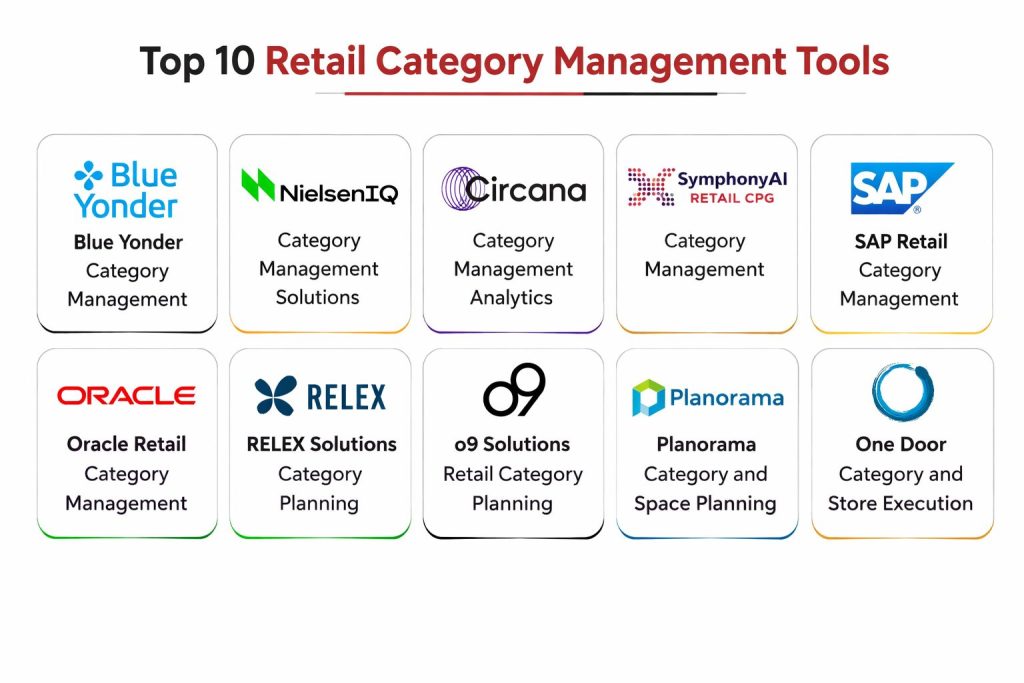
Top 10 Retail Category Management Tools
1 — Blue Yonder Category Management
Built for large retailers that need strong category planning, assortment, and demand-aware decisions tied to supply chain realities.
Key Features
- Category planning workflows for multi-store operations
- Assortment optimization with scenario testing
- Integration-friendly planning for inventory-aware decisions
- Performance analytics for category KPIs
- Scalable planning for large SKU counts
Pros
- Strong for enterprise retail planning complexity
- Good fit when supply and demand must stay aligned
Cons
- Can be heavy to implement and standardize
- Requires strong data foundations to perform well
Platforms / Deployment
Varies / N/A
Security and Compliance
Not publicly stated
Integrations and Ecosystem
Often used with retail planning and supply chain systems to keep category choices realistic and executable.
- Integrations with retail data sources and planning stacks
- Works best with strong master data governance
- Supports enterprise workflow adoption patterns
Support and Community
Varies / Not publicly stated
2 — NielsenIQ Category Management Solutions
Strong for retailers and brands that rely on consumer insights, market measurement, and category performance analysis to drive decisions.
Key Features
- Category performance and market insight analytics
- Shopper and basket behavior analysis support
- Assortment insights using market and internal signals
- Category opportunity identification workflows
- Reporting for supplier collaboration discussions
Pros
- Strong insight depth for category diagnosis
- Useful for retailer and supplier alignment
Cons
- Execution workflows may require pairing with other tools
- Value depends on data access and coverage
Platforms / Deployment
Varies / N/A
Security and Compliance
Not publicly stated
Integrations and Ecosystem
Works best when connected to POS, loyalty, and market measurement data for a fuller view of category performance.
- Commonly paired with retail BI and planning tools
- Supports collaborative planning conversations
- Extensibility depends on chosen modules
Support and Community
Varies / Not publicly stated
3 — Circana Category Management Analytics
Focused on category insights using market intelligence and retail performance signals, helping teams understand what is changing and why.
Key Features
- Market-level category performance analytics
- Assortment and shopper demand insight signals
- Promotional impact analysis for category planning
- Category growth drivers and risk identification
- Practical reporting for business reviews
Pros
- Strong category intelligence for planning decisions
- Helps identify external demand shifts early
Cons
- Execution planning may need additional tools
- Data coverage can vary by market and segment
Platforms / Deployment
Varies / N/A
Security and Compliance
Not publicly stated
Integrations and Ecosystem
Often used alongside internal retail analytics and planning workflows to combine market reality with store-level execution.
- Works with retailer sales and loyalty signals
- Useful for supplier performance discussions
- Integration approach depends on delivery model
Support and Community
Varies / Not publicly stated
4 — SymphonyAI Retail CPG Category Management
Designed for retail and CPG teams that want analytics-driven category decisions with operational alignment and measurable outcomes.
Key Features
- Category performance analytics and KPI tracking
- Assortment and promotion decision support
- Shopper behavior insights for category strategy
- Workflow support for planning and reviews
- Retail and CPG collaboration enablement
Pros
- Practical for teams connecting insights to actions
- Useful for recurring category review cycles
Cons
- Implementation success depends on data readiness
- Feature depth may vary by modules chosen
Platforms / Deployment
Varies / N/A
Security and Compliance
Not publicly stated
Integrations and Ecosystem
Commonly connected to POS, loyalty, and promotional systems to measure the effect of category decisions.
- Integrates with retail data platforms and BI
- Supports recurring planning workflows
- Extensibility depends on configuration
Support and Community
Varies / Not publicly stated
5 — SAP Retail Category Management
A strong fit for retailers already using SAP retail systems who want category decisioning aligned with ERP, supply, and pricing structures.
Key Features
- Category structures aligned to enterprise master data
- Planning workflows tied to retail operations
- Reporting and analytics for category performance
- Governance and control patterns for large orgs
- Integration alignment with SAP ecosystem
Pros
- Strong ecosystem fit for SAP-based retailers
- Helpful for governance-heavy enterprises
Cons
- Can be complex to configure for fast iteration
- Best value often depends on broader SAP footprint
Platforms / Deployment
Varies / N/A
Security and Compliance
Not publicly stated
Integrations and Ecosystem
Works best when category plans connect with ERP, replenishment, and pricing operations so decisions are executable.
- Strong integration posture inside SAP stacks
- Data governance depends on enterprise setup
- Often used with broader retail planning processes
Support and Community
Varies / Not publicly stated
6 — Oracle Retail Category Management
Built for retailers using Oracle retail suites who need structured category processes and planning linked to merchandising operations.
Key Features
- Category planning workflows for merchandising teams
- Assortment support tied to retail master data
- Reporting for category health and KPIs
- Scale for multi-store, large SKU environments
- Alignment with Oracle retail ecosystem modules
Pros
- Strong fit for Oracle-centric retail environments
- Structured workflows for merchandising governance
Cons
- Implementation can be heavy without clear process ownership
- Value increases when paired with broader suite usage
Platforms / Deployment
Varies / N/A
Security and Compliance
Not publicly stated
Integrations and Ecosystem
Often used with merchandising, pricing, and planning components to keep category decisions aligned across the business.
- Strong within-suite integration patterns
- Can connect to retail data sources
- Best results with consistent master data discipline
Support and Community
Varies / Not publicly stated
7 — RELEX Solutions Category Planning
Known for retail planning depth and analytics-driven decision support, especially for assortment and demand-aligned planning.
Key Features
- Assortment planning with scenario modeling
- Demand-aware insights for category decisions
- Tools to manage localized assortments
- Planning workflows for retail teams
- Performance tracking for category outcomes
Pros
- Strong planning logic for multi-store retail
- Good for retailers needing localized strategies
Cons
- Requires data quality and process standardization
- Setup complexity depends on scale and scope
Platforms / Deployment
Varies / N/A
Security and Compliance
Not publicly stated
Integrations and Ecosystem
Often used with POS, inventory, and forecasting data to ensure category choices match supply realities.
- Connects with planning and replenishment processes
- Supports retailer workflows across categories
- Integration depth depends on implementation approach
Support and Community
Varies / Not publicly stated
8 — o9 Solutions Retail Category Planning
A planning platform approach that supports scenario planning and cross-functional alignment, useful when category strategy must connect to supply and finance.
Key Features
- Scenario planning for category and assortment choices
- Cross-functional planning alignment capabilities
- Analytics-driven decision support for category outcomes
- Workflow management for planning cycles
- Scalable modeling for complex retail structures
Pros
- Strong scenario planning for complex decisions
- Useful when many teams must align on outcomes
Cons
- May require skilled teams to configure effectively
- Value depends on planning maturity and adoption
Platforms / Deployment
Varies / N/A
Security and Compliance
Not publicly stated
Integrations and Ecosystem
Often positioned as a planning layer that connects multiple data sources to improve decision speed and alignment.
- Connects to ERP, sales, and supply signals
- Supports multi-team planning workflows
- Integration approach varies by organization
Support and Community
Varies / Not publicly stated
9 — Planorama Category and Space Planning
Focused on space planning and planogram workflows, helping category decisions translate into shelf execution and measurable performance.
Key Features
- Planogram and space planning workflows
- Store-level execution alignment for category plans
- Category analytics tied to shelf outcomes
- Visual planning for assortment placement
- Operational tools for store rollout
Pros
- Strong for turning category strategy into store shelves
- Good fit for retailers emphasizing planogram discipline
Cons
- May require pairing with broader category analytics tools
- Outcomes depend on store execution consistency
Platforms / Deployment
Varies / N/A
Security and Compliance
Not publicly stated
Integrations and Ecosystem
Works best when planograms connect with product, pricing, and store execution data so results can be measured and improved.
- Works with merchandising data and store execution signals
- Supports rollout planning across stores
- Integration depends on retailer systems
Support and Community
Varies / Not publicly stated
10 — One Door Category and Store Execution
Supports category and merchandising execution through store-level workflows, ensuring category strategies are actually implemented in-store.
Key Features
- Store execution workflows for merchandising and category tasks
- Task management and compliance tracking
- Category plan rollout visibility across stores
- Operational reporting for execution consistency
- Supports collaboration between HQ and stores
Pros
- Strong for connecting category plans to store execution
- Helpful for enforcing consistency at scale
Cons
- Category analytics depth may need pairing with other tools
- Adoption depends on store process and change management
Platforms / Deployment
Varies / N/A
Security and Compliance
Not publicly stated
Integrations and Ecosystem
Often used as an execution layer that connects HQ plans to store teams and tracks compliance.
- Integrates with merchandising and store systems
- Supports operational data feedback loops
- Extensibility depends on deployment model
Support and Community
Varies / Not publicly stated
Comparison Table
| Tool Name | Best For | Platform(s) Supported | Deployment | Standout Feature | Public Rating |
|---|---|---|---|---|---|
| Blue Yonder Category Management | Enterprise retail category planning | Varies / N/A | Varies / N/A | Supply-aligned category decisions | N/A |
| NielsenIQ Category Management Solutions | Market insights for category strategy | Varies / N/A | Varies / N/A | Strong consumer and market intelligence | N/A |
| Circana Category Management Analytics | Category intelligence and performance | Varies / N/A | Varies / N/A | Market-driven category trend signals | N/A |
| SymphonyAI Retail CPG Category Management | Insight-to-action category workflows | Varies / N/A | Varies / N/A | Retail and CPG collaboration support | N/A |
| SAP Retail Category Management | SAP-based retail governance | Varies / N/A | Varies / N/A | Strong alignment with SAP retail data | N/A |
| Oracle Retail Category Management | Oracle merchandising environments | Varies / N/A | Varies / N/A | Structured merchandising workflows | N/A |
| RELEX Solutions Category Planning | Localized assortment planning | Varies / N/A | Varies / N/A | Demand-aware category planning | N/A |
| o9 Solutions Retail Category Planning | Scenario-driven planning alignment | Varies / N/A | Varies / N/A | Cross-functional scenario planning | N/A |
| Planorama Category and Space Planning | Planograms and shelf execution | Varies / N/A | Varies / N/A | Space planning to shelf outcomes | N/A |
| One Door Category and Store Execution | Store execution and compliance | Varies / N/A | Varies / N/A | Store-level rollout and task control | N/A |
Evaluation and Scoring of Retail Category Management Tools
Weights
Core features 25 percent
Ease of use 15 percent
Integrations and ecosystem 15 percent
Security and compliance 10 percent
Performance and reliability 10 percent
Support and community 10 percent
Price and value 15 percent
| Tool Name | Core | Ease | Integrations | Security | Performance | Support | Value | Weighted Total |
|---|---|---|---|---|---|---|---|---|
| Blue Yonder Category Management | 9.0 | 7.0 | 8.5 | 6.0 | 8.5 | 7.5 | 6.5 | 7.88 |
| NielsenIQ Category Management Solutions | 8.0 | 7.5 | 7.5 | 6.0 | 7.5 | 7.0 | 7.0 | 7.43 |
| Circana Category Management Analytics | 8.0 | 7.5 | 7.5 | 6.0 | 7.5 | 7.0 | 7.0 | 7.43 |
| SymphonyAI Retail CPG Category Management | 8.0 | 7.5 | 7.5 | 6.0 | 7.5 | 7.0 | 7.5 | 7.50 |
| SAP Retail Category Management | 8.5 | 6.5 | 8.0 | 6.5 | 8.0 | 7.5 | 6.5 | 7.53 |
| Oracle Retail Category Management | 8.5 | 6.5 | 8.0 | 6.5 | 8.0 | 7.5 | 6.5 | 7.53 |
| RELEX Solutions Category Planning | 8.5 | 7.0 | 7.5 | 6.0 | 8.0 | 7.0 | 7.0 | 7.65 |
| o9 Solutions Retail Category Planning | 8.5 | 6.5 | 8.0 | 6.0 | 8.0 | 7.0 | 6.5 | 7.48 |
| Planorama Category and Space Planning | 7.5 | 7.5 | 7.0 | 6.0 | 7.5 | 6.5 | 7.0 | 7.18 |
| One Door Category and Store Execution | 7.5 | 8.0 | 7.0 | 6.0 | 7.5 | 6.5 | 7.0 | 7.25 |
How to interpret the scores
These scores help compare options, not declare a universal winner. A tool with a slightly lower total can still be the best fit if it matches your retail operating model and data maturity. Core and integrations impact long-term success, while ease influences rollout speed across teams and stores. Security scores are conservative because many details are not publicly stated and should be validated directly. Use these scores to shortlist, then pilot with real category data and real store constraints.
Which Retail Category Management Tool Is Right for You
Solo or Freelancer
If you support smaller retail clients as a consultant, you may prioritize insight tools that speed up diagnosis and storytelling. NielsenIQ Category Management Solutions and Circana Category Management Analytics can be useful when your work depends on market understanding and category narratives. If your focus is execution, Planorama Category and Space Planning can help translate decisions into shelf outcomes.
SMB
SMBs usually need fast time-to-value and simpler workflows. SymphonyAI Retail CPG Category Management can work well when you want insight-to-action cycles without heavy enterprise complexity. Planorama Category and Space Planning is useful if shelf execution and planograms are a top priority. RELEX Solutions Category Planning can be a good fit if localized assortment decisions matter.
Mid-Market
Mid-market retailers often need scalable planning across many stores without losing agility. RELEX Solutions Category Planning can be a strong fit for localized assortment planning and demand-aware decisions. Blue Yonder Category Management can work when you need planning tied to supply realities. o9 Solutions Retail Category Planning is useful when scenario planning and cross-team alignment is a key requirement.
Enterprise
Large retailers typically need governance, scalability, and integration consistency across functions. SAP Retail Category Management and Oracle Retail Category Management can fit best when your organization is already aligned to their ecosystems. Blue Yonder Category Management often fits enterprise-scale planning when demand and supply must stay aligned. One Door Category and Store Execution can add value for store execution compliance across large footprints.
Budget vs Premium
Budget-focused buyers often start with tools that deliver immediate insight or execution improvements without a heavy transformation. Premium investments usually target enterprise suites that connect category decisions to operations, finance, and supply chain constraints. The best approach is to invest where your current pain is highest, not where the tool looks most powerful.
Feature Depth vs Ease of Use
If you need deep enterprise planning workflows, Blue Yonder Category Management, SAP Retail Category Management, and Oracle Retail Category Management tend to fit, but can require more effort to implement. If you need easier rollout and faster adoption, SymphonyAI Retail CPG Category Management and Planorama Category and Space Planning can feel more practical for daily team usage.
Integrations and Scalability
For scale, prioritize tools that connect cleanly to POS, inventory, product master data, and promotional systems. Enterprise suites can reduce integration complexity when you already use the same ecosystem. If your stack is mixed, evaluate how quickly you can connect data, standardize definitions, and keep governance consistent across categories.
Security and Compliance Needs
Retail category data can include sensitive performance signals and supplier strategy, so access control and governance matter. Because many vendor security details are not publicly stated, treat security validation as part of procurement. Focus on role-based access, auditability, data handling controls, and clear ownership of category planning data.
Frequently Asked Questions
1. What problems do category management tools solve first
They reduce guesswork by showing what drives category performance and what to change. Most teams start by improving assortment decisions and then expand into space planning and execution consistency.
2. Do these tools replace spreadsheets completely
Not always. Many teams still use spreadsheets for quick drafts, but category tools reduce manual effort by centralizing data, standardizing KPIs, and supporting scenario planning in a repeatable way.
3. How long does implementation usually take
It varies by data readiness and scope. A focused pilot for one category can start quickly, while enterprise rollouts across many categories and stores typically take longer due to governance and integration work.
4. What data do I need to get value quickly
Start with POS sales, inventory, product master data, store attributes, and promotion history. Adding loyalty and shopper behavior data improves targeting and helps explain why changes work.
5. What is the biggest reason category projects fail
Poor data quality and unclear ownership. If category definitions, product hierarchies, and KPIs are inconsistent, even the best tool will produce confusing recommendations.
6. How do I choose between insight tools and planning tools
If your biggest problem is understanding what is happening and why, start with insight tools. If your biggest problem is turning decisions into consistent execution, prioritize planning and space tools.
7. Can these tools support localized assortments by store cluster
Many tools support store clustering and localized decisions, but the outcome depends on your store attribute data and how consistently teams follow the recommended process.
8. What should I validate during a pilot
Validate category KPIs, data freshness, scenario accuracy, usability for planners, and how well the tool supports your actual category review workflow. Also validate whether outputs are easy to execute in stores.
9. How do these tools help supplier collaboration
They provide a shared view of category performance and opportunities so retailer and supplier teams can align on targets. The best setups include clear KPIs, timelines, and measurable actions.
10. What is a safe next step after picking two tools
Run a short pilot on one category and one region, then compare results against a baseline. Confirm that the tool integrates with your data sources and that the team can adopt it without heavy manual work.
Conclusion
Retail category management tools help retailers move from reactive decisions to structured, measurable category growth. The right tool depends on your data maturity, store footprint, and how tightly you need category plans to connect with supply, pricing, and store execution. Enterprise suites like Blue Yonder Category Management, SAP Retail Category Management, and Oracle Retail Category Management often fit large organizations that need governance and integration consistency. Insight-led options like NielsenIQ Category Management Solutions and Circana Category Management Analytics can help teams understand demand shifts and category drivers. Execution-focused tools like Planorama Category and Space Planning and One Door Category and Store Execution help ensure plans become real shelf outcomes. Next, shortlist two or three tools, run a pilot on one category, validate integrations, and measure results against a baseline.