Introduction
Reinsurance management software is a critical specialized infrastructure used by insurance carriers and reinsurers to manage the transfer of risk from primary insurers to secondary risk-takers. These platforms automate the complex calculations, accounting, and claims recovery processes associated with treaty and facultative reinsurance. In the current landscape, these tools have moved beyond simple record-keeping to become intelligent hubs that leverage artificial intelligence for bordereaux processing, real-time exposure tracking, and automated regulatory reporting under standards like IFRS 17.
Modern reinsurance management is no longer just a back-office accounting function; it is a strategic lever for capital optimization. By centralizing all reinsurance contracts in a single source of truth, these systems allow organizations to maximize recoverables and eliminate the “claims leakage” that occurs when ceded losses are not properly billed to reinsurers. As global risks become more volatile, the ability to simulate “what-if” scenarios and monitor reinsurer credit ratings in real-time has become essential for maintaining solvency and operational transparency.
Best for: Large-scale primary insurers (cedants), professional reinsurers, Managing General Agents (MGAs), and global insurance groups managing multi-layered risk portfolios.
Not ideal for: Small independent retail agencies, basic personal lines brokers, or firms that do not engage in risk-sharing or capital-transfer agreements.
Key Trends in Reinsurance Management Software
- AI-Powered Bordereaux Mapping: Advanced machine learning models now automatically ingest and validate complex bordereaux files from multiple sources, correcting data anomalies without manual intervention.
- Real-Time Recovery Forecasting: Predictive analytics engines calculate potential reinsurance recoveries the moment a claim is filed, providing immediate visibility into net loss positions.
- Open API Connectivity: Modern platforms are shifting toward “headless” architectures that allow reinsurance data to flow seamlessly between core policy administration systems and external accounting ledgers.
- Automated IFRS 17 Compliance: Systems now feature built-in accounting engines that handle the complex discounting and risk-adjustment calculations required for modern international financial reporting.
- Digital Contract Authoring: Moving away from paper-based agreements, new tools allow for the digital drafting of treaties with standardized clauses to ensure “contract certainty” before the inception date.
- Parametric Trigger Integration: Support for parametric reinsurance is increasing, where payments are triggered by verified data (such as wind speed or earthquake magnitude) rather than manual loss assessment.
- Enhanced Credit Risk Monitoring: Platforms are integrating live feeds from rating agencies to alert managers if a participating reinsurer’s financial strength falls below a defined threshold.
How We Selected These Tools (Methodology)
The selection methodology for these reinsurance tools focused on “technical robustness” and “end-to-end lifecycle coverage.” We prioritized platforms that can manage the entire spectrum of reinsurance—from initial placement and contract authoring to technical accounting and final claims settlement. A key criterion was the software’s ability to handle both proportional (quota share, surplus) and non-proportional (excess of loss, catastrophe) structures within a single environment.
Furthermore, we evaluated each tool’s “integration agility.” In a modern insurance ecosystem, a reinsurance tool must communicate effectively with policy and claims systems to prevent data silos. We also analyzed the security frameworks of each provider, ensuring they meet the stringent data privacy and auditability requirements of the global financial sector. Finally, we considered the scalability of the solutions, favoring those that can manage multi-currency, multi-entity operations for global insurance conglomerates.
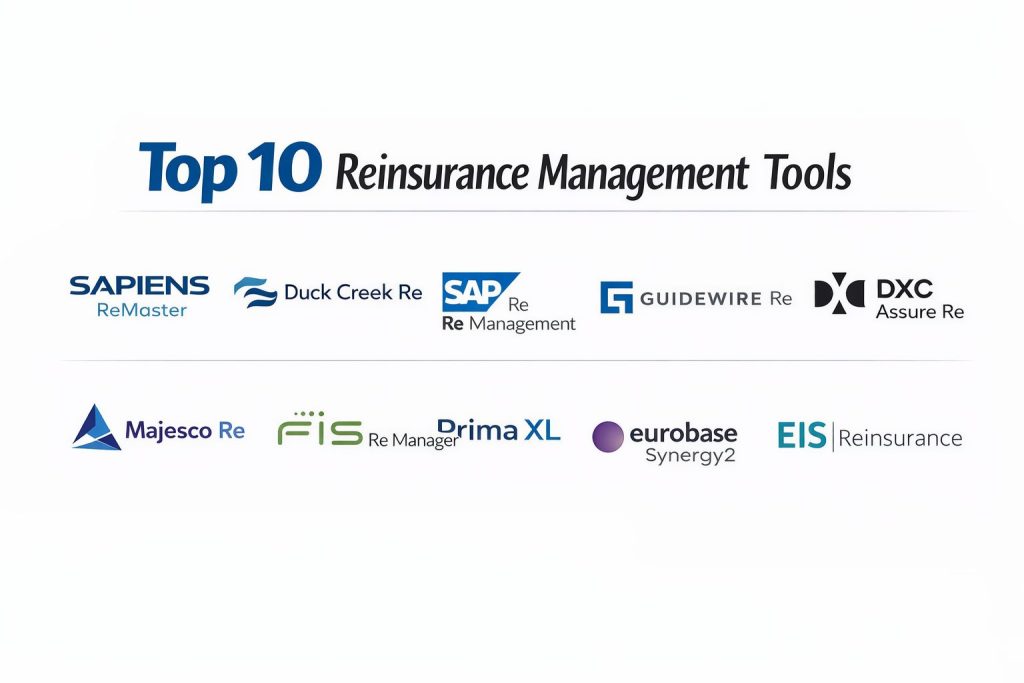
Top 10 Reinsurance Management Tools
Sapiens ReinsuranceMaster
Sapiens ReinsuranceMaster is a comprehensive, end-to-end administration platform designed for global insurers and reinsurers. It provides full financial control over all lines of business, automating the most complex reinsurance transactions through a single, unified data repository.
Key Features
- Automated Technical Accounting: Handles complex premium and claims calculations for all treaty and facultative types.
- Bordereaux Management: Advanced tools for importing, validating, and reconciling massive datasets from various partners.
- Retrocession Support: Allows professional reinsurers to manage their own risk-transfer programs seamlessly.
- Regulatory Reporting: Built-in templates for international standards, including IFRS 17 and local statutory filings.
- Claims Recovery Logic: Automatically triggers recovery notifications and billing when claims hit specific thresholds.
- Multi-Currency Engine: Manages global portfolios with real-time currency conversion and settlement capabilities.
Pros
- Unrivaled depth in handling multi-national programs with complex, multi-layered structures.
- Exceptionally strong audit trails and transparency for financial and regulatory reviews.
Cons
- The depth of functionality results in a longer implementation timeframe compared to modular tools.
- High enterprise-level pricing makes it less accessible for small-market participants.
Platforms / Deployment
- Web-based / Cloud-native (SaaS)
- On-premise
Security & Compliance
- Features: Role-based access control (RBAC), full audit logging, and data encryption at rest.
- Compliance: SOC 2, ISO 27001, IFRS 17.
Integrations & Ecosystem
Integrates natively with the Sapiens IDIT and CoreSuite platforms but also offers an API-first approach for third-party policy and claims systems.
Support & Community
Sapiens offers professional global support with dedicated account managers and an extensive user community focused on industry best practices.
Duck Creek Reinsurance
Duck Creek Reinsurance is a modern, cloud-first platform that focuses on creating operational efficiency and reducing claims leakage. It is designed to replace fragmented legacy systems with a transparent, automated environment that ensures contract certainty.
Key Features
- Contract Management: A centralized hub for digitizing all treaty and facultative agreements.
- Real-Time Recovery Tracking: Instantly identifies claims eligible for recovery and generates reinsurance bills.
- Advanced Analytics: Dynamic reporting modules for tracking balance sheets and income statement impacts.
- Rules-Based Automation: Configurable logic that automates cessions and calculations based on contract terms.
- What-If Simulations: Tools for modeling the financial impact of different reinsurance structures before signing.
- Seamless Workflow: Synchronizes data across policy, claims, and billing for a unified operational view.
Pros
- Rapid deployment and excellent scalability through its cloud-native architecture.
- Highly intuitive user interface that reduces the training burden for reinsurance technicians.
Cons
- Best utilized within the Duck Creek ecosystem; integration with non-Duck Creek systems requires more effort.
- Some advanced actuarial modeling features may require third-party specialized plugins.
Platforms / Deployment
- Microsoft Azure Cloud
- SaaS
Security & Compliance
- Features: Enterprise-grade security via Azure, including multi-factor authentication and threat monitoring.
- Compliance: SOC 1/2, HIPAA, GDPR.
Integrations & Ecosystem
Features deep, out-of-the-box integration with Duck Creek Policy, Claims, and Billing modules, as well as external financial ledgers.
Support & Community
Supported by the Duck Creek University training program and a robust network of implementation partners.
SAP Reinsurance Management
SAP Reinsurance Management provides a robust, finance-centric solution for managing ceded and assumed reinsurance. It is the tool of choice for organizations that prioritize deep integration with enterprise financial and general ledger systems.
Key Features
- Unified Financial Ledger: Direct integration with SAP S/4HANA Finance for real-time accounting and settlements.
- Complex Structure Handling: Supports intricate pools, associations, and global retrocession programs.
- Risk Accumulation Control: Real-time monitoring of geographic and peril-based risk concentrations.
- Automated Settlements: Streamlines the payment process between cedants and reinsurers within the ERP environment.
- Global Compliance Framework: Specifically designed to meet global tax and financial reporting standards.
- Bordereaux Processing: Robust ETL tools for handling high-volume transaction data from multiple entities.
Pros
- Unmatched financial governance and reliability for large-scale corporate accounting.
- Leverages the global SAP support network and ecosystem for stability and security.
Cons
- Requires an existing SAP footprint to realize its full value; standalone use is less common.
- Configuration and customization typically require specialized SAP technical consultants.
Platforms / Deployment
- SAP HANA Cloud
- On-premise
Security & Compliance
- Features: Inherits SAP’s world-class enterprise security protocols and identity management.
- Compliance: ISO 27001, GDPR, SOX.
Integrations & Ecosystem
Fully integrated into the SAP Insurance and Finance ecosystem, providing a “single source of truth” for all corporate data.
Support & Community
Global enterprise support is available 24/7, supported by a massive community of SAP professionals and partners.
Guidewire Reinsurance Management
Guidewire Reinsurance Management is a core module within the Guidewire InsuranceSuite that automates the entire reinsurance lifecycle. It is designed to provide primary insurers with a seamless way to manage ceded business directly from their core platforms.
Key Features
- Ceded Reinsurance Automation: Automatically identifies policies and claims subject to reinsurance during the core lifecycle.
- Treaty and Facultative Support: Unified management for all risk-transfer types in a single interface.
- Advanced Calculations: Handles complex calculations for proportional and non-proportional recoveries.
- Native Policy/Claims Linking: Ensures that every recovery is tied directly to the underlying policy and claim record.
- Reporting Dashboards: Provides executives with a clear view of net vs. gross exposure and recovery status.
- Workflow Orchestration: Automates the routing of reinsurance tasks based on contract triggers.
Pros
- Provides the most seamless experience for insurers already using Guidewire PolicyCenter or ClaimCenter.
- Eliminates data entry errors by pulling information directly from the source systems in real-time.
Cons
- Lacks the standalone flexibility of some specialized reinsurance-only platforms.
- Subscription costs are tied to the broader Guidewire suite, which can be expensive for smaller firms.
Platforms / Deployment
- Guidewire Cloud (SaaS)
- On-premise
Security & Compliance
- Features: Advanced threat detection and cloud security management via Guidewire Cloud.
- Compliance: SOC 1/2, PCI DSS.
Integrations & Ecosystem
Part of the Guidewire Marketplace, allowing for easy connection to third-party data providers and specialized actuarial tools.
Support & Community
Guidewire provides extensive documentation, a dedicated customer success program, and a large global user community.
DXC Assure Reinsurance
DXC Assure Reinsurance is the modernized, cloud-enabled successor to the widely used SICS platform. It is a modular SaaS solution built to handle the complexities of the global market for both life and non-life business.
Key Features
- Modernized SICS Engine: Leverages decades of industry-standard logic in a modern, API-first architecture.
- Modular Design: Allows companies to deploy only the specific reinsurance modules they need.
- Global Multi-Entity Support: Designed for massive groups operating across dozens of jurisdictions and currencies.
- AI Insights: Embedded analytics for identifying trends in risk performance and recovery efficiency.
- SaaS Delivery: High-availability cloud infrastructure that reduces IT maintenance overhead.
- Comprehensive Lifecycle Support: Manages everything from initial quote and bind to final settlement.
Pros
- Combines a “battle-tested” pedigree with modern cloud flexibility and API connectivity.
- Supports both life and property & casualty lines within the same platform effectively.
Cons
- The migration path from legacy SICS versions can be complex for long-term users.
- User interface, while modernized, still carries some complexity from its legacy roots.
Platforms / Deployment
- AWS / Azure / Google Cloud
- SaaS
Security & Compliance
- Features: Multi-layered encryption, identity management, and proactive vulnerability scanning.
- Compliance: ISO 27001, GDPR.
Integrations & Ecosystem
Strong API framework allows it to serve as the “reinsurance brain” for diverse legacy core systems.
Support & Community
DXC provides 24/7 global support and has one of the largest installed bases in the reinsurance industry.
Majesco Reinsurance
Majesco Reinsurance is a cloud-native platform that empowers insurers to manage complex programs with high accuracy and low manual effort. It is built for agility, allowing organizations to rapidly adjust their reinsurance strategies.
Key Features
- Flexible Contract Modeling: Supports a wide variety of non-standard and complex treaty structures.
- Automated Cessions: Real-time processing of cessions as policies are written or updated in core systems.
- Financial Controls: Robust tools for managing accounts receivable/payable and financial reconciliation.
- Audit-Ready Reporting: Generates all necessary documents for internal audits and external regulatory filings.
- Analytics Workbench: A dedicated space for analyzing portfolio performance and reinsurer profitability.
- Cloud Scalability: Automatically scales to handle peak processing periods like year-end renewals.
Pros
- Known for its high speed of implementation and ease of configuration for new contract types.
- Excellent focus on user experience, making it popular among business users and accountants.
Cons
- As a newer cloud contender, it may lack some of the deepest “retrocession” features of legacy competitors.
- Third-party community support is smaller compared to industry giants like SAP or Guidewire.
Platforms / Deployment
- Cloud (SaaS)
- Web-based
Security & Compliance
- Features: Secure SaaS architecture with regular penetration testing and data isolation.
- Compliance: SOC 2 Type II, GDPR.
Integrations & Ecosystem
Features a library of connectors for major policy and claims platforms, focusing on a “plug-and-play” philosophy.
Support & Community
Majesco provides a dedicated customer success portal and structured training through Majesco Academy.
FIS Reinsurance Manager
FIS Reinsurance Manager is a source-independent solution that focuses on increasing the transparency and efficiency of reinsurance operations. It is designed to be highly scalable, fitting the needs of both mid-sized and large-scale insurers.
Key Features
- Source Independence: Can ingest data from any policy or claims system regardless of the vendor.
- Centralized Data Repository: Creates a single source of truth for all reinsurance-related data.
- Automated Calculations: Streamlines the calculation of ceded premiums, losses, and technical provisions.
- Regulatory Compliance: Built-in support for global reporting requirements, including statutory and GAAP.
- Enhanced Auditability: Every transaction and change is tracked with a detailed, tamper-proof audit trail.
- Flexible Accounting Engine: Configurable to align with the specific general ledger structures of the insurer.
Pros
- Excellent for insurers with heterogeneous IT environments (multiple different core systems).
- Highly reliable and stable, backed by the financial technology expertise of FIS.
Cons
- The platform can feel more “accounting-heavy” and less “design-focused” than some newer SaaS rivals.
- Primarily focused on the back-office; lacks some of the front-end “what-if” modeling of competitors.
Platforms / Deployment
- Web-based / Cloud
- Desktop (On-premise)
Security & Compliance
- Features: Enterprise-level security standards required by global financial institutions.
- Compliance: SOX, GDPR, SOC 2.
Integrations & Ecosystem
Designed to be an “integrator,” it excels at pulling data from various legacy platforms and pushing it to ERP systems.
Support & Community
FIS offers professional global support and a structured user group for knowledge sharing and feedback.
Prima XL
Prima XL is a specialized reinsurance management tool that focuses on high precision and complex commercial risks. It is a favorite among London market participants and those dealing with specialty lines like marine and aviation.
Key Features
- Specialty Lines Expertise: Pre-configured for the unique requirements of complex commercial and specialty risks.
- Market Alignment: Deep integration with market-standard formats and processes (e.g., Lloyd’s of London).
- Treaty & Facultative Mastery: High-resolution management of individual risk placements and large programs.
- Advanced Recovery Logic: Specifically tuned for multi-layered and overlapping excess-of-loss structures.
- Interactive Dashboards: Real-time visualization of risk appetite vs. actual exposure.
- Document Management: Integrated storage and versioning for all contract and legal documents.
Pros
- The gold standard for insurers with highly non-standard or “one-off” reinsurance needs.
- Very close alignment with global reinsurance brokerage standards and terminology.
Cons
- May be “over-engineered” for personal lines insurers with simple quota-share needs.
- Smaller global footprint compared to major enterprise software vendors.
Platforms / Deployment
- Web-based / Cloud
- On-premise
Security & Compliance
- Features: Dedicated security team and regular external audits to protect sensitive risk data.
- Compliance: GDPR, IFRS 17.
Integrations & Ecosystem
Focused on connecting to specialty market platforms and specialized actuarial software.
Support & Community
Offers high-touch professional support and a community of experts in specialized risk management.
Eurobase Synergy2
Eurobase Synergy2 is a versatile reinsurance platform that caters to the entire lifecycle of both assumed and ceded business. It is known for its “domain excellence,” having been built specifically for the reinsurance community over several decades.
Key Features
- End-to-End Lifecycle: Manages underwriting, claims, accounting, and retrocession in one system.
- Real-Time Analytics: KPIs with full drill-down capability for boardroom-level reporting.
- Customizable Dashboards: Allows users to build their own views of exposure and performance.
- Automation Framework: Drastically reduces manual data entry through intelligent data mapping.
- Multi-Peril Modeling: Support for complex catastrophe and specialty risk structures.
- Global Accessibility: Secure web-based interface for remote teams and global offices.
Pros
- Boasts a 100% implementation success rate across various global jurisdictions.
- Highly adaptable solution that can grow from a small startup reinsurer to a global player.
Cons
- Requires a well-defined internal process to get the most out of the system’s flexibility.
- Technical documentation can be dense for non-specialized IT teams.
Platforms / Deployment
- Microsoft Azure Cloud
- On-premise
Security & Compliance
- Features: Flexible hosting options with robust encryption and role-based security.
- Compliance: GDPR, IFRS 17.
Integrations & Ecosystem
Offers a wide range of APIs to connect with existing core insurance systems and financial ledgers.
Support & Community
UK-based dedicated support team with a strong focus on customer satisfaction and domain expertise.
EIS Reinsurance
EIS Reinsurance is a highly configurable, modern platform that is part of the larger EIS core suite. It is built on a microservices architecture, making it one of the most technologically advanced options for high-volume insurers.
Key Features
- Microservices Architecture: Allows for independent scaling of different reinsurance functions.
- Real-Time Unified Ledger: Provides an instant view of financial positions across all programs.
- AI-Driven Bordereaux Validation: Uses machine learning to clean and map incoming partner data.
- Configurable Business Rules: No-code/low-code interface for adjusting reinsurance logic.
- Automated Claims Recovery: Seamless link between core claims files and reinsurance billing.
- Omnichannel Reporting: Access to reinsurance insights via mobile, web, or automated alerts.
Pros
- The most technologically “future-proof” architecture in the reinsurance software market.
- Exceptionally good at handling the data volume of high-frequency personal lines reinsurance.
Cons
- As part of a broader core system shift, the implementation is a major enterprise project.
- Still building out some of the niche specialty-line features found in older competitors.
Platforms / Deployment
- Cloud-native (SaaS)
- Hybrid Cloud
Security & Compliance
- Features: Zero-trust security model and continuous identity verification.
- Compliance: ISO 27001, SOC 2, IFRS 17.
Integrations & Ecosystem
Designed to be the center of a “connected insurance ecosystem,” with dozens of pre-built API integrations.
Support & Community
Offers proactive 24/7 monitoring and a growing community of digital-first insurance innovators.
Comparison Table (Top 10)
| Tool Name | Best For | Platform(s) Supported | Deployment | Standout Feature | Public Rating |
| Sapiens ReMaster | Global Groups | Web, Cloud | SaaS / On-prem | Retrocession Engine | 4.8/5 |
| Duck Creek Re | Operational Speed | Azure Cloud | SaaS | Claims Leakage Tool | 4.7/5 |
| SAP Re Management | Financial Governance | HANA Cloud | SaaS / On-prem | S/4HANA Integration | 4.6/5 |
| Guidewire Re | Guidewire Users | Cloud | SaaS / On-prem | Core-Link Automation | 4.7/5 |
| DXC Assure Re | Large-Scale P&C | AWS, Azure | SaaS | Modular SaaS Design | 4.5/5 |
| Majesco Re | Rapid Setup | Cloud | SaaS | UX-Driven Config | 4.4/5 |
| FIS Re Manager | Multi-Vendor IT | Web, Cloud | SaaS / On-prem | Source Independence | 4.5/5 |
| Prima XL | Specialty Lines | Web, Cloud | SaaS / On-prem | London Market Logic | 4.6/5 |
| Eurobase Synergy2 | Domain Excellence | Azure Cloud | SaaS / On-prem | 100% Success Rate | 4.4/5 |
| EIS Reinsurance | Digital-First | Cloud-native | SaaS | Microservices | 4.3/5 |
Evaluation and Scoring of Revenue Recognition Software
Weights
Core features 25 percent
Ease of use 15 percent
Integrations and ecosystem 15 percent
Security and compliance 10 percent
Performance and reliability 10 percent
Support and community 10 percent
Price and value 15 percent
| Tool Name | Core (25%) | Ease (15%) | Integrations (15%) | Security (10%) | Performance (10%) | Support (10%) | Value (15%) | Weighted Total |
| Sapiens ReMaster | 10 | 6 | 9 | 10 | 9 | 9 | 7 | 8.50 |
| Duck Creek Re | 9 | 9 | 8 | 9 | 9 | 8 | 8 | 8.60 |
| SAP Re Management | 10 | 5 | 10 | 10 | 10 | 9 | 6 | 8.40 |
| Guidewire Re | 9 | 8 | 10 | 10 | 9 | 9 | 7 | 8.65 |
| DXC Assure Re | 9 | 6 | 8 | 9 | 9 | 9 | 8 | 8.20 |
| Majesco Re | 8 | 9 | 8 | 9 | 8 | 8 | 9 | 8.25 |
| FIS Re Manager | 9 | 7 | 10 | 9 | 9 | 8 | 7 | 8.25 |
| Prima XL | 10 | 6 | 7 | 9 | 8 | 9 | 7 | 7.95 |
| Eurobase Synergy2 | 9 | 7 | 8 | 9 | 8 | 10 | 8 | 8.20 |
| EIS Reinsurance | 8 | 7 | 10 | 10 | 10 | 8 | 8 | 8.4 |
How to interpret the scores
These scores are comparative and help you shortlist tools based on typical finance needs. A slightly lower score can still be the best choice if it matches your billing model and contract complexity. Core features and integrations often determine long-term fit, while ease impacts adoption speed. Security and support matter most during audits and close pressure. Value can change based on pricing, team size, and how much automation you actually use.
Which Reinsurance Management Tool Is Right for You?
Global Insurance Groups
For large-scale conglomerates operating across multiple continents, Sapiens ReinsuranceMaster and SAP Reinsurance Management are the leading choices. These tools provide the necessary depth for multi-currency settlements and complex retrocession programs that spanning hundreds of entities.
Guidewire or Duck Creek Core Users
If your organization is already standardized on a major core platform, the “native” choice is usually best. Guidewire Reinsurance Management and Duck Creek Reinsurance provide pre-built integrations that drastically reduce data entry errors and implementation risk.
Specialty & London Market
For those dealing with highly complex, non-proportional specialty risks in marine, aviation, or energy, Prima XL and Eurobase Synergy2 offer the most specialized logic. These tools are built to reflect the specific nuances and contract styles of the London and global specialty markets.
Digital-First & High-Volume P&C
Insurers focused on high-speed, digital personal lines should consider EIS Reinsurance. Its microservices architecture and AI-driven automation are specifically designed to handle the massive data volumes of modern, high-frequency insurance products.
Budget vs. Premium
While there are no “cheap” reinsurance tools at the enterprise level, Majesco Reinsurance and iPro often offer more flexible entry points for mid-market insurers. Premium tools like SAP involve higher costs but offer unparalleled financial governance for multi-billion dollar programs.
Feature Depth vs. Ease of Use
If you need deep actuarial simulation and complex treaty logic, SideFX (for modeling) or Sapiens are the heavy hitters. If you need a tool that your accounting team can learn in a few weeks to manage standard quota-share treaties, Duck Creek or Majesco are more user-friendly.
Integration & Scalability Needs
For firms with a “patchwork” of legacy systems, FIS Reinsurance Manager is excellent due to its source-independent nature. For firms looking for future scalability in a cloud-native environment, EIS or DXC Assure represent the next generation of architecture.
Security & Compliance Focus
For organizations with extreme security requirements or those undergoing heavy IFRS 17 audits, SAP and Guidewire provide the most robust enterprise security frameworks and compliance reporting out of the box.
Frequently Asked Questions (FAQs)
What is the primary benefit of reinsurance management software?
The main benefit is the automation of complex calculations and the reduction of “claims leakage.” By ensuring every claim is correctly identified and billed to the relevant reinsurer, companies can recover millions of dollars that might otherwise be missed in manual spreadsheets.
Can these tools handle both Life and P&C reinsurance?
Most top-tier tools like Sapiens and DXC Assure are designed to handle both. However, some specialized tools focus strictly on P&C (Property & Casualty) or life-specific actuarial valuation, so it’s important to verify the tool’s line-of-business capabilities.
Is it possible to integrate these tools with legacy policy systems?
Yes, modern reinsurance tools like FIS Reinsurance Manager and DXC Assure are built with API-first architectures specifically to act as an “overlay” for legacy systems, allowing firms to modernize reinsurance without replacing their entire core stack.
How does AI help in reinsurance management?
AI is primarily used for Bordereaux Ingestion. It automatically maps and cleanses messy data files sent by partners, identifying errors or missing information instantly, which saves hundreds of hours of manual data entry and reconciliation.
What is “Contract Certainty” and how do these tools help?
Contract certainty is the practice of ensuring all terms of a reinsurance treaty are finalized and signed before the risk begins. These tools provide digital workflow and version control to ensure all parties have agreed to the same standardized clauses on time.
Are these tools cloud-based or on-premise?
The industry is rapidly moving toward SaaS (Software as a Service). While legacy providers still offer on-premise versions for highly regulated entities, the vast majority of new implementations are cloud-native to ensure better scalability and security.
Do these systems help with IFRS 17 compliance?
Yes, most top-tier tools now include specialized modules for IFRS 17. They handle the complex discounting, risk adjustments, and financial reporting required to present reinsurance assets and liabilities correctly under the new standards.
How long does it take to implement a reinsurance system?
Implementation can range from 6 months for a modular cloud-based tool to 18+ months for a full enterprise-scale deployment in a global multi-national group. The complexity of existing data is usually the biggest variable.
What is the role of a “Unified Ledger” in these tools?
A unified ledger ensures that every reinsurance transaction is immediately reflected in the company’s financial records. This prevents the need for manual reconciliation between the reinsurance team and the corporate accounting department.
Can these tools manage “Retrocession”?
Yes, advanced systems like Sapiens and Eurobase are designed for professional reinsurers who need to “re-reinsure” their own risks. These tools track both the assumed risk from the primary insurer and the ceded risk to the retrocessionaire.
Conclusion
The selection of a reinsurance management tool is a foundational decision that impacts the long-term capital efficiency and regulatory standing of an insurance organization. In 2026, the market is defined by a clear divide between “core-integrated” modules like Guidewire and Duck Creek, and “best-of-breed” specialized platforms like Sapiens and Prima XL. For most insurers, the choice will depend on whether they prioritize seamless integration with their existing policy systems or the deep, specialized functionality required for complex global programs and retrocession.
As AI continues to automate the “dirty work” of data ingestion and reconciliation, the role of the reinsurance professional is shifting toward strategy and portfolio optimization. Choosing a tool that not only automates today’s tasks but also provides the analytics for tomorrow’s risk decisions is essential for staying competitive in an increasingly volatile global market.