Introduction
Regulatory Technology (RegTech) monitoring tools are specialized software platforms designed to help organizations automate the tracking of compliance obligations and detect regulatory risks in real time. In the current landscape, these tools have moved beyond simple checklists to become sophisticated “compliance-as-a-service” ecosystems that leverage artificial intelligence to interpret complex legal texts and monitor billions of transactions. They are the primary defense for financial institutions, healthcare providers, and global enterprises against the rising tide of regulatory fines and the increasing complexity of cross-border laws.
The core value of a RegTech monitoring tool lies in its ability to provide continuous oversight rather than periodic audits. By integrating directly into a company’s operational workflows, these platforms can flag a suspicious transaction, a data privacy breach, or a change in global sanctions the moment they occur. As regulators move toward “data-first” supervision, having a robust monitoring tool is no longer an optional luxury but a foundational requirement for maintaining a license to operate in any highly regulated market.
Best for: Banks, fintechs, asset managers, and insurance companies requiring automated AML (Anti-Money Laundering), KYC (Know Your Customer), and real-time transaction surveillance.
Not ideal for: Unregulated small businesses with static operations or firms looking for a “legal-only” library without active data monitoring capabilities.
Key Trends in RegTech Monitoring Software
- Agentic Compliance Automation: The shift from passive alerts to “AI agents” that can perform initial investigations, categorize risks, and even draft Suspicious Activity Reports (SARs) without human intervention.
- Unified Scene of Risk: Integration of communication monitoring (Slack, Zoom, WhatsApp) with trade surveillance to detect market abuse and insider trading in a single pane of glass.
- Open Regulatory Intelligence: Tools are increasingly using Natural Language Processing (NLP) to scan thousands of global regulatory bodies and automatically update internal control maps.
- Graph-Based Entity Resolution: Moving beyond simple name matching to using network science to uncover hidden relationships between high-risk entities and sanctioned individuals.
- Cloud-Native Digital Twins: RegTech tools now create “compliance twins” of organizations, simulating how a change in regulation will impact existing business processes before it is implemented.
- Self-Healing Controls: AI-driven systems that detect when a compliance control has failed or become outdated and suggest immediate technical remediations.
- Zero-Trust Monitoring: A shift toward verifying every identity and transaction continuously, rather than just at the point of onboarding or initial contract signing.
How We Selected These Tools (Methodology)
The methodology for selecting the top 10 RegTech monitoring tools involved a rigorous evaluation of their technical architecture, market impact, and ability to handle high-volume data streams. We prioritized platforms that demonstrate “regulatory agility,” which refers to how quickly a tool can ingest new global mandates and apply them to an existing data set. Each tool was assessed on its ability to offer a “full-cycle” compliance journey, from identity verification to ongoing transaction monitoring and final regulatory reporting.
Performance reliability was a critical factor, particularly for tools used in the financial sector where latency can lead to missed alerts. We analyzed security and compliance postures, looking for SOC 2 Type II certifications and alignment with global frameworks like FATF and GDPR. Finally, we weighted the “human-in-the-loop” experience, ensuring that while the tools are highly automated, they provide clear, auditable narratives that human compliance officers can easily verify during a regulatory inquiry.
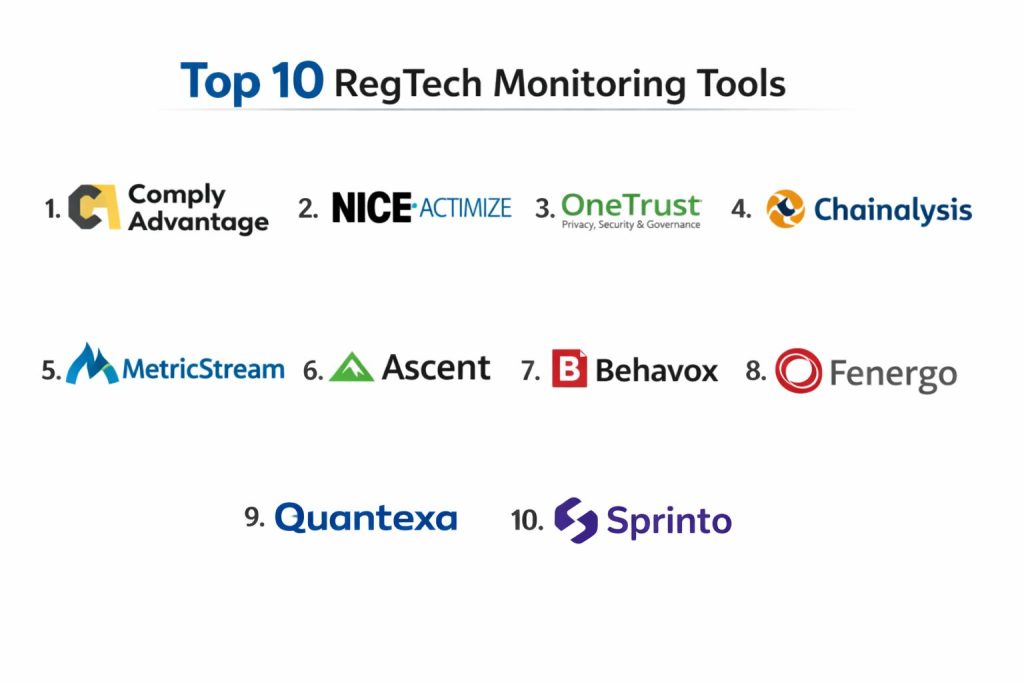
Top 10 RegTech Monitoring Tools
1. ComplyAdvantage
ComplyAdvantage is an AI-driven leader in financial crime detection, offering a real-time risk database that covers sanctions, PEPs (Politically Exposed Persons), and adverse media. It is designed for digital-first firms that require high-speed monitoring and automated customer screening.
Key Features
- Real-Time AML Monitoring: Continuously scans transactions against a proprietary, AI-updated global database.
- Dynamic Risk Scoring: Automatically adjusts a customer’s risk profile based on changing external data and transaction behavior.
- Adverse Media Scanning: Uses NLP to monitor news sources in real-time, identifying risks long before they hit official watchlists.
- Onboarding Verification: Seamlessly integrates KYC and KYB (Know Your Business) checks into the user sign-up flow.
- Payment Screening: High-speed scanning of global payments to ensure compliance with international sanctions.
- Case Management: A unified interface for compliance teams to investigate and resolve flagged alerts efficiently.
Pros
- Offers one of the most comprehensive and frequently updated global risk databases in the industry.
- Highly flexible API architecture makes it easy for fintechs to embed compliance into their apps.
Cons
- The vast amount of data can occasionally lead to a higher volume of false positives for less-configured systems.
- Primarily focused on financial crime; lacks broader GRC (Governance, Risk, and Compliance) features.
Platforms / Deployment
- Cloud-Based (SaaS)
- API-First
Security & Compliance
- Features: SOC 2 Type II, ISO 27001, end-to-end data encryption.
- Compliance: FATF, Wolfsberg Group, GDPR.
Integrations & Ecosystem
ComplyAdvantage integrates with major banking cores and CRM systems. It features pre-built connectors for platforms like Salesforce and various transaction processing hubs.
Support & Community
The company provides professional implementation support and a detailed documentation portal. They host regular webinars and “RegTech summits” for their global user base.
2. NICE Actimize
NICE Actimize is the industry titan for enterprise-scale financial crime, risk, and compliance. It is the go-to solution for the world’s largest Tier 1 banks that require heavy-duty surveillance and multi-jurisdictional trade monitoring.
Key Features
- X-Sight Entity Resolution: Connects disparate data points to create a single, clear view of a customer’s true identity and risk.
- Trade Surveillance: Sophisticated monitoring of market activities to detect insider trading, spoofing, and market manipulation.
- Autonomous Financial Crime: Uses advanced machine learning to automate the entire investigation lifecycle.
- Fraud Management: Integrated tools to detect real-time payment fraud across digital and traditional channels.
- Regulatory Reporting: Automated generation and submission of SARs and other required regulatory filings.
- Cloud & On-Premise: Offers flexible deployment options to meet the strict security requirements of global banks.
Pros
- Unmatched scalability, capable of processing millions of transactions per second for global institutions.
- Highly mature product with a deep understanding of the most complex global regulatory requirements.
Cons
- Implementation is often long and complex, requiring significant technical and consulting resources.
- The pricing model is geared toward large enterprises, making it inaccessible for smaller startups.
Platforms / Deployment
- Cloud / On-Premise / Hybrid
- Enterprise Desktop
Security & Compliance
- Features: FIPS-compliant, SOC 2, and rigorous data masking capabilities.
- Compliance: MiFID II, Dodd-Frank, FINRA, SEC.
Integrations & Ecosystem
Actimize features a robust marketplace for pre-built compliance models and has deep integrations with enterprise IT stacks, including IBM and Oracle.
Support & Community
Offers 24/7 global enterprise support and dedicated account management. The user community is vast, consisting primarily of high-level compliance executives and technical directors.
3. OneTrust
OneTrust is the premiere platform for GRC and data privacy monitoring. It is the global standard for firms that need to monitor compliance with privacy laws like GDPR and CCPA while managing third-party risks.
Key Features
- Privacy Impact Assessments: Automated workflows to monitor and assess the privacy risks of new projects and vendors.
- Consent Management: Real-time monitoring and enforcement of user data preferences across web and mobile platforms.
- Third-Party Risk Exchange: A massive database of pre-assessed vendors to speed up third-party compliance monitoring.
- Data Mapping: Automatically discovers and maps where sensitive data lives across an entire enterprise.
- Incident Management: Tools for tracking data breaches and ensuring compliance with strict regulatory reporting timelines.
- ESG Monitoring: Integrated modules for monitoring Environmental, Social, and Governance metrics and compliance.
Pros
- The most comprehensive solution available for global data privacy and trust management.
- Excellent modularity, allowing firms to start with one compliance area and expand as they grow.
Cons
- The platform is so broad that it can feel overwhelming and complex for smaller organizations.
- Integration with legacy on-premise databases can sometimes require custom development work.
Platforms / Deployment
- Cloud-Based (SaaS)
- Mobile (for on-site audits)
Security & Compliance
- Features: SOC 2 Type II, ISO 27001, CCPA-aligned, GDPR-native.
- Compliance: ISO 27701, NIST, HIPAA.
Integrations & Ecosystem
OneTrust has one of the largest integration ecosystems in the world, connecting with everything from AWS to Slack and SAP.
Support & Community
The “OneTrust Connect” series provides extensive networking and training. They offer a highly responsive customer success team and a deep library of self-service training.
4. Chainalysis
Chainalysis is the definitive monitoring tool for blockchain and cryptocurrency compliance. It allows financial institutions and government agencies to trace the flow of illicit funds across decentralized networks.
Key Features
- KYT (Know Your Transaction): Real-time monitoring of crypto transactions for AML and sanctions risk.
- Reactor: A visual investigation tool that allows users to trace transactions through complex “mixers” and wallets.
- Address Screening: Instantly identifies if a crypto address is associated with a sanctioned entity or darknet market.
- VASP Risk Scoring: Evaluates the compliance posture of Virtual Asset Service Providers (exchanges, custodians).
- Cross-Chain Monitoring: Tracks the movement of assets as they hop between different blockchains (e.g., Bitcoin to Ethereum).
- Chainalysis Sentinel: An automated alert system for detecting high-risk patterns in massive crypto datasets.
Pros
- The “gold standard” for crypto forensics, trusted by the FBI, IRS, and major global banks.
- Unrivaled data quality, with the most extensive mapping of crypto addresses to real-world entities.
Cons
- Highly specialized for blockchain; requires other tools for traditional fiat monitoring.
- The technical nature of the platform requires specialized training for compliance officers.
Platforms / Deployment
- Cloud-Based (SaaS)
- API-Based
Security & Compliance
- Features: SOC 2, high-security data centers, private cloud options.
- Compliance: FATF Travel Rule, OFAC, FinCEN.
Integrations & Ecosystem
Integrates with major crypto exchanges and custodians. It also works with traditional GRC tools to provide a holistic view of financial risk.
Support & Community
Offers the “Chainalysis Academy” for professional certification. The company provides white-glove support for complex investigations and law enforcement inquiries.
5. MetricStream
MetricStream provides an AI-powered GRC platform that specializes in connected compliance. It is ideal for large organizations in energy, healthcare, and finance that need to monitor risk across multiple business units.
Key Features
- AI-First Compliance: Automatically ingests regulatory updates and maps them to internal controls and policies.
- Continuous Monitoring: Real-time tracking of compliance metrics through automated control testing.
- Audit Management: Streamlines the entire internal and external audit process with centralized evidence collection.
- Policy Lifecycle Management: Monitors policy adherence and automates the review and approval process.
- Risk Quantification: Uses the Open FAIR model to assign financial values to compliance risks.
- Federated Data Model: Allows different departments to share compliance data while maintaining strict access controls.
Pros
- Exceptional at breaking down “silos,” allowing risk, compliance, and audit teams to work together.
- Highly customizable reporting dashboards for executive and board-level visibility.
Cons
- Requires a significant upfront investment in time to map the organization’s unique regulatory profile.
- User interface can feel “corporate” and less modern than some newer SaaS competitors.
Platforms / Deployment
- Cloud / On-Premise
- Desktop
Security & Compliance
- Features: Multi-tenant security, RBAC (Role-Based Access Control), encryption at rest.
- Compliance: SOX, HIPAA, PCI-DSS, GDPR.
Integrations & Ecosystem
Integrates deeply with enterprise ERP systems like SAP and Oracle, as well as IT management tools like ServiceNow.
Support & Community
MetricStream hosts the “GRC Summit,” a major industry event. They offer robust professional services for large-scale global implementations.
6. Ascent
Ascent is a specialized RegTech tool that uses “Vertical AI” to convert regulatory text into actionable tasks. It is specifically designed to help compliance teams monitor and manage the constant stream of regulatory changes.
Key Features
- Regulatory Lifecycle Management: Tracks a regulation from the “proposed” stage through to final enforcement.
- Obligation Mapping: Automatically identifies the specific rules that apply to your business and maps them to your controls.
- Change Management: Flags whenever a regulation changes and identifies exactly which policies need updating.
- Horizon Scanning: Uses AI to predict upcoming regulatory trends and potential legislative shifts.
- AscentFocus: A module dedicated to automating the monitoring of complex, industry-specific mandates.
- Evidence Management: Centralizes the documentation needed to prove compliance during an exam.
Pros
- Solves the massive manual burden of reading and interpreting thousands of pages of regulatory text.
- Dramatically reduces the risk of missing a regulatory update in a niche or foreign jurisdiction.
Cons
- It is a “narrow” tool focused on intelligence; it does not perform transaction or communication monitoring.
- The AI mapping requires initial verification by subject matter experts to ensure 100% accuracy.
Platforms / Deployment
- Cloud-Based (SaaS)
- API
Security & Compliance
- Features: SOC 2 Type II, encrypted data transfer.
- Compliance: Global jurisdictional coverage (180+ countries).
Integrations & Ecosystem
Designed to feed regulatory intelligence into larger GRC platforms like RSA Archer or MetricStream via API.
Support & Community
Provides high-touch support from regulatory experts. The community is focused on the intersection of law, AI, and compliance technology.
7. Behavox
Behavox is the leader in AI-driven communication monitoring. It analyzes internal communications (voice, email, chat) to detect market abuse, employee misconduct, and regulatory breaches before they cause damage.
Key Features
- Multi-Channel Monitoring: Captures data from over 150 sources, including Zoom, Slack, WhatsApp, and Microsoft Teams.
- Contextual Analysis: Uses AI to understand the intent behind a conversation, reducing false positives from harmless jokes.
- Market Abuse Detection: Identifies patterns of insider trading, collusion, and front-running in real-time.
- Voice Analytics: Features industry-leading transcription and sentiment analysis for phone and video calls.
- Conduct Risk Monitoring: Detects non-financial risks like harassment, bullying, or sensitive data leakage.
- Compliant Archive: Stores all communications in a tamper-proof, regulator-ready format.
Pros
- Unrivaled ability to detect “hidden” risks within informal communications that traditional keyword tools miss.
- Built-in AI models are specifically trained on financial industry scenarios and terminology.
Cons
- The depth of monitoring can raise privacy concerns among employees if not managed transparently.
- Requires significant processing power and high-quality data ingestion for the best results.
Platforms / Deployment
- Cloud / Hybrid / On-Premise
- Desktop
Security & Compliance
- Features: SOC 2, GDPR-aligned data residency, end-to-end encryption.
- Compliance: SEC 17a-4, FINRA, MiFID II.
Integrations & Ecosystem
Integrates with almost every major workplace communication tool and CRM platform.
Support & Community
Offers “white-glove” implementation and a dedicated research team that keeps the AI models updated against new types of market abuse.
8. Fenergo
Fenergo specializes in Client Lifecycle Management (CLM) for financial services. It monitors the compliance status of corporate clients from the moment of onboarding through the entire duration of the business relationship.
Key Features
- Regulatory Rules Engine: A central hub that maintains the rules for over 100 jurisdictions globally.
- Ongoing Due Diligence: Automatically triggers reviews of a client’s profile based on time-based or event-based triggers.
- UBO Identification: Specialized tools for uncovering Ultimate Beneficial Owners in complex corporate structures.
- Digital Onboarding: A seamless, paperless experience for high-net-worth and corporate clients.
- Regulatory Reporting: Consolidates data for global reporting requirements like FATCA and CRS.
- Case Management: Coordinates compliance, legal, and risk teams during the approval of complex clients.
Pros
- The most “relationship-centric” RegTech tool, focusing on the long-term monitoring of high-value accounts.
- Exceptional at handling the complex onboarding requirements of institutional and private banking.
Cons
- Not a “generalist” tool; it is very specifically focused on the client relationship in financial services.
- Higher cost of ownership due to the specialized nature of the platform.
Platforms / Deployment
- Cloud-Based (SaaS)
- Desktop
Security & Compliance
- Features: ISO 27001, SOC 2, rigorous multi-jurisdictional data privacy controls.
- Compliance: AMLD5/6, KYC, Tax (FATCA/CRS).
Integrations & Ecosystem
Integrates with leading data providers like Refinitiv and Dun & Bradstreet to pull in external corporate data automatically.
Support & Community
Offers a structured client success program and an active global user group where compliance leaders share regulatory insights.
9. Quantexa
Quantexa uses “Decision Intelligence” to monitor and detect financial crime by analyzing vast networks of data. It is the tool of choice for organizations that need to find patterns of money laundering across massive, disconnected datasets.
Key Features
- Network Graph Technology: Visualizes the links between people, companies, addresses, and accounts.
- Entity Resolution: Cleans and matches data from internal and external sources to identify unique individuals.
- Contextual Alerts: Only flags suspicious activity when the context of the entire network suggests a high risk.
- Real-Time Scoring: Evaluates the risk of a transaction or relationship as data flows into the system.
- Fraud Detection: Specialized models for detecting “mule” accounts and sophisticated professional laundering.
- Investigation Workspace: A highly visual tool for investigators to “drill down” into complex networks.
Pros
- Effectively solves the “silo” problem by connecting data that other tools see as unrelated.
- Dramatically reduces the number of false alerts by focusing on the “bigger picture” of network risk.
Cons
- Requires a high level of data maturity within the organization to feed the graph engine.
- The interface is designed for professional investigators and can be complex for general compliance staff.
Platforms / Deployment
- Cloud / Hybrid / On-Premise
- Enterprise Desktop
Security & Compliance
- Features: SOC 2, ISO 27001, and advanced data anonymization for privacy.
- Compliance: AML, CTF, Fraud.
Integrations & Ecosystem
Works alongside existing AML systems as an “intelligence layer” and integrates with big data platforms like Hadoop and Snowflake.
Support & Community
Provides professional services for custom model development. The community is focused on data science and advanced financial crime detection.
10. Sprinto
Sprinto is a modern compliance automation platform built specifically for SaaS and cloud-first companies. It focuses on continuous monitoring of security controls to maintain “audit-ready” status for certifications like SOC 2 and ISO 27001.
Key Features
- Automated Evidence Collection: Connects to your cloud stack (AWS, Google Cloud, Slack) to automatically gather proof of compliance.
- Real-Time Control Monitoring: Notifies you immediately if a security control (like MFA or encryption) fails.
- Vulnerability Tracking: Monitors your infrastructure for security flaws and tracks their remediation.
- Employee Compliance: Tracks mandatory security training and policy attestations for all staff.
- Risk Register: A centralized place to monitor and manage all identified organizational risks.
- Audit Dashboard: A dedicated space for external auditors to review evidence, significantly speeding up the audit process.
Pros
- The fastest path to compliance for high-growth tech companies that need to “unlock” enterprise deals.
- Extremely easy to set up, with most cloud integrations taking only a few minutes.
Cons
- Focused primarily on security and IT compliance; not suitable for banking-specific AML/KYC needs.
- May lack the “depth” required for traditional brick-and-mortar industrial compliance.
Platforms / Deployment
- Cloud-Based (SaaS)
- API
Security & Compliance
- Features: SOC 2 Type II, ISO 27001, end-to-end encryption.
- Compliance: SOC 2, ISO 27001, HIPAA, PCI-DSS.
Integrations & Ecosystem
Integrates with nearly 200 cloud tools, including GitHub, Jira, Okta, and all major cloud service providers.
Support & Community
Offers exceptional, high-touch support that guides users through the entire certification process. The community is focused on CTOs and DevOps leaders.
Comparison Table (Top 10)
| Tool Name | Best For | Platform(s) Supported | Deployment | Standout Feature | Public Rating |
| ComplyAdvantage | Fintech AML | Cloud, API | SaaS | Real-time Risk Database | 4.6/5 |
| NICE Actimize | Tier 1 Banking | Cloud, On-Prem, Hybrid | Enterprise | X-Sight Entity Resolution | 4.4/5 |
| OneTrust | Data Privacy | Cloud, Mobile | SaaS | Third-Party Risk Exchange | 4.5/5 |
| Chainalysis | Crypto Monitoring | Cloud, API | SaaS | Reactor Visual Trace | 4.8/5 |
| MetricStream | Enterprise GRC | Cloud, On-Prem | Hybrid | Federated Data Model | 4.2/5 |
| Ascent | Regulatory Intel | Cloud, API | SaaS | Vertical AI Text Analysis | 4.3/5 |
| Behavox | Comms Surveillance | Cloud, On-Prem | Hybrid | Contextual Voice/Chat AI | 4.7/5 |
| Fenergo | Client Lifecycle | Cloud | SaaS | Multi-Jurisdiction Rules | 4.4/5 |
| Quantexa | Network Analysis | Cloud, On-Prem | Enterprise | Network Graph Tech | 4.6/5 |
| Sprinto | SaaS Security | Cloud, API | SaaS | Automated Evidence | 4.8/5 |
Evaluation & Scoring of RegTech Monitoring Tools
The scoring below is a comparative model intended to help shortlisting. Each criterion is scored from 1–10, then a weighted total from 0–10 is calculated using the weights listed. These are analyst estimates based on typical fit and common workflow requirements, not public ratings.
Weights:
Price / value – 15%
Core features – 25%
Ease of use – 15%
Integrations & ecosystem – 15%
Security & compliance – 10%
Performance & reliability – 10%
Support & community – 10%
| Tool Name | Core (25%) | Ease (15%) | Integrations (15%) | Security (10%) | Performance (10%) | Support (10%) | Value (15%) | Weighted Total |
| ComplyAdvantage | 9 | 8 | 9 | 9 | 9 | 8 | 8 | 8.65 |
| NICE Actimize | 10 | 4 | 9 | 10 | 10 | 9 | 5 | 8.15 |
| OneTrust | 10 | 6 | 10 | 10 | 9 | 9 | 7 | 8.60 |
| Chainalysis | 10 | 5 | 8 | 9 | 9 | 10 | 6 | 8.05 |
| MetricStream | 9 | 6 | 9 | 9 | 8 | 8 | 7 | 8.00 |
| Ascent | 8 | 7 | 8 | 9 | 8 | 8 | 8 | 7.85 |
| Behavox | 9 | 7 | 8 | 10 | 9 | 9 | 7 | 8.35 |
| Fenergo | 9 | 6 | 8 | 9 | 8 | 8 | 6 | 7.65 |
| Quantexa | 10 | 5 | 8 | 9 | 10 | 8 | 6 | 7.95 |
| Sprinto | 7 | 10 | 9 | 9 | 9 | 10 | 9 | 8.60 |
How to interpret the scores:
- Use the weighted total to shortlist candidates, then validate with a pilot.
- A lower score can mean specialization, not weakness.
- Security and compliance scores reflect controllability and governance fit, because certifications are often not publicly stated.
- Actual outcomes vary with assembly size, team skills, templates, and process maturity.
Which RegTech Monitoring Tool Is Right for You?
Solo / Fintech Startup
If you are a solo founder or a small fintech, Sprinto is the best starting point for security compliance, while ComplyAdvantage is the most accessible for meeting your mandatory AML and KYC obligations. These tools offer API-first designs that grow with your company.
SMB
Small and medium businesses in regulated spaces should consider OneTrust for its modularity. You can start with simple data privacy monitoring and add third-party risk management as your vendor list expands.
Mid-Market
For growing financial institutions, the combination of Fenergo for client management and Behavox for internal communication monitoring provides a robust defense against both external and internal risks without the massive overhead of Tier 1 banking suites.
Large Enterprise
Global Tier 1 banks and multinational corporations require the heavy-duty power of NVIDIA Actimize and MetricStream. These tools are built to handle the immense data volume and complex legal hierarchies of multi-country operations.
Budget vs Premium
Sprinto offers the best value for cloud-native companies looking for fast ROI. On the premium end, Chainalysis and Behavox command higher prices due to their specialized AI models and the unique, high-stakes data they monitor.
Feature Depth vs Ease of Use
Sprinto and ComplyAdvantage lead in ease of use and speed of implementation. However, if you require extreme feature depth for criminal investigations or market abuse, Quantexa and Chainalysis are necessary despite their steeper learning curves.
Integrations & Scalability
For sheer scalability and the ability to integrate into an existing legacy IT stack, NICE Actimize and MetricStream are the leaders. They are designed to live at the center of an enterprise ecosystem.
Security & Compliance Needs
Organizations with the highest security requirements—such as those handling government contracts or national critical infrastructure—should prioritize NICE Actimize or Behavox, as they offer robust on-premise and hybrid deployment options.
Frequently Asked Questions (FAQs)
What is the primary goal of RegTech monitoring tools?
The primary goal is to automate the oversight of regulatory compliance, ensuring that a company follows laws in real-time. This includes monitoring transactions for money laundering, checking identities for sanctions, and ensuring data privacy rules are followed.
How does AI help in regulatory monitoring?
AI helps by reading and interpreting thousands of pages of legal text, identifying patterns in financial transactions that humans might miss, and reducing “false positives” by understanding the context of a conversation or relationship.
Are these tools only for banks?
No. While banks are the largest users, RegTech monitoring tools are used in healthcare, energy, e-commerce, and any industry where data privacy, anti-corruption, or safety regulations are strictly enforced.
Can RegTech tools replace compliance officers?
No, they are meant to augment them. These tools handle the “heavy lifting” of data analysis, allowing human compliance officers to focus on high-level decision-making and complex investigations that require human judgment.
What is “Transaction Monitoring”?
Transaction monitoring is the process of reviewing all financial activity in real-time to identify suspicious patterns, such as multiple small transfers that might be an attempt to bypass reporting thresholds (structuring).
How long does it take to implement a RegTech tool?
Implementation can range from a few hours for cloud-native tools like Sprinto to several months for enterprise-grade suites like NICE Actimize, depending on the complexity of the data integration required.
What is a “False Positive” in RegTech?
A false positive occurs when the system flags a legitimate transaction or customer as high-risk. High-quality RegTech tools use AI to minimize these errors, as they can cause significant delays and extra work for compliance teams.
Are these tools legally required?
While a specific brand of tool is not required, regulators in most jurisdictions now mandate that companies have “adequate systems and controls.” In 2026, it is virtually impossible to prove adequacy without some form of automated monitoring.
How much do RegTech monitoring tools cost?
Pricing varies wildly based on volume. Small startups might pay a few hundred dollars a month for a basic API, while global banks may pay millions of dollars annually for a full enterprise surveillance suite.
Do these tools work across different countries?
Yes, top tools like Fenergo and Ascent feature global rulebooks that automatically adjust their monitoring based on the jurisdiction of the customer or the transaction.
Conclusion
RegTech monitoring tools have transitioned from “back-office utilities” to central pillars of corporate strategy. In an era of instant global payments and strict data sovereignty, the ability to monitor risk at the speed of business is the only way to ensure long-term sustainability. Whether you are a small SaaS company securing your first enterprise deal with Sprinto or a global bank defending against sophisticated financial crime with NICE Actimize, the right tool provides the transparency and audit-readiness required by modern regulators.
As AI continues to mature, the gap between organizations using automated monitoring and those relying on manual checks will continue to widen. Selecting the right platform today is not just about avoiding a fine; it is about building a foundation of trust that allows your organization to scale confidently into new markets and jurisdictions.