Introduction
Real estate leasing management tools have transitioned from passive record-keeping systems into proactive operational engines that drive portfolio yield and tenant satisfaction. In the current market, managing a lease is no longer just about tracking an expiration date; it involves a complex orchestration of digital marketing, automated tenant screening, integrated financial accounting, and high-touch resident services. These platforms serve as a centralized “source of truth,” eliminating the fragmented data silos that traditionally plagued property management. By automating the high-volume, repetitive tasks associated with the leasing lifecycle, these tools allow property managers to focus on strategic asset growth and the human element of real estate.
The modern leasing environment demands a seamless, consumer-grade digital experience for tenants while providing robust, audit-ready financial governance for owners. This dual requirement has pushed software providers to integrate advanced features such as AI-powered lease abstraction, real-time maintenance tracking, and automated CAM (Common Area Maintenance) reconciliations. Whether managing a single-family residential portfolio or a massive commercial retail mall, the ability to access real-time occupancy data and financial performance metrics from any device is a non-negotiable requirement for staying competitive. For the professional manager, these tools represent the difference between a reactive, paper-heavy operation and an agile, data-driven business.
Best for: Property management firms, independent landlords, REITs (Real Estate Investment Trusts), and commercial asset managers looking to automate the end-to-end leasing process and improve financial accuracy.
Not ideal for: Individual homeowners with a single, long-term tenant who do not require automated accounting, or hospitality businesses like hotels that operate on a nightly “booking” model rather than a long-term “lease” structure.
Key Trends in Real Estate Leasing Management Tools
The integration of Artificial Intelligence (AI) has become the defining trend, with platforms deploying “Lease AI Agents” that can autonomously draft legal documents, answer tenant inquiries at midnight, and even predict move-out dates based on behavioral patterns. Predictive analytics are now being used to optimize rent pricing in real-time, matching local market demand with individual unit availability to maximize effective gross income. We are also seeing a significant move toward “FinTech-fused” leasing, where platforms provide integrated insurance products, rent-reporting to credit bureaus, and instant financing for maintenance repairs directly within the management interface.
Sustainability and ESG (Environmental, Social, and Governance) tracking have moved from the fringe to the core of commercial leasing platforms. Modern tools now include modules for monitoring energy consumption, tracking “green lease” compliance, and generating the sustainability reports required by institutional investors. Additionally, the rise of the “Smart Building” has led to deep integrations between leasing software and IoT sensors, allowing managers to monitor unit health and utility usage automatically. This shift toward a more connected, automated ecosystem is reducing the “management-per-unit” cost significantly, allowing firms to scale their portfolios without proportionally increasing their administrative headcount.
How We Selected These Tools
Our selection process for the top 10 leasing management tools focused on four primary dimensions: operational depth, user experience, financial rigor, and scalability. We prioritized platforms that offer a “Unified Data Architecture,” ensuring that a single entry in the leasing module flows automatically into the general ledger and the maintenance queue. We evaluated the strength of the resident and owner portals, as these are the primary interfaces for stakeholders and directly impact the perceived value of the management service. Tools that provide high-speed automation for routine tasks like late-fee application and listing syndication were given a higher weight in our rankings.
We also scrutinized the specialized needs of different asset classes, ensuring our list includes champions for residential, commercial, and mixed-use portfolios. Security and compliance were non-negotiable criteria; we only selected tools that maintain enterprise-grade encryption and stay updated with evolving state and federal leasing laws. Finally, we considered “Time-to-Value,” looking for platforms that offer intuitive onboarding and reliable customer support to ensure that firms can transition their data without significant operational downtime. Our final list represents a balanced mix of enterprise-grade powerhouses and agile, high-value solutions for independent operators.
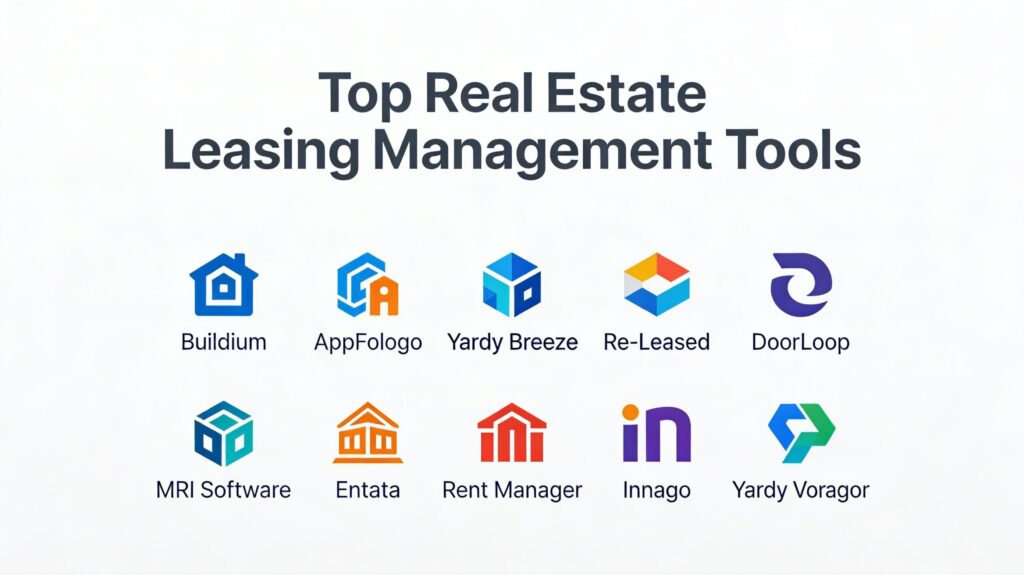
1. Buildium
Buildium is a comprehensive, all-in-one property management platform that has become the preferred choice for small to mid-sized residential property managers. It balances professional-grade accounting with an incredibly user-friendly leasing workflow that helps teams scale without adding administrative complexity.
Key Features
The platform features “Lumina AI,” which helps automate lead management and tenant communication. It includes a robust “Resident Center” for mobile rent payments, maintenance requests, and document access. The system offers “EZ Lease” functionality, which provides state-specific lease templates and integrated e-signatures. It also features a built-in accounting suite that supports both cash and accrual basis reporting. Additionally, its “Listing Syndication” tool pushes vacancies to over 20 major rental sites with a single click.
Pros
It offers one of the most intuitive interfaces in the market, making it easy for new staff to learn. The pricing model is transparent and accessible for growing portfolios without minimum unit requirements.
Cons
Some advanced analytical and insight tools are locked behind the higher-priced “Premium” tier. It is primarily residential-focused and lacks the complex CAM reconciliation tools needed for large-scale commercial retail.
Platforms and Deployment
Cloud-based SaaS with highly rated native mobile apps for iOS and Android.
Security and Compliance
Maintains SOC 2 compliance and utilizes bank-grade encryption for all financial transactions and tenant data.
Integrations and Ecosystem
Offers an extensive “Marketplace” for third-party integrations, including QuickBooks Online, TransUnion, and various utility services.
Support and Community
Provides a dedicated “Buildium Help Hub” and 24/7 ticket-based support, along with the “Buildium Academy” for user training.
2. AppFolio Property Manager
AppFolio is a modern, cloud-native platform designed for mid-to-large residential and commercial portfolios. It is renowned for its sleek design and “smart” automation features that significantly reduce the manual effort required for high-volume leasing operations.
Key Features
The platform features “Realm-X,” an AI-driven assistant that handles maintenance scheduling, lease renewals, and tenant inquiries. It includes a comprehensive “Leasing Gallery” for managing professional property photos and virtual tours. The system offers “Smart Bill Entry,” which uses OCR technology to read and process vendor invoices automatically. It features a robust “Mobile App for Owners” that provides real-time portfolio performance visibility. Additionally, it includes “AppFolio Investment Management” for organizations that need to manage capital raising and investor distributions.
Pros
The “Unified Data Architecture” ensures that all modules communicate in real-time without batch syncing. The AI-driven workflows are among the most advanced in the industry for reducing operational overhead.
Cons
Requires a minimum of 50 units for most plans, making it less accessible for very small independent landlords. The pricing can increase rapidly as you add more specialized modules and units.
Platforms and Deployment
Web-based SaaS with a fully integrated mobile ecosystem for tenants, owners, and staff.
Security and Compliance
Adheres to strict global data privacy standards and provides advanced user permission controls to protect sensitive financial data.
Integrations and Ecosystem
Features a curated “AppFolio Stack” of partners and a robust API for custom enterprise integrations.
Support and Community
Offers premium “white-glove” onboarding and a comprehensive knowledge base, though some users report high wait times for phone support.
3. Yardi Breeze
Yardi Breeze is the “agile” version of the industry-leading Yardi Voyager, designed to provide smaller property managers with the power of the Yardi ecosystem in a simplified, easy-to-deploy cloud platform. It is a top choice for firms that plan to scale into enterprise-level management.
Key Features
The platform features “Automated CAM Reconciliations,” making it a standout for mixed-use and commercial properties. It includes a “Basic Accounting” module that handles payables, receivables, and bank reconciliations with Yardi’s signature financial rigor. The system offers “Lease Tracking” with automated renewal alerts and critical date management. It features an “Online Resident Portal” for rent collection and maintenance requests. Additionally, it provides a “Commercial Tenant Portal” specifically designed for business tenants to track their unique lease obligations.
Pros
It provides a seamless migration path to Yardi Voyager if your portfolio grows to an enterprise scale. It is one of the few platforms in its price range that handles commercial lease complexities like percentage rent and triple-net leases.
Cons
The reporting depth is lighter compared to its big brother, Voyager, which may frustrate highly data-driven managers. The user interface, while improved, can still feel a bit more “traditional” than newer startups.
Platforms and Deployment
Cloud-based platform accessible via any modern web browser.
Security and Compliance
Built on Yardi’s enterprise security infrastructure, ensuring high-level data protection and compliance with real estate regulations.
Integrations and Ecosystem
Includes integrated “Yardi Matrix” data for market insights and connects with various Yardi add-on services like screening and insurance.
Support and Community
Provides live chat support directly within the platform and a robust library of training videos and documentation.
4. Re-Leased
Re-Leased is a specialized commercial lease management platform built for landlords and property managers who deal with office, industrial, and retail assets. It is designed to replace the complex spreadsheets typically used for commercial lease administration.
Key Features
The platform features “Credia AI,” which automatically extracts key terms and data from physical lease documents to populate the system. It includes an “Automated CAM/Service Charge” engine that simplifies the complex year-end reconciliation process. The system offers “Critical Date Alerts” that notify teams months in advance of rent reviews, break clauses, and expirations. It features a “Global Portfolio Dashboard” that provides a bird’s-eye view of occupancy and arrears across different regions. Additionally, it provides deep “Xero and QuickBooks” integration for real-time financial syncing.
Pros
It is one of the few tools natively built for the complexities of commercial real estate rather than being a residential tool “retrofitted” for commercial use. The AI lease abstraction saves hundreds of hours of manual data entry.
Cons
If your portfolio is 100% residential, you may find the platform overly complex for your needs. The pricing is on the higher end, reflecting its specialized commercial functionality.
Platforms and Deployment
Cloud-native SaaS designed for both desktop and mobile access.
Security and Compliance
Maintains ISO 27001 certification and provides full audit trails for every lease modification and financial transaction.
Integrations and Ecosystem
Renowned for its “Best-of-Breed” integration philosophy, specifically with top-tier accounting platforms like Xero, Sage, and NetSuite.
Support and Community
Provides localized support in major markets (US, UK, AU, NZ) and a dedicated customer success manager for enterprise accounts.
5. DoorLoop
DoorLoop is an all-in-one property management platform that markets itself on its modern, incredibly fast user interface and its ability to handle any type of property—from residential and commercial to student housing and self-storage.
Key Features
The platform features “Fully Integrated Accounting,” allowing users to manage their entire chart of accounts without needing a separate ledger. It includes an “Unlimited Document Storage” module with a secure e-signature platform for all lease agreements. The system offers “Automated Rent Collection” with zero fees for ACH payments on certain plans. It features a “Custom Website Builder” to help managers create professional-looking listing pages. Additionally, it provides a “CRM for Leads” to track every prospective tenant from the first inquiry to the signed lease.
Pros
The interface is widely considered one of the most “modern” and fastest to navigate in the real estate tech space. It offers high flexibility for managers who have a very diverse portfolio of asset types.
Cons
While it handles commercial properties, it lacks the extreme depth of specialized commercial-only platforms like Re-Leased. Some users find the pricing for the “Pro” and “Premium” tiers to be a jump.
Platforms and Deployment
Web-based SaaS with high-performance mobile apps for managing properties on the go.
Security and Compliance
Uses 256-bit encryption and maintains SOC 2 compliance to ensure all financial and personal data is secure.
Integrations and Ecosystem
Integrates with thousands of apps through Zapier and offers native connections to QuickBooks and various screening services.
Support and Community
Offers “World Class” support with lightning-fast response times and a dedicated account manager for most users.
6. MRI Software
MRI Software is an enterprise-grade powerhouse that has been a staple in the real estate industry for decades. It is known for its “Open and Connected” ecosystem, which allows large organizations to build a highly customized technology stack.
Key Features
The platform features “MRI Agora,” a centralized data platform that unifies insights across all modules and third-party apps. It includes “Advanced Commercial Management” for managing complex retail requirements like percentage rent and tenant sales tracking. The system offers “Investment Modeling” for deep financial forecasting and portfolio analysis. It features “Automated Lease Administration” with robust governance for international portfolios. Additionally, it provides specialized “Public Housing” and “Affordable Housing” modules to manage complex regulatory compliance.
Pros
The level of customization is unmatched, allowing the platform to be tailored to the exact workflows of a global real estate firm. Its “Open Architecture” means it can connect to almost any other enterprise system.
Cons
The implementation process is complex and can take several months, requiring significant internal IT resources. The cost and complexity make it unsuitable for small to mid-market property managers.
Platforms and Deployment
Offers cloud, hybrid, and on-premise deployment options to meet different corporate IT requirements.
Security and Compliance
Enterprise-grade security with support for global standards including GDPR, IFRS 16, and ASC 842 lease accounting.
Integrations and Ecosystem
The “MRI Partner Connect” program provides one of the largest ecosystems of pre-integrated third-party real estate applications.
Support and Community
Provides extensive global support with a dedicated “MRI University” and large-scale annual user conferences.
7. Entrata
Entrata is a comprehensive “Operating System” for multifamily real estate, known for its single-login approach that combines marketing, leasing, management, and accounting into one powerful, cohesive platform.
Key Features
The platform features “Entrata Core,” a robust accounting system built specifically for the needs of large apartment communities. It includes “LeaseExecution,” which automates the entire screening and signing process for prospective residents. The system offers “ResidentPay,” a flexible payment portal that supports multiple payment types and “buy-now-pay-later” rent options. It features “Entrata Insights,” a deep business intelligence tool for tracking real-time community performance. Additionally, its “Message Center” unifies all emails, texts, and calls into a single tenant communication thread.
Pros
The “Single-Login” architecture eliminates the need for messy integrations between separate marketing and management tools. It is exceptionally strong in the multifamily and student housing sectors.
Cons
The platform’s vast feature set can be overwhelming for smaller teams that don’t need a full “Operating System.” The pricing is generally quote-based and reflects its enterprise positioning.
Platforms and Deployment
Cloud-native platform with a suite of mobile apps for residents and site staff.
Security and Compliance
Maintains industry-leading security certifications and provides automated tools for maintaining Fair Housing compliance.
Integrations and Ecosystem
Offers a robust “App Store” and a well-documented API for connecting with external marketing and financial systems.
Support and Community
Provides high-touch customer success management and a massive library of on-demand training through “Entrata Academy.”
8. Rent Manager
Rent Manager is a highly configurable property management software that excels in managing non-traditional portfolios, such as manufactured housing, self-storage, and diverse mixed-use developments.
Key Features
The platform features “Rent Manager Online (RMO),” providing the full power of the desktop software in a modern cloud environment. It includes a “Custom Report Writer” that allows users to build nearly any financial or operational report from scratch. The system offers “User Defined Fields,” giving managers the ability to track any unique data point for their specific property type. It features “rmVoIP,” a fully integrated phone system that tracks and records every call with tenants and leads. Additionally, it provides a “Work Order Management” system with a dedicated technician mobile app.
Pros
It is widely considered the most “configurable” platform on this list, making it ideal for unique or complex property types. The offline/online flexibility (standalone vs. cloud) is unique in the modern SaaS market.
Cons
The high level of configurability means the initial setup and training can take longer than “out-of-the-box” solutions like Buildium. The interface can feel more technical and less “polished” than some newer competitors.
Platforms and Deployment
Available as a cloud SaaS, a private hosted solution, or a standalone desktop installation.
Security and Compliance
Provides robust data security and automated compliance tracking for HUD and other government-subsidized housing programs.
Integrations and Ecosystem
Integrates with over 160 third-party partners through its “API” and the “Rent Manager Marketplace.”
Support and Community
Offers a dedicated implementation specialist for new users and extensive training via “Rent Manager University.”
9. Innago
Innago is a high-value, streamlined property management tool designed for the independent landlord who needs professional features without the heavy monthly subscription fees of enterprise platforms.
Key Features
The platform features “Free Core Management,” where the landlord pays no monthly fee and costs are instead covered by small transaction fees paid by tenants. It includes “Digital Lease Signing” with customizable templates and automated storage. The system offers “Online Rent Collection” with automated late fees and reminders. It features a “Tenant Screening” module that provides credit, criminal, and eviction reports directly through the interface. Additionally, it provides “Maintenance Tracking” where tenants can upload photos and videos of repair needs.
Pros
It is the best value in the market for landlords with small portfolios who still want professional-grade screening and payment tools. The setup process is incredibly fast, often taking less than ten minutes to launch.
Cons
It lacks the deep “General Ledger” accounting and complex CAM reconciliation tools needed for professional management firms or commercial portfolios. It is primarily a “self-service” platform with fewer advanced automations.
Platforms and Deployment
Cloud-based SaaS with a simple, effective mobile app for both landlords and tenants.
Security and Compliance
Uses industry-standard encryption and partners with established financial institutions for secure payment processing and screening.
Integrations and Ecosystem
Offers a clean integration with QuickBooks Online for those who need more advanced accounting beyond the platform’s basic tools.
Support and Community
Provides surprisingly robust personal support for a free platform, including phone support and a detailed help center.
10. Yardi Voyager
Yardi Voyager is the undisputed “Gold Standard” for enterprise real estate management, serving the world’s largest REITs and global property management companies with unmatched depth and scalability.
Key Features
The platform features “Full Lifecycle Investment Management,” covering everything from capital raising to asset disposition. It includes “Automated Rent Roll” systems that are architected to meet GAAP and Sarbanes-Oxley compliance standards. The system offers “Global Multi-Currency Accounting,” allowing firms to manage portfolios across multiple countries and tax jurisdictions. It features “Virtuoso AI,” which provides automated insights into portfolio performance and risk management. Additionally, it provides specialized “Legal and Governance” tools for managing complex ownership structures.
Pros
It offers the most rigorous financial architecture in the industry, making it the only choice for many publicly traded real estate firms. The breadth of the Yardi ecosystem means you can manage every single aspect of real estate within one vendor.
Cons
The implementation is a massive undertaking, often taking 6-12 months and requiring dedicated consulting teams. The interface is powerful but extremely complex, requiring significant training for all users.
Platforms and Deployment
Cloud-based enterprise platform with various specialized mobile apps for different staff roles.
Security and Compliance
Maintains the highest possible security certifications (SOC 1, SOC 2) and provides the rigor needed for high-level regulatory audits.
Integrations and Ecosystem
The Yardi ecosystem is the largest in the world, with hundreds of native modules and thousands of third-party integration partners.
Support and Community
Provides dedicated account management teams and massive annual conferences (YASC) for networking and training.
Comparison Table
| Tool Name | Best For | Platform(s) Supported | Deployment | Standout Feature | Public Rating |
| 1. Buildium | Residential SMBs | Web, iOS, Android | Cloud SaaS | Lumina AI Automation | 4.6/5 |
| 2. AppFolio | Mid-to-Large Residential | Web, iOS, Android | Cloud SaaS | Realm-X AI Agent | 4.6/5 |
| 3. Yardi Breeze | Mixed-Use Scalability | Web-Based | Cloud SaaS | Automated CAM Reconciles | 4.4/5 |
| 4. Re-Leased | Specialized Commercial | Web, iOS, Android | Cloud SaaS | AI Lease Abstraction | 4.6/5 |
| 5. DoorLoop | Diverse Portfolios | Web, iOS, Android | Cloud SaaS | All-in-One UI Speed | 4.8/5 |
| 6. MRI Software | Global Enterprise | Web, Hybrid | Enterprise Cloud | Open Architecture | 4.2/5 |
| 7. Entrata | Large Multifamily | Web, iOS, Android | Cloud SaaS | Single-Login OS | 4.6/5 |
| 8. Rent Manager | Unique Asset Types | Web, Desktop | Cloud / Local | Custom Configurability | 4.6/5 |
| 9. Innago | Independent Landlords | Web, iOS, Android | Cloud SaaS | $0 Subscription Model | 4.8/5 |
| 10. Yardi Voyager | REITs / Institutional | Web-Based | Enterprise Cloud | Audit-Grade Accounting | 4.1/5 |
Evaluation & Scoring of Real Estate Leasing Management Tools
The scoring below is a comparative model intended to help shortlisting. Each criterion is scored from 1–10, then a weighted total from 0–10 is calculated using the weights listed. These are analyst estimates based on typical fit and common workflow requirements, not public ratings.
Weights:
- Core features – 25%
- Ease of use – 15%
- Integrations & ecosystem – 15%
- Security & compliance – 10%
- Performance & reliability – 10%
- Support & community – 10%
- Price / value – 15%
| Tool Name | Core (25%) | Ease (15%) | Integrations (15%) | Security (10%) | Performance (10%) | Support (10%) | Value (15%) | Weighted Total |
| 1. Buildium | 9 | 9 | 8 | 9 | 9 | 9 | 9 | 8.85 |
| 2. AppFolio | 10 | 8 | 7 | 9 | 10 | 8 | 7 | 8.55 |
| 3. Yardi Breeze | 8 | 8 | 7 | 10 | 9 | 8 | 8 | 8.05 |
| 4. Re-Leased | 9 | 8 | 9 | 9 | 9 | 9 | 7 | 8.50 |
| 5. DoorLoop | 8 | 10 | 8 | 9 | 10 | 10 | 9 | 8.95 |
| 6. MRI Software | 10 | 4 | 10 | 10 | 9 | 8 | 6 | 8.15 |
| 7. Entrata | 10 | 7 | 8 | 9 | 9 | 9 | 7 | 8.50 |
| 8. Rent Manager | 9 | 6 | 9 | 9 | 9 | 9 | 8 | 8.30 |
| 9. Innago | 7 | 10 | 7 | 8 | 9 | 8 | 10 | 8.25 |
| 10. Yardi Voyager | 10 | 3 | 10 | 10 | 9 | 8 | 6 | 8.00 |
How to interpret the scores:
- Use the weighted total to shortlist candidates, then validate with a pilot.
- A lower score can mean specialization, not weakness.
- Security and compliance scores reflect controllability and governance fit, because certifications are often not publicly stated.
- Actual outcomes vary with assembly size, team skills, templates, and process maturity.
Which Real Estate Leasing Management Tool Is Right for You?
Solo / Freelancer
For the “DIY” landlord managing a handful of units, simplicity and cost are the most critical factors. You need a platform that streamlines the basics—tenant screening, rent collection, and digital lease signing—without the weight of a complex accounting system. A solution that operates on a “no-monthly-fee” basis is often the smartest move here, allowing you to maintain professional standards while keeping your overhead near zero.
SMB
As you transition from a handful of units to a professional management business (50–500 units), your needs shift toward operational efficiency and owner transparency. You require a tool that syndicates your listings automatically and provides professional “Owner Portals” to build trust with your clients. Look for “Goldilocks” solutions that provide a robust accounting base and automated workflows without the multi-month implementation times of enterprise software.
Multifamily / Student Housing Specialist
High-density housing requires a platform that can handle massive “turnover seasons” and centralized community operations. The priority here is a unified experience where marketing, leasing, and resident services are all contained in a single login. Advanced resident communication tools and “buy-now-pay-later” rent options are essential for maintaining high occupancy and resident satisfaction in competitive markets.
Commercial / Mixed-Use Manager
Commercial leasing is a different beast entirely, requiring rigorous tracking of “critical dates” like rent reviews and break clauses. Your platform must be able to handle complex CAM (Common Area Maintenance) reconciliations and triple-net lease structures. For these assets, a specialized commercial tool that uses AI to abstract lease data from legal documents will save you hundreds of hours of manual work and prevent costly oversights.
Institutional / REIT Enterprise
For firms managing billions in assets across international borders, financial rigor and data governance are the top priorities. You require a platform that is architected for audit-grade compliance and can handle multi-entity, multi-currency accounting natively. At this scale, the ability to customize every workflow and connect with a vast ecosystem of third-party data providers is more important than a “pretty” interface.
Budget vs Premium
Budget options are excellent for those starting out, focusing on the core essentials like payments and screening. However, as your portfolio grows, the “premium” features—like AI-driven maintenance scheduling or advanced financial forecasting—often pay for themselves through reduced labor costs and higher asset yields. The “best” value is found where the software’s automation features allow you to manage more units per employee.
Mobile-First vs Desktop-Heavy
Consider how your team actually works. If your staff is constantly in the field performing inspections and meeting tenants, a platform with a world-class “Mobile App for Staff” is essential. Conversely, if your operation is centralized in a back-office with heavy accounting needs, you may prioritize a web-based dashboard with deep reporting capabilities and dual-screen data entry features.
Security & Scalability
Always look two years ahead when selecting a tool. Migration is painful, so choose a platform that can handle where you plan to be, not just where you are today. Ensure the platform has the security certifications (like SOC 2) required by your most sophisticated owners and the “API depth” to integrate with future technologies like smart home sensors or institutional capital portals.
Frequently Asked Questions (FAQs)
1. What is the difference between property management and leasing management software?
Leasing management focuses specifically on the “front-end” of the relationship—marketing, applications, screening, and document signing. Property management software is a broader category that includes leasing but also handles long-term accounting, maintenance, and owner reporting. Most modern tools combine both into a single platform.
2. How does automated tenant screening work?
When an applicant submits a rental application, the platform automatically requests reports from credit bureaus and national criminal/eviction databases. The results are typically delivered in minutes, providing a “recommendation” based on your pre-set criteria, which helps ensure Fair Housing compliance and speeds up the approval process.
3. Is it safe to collect rent through an online portal?
Yes, professional leasing tools use bank-grade encryption (SSL/TLS) and are usually PCI-compliant to handle financial data. Collecting rent through a portal is actually much safer than handling physical checks or cash, as it creates an instant digital audit trail and reduces the risk of loss or theft.
4. Can I migrate my data from spreadsheets to these tools?
Most platforms offer “Data Migration” services where they take your existing Excel or CSV files and import them into the new system. For larger portfolios, enterprise vendors often provide a dedicated implementation specialist to ensure that your historical ledgers and lease data are mapped correctly.
5. What is “AI Lease Abstraction”?
This is a feature—often found in commercial platforms—where Artificial Intelligence “reads” a PDF of a lease and automatically identifies and extracts key data like rent amounts, expiration dates, and renewal options. This eliminates the need for manual data entry and reduces the risk of human error in complex commercial leases.
6. Do these tools handle “Section 8” or affordable housing compliance?
Yes, several specialized platforms (like Yardi and Rent Manager) have built-in modules specifically designed for HUD and Section 8 compliance. They automate the complex calculations and reporting required for government-subsidized housing programs to ensure you stay in compliance with federal regulations.
7. Can I use these tools if I only have one or two properties?
Absolutely. There are “freemium” or “pay-per-unit” models (like Innago or Buildium) that are designed specifically for small-scale landlords. These tools provide you with the same professional-grade screening and payment tools used by large firms, helping you manage your properties more effectively.
8. What are “CAM Reconciliations”?
Common Area Maintenance (CAM) reconciliations are the year-end process in commercial real estate where the actual costs of operating a building (like security, cleaning, and taxes) are compared against what the tenants paid in estimates. Specialized software automates this calculation based on each tenant’s “pro-rata share.”
9. How do mobile apps for tenants benefit the property manager?
Tenant apps significantly reduce “administrative noise” by allowing residents to pay rent, report maintenance issues with photos, and renew their leases without calling or emailing the office. This “self-service” model increases tenant satisfaction while freeing up the manager’s time for more important tasks.
10. What is an “Owner Portal”?
An owner portal is a secure website where the property owner can log in to see their financial statements, active work orders, and real-time occupancy of their properties. This transparency reduces the number of “status update” requests a manager receives and improves the overall professional image of the firm.
Conclusion
The selection of a real estate leasing management tool is a foundational decision that impacts every stakeholder in the property lifecycle—from the site technician to the institutional investor. The market has matured to offer specialized solutions for every niche, whether it’s the AI-powered commercial efficiency of Re-Leased or the “operating system” simplicity of Entrata for multifamily communities. By leveraging these technologies, property managers can eliminate the “friction” of manual paperwork, reduce vacancy times through smarter marketing, and provide a level of financial transparency that was previously impossible. Ultimately, the best tool is the one that aligns with your portfolio’s complexity while providing the scalability to grow alongside your ambitions.