Introduction
A Radiology Information System (RIS) is the core operational software used by radiology departments and diagnostic centers to manage the business and clinical side of medical imaging. Unlike a PACS (Picture Archiving and Communication System), which focuses on storing and viewing the images themselves, an RIS manages the metadata, patient flow, and administrative tasks that keep a facility running. It acts as the “brain” of the department, handling everything from the moment a physician places an order to the final delivery of the diagnostic report and the subsequent billing process.
The role of RIS has evolved from a simple digital filing cabinet into an intelligent orchestration engine. Modern systems are now expected to manage massive patient volumes while integrating seamlessly with AI-driven diagnostic tools and complex Electronic Health Records (EHR). For healthcare executives, selecting the right RIS is no longer just a technical checkbox; it is a strategic decision that affects clinician burnout, patient wait times, and the financial health of the entire healthcare enterprise.
- Best for: Multi-modality hospitals, private diagnostic imaging centers, teleradiology groups, and large-scale healthcare networks.
- Not ideal for: General practitioner clinics that do not perform on-site imaging or small facilities with extremely low patient volumes.
Key Trends in Radiology Information Systems
- AI-Ready Workflow Orchestration: Modern RIS platforms now use machine learning to prioritize urgent cases in the worklist, ensuring that critical findings are flagged for immediate review.
- Open Interoperability Standards: Broad adoption of FHIR and HL7 protocols allows the RIS to share data effortlessly with diverse EHRs and external physician portals.
- Zero-Footprint Web Access: Radiologists can now access fully functional worklists and reporting tools through any secure browser without needing localized software installations.
- Patient-Centric Automation: Automated SMS and WhatsApp notifications for appointment reminders and secure portal links for patient result delivery.
- Cloud-Native Scalability: A shift toward “Software as a Service” (SaaS) models that reduce on-premise server maintenance while providing robust disaster recovery.
- Integrated Business Intelligence: Real-time dashboards that monitor equipment utilization, technologist performance, and referral patterns to optimize revenue.
How We Selected These Tools
- Market Presence and Reliability: Preference was given to established vendors with a proven track record of uptime in high-volume environments.
- Workflow Depth: Analysis of features across the entire patient journey—from scheduling and registration to reporting and billing.
- Integration Capabilities: Evaluation of how easily the system connects with diverse PACS, VNA, and EHR platforms.
- Security & Compliance Standards: Verification of HIPAA, GDPR, and localized health data protection standards.
- AI Integration Maturity: Prioritizing systems that offer “invisible” background AI processing for triage and automated measurements.
- User Feedback and Scalability: Reviewing how well the platforms perform under the stress of 2026-level imaging volumes.
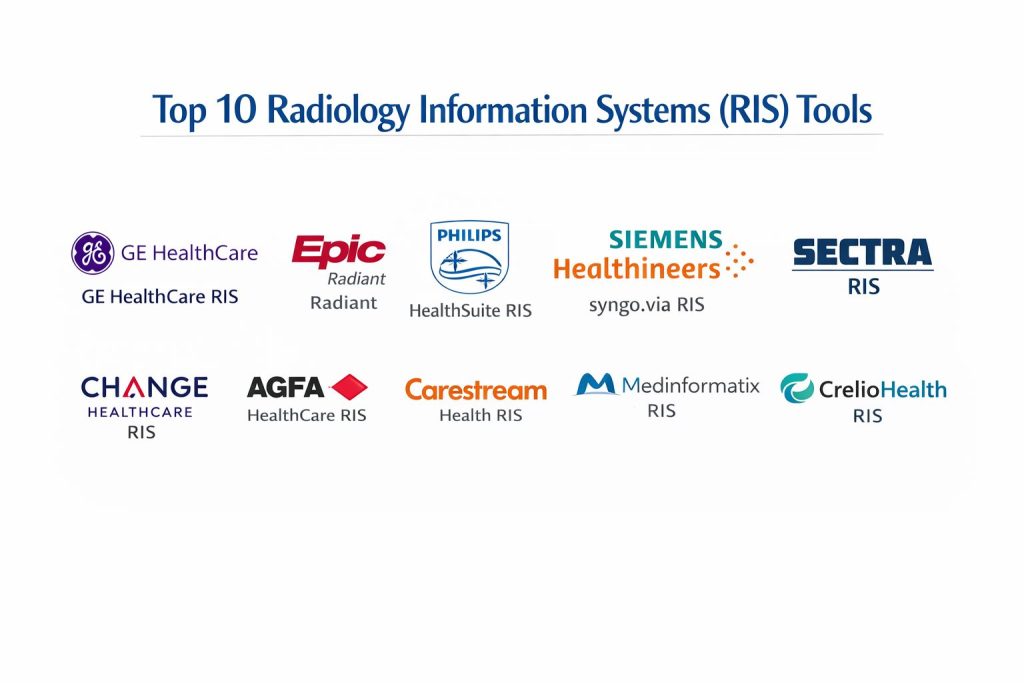
Top 10 Radiology Information System (RIS) Tools
1. GE HealthCare RIS
A powerful, enterprise-grade solution designed for large hospital networks that require deep automation and complex analytics.
Key Features
- Intelligent Worklist Management: Uses AI to categorize and route cases based on urgency and radiologist specialty.
- Enterprise-Wide Scheduling: Manages resources across multiple locations and modalities in a single view.
- Integrated Revenue Cycle Management: Seamlessly connects clinical documentation to billing for faster reimbursement.
- Advanced Analytics Dashboard: Provides real-time insights into modality performance and patient throughput.
- Scalable Web Architecture: Supports remote reading and multi-facility coordination through a secure web portal.
Pros
- Exceptional scalability for the world’s largest healthcare organizations.
- Deep integration with GE’s vast ecosystem of imaging hardware and PACS.
Cons
- Higher total cost of ownership compared to modular solutions.
- Can be overly complex for small, single-site diagnostic centers.
Platforms / Deployment
- Windows / Web-based
- On-premise / Hybrid / Cloud
Security & Compliance
- HIPAA, GDPR, ISO 27001, and role-based access controls (RBAC).
Integrations & Ecosystem
Offers industry-leading integration with major HIS/EHR systems and remains a hub for the GE HealthCare digital health platform.
Support & Community
Global 24/7 technical support with dedicated account managers and extensive user training programs.
2. Epic Radiant
Radiant is the radiology-specific module of the Epic EHR, providing an unmatched level of clinical continuity and data centralisation.
Key Features
- Unified Patient Record: Eliminates the need for data transfer between RIS and EHR; everything lives in one record.
- Embedded Decision Support: Provides clinical guidelines to referring physicians at the point of order entry.
- Integrated Patient Portal: Allows patients to schedule exams and view reports directly via MyChart.
- Comprehensive Tech Worklists: Streamlines the technologist’s workflow from patient arrival to image acquisition.
- In-Depth Financial Integration: Leverages Epic’s powerful billing engine for high-accuracy claims processing.
Pros
- Zero-friction data flow for hospitals already using the Epic ecosystem.
- Highly effective at reducing duplicate testing and administrative errors.
Cons
- Only available to organizations that are already Epic EHR customers.
- Implementation is a massive undertaking requiring significant internal resources.
Platforms / Deployment
- Windows / Web
- Cloud-hosted (Epic-managed)
Security & Compliance
- Enterprise-grade security with advanced audit trails and strict HIPAA compliance.
Integrations & Ecosystem
Native integration with all other Epic modules and broad support for HL7/FHIR for external connections.
Support & Community
Direct vendor support supplemented by a highly active and collaborative community of Epic users.
3. Philips HealthSuite RIS
A clinical-first RIS designed to bridge the gap between diagnostic data and actionable treatment plans through smart orchestration.
Key Features
- Patient Journey Tracking: Visualizes the entire patient lifecycle within the department in real-time.
- Workflow Orchestrator: Intelligently balances workloads across the radiology team to prevent burnout.
- Native Voice Recognition Integration: Supports hands-free reporting to speed up the turnaround time of results.
- Collaborative Care Tools: Facilitates easy sharing of reports and images with referring physicians through a secure portal.
- Energy-Efficient Cloud Hosting: Optimized for lower infrastructure costs and environmental impact.
Pros
- Modern, intuitive interface that focuses on reducing clicks for the user.
- Strong focus on interoperability with non-Philips PACS systems.
Cons
- Some advanced features require additional modular licensing.
- Integration with older legacy HIS systems can occasionally be complex.
Platforms / Deployment
- Web-based
- Cloud-native / Hybrid
Security & Compliance
- SOC2 Type II, HIPAA, and advanced encryption for data at rest and in transit.
Integrations & Ecosystem
Strongest when paired with Philips’ wider HealthSuite digital platform but supports all major DICOM/HL7 standards.
Support & Community
Professional support services with a focus on workflow optimization and clinical performance consulting.
4. Siemens Healthineers syngo.via / RIS
Siemens offers a highly technical RIS that leverages AI and clinical specialized modules to enhance diagnostic precision.
Key Features
- AI-Powered Decision Support: Automatically flags potentially critical findings during the ingestion process.
- Specialized Clinical Workflows: Dedicated modules for oncology, cardiology, and neurology imaging needs.
- Integrated Reporting Templates: Ensures consistency and quality through structured, modality-specific templates.
- Global Worklist Sharing: Allows for easy distribution of cases across a distributed network of radiologists.
- Proactive System Monitoring: Predictive maintenance for both software and connected imaging hardware.
Pros
- Unrivaled for facilities that focus on high-end specialized imaging.
- Excellent technical reliability and deep hardware-software synergy.
Cons
- Steep learning curve for administrative staff due to the technical depth.
- Subscription pricing can be complex to manage for mid-market users.
Platforms / Deployment
- Windows / Web
- On-premise / Cloud
Security & Compliance
- Comprehensive cybersecurity framework with 24/7 monitoring capabilities.
Integrations & Ecosystem
Designed to function as an open platform that integrates with third-party AI and PACS vendors.
Support & Community
Siemens provides extensive educational resources through its PEPconnect platform and global technical support.
5. Sectra RIS
Known for its extreme stability and security, Sectra RIS is a favorite for government and high-security enterprise environments.
Key Features
- Unified RIS/PACS Interface: Provides a “single pane of glass” experience for radiologists and staff.
- Advanced Security Architecture: Built from the ground up to exceed national cybersecurity requirements.
- Dynamic Worklist Prioritization: Adjusts the reading queue based on clinical urgency and service level agreements (SLAs).
- Multi-Site Coordination: Effortlessly manages patient data across multiple regional health systems.
- Integrated Peer Review: Built-in quality assurance tools for continuous clinical improvement.
Pros
- Consistently ranked high for user satisfaction and system reliability.
- Exceptional customer support and a collaborative development approach.
Cons
- Market presence is smaller in some regions compared to the “Big Three” (GE, Philips, Siemens).
- Initial implementation costs can be higher than modular outpatient systems.
Platforms / Deployment
- Windows / Web-based
- Hybrid / Cloud
Security & Compliance
- High-level security certifications, suitable for defense-grade or national health projects.
Integrations & Ecosystem
Highly vendor-neutral, allowing for easy integration with any PACS or EHR on the market.
Support & Community
Regular user group meetings and a reputation for being highly responsive to customer feedback.
6. Change Healthcare RIS (Part of UnitedHealth Group)
A financially-focused RIS that excels at managing the business side of imaging, particularly in the North American market.
Key Features
- Advanced Billing & Collections: Specialized tools for insurance verification and automated claims management.
- Referral Management Portal: Helps imaging centers track and nurture relationships with referring doctors.
- Integrated Teleradiology Support: Built-in features for managing remote reading contracts and workflows.
- Performance Analytics: Deep financial reporting to help centers identify their most profitable modalities.
- Regulatory Compliance Suite: Automated updates for the latest medical coding and billing regulations.
Pros
- Best-in-class for outpatient imaging centers focused on maximizing revenue.
- Strong integration with Change Healthcare’s massive financial network.
Cons
- The clinical interface is sometimes perceived as less modern than competitors.
- Corporate structure changes can impact long-term roadmap visibility.
Platforms / Deployment
- Windows / Web
- Cloud-hosted
Security & Compliance
- HIPAA, HITECH, and deep financial data protection standards.
Integrations & Ecosystem
Excellent integration with billing clearinghouses and large-scale payer networks.
Support & Community
Wide-scale professional support and a large user base within the private imaging sector.
7. Agfa HealthCare RIS
Agfa provides a modular RIS that is highly adaptable to the specific workflow needs of diverse imaging facilities.
Key Features
- Enterprise Imaging Integration: Designed to work as part of a total “imaging record” strategy.
- Worklist Orchestration: Prevents bottlenecks by automatically re-routing cases during peak hours.
- Embedded AI Triage: Flags suspected time-critical findings directly in the RIS worklist.
- Flexible Reporting Tools: Supports both voice recognition and highly customized structured templates.
- Referrer Access Portals: Provides a seamless way for outside doctors to view reports and track status.
Pros
- High degree of customization available for specific clinical departmental needs.
- Strong international presence with support for multiple languages and regulations.
Cons
- UI can feel slightly dated in the older versions of the software.
- Requires a well-trained IT staff to manage the high level of customization.
Platforms / Deployment
- Windows / Web
- On-premise / Hybrid
Security & Compliance
- HIPAA and GDPR compliant with robust audit logging for all patient interactions.
Integrations & Ecosystem
A strong proponent of vendor neutrality, ensuring it plays well in heterogeneous IT environments.
Support & Community
Comprehensive service level agreements and a dedicated global help desk.
8. Carestream Health RIS
A balanced RIS solution that focuses on ease of use and streamlined clinical productivity for mid-market facilities.
Key Features
- Single-Screen Workflow: Aimed at reducing administrative burden by consolidating patient data onto one screen.
- Integrated PACS/RIS Solution: Offers a unified database to eliminate data synchronization errors.
- Automated Result Distribution: Sends reports via fax, email, or secure portal automatically upon sign-off.
- Inventory Management: Tracks consumables like contrast media and film (where applicable) automatically.
- Customizable Dashboard: Allows administrators to see the most important KPIs at a glance.
Pros
- Highly cost-effective for mid-sized hospitals and private clinics.
- Easy to implement and requires less user training than larger enterprise systems.
Cons
- May lack some of the extreme technical specialized modules found in Siemens or GE.
- Cloud transition is still ongoing for some legacy modules.
Platforms / Deployment
- Windows / Web
- Desktop-centric / Hybrid
Security & Compliance
- HIPAA compliant with standard encryption and access management features.
Integrations & Ecosystem
Excellent connectivity with Carestream’s own popular imaging hardware and PACS systems.
Support & Community
Reliable customer service with a focus on quick resolution times for smaller facilities.
9. Medinformatix RIS
A “radiology-first” system that is highly specialized for the outpatient market with a strong emphasis on the user experience.
Key Features
- Radiology-Specific EMR: Built specifically for the needs of imaging centers rather than general hospitals.
- Customizable eForms: Allows centers to digitize all patient intake paperwork with ease.
- Wait-Time Tracking: Provides real-time data on how long patients are waiting in the lobby.
- Automated Pre-Authorizations: Helps staff clear insurance hurdles before the patient arrives.
- Mobile-Friendly Portals: Patients can complete registration on their phones via a secure link.
Pros
- Exceptional at improving the “front-of-house” patient experience.
- Highly responsive to specific requests for workflow customizations.
Cons
- Smaller enterprise scale compared to the major international conglomerates.
- Integration with deep clinical EHRs can require more custom development.
Platforms / Deployment
- Windows
- Desktop / Hybrid
Security & Compliance
- HIPAA compliant with a focus on protecting patient data in the outpatient setting.
Integrations & Ecosystem
Strongest integration with outpatient PACS and medical billing systems.
Support & Community
Direct access to developers and a very high level of personalized customer service.
10. CrelioHealth RIS
A modern, cloud-native RIS that focuses on extreme ease of use and rapid digital communication for diagnostic centers.
Key Features
- WhatsApp/SMS Integration: Automatically delivers report links to patients via common messaging apps.
- Zero-Install Viewer: Allows referring doctors to view DICOM images directly in their browser.
- Multi-Location Hub: Manages dozens of collection centers and processing labs from a single portal.
- Dynamic Template Engine: Allows for the rapid creation of modality-specific reporting templates.
- Automated Financial Tracking: Monitors daily collections and outstanding dues in real-time.
Pros
- The fastest system to deploy, often going live in a matter of days.
- Modern, “app-like” interface that requires almost zero training for staff.
Cons
- Lacks the deep clinical “specialty modules” required for academic medical centers.
- Primarily designed for the outpatient and diagnostic lab market.
Platforms / Deployment
- Web-based
- Cloud-native
Security & Compliance
- HIPAA and GDPR compliant with modern cloud-based security protocols.
Integrations & Ecosystem
Built on a modern API, making it easy to connect to other cloud-based medical software.
Support & Community
High-speed digital support and a rapidly growing international user base.
Comparison Table
| Tool Name | Best For | Platform(s) Supported | Deployment | Standout Feature | Public Rating |
| 1. GE HealthCare RIS | Large Enterprises | Windows, Web | Hybrid | Enterprise Scalability | N/A |
| 2. Epic Radiant | Epic-based Hospitals | Windows, Web | Cloud | Unified EHR Record | N/A |
| 3. Philips HealthSuite | Clinical Workflow | Web-based | Cloud-native | Smart Orchestration | N/A |
| 4. Siemens syngo.via | High-End Specialty | Windows, Web | Hybrid | AI Clinical Modules | N/A |
| 5. Sectra RIS | High Security | Windows, Web | Hybrid | Cybersecurity Focus | N/A |
| 6. Change Healthcare | Financial ROI | Windows, Web | Cloud | Revenue Cycle Tools | N/A |
| 7. Agfa HealthCare | Adaptability | Windows, Web | Hybrid | Modular Flexibility | N/A |
| 8. Carestream RIS | Mid-Market | Windows, Web | Local/Hybrid | Ease of Use | N/A |
| 9. Medinformatix | Outpatient Centers | Windows | Local/Hybrid | Patient Experience | N/A |
| 10. CrelioHealth | Modern Diagnostics | Web-based | Cloud-native | SMS/WhatsApp Integration | N/A |
Evaluation & Scoring of Radiology Information Systems (RIS)
The scoring below is a comparative model intended to help shortlisting. Each criterion is scored from 1–10, then a weighted total from 0–10 is calculated using the weights listed. These are analyst estimates based on typical fit and common workflow requirements, not public ratings.
Weights:
- Core features – 25%
- Ease of use – 15%
- Integrations & ecosystem – 15%
- Security & compliance – 10%
- Performance & reliability – 10%
- Support & community – 10%
- Price / value – 15%
| Tool Name | Core (25%) | Ease (15%) | Integrations (15%) | Security (10%) | Performance (10%) | Support (10%) | Value (15%) | Total |
| 1. GE RIS | 10 | 5 | 10 | 9 | 9 | 9 | 6 | 8.35 |
| 2. Epic Radiant | 10 | 4 | 10 | 10 | 9 | 8 | 5 | 8.15 |
| 3. Philips RIS | 9 | 8 | 9 | 9 | 8 | 8 | 7 | 8.30 |
| 4. Siemens RIS | 10 | 5 | 9 | 9 | 10 | 9 | 6 | 8.20 |
| 5. Sectra RIS | 9 | 7 | 8 | 10 | 9 | 10 | 7 | 8.35 |
| 6. Change RIS | 8 | 7 | 9 | 8 | 8 | 8 | 8 | 7.95 |
| 7. Agfa RIS | 8 | 6 | 8 | 8 | 8 | 7 | 7 | 7.35 |
| 8. Carestream RIS | 7 | 8 | 7 | 8 | 8 | 8 | 9 | 7.65 |
| 9. Medinformatix | 8 | 9 | 7 | 7 | 8 | 9 | 8 | 7.95 |
| 10. CrelioHealth | 7 | 10 | 8 | 7 | 9 | 8 | 10 | 8.15 |
How to interpret the scores:
- Use the weighted total to shortlist candidates, then validate with a pilot.
- A lower score can mean specialization, not weakness.
- Security and compliance scores reflect controllability and governance fit, because certifications are often not publicly stated.
- Actual outcomes vary with assembly size, team skills, templates, and process maturity.
Which Radiology Information System (RIS) Is Right for You?
Solo / Small Diagnostic Center
For a small site where speed and cost are the primary drivers, CrelioHealth or Medinformatix offer the best user experience and patient communication tools without the overhead of an enterprise suite.
Mid-Market / Independent Imaging Network
For a growing network of 5-10 sites, Carestream or Change Healthcare provide the right balance of financial management and clinical reliability needed to maintain healthy margins and a steady workflow.
Mid-Market Hospital
A hospital with 200-500 beds should look toward Philips HealthSuite or Sectra. These platforms offer the technical depth required for diverse modalities while being easier to manage than the massive enterprise equivalents.
Enterprise / Academic Medical Center
At the highest level, GE HealthCare RIS or Epic Radiant (if you already use Epic EHR) are the only solutions capable of managing the extreme complexity, data volume, and security requirements of a global health network.
Frequently Asked Questions
1. What is the difference between RIS and PACS?
The RIS manages patient data, schedules, and administrative workflows, while the PACS (Picture Archiving and Communication System) stores and displays the actual medical images.
2. Can an RIS integrate with my existing EHR?
Yes, most modern RIS systems use HL7 or FHIR standards to communicate directly with EHRs like Epic, Cerner, or Allscripts to ensure data consistency.
3. Does RIS software help with medical billing?
Most RIS solutions include or integrate with Revenue Cycle Management (RCM) tools to handle insurance verification, coding, and claims submission.
4. Is cloud-based RIS secure?
Cloud RIS use advanced encryption and compliance frameworks (HIPAA/GDPR) that are often more secure than on-premise servers managed by local staff.
5. How does AI benefit an RIS?
AI can help by prioritizing urgent cases in the worklist, automating repetitive data entry, and providing clinical decision support during the reporting process.
6. Do I need specialized hardware to run an RIS?
Most modern RIS systems are web-based and can run on standard PCs, though radiologists usually require high-resolution diagnostic monitors for viewing images.
7. Can patients access their own reports via the RIS?
Yes, most modern systems include a secure patient portal where individuals can view their reports and download their images directly.
8. How long does it take to implement a new RIS?
Cloud-native systems can be set up in days or weeks, while large-scale enterprise hospital implementations can take 6 to 12 months.
9. What is a “Modality Worklist”?
It is a feature that sends patient and exam information directly from the RIS to the imaging machine (like an MRI or CT), eliminating manual data entry by the technologist.
10. Is an RIS necessary for a small clinic?
If the clinic performs its own imaging, an RIS is essential for tracking patients and ensuring reports are not lost or delayed.
Conclusion
Selecting a Radiology Information System is a pivotal investment that determines the long-term agility and efficiency of your imaging department.The ideal RIS must serve as more than a simple database; it must be a proactive partner that leverages AI for triage, automates patient engagement, and maintains the highest standards of data security. Whether you are a small diagnostic center looking for the rapid communication of CrelioHealth or an enterprise hospital requiring the deep integration of GE or Epic, your choice will ultimately define your facility’s ability to provide timely, accurate patient care. I recommend starting with a workflow audit of your current system to identify bottlenecks before scheduling demonstrations with at least three of these top-tier vendors.