Introduction
Preference management tools represent a critical evolution in customer data strategy, moving beyond simple “unsubscribe” buttons to granular, user-controlled communication frameworks. These platforms allow organizations to capture, store, and synchronize specific user choices regarding channel frequency, content topics, and data usage permissions across fragmented digital ecosystems. In the modern enterprise, a preference center acts as the “source of truth” for customer intent, ensuring that marketing automation, CRM, and data warehouse systems operate in alignment with the user’s explicit desires. By providing this transparency, businesses can drastically reduce churn, improve engagement rates, and build long-term brand equity through trust-based interactions.
The necessity of these tools is driven by a dual pressure: increasing global privacy regulations and a marketplace shift toward hyper-personalization. Modern consumers expect a “self-service” experience where they can pause communications or opt into specific newsletters without losing access to the brand entirely. From a technical standpoint, these platforms solve the “preference fragmentation” problem, where a user might opt-out on a mobile app but still receive emails due to desynchronized databases. When evaluating these tools, buyers must prioritize real-time orchestration, the ability to handle complex identity resolution, and the flexibility to deploy localized experiences that comply with varying regional laws like GDPR and CPRA.
Best for: Global marketing teams, privacy officers, and customer experience (CX) directors who need to harmonize user choice across multiple brands, regions, and communication channels.
Not ideal for: Small businesses with a single mailing list or organizations that only require basic “all-or-nothing” unsubscribe functionality without the need for cross-system data synchronization.
Key Trends in Preference Management Tools
The industry is rapidly shifting toward “Zero-Party Data” collection, where preference centers are used as strategic touchpoints to ask users directly about their interests and purchase intent. This trend turns a compliance requirement into a powerful marketing asset, providing high-quality data that third-party cookies can no longer provide. There is also a massive move toward real-time enforcement, where a change made in a preference center is propagated to downstream marketing tools in milliseconds, preventing “accidental” communications that could lead to regulatory fines or brand damage.
AI-driven optimization is another major trend, with platforms using machine learning to suggest “optimal” communication frequencies to users, potentially preventing a full opt-out by offering a “less frequent” alternative. We are also seeing the rise of omni-channel centers that manage preferences not just for email and SMS, but for push notifications, direct mail, and even personalized web experiences. Finally, there is a strong focus on “Privacy UX,” with brands designing their preference centers to be as intuitive and aesthetically pleasing as their main product interfaces, reinforcing the idea that respecting privacy is a core brand value.
How We Selected These Tools
The selection of these top 10 tools involved a rigorous evaluation of their ability to scale within complex enterprise environments. We prioritized platforms that offer native “orchestration” capabilities—the ability to not just record a preference, but to actively enforce it across other software. Reliability was a key metric, as a preference center must have near-perfect uptime to ensure that user choices are always captured and respected. We also analyzed the depth of their API libraries, looking for tools that allow developers to build custom front-end experiences while utilizing a robust back-end repository.
Market presence and regulatory “future-proofing” were also essential criteria. We selected tools that consistently update their frameworks to include new global privacy laws and industry standards. Ease of integration with major CRM and CDP platforms was heavily weighted, as a preference tool is only as good as its connection to the rest of the tech stack. Finally, we considered the “User Experience” from both sides: the administrative interface for marketing teams to build centers and the end-user interface where customers manage their choices.
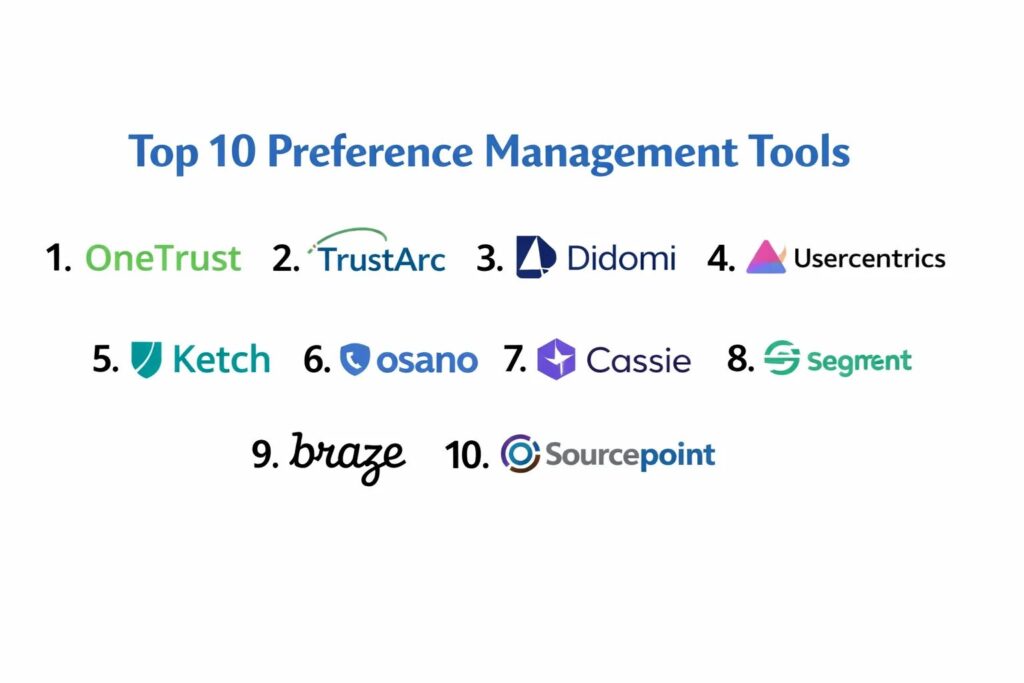
1. OneTrust PreferenceChoice
OneTrust is the dominant leader in the GRC (Governance, Risk, and Compliance) space, offering a massive, modular suite of privacy tools. Its PreferenceChoice module is designed for the most complex global enterprises, providing a centralized repository that can manage millions of unique user profiles across hundreds of different jurisdictions and brands.
Key Features
The platform offers a unified “Consent & Preference” vault that acts as a single source of truth for all user choices. It includes a highly customizable builder for creating multi-language preference centers that adapt to the user’s location. Its advanced orchestration engine can trigger updates in real-time across CRMs like Salesforce and marketing clouds like Adobe. The tool also provides detailed audit trails for every preference change, which is essential for regulatory reporting. Furthermore, it supports “Universal Consent,” allowing preferences to persist across web, mobile, and even offline interactions.
Pros
It offers the most comprehensive set of regulatory templates in the world, ensuring compliance with almost any local law. The integration ecosystem is vast, covering nearly every enterprise-grade marketing tool.
Cons
The setup process is notoriously complex and often requires professional services or external consultants. The cost is high, making it inaccessible for many smaller organizations.
Platforms and Deployment
Cloud-based SaaS with extensive SDKs for mobile and web integration.
Security and Compliance
Holds numerous certifications including ISO 27001 and SOC 2. It offers robust RBAC (Role-Based Access Control) and multi-factor authentication.
Integrations and Ecosystem
Seamlessly integrates with Salesforce, HubSpot, Marketo, and major Customer Data Platforms (CDPs).
Support and Community
Offers a deep knowledge base, a global user community, and tiered professional support packages.
2. TrustArc
TrustArc is a long-standing pioneer in the privacy industry, known for its expertise-driven approach to compliance. Its preference management solution focuses on building “trust-based” relationships, providing a user-friendly interface that simplifies the process of managing complex data permissions.
Key Features
The platform features “Arc Intelligence,” an AI-driven system that helps automate the classification of data and suggests optimal privacy settings. It provides a non-technical, drag-and-drop builder for preference centers, allowing marketing teams to make changes without engineering help. The tool includes a “Privacy Risk” dashboard that alerts users to potential compliance gaps in their current data flows. It also supports cross-device preference syncing, ensuring that a choice made on a desktop is reflected on a mobile device. Additionally, it offers pre-built templates for major regulations like GDPR and CCPA.
Pros
The interface is significantly more intuitive than some of its enterprise competitors, reducing the time to value. It is backed by a company with nearly three decades of privacy consulting experience.
Cons
Some users find the reporting features to be less granular than those offered by OneTrust. The “Legacy” feel of some older modules can occasionally be frustrating for modern developers.
Platforms and Deployment
Cloud-based platform with flexible deployment options for web and mobile.
Security and Compliance
Features enterprise-grade encryption and is recognized as a government-standard accountability agent.
Integrations and Ecosystem
Strong connections to Adobe, Oracle, and Microsoft marketing suites.
Support and Community
Provides excellent customer success management and a wealth of regulatory research.
3. Didomi
Didomi is an enterprise-first platform that focuses on “Privacy UX,” helping brands turn compliance into a competitive advantage. It is particularly strong in the European market, with a deep understanding of the strict requirements of the GDPR and the Transparency and Consent Framework (TCF).
Key Features
The platform offers a highly flexible API and SDK architecture, allowing brands to build completely custom preference experiences that match their UI. It features real-time consent and preference analytics, providing insights into which channels have the highest opt-in rates. Its “Global Privacy UX” solution manages consent strings and signatures to ensure the integrity of user data. It also includes a robust system for managing vendor-level preferences, allowing users to choose exactly which third-party partners can access their data.
Pros
It is optimized for performance, with some of the fastest-loading consent and preference scripts in the industry. The focus on “user-centric” design leads to higher consent rates and better data quality.
Cons
The platform’s focus on high-end enterprise needs means its pricing can be steep for mid-market buyers. Some advanced features require significant developer resources to implement correctly.
Platforms and Deployment
Cloud-based SaaS with dedicated SDKs for web, mobile apps, and even Connected TV (CTV).
Security and Compliance
Fully TCF v2.3 compliant with high uptime guarantees and secure data vaulting.
Integrations and Ecosystem
Excellent integration with Google Tag Manager, Salesforce, and major advertising platforms.
Support and Community
Offers dedicated technical account managers and a strong presence in the privacy-tech community.
4. Usercentrics
Usercentrics is a global leader in consent and preference management, particularly after its merger with Cookiebot. It provides a scalable solution that works for everything from individual websites to massive, multi-brand conglomerates.
Key Features
The platform features a “Smart Data Protector” that automatically blocks third-party scripts until the user has provided explicit consent. Its preference center builder allows for granular “purpose-based” choices, where users can opt into “Marketing” but out of “Analytics.” It includes specialized tools for managing consent in non-traditional environments like gaming consoles and smart TVs. The tool also provides a clear, versioned audit trail for every user interaction. It also offers a “CMP for Apps” SDK that is highly optimized for mobile performance.
Pros
It offers one of the most accurate and deep cookie-scanning technologies on the market. The platform is highly scalable, making it a good choice for businesses that expect rapid growth.
Cons
Merging the different technologies from its acquisitions has led to some interface inconsistencies in the past. The advanced reporting features are often locked behind the highest pricing tiers.
Platforms and Deployment
SaaS-based web dashboard with comprehensive mobile and CTV SDKs.
Security and Compliance
GDPR and CCPA compliant with a strong focus on “Privacy by Design” principles.
Integrations and Ecosystem
Deeply integrated with WordPress, Shopify, and major enterprise tag managers.
Support and Community
Provides extensive documentation and a responsive global support team.
5. Ketch
Ketch is a “next-generation” data permissioning platform that emphasizes automation and a “programmatic” approach to privacy. It is designed to handle the complexity of modern data stacks, where preferences must be enforced across data lakes, warehouses, and streaming platforms.
Key Features
Ketch utilizes “Smart Policies” that automatically translate complex legal requirements into technical data rules. Its “Data Permissions” engine moves beyond simple UI choices to enforce privacy at the data layer. It provides a no-code preference center builder that allows for rapid deployment and A/B testing of different user experiences. The platform also features “Identity Resolution” capabilities, linking preferences across different identifiers without the need for cookies. It also offers a “Privacy-as-Code” approach for developers to integrate compliance into their CI/CD pipelines.
Pros
The “orchestration” capabilities are among the most advanced, ensuring preferences are respected in real-time across the entire data ecosystem. It offers a modern, clean interface that is easy for both legal and technical teams to use.
Cons
As a newer entrant in the market, it has a smaller third-party plugin ecosystem compared to giants like OneTrust. It may be too technical for organizations looking for a simple, superficial banner.
Platforms and Deployment
Cloud-native platform with an API-first architecture.
Security and Compliance
Built with zero-trust architecture and provides automated data discovery for compliance audits.
Integrations and Ecosystem
Strongest in modern data stacks including Snowflake, Databricks, and Segment.
Support and Community
Highly responsive technical support and a growing community of modern privacy engineers.
6. Osano
Osano is known for its focus on simplicity and “human-readable” privacy. It is a popular choice for mid-market companies that need to get a compliant preference center running quickly without a six-month implementation cycle.
Key Features
The platform includes a “Vendor Discovery” tool that automatically identifies every third party running on your site and rates their privacy risk. It features a straightforward preference center builder with pre-configured templates for various global regions. Osano provides a unique “No-Fines Guarantee” for some customers, demonstrating their confidence in their compliance logic. It also offers a simplified DSAR (Data Subject Access Request) workflow that is integrated directly with the preference center. The “Quantum” plan includes automated data mapping and discovery.
Pros
It is arguably the easiest enterprise-grade preference tool to deploy, with some companies going live in less than an hour. The interface is exceptionally clean and friendly for non-technical users.
Cons
It lacks the deep cross-system “orchestration” found in more technical platforms like Ketch or OneTrust. Large enterprises with highly complex custom data needs may find it too restrictive.
Platforms and Deployment
Cloud-based SaaS with a lightweight JavaScript snippet.
Security and Compliance
B-Corp certified with a strong emphasis on ethical data practices and SOC 2 compliance.
Integrations and Ecosystem
Good integration with major CMS platforms and basic marketing tools.
Support and Community
Offers a friendly support team and a wealth of educational content for SMBs and mid-market teams.
7. Cassie (by Syrenis)
Cassie is a highly specialized preference management platform that excels in “identity-first” data management. It is designed for large-scale organizations that have complex, multi-layered relationships with their customers across many different brands and systems.
Key Features
The platform features a powerful “Identity Vault” that can merge disparate data points into a single, preference-aware customer profile. It handles billions of preference records with high speed, making it suitable for global retail and financial institutions. Cassie provides “Granular Preference Centers” that can manage everything from communication frequency to specific topic interests. Its “Rules Engine” allows for complex logic, such as “if a user opts out of email, increase push notification frequency by 10%.” It also provides deep audit trails for regulatory compliance.
Pros
It is one of the most powerful tools for resolving preferences across siloed legacy systems. The platform is highly customizable to meet specific, unique business requirements.
Cons
The interface is professional but can feel technical and less “modern” than some of the newer SaaS competitors. Implementation requires a high level of data maturity within the organization.
Platforms and Deployment
Cloud-based or on-premise deployment options are available.
Security and Compliance
Offers high-level encryption and is built to meet the strictest standards of the financial services industry.
Integrations and Ecosystem
Strong API capabilities for connecting to legacy ERPs, CRMs, and custom-built applications.
Support and Community
Provides dedicated project management and technical support for large-scale deployments.
8. Segment (Preferences via Profiles)
Twilio Segment is primarily a Customer Data Platform (CDP), but its “Unify” and “Profiles” features make it a powerful tool for preference management. It is the choice for data-driven companies that want their preference data to live exactly where their customer data lives.
Key Features
Segment allows you to create custom “Preference Attributes” on a user’s profile that are updated in real-time as they interact with your site. These attributes can then be used to filter audiences before they are sent to marketing tools like Braze or Marketo. It provides “Function” capabilities, allowing developers to write custom code that enforces preferences as data flows through the system. Its “Privacy Portal” helps automate the discovery of personally identifiable information (PII). It also includes a “Consent Management” tool that integrates with other CMPs to ensure tags only fire when allowed.
Pros
By managing preferences within the CDP, you ensure that every downstream tool is perfectly synchronized without needing separate integrations. It is the ultimate tool for developers who want total control over the data flow.
Cons
It is not a “dedicated” preference management tool, meaning you must build the front-end user interface yourself. The costs can scale rapidly based on the number of “Monthly Tracked Users” (MTUs).
Platforms and Deployment
Cloud-native API-first platform.
Security and Compliance
Enterprise-grade security with deep data governance tools and SOC 2 Type II certification.
Integrations and Ecosystem
Boasts the largest integration marketplace in the data industry with over 450+ connectors.
Support and Community
Offers extensive technical documentation and a massive community of data engineers.
9. Braze (User Preference Management)
Braze is a leading customer engagement platform that has built robust preference management directly into its orchestration engine. It is ideal for brands that want to manage user choice within the same tool they use for their marketing campaigns.
Key Features
Braze features “Subscription Groups,” allowing users to opt into specific types of content (e.g., “Weekly Deals” vs. “Product Updates”). Its “Preference Center” builder is integrated into its drag-and-drop campaign editor, allowing for a seamless visual experience. The tool supports “Frequency Capping,” which can automatically pause messages to a user if they have reached a certain threshold, even without a manual opt-out. It also provides “Real-time Webhooks” to push preference changes to external databases. Additionally, it offers “Predictive Opt-Out” alerts using machine learning to identify users at risk of unsubscribing.
Pros
The tight integration between the preference center and the messaging engine results in zero latency for enforcement. It is exceptionally strong in the mobile and push-notification space.
Cons
It is primarily a marketing tool, so it may not serve as the “Universal” preference vault for non-marketing systems (like a customer support portal). It can be expensive if used solely for preference management.
Platforms and Deployment
SaaS-based platform with world-class SDKs for iOS, Android, and Web.
Security and Compliance
Enterprise-level security and highly compliant with global messaging regulations like TCPA and GDPR.
Integrations and Ecosystem
Deeply integrated with CDPs like Segment and mParticle, as well as major data warehouses.
Support and Community
Offers a high-touch customer success model and a very active community of lifecycle marketers.
10. Sourcepoint
Sourcepoint is a specialized platform that focuses on the “Media and Publishing” vertical. It is designed to help publishers navigate the complex trade-offs between user privacy, advertising revenue, and content access.
Key Features
The platform features “Dialogue,” a tool for creating conversational preference centers that explain the “value exchange” of data to the user. It provides deep integrations with the ad-tech ecosystem, ensuring that consent signals are correctly passed to all advertising partners. Its “Consent Analytics” provides a clear view of how different preference choices impact revenue. It also features “Cross-Device Sync” that works without requiring a user login in some scenarios. The tool includes specialized modules for “Privacy Sandbox” and other post-cookie advertising technologies.
Pros
It is the gold standard for large-scale digital publishers who need to balance compliance with sophisticated ad-monetization strategies. The team has deep expertise in the “IAB TCF” and other publishing-specific standards.
Cons
Its focus on the advertising ecosystem makes it less of a fit for “traditional” B2B or non-media enterprises. The interface is optimized for ad-ops and privacy teams, which may have a learning curve for general marketers.
Platforms and Deployment
Cloud-based SaaS with specialized SDKs for web, mobile, and OTT.
Security and Compliance
A major contributor to the IAB TCF and a leader in advertising-focused privacy compliance.
Integrations and Ecosystem
Excellent connections to all major Supply-Side Platforms (SSPs) and Demand-Side Platforms (DSPs).
Support and Community
Highly technical support for complex ad-tech integrations and a strong voice in publishing industry groups.
Comparison Table
| Tool Name | Best For | Platform(s) Supported | Deployment | Standout Feature | Public Rating |
| 1. OneTrust | Global Enterprise | Web, Mobile, CTV | Hybrid | Universal Consent Vault | 4.3/5 |
| 2. TrustArc | Compliance Expertise | Web, Mobile | Cloud | Arc Intelligence AI | 4.2/5 |
| 3. Didomi | Privacy UX/Perf | Web, Mobile, CTV | Cloud | Ultra-lightweight SDKs | 4.6/5 |
| 4. Usercentrics | Multi-brand Scaling | Web, Mobile, CTV | Cloud | Smart Data Protector | 4.6/5 |
| 5. Ketch | Real-time Orchestration | Web, API | Cloud | Privacy-as-Code Engine | 4.7/5 |
| 6. Osano | Mid-Market Ease | Web | Cloud | No-Fines Guarantee | 4.7/5 |
| 7. Cassie | Identity Resolution | Web, API | Hybrid | High-Volume Vaulting | N/A |
| 8. Segment | Data Engineers | Web, API | Cloud | Direct CDP Attribute Sync | 4.7/5 |
| 9. Braze | Lifecycle Marketing | Web, Mobile | Cloud | Automated Frequency Caps | 4.6/5 |
| 10. Sourcepoint | Publishers/Ad-Tech | Web, Mobile, OTT | Cloud | Revenue Impact Analytics | 4.7/5 |
Evaluation & Scoring of Preference Management Tools
The scoring below is a comparative model intended to help shortlisting. Each criterion is scored from 1–10, then a weighted total from 0–10 is calculated using the weights listed. These are analyst estimates based on typical fit and common workflow requirements, not public ratings.
Weights:
- Core features – 25%
- Ease of use – 15%
- Integrations & ecosystem – 15%
- Security & compliance – 10%
- Performance & reliability – 10%
- Support & community – 10%
- Price / value – 15%
| Tool Name | Core (25%) | Ease (15%) | Integrations (15%) | Security (10%) | Performance (10%) | Support (10%) | Value (15%) | Weighted Total |
| 1. OneTrust | 10 | 4 | 10 | 10 | 8 | 9 | 6 | 8.25 |
| 2. TrustArc | 9 | 7 | 8 | 9 | 8 | 10 | 7 | 8.35 |
| 3. Didomi | 9 | 8 | 9 | 9 | 10 | 9 | 8 | 8.85 |
| 4. Usercentrics | 9 | 7 | 9 | 9 | 9 | 8 | 8 | 8.45 |
| 5. Ketch | 10 | 7 | 9 | 9 | 10 | 9 | 8 | 8.95 |
| 6. Osano | 7 | 10 | 7 | 9 | 9 | 8 | 9 | 8.20 |
| 7. Cassie | 10 | 4 | 7 | 10 | 9 | 8 | 7 | 8.05 |
| 8. Segment | 8 | 5 | 10 | 9 | 10 | 10 | 8 | 8.25 |
| 9. Braze | 8 | 9 | 9 | 8 | 10 | 9 | 7 | 8.45 |
| 10. Sourcepoint | 9 | 7 | 9 | 8 | 9 | 8 | 7 | 8.20 |
How to interpret the scores:
- Use the weighted total to shortlist candidates, then validate with a pilot.
- A lower score can mean specialization, not weakness.
- Security and compliance scores reflect controllability and governance fit, because certifications are often not publicly stated.
- Actual outcomes vary with assembly size, team skills, templates, and process maturity.
Which Preference Management Tool Is Right for You?
Solo / Freelancer
For individuals or solo creators, a dedicated preference management platform is often overkill. Using the built-in preference features of an email service provider (ESP) like Mailchimp or ConvertKit is generally the most cost-effective and efficient solution.
SMB
Small businesses that are starting to grow their data footprint should look toward Osano or a similar mid-market tool. These offer a significant step up from basic opt-out links by providing a professional, compliant experience that is very easy to manage without a technical team.
Mid-Market
Organizations in the mid-market range often find the best balance with Usercentrics or Didomi. These platforms offer enough technical depth to handle multiple regions and sites, but they aren’t as daunting or expensive as the massive GRC platforms used by the Fortune 500.
Enterprise
For global enterprises with massive compliance risks and complex data structures, OneTrust or TrustArc are the standard choices. These platforms provide the governance depth and regulatory breadth required to protect a global brand across hundreds of legal jurisdictions.
Budget vs Premium
If the primary goal is compliance at the lowest price, simple banner tools are sufficient. However, if the business treats user data as a strategic asset, investing in a premium platform like Ketch or OneTrust pays off through better data quality and reduced risk of massive regulatory fines.
Feature Depth vs Ease of Use
Ketch and Segment represent the “technical depth” end of the spectrum, requiring a data-savvy team but offering incredible control. Osano and Braze sit on the “ease of use” side, allowing marketers to take full control of the preference experience with minimal technical friction.
Integrations & Scalability
Scale is the ultimate test of a preference tool. A platform like Cassie or OneTrust is built to handle the synchronization of choices across thousands of systems. Before choosing, map out your current and future tech stack to ensure the tool can grow with your data ecosystem.
Security & Compliance Needs
Highly regulated industries like finance and healthcare should prioritize tools with the highest levels of certification and “on-premise” or “private cloud” deployment options. In these cases, the historical reliability of a company like TrustArc or Cassie is often more important than a flashy UI.
Frequently Asked Questions (FAQs)
1. What is the difference between consent management and preference management?
Consent is a legal binary (yes or no) for data processing under laws like GDPR. Preference management is more granular, focusing on user choices like “I want monthly emails about sports but no daily SMS about footwear.”
2. Are preference management tools required by law?
While the specific term “preference management” isn’t always in the law, regulations like GDPR and CPRA require that users have an “easy way” to withdraw consent and manage their data. A preference center is the industry standard for meeting this requirement.
3. Can these tools help reduce my “Unsubscribe” rate?
Yes. By offering a “down-opt” (e.g., weekly instead of daily) or allowing users to opt out of specific topics, you can retain subscribers who would have otherwise performed a full “Unsubscribe from all” action.
4. How do these tools work with “Cookie-less” browsing?
Modern preference tools use server-side tracking and identity resolution to link a user’s choices to their account or persistent identifier, rather than relying solely on client-side browser cookies that may be blocked.
5. How long does a typical implementation take?
For a simple site using a tool like Osano, it can take less than a day. For a global enterprise deploying a tool like OneTrust across multiple legacy systems, the process can take anywhere from three to nine months.
6. Do these tools integrate with offline data?
Yes, several enterprise platforms allow you to import preference changes from physical store kiosks, call centers, or mail-in forms, ensuring that a user’s choice is respected regardless of how they communicated it.
7. Can I use my own design for the preference center?
Most professional tools provide a “Headless” or API-first option that allows your developers to build a completely custom UI that matches your brand exactly, while the platform handles the data vaulting and synchronization behind the scenes.
8. What happens if a tool goes down?
Top-tier platforms have high-availability architectures to ensure that user choices are always recorded. Many also use local caching so that the preference center UI remains visible to the user even if the primary server has a brief interruption.
9. Is Zero-Party Data related to preference management?
Yes, preference centers are one of the best places to collect zero-party data. By asking users about their interests in the preference center, you are collecting data that they have proactively and explicitly shared with you.
10. Do I need a preference management tool if I only use one email list?
Probably not. Most modern Email Service Providers (ESPs) have built-in tools for basic preference management. A dedicated platform is only necessary when you need to synchronize those choices across multiple different marketing and data systems.
Conclusion
Navigating the landscape of preference management is no longer a peripheral task for IT or legal departments; it is a central pillar of the modern customer experience. As we move further into a privacy-first era, the ability to demonstrate a genuine respect for user choice becomes a key differentiator for global brands. The right tool acts as more than a compliance shield; it functions as a bridge of trust between the organization and its audience, enabling a level of personalization that is both effective and ethical. By centralizing user intent and automating its enforcement across the tech stack, organizations can move away from intrusive marketing toward a model of permission-based engagement that drives long-term loyalty and sustainable growth.