Introduction
Payment orchestration platforms serve as the central intelligence layer for modern digital commerce, sitting between a merchant’s checkout page and a vast network of payment service providers (PSPs), banks, and fraud prevention tools. By centralizing payment logic, these platforms allow businesses to manage multiple payment methods through a single integration, effectively decoupling the checkout experience from the underlying financial infrastructure. This technology empowers merchants to route transactions dynamically, optimize authorization rates, and reduce the complexity of managing fragmented global payment ecosystems.
As digital trade continues to expand across borders, payment orchestration has transitioned from a technical luxury to a strategic necessity for high-growth enterprises. The ability to instantly add local payment methods, automate failover routing, and consolidate reporting across dozens of regions provides a significant competitive advantage. For businesses looking to scale, these platforms offer a way to eliminate vendor lock-in, significantly reduce transaction costs, and ensure a seamless, high-converting payment experience for customers regardless of their location or preferred currency.
Real-World Use Cases
- Dynamic Smart Routing: Merchants use orchestration to automatically route transactions to the processor most likely to authorize them based on historical data, card type, and geographical location, significantly boosting successful conversion rates.
- Automatic Failover and Redundancy: If a primary payment gateway experiences downtime or a technical glitch, the orchestration layer instantly reroutes the transaction to a secondary provider, ensuring the customer’s purchase is never interrupted.
- Global Market Expansion: Companies entering new regions can use these platforms to toggle on local payment methods like digital wallets or local bank transfers through a single API, bypassing the need for months of custom engineering work.
- Unified Reconciliation and Reporting: Finance teams use orchestration to aggregate transaction data from multiple gateways into one dashboard, simplifying the complex process of cross-border reconciliation and financial auditing.
- Optimizing Transaction Costs: Orchestration allows businesses to route transactions based on the lowest processing fees or the best currency exchange rates, directly impacting the bottom line for high-volume retailers.
Buyer Evaluation Criteria
- Gateway Agnosticism and Connectivity: Does the platform offer a truly neutral environment with pre-built integrations to a wide range of global and regional payment service providers, or are they biased toward specific partners?
- Smart Routing Engine Sophistication: Evaluate the granularity of the routing rules—can you route by bin, amount, currency, or risk level—and does the platform use machine learning to optimize these decisions over time?
- Ease of Integration and API Quality: Look for platforms that offer clean, well-documented APIs and flexible SDKs that allow your development team to build custom checkout flows without being restricted by the platform’s architecture.
- Security and Compliance Standards: Ensure the platform is PCI-DSS Level 1 compliant and offers advanced features like universal tokenization, which allows you to move card data between different processors securely.
- Fraud and Risk Management Tools: Check if the platform has built-in fraud prevention or if it allows for “pluggable” integrations with leading third-party risk engines to protect against chargebacks and digital theft.
- Unified Reporting and Data Analytics: Determine if the platform provides real-time, consolidated data visualization that allows you to compare the performance and costs of different payment providers side-by-side.
- Scalability and Uptime Reliability: For enterprise buyers, the orchestration layer must be more reliable than the gateways it manages, offering near-perfect uptime and the ability to handle massive spikes in transaction volume.
- Cost and Pricing Transparency: Analyze the pricing model—does the platform charge per transaction, a flat monthly fee, or a percentage of volume—and ensure there are no hidden “integration taxes” for adding new gateways.
- Local Payment Method Support: Verify that the platform supports the specific local payment methods required for your target markets, such as Pix in Brazil, iDEAL in the Netherlands, or various mobile wallets in Asia.
- Tokenization and Portability: A critical feature is the ability to own your customer data via vaulting, allowing you to switch payment providers without forcing your customers to re-enter their credit card information.
Best for: High-volume e-commerce merchants, global SaaS companies, and digital marketplaces that operate in multiple regions and want to optimize payment performance while reducing vendor dependency.
Not ideal for: Small local businesses that only use a single payment provider or early-stage startups with very low transaction volumes where the cost of an orchestration layer might outweigh the benefits.
Key Trends in Payment Orchestration Platforms
- Machine Learning Optimization: Platforms are increasingly using advanced algorithms to predict which payment gateway has the highest success rate for a specific transaction in real-time, far surpassing manual routing rules.
- Universal Tokenization Dominance: The shift toward “vault-agnostic” tokenization allows merchants to remain truly portable, ensuring they can switch financial partners instantly without losing access to their stored customer payment data.
- No-Code Flow Builders: The rise of visual, drag-and-drop interfaces is allowing non-technical product managers to design and test complex payment routing logic without writing a single line of code.
- Agentic AI for Fraud Prevention: AI agents are being deployed within the orchestration layer to identify subtle patterns of fraudulent behavior across multiple gateways, providing a more robust defense than single-gateway security.
- Embedded Finance and Lending: Orchestration platforms are expanding to include “Buy Now, Pay Later” (BNPL) and instant credit options as standard routing choices, catering to the growing demand for flexible consumer financing.
- Hyper-Localization as a Standard: As global commerce matures, the ability to offer local “look and feel” checkouts and hyper-local payment rails has moved from a premium feature to a core requirement for all orchestration tools.
- Real-Time Settlement and Payouts: There is a strong movement toward integrating instant payout capabilities, allowing marketplaces to pay their vendors and sellers immediately upon a successful transaction.
- Sustainability Tracking in Payments: Some modern platforms are beginning to include modules that calculate the carbon footprint of digital transactions, helping brands meet their corporate social responsibility targets.
How We Selected These Tools (Methodology)
Our selection of the top 10 payment orchestration platforms was based on an extensive analysis of market share, technological innovation, and enterprise-grade reliability. We prioritized platforms that maintain strict gateway neutrality and offer the most robust features for scaling global businesses.
- Gateway Connectivity: We measured the number and quality of pre-built integrations to global payment service providers, ensuring the list includes tools that truly eliminate vendor lock-in.
- Sophistication of Routing Logic: Each platform was evaluated on its ability to handle complex, multi-variable routing rules and its utilization of AI for authorization optimization.
- Developer Experience: We analyzed API documentation, the quality of developer support, and the flexibility of the platform’s SDKs to ensure they meet the needs of modern engineering teams.
- Security and Compliance: Only platforms that meet the highest tiers of PCI-DSS compliance and offer secure, portable tokenization were considered for this list.
- Global Scalability: We looked for a proven track record of handling high-volume transactions for multi-national brands, ensuring the infrastructure is built for enterprise-level demands.
- Analyst Recognition and User Feedback: Our team reviewed industry reports and verified user reviews to gauge long-term customer satisfaction and platform stability.
- Interoperability: Platforms were scored on their ability to integrate with surrounding tech stacks, including ERP systems, subscription management tools, and fraud prevention engines.
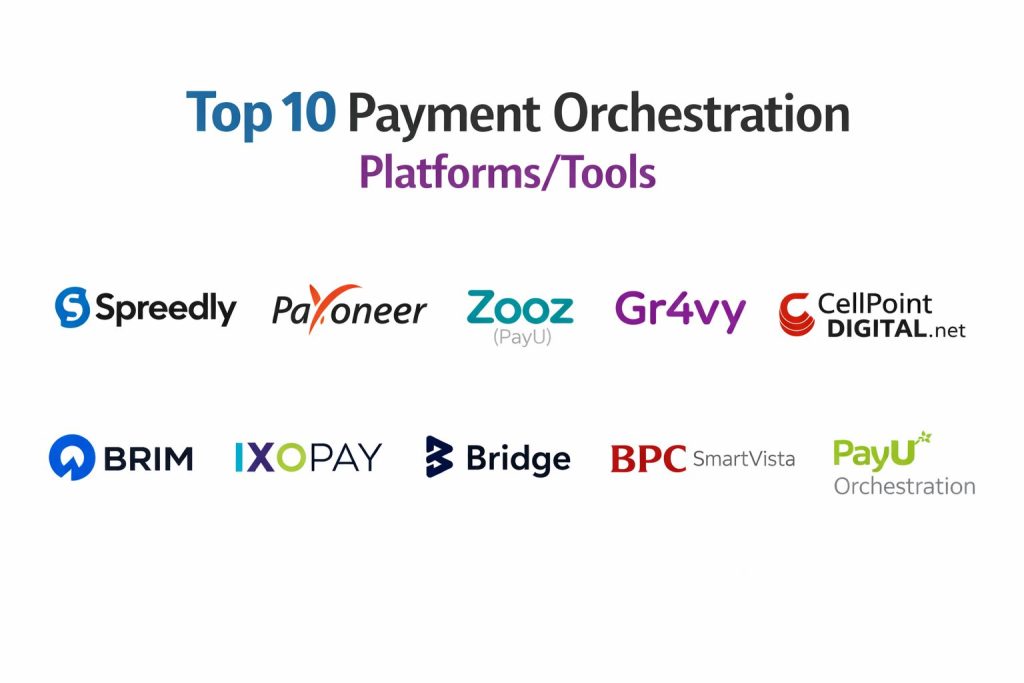
Top 10 Payment Orchestration Platforms
1. Spreedly
Spreedly is a pioneer in the payment orchestration space, offering a robust, gateway-agnostic platform that focuses on secure tokenization and flexible payment routing. It allows businesses to store payment methods in a neutral vault and then “work with” any number of payment services simultaneously.
Key Features
- Universal Tokenization: Securely store credit card data in a gateway-neutral vault, ensuring you own your customer data and can move it between processors at any time.
- Advanced Smart Routing: A flexible engine that allows you to route transactions to any of the hundreds of supported gateways based on custom business logic.
- Spreedly Plus: An optimized routing service that uses data-driven insights to help increase transaction success rates and lower the total cost of processing.
- Support for 120+ Gateways: One of the most extensive libraries of pre-built gateway integrations in the world, covering nearly every global and regional market.
- 3DS2 Integration: Built-in support for the latest authentication standards to ensure compliance with European and global security regulations.
- Unified API: A single, clean integration point that allows your developers to interact with hundreds of different financial services through one set of commands.
- Fraud Provider Integrations: Seamlessly connect to leading fraud prevention tools to add a layer of security to every transaction before it is sent to the gateway.
Pros
- Unmatched flexibility in data portability; you are never locked into a single payment provider or financial partner.
- Exceptional API reliability and documentation, making it a favorite among high-level engineering teams.
- Extremely neutral stance in the market, with no preference for specific gateways, ensuring your business interests always come first.
Cons
- The pricing model can be complex for very high-volume merchants who use multiple advanced features.
- Requires a certain level of technical expertise to fully utilize the more advanced custom routing capabilities.
- The interface, while professional, focuses more on developer tools than on “no-code” visual builders.
Platforms / Deployment
- Cloud-based SaaS
- Robust API and Mobile SDKs
Security & Compliance
- PCI-DSS Level 1 Compliant.
- GDPR and CCPA compliant with secure, encrypted data vaulting.
Integrations & Ecosystem
Spreedly is built to be the “glue” of your payment stack, connecting to a vast array of services.
- Direct integrations with over 120 payment gateways globally.
- Connections to fraud engines like Kount and Signifyd.
- Integration with subscription billing tools like Chargebee and Recurly.
- Support for major digital wallets including Apple Pay and Google Pay.
Support & Community
Spreedly provides professional-tier support with dedicated technical account managers for enterprise clients. They maintain an extensive library of documentation and a highly active developer community.
2. Payoneer
Payoneer is a global financial services company that provides an integrated payment orchestration solution specifically designed for cross-border e-commerce and marketplaces. It excels at helping businesses scale into international markets by simplifying the complexity of local currency handling and payouts.
Key Features
- Cross-Border Optimization: Built specifically to handle the complexities of multi-currency transactions and international banking regulations.
- Integrated Payouts: A unique combination of a payment orchestration layer with a robust global payout system for vendors and sellers.
- Local Currency Receiving Accounts: Allows businesses to receive payments in multiple local currencies as if they had a local bank account in that region.
- Smart Routing for SMBs: An accessible routing engine that helps smaller and mid-sized businesses optimize their authorization rates without complex coding.
- Unified Merchant Dashboard: A single view of all global sales, currency balances, and payout histories across all connected sales channels.
- Risk and Compliance Management: Advanced built-in tools for KYC (Know Your Customer) and AML (Anti-Money Laundering) compliance.
- Marketplace Specialized Tools: Tailored features for platforms that need to manage high volumes of split payments and international seller disbursements.
Pros
- The best “all-in-one” choice for businesses that need both payment acceptance and international payouts in one platform.
- Extremely strong in emerging markets and regions where traditional banking infrastructure is difficult to navigate.
- Provides a simpler, more “productized” experience for businesses that don’t have a massive team of payment engineers.
Cons
- Not as gateway-agnostic as pure-play orchestration tools; there is a stronger pull toward using Payoneer’s own financial services.
- Customization options for highly complex, technical routing rules are more limited than Spreedly or Zooz.
- Per-transaction costs for currency conversion can add up for merchants with very thin margins.
Platforms / Deployment
- Cloud-based SaaS
- Mobile App for account management
Security & Compliance
- Fully regulated as a financial institution in multiple jurisdictions (US, EU, HK, etc.).
- SOC 2 Type II and PCI-DSS compliant.
Integrations & Ecosystem
Payoneer is deeply integrated into the world of global e-commerce marketplaces.
- Native connections to major marketplaces like Amazon, eBay, and Airbnb.
- Integrations with e-commerce platforms like Shopify and WooCommerce.
- Connections to various local payment rails in over 190 countries.
Support & Community
Payoneer offers localized 24/7 support in multiple languages and has a massive global community of entrepreneurs and digital businesses.
3. Zooz (by PayU)
Zooz is a high-performance payment orchestration platform that focuses on data-driven optimization for global retailers. Now part of PayU, it provides a sophisticated set of tools for merchants who want to maximize their global conversion rates and minimize transaction costs through advanced logic.
Key Features
- Decision Engine: A powerful, rule-based engine that allows for granular routing of transactions based on any data point in the transaction request.
- Intelligent Failover: Automatically switches to a backup provider in real-time if a transaction fails due to a technical error or gateway rejection.
- Smart Routing by BIN: Optimize authorization rates by routing cards to local acquirers based on the Bank Identification Number (BIN).
- Consolidated Data Analytics: A high-level BI tool that provides a unified view of payment performance across all processors and regions.
- Universal Tokenization: Allows for secure, gateway-neutral storage of card data to ensure merchant portability and customer convenience.
- Dynamic Checkout: A flexible checkout UI that automatically presents the most relevant local payment methods based on the user’s location.
- Payment Method Library: Access to a vast range of global and local payment methods including credit cards, wallets, and alternative payments.
Pros
- Exceptional for data-heavy merchants who want to conduct deep analysis of their payment performance and A/B test routing rules.
- Highly reliable infrastructure designed for the needs of “Tier 1” global retailers and high-volume brands.
- Benefit from the global financial reach and stability of its parent company, PayU.
Cons
- The implementation process is more intensive and geared toward larger organizations with dedicated technical resources.
- Pricing is typically aimed at the enterprise market, making it less accessible for small-to-medium businesses.
- Some users may find the sheer number of configuration options and data points to be overwhelming at first.
Platforms / Deployment
- Cloud-based SaaS
- Sophisticated API and Web SDKs
Security & Compliance
- PCI-DSS Level 1 Compliant.
- GDPR compliant with advanced data encryption and secure tokenization.
Integrations & Ecosystem
Zooz acts as a sophisticated hub for the global retail technology stack.
- Pre-built connections to dozens of the world’s largest payment gateways.
- Native integration with the broader PayU financial ecosystem.
- Support for top-tier fraud prevention services and risk engines.
- Bridges to major ERP and retail management systems.
Support & Community
Zooz provides high-end enterprise support with dedicated integration engineers and 24/7 technical assistance. They focus on providing strategic consulting alongside their software.
4. Gr4vy
Gr4vy is a modern, cloud-native payment orchestration platform that emphasizes simplicity, scalability, and “no-code” configuration. It allows businesses to deploy their own dedicated “cloud payment infrastructure” in minutes, providing a clean way to manage global payment expansion.
Key Features
- No-Code Workflow Engine: A visual builder that allows non-technical staff to create and edit complex payment routing flows with a drag-and-drop interface.
- Cloud-Native Infrastructure: Every merchant gets their own dedicated cloud instances, ensuring maximum performance and isolation from other users.
- Universal Token Vault: A secure, independent vault for payment data that supports tokenization across any connected provider.
- Instant Gateway Deployment: Add and activate new payment gateways or local payment methods with a single click in the dashboard.
- Advanced Subscription Management: Built-in tools for handling recurring billing and trial periods across multiple processors.
- Real-Time Dashboards: Clean, modern data visualizations that provide immediate insights into payment health and routing efficiency.
- Edge Routing: Optimized for speed, the platform routes transactions through the closest geographical cloud node to minimize latency.
Pros
- Perhaps the easiest high-end orchestration platform for non-developers to manage on a day-to-day basis.
- The “dedicated instance” model provides an extra layer of performance security and data isolation for enterprise clients.
- Very modern, clean UI that feels like a consumer-grade application rather than a legacy financial tool.
Cons
- As a newer player in the market, their total number of pre-built integrations is smaller than veterans like Spreedly.
- The “dedicated cloud” model may involve different pricing considerations compared to traditional multi-tenant SaaS tools.
Platforms / Deployment
- Cloud-native SaaS (Dedicated instances)
- Modern GraphQL API
Security & Compliance
- PCI-DSS Level 1 Compliant.
- SOC 2 Type II certified.
Integrations & Ecosystem
Gr4vy is built on a modern architecture designed for rapid ecosystem expansion.
- Rapidly growing library of gateways including Stripe, Adyen, and Braintree.
- Built-in support for major “Buy Now, Pay Later” providers like Affirm and Klarna.
- Integration with major e-commerce platforms and modern headless commerce stacks.
Support & Community
Gr4vy offers modern, responsive support via multiple channels and provides extensive interactive documentation for developers.
5. CellPoint Digital
CellPoint Digital is the leading payment orchestration platform for the travel and airline industry, though it has expanded into other verticals. It is designed to handle the hyper-complex, multi-layered payment needs of global travel brands, including split payments and complex refunds.
Key Features
- Travel-Specific Orchestration: Tailored logic for the airline industry, including support for IATA standards and complex ticket pricing models.
- Veloce Platform: A high-speed orchestration engine designed to handle massive transaction bursts during peak travel booking periods.
- Multi-Acquirer Strategy: Seamlessly manages relationships with dozens of local acquirers to ensure the lowest possible merchant fees globally.
- Split Payments and Settlements: Built-in ability to split a single customer payment among multiple vendors or service providers in real-time.
- Alternative Payment Methods (APMs): Extensive support for hundreds of local payment methods popular in tourism and travel.
- Omni-channel Support: Provides a consistent payment experience across web, mobile apps, call centers, and in-person kiosks.
- Fraud and Chargeback Management: Integrated risk management that is specifically tuned for the high-volume travel sector.
Pros
- The undisputed “best-of-breed” tool for airlines, hotels, and travel aggregators with complex industry requirements.
- Incredible robustness; the platform is built to handle the technical rigors of some of the world’s largest airline booking engines.
- Deep expertise in the financial regulations and payment behaviors of the travel industry.
Cons
- The platform’s industry-specific focus makes it less intuitive for standard retail or SaaS businesses.
- The complexity of the tool means that implementation usually requires a significant professional services engagement.
- Pricing is aimed at the high-enterprise level, reflecting the critical nature of travel payment infrastructure.
Platforms / Deployment
- Cloud-based SaaS
- Specialized SDKs for airline mobile apps
Security & Compliance
- PCI-DSS Level 1 Compliant.
- Fully compliant with airline industry standards (IATA, NDC).
Integrations & Ecosystem
CellPoint Digital sits at the center of the travel technology universe.
- Deep integrations with Global Distribution Systems (GDS) like Amadeus and Sabre.
- Connections to over 400 global and local payment methods.
- Bridges to specialized airline loyalty and frequent flyer systems.
Support & Community
The company provides high-touch, 24/7 enterprise support with a focus on mission-critical uptime for global travel brands.
6. BRIM
BRIM is a highly flexible payment orchestration platform that specializes in “Modular Payments” and platform-level financial services. It is often used by large financial institutions and fintechs to build their own custom branded payment experiences and credit programs.
Key Features
- Modular Infrastructure: Allows businesses to pick and choose specific payment modules (orchestration, credit, loyalty) to build a custom stack.
- Platform-as-a-Service (PaaS): Designed for organizations that want to offer payment orchestration as a service to their own sub-merchants.
- Real-Time Credit Decisioning: Built-in tools for offering instant credit and financing options at the point of sale.
- Integrated Loyalty Programs: Allows for the seamless integration of rewards and points directly into the payment orchestration flow.
- Digital Card Issuance: The ability to issue virtual and physical cards directly from the platform as part of the orchestration ecosystem.
- Multi-Gateway Smart Routing: Core orchestration features that allow for the dynamic routing of transactions to optimize costs and success rates.
- White-Label Capability: The entire platform can be branded and offered as a native service by a bank or large enterprise.
Pros
- The best choice for fintechs and banks that want a “foundation” on which to build their own financial products.
- Offers a unique combination of payment orchestration with credit and loyalty modules that are usually separate tools.
- Highly scalable and designed for the rigorous compliance needs of the banking sector.
Cons
- May be overly complex for a standard e-commerce brand that just needs simple payment routing.
- The sales and implementation cycle is typically longer, reflecting the platform-level nature of the tool.
Platforms / Deployment
- Cloud-based SaaS / PaaS
- Comprehensive Enterprise APIs
Security & Compliance
- Bank-grade security and compliance standards.
- PCI-DSS Level 1 and regional banking certifications.
Integrations & Ecosystem
BRIM is designed to integrate with core banking systems and legacy financial infrastructure.
- Connects to major card networks (Visa, Mastercard).
- Integrations with global payment processors and local banking rails.
- Bridges to enterprise CRM and loyalty management systems.
Support & Community
BRIM provides high-level professional services and strategic partnership support for its enterprise and banking clients.
7. IXOPAY
IXOPAY is a highly scalable, independent payment orchestration platform that prides itself on its “pure-play” neutrality and sophisticated risk management. It is designed for multi-national corporations that need to centralize complex payment operations across hundreds of sub-entities and gateways.
Key Features
- Post-Processing Engine: A unique feature that handles the complex logic required for refunds, chargebacks, and settlements after the transaction is complete.
- Centralized Risk Management: Aggregates risk data from multiple gateways and third-party tools into a single, unified scoring engine.
- Fee Management and Calculation: Automatically calculates and audits the fees charged by different processors to ensure billing accuracy.
- Hierarchical Account Management: Allows large conglomerates to manage payments for dozens of different brands and subsidiaries from one master account.
- Smart Routing and Failover: Core orchestration features that use real-time performance data to route transactions to the best provider.
- Token Vault and Portability: Provides a secure, independent environment for card data to prevent gateway lock-in.
- Alternative Payment Method Support: Rapidly deploy hundreds of local payment methods across any geographical market.
Pros
- One of the best tools for the “Finance” side of payments, with superior tools for fee auditing and post-processing.
- Extremely neutral and independent; they have no ties to any specific payment gateway or bank.
- Highly customizable for complex corporate structures with many different business units.
Cons
- The user interface is very data-dense and professional, requiring a learning curve for new users.
- Pricing is geared toward the mid-to-high enterprise market.
Platforms / Deployment
- Cloud-based SaaS
- On-premise options for specific high-security requirements
Security & Compliance
- PCI-DSS Level 1 Compliant.
- GDPR compliant with advanced data residency and isolation options.
Integrations & Ecosystem
IXOPAY acts as a neutral aggregator for the entire financial services industry.
- Over 200 pre-built integrations to global payment providers and acquirers.
- Connections to all major fraud prevention and risk scoring engines.
- Integrations with high-end ERP and financial accounting software.
Support & Community
IXOPAY provides professional 24/7 technical support and has a strong reputation for its “consultative” approach to integration.
8. Bridge
Bridge is a modern, high-growth payment orchestration platform that focuses on helping merchants “bridge” the gap between fragmented payment ecosystems. It is known for its speed of deployment and its ability to provide high-end orchestration features with a lower barrier to entry.
Key Features
- Simplified Smart Routing: An intuitive engine that allows merchants to set up routing rules based on region, currency, or processor performance.
- Instant Onboarding: A streamlined process for adding new gateways that focuses on getting merchants live in hours rather than weeks.
- Unified Settlement Reports: Automatically merges data from all connected gateways into a clean, actionable financial report.
- Failover Automation: Protects revenue by instantly switching processors during technical outages or high decline rates.
- Vault-Agnostic Tokenization: Ensures that customer card data remains secure and portable across any processor.
- A/B Testing for Payments: Allows merchants to test different routing strategies on a percentage of traffic to see which yields the highest conversion.
- Global Payment Method Access: One-click activation for hundreds of local payment options.
Pros
- Offers a “modern SaaS” experience with a focus on rapid deployment and an intuitive user interface.
- Excellent choice for fast-growing companies that need to move away from a single-gateway setup quickly.
- Provides high-end features like A/B testing that are often reserved for more expensive enterprise platforms.
Cons
- The total number of pre-built integrations is growing but still smaller than established players like Spreedly or IXOPAY.
- May lack some of the hyper-specialized “travel” or “banking” features found in niche platforms.
Platforms / Deployment
- Cloud-based SaaS
- Modern API-first architecture
Security & Compliance
- PCI-DSS Level 1 Compliant.
- GDPR and data privacy compliant.
Integrations & Ecosystem
Bridge is built for the modern, headless commerce era.
- Integrations with major gateways like Stripe, Braintree, and Checkout.com.
- Support for major BNPL and digital wallet providers.
- Native connectors for modern e-commerce platforms like Commercetools and BigCommerce.
Support & Community
Bridge provides responsive, 24/7 digital support and is active in the modern e-commerce developer community.
9. BPC (SmartVista)
BPC is a global leader in payment infrastructure, and its SmartVista platform provides a powerful orchestration layer designed for the “Enterprise and Banking” scale. It is often used to power national payment rails and massive-scale financial ecosystems.
Key Features
- National-Scale Orchestration: Capable of managing the transaction flows for entire countries or massive banking networks.
- Omni-channel Acceptance: Seamlessly connects online, mobile, and in-person POS transactions into a single orchestration flow.
- Sophisticated Fraud and Risk Engine: Includes one of the most advanced real-time risk scoring modules in the financial industry.
- Merchant Management System: Specialized tools for banks to manage thousands of sub-merchants within an orchestration framework.
- Ecosystem Connectivity: Bridges the gap between traditional banking rails, digital wallets, and modern crypto-payments.
- Highly Customizable Logic: Allows for the creation of virtually any payment workflow, regardless of technical complexity.
- Open Banking Support: Built-in tools for integrating with modern Open Banking APIs and real-time payment rails.
Pros
- The choice for organizations that need “Infrastructure-level” reliability and power.
- Exceptional at managing both digital and physical (POS) payments in a unified orchestration layer.
- Provides the highest level of security and regulatory compliance required for national banking.
Cons
- Far too complex for a typical e-commerce retailer; this is an infrastructure-level tool.
- Implementation is a major enterprise undertaking that usually involves a long-term strategic partnership.
Platforms / Deployment
- Cloud / On-premise / Hybrid
- Massive-scale Enterprise Infrastructure
Security & Compliance
- Highest tier banking and financial security certifications.
- Fully compliant with global PCI-DSS and regional banking regulations.
Integrations & Ecosystem
BPC is built to connect at the level of central banks and global financial networks.
- Direct connections to Visa, Mastercard, and national payment rails.
- Bridges to core banking systems and legacy financial mainframes.
- Support for a vast range of emerging digital payment technologies.
Support & Community
BPC provides high-level professional services and 24/7 mission-critical support for its global banking and infrastructure clients.
10. PayU (Global Orchestration)
PayU is a global financial powerhouse that offers its own sophisticated payment orchestration layer. It is particularly strong for businesses looking to dominate high-growth emerging markets in Latin America, Central/Eastern Europe, and India.
Key Features
- Emerging Market Focus: Deep, native connections to local payment rails in some of the world’s fastest-growing digital economies.
- Integrated Hub: Access to a global network of acquirers and payment methods through a single integration.
- Smart Routing and Redundancy: Built-in logic to optimize authorization rates by routing through local acquirers whenever possible.
- Risk and Fraud Prevention: Uses PayU’s massive global transaction data to provide superior fraud detection in emerging markets.
- Unified Settlement: Simplifies global finance by providing a single point of settlement for dozens of different regional markets.
- Subscription and Recurring Billing: Robust tools for managing global subscriptions across different processors.
- Local Compliance Expertise: Built-in logic that handles the unique regulatory and tax requirements of high-growth regions.
Pros
- The undisputed “best choice” for merchants who are prioritizing growth in India, Latin America, and emerging Europe.
- Provides the stability and financial backing of a global fintech giant.
- Simplifies the “cross-border” nightmare of managing local entities and local banking in difficult-to-enter markets.
Cons
- There is a natural bias toward the PayU financial ecosystem compared to purely neutral platforms like Spreedly.
- The feature set in North America is not as dominant as its presence in other global regions.
Platforms / Deployment
- Cloud-based SaaS
- Comprehensive SDKs for all major platforms
Security & Compliance
- PCI-DSS Level 1 Compliant.
- Fully licensed and regulated in dozens of global jurisdictions.
Integrations & Ecosystem
PayU provides a “one-stop-shop” for global expansion.
- Native connections to over 50 global and local payment providers.
- Deep integration with local banking rails in high-growth markets.
- Bridges to major e-commerce platforms and global ERP systems.
Support & Community
PayU provides professional, localized support across its global regions and offers strategic consulting on entering new emerging markets.
Comparison Table (Top 10)
| Tool Name | Best For | Platform(s) | Deployment | Standout Feature |
| Spreedly | Developer-centric / Neutrality | Cloud / API | SaaS | Independent Token Vault |
| Payoneer | Cross-border Marketplaces | Cloud / App | SaaS | Integrated Global Payouts |
| Zooz (PayU) | Data-driven Retailers | Cloud / API | SaaS | Smart Routing by BIN |
| Gr4vy | No-code / Rapid Deployment | Cloud-native | SaaS | Dedicated Cloud Instances |
| CellPoint Digital | Travel & Airline Industry | Cloud / SDK | SaaS | IATA/Travel Specific Logic |
| BRIM | Banks & Fintech Builders | Cloud / API | PaaS | Modular Credit & Loyalty |
| IXOPAY | Large Corporate Finance | Cloud / On-prem | SaaS | Post-Processing Engine |
| Bridge | Fast-growing SaaS / Retail | Cloud / API | SaaS | A/B Testing for Payments |
| BPC (SmartVista) | National Infrastructure | Multi-cloud | Hybrid | National-scale Performance |
| PayU Orchestration | Emerging Markets Focus | Cloud / SDK | SaaS | Native Emerging Market Rails |
Evaluation & Scoring of Payment Orchestration Platforms
The scoring below is a comparative model intended to help shortlisting. Each criterion is scored from 1–10, then a weighted total from 0–10 is calculated using the weights listed. These are analyst estimates based on typical fit and common workflow requirements, not public ratings.
Weights:
- Price / value – 15%
- Core features – 25%
- Ease of use – 15%
- Integrations & ecosystem – 15%
- Security & compliance – 10%
- Performance & reliability – 10%
- Support & community – 10%
| Tool Name | Routing Power (25%) | Neutrality (20%) | Integrations (15%) | Ease of Use (15%) | Global Reach (15%) | Security (10%) | Weighted Total |
| Spreedly | 9 | 10 | 10 | 6 | 9 | 10 | 8.9 |
| Payoneer | 7 | 4 | 8 | 9 | 10 | 10 | 7.8 |
| Zooz (PayU) | 10 | 8 | 9 | 7 | 9 | 10 | 8.9 |
| Gr4vy | 8 | 9 | 8 | 10 | 8 | 10 | 8.7 |
| CellPoint Digital | 9 | 8 | 7 | 6 | 10 | 10 | 8.3 |
| BRIM | 8 | 8 | 7 | 6 | 8 | 10 | 7.7 |
| IXOPAY | 10 | 10 | 9 | 6 | 9 | 10 | 8.9 |
| Bridge | 8 | 9 | 8 | 10 | 8 | 10 | 8.7 |
| BPC (SmartVista) | 10 | 7 | 8 | 5 | 10 | 10 | 8.4 |
| PayU (Global) | 9 | 5 | 9 | 8 | 10 | 10 | 8.5 |
How to interpret the scores:
- Use the weighted total to shortlist candidates, then validate with a pilot.
- A lower score can mean specialization, not weakness.
- Security and compliance scores reflect controllability and governance fit, because certifications are often not publicly stated.
- Actual outcomes vary with assembly size, team skills, templates, and process maturity.
Which Payment Orchestration Platform Tool Is Right for You?
Solo / SMB Merchants
For growing SMBs, Bridge or Gr4vy are the most practical choices. They offer a “modern SaaS” experience that is easy to manage without a team of specialized payment engineers, allowing you to scale into new regions quickly.
Mid-Market Retailers
Organizations with a solid technical team should look at Spreedly or IXOPAY. These platforms offer the ultimate in neutrality and developer flexibility, allowing you to build a highly customized payment stack that can grow with your business for years.
Global Enterprise
Large multinational corporations need the data-driven power of Zooz or the financial auditing depth of IXOPAY. These tools provide the high-level reporting and complex account hierarchies required to manage hundreds of millions of dollars in global sales.
Specialized (Travel, Banking, High-Risk)
If you are in a niche vertical, the generalist tools might not be enough. CellPoint Digital is the mandatory choice for airlines and travel brands, while BPC or BRIM are the preferred partners for banks and fintech companies building their own infrastructure.
Emerging Markets Growth
If your primary growth strategy involves India, Latin America, or Southeast Asia, PayU or Payoneer are the best partners. Their deep, native connections to local banking rails and their understanding of regional regulations will save your team months of work.
Frequently Asked Questions (FAQs)
What is the primary difference between a Payment Gateway and an Orchestration Platform?
A Payment Gateway (like Stripe) is the service that actually processes the money. An Orchestration Platform (like Spreedly) is the software layer on top that manages and routes transactions between multiple gateways.
Does using an orchestration platform increase latency during checkout?
In the past, adding a layer could add milliseconds, but modern platforms like Gr4vy and Bridge use edge computing to ensure that the impact on checkout speed is virtually undetectable to the customer.
Do I still need to sign separate contracts with individual payment gateways?
Yes, typically. An orchestration platform provides the technical integration, but you still need to maintain your own commercial relationships and contracts with processors like Adyen, Braintree, or Worldpay.
Can orchestration platforms help me reduce chargebacks?
Directly, no—but they help indirectly by allowing you to integrate “best-of-breed” fraud prevention tools like Kount or Signifyd into the payment flow before the transaction is authorized.
Is it difficult to switch from one orchestration platform to another?
It depends on tokenization. If you use a platform that offers “portable tokenization” (like Spreedly or Zooz), you can move your customer data to a new platform relatively easily.
How does “Smart Routing” actually work?
The platform looks at the data from the transaction (card type, country, amount) and uses a set of rules or an AI model to send it to the gateway that has the highest historical success rate for that specific profile.
Is payment orchestration only for large companies?
Historically yes, but new platforms like Bridge and Gr4vy have made the technology accessible to mid-sized businesses that are just starting to expand into their second or third international market.
Does payment orchestration help with PCI compliance?
Yes. By using the platform’s secure vault and iFrame/SDK solutions, the merchant’s servers never actually “touch” the sensitive card data, which significantly simplifies the PCI-DSS audit process.
Can these platforms handle “Buy Now, Pay Later” (BNPL) providers?
Yes, most modern orchestration platforms have pre-built integrations for BNPL leaders like Klarna, Affirm, and Afterpay, allowing you to offer them as a routing choice alongside credit cards.
What is the most common pricing model for these tools?
Most orchestration platforms charge a combination of a monthly platform fee and a small fixed fee per transaction (usually a few cents). Some also offer volume-based discounts for enterprise clients.
Conclusion
Payment orchestration platforms represent the final frontier in the democratization of global finance. By breaking the monopoly of single-gateway providers, tools like Spreedly, Zooz, and IXOPAY have put the power back into the hands of the merchant. Whether you are a fast-growing retailer using Gr4vy to simplify your checkout or a global airline using CellPoint Digital to manage complex travel payments, the choice of orchestration platform is now a core part of your business strategy. As the world of digital payments becomes increasingly fragmented, the ability to orchestrate that complexity into a seamless customer experience will be the hallmark of the next generation of global market leaders.