Introduction
Patent search tools have evolved from simple keyword databases into sophisticated AI-driven intelligence platforms. For intellectual property (IP) professionals, R&D teams, and legal experts, these tools are indispensable for navigating a global landscape that now sees millions of new patent filings annually. Modern platforms utilize Large Language Models (LLMs) and semantic neural networks to understand the “intent” behind an invention, allowing users to find prior art that traditional Boolean searches might miss. Whether you are conducting a freedom-to-operate (FTO) analysis, checking patentability, or monitoring competitor activity, the right tool can mean the difference between a successful market launch and a multi-million dollar infringement lawsuit.
The integration of agentic AI has further revolutionized the industry, enabling automated “patent drafting assistants” and real-time litigation monitoring. High-fidelity data is now the gold standard, with top-tier tools offering human-curated abstracts that translate “patentese” into searchable technical language. As global trade becomes increasingly digitized, these platforms provide the necessary “IP transparency” to ensure innovation is both protected and legally sound. For businesses ranging from solo inventors to Fortune 500 conglomerates, selecting a tool depends on the required balance between cost, data depth, and the complexity of the analytical visualizations needed to present findings to stakeholders.
Real-World Use Cases
- Freedom-to-Operate (FTO) Analysis: Companies use these tools to ensure their new product doesn’t infringe on existing active patents before investing in manufacturing.
- Prior Art Discovery: Patent attorneys use semantic search to find obscure documents or non-patent literature that could invalidate a competitor’s broad patent claims.
- Competitive Intelligence: R&D leaders monitor the filing patterns of rivals to predict their future product roadmaps and technology pivots.
- White Space Analysis: Strategic planners use landscape maps to identify “gaps” in current technology where new patents can be filed with less competition.
- Portfolio Valuation: Financial analysts and M&A teams evaluate the “strength” of a company’s IP assets during due diligence using standardized quality metrics.
Buyer Evaluation Criteria
- Data Coverage and Update Frequency: Ensure the tool covers all major jurisdictions (USPTO, EPO, WIPO, CNIPA, JPO) and updates data weekly or daily to reflect recent filings.
- Semantic vs. Boolean Search: Look for platforms that support both traditional exact-match queries and AI-driven “natural language” searches for better discovery.
- Human-Curated Data: Determine if the platform provides “cleaned” data and rewritten abstracts, which significantly improve search accuracy compared to raw patent office text.
- Landscape Visualization Tools: The ability to generate 3D maps or topographical charts of technology areas is essential for communicating complex IP data to executives.
- Integration with Non-Patent Literature (NPL): High-quality tools index scientific journals, conference papers, and technical blogs alongside patent documents for comprehensive prior art searches.
- Legal Status and Litigation Tracking: The tool should provide real-time updates on whether a patent is active, expired, or currently involved in a lawsuit.
- Collaboration and Workflow Features: Enterprise teams need the ability to share folders, annotate patents, and assign review tasks within the platform.
- Security and Data Privacy: Look for SOC 2 compliance and “Zero-Retention” AI policies to ensure your sensitive invention disclosures are never used to train public models.
- Translation Quality: For global searches, robust machine translation (or human-verified translation) of Chinese, Japanese, and Korean patents is a non-negotiable requirement.
- Export and Reporting Options: Evaluate how easily the tool can generate professional PDF or Excel reports for legal opinions or boardroom presentations.
Best for: Patent attorneys, corporate IP departments, and R&D engineers who need to validate the novelty of their ideas and protect their company’s market position.
Not ideal for: General hobbyists or those looking for deep-dive technical “how-to” manuals, as patent documents are legal instruments rather than instructional guides.
Key Trends in Patent Search Tools
- Agentic AI Search Bots: AI “agents” can now autonomously run complex search iterations, filtering thousands of results down to the most relevant ten based on a technical description.
- 3D Topographical Landscaping: Advanced visualization has shifted from static charts to interactive 3D “Innovation Landscapes” that show the density of patents in specific sub-sectors.
- Predictive Grant Probability: Many platforms now offer “Allowance Scores” that use historical examiner data to predict the likelihood of a patent application being granted.
- Unified IP Ecosystems: The boundary between searching, drafting, and management has blurred, with tools offering end-to-end workflows from the first search to the final maintenance fee.
- Explainable AI (XAI): New systems don’t just give results; they highlight why a specific patent was flagged, showing the conceptual overlap between your idea and the prior art.
- Real-time Litigation Integration: Direct links between patent databases and global court records (like Darts-ip) allow users to see the “battle-tested” history of any patent family.
- Sustainability & ESG Tagging: Patents are now automatically tagged with ESG categories, allowing investors to identify “Green Tech” leaders and carbon-reduction innovations.
- Cross-Language Semantic Mapping: AI now maps concepts across different languages (e.g., matching a German technical term to a Japanese equivalent) without needing word-for-word translation.
How We Selected These Tools (Methodology)
Our selection of the top 10 patent search tools is based on a rigorous evaluation of database breadth, AI sophistication, and industry reputation. We prioritized tools that offer a “single source of truth” for global IP data while maintaining high standards for user experience and data security.
- Database Scale: We verified that each tool provides access to at least 100+ million documents from major global patent offices.
- AI and Semantic Capability: We tested the effectiveness of each platform’s AI search engine in identifying non-obvious prior art.
- Professional Trust: Only tools widely used by top-tier law firms and Fortune 500 IP departments were considered for the final list.
- Fidelity of Curated Content: We looked for platforms that add value through normalized assignee names and expert-written abstracts.
- Visualization and Analytics: Tools were ranked based on their ability to turn raw data into actionable visual intelligence for strategic decision-making.
- Implementation and Support: We prioritized vendors that offer comprehensive training, localized support, and high system reliability.
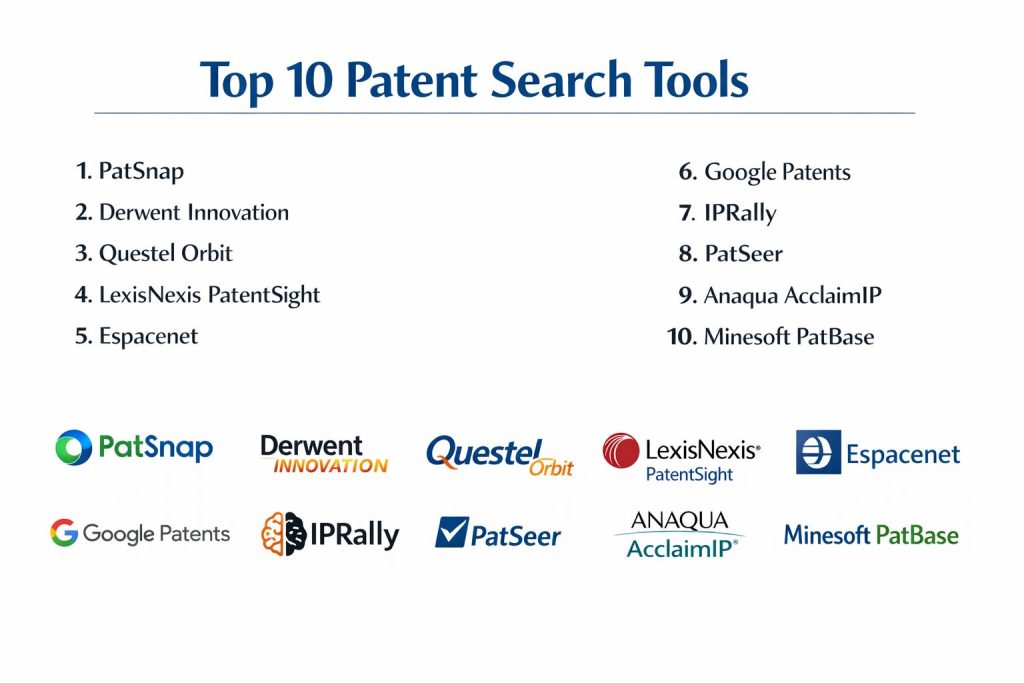
Top 10 Patent Search Tools
1 PatSnap
PatSnap is a global leader in “Connected Innovation Intelligence,” providing an AI-powered platform that bridges the gap between R&D, legal, and commercial teams. It is famous for its highly visual 3D landscapes and its massive database that connects patents to scientific literature and market data.
Key Features
- Eureka Platform: A specialized AI search tool designed specifically for R&D engineers to conduct quick novelty searches without needing complex legal training.
- 3D Innovation Landscapes: Interactive topographical maps that visualize technology clusters, making it easy to spot “white spaces” and competitor strongholds.
- Synapse Module: Connects patent data with over 150 million scientific articles and 2 million clinical trial records for comprehensive state-of-the-art research.
- AI Discovery Engine: Uses advanced semantic processing to find relevant patents based on a simple paragraph of technical text.
- Patent Quality Scoring: Uses a proprietary algorithm to rank patents based on their technical relevance, geographic reach, and citation history.
- Real-time Monitoring: Automated alerts that track new filings by competitors or changes in the legal status of key patent families.
- Sustainability Insights: Automatically identifies “Green Tech” patents and calculates the environmental impact of technology portfolios.
Pros
- Exceptionally user-friendly interface that makes complex IP data accessible to non-legal professionals.
- The most advanced visualization tools in the industry for communicating strategy to stakeholders.
- Deep integration between patent data and broader scientific/market intelligence.
Cons
- The full suite of analytics and specialized modules can be very expensive for smaller startups.
- The 3D maps, while visually impressive, can sometimes require a high-performance computer to run smoothly.
- Some users find the sheer volume of data and features overwhelming without proper training.
Platforms / Deployment
- Web / Cloud-based SaaS
Security & Compliance
- SOC 2 Type II certified.
- GDPR and CCPA compliant with secure, private data silos for user queries.
Integrations & Ecosystem
PatSnap is built to integrate with the broader enterprise innovation stack.
- API access for integrating IP data into internal R&D portals.
- Connectors for major PLM (Product Lifecycle Management) systems.
- Integration with academic research databases for NPL searching.
- Export formats optimized for Excel, PDF, and specialized IP management software.
Support & Community
PatSnap provides a dedicated “Customer Success Manager” for enterprise clients and hosts a massive “PatSnap Academy” with hundreds of hours of training. They are a frequent sponsor of global innovation summits.
2 Derwent Innovation
Owned by Clarivate, Derwent Innovation is the “gold standard” for professional patent searchers and attorneys. It is powered by the Derwent World Patents Index (DWPI), which features human-curated abstracts that clarify the technical essence of every patent.
Key Features
- Derwent World Patents Index (DWPI): Human-rewritten titles and abstracts that use standardized terminology to make patents easier to find and understand.
- Smart Search: A hybrid search engine that combines the precision of Boolean operators with the conceptual reach of AI-driven semantic search.
- Themescape: A highly accurate landscape visualization tool used by major patent offices to analyze global technology trends.
- Optimized Legal Status: Provides a cleaned and “normalized” view of a patent’s legal life, including expiration dates and ownership changes.
- Darts-ip Integration: Direct access to global litigation data, allowing users to see which patents have been involved in court cases or oppositions.
- Normalized Assignee Names: Fixes the problem of “company name variations” (e.g., IBM vs. International Business Machines) for accurate competitor tracking.
- Global Search Coverage: Access to full-text data from over 50 patent offices and bibliographic data from over 100 jurisdictions.
Pros
- The highest data fidelity in the market thanks to the human-curated DWPI database.
- Trusted by the world’s largest patent offices (including the USPTO and EPO) for their own internal searches.
- Excellent for Freedom-to-Operate (FTO) work where missing a single relevant patent is not an option.
Cons
- The user interface is built for professionals and has a steeper learning curve than “modern” AI startups.
- Pricing is at the highest end of the market, reflecting the cost of human data curation.
- The platform can be slower to navigate compared to lighter, purely algorithmic tools.
Platforms / Deployment
- Web / Cloud-based SaaS
Security & Compliance
- ISO 27001 and SOC 2 Type II certified.
- Strict enterprise-grade data privacy protocols for all search history.
Integrations & Ecosystem
Derwent is part of the Clarivate ecosystem, offering deep ties to other professional data tools.
- Integration with the Web of Science for elite-level non-patent literature (NPL) searching.
- Connectors for Innography and other IP management platforms.
- API support for large-scale data harvesting and internal analytics.
- Direct export to various patent drafting and management tools.
Support & Community
Clarivate offers world-class technical support and professional training. They publish the annual “Top 100 Global Innovators” report, which is a benchmark for the IP industry.
3 Questel Orbit
Questel Orbit (often called Orbit Intelligence) is a comprehensive IP intelligence platform that excels in multi-modal searching and portfolio management. It is particularly strong in the life sciences and chemistry sectors, offering specialized modules for searching molecular structures.
Key Features
- Orbit Intelligence: A unified search and analytics engine that covers patents, designs, and trademarks in a single interface.
- Chemistry/Bio Module: Specialized tools for searching chemical structures, DNA sequences, and pharmaceutical formulations.
- Darts-ip Case Law: Seamless integration of global IP litigation data into the search results.
- Collaborative Workspaces: Allows teams to share search projects, vote on relevant patents, and manage an internal “portfolio” of interesting documents.
- Advanced Visual Analytics: Clean, modern dashboards for benchmarking portfolios and identifying technology leaders.
- Automated Alerting: Sophisticated monitors for competitor filings, legal status changes, and new “cited by” events.
- Custom Reporting: A highly flexible reporting engine that allows users to create branded IP reports in seconds.
Pros
- The most complete “all-in-one” solution for companies needing to track patents, trademarks, and industrial designs.
- Unmatched strength in the chemical and life sciences sectors with specialized indexing.
- Excellent user interface that balances deep technical power with a modern, intuitive design.
Cons
- Access to specialized chemistry or litigation modules requires significant additional subscription fees.
- Some users find the “credits-based” export system for certain reports to be cumbersome.
- Initial setup and training can be lengthy given the breadth of the platform.
Platforms / Deployment
- Web / Cloud-based SaaS
Security & Compliance
- ISO 27001 and GDPR compliant.
- Private, encrypted environments for corporate clients to protect their search strategies.
Integrations & Ecosystem
Questel provides an end-to-end IP lifecycle management experience.
- Native integration with Orbit Asset for portfolio management.
- Connections to Questel’s patent filing and translation services.
- API for integrating search results into internal business intelligence tools.
- Support for major legal and docketing software.
Support & Community
Questel offers localized support in over 30 countries and a robust user community. They host regular training webinars and “IP strategy” workshops for their clients.
4 LexisNexis PatentSight
LexisNexis PatentSight is a premium analytics platform designed for high-level strategic decision-making and portfolio benchmarking. It is famous for its “Patent Asset Index” (PAI), a scientifically validated metric used to measure the objective strength of a patent portfolio.
Key Features
- Patent Asset Index (PAI): A world-renowned metric that combines “Technology Relevance” and “Market Coverage” to calculate a patent’s value.
- Strategic Benchmarking: Allows executives to compare their company’s portfolio strength directly against global competitors in a single chart.
- M&A Due Diligence: Specialized tools for evaluating the IP value of potential acquisition targets during a merger.
- Quality vs. Quantity Analysis: Visualizations that show which companies have the most “valuable” patents, rather than just the highest number of filings.
- Landscape Mapping: High-level maps that identify technology shifts and “emerging players” in specific industries.
- Cleaned Data Engine: Uses advanced algorithms to normalize assignee names and legal status for 100% accurate data.
- Custom Charting: An extremely flexible charting engine designed for boardroom-ready presentations.
Pros
- The industry standard for “objective” patent valuation and benchmarking.
- Used extensively by consultants (e.g., McKinsey, BCG) and corporate boards for strategic IP planning.
- Exceptionally clean data that eliminates the “noise” common in raw patent databases.
Cons
- Focused more on high-level analytics than on the granular, “nitty-gritty” of individual prior art searches.
- One of the most expensive platforms on the list, targeting the “Strategic” rather than “Operational” user.
- Requires a certain level of data literacy to interpret the complex PAI metrics correctly.
Platforms / Deployment
- Web / Cloud-based SaaS
Security & Compliance
- SOC 2 Type II and GDPR compliant.
- Backed by the global security infrastructure of LexisNexis and RELX Group.
Integrations & Ecosystem
PatentSight is designed to feed strategic data into the executive decision-making process.
- Integration with LexisNexis TotalPatent One for deep-dive searching.
- API for exporting valuation metrics into internal finance and strategy systems.
- Support for common business intelligence tools (e.g., Tableau, PowerBI) via data exports.
Support & Community
LexisNexis provides “white-glove” support and consulting services for PatentSight users. They are a major thought leader in the “Patent Valuation” space and publish frequent industry reports.
5 Espacenet (European Patent Office)
Espacenet is the free, official search tool provided by the European Patent Office (EPO). It is one of the most reliable and widely used resources in the world, offering access to over 150 million patent documents from every major country.
Key Features
- Smart Search: A powerful, simplified search bar that accepts keywords, names, and classification codes in a single field.
- Advanced Search Toggle: A detailed interface for professional searchers to build complex, multi-variable queries.
- Patent Family View: Provides a clear, grouped view of all global equivalents for a single invention (INPADOC family).
- Global Dossier: Direct access to the internal “file history” (examiner comments, rejections) from the world’s largest patent offices.
- Machine Translation: Integrated “Patent Translate” tool that provides high-quality English translations for almost any non-English document.
- Classification Search: A dedicated tool for navigating the Cooperative Patent Classification (CPC) system.
- NPL Linking: Identifies and provides bibliographic links to non-patent literature cited by examiners.
Pros
- Entirely free to use with no subscription or account required for basic searching.
- Features the most accurate and up-to-date data directly from the official EPO sources.
- The “Global Dossier” is an invaluable tool for understanding why a patent was granted or rejected.
Cons
- Lacks the advanced “AI-powered” semantic search and 3D landscaping of paid enterprise tools.
- No dedicated project management or collaboration features for corporate teams.
- The interface, while clean, is designed for research rather than high-level business analytics.
Platforms / Deployment
- Web-based
Security & Compliance
- Operated by a major intergovernmental organization (EPO) with high standards for public data access.
- No data-sharing with third-party advertisers.
Integrations & Ecosystem
Espacenet serves as the foundational data source for many other tools in the industry.
- Open data API (OPS) for developers to build their own search applications.
- Integration with the “Common Citation Document” tool for cross-office citation analysis.
- Easy “one-click” exports to CSV or PDF for individual documents.
Support & Community
The EPO provides extensive help documentation, video tutorials, and a dedicated “User Support” forum. They are the primary source of training for patent search standards globally.
6 Google Patents
Google Patents is the most popular starting point for inventors and researchers. It applies Google’s legendary search algorithms to the world of patents, offering a fast, free, and incredibly easy-to-use platform that indexes over 120 million documents.
Key Features
- Prior Art Finder: A one-click tool that uses machine learning to automatically generate a list of relevant patents and academic papers for your search.
- Google Scholar Integration: Seamlessly searches millions of academic journals, books, and technical papers alongside patent data.
- High-Speed PDF Viewer: The fastest and most reliable way to view and download original patent images and full-text documents.
- Natural Language Processing: Allows users to find results using plain technical descriptions rather than needing complex Boolean logic.
- Global Coverage: Includes full-text data from over 100 patent offices, with high-quality machine translations.
- Prior Art Archive: Integration with a massive database of “defensive publications” designed to prevent low-quality patents from being granted.
- Simple Interface: A familiar, clutter-free search experience that requires zero training for new users.
Pros
- The fastest search engine in the market for quick “sanity checks” on a new idea.
- Unmatched integration with non-patent literature through Google Scholar and Google Books.
- Completely free and accessible from any device without needing a login.
Cons
- The “Assignee” data is often messy and lacks the normalization found in paid tools like PatSnap or Derwent.
- Legal status data can sometimes lag several months behind official office updates.
- No enterprise-grade security or private “project folders” for sensitive corporate research.
Platforms / Deployment
- Web-based
Security & Compliance
- Standard Google privacy terms; however, search history is not “private” in the way enterprise IP tools are.
- Not recommended for highly sensitive “Zero-Disclosure” corporate R&D.
Integrations & Ecosystem
Google Patents is a standalone tool but is often used in conjunction with other Google services.
- Export to Google Sheets for basic analysis.
- Links to Google Scholar for deep-dive academic research.
- Public datasets available via BigQuery for large-scale data scientists and researchers.
Support & Community
Support is limited to a standard Help Center and feedback forms. However, because it is so widely used, there are thousands of community-made tutorials and guides available online.
7 IPRally
IPRally is a “next-generation” patent search tool that uses a unique graph-based AI to understand the technical structure of an invention. It is designed for users who want to search using “concepts and relationships” rather than just keywords.
Key Features
- Graph-Based AI: Visualizes the “features” of an invention as a graph, allowing the system to match technical concepts even if different words are used.
- Plain Language Searching: Users can copy-paste an entire claim or a technical disclosure to find highly relevant prior art.
- Explainable AI (XAI): Highlights the specific parts of a search result that match the user’s query, providing transparency into why a patent was found.
- Interactive Filtering: A modern, streamlined interface that allows for rapid scanning and categorization of result sets.
- Automatic Patent Summaries: AI-generated “technical summaries” that help users quickly understand the core of a patent without reading the full legal text.
- Collaborative Review: Built-in tools for teams to share, tag, and discuss patent results in real-time.
- Global Data Access: Comprehensive coverage of all major patent jurisdictions with high-quality machine translation.
Pros
- One of the most intuitive and modern AI search engines on the market; it feels like “cheating” compared to Boolean searching.
- Exceptional for finding “non-obvious” prior art that keyword-based tools often miss.
- Very high user satisfaction due to the “transparency” of the AI results.
Cons
- A newer player in the market, so its administrative and management features are not as deep as Questel or Anaqua.
- Lacks the specialized chemical or biological search capabilities of traditional “pro” tools.
- Pricing is competitive but can be high for firms only needing basic keyword search.
Platforms / Deployment
- Web / Cloud-based SaaS
Security & Compliance
- SOC 2 Type II compliant.
- Uses private, encrypted AI models that do not store or learn from user-uploaded invention disclosures.
Integrations & Ecosystem
IPRally is an “API-first” company, making it easy to build into a modern tech stack.
- Robust API for integrating AI search results into internal dashboards.
- Support for major IP management and drafting platforms.
- Easy export to standard legal and spreadsheet formats.
Support & Community
IPRally provides excellent, responsive support and is known for its “community-driven” product roadmap, where user feedback is quickly turned into new features.
8 PatSeer
PatSeer is a powerful, flexible patent search and analytics platform that balances advanced professional features with a modern web interface. It is highly valued for its “Hybrid Search” capabilities and its robust tools for large-scale FTO and patentability projects.
Key Features
- Hybrid Search Engine: Allows users to combine Boolean logic, semantic search, and proximity operators in a single, powerful query.
- Project Management Workspaces: Detailed tools for managing large review projects, including “workflow states” (e.g., Not Reviewed, Relevant, Junk).
- AI-Driven Automated Categorization: Uses machine learning to automatically tag and sort patents into your custom technology taxonomy.
- Comprehensive Analytics: Over 40 different chart types for visualizing trends, competitor landscapes, and portfolio distributions.
- Collaborative Highlighting: Allows teams to use custom colors and tags to annotate specific claims or technical details in real-time.
- Integrated NPL Search: Access to over 100 million non-patent literature records (journals, standards, papers) within the same interface.
- Flexible Exports: Supports a massive range of export formats, including custom-branded Word and PDF reports.
Pros
- One of the most feature-rich platforms for the price, offering “enterprise-grade” tools at a more accessible point.
- Excellent project management features for teams handling thousands of patents per month.
- Highly customizable interface that can be tailored to the specific needs of different searchers.
Cons
- The user interface is powerful but can be quite dense and “click-heavy” for simple searches.
- While global, their machine translation for certain Asian jurisdictions is sometimes viewed as slightly behind Derwent or PatSnap.
- Some advanced analytics modules require separate add-on licenses.
Platforms / Deployment
- Web / Cloud-based SaaS
Security & Compliance
- SOC 2 Type II and GDPR compliant.
- Features advanced user permissions and audit logs for corporate security.
Integrations & Ecosystem
PatSeer is built to be the “engine” for an IP department’s daily work.
- Native integration with IP management and docketing systems.
- API for large-scale data analysis and internal reporting.
- Browser extensions for capturing data from external patent office websites.
- Direct bridges to popular patent drafting tools.
Support & Community
PatSeer offers 24/5 global support and a very active training program. They provide a comprehensive knowledge base and frequent “Expert Search” webinars.
9 Anaqua AcclaimIP
AcclaimIP is the visibility and analytics component of the Anaqua IP management suite. It is built for high-speed research and is particularly famous for its “Matrix” queries and its deep data on patent examiner behavior and rejection rates.
Key Features
- High-Speed Searching: Optimized for professional searchers who need to cycle through hundreds of queries and thousands of documents per day.
- Matrix Analytics: A unique tool for building complex, multi-axis technology maps that reveal hidden relationships between companies and technologies.
- Examiner and Rejection Data: Detailed insights into specific USPTO examiners, including their “allowance rate” and common rejection types.
- Automated Landscaping: One-click tools for generating competitor benchmarking and technology trend dashboards.
- Cleaned EP Validations: Superior data on European patent validations, showing exactly which countries a patent is active in.
- Integrated Project Folders: Private, secure workspaces for organizing research by client, project, or technology area.
- Direct NPL Access: Seamlessly integrates millions of scientific and technical documents into the patent search workflow.
Pros
- The fastest “professional” search platform on the market, ideal for high-volume patent agents.
- The “Examiner Analytics” are a game-changer for patent prosecutors looking to refine their strategy.
- Exceptional data on European “validation” status, which is notoriously difficult to track accurately.
Cons
- Primarily targeted at US and European markets; depth in certain Asian regions is slightly less than specialized competitors.
- The interface is professional and “Windows-style,” which may feel less modern than tools like PatSnap or IPRally.
- Best used as part of the broader Anaqua ecosystem, though it is available as a standalone tool.
Platforms / Deployment
- Web / Cloud-based SaaS
Security & Compliance
- SOC 2 Type II, ISO 27001, and GDPR compliant.
- Trusted by some of the world’s largest corporate IP departments and law firms.
Integrations & Ecosystem
AcclaimIP is the “Intelligence” layer of the broader Anaqua environment.
- Deep, native integration with Anaqua’s IP Management and Docketing platforms.
- API for custom data harvesting and corporate reporting.
- Support for exporting data directly into strategic planning software.
- Connectors for major patent annuity and renewal services.
Support & Community
Anaqua offers global, enterprise-level support and hosts the massive “ACE” (Anaqua Client Experience) conference every year for its users.
10 Minesoft PatBase
PatBase is a leading global patent database designed by patent professionals, for patent professionals. It is known for its “Family-centric” data structure, which simplifies the search process by grouping global equivalents into a single, searchable record.
Key Features
- Family-Centric Database: Groups millions of individual publications into “inventions,” reducing the “noise” of seeing the same patent multiple times.
- AI Explain: A transparency tool that highlights exactly why a patent was found and how it relates to the user’s technical query.
- PatBase Analytics V3: A powerful, integrated charting tool for competitive intelligence and technology monitoring.
- Non-English Search (NPL): Allows users to search original non-English text (Chinese, Japanese, etc.) alongside translated data.
- Document Chat: An AI-powered assistant that allows users to “ask questions” to a specific patent (e.g., “What are the specific temperature ranges in claim 5?”).
- Minesoft Origin Integration: A seamless workflow for moving from search results to patent drafting and prosecution.
- Custom Alerts (AI Alerts): Smart monitors that “learn” from your feedback to provide increasingly relevant updates on new filings.
Pros
- The family-centric approach is widely considered the most efficient way to handle global searches.
- Long-standing reputation for having some of the cleanest and most reliable raw patent data in the industry.
- The “Document Chat” and AI features are exceptionally practical for daily patent review work.
Cons
- The user interface is dense and “pro-focused,” which can be intimidating for casual users.
- Pricing is in the premium tier, though it is considered a high-value investment for professional firms.
- Some visualization features require a bit more manual configuration compared to the “one-click” style of PatSnap.
Platforms / Deployment
- Web / Cloud-based SaaS
Security & Compliance
- ISO 27001 certified and GDPR compliant.
- Servers are based in highly secure, UK-based data centers.
Integrations & Ecosystem
Minesoft provides a connected environment for the entire IP lifecycle.
- Native integration with Minesoft Origin for patent drafting.
- Connectors for major IP management and docketing software.
- API for enterprise-level data integration and internal portals.
- Direct links to global legal and litigation data sources.
Support & Community
Minesoft is famous for its high-touch, multilingual customer support (15+ languages). They have a dedicated team for training and maintaining strong partnerships with major IP organizations globally.
Comparison Table (Top 10)
| Tool Name | Best For | Platform(s) Supported | Deployment | Standout Feature |
| PatSnap | R&D & Visual Strategy | Web | Cloud (SaaS) | 3D Innovation Landscapes |
| Derwent Innovation | FTO & Professional Legal | Web | Cloud (SaaS) | Human-Curated DWPI Data |
| Questel Orbit | Life Sciences & Chemistry | Web | Cloud (SaaS) | Molecular Structure Search |
| LexisNexis PatentSight | Boardroom Strategy & M&A | Web | Cloud (SaaS) | Patent Asset Index (PAI) |
| Espacenet | Free Official Research | Web | Web-based | Global Dossier Access |
| Google Patents | Fast Novelty Checks | Web | Web-based | Google Scholar Integration |
| IPRally | Graph-Based AI Search | Web | Cloud (SaaS) | Feature-Graph Mapping |
| PatSeer | High-Volume Projects | Web | Cloud (SaaS) | Hybrid Search Engine |
| Anaqua AcclaimIP | US/EP Prosecution Speed | Web | Cloud (SaaS) | Examiner Analytics |
| Minesoft PatBase | Global Family Searches | Web | Cloud (SaaS) | Family-Centric Records |
Evaluation & Scoring of IP Management Software
Weights
Core features 25 percent
Ease of use 15 percent
Integrations and ecosystem 15 percent
Security and compliance 10 percent
Performance and reliability 10 percent
Support and community 10 percent
Price and value 15 percent
| Tool Name | Data Quality (25%) | Search Power (20%) | Analytics (15%) | AI Sophistication (15%) | Ease of Use (10%) | Security (15%) | Weighted Total |
| PatSnap | 9 | 9 | 10 | 10 | 9 | 9 | 9.2 |
| Derwent Innovation | 10 | 10 | 8 | 8 | 6 | 10 | 8.9 |
| Questel Orbit | 9 | 10 | 9 | 9 | 8 | 9 | 9.1 |
| LexisNexis PatentSight | 10 | 7 | 10 | 8 | 7 | 10 | 8.8 |
| Espacenet | 10 | 8 | 5 | 6 | 7 | 8 | 7.7 |
| Google Patents | 7 | 8 | 4 | 9 | 10 | 6 | 7.2 |
| IPRally | 8 | 10 | 8 | 10 | 10 | 9 | 9.1 |
| PatSeer | 9 | 9 | 9 | 8 | 8 | 9 | 8.7 |
| Anaqua AcclaimIP | 9 | 9 | 9 | 8 | 8 | 10 | 8.9 |
| Minesoft PatBase | 10 | 9 | 8 | 9 | 7 | 10 | 9.0 |
How to interpret these scores
- Data Quality (25%): Reflects the presence of human-curated abstracts, normalized names, and frequency of updates.
- Search Power (20%): Measures the ability to build complex Boolean queries and the breadth of global coverage.
- AI Sophistication (15%): Scores the effectiveness of semantic search, graph mapping, and LLM-based patent summaries.
- Security (15%): Critical for protecting unfiled invention disclosures and corporate search strategies.
Which Patent Search Tool Is Right for You?
Solo Inventors & Small Teams
If you are in the “idea phase,” Google Patents is the best starting point for a fast, free novelty check. Once you are serious about filing, Espacenet provides the official data needed to ensure your application stands up to examiner scrutiny without any cost.
Mid-Market Innovation Teams
For growing companies that need to coordinate between engineers and legal staff, PatSnap or IPRally are the clear winners. These tools prioritize ease of use and visual storytelling, allowing non-lawyers to contribute to the IP strategy effectively.
Enterprise IP Departments
Large corporations with massive portfolios should look at Derwent Innovation for its unmatched legal reliability or Questel Orbit for its ability to manage patents, trademarks, and designs in one ecosystem. For global strategic planning, LexisNexis PatentSight is essential.
Law Firms & Professional Searchers
Professionals who live in these tools 8 hours a day will appreciate the speed and family-centric logic of Minesoft PatBase or the flexible project management and hybrid search power of PatSeer.
High-Value Life Sciences & Bio-Tech
Companies searching for chemical structures or biological sequences should prioritize Questel Orbit or Derwent Innovation, as they offer the most specialized indexing and search modules for these complex technical fields.
Strategic Planning & Boardroom Use
If your primary goal is to present IP health and competitor threats to executives, LexisNexis PatentSight and PatSnap offer the most “persuasive” and clear visualizations of portfolio value and technology landscapes.
Budget-Conscious Professional Search
PatSeer and Anaqua AcclaimIP offer an excellent “middle ground,” providing nearly all the power of the top-tier enterprise platforms but often at a more flexible price point for mid-sized firms.
Security-Focused Corporate R&D
For teams working on highly sensitive “Top Secret” innovations, Derwent Innovation, Questel Orbit, and SAP Business Network (if applicable) provide the most stringent, enterprise-grade security environments and data silos.
Frequently Asked Questions (FAQs)
Is a free patent search tool enough for a formal patent application?
Free tools like Google Patents are great for initial research, but professional attorneys usually recommend a “paid” search using tools like Derwent or PatBase to ensure 100% accuracy and avoid missing critical non-English prior art.
What is the difference between a “Keyword” and “Semantic” search?
Keyword search looks for exact matches of words (e.g., “fastening device”), while semantic search understands the concept (e.g., it will also find “securing mechanism” or “bolt assembly”) even if the exact words are different.
How often is global patent data updated?
Official offices like the USPTO and EPO update their data weekly. Top-tier tools like PatSnap or AcclaimIP ingest this data within 24–48 hours of its public release.
What is “Freedom-to-Operate” (FTO)?
FTO is a legal analysis to determine if making or selling your product will infringe on someone else’s active patent. It requires a much deeper search than a simple novelty check.
Can these tools search for non-patent literature (NPL)?
Yes, most professional tools like PatSnap and PatSeer integrate scientific journals, conference papers, and technical blogs, as these can also be used as “prior art” to block a patent.
Why do some patents have different “Assignee” names for the same company?
Companies often file under various subsidiary names or abbreviations (e.g., “IBM Corp” vs. “International Business Machines”). Professional tools “normalize” these names so you can see the entire portfolio in one place.
Can I use these tools to find if a patent has expired?
Yes, paid tools provide a “Legal Status” field that tracks maintenance fee payments and expiration dates. Free tools like Espacenet also show this through their “Event History” tab.
What is a “Patent Family”?
A patent family is a set of patent filings in different countries that all relate to the same original invention. Searching by family prevents you from having to read the same document five times in different languages.
How does AI help in patent drafting?
Tools like IPRally and Minesoft Origin use AI to help draft claims that are broad enough for protection but specific enough to avoid existing prior art found during the search.
Is my search history private on these platforms?
On professional paid platforms, your search history is private and encrypted. On free public platforms like Google Patents, your data is subject to standard privacy policies and is generally not considered “secure” for sensitive corporate work.
Conclusion
The patent search landscape is defined by a powerful synergy between high-fidelity human data and cutting-edge artificial intelligence. While free tools like Google Patents and Espacenet remain essential for initial discovery, the strategic needs of modern business demand the advanced analytics and “concept-based” searching found in platforms like PatSnap, Derwent Innovation, and IPRally. By choosing the tool that best aligns with your technical field and strategic goals, you can navigate the complex world of intellectual property with confidence, ensuring that your innovations are both unique and legally protected in a competitive global market.