Introduction
In the current business landscape, outbound dialer software has evolved from a basic automation tool into a sophisticated AI-driven engagement engine. At its core, an outbound dialer is a software system that automates the process of placing calls to a list of contacts. By eliminating manual dialing and navigating past busy signals or disconnected numbers, these systems ensure that agents spend their time in live conversations rather than managing dial pads.
The importance of this software today is driven by the “Latency Advantage” and “Caller ID Reputation.” With modern carriers utilizing hyper-strict AI filtering, a non-optimized dialer will often see 40–70% of its calls flagged as “Spam Likely” before the phone even rings. Today’s top-tier dialers solve this through automated reputation management and “Agentic AI” workflows that qualify leads before a human ever picks up the headset.
Real-world use cases include:
- Proactive Lead Qualification: AI voice agents initiate the first touch to verify interest and intent, only transferring high-intent prospects to human sales reps.
- Automated Debt Recovery: Systems utilize progressive dialing to reach out to customers with outstanding balances, ensuring agents are only connected when a person answers.
- Political & Non-Profit Outreach: High-velocity predictive dialing allows organizations to reach thousands of constituents in minutes for urgent messaging or fundraising.
- Patient Reminders: Healthcare providers use HIPAA-compliant dialers to automate appointment confirmations and post-operative follow-up calls.
- Insurance Renewals: Insurance agencies use power dialers to cycle through expiring policies, ensuring no client is left behind due to manual oversight.
Buyers should evaluate these criteria:
- Dialing Modes: Does it offer Power, Progressive, and Predictive modes?
- AI-Driven Pacing: Can the software adjust dialing speeds based on real-time agent availability and historical pickup rates?
- Regulatory Compliance: Does it feature built-in TCPA, GDPR, and “3-in-24” state-level rule enforcement?
- Caller ID Health: Is there an automated system to rotate and replace numbers flagged as “Spam Likely”?
- CRM Synchronization: Does it provide “click-to-call” and automatic activity logging within your existing CRM?
- AMD (Answering Machine Detection): How accurately does it distinguish between a live person and a voicemail?
- Latency (The Microsecond Gap): Is the connection instant, or is there a “telemarketer gap” that causes people to hang up?
- Omnichannel Integration: Can the dialer trigger an SMS or email immediately after a failed call attempt?
- Supervisory Tools: Does it allow for real-time call whispering, barging, and sentiment analysis?
- Global Reach: Does the provider offer localized caller IDs for all target countries?
Best for: High-volume sales teams, debt collection agencies, and market research firms looking to maximize agent “talk time.”
Not ideal for: Low-volume, high-touch account-based marketing (ABM) where each call requires 20 minutes of research before dialing.
Key Trends in Outbound Dialer Software
- Agentic AI Workflows: Marks the shift where AI agents handle the “front-end” of the call, qualifying the lead before the human agent is alerted.
- Ultra-Low Latency: Technology has advanced to reduce the “silent gap” to microseconds, making automated calls feel identical to manual ones.
- Reputation-Aware Dialing: Dialers now monitor their own caller ID health in real-time, pulling numbers from rotation the moment they are flagged by a major carrier.
- STIR/SHAKEN Level A Attestation: Top providers now ensure every call is digitally “signed” at the highest level to verify the caller’s identity to carriers.
- Sentiment Analysis Overlays: AI monitors the prospect’s tone in real-time and provides the agent with “next best move” coaching on their screen.
- Predictive Engagement: Using website behavior data to trigger an outbound call at the exact moment a prospect is looking at a pricing page.
- DNC Scrubbing 3.0: Real-time integration with state and national “Do Not Call” registries that updates within seconds of a consumer opting out.
- Cloud-First Global Infrastructure: Moving away from regional servers to decentralized global mesh networks to ensure 99.999% uptime.
How We Selected These Tools (Methodology)
To select the top 10 outbound dialer tools, we applied a rigorous screening process focused on enterprise-level reliability:
- Call Success Rate: We prioritized tools that demonstrate the highest “Answer to Connection” ratios through superior AMD technology.
- Compliance Safeguards: Only tools with robust, automated TCPA and GDPR guardrails were considered.
- AI Sophiciency: We looked for platforms that have moved beyond simple auto-dialing into conversational AI and intelligent coaching.
- Integration Maturity: Selection was weighted toward platforms with deep, native integrations for Salesforce, HubSpot, and Microsoft Dynamics.
- Scalability: We analyzed how well the software maintains performance during “burst” periods, such as year-end sales or political campaigns.
- Security Standards: We verified SOC 2 Type II, HIPAA, and PCI DSS compliance across all listed vendors.
- Carrier Relationships: Priority was given to providers with direct relationships with major telecom carriers (Verizon, AT&T, etc.) to ensure better call delivery.
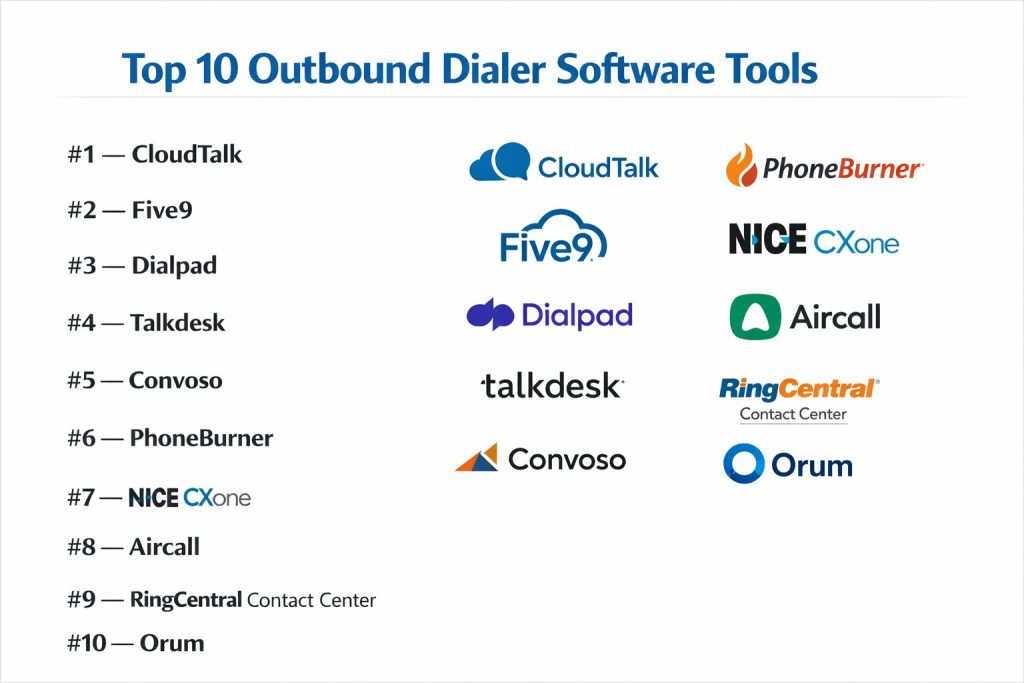
Top 10 Outbound Dialer Software Tools
#1 — CloudTalk
CloudTalk is a modern, AI-driven business phone system designed specifically for sales and support teams. It is widely praised for its ease of use and its ability to handle complex international calling requirements with localized numbers in over 160 countries.
Key Features
- Smart Dialer: Automatically scans a webpage or CRM for numbers and creates a dynamic calling queue.
- AI Call Summaries: Automatically generates post-call notes and sentiment analysis for every conversation.
- Power Dialer: Allows agents to call through a list sequentially, reducing idle time by up to 300%.
- Workflow Automation: Triggers follow-up emails or CRM updates based on call tags or results.
- Voicemail Drop: Enables agents to leave a pre-recorded message with one click, saving hours of manual recording.
- Global Infrastructure: Provides localized caller ID and high-definition voice quality across 160+ countries.
- Real-Time Dashboard: Gives managers immediate visibility into agent productivity and campaign success.
Pros
- Fast Setup: Teams can be fully operational in minutes rather than days.
- Deep CRM Sync: One of the best “zero-latency” integrations with Pipedrive and HubSpot.
Cons
- Feature Gating: Advanced AI features and predictive dialing are reserved for higher-tier plans.
- Reporting Complexity: Customizing advanced reports can be slightly technical for new users.
Platforms / Deployment
- Windows / macOS / Linux / Mobile (iOS & Android)
- Cloud-Native
Security & Compliance
- Encryption: AES-256 for data at rest; TLS 1.2 for data in transit.
- Compliance: HIPAA, GDPR, SOC 2 Type II.
Integrations & Ecosystem
CloudTalk supports 80+ integrations including Salesforce, Zendesk, Intercom, and MS Teams. Its open API allows for deep customization in proprietary stacks.
Support & Community
Offers 24/7 email and chat support, extensive video documentation, and dedicated account managers for enterprise clients.
#2 — Five9
Five9 is an industry titan in the cloud contact center space. It is a robust, enterprise-grade platform that specializes in high-volume outbound campaigns with a heavy emphasis on intelligent automation.
Key Features
- Predictive Dialer: Uses sophisticated algorithms to predict agent availability and dial numbers accordingly.
- Intelligent Virtual Assistant (IVA): Conversational AI that handles routine inquiries and qualifies leads before human intervention.
- Agent Assist: Real-time AI coaching that provides knowledge-base articles to agents during a live call.
- Omnichannel Engagement: Seamlessly blends voice with email, SMS, and social messaging.
- Visual IVR: Allows customers to interact with menus on their smartphones for faster self-service.
- Global Reach: Robust carrier-grade network architecture with global points of presence.
Pros
- Massive Scalability: Designed to handle thousands of concurrent agents without performance degradation.
- Advanced Compliance: Market-leading tools for managing DNC lists and state-specific calling hours.
Cons
- Complex Implementation: Often requires a professional services engagement for initial setup.
- Legacy Interface: Some parts of the administrative backend feel dated compared to newer cloud rivals.
Platforms / Deployment
- Web-Based / Desktop App
- Public Cloud / Private Cloud
Security & Compliance
- Certifications: PCI DSS Level 1, ISO 27001, FedRAMP authorized.
- Encryption: Enterprise-grade encryption across all channels.
Integrations & Ecosystem
Deep native integrations with Oracle, SAP, Salesforce, and Microsoft. Its “Five9 University” provides comprehensive training for large-scale operations.
Support & Community
24/7/365 global support and a vast network of certified implementation partners.
#3 — Dialpad
Dialpad is a “mobile-first” communication platform built on Google Cloud. It stands out for its proprietary “Dialpad Ai” which transcribes calls in real-time and provides instant insights to sales teams.
Key Features
- Ai Sales Dialer: Includes a built-in power dialer with real-time AI transcription and coaching prompts.
- Post-Call Summaries: Delivers a concise recap of every call, including action items and sentiment scores.
- Local Presence: Automatically displays a local area code for the person being called to increase answer rates.
- Ai CSAT: Uses voice analysis to predict customer satisfaction scores for 100% of calls, not just those who take surveys.
- Unified Communications: Combines video meetings, messaging, and dialing in a single application.
Pros
- Modern UX: Extremely intuitive interface that requires almost no agent training.
- AI Accuracy: Widely considered the gold standard for real-time transcription accuracy.
Cons
- Advanced Dialing: Lacks the “parallel dialing” capabilities of some sales-specific competitors like Orum.
- Price: Can become expensive when adding specialized AI features for large teams.
Platforms / Deployment
- Windows / Mac / iOS / Android / Web
- Cloud (Google Cloud Platform)
Security & Compliance
- Compliance: SOC 2 Type II, HIPAA, GDPR.
- Architecture: Zero-trust security model.
Integrations & Ecosystem
Native integrations with Google Workspace, Microsoft 365, and Slack. Its App Marketplace features hundreds of pre-built connectors.
Support & Community
Provides a 100% uptime SLA for Enterprise customers and extensive online help centers.
#4 — Talkdesk
Talkdesk is a “clicks-not-code” cloud contact center platform. It is designed for businesses that want an enterprise-level dialer but need the flexibility to change their workflows instantly without IT help.
Key Features
- Talkdesk Dialer: Offers multiple dialing modes including preview and power dialing.
- Experience.Ai: A specialized AI suite for analyzing customer intent and providing agent guidance.
- AppConnect: An “app store” for contact centers that allows users to add new features with one click.
- Guardian: An AI-powered security tool that monitors agent behavior for potential data breaches or compliance risks.
- Quality Management: Advanced tools for screen recording and agent evaluation.
Pros
- User Interface: Clean, modern, and highly responsive.
- Innovation Speed: One of the fastest-moving companies in terms of releasing new AI features.
Cons
- Enterprise Focus: Their pricing and sales process are primarily geared toward larger organizations.
- Complexity: Some users find the sheer number of settings overwhelming at first.
Platforms / Deployment
- Browser-Based / Desktop Client
- Cloud-Native (AWS)
Security & Compliance
- Certifications: ISO 27001, SOC 2, HIPAA, GDPR, PCI DSS.
- Protection: Real-time fraud detection and voice biometrics.
Integrations & Ecosystem
Market-leading Salesforce integration. Known for its “Automation Designer” which allows non-technical users to build complex call flows.
Support & Community
Exceptional 24/7 technical support and an active “Talkdesk Community” for peer-to-peer learning.
#5 — Convoso
Convoso is a highly specialized outbound dialer focused on “Lead Penetration.” It is the preferred tool for high-volume sales teams that need to maximize the ROI on every lead through advanced pacing and reputation management.
Key Features
- ClearView: An automated caller ID reputation management system that monitors numbers for “Spam” flags.
- Dynamic Pacing: Automatically adjusts how many lines are dialed per agent to minimize dropped calls while maximizing talk time.
- Workflow Automation: Advanced logic to determine exactly when to retry a lead across multiple channels.
- Conversational AI: AI voice agents that can handle initial lead qualification at massive scale.
- Advanced AMD: Industry-leading accuracy in detecting answering machines to prevent agents from wasting time.
Pros
- Contact Rates: Specifically engineered to bypass carrier filters and increase answer rates.
- Regulatory Focus: Deeply integrated guardrails for TCPA and state-level compliance.
Cons
- Learning Curve: The advanced settings for pacing and reputation management require some training.
- Target Market: Not a general-purpose phone system; it is strictly a high-volume outbound engine.
Platforms / Deployment
- Web-Based
- Cloud
Security & Compliance
- Focus: TCPA compliance is a core feature; SOC 2 and PCI DSS support.
Integrations & Ecosystem
Integrates with major CRMs and lead providers. Highly focused on the “Performance Marketing” ecosystem.
Support & Community
Dedicated compliance consultants and account managers who help optimize dialing strategies for maximum conversion.
#6 — PhoneBurner
PhoneBurner is a “Power Dialer” that emphasizes simplicity and agent productivity. It is a favorite for small to mid-sized sales teams who want to start dialing without a complex technical setup.
Key Features
- No-Delay Connection: Unlike predictive dialers, PhoneBurner ensures the agent is already on the line when the prospect answers.
- Lead Management: Built-in CRM for organizing prospects and tracking interaction history.
- One-Click Voicemail: Speeds up outreach by automating the voicemail delivery process.
- Smart Sender: Automatically sends personalized follow-up emails based on the outcome of the call.
- Local ID Presence: Verified local numbers to improve pickup rates across different regions.
Pros
- Ease of Use: Agents can be trained and dialing within 15 minutes.
- Compliance Safety: Because it is a power dialer (one call at a time per agent), it carries lower TCPA risks than predictive dialers.
Cons
- Manual Logic: Lacks the hyper-advanced AI “Agentic” workflows found in Five9 or Dialpad.
- Volume Limits: Not designed for massive, 500-agent simultaneous predictive campaigns.
Platforms / Deployment
- Web-Based
- Cloud
Security & Compliance
- Standard: GDPR compliant, SOC 2 Type II, encrypted data storage.
Integrations & Ecosystem
Strong integrations with Salesforce, HubSpot, and Zapier. It offers a “dial from anywhere” browser extension.
Support & Community
Friendly, US-based support team and a very active training webinar schedule.
#7 — NICE CXone
NICE CXone is a global leader in the contact center market. It provides a massive, unified platform that combines outbound dialing with workforce management and deep behavioral analytics.
Key Features
- Personal Connection™: A patented technology that eliminates the “telemarketer pause” by connecting agents to prospects instantly.
- Enlighten AI: A behavioral AI that scores agent soft skills and sentiment in real-time.
- Workforce Management (WFM): Advanced tools for scheduling thousands of agents across different time zones.
- Predictive Engagement: Identifies the best time and channel to reach a specific customer based on historical data.
- Real-Time Reporting: One of the most granular reporting engines in the industry.
Pros
- Feature Completeness: It is an all-in-one solution that replaces five or six separate software tools.
- Enterprise Reliability: Preferred by Fortune 500 companies for its extreme uptime and security.
Cons
- Cost: One of the most expensive options on the market.
- Complexity: Requires a dedicated internal admin to manage the platform effectively.
Platforms / Deployment
- Web / Desktop
- Cloud-Native (AWS/Azure)
Security & Compliance
- Certifications: FedRAMP, HIPAA, HITRUST, SOC 2, PCI DSS Level 1.
Integrations & Ecosystem
Native integrations with virtually every major enterprise software. The “NICE Exchange” features hundreds of third-party extensions.
Support & Community
Global enterprise support tiers and “NICE University” for professional certification.
#8 — Aircall
Aircall is a modern, cloud-based phone system that has gained massive popularity among sales-driven SMBs. It focuses on the “Essential Outbound” workflow—making it perfect for teams that live in their CRM.
Key Features
- Power Dialer Extension: Turns any list of phone numbers in a CRM into a click-to-dial queue.
- Call Whispering: Allows managers to coach agents live without the customer hearing.
- Insights Dashboard: Tracks key outbound metrics like average talk time and missed call rates.
- Smart Routing: Ensures follow-up calls are routed back to the agent who previously spoke with the lead.
- Mobile-First: A highly polished mobile app that allows for high-quality outbound calling from anywhere.
Pros
- User Experience: Widely cited as having the most “Apple-like” clean interface in the VoIP world.
- App Ecosystem: Hundreds of one-click integrations that genuinely work without technical assistance.
Cons
- Predictive Missing: Does not offer a true predictive dialer mode for very high-volume automated campaigns.
- Basic Analytics: While good for SMBs, enterprise teams may find the data depth lacking compared to NICE or Five9.
Platforms / Deployment
- Windows / Mac / iOS / Android
- Cloud
Security & Compliance
- Standard: GDPR compliant, SOC 2, HIPAA support.
Integrations & Ecosystem
Arguably the best HubSpot and Pipedrive integrations on the market. Very strong presence in the Shopify and e-commerce space.
Support & Community
Fast-response chat support and a very proactive customer success team for mid-market accounts.
#9 — RingCentral Contact Center
RingCentral is a household name in unified communications. Their contact center offering (powered by NICE) provides a robust outbound dialer for businesses that want to keep their office phones and contact center under one vendor.
Key Features
- Omnichannel Routing: Manages outbound calls, texts, and social media interactions in one inbox.
- Progressive Dialing: Protects your reputation by ensuring an agent is always available before a call is placed.
- RingSense AI: A conversational intelligence tool that automatically scores calls and extracts key meeting moments.
- Expert Connect: Allows agents to quickly reach out to internal subject matter experts during a call to close deals faster.
- Global Presence: High-reliability network with “five nines” (99.999%) uptime guarantee.
Pros
- Unified Billing: One vendor for your entire company’s communication needs.
- Proven Stability: One of the most reliable networks in the telecom industry.
Cons
- Pricing Structure: Can be confusing with many different add-ons and license tiers.
- Platform Blend: The contact center interface is different from the standard office phone app.
Platforms / Deployment
- Desktop / Mobile / Web
- Cloud
Security & Compliance
- Standard: SOC 2, HIPAA, HITRUST, PCI DSS.
Integrations & Ecosystem
Massive ecosystem with over 300+ pre-built integrations. Strong focus on Microsoft Teams integration.
Support & Community
24/7 global support and a very high level of professional training resources.
#10 — Orum
Orum is a specialized “Parallel Dialer” built specifically for sales development reps (SDRs). It is designed for one thing: getting reps into as many conversations as possible, as fast as possible.
Key Features
- Parallel Dialing: Dials multiple numbers simultaneously and instantly connects the rep when someone answers.
- AI AMD: Uses advanced neural networks to filter out 99% of voicemails and automated attendants.
- CRM Hot-Linking: Instantly opens the correct prospect record in the CRM the moment a call is connected.
- Call Coaching: Allows managers to listen in and “live-coach” SDRs during their dial blocks.
- Live Feed: Gamifies the experience by showing team-wide connection rates and “wins” in real-time.
Pros
- Pure Speed: It is arguably the fastest way for an SDR to reach 100+ dials per hour.
- Low Friction: Requires very little configuration to start seeing massive productivity gains.
Cons
- Niche Tool: It is an “overlay” for your phone system, not a replacement for a full contact center suite.
- Compliance Risk: Parallel dialing requires strict adherence to TCPA rules regarding “abandonment rates.”
Platforms / Deployment
- Web-Based
- Cloud (Overlay)
Security & Compliance
- Standard: SOC 2 Type II, encrypted data sync with CRMs.
Integrations & Ecosystem
Native, high-speed sync with Outreach, Salesloft, Salesforce, and HubSpot.
Support & Community
Highly specialized support for sales leaders; known for helping teams build “dialing culture.”
Comparison Table (Top 10)
| Tool Name | Best For | Dialing Modes | Standout Feature | Public Rating |
| CloudTalk | Growing SMBs | Power, Smart | AI Automatic Call Summaries | 4.6/5 |
| Five9 | Large Enterprise | Predictive, Power, Preview | AI Virtual Assistants (IVA) | 4.5/5 |
| Dialpad | AI-First Teams | Power | Real-time Ai Transcription | 4.7/5 |
| Talkdesk | Modern Call Centers | Power, Progressive, Preview | Experience.Ai Coaching | 4.6/5 |
| Convoso | Lead Penetration | Predictive, Power | ClearView ID Reputation | 4.8/5 |
| PhoneBurner | Mid-Sized Sales | Power | No-Delay Connection | 4.5/5 |
| NICE CXone | Global Centers | Predictive, Progressive | Personal Connection™ | 4.4/5 |
| Aircall | CRM-Centric Teams | Power | One-Click CRM Dialing | 4.6/5 |
| RingCentral | Unified Comms | Progressive, Preview | RingSense Ai Intelligence | 4.4/5 |
| Orum | SDR Speed | Parallel, Power | AI Answering Machine Filter | 4.8/5 |
Evaluation & Scoring of Outbound Dialer Software
The scoring reflects the tool’s performance in high-pressure outbound environments typical.
| Tool Name | Core (25%) | Ease (15%) | Integrations (15%) | Security (10%) | Performance (10%) | Support (10%) | Value (15%) | Weighted Total |
| CloudTalk | 9 | 9 | 9 | 8 | 9 | 8 | 9 | 8.85 |
| Five9 | 10 | 6 | 10 | 10 | 10 | 9 | 7 | 8.80 |
| Dialpad | 9 | 10 | 9 | 9 | 9 | 9 | 8 | 9.00 |
| Talkdesk | 9 | 8 | 9 | 10 | 9 | 9 | 7 | 8.60 |
| Convoso | 10 | 7 | 8 | 8 | 10 | 9 | 7 | 8.65 |
| PhoneBurner | 8 | 10 | 8 | 8 | 8 | 9 | 8 | 8.15 |
| NICE CXone | 10 | 5 | 10 | 10 | 10 | 9 | 6 | 8.40 |
| Aircall | 8 | 10 | 10 | 8 | 8 | 9 | 9 | 8.70 |
| RingCentral | 9 | 7 | 9 | 10 | 9 | 8 | 7 | 8.30 |
| Orum | 9 | 9 | 9 | 8 | 10 | 8 | 7 | 8.55 |
Which Outbound Dialer Tool Is Right for You?
Solo / Small Team
If you are a solo agent or a team of under 10 people, PhoneBurner or Aircall are your best bets. They offer the lowest barrier to entry and require zero technical knowledge to maintain compliance and start seeing results.
High-Volume Sales (SDRs)
For teams where the primary goal is maximizing “dials per hour,” Orum is the specialized choice. If you need a more complete phone system with those high-speed capabilities, CloudTalk offers a superior balance of speed and AI features.
Enterprise / Global Support
Large organizations with strict security requirements (SOC 2, ISO) and thousands of agents should focus on Five9 or NICE CXone. These platforms are built for “five-nines” reliability and offer the most robust workforce management tools.
Compliance-Heavy Industries
If you are in real estate, insurance, or debt collection and are terrified of TCPA lawsuits, Convoso is the correct choice. Their “ClearView” technology and automated guardrails are specifically built to protect high-volume dialers from legal and carrier-level risks.
AI & Innovation
If your team wants to be on the cutting edge of real-time transcription, sentiment analysis, and automated coaching, Dialpad and Talkdesk lead the market in AI-native architecture.
Frequently Asked Questions (FAQs)
What is the difference between a Power Dialer and a Predictive Dialer?
A Power Dialer dials one number at a time per agent, ensuring the agent is always there when someone answers. A Predictive Dialer dials multiple lines simultaneously, using an algorithm to “predict” when an agent will become free.
Is outbound dialer software legal?
Yes, but it is highly regulated. In the US, you must follow TCPA (Telephone Consumer Protection Act) rules, which include honoring the National Do Not Call Registry and adhering to state-specific calling hours.
What is “Spam Likely” and how do I avoid it?
Carriers flag numbers that dial too many people too fast or have high “hang-up” rates. Modern dialers use “Reputation Management” to monitor these flags and automatically rotate your caller IDs to keep your answer rates high.
Can these tools integrate with my CRM?
Yes, most top-tier dialers offer native integrations with Salesforce, HubSpot, Zoho, and Pipedrive. This allows for “click-to-call” and ensures all call recordings and notes are automatically saved to the customer’s record.
Do I need special hardware to use this software?
No. Most dialers are cloud-based and only require a stable internet connection and a high-quality USB or Bluetooth headset.
What is AMD (Answering Machine Detection)?
AMD is an AI feature that determines within milliseconds if a human or a voicemail has answered the call. High-quality AMD ensures your agents aren’t stuck listening to “Please leave a message” hundreds of times a day.
How does AI improve outbound dialing?
AI now handles real-time transcription, provides agents with live coaching “cheat sheets,” automatically summarizes calls, and can even qualify leads via voice-bots before transferring them to a human.
What is the “Telemarketer Gap”?
This is the awkward 1-2 second silence after a prospect says “Hello” but before the system connects the agent. Modern “Ultra-Low Latency” dialers have reduced this to nearly zero.
Can I use local numbers when calling prospects?
Yes. Most providers offer “Local Presence” features that automatically display a caller ID with the same area code as the prospect, which can increase answer rates by up to 400%.
Are there limits on how many calls I can make?
While most “unlimited” plans exist for standard office phones, high-volume outbound dialers usually charge per-minute or per-user, and carrier-level “velocity rules” may limit how many calls you can send from a single number.
Conclusion
The selection of an outbound dialer is a strategic decision that directly impacts your lead conversion and regulatory risk. While CloudTalk and Aircall offer the most user-friendly experiences for growing teams, enterprise giants like Five9 and NICE CXone provide the infrastructure necessary for global operations. For teams focused purely on velocity and contact rates, specialized tools like Convoso and Orum offer competitive advantages that traditional phone systems simply cannot match.
The “future-proof” choice is a platform that combines high-fidelity voice with Agentic AI and Automated Reputation Management. As carriers become stricter, your software must be smarter.