Introduction
Setting goals is one of the oldest business practices in the book, but the way we track them has changed completely. OKR & Goal Management Software is a digital platform designed to help teams define high-level Objectives and track the measurable Key Results that lead to them. Instead of a dusty spreadsheet that nobody looks at after January, these tools act as a live dashboard for a company’s strategy. They turn vague “to-do” lists into a structured map where everyone can see how their daily tasks push the needle on the company’s biggest priorities.
In the current professional landscape, speed is everything. Organizations can no longer wait for annual reviews to see if they are on track. These platforms provide real-time visibility, allowing leaders to pivot quickly when a strategy isn’t working. By moving away from static goal-setting, companies foster a culture of transparency and accountability. Whether you are managing a remote team of ten or a global enterprise of thousands, these tools bridge the gap between “having a plan” and “executing a plan.”
Real-World Use Cases
- Strategic Alignment: Ensuring the engineering team and the marketing team are actually moving toward the same quarterly revenue target.
- Continuous Performance Tracking: Moving away from annual reviews to weekly check-ins that keep momentum high.
- Resource Optimization: Identifying which projects are under-resourced or failing before they drain the budget.
- Transparency Initiatives: Letting every employee see the CEO’s goals so they understand the “why” behind their work.
- Remote Team Management: Providing a central “source of truth” for distributed workers who need to stay synchronized without constant meetings.
What Buyers Should Evaluate
- Ease of Use: If the tool is too complex, employees simply won’t use it.
- Integration Depth: Does it connect with Slack, Microsoft Teams, or Jira where your work actually happens?
- Automation: Can it update Key Results automatically based on data from other apps?
- Hierarchy Support: Does it allow goals to cascade from the top down and bubble from the bottom up?
- Security Standards: Look for SSO, MFA, and industry-standard data protection.
- Reporting Flexibility: Can you generate a boardroom-ready report in a few clicks?
- Customization: Can you adjust the terminology (e.g., using “Goals” instead of “Objectives”)?
- Support and Coaching: Does the vendor provide help with the OKR methodology, not just the software?
Best for: Rapidly growing tech companies, large enterprises undergoing digital transformation, and results-oriented leadership teams.
Not ideal for: Very small teams with low complexity that can still manage effectively with a simple shared document or basic task manager.
Key Trends in OKR & Goal Management Software
- AI-Powered Goal Drafting: Modern platforms now offer suggestions to help users write “SMART” goals, ensuring that objectives are actually measurable and not just vague aspirations.
- Predictive Performance Insights: Using historical data, tools can now flag goals that are “at risk” of failure weeks before they actually miss their deadline.
- Shift to “Agentic” Automation: Software is moving from simple tracking to active agents that can autonomously gather data from multiple sources to update progress reports.
- Contextual Goal Integration: Instead of being a separate app, goal management is being baked directly into communication tools like Slack and MS Teams.
- Emphasis on Psychological Safety: Newer tools include “confidence scores” where employees can honestly state how they feel about a goal without fear of immediate reprimand.
- Consolidation with Performance Management: The line between “business goals” and “employee performance reviews” is disappearing, with many tools now handling both in one place.
- Vertical and Horizontal Alignment: Modern software visualizes dependencies across different departments, showing how a delay in Product affects Sales targets.
- Enhanced Data Residency: With stricter global regulations, top-tier vendors are offering more choices for where data is physically stored and how it is encrypted.
How We Selected These Tools (Methodology)
To select the top 10 tools for this category, we used a rigorous evaluation framework focused on professional reliability and market performance:
- Adoption and Mindshare: We prioritized tools that are trusted by industry leaders and have a proven track record in professional environments.
- Methodology Rigor: We selected tools that natively support the OKR framework but allow enough flexibility for varied business models.
- Automation Capabilities: Extra weight was given to platforms that reduce the “manual update” burden through deep integrations.
- Security Posture: Only tools with enterprise-grade security signals (like SSO and robust permissions) were considered for the final list.
- Scalability: We looked for software that functions as well for a startup as it does for a company with 10,000 employees.
- User Experience: We focused on tools that lower the barrier to entry for non-technical users to ensure high adoption rates.
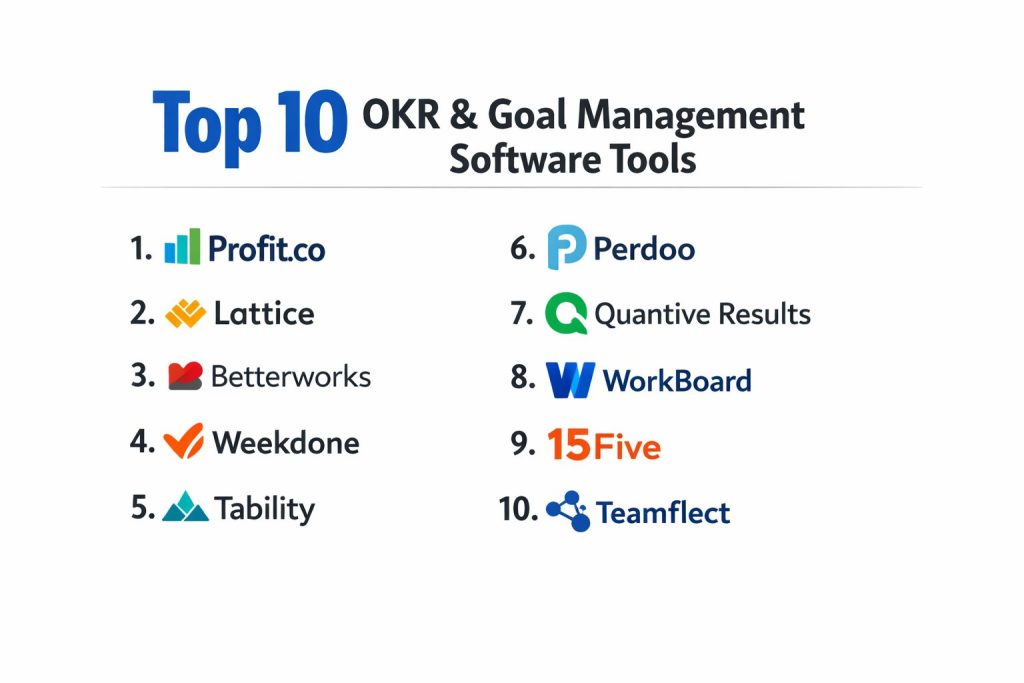
Top 10 OKR & Goal Management Software Tools
1. Profit.co
A comprehensive, all-in-one platform that bridges the gap between strategy, OKRs, and task execution. It is designed for businesses that want a high level of customization and deep feature sets.
Key Features
- AI-Powered OKR Authoring: Helps users refine their goal language to meet professional standards.
- Integrated Task Management: Links daily work directly to Key Results so progress is reflected in real-time.
- Custom Dashboards: Over 400 built-in KPIs and the ability to create highly specific visual reports.
- Employee Engagement Tools: Includes pulse surveys and recognition features to boost morale alongside performance.
- Strategy Maps: Visualizes the “Big Picture” to show exactly how every goal connects to the company’s mission.
Pros
- Offers one of the most complete feature sets on the market, covering OKRs, tasks, and performance.
- Highly flexible, allowing organizations to keep their existing terminology and workflows.
Cons
- The sheer number of features can be overwhelming for smaller, simpler teams.
- Requires a significant initial setup time to get the most out of the platform.
Platforms / Deployment
- Web / Windows / macOS / iOS / Android
- Cloud / Hybrid
Security & Compliance
- SSO/SAML, MFA, and role-based access control.
- SOC 2, ISO 27001, and GDPR compliant.
Integrations & Ecosystem
Profit.co offers over 50 native integrations with major business tools, making it easy to automate progress updates.
- Jira, Slack, Microsoft Teams, and Salesforce.
- HubSpot, GitHub, and Google Sheets.
- Robust API for custom enterprise connections.
Support & Community
Provides 24/7 live support and dedicated OKR coaching. Documentation is extensive, featuring many templates and guides.
2. Lattice
A people-centric platform that combines goal management with performance reviews and employee engagement. It is a favorite for HR teams who want goals and growth in one place.
Key Features
- Unified Goals and Reviews: Automatically pulls goal progress into employee performance discussions.
- Real-Time Feedback: Allows for “shout-outs” and continuous feedback linked to specific achievements.
- 1:1 Meeting Templates: Encourages managers to discuss OKRs during their regular weekly check-ins.
- Analytics for HR: Provides deep insights into team sentiment and goal completion rates across the company.
- Cascading Goals: Clear visualization of how individual goals support department and company objectives.
Pros
- Exceptional user interface that encourages high adoption from all employees.
- Excellent for building a culture where growth and goals are seen as a single journey.
Cons
- Can be more expensive than standalone OKR tools since it is often bundled with performance modules.
- Not as focused on “task-level” automation as some of the more technical platforms.
Platforms / Deployment
- Web / iOS / Android
- Cloud
Security & Compliance
- SSO/SAML, encryption at rest and in transit.
- SOC 2 Type II and GDPR compliant.
Integrations & Ecosystem
Lattice integrates deeply with the standard tech stack to ensure goals stay top-of-mind.
- Slack, MS Teams, and G-Suite.
- BambooHR, HiBob, and Workday.
- Jira and Salesforce for automated metric tracking.
Support & Community
Known for a strong community (Lattice for Humans) and excellent customer success management for mid-market clients.
3. Betterworks
An enterprise-grade solution focused on aligning global teams and driving large-scale strategic execution. It specializes in making complex organizations feel more connected.
Key Features
- Alignment View: A powerful visual map that shows the dependencies between different global business units.
- Continuous Conversations: Built-in workflows for check-ins, feedback, and recognition.
- Advanced Reporting: High-level executive dashboards that summarize organizational health at a glance.
- Development Plans: Integrates career growth goals with operational business OKRs.
- Configurable Workflows: Allows enterprise admins to set strict or flexible approval processes for goals.
Pros
- Built for scale; handles the complexity of thousands of users with ease.
- Strong focus on strategic execution and “clearing the path” for large-scale initiatives.
Cons
- Higher price point makes it less suitable for small businesses.
- The complexity of the tool often requires a dedicated internal admin for large rollouts.
Platforms / Deployment
- Web / iOS / Android
- Cloud / Hybrid
Security & Compliance
- Enterprise-level SSO, MFA, and advanced audit logs.
- SOC 2, ISO 27001, and HIPAA (where applicable).
Integrations & Ecosystem
Betterworks focuses on connecting with the “system of record” for every department.
- Salesforce, Jira, and Microsoft Dynamics.
- Slack, MS Teams, and Outlook.
- Oracle and SAP HR systems.
Support & Community
Provides high-touch enterprise support and strategic consulting to ensure the OKR rollout is successful at scale.
4. Weekdone
A streamlined tool that focuses on the “weekly habit” of goal tracking. It is perfect for SMBs and teams that want a simple way to stay aligned without too much overhead.
Key Features
- Weekly Check-ins: Prompts users to list their plans, progress, and problems (PPP) every week.
- Visual Tree View: A clean, easy-to-understand hierarchy showing how everything connects.
- One-Click Reports: Generates automated summaries of what the team achieved during the week.
- Team Recognition: Simple ways to “like” or comment on a teammate’s weekly progress.
- KPI Tracking: Allows for ongoing metrics to be tracked alongside specific quarterly OKRs.
Pros
- Extremely easy to set up; a team can be running in less than a day.
- Very affordable, with a generous free tier for small groups.
Cons
- Lacks the deep performance review features of more complex HR platforms.
- Analytics are sufficient for small teams but may feel basic for large enterprises.
Platforms / Deployment
- Web / iOS / Android
- Cloud
Security & Compliance
- SSO available on higher tiers, MFA.
- GDPR compliant.
Integrations & Ecosystem
Focuses on the most common tools for communication and simple task management.
- Slack, MS Teams, and Google Sheets.
- Jira, Asana, and Zapier.
- Basecamp and Trello.
Support & Community
Offers great onboarding calls and a solid library of “how-to” videos for OKR beginners.
5. Tability
A modern, AI-first platform that removes the “friction” of goal tracking. It is designed for teams that want a low-maintenance way to stay focused.
Key Features
- AI OKR Coach: Automatically checks the quality of your goals and suggests improvements.
- Automated Reminders: Smart notifications that prompt users for updates only when needed.
- Focus View: A personal dashboard that shows an employee exactly what they need to worry about today.
- Public Dashboards: Easily share progress with stakeholders or board members via a secure link.
- Flexible Cycles: Supports quarterly, monthly, or custom goal timelines without messy configuration.
Pros
- One of the fastest interfaces in the category; it doesn’t “get in the way” of work.
- Strong use of AI to help teams who are new to the OKR methodology.
Cons
- Younger platform, so it may lack some of the historical “enterprise” features of legacy tools.
- The community is smaller compared to industry giants like Maya or Lattice.
Platforms / Deployment
- Web
- Cloud
Security & Compliance
- SSO/SAML support, encryption, and regular security audits.
- SOC 2 Type II compliant.
Integrations & Ecosystem
Tability is built for the modern cloud-native stack.
- Slack and MS Teams (Deeply integrated).
- Jira, GitHub, and Linear for developer teams.
- Notion and HubSpot.
Support & Community
Responsive chat support and a very active blog focused on “making goals easier.”
6. Perdoo
A strategy-first platform that emphasizes the connection between a company’s “Roadmap” and its OKRs. It is built for clarity and strategic long-term thinking.
Key Features
- Strategy Map: A visual roadmap that connects long-term vision to quarterly targets.
- Progress Reports: Clean, presentation-ready slides that can be exported instantly.
- Key Result Auto-Updates: Connects to data sources to track progress without manual typing.
- Health Indicators: Flags when a goal is “stuck” or needs leadership attention.
- Collaborative Feed: A social-style wall for team updates and celebratory announcements.
Pros
- Excellent visual design that helps everyone understand the “Why” behind their goals.
- Very strong educational resources for companies trying to learn the OKR method.
Cons
- Some advanced automation features are locked behind higher pricing tiers.
- The mobile experience is good but less feature-rich than the desktop version.
Platforms / Deployment
- Web / iOS / Android
- Cloud
Security & Compliance
- SSO/SAML, MFA, and data encryption.
- GDPR compliant and ISO 27001 signals.
Integrations & Ecosystem
Integrates with the core tools where data lives to ensure accuracy.
- Slack, MS Teams, and Google Sheets.
- Salesforce, Jira, and HubSpot.
- Zapier for connecting to hundreds of other apps.
Support & Community
Known for the “Perdoo University” and high-quality customer success managers who act as strategic partners.
7. Quantive Results
Formally known as Gtmhub, this is arguably the most powerful data-driven OKR platform on the market. It is for companies that want to automate everything.
Key Features
- 150+ Data Connectors: The widest range of integrations for automatic progress tracking.
- White-Labeling: Allows large organizations to brand the platform as their own.
- Custom Insights: A powerful engine for building unique reports using SQL or visual tools.
- Dynamic Target Tracking: Adjusts goals automatically based on shifting market data.
- Enterprise Governance: Granular permissions and approval workflows for complex hierarchies.
Pros
- Unmatched for data-heavy companies that want “zero manual input” OKRs.
- Extremely scalable and flexible for any organizational structure.
Cons
- High learning curve; you might need a “power user” to set up complex data links.
- Pricing can be high for teams that don’t need the advanced data features.
Platforms / Deployment
- Web / iOS / Android
- Cloud / Self-hosted / Hybrid
Security & Compliance
- SSO, MFA, Audit logs, and granular RBAC.
- SOC 2, ISO 27001, and HIPAA compliant.
Integrations & Ecosystem
Quantive is the leader in the ecosystem space, connecting to almost anything.
- Salesforce, Jira, Tableau, and Snowflake.
- Microsoft Dynamics, Oracle, and SAP.
- Custom API and Webhooks.
Support & Community
Professional services are available for large implementations. The community is focused on high-level data analysis and strategy.
8. WorkBoard
An enterprise “Strategy Execution” platform that helps leaders manage business reviews and operational meetings alongside OKRs.
Key Features
- Digital Operating Rhythm: Automates the preparation for weekly or monthly business reviews.
- Strategy Alignment Maps: Visualizes how goals are connected across silos.
- Meeting Management: Integrated agendas and action items that link directly to OKRs.
- Smart Progress Updates: AI-enhanced summaries of what happened during the goal cycle.
- Resource Mapping: Helps leaders see where talent is allocated against top priorities.
Pros
- Unique focus on the “meeting” aspect of leadership, making it very practical for executives.
- Very strong at breaking down departmental silos in large corporations.
Cons
- Can feel “too big” or complex for a small startup or individual team.
- The user interface is professional but carries a steeper learning curve than newer tools.
Platforms / Deployment
- Web / iOS / Android
- Cloud / Hybrid
Security & Compliance
- Enterprise SSO, MFA, and advanced encryption standards.
- SOC 2 Type II and ISO 27001 certifications.
Integrations & Ecosystem
WorkBoard connects with the heavy-duty tools used by enterprise management.
- Jira, Microsoft Azure DevOps, and Salesforce.
- Slack, MS Teams, and Webex.
- High-level BI tools like PowerBI.
Support & Community
Known for their “OKR Coach Certification” program, which is highly respected in the industry.
9. 15Five
A holistic “Performance Management” tool that uses OKRs as a foundation for employee engagement and manager development.
Key Features
- High Five Recognition: A peer-to-peer appreciation system that boosts team morale.
- Weekly Check-ins: Structured updates that keep managers and employees in sync.
- Engagement Surveys: Science-backed surveys to measure the “pulse” of the organization.
- Manager Training: Integrated coaching tools to help team leads become better mentors.
- Goal Cascading: Simple visual links between high-level company OKRs and individual work.
Pros
- Best for companies that prioritize employee well-being and manager quality.
- Very user-friendly and encourages a positive, conversational culture.
Cons
- OKR features are powerful but are part of a larger HR suite that you may or may not need.
- Less focus on technical data integrations compared to a tool like Quantive.
Platforms / Deployment
- Web / iOS / Android
- Cloud
Security & Compliance
- SSO/SAML, MFA, and data privacy controls.
- SOC 2 and GDPR compliant.
Integrations & Ecosystem
15Five integrates with HRIS and communication platforms to stay central to the employee experience.
- BambooHR, Workday, and Namely.
- Slack and Microsoft Teams.
- Jira for linking goals to development tasks.
Support & Community
Excellent customer support and a vast library of research-backed HR resources and webinars.
10. Teamflect
The premier OKR and performance tool built inside Microsoft Teams. It is the perfect choice for organizations that live and breathe the Microsoft ecosystem.
Key Features
- Native Teams Integration: No new app to learn; it lives in the sidebar of your Teams app.
- Meeting Check-ins: Bring goal progress directly into your video calls and chat threads.
- Review Cycle Automation: Handles performance reviews without leaving the Teams interface.
- Feedback & Praise: Integrated “shout-outs” that appear in your team’s common channels.
- Task to OKR Link: Connects Microsoft Planner tasks directly to your Key Results.
Pros
- Zero “context switching”—employees don’t have to leave their primary work app.
- Extremely cost-effective for teams already paying for Microsoft 365.
Cons
- Only available for teams using Microsoft 365; not an option for Google Workspace users.
- Limited customization compared to standalone, “best-of-breed” OKR platforms.
Platforms / Deployment
- Microsoft Teams (Windows / macOS / iOS / Android)
- Hybrid (via Microsoft Cloud)
Security & Compliance
- Inherits Microsoft 365’s enterprise-grade security.
- SOC 2, ISO 27001, and HIPAA (via Microsoft environment).
Integrations & Ecosystem
The tool is built to be the “missing piece” of the Microsoft productivity suite.
- Full Microsoft 365 integration (Planner, Outlook, SharePoint).
- PowerBI for advanced goal reporting.
- Azure AD for user management.
Support & Community
Provides direct support for IT admins and managers, with a focus on maximizing the value of existing Microsoft investments.
Comparison Table (Top 10)
| Tool Name | Best For | Platform(s) Supported | Deployment | Standout Feature | Public Rating |
| Profit.co | Integrated Tasks & OKRs | Web, Mobile | Hybrid | 400+ built-in KPIs | N/A |
| Lattice | HR & Employee Growth | Web, Mobile | Cloud | Unified Reviews & Goals | N/A |
| Betterworks | Global Enterprise Scale | Web, Mobile | Hybrid | Dependency Mapping | N/A |
| Weekdone | Weekly Team Rhythm | Web, Mobile | Cloud | PPP (Plans, Progress, Problems) | N/A |
| Tability | AI-First Low Maintenance | Web | Cloud | AI OKR Coaching | N/A |
| Perdoo | Strategy Visualization | Web, Mobile | Cloud | Strategy Roadmap view | N/A |
| Quantive Results | Data-Heavy Automation | Web, Mobile | Hybrid | 150+ Data Connectors | N/A |
| WorkBoard | Executive Reviews | Web, Mobile | Hybrid | Meeting Agendas for OKRs | N/A |
| 15Five | Manager Development | Web, Mobile | Cloud | Peer Recognition (High Fives) | N/A |
| Teamflect | Microsoft Teams Users | MS Teams | Hybrid | Native Teams Sidebar App | N/A |
Evaluation & Scoring of OKR & Goal Management Software
The following scoring reflects a comparative analysis of professional suitability and organizational impact.
| Tool Name | Core (25%) | Ease (15%) | Integrations (15%) | Security (10%) | Performance (10%) | Support (10%) | Value (15%) | Weighted Total |
| Profit.co | 10 | 6 | 9 | 9 | 9 | 9 | 8 | 8.6 |
| Lattice | 8 | 10 | 8 | 9 | 9 | 9 | 7 | 8.5 |
| Betterworks | 9 | 6 | 9 | 10 | 10 | 9 | 6 | 8.2 |
| Weekdone | 7 | 9 | 7 | 7 | 8 | 8 | 9 | 7.8 |
| Tability | 8 | 9 | 8 | 8 | 9 | 7 | 9 | 8.3 |
| Perdoo | 8 | 9 | 8 | 8 | 8 | 9 | 8 | 8.2 |
| Quantive | 10 | 5 | 10 | 10 | 10 | 8 | 7 | 8.4 |
| WorkBoard | 9 | 6 | 8 | 10 | 9 | 9 | 6 | 7.8 |
| 15Five | 7 | 9 | 7 | 8 | 8 | 9 | 8 | 7.8 |
| Teamflect | 8 | 9 | 10 | 9 | 9 | 8 | 10 | 8.8 |
How to Interpret These Scores
- Core features: Evaluates the depth of the OKR engine and hierarchical capabilities.
- Ease of use: Focuses on how quickly a typical employee can start updating their goals.
- Integrations: Measures how well the tool talks to other business systems (Jira, Salesforce, etc.).
- Weighted Total: A high score indicates a versatile tool. Specialized tools (like Quantive for data or Teamflect for MS Teams) may have lower “ease” scores but remain the superior choice for their specific niche.
Which OKR & Goal Management Software Tool Is Right for You?
Solo / Freelancer
Most full-scale OKR tools are overkill for one person. However, if you want to build the habit, Weekdone or the free tier of Tability offer the best balance of structure without the noise of enterprise features.
SMB
Small businesses with 10–50 employees should prioritize adoption. Weekdone or Perdoo are excellent because they are visually intuitive and focus on the “team rhythm” rather than complex data science.
Mid-Market
Companies with 100–500 employees need a mix of people management and goal tracking. Lattice or 15Five are the front-runners here, as they help build a high-performing culture while keeping goals organized.
Enterprise
For organizations with thousands of users, Betterworks, WorkBoard, or Quantive are necessary. They offer the security, granular permissions, and complex reporting that large IT and leadership teams require.
Budget vs Premium
- Budget: Teamflect (if you have Microsoft 365) or Blender are the most cost-effective. (Note: Blender is for 3D, for OKRs, look at free tiers from Weekdone).
- Premium: Quantive and Betterworks represent the high-end “premium” tier with advanced automation.
Feature Depth vs Ease of Use
- Deep Tools: Profit.co and Quantive have a massive feature set but take longer to learn.
- Easy Tools: Tability and Lattice focus on a beautiful, fast user experience.
Frequently Asked Questions (FAQs)
What is the typical pricing model for OKR software?
Most professional tools charge on a “per user, per month” basis, billed annually. Prices usually range from $5 to $15 per user, though enterprise tiers with advanced security can be higher.
How long does it take to implement an OKR tool?
For a small team, it takes about a week to set up and train everyone. For a large enterprise, a full rollout including methodology coaching and integration setup can take 2–3 months.
What is the most common mistake when starting with OKRs?
The biggest mistake is setting too many goals. Professionals recommend focusing on 3–5 Objectives per quarter. Another common error is using a tool to track “tasks” instead of “outcomes.”
Do I really need a tool, or can I use a spreadsheet?
Spreadsheets are great for the first quarter, but they fail to scale. They lack the automated reminders, visual hierarchy, and real-time integrations that professional software provides to keep people engaged.
Is my strategic data secure in these platforms?
Yes, top-tier vendors use enterprise-grade encryption and are regularly audited (SOC 2). Strategic plans are sensitive, so look for tools that offer SSO and granular permission controls.
Can these tools handle multi-departmental goals?
Absolutely. Modern software allows for “shared OKRs” where a marketing objective can have key results owned by both the content team and the sales team, ensuring horizontal alignment.
Should I link my OKRs to employee bonuses?
Most OKR experts recommend keeping goal achievement separate from direct financial compensation. This encourages teams to set “ambitious” goals without fearing they will lose money if they only hit 70% of a moonshot target.
How often should we update our goals in the software?
The best practice is a “weekly check-in.” Spending 5–10 minutes a week updating progress keeps goals visible and ensures that “at risk” items are flagged early.
Can I migrate data from one OKR tool to another?
Most platforms allow you to export your data to CSV or Excel. New vendors often provide “migration services” or import tools to help you move your historical goal data over to their platform.
Does the software come with OKR training?
Many premium vendors like Profit.co or Perdoo offer built-in coaching or “OKR Universities.” For smaller tools, you may need to hire an external consultant if your team doesn’t know the methodology yet.
Conclusion
Finding the “right” OKR & Goal Management Software is less about the features and more about your company’s culture. If you are a data-heavy organization, you need the automation of Quantive. If you are a people-focused HR team, Lattice will likely be your best fit. For those deep in the Microsoft world, Teamflect is the most natural choice.