Introduction
Natural Language Processing toolkits are software frameworks and libraries that help developers and teams build systems that understand, analyze, and generate human language. In simple terms, they turn raw text into structured meaning so you can search, classify, extract entities, detect sentiment, summarize, translate, or build chat and voice experiences. They matter now because every product is becoming more conversational and more data-driven, and teams need reliable building blocks to move from experiments to production. Typical use cases include customer support automation, document understanding for finance and healthcare, enterprise search and knowledge discovery, social listening and brand analytics, and content moderation. Buyers should evaluate language coverage, model quality, ease of training and fine-tuning, speed and scalability, deployment options, integration with ML stacks, monitoring and governance, security expectations, licensing, and community support.
Best for: data scientists, ML engineers, software teams, researchers, and product teams building search, chat, analytics, or document intelligence solutions.
Not ideal for: teams that only need simple keyword search, basic rule-based parsing, or one-off text cleanup where lightweight scripts are enough.
Key Trends in NLP Toolkits
- More teams are shifting from classical NLP pipelines to transformer-based workflows for stronger accuracy.
- Lightweight, production-first toolkits are gaining preference for speed, packaging, and operational reliability.
- Hybrid approaches are rising, mixing rules, statistical models, and transformers for better control and cost.
- Retrieval-augmented patterns are pushing toolkits to support chunking, embeddings, and structured extraction.
- Multilingual and cross-lingual support is becoming a requirement for global products and analytics.
- Governance needs are increasing, so teams want traceability, reproducibility, and model lifecycle discipline.
- Efficiency matters more, leading to smaller models, quantization, and CPU-friendly inference options.
- Better evaluation practices are becoming standard, including task-specific metrics and drift awareness.
How We Selected These Tools (Methodology)
- Picked toolkits with strong adoption in research, production, or education.
- Balanced deep-learning-focused libraries with classical NLP frameworks to cover many workflows.
- Considered breadth of capabilities: tokenization, tagging, parsing, classification, embeddings, and training support.
- Looked for ecosystem fit with common ML stacks and deployment patterns.
- Included both beginner-friendly tools and advanced frameworks used in serious pipelines.
- Considered community strength, documentation quality, and long-term maintainability signals.
- Prioritized tools that can be used to build repeatable, testable NLP components.
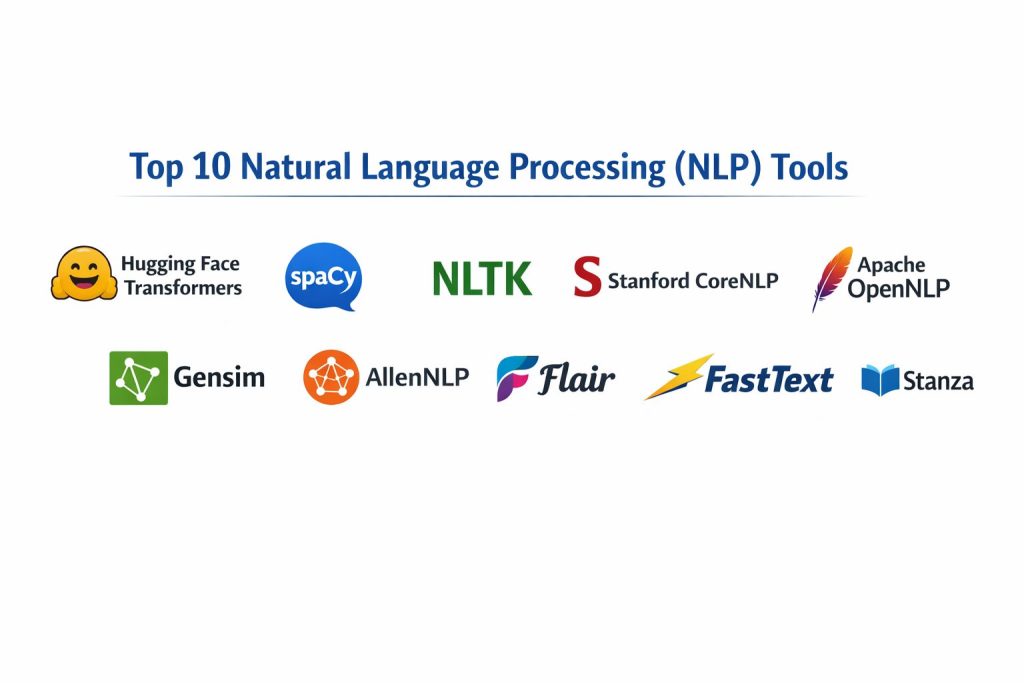
Top 10 Natural Language Processing (NLP) Toolkits
1 — Hugging Face Transformers
A widely used toolkit for transformer-based NLP models, supporting tasks like classification, extraction, summarization, translation, and text generation, with strong ecosystem support.
Key Features
- Large collection of pre-trained transformer model architectures
- Task pipelines for quick prototyping and baseline creation
- Fine-tuning workflows for supervised tasks
- Tokenizers and model utilities for consistent preprocessing
- Strong interoperability with common deep learning workflows
- Broad community contributions and model sharing patterns
Pros
- Fast path from prototype to strong baseline performance
- Huge ecosystem and rapid innovation across tasks
Cons
- Production optimization requires careful engineering and testing
- Model sizes can drive cost and latency if not managed
Platforms / Deployment
Varies / N/A
Security and Compliance
Not publicly stated
Integrations and Ecosystem
Works well in modern ML stacks where teams already use deep learning training and inference workflows.
- Common fit with training pipelines and experiment tracking stacks
- Works alongside embedding, evaluation, and serving approaches
- Large ecosystem of shared models and task patterns
Support and Community
Very strong community, extensive examples, and rapid iteration; support quality depends on usage patterns.
2 — spaCy
A production-oriented NLP toolkit built for fast pipelines, practical components, and developer-friendly APIs, often used for entity extraction and text processing at scale.
Key Features
- Fast tokenization and pipeline processing performance
- Named entity recognition and text classification components
- Training utilities for custom models and pipelines
- Rule-based patterns combined with ML components
- Efficient packaging and deployment-friendly design
- Strong developer ergonomics and clean APIs
Pros
- Strong speed and production readiness for many tasks
- Great for structured extraction and practical pipelines
Cons
- Some advanced research workflows may require extra tooling
- Model choices and language coverage can vary by setup
Platforms / Deployment
Varies / N/A
Security and Compliance
Not publicly stated
Integrations and Ecosystem
Commonly used in apps that need reliable NLP building blocks and fast inference.
- Fits well with Python-based services and data pipelines
- Strong rule-plus-ML pattern support for controlled extraction
- Extensible pipeline components for custom workflows
Support and Community
Strong documentation and active community; commercial support varies.
3 — NLTK
A classic NLP toolkit often used for learning, prototyping, and building baseline text processing workflows with many algorithms and corpora utilities.
Key Features
- Broad set of classical NLP algorithms and utilities
- Tokenization, stemming, tagging, and parsing components
- Corpus handling and educational-friendly resources
- Flexible for experimentation and teaching workflows
- Useful for quick baseline features and preprocessing
- Large body of tutorials and community examples
Pros
- Great for learning and rapid experimentation
- Wide coverage of traditional NLP methods
Cons
- Not designed as a production-optimized toolkit
- Modern deep-learning workflows often need other libraries
Platforms / Deployment
Varies / N/A
Security and Compliance
Not publicly stated
Integrations and Ecosystem
Often used as a companion library for preprocessing and classical NLP steps.
- Useful in research and education pipelines
- Works alongside ML libraries for feature-based models
- Good for quick exploration and baseline comparisons
Support and Community
Long-standing community and lots of learning content; support is community-driven.
4 — Stanford CoreNLP
A well-known NLP framework that provides a full pipeline of classical NLP components like tokenization, tagging, parsing, and entity recognition.
Key Features
- Full pipeline approach for classical NLP tasks
- POS tagging, dependency parsing, and NER components
- Strong linguistic features and analysis output
- Works well for structured annotation workflows
- Useful for academic and enterprise annotation needs
- Stable pipeline behavior for consistent outputs
Pros
- Strong linguistic pipeline with rich structured outputs
- Useful for consistent annotation-style processing
Cons
- Heavier setup and operational overhead than lighter toolkits
- Deep-learning-first workflows may require different tools
Platforms / Deployment
Varies / N/A
Security and Compliance
Not publicly stated
Integrations and Ecosystem
Often used where teams want a packaged pipeline producing structured linguistic annotations.
- Fits into batch processing and annotation workflows
- Useful for rule-based systems relying on parsed structure
- Works as an upstream component for analytics pipelines
Support and Community
Strong academic recognition; community support and documentation vary.
5 — Apache OpenNLP
A toolkit focused on classical NLP tasks such as sentence detection, tokenization, named entities, and document categorization, commonly used in Java ecosystems.
Key Features
- Sentence detection and tokenization components
- Named entity recognition and chunking support
- Document categorization utilities
- Model training for supported tasks
- Java-friendly integration patterns
- Practical for enterprise Java stacks
Pros
- Good fit for Java-based enterprise environments
- Solid for classical NLP tasks and pipelines
Cons
- Less focused on modern transformer workflows
- Some advanced tasks require additional libraries
Platforms / Deployment
Varies / N/A
Security and Compliance
Not publicly stated
Integrations and Ecosystem
Often chosen when Java is the primary platform and teams want dependable NLP components.
- Integrates into Java services and enterprise systems
- Useful for structured NLP in legacy environments
- Works best with clear model management practices
Support and Community
Community-driven support with stable project patterns; depth varies by use case.
6 — Gensim
A toolkit commonly used for topic modeling and vector space modeling, useful for exploring text collections and building semantic representations.
Key Features
- Topic modeling workflows for large text corpora
- Efficient vectorization and similarity computation
- Practical for semantic search prototypes and clustering
- Handles large text collections with streaming patterns
- Useful for unsupervised analysis workflows
- Lightweight integration for analytics pipelines
Pros
- Strong for topic modeling and semantic exploration
- Efficient for large-scale text analysis patterns
Cons
- Not an end-to-end deep-learning NLP toolkit
- Some modern embedding workflows may use other tools
Platforms / Deployment
Varies / N/A
Security and Compliance
Not publicly stated
Integrations and Ecosystem
Often used in analytics pipelines where topic modeling or similarity is central.
- Useful for exploration and clustering tasks
- Fits well into Python data processing flows
- Works best when paired with modern embedding approaches as needed
Support and Community
Established community and solid documentation; support is mostly community-driven.
7 — AllenNLP
A research-friendly toolkit built to make it easier to build, train, and evaluate deep learning NLP models with clean experiment structure.
Key Features
- Training framework for deep learning NLP experiments
- Strong configuration-driven experiment structure
- Components for common NLP tasks and modeling patterns
- Emphasis on reproducibility and evaluation practices
- Useful for research pipelines and model iteration
- Extensible for custom model development
Pros
- Great structure for serious experimentation and evaluation
- Helpful abstractions for building custom NLP models
Cons
- Less “plug-and-play” for production deployment
- Ecosystem momentum can vary compared to larger toolkits
Platforms / Deployment
Varies / N/A
Security and Compliance
Not publicly stated
Integrations and Ecosystem
Commonly used in research environments and advanced model development workflows.
- Useful for structured experimentation and benchmarks
- Works alongside training infrastructure and evaluation tooling
- Better for model development than turnkey production pipelines
Support and Community
Documentation is available; community strength varies over time.
8 — Flair
A flexible NLP toolkit focused on embeddings and sequence labeling tasks like NER and tagging, often used for experimentation and research-oriented workflows.
Key Features
- Embedding-based NLP components for sequence labeling
- NER and tagging workflows with customizable training
- Support for combining different embedding types
- Practical for rapid experimentation on labeling tasks
- Works well for research and prototype development
- Straightforward APIs for common NLP pipelines
Pros
- Strong for sequence labeling tasks like NER
- Flexible embedding combinations for experimentation
Cons
- Not a full pipeline toolkit for every NLP use case
- Production scaling may require extra engineering
Platforms / Deployment
Varies / N/A
Security and Compliance
Not publicly stated
Integrations and Ecosystem
Used often when teams focus on tagging and labeling tasks and want flexibility in embeddings.
- Pairs with data labeling workflows and evaluation patterns
- Useful for experiments and task-specific training
- Works best with clear dataset discipline and metrics
Support and Community
Good documentation and research community presence; support varies.
9 — FastText
A toolkit focused on efficient word representations and text classification, known for speed and practicality in many language and classification tasks.
Key Features
- Efficient embeddings and subword representations
- Fast text classification workflows
- Works well for multilingual and noisy text patterns
- Lightweight training and inference approach
- Useful for baseline models and quick classifiers
- Practical for CPU-friendly deployments
Pros
- Very fast training and inference for many classification needs
- Strong baselines with low operational complexity
Cons
- Not designed for advanced generative NLP tasks
- Deep context modeling is limited versus transformers
Platforms / Deployment
Varies / N/A
Security and Compliance
Not publicly stated
Integrations and Ecosystem
Often used as a strong baseline or a component inside larger NLP systems.
- Works well in data pipelines for classification tasks
- Useful for fast baselines in production-like settings
- Can complement transformer systems for efficiency needs
Support and Community
Well-known and widely referenced; community support varies by use case.
10 — Stanza
A toolkit focused on linguistic analysis pipelines such as tokenization, tagging, parsing, and entity extraction, with emphasis on multilingual processing.
Key Features
- Tokenization, tagging, and parsing pipeline components
- Named entity recognition support
- Multilingual language processing focus
- Useful for linguistic annotation workflows
- Practical outputs for structured downstream analysis
- Works well for research and annotation tasks
Pros
- Strong for multilingual linguistic pipelines
- Useful when structured linguistic annotations are needed
Cons
- Not a full deep-learning toolkit for all modern tasks
- Production packaging depends on your deployment approach
Platforms / Deployment
Varies / N/A
Security and Compliance
Not publicly stated
Integrations and Ecosystem
Often used where linguistic structure and multilingual support are central to the pipeline.
- Fits into annotation and batch processing workflows
- Useful upstream component for analytics and extraction
- Works best with standardized preprocessing rules
Support and Community
Research-driven community; documentation available, depth varies.
Comparison Table
| Tool Name | Best For | Platform(s) Supported | Deployment | Standout Feature | Public Rating |
|---|---|---|---|---|---|
| Hugging Face Transformers | Transformer-based NLP tasks | Varies / N/A | Varies / N/A | Large model ecosystem for many tasks | N/A |
| spaCy | Production NLP pipelines | Varies / N/A | Varies / N/A | Fast, practical extraction pipelines | N/A |
| NLTK | Learning and classic NLP | Varies / N/A | Varies / N/A | Broad classic NLP utilities | N/A |
| Stanford CoreNLP | Structured linguistic pipelines | Varies / N/A | Varies / N/A | Full classical annotation pipeline | N/A |
| Apache OpenNLP | Java-based NLP components | Varies / N/A | Varies / N/A | Classical NLP in Java stacks | N/A |
| Gensim | Topic modeling and similarity | Varies / N/A | Varies / N/A | Efficient topic modeling workflows | N/A |
| AllenNLP | Research model development | Varies / N/A | Varies / N/A | Configuration-driven experiments | N/A |
| Flair | Sequence labeling and NER | Varies / N/A | Varies / N/A | Flexible embedding combinations | N/A |
| FastText | Efficient classification | Varies / N/A | Varies / N/A | Fast baselines with subword features | N/A |
| Stanza | Multilingual linguistic processing | Varies / N/A | Varies / N/A | Strong multilingual pipeline focus | N/A |
Evaluation and Scoring of Natural Language Processing (NLP) Toolkits
Weights
Core features 25 percent
Ease of use 15 percent
Integrations and ecosystem 15 percent
Security and compliance 10 percent
Performance and reliability 10 percent
Support and community 10 percent
Price and value 15 percent
| Tool Name | Core | Ease | Integrations | Security | Performance | Support | Value | Weighted Total |
|---|---|---|---|---|---|---|---|---|
| Hugging Face Transformers | 9.5 | 7.5 | 9.5 | 6.0 | 8.5 | 9.0 | 8.5 | 8.72 |
| spaCy | 8.5 | 8.5 | 8.5 | 6.0 | 8.5 | 8.0 | 8.5 | 8.08 |
| NLTK | 7.5 | 7.5 | 7.0 | 5.5 | 7.0 | 8.0 | 9.5 | 7.62 |
| Stanford CoreNLP | 8.0 | 6.5 | 7.5 | 5.5 | 7.5 | 7.0 | 7.5 | 7.25 |
| Apache OpenNLP | 7.5 | 7.0 | 7.5 | 5.5 | 7.5 | 6.5 | 8.0 | 7.28 |
| Gensim | 7.0 | 7.5 | 7.0 | 5.5 | 8.0 | 6.5 | 8.5 | 7.35 |
| AllenNLP | 8.0 | 6.5 | 7.5 | 5.5 | 7.5 | 6.5 | 7.5 | 7.10 |
| Flair | 7.5 | 7.0 | 7.0 | 5.5 | 7.0 | 6.5 | 8.0 | 7.10 |
| FastText | 7.0 | 8.0 | 7.0 | 5.5 | 8.5 | 7.0 | 9.0 | 7.62 |
| Stanza | 7.5 | 6.5 | 7.0 | 5.5 | 7.0 | 6.5 | 8.0 | 7.05 |
How to interpret the scores
These scores help compare toolkits across common buyer priorities, not declare one universal winner. A toolkit can score lower overall but still be perfect for your specific workflow, especially if your task focus is narrow. Core and integrations usually impact long-term maintainability, while ease affects onboarding and productivity. Performance matters most at scale, but can be improved with smart model choices and caching. Use the table to shortlist options, then validate quickly with a pilot.
Which Natural Language Processing (NLP) Toolkit Is Right for You
Solo or Freelancer
If you want speed and simplicity, spaCy is a strong option for practical pipelines. If you want a deep modern model playground for experiments and client prototypes, Hugging Face Transformers can be powerful. For learning and classic baselines, NLTK remains helpful.
SMB
Small teams often do best with spaCy for production-friendly pipelines plus Hugging Face Transformers for higher-accuracy models when needed. If your stack is Java-heavy, Apache OpenNLP can help you keep architecture consistent.
Mid-Market
Mid-sized teams should optimize for repeatability, monitoring, and easy retraining. Hugging Face Transformers works well for modern tasks, while spaCy helps for extraction-heavy workflows. If you do topic discovery or clustering, Gensim can be useful alongside modern embeddings.
Enterprise
Enterprise environments often want predictable workflows, governance, and standardized integrations. Hugging Face Transformers is common for modern tasks, spaCy for production pipelines, and Stanford CoreNLP or Stanza when structured linguistic outputs are required. Ensure you evaluate operational controls, data handling policies, and reproducibility practices.
Budget vs Premium
Budget-focused teams can build strong systems using open toolkits and careful engineering choices, especially when you focus on efficient models and caching. Premium investments typically go into better infrastructure, labeling workflows, and serving reliability rather than only choosing one toolkit.
Feature Depth vs Ease of Use
If you want maximum depth for modern tasks, Hugging Face Transformers provides broad capability but needs stronger engineering. If you want practical ease, spaCy is often the smoother production path. NLTK is easiest for learning, but less aligned with advanced production demands.
Integrations and Scalability
Transformers-based systems often integrate best with common ML training and serving stacks, while spaCy fits well into services that need fast text processing. For enterprise Java services, OpenNLP can reduce friction. Choose based on where your NLP runs, how you deploy, and how you monitor quality over time.
Security and Compliance Needs
Most toolkits are libraries, so compliance depends on your surrounding controls like access to data, logging policies, model governance, and reproducibility. If security requirements are strict, prioritize clear data handling practices, least-privilege access, and internal auditability for training and inference pipelines.
Frequently Asked Questions
1. What is the difference between an NLP toolkit and an NLP model
A toolkit is the framework that helps you build workflows, train, evaluate, and deploy. A model is the learned component that performs a task like classification or extraction inside that workflow.
2. Which toolkit is best for named entity recognition
spaCy is often a strong practical choice for production pipelines, while Hugging Face Transformers can provide higher accuracy with the right model and fine-tuning. Flair can also be effective for sequence labeling experiments.
3. Do I need deep learning for most NLP problems
Not always. Simple classification, keyword-based routing, and rule-based extraction can work well for stable problems. Deep learning becomes important when language is messy, ambiguous, or needs high accuracy at scale.
4. How do I choose between spaCy and Hugging Face Transformers
Choose spaCy when you want fast pipelines and production simplicity. Choose Transformers when you need stronger accuracy on complex tasks and are ready for extra engineering and model management effort.
5. What are common mistakes when building NLP systems
Common mistakes include skipping data cleaning, not defining evaluation metrics, training on biased or weak labels, and ignoring monitoring after deployment. Another mistake is choosing large models without controlling cost and latency.
6. How do I handle multilingual text reliably
Start by defining the languages you must support, then test on real samples for each language. Toolkits like Stanza can help with multilingual linguistic pipelines, while Transformers can work well with multilingual model choices.
7. Is topic modeling still useful today
Yes, especially for discovery, clustering, and exploring large document collections. Gensim is commonly used for topic modeling workflows, and it can complement modern embedding-based approaches.
8. How do I move from prototype to production
Standardize preprocessing, define test datasets, version your models and training data, and set up repeatable training and evaluation. Also set up logging for quality signals and a simple rollback plan.
9. How can I reduce inference cost and latency
Use smaller models, quantization, caching, and batch inference where possible. FastText can be a strong baseline for lightweight classification, and some tasks can be solved with rules before calling heavier models.
10. What is a simple pilot plan for selecting a toolkit
Pick two or three toolkits and test the same tasks with the same dataset. Compare accuracy, speed, integration complexity, and how easy it is to retrain and maintain. Choose the one that gives predictable results with the least operational friction.
Conclusion
Natural Language Processing toolkits are the building blocks that turn raw text into useful product features like search, extraction, classification, and conversational experiences. The best choice depends on your task mix, engineering skill level, and how you plan to deploy and maintain the system. Hugging Face Transformers is a strong option when you need modern model performance across many NLP tasks and you can handle model management and optimization. spaCy is often the practical choice when you want fast, reliable pipelines for extraction-heavy workloads. NLTK is valuable for learning and classic methods, while OpenNLP can fit well in Java ecosystems. For specialized needs, Gensim helps with topic discovery, and Stanza supports multilingual linguistic pipelines. A smart next step is to shortlist two or three options, run a small pilot using your real text data, validate performance and maintainability, then standardize the winning approach.