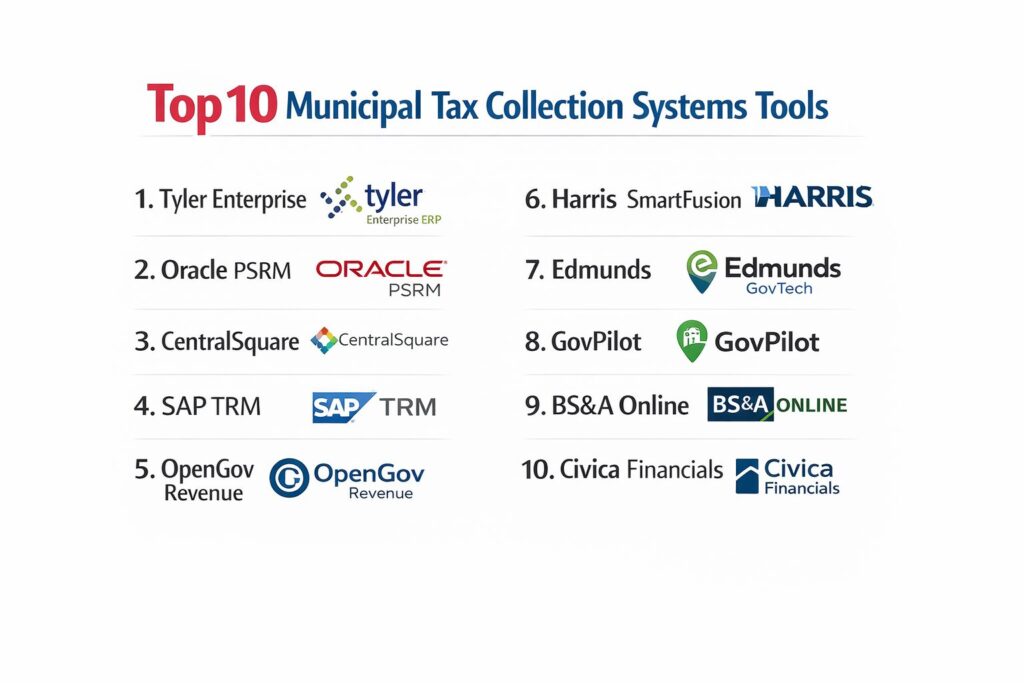
Introduction
Municipal tax collection systems represent the critical financial infrastructure of local governance, facilitating the capture and management of revenue essential for public services. These platforms have transitioned from simple ledger-based accounting to sophisticated, cloud-native Enterprise Resource Planning (ERP) environments. By integrating property appraisal, billing, collection, and distribution into a single digital ecosystem, these systems enable municipalities to maintain fiscal health while reducing administrative overhead. The primary objective of a modern tax system is to ensure equitable taxation through accurate data while providing citizens with seamless, transparent payment interfaces.
The deployment of these systems is a strategic necessity for urban local bodies facing increasing demands for infrastructure and sanitation. Modern solutions utilize Computer-Assisted Mass Appraisal (CAMA) and Geographic Information Systems (GIS) to link financial data with physical geography, ensuring that every taxable parcel is accounted for and valued correctly. For tax administrators, these tools provide a “single source of truth,” eliminating the data silos that traditionally existed between the assessor, auditor, and treasurer offices. When a municipality invests in a robust collection system, it isn’t just buying software; it is implementing a framework for accountability and trust between the government and its constituents.
Best for: Municipal finance departments, city treasurers, property assessors, and urban local bodies looking to digitize revenue cycles and improve citizen payment compliance.
Not ideal for: Small neighborhood associations or private property management firms that do not require the complex legislative compliance and mass appraisal capabilities of governmental systems.
Key Trends in Municipal Tax Collection Systems
The most significant trend is the rapid adoption of cloud-native architectures that replace aging on-premise mainframes. This shift allows for real-time data synchronization and remote access for field assessors. Furthermore, the integration of GIS (Geographic Information Systems) has become standard, enabling visual tax mapping and spatial analysis to identify unassessed properties or undervalued parcels. We are also seeing a rise in “citizen-first” portals that offer mobile-friendly payment options, including digital wallets and automated recurring payments, which significantly boost on-time collection rates.
Artificial Intelligence (AI) is now being utilized for predictive revenue forecasting and detecting anomalies in assessment data. These AI-driven tools can flag potential mis-assessments before bills are mailed, reducing the volume of costly appeals. Additionally, there is a growing emphasis on inter-departmental transparency, where tax data is shared with public safety and community development modules to create a holistic view of urban health. Finally, cybersecurity has moved to the forefront, with platforms now requiring FedRAMP or SOC 2 compliance to protect sensitive taxpayer information against increasing ransomware threats.
How We Selected These Tools
Our selection process focused on platforms that demonstrate a proven track record in the public sector, specifically targeting those that handle the unique complexities of municipal law and millage rate calculations. We prioritized “all-in-one” ERP suites that provide seamless transitions between appraisal, billing, and distribution. Market share and long-term stability were also key factors, as local governments require vendors that can provide decades of support and regular updates to match changing state and federal regulations.
Technical robustness was evaluated based on API extensibility and the ability to handle high-volume batch processing during peak tax seasons. We also examined the user experience from two perspectives: the administrative dashboard for government employees and the self-service portal for citizens. Platforms that offered integrated GIS tools and automated delinquency workflows scored higher. Finally, we considered the scalability of these systems, ensuring our list includes solutions suitable for small townships as well as tier-1 metropolitan cities.
1. Tyler Technologies Enterprise ERP
Tyler Technologies is the dominant player in the North American public sector market. Its Enterprise ERP (formerly Munis) provides an end-to-end solution for assessment, tax billing, and collections. It is designed to handle the entire parcel life cycle, from initial mapping to final revenue distribution.
Key Features
The system includes a powerful Computer-Assisted Mass Appraisal (CAMA) engine that integrates directly with tax billing. It features automated reconciliation tools that balance value changes with tax rolls in real-time. The “Citizen Transparency” module allows taxpayers to view assessment history and pay bills online. It supports complex multi-district tax calculations and handles personal property assets alongside real estate. Additionally, it offers robust tax sale and foreclosure management workflows for managing severe delinquencies.
Pros
Offers the most comprehensive feature set specifically built for government workflows. Excellent integration with other Tyler modules like Public Safety and Planning.
Cons
Implementation can be lengthy and requires significant staff training. The cost is often at the higher end of the market spectrum.
Platforms and Deployment
Cloud-based (SaaS), hosted, or on-premise deployment options.
Security and Compliance
FedRAMP authorized and SOC 1/2 compliant with high-level encryption for taxpayer data.
Integrations and Ecosystem
Native integration with the entire Tyler product suite and external GIS providers like Esri.
Support and Community
Provides 24/7 technical support and a massive user community with annual training conferences.
2. Oracle Public Sector Revenue Management (PSRM)
Oracle’s PSRM is an enterprise-grade platform built for high-volume jurisdictions and state-level agencies. It is a rules-based engine that can be configured to manage any type of tax or license, making it highly versatile for large metros.
Key Features
The platform utilizes a highly flexible configuration engine that allows administrators to update tax laws without custom coding. It features advanced batch processing capabilities for managing millions of records simultaneously. It includes a holistic “Taxpayer 360” view that links all accounts associated with a single individual or business. The system provides sophisticated audit and compliance tools to detect under-reporting. It also supports multiple payment channels and automated debt collection workflows.
Pros
Unrivaled scalability for the largest cities and state agencies. The rules-based architecture ensures the system can adapt to virtually any legislative change.
Cons
Requires a high level of technical expertise to manage and configure. Not cost-effective for smaller municipalities.
Platforms and Deployment
Cloud-native on Oracle Cloud Infrastructure (OCI) or on-premise.
Security and Compliance
FIPS 140-2, HIPAA, and GDPR compliant with enterprise-grade security protocols.
Integrations and Ecosystem
Deeply integrated with Oracle’s financial and analytics suites and external payment gateways.
Support and Community
Global support network with dedicated public sector consultants and extensive documentation.
3. CentralSquare Property Tax
CentralSquare offers a unified suite of public administration tools, with its Property Tax module being a standout for its “citizen-first” approach. It focuses on making the tax process as intuitive as possible for both government staff and the public.
Key Features
The system provides automated bill generation with options for digital distribution via email or text. It features an interactive citizen engagement portal that stores full payment history and tax documents. The GIS integration allows staff to perform spatial analysis of tax data directly from the dashboard. It automates the calculation of penalties and interest for late payments. The software also includes a “Mass Update” tool for quickly adjusting millage rates across an entire jurisdiction.
Pros
Highly user-friendly interface that reduces the learning curve for new staff. Excellent “citizen-facing” features that improve the public’s perception of government services.
Cons
Some users report that advanced reporting customization can be complex. Integration with non-CentralSquare legacy systems can sometimes be challenging.
Platforms and Deployment
Primarily cloud-based SaaS, but supports hybrid deployments.
Security and Compliance
Adheres to strict government data standards and provides audit-ready financial data.
Integrations and Ecosystem
Works seamlessly with CentralSquare’s Finance, Community Development, and Public Safety modules.
Support and Community
Offers a robust online help center and regional user groups for collaborative problem-solving.
4. SAP Tax and Revenue Management (TRM)
SAP TRM is designed for large municipalities that want to integrate tax collection into a broader SAP ERP ecosystem. It provides a highly detailed view of financial health and taxpayer compliance on a global scale.
Key Features
The platform features a centralized “Taxpayer Account” that tracks every interaction and transaction. It uses sophisticated analytics to identify patterns of non-compliance and tax evasion. It supports automated document management for storing tax returns and appeals. The system is highly localized, supporting the specific tax laws of various countries and regions. It also features a self-service portal where businesses can file and pay local taxes online.
Pros
Provides real-time financial insights and world-class reporting capabilities. Ideal for cities that already utilize SAP for their general ledger and HR functions.
Cons
Extremely high total cost of ownership (TCO) compared to niche municipal software. Requires specialized SAP consultants for implementation.
Platforms and Deployment
Available on SAP S/4HANA Cloud or on-premise.
Security and Compliance
ISO 27001, SOC 1, and SOC 2 compliant with global data privacy standards.
Integrations and Ecosystem
Deeply integrated with the SAP Business Technology Platform and various third-party financial apps.
Support and Community
Extensive global support network and a massive ecosystem of certified implementation partners.
5. OpenGov Revenue
OpenGov has disrupted the government software market with its sleek, cloud-native platform. It focuses on transparency and modern workflows, making it a favorite for forward-thinking finance directors.
Key Features
The platform offers a “Standardized Billing” process that handles real estate, personal property, and utility taxes. It features an import wizard that validates and balances assessment data before it is committed to the system. The paperless billing options are designed to reduce postage costs by up to 30%. It provides an executive dashboard with real-time visual data on collection rates and staff activities. The system also includes automated reminders and notifications via email and SMS to reduce delinquencies.
Pros
The most modern and aesthetically pleasing user interface in the industry. Faster onboarding and implementation times compared to traditional ERPs.
Cons
As a newer entrant in the specialized tax space, it may lack some of the deeper “niche” features of legacy systems. The product roadmap is still evolving for complex appraisal needs.
Platforms and Deployment
100% cloud-native SaaS.
Security and Compliance
SOC 2 Type II compliant with cloud-native disaster recovery protocols.
Integrations and Ecosystem
Strong API-first approach that allows for easy connection to various financial and GIS systems.
Support and Community
Provides excellent product training and a dedicated customer success team.
6. Harris Local Government (SmartFusion)
Harris Local Government provides a suite called SmartFusion, which is tailored for small to mid-sized municipalities. It is known for its reliability and its focus on the essential needs of local tax offices.
Key Features
The system includes a fully integrated Tax and Assessing module that eliminates double data entry. It features a “GeoAnalyst” tool for viewing tax data through a GIS lens. It supports personal property valuation for business assets and specialized tax types like Tax Increment Financing (TIF). The platform automates the reconciliation of tax payments with bank files. It also provides a robust workflow for managing tax sales and the foreclosure process.
Pros
Highly cost-effective for smaller jurisdictions. The software is stable and has been refined over decades to meet municipal needs.
Cons
The user interface feels dated compared to cloud-native competitors. It may lack some of the advanced AI features found in larger enterprise suites.
Platforms and Deployment
Available as a hosted solution or on-premise.
Security and Compliance
Ensures secure transaction processing and maintains detailed audit logs for every user action.
Integrations and Ecosystem
Integrates well with other Harris modules for Utility Billing and Payroll.
Support and Community
Strong regional support teams and a loyal user base in the Southeast United States.
7. Edmunds GovTech
Edmunds GovTech focuses on providing an all-encompassing solution for local governments, with a heavy emphasis on integration and ease of use for clerks and treasurers.
Key Features
The platform features a seamless linkage between the assessing, tax, and finance databases. It offers automated demand notices and tax bill printing services. The system includes powerful mass-update tools for millage rates and exemptions. It provides an intuitive “Property Search” function for both staff and the public. The software also handles the complex nuances of supplemental billing and tax adjustments throughout the year.
Pros
Exceptional customer satisfaction ratings due to their responsive support. The modular design allows municipalities to buy only what they need.
Cons
Primarily focused on the U.S. market, which may limit its use for international municipalities. The cloud transition for some of their older modules is still ongoing.
Platforms and Deployment
Cloud-hosted and on-premise versions available.
Security and Compliance
Adheres to standard government financial security protocols and data encryption.
Integrations and Ecosystem
Strong integrations with popular payment processors and local banking institutions.
Support and Community
Renowned for their “person-to-person” support and high retention rates among clients.
8. GovPilot
GovPilot is a modular platform that focuses on digitizing the paper-heavy processes of local government. It is unique in its focus on “work-flow” automation across all city departments.
Key Features
The system provides parcel-level integration with GIS maps for every property in the jurisdiction. It features 24/7 digital forms for address changes and exemption requests. It includes automated email and SMS alerts for upcoming tax deadlines. The platform’s “Assessment and Tax” module is designed to replace physical files with a centralized digital record. It also offers a public-facing map where citizens can view tax and property information in real-time.
Pros
Excellent for municipalities that want to digitize their entire operation, not just taxes. Very affordable and quick to deploy for small towns.
Cons
May not have the “deep” financial appraisal features required by very large counties. The financial reporting is not as robust as a full-scale ERP like Tyler.
Platforms and Deployment
100% cloud-based.
Security and Compliance
Uses industry-standard encryption and offers cloud-based disaster recovery.
Integrations and Ecosystem
Integrates with various third-party payment gateways and state-level databases.
Support and Community
Responsive customer success team and a library of video tutorials for new users.
9. BS&A Online
BS&A is widely regarded for having some of the highest customer satisfaction ratings in the local government software industry. Their Tax module is praised for its simplicity and accuracy.
Key Features
The platform allows for the seamless transfer of data from the assessing database to the tax billing system. It features a “What-If” millage rate calculator to help officials forecast revenue. It provides an easy-to-use cashiering system for over-the-counter payments. The system automates the distribution of collected funds to various taxing authorities. It also features a highly searchable public portal for tax history and parcel information.
Pros
Incredibly stable software with a very logical workflow that matches real-world government processes. Outstanding reputation for customer service.
Cons
The visual design of the software is functional rather than modern. Market reach is concentrated in specific U.S. regions (like the Midwest).
Platforms and Deployment
Cloud-hosted and on-premise.
Security and Compliance
Maintains strict audit trails and is compliant with state-level financial reporting standards.
Integrations and Ecosystem
Native integration with BS&A’s Assessing, Financial Management, and Utility Billing suites.
Support and Community
Offers some of the best technical support in the industry with very high renewal rates.
10. Civica Financials
Civica is a major player in the international market, providing comprehensive financial management solutions tailored to the unique needs of local authorities, particularly in the UK and Australia.
Key Features
The system offers a holistic financial management suite that covers GL, AP, AR, and Tax. It features real-time analytics and business intelligence dashboards for council leaders. The platform automates VAT and local tax compliance for international jurisdictions. It provides self-service portals for citizen billing and payments. The scalable architecture allows it to serve small councils and large metropolitan authorities alike.
Pros
Strong expertise in international municipal laws and tax structures. Provides a very robust set of financial reporting tools for complex budgets.
Cons
Less presence in the U.S. market compared to Tyler or CentralSquare. Can be complex to configure for non-standard local tax types.
Platforms and Deployment
Cloud-native and hybrid deployment models.
Security and Compliance
ISO 27001 compliant and adheres to strict international data privacy laws like GDPR.
Integrations and Ecosystem
Integrates with a wide range of public sector management tools and banking systems.
Support and Community
Provides localized support teams and a strong presence in the global “Smart City” movement.
Comparison Table
| Tool Name | Best For | Platform(s) Supported | Deployment | Standout Feature | Public Rating |
| 1. Tyler Enterprise ERP | Large Counties/Cities | Web, API | Hybrid | CAMA Integration | 4.1/5 |
| 2. Oracle PSRM | Tier 1/State Agencies | Web, Cloud | Cloud/On-Prem | Rules-Based Engine | 4.3/5 |
| 3. CentralSquare | Citizen Engagement | Web, Mobile | Cloud | Citizen Portal | 4.0/5 |
| 4. SAP TRM | SAP-Centric Metros | Web, S/4HANA | Cloud | Global Compliance | 4.5/5 |
| 5. OpenGov Revenue | Modern Transparency | Web, Mobile | SaaS | Cloud-Native UI | 4.8/5 |
| 6. Harris SmartFusion | Small/Mid Municipalities | Web, GIS | Hosted | GeoAnalyst Tool | 4.2/5 |
| 7. Edmunds GovTech | Clerk Efficiency | Web, Local | Hybrid | Integration Depth | 4.6/5 |
| 8. GovPilot | Digital Transformation | Web, GIS | Cloud | Workflow Automation | 4.5/5 |
| 9. BS&A Online | Ease of Use | Web, Local | Hybrid | Customer Service | 4.8/5 |
| 10. Civica Financials | International Metro | Web, API | Cloud | VAT Compliance | 4.3/5 |
Evaluation & Scoring of Municipal Tax Collection Systems
The scoring below is a comparative model intended to help shortlisting. Each criterion is scored from 1–10, then a weighted total from 0–10 is calculated using the weights listed. These are analyst estimates based on typical fit and common workflow requirements, not public ratings.
Weights:
- Core features – 25%
- Ease of use – 15%
- Integrations & ecosystem – 15%
- Security & compliance – 10%
- Performance & reliability – 10%
- Support & community – 10%
- Price / value – 15%
| Tool Name | Core (25%) | Ease (15%) | Integrations (15%) | Security (10%) | Performance (10%) | Support (10%) | Value (15%) | Weighted Total |
| 1. Tyler Enterprise ERP | 10 | 7 | 10 | 10 | 9 | 9 | 7 | 8.95 |
| 2. Oracle PSRM | 10 | 6 | 9 | 10 | 10 | 8 | 6 | 8.45 |
| 3. CentralSquare | 9 | 9 | 9 | 9 | 8 | 9 | 8 | 8.75 |
| 4. SAP TRM | 10 | 6 | 10 | 10 | 10 | 8 | 5 | 8.40 |
| 5. OpenGov Revenue | 8 | 10 | 9 | 9 | 9 | 9 | 8 | 8.75 |
| 6. Harris SmartFusion | 8 | 8 | 8 | 8 | 8 | 8 | 9 | 8.15 |
| 7. Edmunds GovTech | 8 | 8 | 9 | 9 | 8 | 10 | 8 | 8.55 |
| 8. GovPilot | 7 | 10 | 8 | 8 | 8 | 9 | 9 | 8.20 |
| 9. BS&A Online | 8 | 9 | 8 | 9 | 9 | 10 | 8 | 8.65 |
| 10. Civica Financials | 9 | 7 | 8 | 9 | 9 | 8 | 8 | 8.30 |
How to interpret the scores:
- Use the weighted total to shortlist candidates, then validate with a pilot.
- A lower score can mean specialization, not weakness.
- Security and compliance scores reflect controllability and governance fit, because certifications are often not publicly stated.
- Actual outcomes vary with assembly size, team skills, templates, and process maturity.
Which Municipal Tax Collection System Is Right for You?
Solo / Freelancer
Not applicable, as these systems are designed for government entities. However, individual tax consultants working with municipalities should look for systems like OpenGov or GovPilot that allow for external auditor access and modern file sharing.
SMB
GovPilot or Harris SmartFusion are excellent choices. They provide the essential modules without the overwhelming complexity of a Tier-1 system, and their price points are more aligned with small-town budgets.
Mid-Market
CentralSquare or BS&A Online offer the perfect balance of advanced features and user-friendliness. These systems are robust enough to handle high-volume residential and commercial property taxes while remaining accessible to a smaller IT staff.
Enterprise
Tyler Technologies or Oracle PSRM are the gold standards for large-scale operations. They have the computational power to handle millions of transactions and the depth of features needed for complex, multi-layered government structures.
Budget vs Premium
If the priority is long-term value and high customer support, BS&A Online is hard to beat. If the priority is absolute feature depth and “future-proofing” with a multi-module ERP, Tyler Technologies is the premium choice.
Feature Depth vs Ease of Use
Oracle and SAP provide the most feature depth but are significantly harder to use. OpenGov and CentralSquare prioritize ease of use and modern interfaces, which can lead to higher staff productivity and lower training costs.
Integrations & Scalability
Tyler Technologies offers the most integrated ecosystem for government, allowing tax data to flow effortlessly into community development and public safety. For sheer scalability of transaction volume, Oracle PSRM is the leader.
Security & Compliance Needs
For U.S.-based municipalities needing strict FedRAMP compliance, Tyler and OpenGov are leading the way in cloud security. For international municipalities with GDPR concerns, Civica and SAP offer the strongest localized compliance frameworks.
Frequently Asked Questions (FAQs)
1. What is the difference between an Assessor and a Tax Collector system?
Assessor systems (CAMA) determine the value of a property based on market data. Tax Collector systems take that value and apply millage rates to generate bills. Modern systems like Tyler or CentralSquare integrate both into a single platform.
2. Can these systems handle specialized taxes like Cannabis or Lodging taxes?
Yes, most modern platforms like OpenGov and Oracle are “tax-type agnostic,” meaning they can be configured to manage business licenses, short-term rental taxes, and other niche revenue streams.
3. How does GIS integration improve tax collection?
GIS allows staff to see “unbilled” parcels on a map. By overlaying tax records with satellite imagery, municipalities can find new construction or improvements that haven’t been assessed, leading to significant revenue discovery.
4. Are these systems cloud-based or on-premise?
While many legacy systems still run on-premise, the industry has shifted toward cloud-hosted (SaaS) models. Cloud systems offer better security, automated updates, and easier remote access for field staff.
5. How long does a typical implementation take?
For a mid-sized city, implementation can take anywhere from 9 to 18 months. This includes data migration from the old system, staff training, and rigorous testing of tax calculation rules.
6. Do these platforms include citizen payment portals?
Most do. Portals like those from CentralSquare or OpenGov allow citizens to pay via credit card, ACH, or mobile wallets, and view their historical statements without calling city hall.
7. Can the software handle property tax appeals?
Yes, advanced systems have “Appraisal Grievance” modules that track the status of an appeal, store supporting documents, and automatically adjust the tax bill if the assessment is lowered.
8. Is data migration from an old system difficult?
It is often the most challenging part of the project. Leading vendors like Tyler and Edmunds have dedicated “conversion teams” to map old data fields into the new database accurately.
9. How do these systems handle delinquent taxes?
They automate the process of adding interest and penalties. If taxes remain unpaid, the system triggers a series of notices and can eventually manage the tax lien sale or foreclosure process.
10. What is a “rules-based engine” in tax software?
It is a system where tax laws are entered as “rules” rather than being hard-coded into the software. This allows non-programmers to update the system when the city council changes tax rates.
Conclusion
The modernization of municipal tax collection systems is no longer an optional luxury but a fundamental requirement for sustainable urban governance. As local governments face increasing fiscal pressure, the ability to accurately assess property, efficiently collect revenue, and transparently manage funds determines the quality of public services. We see a clear divide between municipalities that leverage cloud-native, GIS-integrated platforms and those struggling with legacy paper-based systems. A well-implemented revenue platform does more than just process payments; it serves as a powerful engine for economic development and community trust. By selecting a system that balances technical robustness with ease of use, municipal leaders can ensure their city remains financially resilient while providing the digital convenience that modern citizens expect. The transition to these sophisticated digital ecosystems is an investment in the city’s future, ensuring every tax dollar is accounted for and utilized for the common good.