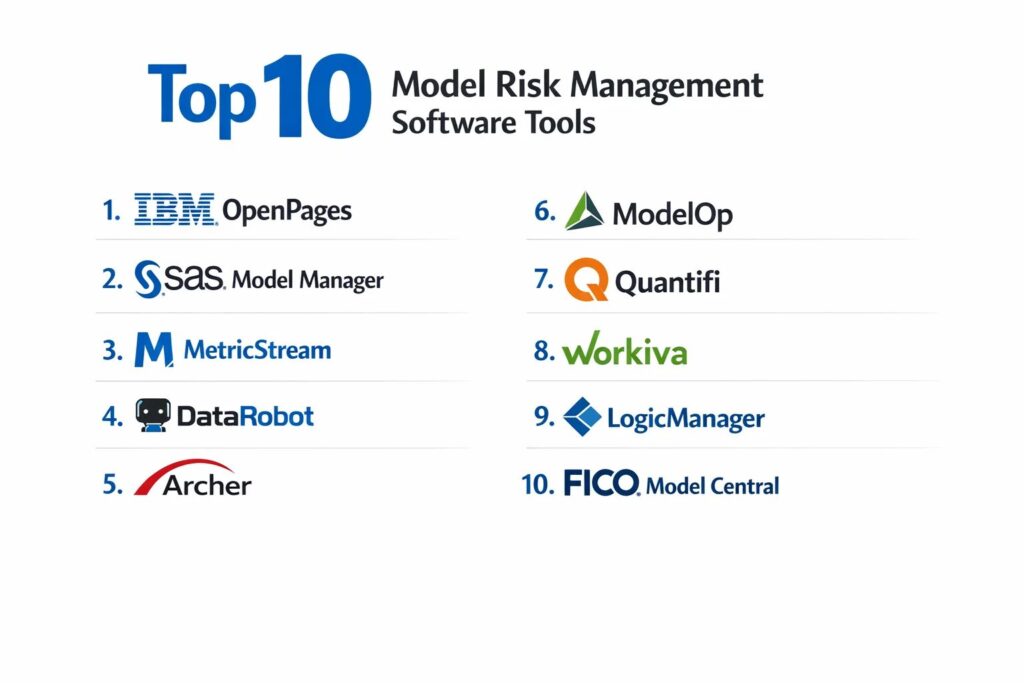
Introduction
Model Risk Management (MRM) software has become a foundational pillar for organizations that rely on complex mathematical models and artificial intelligence to drive decision-making. As businesses increasingly automate financial forecasting, credit scoring, and algorithmic trading, the potential for “model risk”—the risk of financial loss or poor decisions resulting from errors in model development or usage—grows exponentially. MRM platforms provide a centralized, automated framework to govern the entire model lifecycle, from initial design and validation to ongoing monitoring and decommissioning. By replacing fragmented spreadsheets with a single source of truth, these tools ensure that every model is documented, its limitations are understood, and its performance is tracked against pre-defined thresholds.
The necessity for robust MRM software is driven by a combination of regulatory pressure and the rapid adoption of machine learning. Financial institutions, in particular, must adhere to strict guidelines such as SR 11-7, which mandate rigorous independent validation and governance. Beyond compliance, MRM software serves as a strategic asset for AIOps and MLOps teams by providing transparency into “black box” models, thereby mitigating the risk of bias and ensuring ethical AI practices. When evaluating these platforms, buyers must prioritize features like automated workflows, version control, comprehensive audit trails, and the ability to integrate with existing data science environments. A mature MRM solution doesn’t just manage risk; it accelerates innovation by providing a safe, governed path for deploying new models into production.
Best for: Risk officers, compliance managers, data scientists, and quantitative analysts within highly regulated industries such as banking, insurance, and healthcare.
Not ideal for: Small businesses using basic statistical tools or organizations that do not utilize predictive modeling for high-stakes decision-making. If your data usage is limited to descriptive analytics, traditional project management tools may suffice.
Key Trends in Model Risk Management Software
The integration of Generative AI and Large Language Models (LLMs) into the corporate environment has triggered a shift toward “AI Governance,” where MRM tools are now expected to manage the specific risks of non-deterministic outputs and hallucinations. Real-time monitoring has moved from a periodic manual check to a continuous, automated process that alerts stakeholders the moment a model’s performance drifts beyond acceptable bounds. There is also a growing emphasis on “Explainable AI” (XAI), with platforms providing visual tools to help non-technical stakeholders understand how a model reached a specific conclusion.
Interoperability is becoming a core requirement, with MRM software now featuring native integrations into MLOps pipelines to ensure governance is “baked in” from the start of development. We are also seeing a rise in “Model Inventory as a Service,” where cloud-native platforms offer scalable repositories for thousands of models across global enterprises. Furthermore, regulatory reporting is being automated through dynamic templates that can generate board-ready compliance documents with a single click. Finally, the focus is expanding from purely financial risk to including ethical risk, bias detection, and environmental impact as part of the model’s overall risk score.
How We Selected These Tools
The selection of these top 10 MRM platforms was based on an analysis of their ability to handle complex governance workflows and their alignment with global regulatory standards. We prioritized software that offers a comprehensive “Model Inventory” capability, as this is the foundation of any risk management program. Market reputation and adoption within the Tier-1 banking sector served as a primary signal for reliability and feature depth. We also evaluated the flexibility of each tool’s workflow engine, as the ability to customize approval paths is essential for diverse organizational structures.
Technical performance was assessed based on the platform’s ability to ingest data from various sources and its support for both traditional and machine learning models. Security was a critical factor, with a focus on role-based access control, audit logging, and encryption to protect sensitive model intellectual property. We also looked for platforms that provide a clear visual representation of model dependencies—showing how a failure in one model might cascade through an entire system. Finally, we considered the user experience for both technical developers and non-technical risk managers to ensure high adoption rates across the enterprise.
1. IBM OpenPages
IBM OpenPages is a dominant enterprise-scale GRC (Governance, Risk, and Compliance) platform that includes a highly specialized module for Model Risk Management. It is designed to provide a holistic view of risk by connecting model governance to the broader operational risk framework of the organization.
Key Features
The platform features a centralized model inventory that tracks model health, versions, and validation statuses in real-time. It provides automated workflows that guide users through the model lifecycle, ensuring that no model goes into production without proper sign-off. It includes powerful reporting and dashboarding tools that provide executives with a high-level view of the model risk appetite. The software also integrates with IBM Watson OpenScale to monitor for bias and drift in AI models. It supports detailed documentation storage, including validation reports and technical specifications.
Pros
It offers unparalleled scalability for global enterprises and integrates seamlessly with other IBM data and AI tools. The platform is highly customizable to fit the specific regulatory requirements of different jurisdictions.
Cons
The complexity of the system can lead to a long implementation timeframe. It requires significant training for administrators to master the full range of GRC features.
Platforms and Deployment
Cloud, Hybrid, and On-premise deployments.
Security and Compliance
Features enterprise-grade SSO, RBAC, and full audit trails. It is designed to meet SR 11-7, GDPR, and other global banking regulations.
Integrations and Ecosystem
Deeply integrated with IBM Cloud Pak for Data, Watson OpenScale, and major third-party reporting tools like Tableau and Power BI.
Support and Community
Provides 24/7 global enterprise support, a dedicated client success manager for large accounts, and a vast library of technical documentation.
2. SAS Model Manager
SAS is a veteran in the analytics space, and its Model Manager software is built to handle the rigorous demands of quantitative analysts and model validators. It focuses on providing a structured environment for the registration, deployment, and monitoring of analytical models.
Key Features
The software provides a centralized repository for all models, regardless of whether they were built in SAS, Python, or R. It includes automated performance monitoring that generates alerts when a model’s Gini or Kolmogorov-Smirnov (KS) scores deviate. It offers a “one-click” deployment feature that pushes models to various execution environments. The platform also features version control and comparison tools to track changes over time. It provides a robust framework for documenting the entire model lineage, from data source to final output.
Pros
It is exceptionally strong in traditional statistical modeling and has long been a favorite in the financial services sector. The ability to manage open-source models alongside SAS models provides great flexibility.
Cons
The licensing costs can be prohibitive for smaller organizations. The user interface, while functional, can feel more technical and less “modern” than some newer SaaS-first competitors.
Platforms and Deployment
Windows and Linux; available as a cloud-hosted or self-hosted solution.
Security and Compliance
Includes comprehensive identity and access management and is built to facilitate compliance with CCAR and DFAST.
Integrations and Ecosystem
Seamlessly integrates with the SAS Viya platform and provides APIs for integration with CI/CD pipelines and data warehouses.
Support and Community
Offers world-class technical support, professional training certifications, and a highly active community of quantitative professionals.
3. MetricStream
MetricStream is a leading independent GRC provider that offers a dedicated Model Risk Management app designed to simplify the complexities of the model lifecycle. It focuses on collaboration between model owners, developers, and independent validation teams.
Key Features
The platform features a multi-dimensional model inventory that categorizes models by risk level, business unit, and type. It includes a sophisticated workflow engine for managing model assessments and independent validations. Users can define custom risk scoring methodologies to prioritize validation efforts. The software provides real-time dashboards for tracking model issues and remediation plans. It also features a robust document management system that ensures all model documentation is version-controlled and easily accessible during audits.
Pros
The user interface is intuitive and designed for both technical and non-technical users. It is highly effective at breaking down silos between risk and development teams.
Cons
Integrating the software with deeply technical data science pipelines can sometimes require custom API development. Some users find the reporting engine less flexible than specialized BI tools.
Platforms and Deployment
Cloud-native (SaaS).
Security and Compliance
SOC 2 compliant with robust MFA and encryption. It is tailored for SR 11-7 and European banking standards.
Integrations and Ecosystem
Offers a variety of connectors for data ingestion and integrates with standard enterprise platforms like Microsoft 365.
Support and Community
Provides 24/7 support and an active user community focused on GRC best practices.
4. DataRobot
DataRobot is an AI lifecycle platform that includes powerful governance and model risk management features specifically for machine learning. It is built for organizations that need to manage hundreds of AI models at high velocity.
Key Features
The platform provides automated documentation that generates comprehensive “Model Compliance” reports in seconds. It includes a centralized governance hub where every model’s deployment history and performance metrics are tracked. It features built-in bias detection and mitigation tools to ensure ethical AI usage. The software offers real-time service health monitoring to track latency and data drift. It also provides a unique “Challenger” model feature where you can run a new version of a model in the background to compare performance before switching.
Pros
The automation of documentation saves data scientists hundreds of hours of manual work. It is specifically designed for the needs of modern AIOps and MLOps teams.
Cons
Its primary focus is on machine learning, so it may not be as comprehensive for traditional, manual statistical models used in some finance departments.
Platforms and Deployment
Multi-cloud, SaaS, and On-premise.
Security and Compliance
Features robust RBAC, audit logs, and is used in highly regulated government and financial sectors.
Integrations and Ecosystem
Integrates with AWS, Azure, Google Cloud, and popular data sources like Snowflake and Databricks.
Support and Community
Offers extensive online training through DataRobot University and high-touch professional services.
5. Archer
Archer is one of the most established names in integrated risk management, providing a highly flexible Model Risk Management solution that is part of its broader enterprise risk suite. It is built for organizations that want to integrate model risk into their overall corporate governance.
Key Features
The platform offers a unified model inventory that captures key attributes, interdependencies, and risk ratings. It provides a formal process for model change management and decommissioning. The software includes a library of regulatory requirement mappings to help ensure compliance with global standards. It features an automated notification system that alerts model owners when periodic reviews are due. The tool also allows for the tracking of “findings” and “deficiencies” through to resolution.
Pros
The “Archer Exchange” offers a wide range of pre-built integrations and extensions. It is excellent for organizations that already use Archer for other risk functions like IT or operational risk.
Cons
The platform can be resource-intensive to maintain and update. The flexibility of the tool means that a significant amount of configuration is often required during setup.
Platforms and Deployment
Cloud, Hybrid, and On-Premise.
Security and Compliance
Highly secure with specialized controls for sensitive financial and government data.
Integrations and Ecosystem
Extensive integrations with enterprise software and an API for connecting to model development environments.
Support and Community
Robust support infrastructure and a large, long-standing global user base.
6. ModelOp
ModelOp is a specialized software provider that focuses exclusively on Model Operations (ModelOps) and Governance. It is designed to act as the “command center” for all models across an enterprise, regardless of how or where they were developed.
Key Features
The platform provides a comprehensive “Governance Manager” that enforces organizational policies across every model. It features automated “Model Life Cycle” (MLC) pipelines that track a model from lab to production. The software includes real-time monitoring for business value as well as technical performance. It provides a centralized dashboard for all model stakeholders, including risk, legal, and IT. It also offers a unique “regulatory-readiness” feature that constantly audits models against internal and external policies.
Pros
It is vendor-neutral, meaning it works equally well with models from SAS, DataRobot, or custom-built Python scripts. It is specifically built for the “AIOps” era of enterprise computing.
Cons
As a specialized tool, it may require integration with a broader GRC platform for organizations that want a single risk view. It is more focused on the operational side than the GRC-heavy competitors.
Platforms and Deployment
Cloud-native and Hybrid.
Security and Compliance
Implements rigorous security standards for model metadata and provides detailed audit trails for every model change.
Integrations and Ecosystem
Exceptional integration with CI/CD tools, Jupyter Notebooks, and enterprise data platforms.
Support and Community
Offers high-touch support and is frequently cited in industry research for its specialized focus on ModelOps.
7. Quantifi
Quantifi provides specialized risk management and portfolio management solutions, with a strong emphasis on model validation and governance for complex financial instruments. It is a niche player that is highly respected in the capital markets.
Key Features
The platform features a rigorous model validation framework designed specifically for derivative and pricing models. It includes a comprehensive model inventory that tracks the mathematical assumptions behind each model. The software provides tools for stress testing and sensitivity analysis to understand model behavior in extreme market conditions. It features a document management system tailored for the highly technical validation reports required in investment banking. The system also supports the tracking of model limitations and approved use cases.
Pros
The platform understands the specific mathematical risks associated with trading and investment models. It is built by quantitative experts for quantitative experts.
Cons
Its focus is narrower than general GRC tools, making it less suitable for non-financial models. The user base is more specialized, which can make it harder to find peer support outside of capital markets.
Platforms and Deployment
Windows; Local and Cloud-hosted options.
Security and Compliance
High-security standards for protecting proprietary trading algorithms and financial data.
Integrations and Ecosystem
Integrates with major market data providers and internal trading systems.
Support and Community
Provides expert-level support from quantitative analysts and financial engineers.
8. Workiva
Workiva is a cloud-based reporting and compliance platform that has expanded into Model Risk Management to help organizations bridge the gap between model data and regulatory disclosures. It focuses on the “last mile” of model governance.
Key Features
The platform features a collaborative environment where multiple stakeholders can work on model documentation simultaneously. It provides a “linking” technology that ensures a single change in a model’s metadata is reflected across all connected reports and dashboards. It includes an automated audit trail that tracks every cell change and comment. The software offers pre-built templates for SR 11-7 and other regulatory filings. It also features a simplified model inventory for tracking the status of annual reviews and validations.
Pros
It is the best tool on the market for generating high-quality, audit-ready regulatory reports. The collaborative interface is exceptionally easy to use for non-technical stakeholders.
Cons
It lacks the deep technical monitoring (like drift or bias detection) found in more data-science-heavy tools. It is primarily a documentation and reporting layer.
Platforms and Deployment
Cloud-only (SaaS).
Security and Compliance
SOC 1 and SOC 2 compliant, providing high levels of data security and encryption.
Integrations and Ecosystem
Strong integrations with ERP systems, data warehouses, and office productivity suites.
Support and Community
Provides 24/7 customer support and a massive annual user conference focused on compliance and reporting.
9. LogicManager
LogicManager provides an integrated GRC solution with a focus on ease of use and rapid deployment for mid-market and enterprise organizations. Its model risk module is designed to be “out-of-the-box” ready for most common use cases.
Key Features
The software features a centralized model inventory with automated risk assessment questionnaires. It provides a visual “Risk Map” that shows how model risks impact different business goals. The platform includes task management features to ensure that model reviews and validations stay on schedule. It offers a robust reporting engine with pre-built risk dashboards. The system also features a taxonomy builder to help organizations standardize their model definitions and risk categories.
Pros
It offers an excellent balance between feature depth and ease of use. The customer success team is highly rated for helping organizations build their MRM programs from scratch.
Cons
The platform may lack some of the hyper-specialized features required by the largest global investment banks. Its focus is more on the management process than the technical data science validation.
Platforms and Deployment
Cloud-only (SaaS).
Security and Compliance
Full-service security including data encryption and regular third-party audits.
Integrations and Ecosystem
Integrates with standard business applications and provides an API for external data connections.
Support and Community
Award-winning customer support and a wealth of educational webinars and resources.
10. FICO Model Central
FICO, famous for its credit scoring models, provides Model Central as a specialized environment for governing the lifecycle of decision-making models. It is built for organizations that need to manage high-stakes predictive models in production.
Key Features
The platform features a rigorous “Model Governance” framework that includes versioning, audit trails, and automated approvals. It includes specialized monitoring for credit scoring and fraud detection models. The software provides a structured repository for all model documentation, including mathematical proofs and testing results. It features a dashboard for tracking the business impact and ROI of deployed models. The system also supports the “Model Migration” process, helping organizations transition from legacy models to new versions safely.
Pros
It is built with the expertise of one of the world’s most successful model-building companies. The platform is highly optimized for the needs of credit and risk departments.
Cons
The tool can feel very specialized to the financial services industry, which may make it less relevant for other sectors. It is often most effective when used within the broader FICO ecosystem.
Platforms and Deployment
Cloud and On-premise.
Security and Compliance
Meets the high security and regulatory standards required for credit reporting and financial decision-making.
Integrations and Ecosystem
Integrates deeply with the FICO Platform and provides connectors for standard data sources.
Support and Community
Provides professional support and a community of users focused on predictive analytics and decision management.
Comparison Table
| Tool Name | Best For | Platform(s) Supported | Deployment | Standout Feature | Public Rating |
| 1. IBM OpenPages | Enterprise GRC | Win, Linux, Cloud | Hybrid | AI Governance Module | 4.5/5 |
| 2. SAS Model Manager | Quant Analysis | Win, Linux | Hybrid | Multi-language support | 4.6/5 |
| 3. MetricStream | Collaborative GRC | Web-based | Cloud | Custom Risk Scoring | 4.4/5 |
| 4. DataRobot | ML/AI Governance | Web-based | Multi-cloud | Auto-Compliance Reports | 4.8/5 |
| 5. Archer | Integrated Risk | Win, Linux, Cloud | Hybrid | Regulatory Mapping | 4.3/5 |
| 6. ModelOp | ModelOps/AIOps | Web-based | Cloud | MLC Orchestration | 4.7/5 |
| 7. Quantifi | Capital Markets | Windows | Local | Pricing Model Physics | N/A |
| 8. Workiva | Reporting/Audit | Web-based | Cloud | Data Linking Tech | 4.7/5 |
| 9. LogicManager | Mid-market GRC | Web-based | Cloud | Visual Risk Mapping | 4.6/5 |
| 10. FICO Model Central | Decision Analytics | Win, Linux, Cloud | Hybrid | Credit Model Focus | N/A |
Evaluation & Scoring of Model Risk Management Software
The scoring below is a comparative model intended to help shortlisting. Each criterion is scored from 1–10, then a weighted total from 0–10 is calculated using the weights listed. These are analyst estimates based on typical fit and common workflow requirements, not public ratings.
Weights:
- Core features – 25%
- Ease of use – 15%
- Integrations & ecosystem – 15%
- Security & compliance – 10%
- Performance & reliability – 10%
- Support & community – 10%
- Price / value – 15%
| Tool Name | Core (25%) | Ease (15%) | Integrations (15%) | Security (10%) | Performance (10%) | Support (10%) | Value (15%) | Weighted Total |
| 1. IBM OpenPages | 10 | 4 | 9 | 10 | 9 | 10 | 6 | 8.35 |
| 2. SAS Model Manager | 9 | 5 | 9 | 9 | 10 | 9 | 7 | 8.20 |
| 3. MetricStream | 8 | 8 | 8 | 9 | 8 | 9 | 8 | 8.15 |
| 4. DataRobot | 9 | 9 | 10 | 8 | 10 | 9 | 8 | 9.05 |
| 5. Archer | 8 | 5 | 9 | 10 | 7 | 9 | 6 | 7.55 |
| 6. ModelOp | 9 | 7 | 10 | 9 | 9 | 9 | 8 | 8.65 |
| 7. Quantifi | 7 | 5 | 6 | 9 | 9 | 8 | 6 | 6.85 |
| 8. Workiva | 6 | 10 | 8 | 9 | 8 | 9 | 9 | 8.15 |
| 9. LogicManager | 7 | 9 | 7 | 9 | 8 | 10 | 9 | 8.20 |
| 10. FICO Model Central | 8 | 6 | 7 | 9 | 8 | 9 | 7 | 7.55 |
How to interpret the scores:
- Use the weighted total to shortlist candidates, then validate with a pilot.
- A lower score can mean specialization, not weakness.
- Security and compliance scores reflect controllability and governance fit, because certifications are often not publicly stated.
- Actual outcomes vary with assembly size, team skills, templates, and process maturity.
Which Model Risk Management Software Tool Is Right for You?
Solo / Freelancer
For independent consultants or specialized validators, the documentation and reporting power of Workiva is often the best choice. It allows you to build high-quality, audit-ready reports and manage the validation process without needing to manage a heavy enterprise infrastructure.
SMB
Small businesses that are just beginning to formalize their model governance will find LogicManager highly effective. It is easy to implement and provides enough “out-of-the-box” functionality to get an MRM program off the ground without excessive customization.
Mid-Market
Organizations in this tier often need a balance between technical depth and process management. MetricStream offers a collaborative environment that scales well, allowing risk teams to work effectively with model developers as the model inventory grows.
Enterprise
For global financial institutions, IBM OpenPages remains the standard. Its ability to handle massive model inventories and integrate them into a broader global risk framework makes it the only choice for the most complex organizations.
Budget vs Premium
Budget: For those looking for a cost-effective documentation-first approach, Workiva is efficient. Premium: DataRobot and IBM OpenPages represent the high end of the market, offering deep technical automation and enterprise-grade support.
Feature Depth vs Ease of Use
Depth: SAS Model Manager and ModelOp offer the most technical depth for quantitative monitoring. Ease of Use: Workiva and LogicManager prioritize the user experience, making them more accessible to non-technical risk managers.
Integrations & Scalability
If your organization is heavily invested in a specific cloud ecosystem, tools like DataRobot (for ML) or IBM OpenPages offer the best scalability and integration with modern data stacks.
Security & Compliance Needs
For Tier-1 banks subject to SR 11-7, Archer and IBM OpenPages provide the most robust mapping of software features to specific regulatory requirements, ensuring that every audit can be passed with confidence.
Frequently Asked Questions (FAQs)
1. What exactly is “Model Risk”?
Model risk occurs when a model is used incorrectly or is built on flawed assumptions, leading to inaccurate predictions. This can result in financial loss, poor strategic decisions, or regulatory fines if the model’s limitations are not properly governed.
2. How does MRM software differ from MLOps tools?
MLOps tools focus on the technical deployment and scaling of machine learning models. MRM software focuses on the governance, compliance, and independent validation of those models to ensure they meet regulatory and ethical standards.
3. Do I need MRM software if I only have a few models?
While you can manage a few models in a spreadsheet, MRM software becomes essential as your inventory grows. It provides the version control and audit trails that spreadsheets lack, which is critical for passing regulatory audits.
4. Can MRM software detect bias in AI models?
Yes, several modern platforms like DataRobot and IBM OpenPages include specialized modules that monitor for data drift and bias, ensuring that models remain fair and accurate over time.
5. How long does it take to implement an MRM platform?
For SaaS-based tools like LogicManager, implementation can take 4–8 weeks. For complex enterprise platforms like IBM OpenPages, the process can take 6 months or longer to fully integrate into all business units.
6. Is SR 11-7 the only regulation for model risk?
No, while SR 11-7 is the primary guideline in the US, other regions have similar requirements, such as the European Central Bank’s guidelines on internal models. Most MRM tools are built to accommodate multiple global standards.
7. Who should be the “owner” of the MRM software?
The Model Risk Management office or the Chief Risk Officer typically owns the platform, but it is used daily by model developers (data scientists) and independent model validators.
8. Can these tools manage open-source models built in Python or R?
Yes, most modern MRM platforms are “language-agnostic” and can ingest metadata and performance results from models built in any programming language or framework.
9. What is a “Model Inventory”?
A model inventory is a centralized list of every model used by an organization. It includes metadata such as the model’s purpose, its risk rating, the last time it was validated, and who is responsible for its performance.
10. How often should models be validated?
Most regulations require models to undergo a full independent validation at least once a year, though high-risk models may require more frequent performance monitoring and reviews.
Conclusion
In the modern enterprise, the quality of your decisions is only as good as the models that inform them. As we enter an era dominated by automated intelligence and algorithmic forecasting, the role of Model Risk Management software has shifted from a “nice-to-have” compliance requirement to a mission-critical infrastructure component. Selecting the right platform requires a deep understanding of your organization’s technical maturity and regulatory environment. The ideal solution must not only satisfy the rigorous demands of auditors but also empower data scientists by providing a clear, governed path to production. By centralizing your model inventory and automating the validation lifecycle, you transform risk from a bottleneck into a competitive advantage, ensuring that your organization’s innovation is both rapid and responsible.