Introduction
Merchandise storefront platforms represent the critical intersection of brand identity and global supply chain logistics, allowing creators and enterprises to monetize their influence through physical goods. These platforms function by integrating digital storefront interfaces with back-end manufacturing and automated fulfillment systems, often utilizing a “print-on-demand” model to eliminate the risks associated with inventory management. In the modern digital economy, a storefront is no longer just a gallery of products; it is a sophisticated data engine that manages customer relationships, processes secure global payments, and coordinates real-time production across international facilities.
The strategic importance of selecting the right platform lies in its ability to protect brand equity while maintaining high operational margins. For organizations, these tools provide a low-overhead path to market testing and community engagement. When evaluating a storefront solution, decision-makers must look beyond simple aesthetics. Key technical considerations include the robustness of the application programming interface for third-party integrations, the diversity of the product catalog, the reliability of global fulfillment networks, and the transparency of the pricing structure. A well-chosen platform acts as a silent partner, ensuring that every customer interaction—from the first click to the unboxing experience—is consistent with the professional standards of the brand.
Best for: Content creators, digital influencers, enterprise marketing departments, and non-profit organizations seeking to launch branded apparel and accessories without managing physical warehouses or upfront manufacturing costs.
Not ideal for: High-volume retailers requiring hyper-customized, bespoke manufacturing processes or businesses that need total control over every step of the local raw material sourcing and hand-finishing stages.
Key Trends in Merchandise Storefront Platforms
The primary shift in the industry is toward hyper-localized production, where platforms automatically route orders to the facility closest to the end consumer. This trend significantly reduces shipping times and carbon footprints while bypassing complex international customs hurdles. Another major development is the integration of artificial intelligence for predictive design and automated mockup generation, allowing brands to visualize products on virtual models with high physical accuracy before a single item is printed.
Sustainability has moved from a niche requirement to a core platform feature, with many providers now offering certified organic materials and plastic-free packaging options. Social commerce integration has also matured, enabling “link-in-bio” stores and direct-to-consumer checkouts within video platforms and social feeds. Furthermore, white-labeling capabilities have become more sophisticated, allowing brands to remove all traces of the third-party provider, including custom neck labels, branded packing slips, and personalized digital tracking pages that keep the customer entirely within the brand’s ecosystem.
How We Selected These Tools
Our selection process focused on the technical reliability and market reputation of each platform in a professional production environment. We prioritized tools that offer a seamless bridge between front-end design and back-end fulfillment, ensuring that the software can handle sudden spikes in traffic—such as those during a major product launch or viral event—without service degradation. We also examined the depth of the product catalog to ensure a wide range of high-quality items beyond standard t-shirts.
Integration capabilities were a major factor, specifically how easily these platforms connect with existing e-commerce engines like Shopify or social media marketplaces. We evaluated the transparency of the fulfillment process, looking for providers that offer detailed tracking and reliable quality control standards. Security was also scrutinized, with a focus on PCI compliance for payment processing and data protection protocols for customer information. Finally, we balanced the cost of entry against the potential for long-term scalability to determine which platforms offer the best overall value for different organizational sizes.
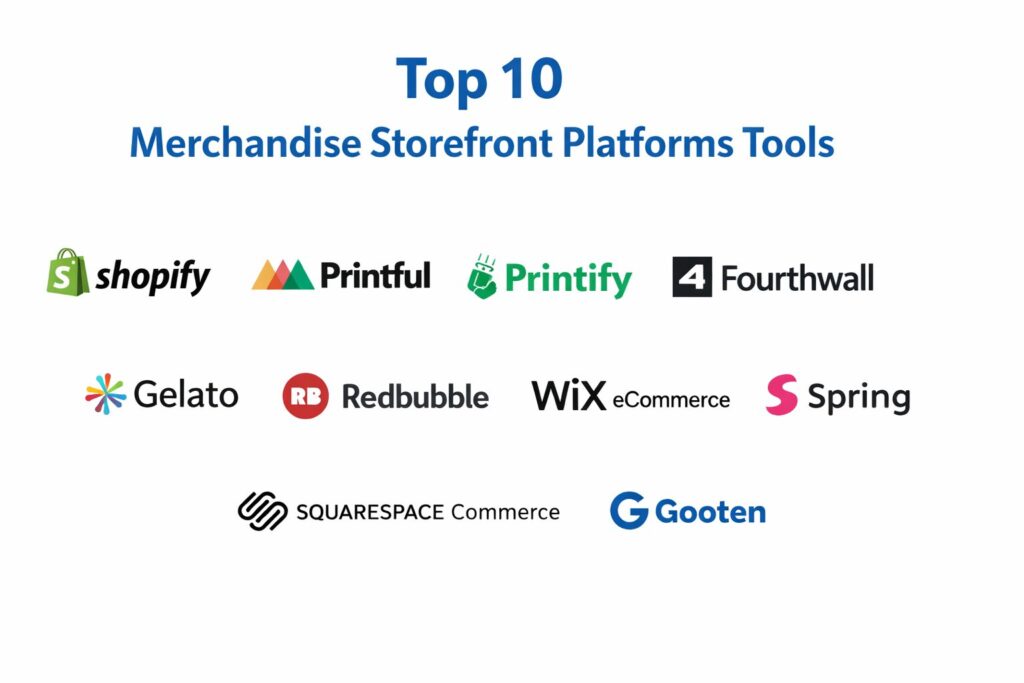
1. Shopify
Shopify is the dominant force in the e-commerce space, providing an all-in-one engine that powers everything from small creator shops to global enterprise brands. It serves as a central hub that connects to hundreds of merchandise and print-on-demand apps, allowing for a highly customized storefront that can scale infinitely. The platform is known for its world-class checkout experience and robust backend management tools.
Key Features
The platform features an extensive app marketplace where users can plug in specialized fulfillment partners for any type of product. It includes a powerful theme editor for creating unique brand identities without deep coding knowledge. The integrated payment system handles global currencies and tax calculations automatically. It also offers advanced analytics that track customer behavior and conversion rates across multiple sales channels. High-level security is built-in, including automatic SSL certificates and full PCI compliance.
Pros
It offers the most complete set of marketing and SEO tools in the industry, ensuring your storefront is discoverable. The scalability is unmatched, capable of handling thousands of simultaneous transactions.
Cons
The monthly subscription fees and additional costs for premium apps can become expensive for low-volume sellers. The high level of customization can result in a longer initial setup time.
Platforms and Deployment
Web-based SaaS with dedicated mobile apps for management. It supports headless commerce for custom front-end builds.
Security and Compliance
Fully PCI DSS Level 1 compliant with built-in fraud analysis and multi-factor authentication for admin accounts.
Integrations and Ecosystem
It has the largest ecosystem in the world, integrating with every major social media platform, shipping carrier, and marketing automation tool.
Support and Community
Offers 24/7 professional support and access to a massive community of developers and experts for hire.
2. Printful
Printful is a leading print-on-demand and fulfillment specialist that focuses on high-quality manufacturing and white-label branding. Unlike marketplace-style platforms, Printful owns many of its fulfillment centers, which allows for tighter control over the quality of the final product and the unboxing experience.
Key Features
The platform provides a sophisticated mockup generator that uses real-life photography to showcase designs. It offers extensive branding options, including custom labels, pack-ins, and branded tracking pages. Its global network of facilities ensures fast shipping to the US, Europe, and Asia. It includes a specialized tool for creating embroidered designs with high precision. The system also supports warehousing services for items not produced by Printful, allowing brands to centralize their entire fulfillment process.
Pros
The “in-house” production model leads to more consistent print quality and more reliable shipping estimates. The white-label features are some of the most advanced available.
Cons
The base prices for products are generally higher than competitors, which can compress profit margins. The product catalog, while high-quality, is not as large as some marketplace providers.
Platforms and Deployment
Cloud-based platform that integrates directly into existing storefronts.
Security and Compliance
Adheres to standard data protection regulations and provides secure payment processing for its fulfillment services.
Integrations and Ecosystem
Integrates seamlessly with Shopify, WooCommerce, Wix, and various marketplaces like Etsy and Amazon.
Support and Community
Provides dedicated customer support and a wealth of educational resources through its academy and blog.
3. Printify
Printify operates as a massive network of independent print providers, giving users access to the largest catalog of customizable products on the market. It functions as a competitive marketplace where brands can choose their fulfillment partners based on price, location, and user ratings.
Key Features
The platform offers over 800 unique products ranging from apparel to home decor and electronics. Users can switch between different print providers for the same product to optimize for shipping speed or cost. It features a simple drag-and-drop design tool that makes product creation accessible to non-designers. A premium subscription tier provides significant discounts on all base product prices. It also includes an automated order routing system to handle out-of-stock situations.
Pros
The competitive nature of the marketplace often results in the lowest base prices in the industry. The sheer variety of products allows brands to build highly specialized merchandise lines.
Cons
Since products come from different providers, quality and shipping times can vary significantly between items. Managing multiple providers within a single order can sometimes lead to split shipments.
Platforms and Deployment
Web-based platform with a focus on ease of use for small to medium sellers.
Security and Compliance
Standard secure account management and PCI-compliant handling of all financial transactions.
Integrations and Ecosystem
Strong connections to major e-commerce platforms and a robust API for custom developer integrations.
Support and Community
Offers 24/7 merchant support and a large user community for troubleshooting and best practices.
4. Fourthwall
Fourthwall is an all-in-one platform specifically designed for creators and influencers who want to combine a merchandise store with a memberships and fan-engagement hub. It emphasizes high-quality, “retail-ready” merchandise and a premium, fully branded customer experience.
Key Features
The platform offers a built-in website builder tailored for creators, including features like YouTube product shelves and Twitch alerts. It provides a curated selection of high-end products that feel more like retail brands than standard merch. It includes a memberships feature that allows creators to offer exclusive products or content to their most loyal fans. The software handles all tax and VAT filings automatically, which is a major benefit for international sellers. It also features direct integrations with major social media platforms for frictionless selling.
Pros
The focus on “retail quality” helps creators build more sustainable, long-term brands. It provides a very clean, professional aesthetic that is specifically designed to maximize fan conversion.
Cons
The platform is more focused on the creator economy than traditional corporate retail. The selection of products is more curated and therefore smaller than some of the larger marketplaces.
Platforms and Deployment
Cloud-based SaaS platform with a focus on mobile-friendly storefronts.
Security and Compliance
Includes enterprise-grade security and automated global tax compliance for digital and physical goods.
Integrations and Ecosystem
Deeply integrated with the social media stacks of modern creators, including TikTok, YouTube, and Twitch.
Support and Community
Highly responsive support team that understands the specific needs and pressures of professional content creators.
5. Spring (formerly Teespring)
Spring is a pioneer in the social commerce space, offering a no-cost entry point for creators to design and sell products. It is built to facilitate viral sales cycles, with deep integrations that allow fans to purchase merchandise directly through video descriptions and social media profiles.
Key Features
The platform features a “Social Commerce” engine that puts products directly in front of fans where they are already consuming content. It provides a launcher tool that allows for rapid product creation across multiple categories simultaneously. It includes a dedicated “Boosted Network” that helps promote products on marketplaces like Amazon and eBay. The platform handles all customer service and returns, making it a truly hands-off solution. It also offers a “digital products” feature for selling things like ebooks or presets alongside physical merch.
Pros
There are no upfront costs or monthly fees, making it the lowest-risk way to start selling. The integration with social media platforms is incredibly smooth for both the creator and the buyer.
Cons
The profit margins can be lower due to the platform taking a larger share of the sale. Customization of the storefront itself is more limited compared to a standalone site builder.
Platforms and Deployment
Web-based platform optimized for rapid social media deployment.
Security and Compliance
Standard secure transaction processing and data protection for all global orders.
Integrations and Ecosystem
Exceptional integrations with YouTube, TikTok, and Instagram, making it the standard for social-first selling.
Support and Community
Offers a self-service help center and community forums, with direct support available for established creators.
6. Gelato
Gelato is a global print-on-demand network that prioritizes local production and sustainability. It works by connecting a brand’s store to a network of over 100 local print houses in 30 countries, ensuring that products are produced as close to the customer as possible.
Key Features
The platform’s standout feature is its intelligent routing system that minimizes shipping distances and times. It offers a wide range of paper-based products, apparel, and home decor with a focus on premium materials. The software provides an easy-to-use interface for managing global orders and tracking environmental impact. It includes professional design tools and a large library of high-resolution mockups. For larger organizations, it offers custom API solutions to integrate high-volume printing into existing corporate workflows.
Pros
The localized production model is ideal for brands that prioritize fast delivery and environmental responsibility. It effectively eliminates most customs duties for international customers.
Cons
While its apparel selection is growing, it is traditionally more specialized in paper-based and wall-art products. The platform may require more manual setup for complex branding compared to Printful.
Platforms and Deployment
Web-based SaaS platform with a robust API for enterprise integration.
Security and Compliance
Global data privacy compliance and secure, encrypted payment processing across all regions.
Integrations and Ecosystem
Strong integrations with Shopify, Etsy, WooCommerce, and Wix, plus a developer-friendly API.
Support and Community
Offers 24/7 global support and a dedicated success team for enterprise-level clients.
7. Redbubble
Redbubble is a marketplace-first platform that connects independent artists with a global audience. It is not a backend fulfillment tool for an existing store, but rather a destination where artists can upload their work and let the platform handle the marketing, selling, and shipping.
Key Features
The platform acts as a high-traffic search engine for unique designs, giving artists immediate exposure to millions of buyers. It handles all aspects of the transaction, including payment processing, printing, and global logistics. Artists have control over their royalty margins for each product type. It features a wide variety of unique items, such as stickers, phone cases, and home accessories. The platform also includes a robust system for protecting intellectual property and managing artist rights.
Pros
It requires zero technical knowledge and zero marketing effort to start making sales. The built-in audience is one of the largest in the art and design world.
Cons
Artists have very little control over the branding or the customer data. The platform is highly competitive, making it difficult for individual designs to stand out without a pre-existing following.
Platforms and Deployment
Marketplace website and mobile app.
Security and Compliance
Secure payment gateways and established protocols for managing artist payouts and data privacy.
Integrations and Ecosystem
Primarily a standalone marketplace with limited external integrations compared to storefront builders.
Support and Community
Provides extensive artist help centers and a vibrant community of creators who share tips and techniques.
8. Wix eCommerce
Wix is a versatile website builder that has developed a powerful e-commerce suite suitable for merchandise stores. It is known for its highly visual, drag-and-drop editor that allows for complete creative control over the storefront’s appearance.
Key Features
The platform includes an intuitive editor with hundreds of templates specifically designed for fashion and merchandise. It integrates directly with major print-on-demand providers through its built-in app market. It features advanced AI tools that can help generate a fully functional store based on a few simple prompts. The dashboard provides a unified view of sales, inventory, and marketing campaigns. It also offers a dedicated mobile app for managing the store and communicating with customers on the go.
Pros
The design flexibility is among the best in the industry, allowing for truly unique storefronts. It is an excellent choice for businesses that want a full-featured website alongside their merchandise shop.
Cons
The interface can sometimes feel overwhelming due to the sheer number of design options. It may not be as optimized for massive, high-velocity inventories as a specialized platform like Shopify.
Platforms and Deployment
Cloud-based SaaS with a highly responsive visual editor.
Security and Compliance
Provides enterprise-grade security, including SSL, PCI compliance, and automated backups.
Integrations and Ecosystem
Features a robust app market with integrations for all major fulfillment partners and marketing tools.
Support and Community
Offers 24/7 priority support for e-commerce plans and a massive library of tutorials and webinars.
9. Squarespace Commerce
Squarespace is the preferred platform for design-focused brands and photographers. It offers world-class aesthetics and a highly curated set of tools that prioritize visual storytelling and a premium user experience.
Key Features
The platform features award-winning design templates that are optimized for high-resolution imagery. It includes a streamlined e-commerce backend that manages products, orders, and customer lists with elegance. It offers a direct integration with professional print-on-demand services for seamless fulfillment. The built-in marketing tools include email campaigns and social media integrations that match the site’s aesthetic. It also features a powerful blogging engine for brands that want to build an audience through content.
Pros
The visual quality of the storefronts is unmatched, making it ideal for high-end lifestyle brands. The user interface is exceptionally clean and easy to navigate for both the owner and the customer.
Cons
The e-commerce features are not as deep or as flexible as those found in Shopify. It is better suited for a curated selection of products rather than a massive, diverse catalog.
Platforms and Deployment
Web-based SaaS platform known for its stability and speed.
Security and Compliance
Standard high-level security features including SSL and secure payment processing through major gateways.
Integrations and Ecosystem
Offers a curated list of high-quality extensions rather than an open marketplace of thousands of apps.
Support and Community
Provides award-winning customer support and a dedicated circle of professional designers for custom work.
10. Gooten
Gooten is a sophisticated supply chain management platform that focuses on providing an automated, scalable fulfillment solution for established brands and high-volume sellers. It acts as a bridge between an existing storefront and a global network of specialized manufacturers.
Key Features
The platform uses an intelligent logistics engine to determine the best manufacturer for an order based on quality, price, and proximity to the customer. It offers a highly curated catalog of over 150 high-quality products. It includes a dedicated “Order Manager” tool for handling complex customer service issues and order edits. The software is designed to handle very high transaction volumes with high reliability. It also provides advanced reporting tools that give brands deep insight into their fulfillment performance and costs.
Pros
The focus on supply chain efficiency makes it a top choice for brands that have outgrown simpler, single-provider solutions. The platform offers a more professional, “behind-the-scenes” feel for corporate users.
Cons
It does not offer its own storefront builder, meaning you must already have a site on another platform. The setup process is more technical and geared toward professional operators.
Platforms and Deployment
Cloud-based fulfillment engine that integrates into external storefronts via app or API.
Security and Compliance
Enterprise-level data security and compliance with international standards for supply chain management.
Integrations and Ecosystem
Direct integrations with Shopify, Etsy, and BigCommerce, along with a powerful API for custom enterprise stacks.
Support and Community
Provides dedicated account management for high-volume partners and professional technical support.
Comparison Table
| Tool Name | Best For | Platform(s) Supported | Deployment | Standout Feature | Public Rating |
|---|---|---|---|---|---|
| Shopify | Full-scale branded merchandise stores | Web, iOS, Android | Cloud / SaaS | Largest app ecosystem and scalable checkout | 4.8/5 |
| Printful | Premium print-on-demand with white-label branding | Web | Cloud | In-house fulfillment and advanced branding options | 4.7/5 |
| Printify | Low-cost product variety and provider choice | Web | Cloud | Huge supplier network and broad catalog | 4.6/5 |
| Fourthwall | Creators and influencer-led branded shops | Web | Cloud | Creator-focused storefront plus memberships | 4.7/5 |
| Spring | Social-first merchandise selling | Web | Cloud | Deep social commerce integrations | 4.4/5 |
| Gelato | Global local-production fulfillment | Web | Cloud | Hyper-localized printing and sustainability focus | 4.6/5 |
| Redbubble | Artists wanting marketplace exposure | Web, Mobile App | Marketplace Cloud | Built-in global buyer marketplace | 4.3/5 |
| Wix eCommerce | Design-flexible websites with merch stores | Web, iOS, Android | Cloud / SaaS | Visual drag-and-drop storefront design | 4.5/5 |
| Squarespace Commerce | Premium visual brands and curated product catalogs | Web, Mobile App | Cloud / SaaS | Best-in-class design presentation | 4.5/5 |
| Gooten | Scalable backend fulfillment for established brands | Web | Cloud | Supply-chain automation and logistics engine | 4.4/5 |
Evaluation & Scoring of Merchandise Storefront Platforms
The scoring below is a comparative model intended to help shortlisting. Each criterion is scored from 1–10, then a weighted total from 0–10 is calculated using the weights listed. These are analyst estimates based on typical fit and common workflow requirements, not public ratings.
Weights:
- Core features – 25%
- Ease of use – 15%
- Integrations & ecosystem – 15%
- Security & compliance – 10%
- Performance & reliability – 10%
- Support & community – 10%
- Price / value – 15%
| Tool Name | Core (25%) | Ease (15%) | Integrations (15%) | Security (10%) | Performance (10%) | Support (10%) | Value (15%) | Weighted Total |
|---|---|---|---|---|---|---|---|---|
| Shopify | 10 | 8 | 10 | 10 | 10 | 9 | 7 | 9.05 |
| Printful | 9 | 8 | 9 | 9 | 9 | 8 | 7 | 8.35 |
| Printify | 8 | 9 | 8 | 8 | 8 | 8 | 10 | 8.45 |
| Fourthwall | 8 | 9 | 8 | 9 | 8 | 9 | 8 | 8.35 |
| Spring | 7 | 9 | 8 | 8 | 8 | 7 | 9 | 8.00 |
| Gelato | 8 | 8 | 8 | 9 | 9 | 8 | 8 | 8.15 |
| Redbubble | 7 | 10 | 5 | 8 | 8 | 7 | 8 | 7.55 |
| Wix eCommerce | 8 | 8 | 8 | 9 | 8 | 8 | 8 | 8.10 |
| Squarespace Commerce | 8 | 9 | 7 | 9 | 8 | 8 | 7 | 7.95 |
| Gooten | 8 | 6 | 9 | 9 | 9 | 8 | 8 | 8.10 |
How to interpret the scores:
- Use the weighted total to shortlist candidates, then validate with a pilot.
- A lower score can mean specialization, not weakness.
- Security and compliance scores reflect controllability and governance fit, because certifications are often not publicly stated.
- Actual outcomes vary with assembly size, team skills, templates, and process maturity.
Which Merchandise Storefront Platform Tool Is Right for You?
Solo / Freelancer
For individuals starting out, a marketplace-style platform or a no-cost entry tool is often the wisest path. These solutions allow you to test designs and build an audience without any financial risk, providing a hands-off approach to fulfillment and customer service.
SMB
Small businesses should look for platforms that offer a balance of design flexibility and automated management. A tool that allows for easy integration with a variety of fulfillment partners will provide the most room to grow without becoming technically unmanageable.
Mid-Market
Organizations in the mid-market require more robust data and better branding control. Choosing a platform that offers white-labeling and detailed analytics is essential for maintaining a professional identity and optimizing marketing spend across multiple channels.
Enterprise
At the enterprise level, the focus is on stability, security, and supply chain logistics. These organizations need platforms that can integrate into existing ERP systems and manage global production through a diversified network of high-capacity manufacturers.
Budget vs Premium
Budget options focus on low upfront costs and ease of use, making them perfect for testing the waters. Premium solutions, while requiring a monthly investment, offer the deep customization, higher profit margins, and advanced security features required for a serious brand.
Feature Depth vs Ease of Use
Some platforms prioritize a simple, guided experience that gets a store live in minutes, while others offer a deep set of tools for technical customization. The right choice depends on whether you value speed to market or total creative and technical control.
Integrations & Scalability
A platform’s ability to “grow with you” is critical. Look for tools that have a rich ecosystem of apps and a strong API, as these will allow you to add features like loyalty programs, advanced SEO, and international shipping as your business expands.
Security & Compliance Needs
For organizations handling high volumes of sensitive customer data, security cannot be a secondary concern. Ensure your chosen platform is fully compliant with international payment standards and has a clear record of protecting user information against breaches.
Frequently Asked Questions (FAQs)
1. What is the difference between a storefront and a fulfillment provider?
A storefront is the digital interface where customers browse and buy products, while a fulfillment provider is the backend company that actually prints, packs, and ships the goods. Some platforms combine both, while others require you to link two separate tools.
2. Do I need to buy inventory in advance?
With the print-on-demand model used by most of these platforms, you do not need to buy any inventory upfront. Products are only manufactured after a customer has placed and paid for an order on your site.
3. Can I sell international orders easily?
Yes, many of these platforms have global fulfillment networks that automatically handle international shipping. However, you should choose a provider with production facilities in your target regions to avoid high shipping costs and customs duties.
4. Who handles customer returns and complaints?
This depends on the platform. Marketplace-style tools often handle all customer service themselves. Standalone storefronts usually require you to handle the initial customer communication, though the fulfillment partner will resolve manufacturing defects.
5. How much profit can I expect to make per item?
Profit margins typically range from 20% to 50% depending on the platform, the product type, and your chosen retail price. You should carefully review the base cost of products and shipping fees when setting your prices.
6. Can I use my own custom domain name?
Most professional storefront builders allow you to connect a custom domain (e.g., yourname.com). This is a critical step for building brand trust and improving your search engine rankings.
7. Is it possible to see a sample before I start selling?
Almost all reputable merchandise platforms allow you to order samples at a discounted price. It is highly recommended to do this so you can verify the print quality and the feel of the material before your customers do.
8. Do these platforms support digital products?
Many modern storefront tools now allow you to sell digital items like PDFs, presets, or music alongside your physical merchandise, providing multiple revenue streams within a single store.
9. How are taxes handled for international sales?
Specialized e-commerce platforms often have built-in tax engines that automatically calculate and collect the correct amount of VAT or sales tax based on the customer’s location, simplifying a very complex part of global retail.
10. Can I move my store from one platform to another later?
While you can move your domain and product designs, migrating customer data and order history can be complex. It is best to choose a platform that can scale with you from the start to avoid a difficult migration later.
Conclusion
Navigating the landscape of merchandise storefront platforms requires a strategic alignment of your brand goals with the technical capabilities of the software. From my perspective, the shift toward localized production and real-time social commerce is not just a trend; it is the new standard for professional digital retail. A successful storefront must act as a seamless extension of your identity, providing a friction-free path from discovery to delivery. Whether you are an individual creator building a community or an enterprise managing global logistics, the key is to prioritize a platform that offers the right balance of security, scalability, and branding control. By carefully evaluating these tools, you can build a resilient digital presence that translates audience engagement into tangible, high-quality products that endure.