Introduction
A Medical Device Quality Management System (QMS) is a structured framework of procedures, processes, and responsibilities designed to ensure that medical devices consistently meet customer requirements and stringent regulatory standards. In the highly regulated MedTech landscape, a QMS is not merely an operational preference but a legal necessity. These systems govern the entire product lifecycle—from initial design and risk management to manufacturing, distribution, and post-market surveillance. By digitizing these processes through an electronic QMS (eQMS), organizations can replace error-prone manual spreadsheets with automated workflows that ensure data integrity and “inspection readiness” at all times.
The strategic implementation of a robust quality system allows manufacturers to navigate the complexities of global markets, such as the FDA’s Quality Management System Regulation (QMSR) and the European Union’s Medical Device Regulation (EU MDR). Beyond compliance, a well-integrated QMS serves as a centralized “source of truth” that connects engineering, quality, and manufacturing teams. This connectivity accelerates time-to-market by streamlining design reviews and change controls while significantly reducing the risk of costly product recalls. For leadership, these systems provide real-time analytics and predictive insights, transforming quality from a reactive “gatekeeper” into a proactive driver of operational excellence and patient safety.
Best for: Medical device startups, mid-market manufacturers, and global life sciences enterprises that must comply with ISO 13485, FDA 21 CFR Part 820, and MDSAP requirements.
Not ideal for: General consumer goods companies or non-regulated industries that do not require the high overhead of clinical-grade validation, electronic signatures (21 CFR Part 11), or rigorous design history file (DHF) maintenance.
Key Trends in Medical Device Quality Systems
The most significant trend is the shift from the FDA’s traditional Quality System Regulation (QSR) toward the new Quality Management System Regulation (QMSR), which harmonizes US requirements with the international ISO 13485:2016 standard. This harmonization simplifies the path for manufacturers seeking global distribution, as it aligns the core quality expectations across different jurisdictions. Additionally, there is a surge in “Quality Intelligence,” where platforms integrate Artificial Intelligence to perform automated gap analyses, predict non-conformance trends, and auto-generate investigation summaries for Corrective and Preventive Actions (CAPA).
Another major evolution is the rise of Software as a Medical Device (SaMD) specific workflows. Traditional quality systems often struggle with the rapid release cycles of software, but modern systems now incorporate Agile-friendly design controls and integrated cybersecurity risk management. Furthermore, the industry is moving toward a “closed-loop” quality ecosystem where the QMS is no longer a silo; it is natively integrated with Product Lifecycle Management (PLM) and Manufacturing Execution Systems (MES). This integration allows for a “digital thread” that tracks every component from a supplier’s raw material through to the specific serial number of a device used in a clinical setting.
How We Selected These Tools
The selection of these platforms was based on their specific utility within the MedTech regulatory framework and their ability to handle the “high-stakes” nature of medical manufacturing. We prioritized systems that offer built-in support for the “big three” standards: ISO 13485, FDA 21 CFR Part 820, and ISO 14971 (Risk Management). A critical factor was the availability of pre-validated software or comprehensive validation packages (IQ, OQ, PQ) that reduce the internal burden on Quality and IT teams during deployment.
Technical evaluation focused on the robustness of “Design Controls” and the ability to automatically generate a living Design History File (DHF). We also looked for platforms that provide specialized modules for Complaint Handling and Electronic Medical Device Reporting (eMDR), which are essential for post-market compliance. Finally, we assessed the scalability of each system—ensuring the list includes options suitable for small startups needing a “ready-to-use” SaaS solution as well as enterprise giants requiring deep configuration and multi-site harmonization.
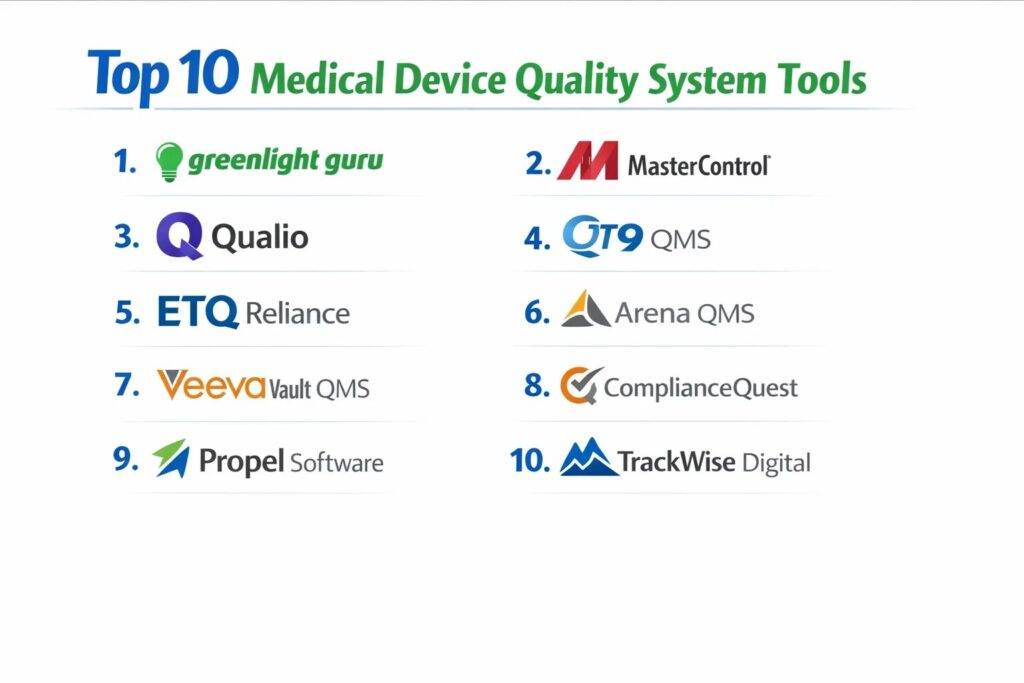
1. Greenlight Guru
Greenlight Guru is the only platform built exclusively for the medical device industry. It is designed to move teams away from “compliance for compliance’s sake” toward “True Quality.” The system is centered around a unique “interconnected database” architecture that eliminates data silos between design and quality.
Key Features
The platform features a dedicated Design Control module that automatically generates a traceability matrix as you work. It includes a risk management engine that is natively aligned with ISO 14971, allowing hazards to be linked directly to design inputs. The system provides automated document routing and advanced version control specifically tuned for MedTech workflows. It also offers a “Guru Drive” for secure, centralized storage and a specialized “Quality Event” module for managing CAPAs and Nonconformances. Additionally, the platform comes with pre-built templates that reflect the latest QMSR and EU MDR language.
Pros
Purpose-built specifically for medical devices, which minimizes the need for custom configuration. Excellent customer support from industry experts who understand the regulatory landscape.
Cons
It is very niche; companies looking to expand into non-medical verticals may find the platform too specialized. The mass import of legacy documents can be a tedious process.
Platforms and Deployment
Cloud-based SaaS platform accessible via any modern web browser.
Security and Compliance
Supports FDA 21 CFR Part 11, ISO 13485, and ISO 14971. Features robust audit trails and secure electronic signatures.
Integrations and Ecosystem
Integrates with popular engineering and collaboration tools like Jira, SolidWorks, and Arena PLM.
Support and Community
Offers a deep knowledge base and the “Greenlight Guru Academy” for professional MedTech education.
2. MasterControl Quality Excellence
MasterControl is an industry standard for large-scale pharmaceutical and medical device manufacturers. It offers a comprehensive “Quality Excellence” suite that focuses on automating the entire product lifecycle on a single, AI-driven platform.
Key Features
The system provides a robust Electronic Device History Record (eDHR) tool that captures live data directly from the shop floor, flagging deviations instantly. It features “Validation on Demand” technology, which significantly reduces the time required to validate software upgrades. The platform includes modules for document control, training management, CAPA, and supplier quality. Its AI capabilities include “Quality Intelligence” for trend analysis and predictive risk modeling. It also provides a centralized platform for managing audits and regulatory submissions across multiple global sites.
Pros
Highly scalable and trusted by major global regulatory bodies. The integration between manufacturing (MES) and quality (QMS) is exceptionally strong.
Cons
The platform is complex and often requires a long implementation period and specialized training. It is among the most expensive solutions on the market.
Platforms and Deployment
Cloud-native architecture with options for hybrid deployment in enterprise environments.
Security and Compliance
Enterprise-grade security with full GxP compliance and patented validation tools.
Integrations and Ecosystem
Extensive integration capabilities with major ERP systems like SAP and Oracle, as well as various PLM and LIMS tools.
Support and Community
Provides dedicated account management and a large global user community for networking and best practices.
3. Qualio
Qualio is a modern, cloud-native QMS designed for rapidly scaling life sciences companies, particularly those in the startup to mid-market range. It prioritizes ease of use and fast implementation to help young companies reach audit readiness quickly.
Key Features
The platform features an intuitive document editor that allows for in-app collaboration and real-time reviews. It includes a “Compliance Intelligence” tool that uses AI to perform gap analyses against international standards. The system automates training management, ensuring that all employees are up-to-date on the latest SOPs. It provides pre-built quality and regulatory content templates to accelerate the path to ISO certification. The dashboard offers real-time visibility into the health of the quality system, including open CAPAs and pending training tasks.
Pros
One of the fastest platforms to implement, often taking weeks instead of months. The user interface is clean and requires very little training for general users.
Cons
May lack the deep configuration options required by massive, multi-national conglomerates. Does not currently offer native ERP integrations for manufacturing-heavy workflows.
Platforms and Deployment
Fully managed cloud SaaS platform.
Security and Compliance
Fully compliant with 21 CFR Part 11 and ISO 13485. Hosted on secure AWS infrastructure with regular third-party audits.
Integrations and Ecosystem
Connects with common business tools like Jira, Slack, and Salesforce to weave quality into daily work.
Support and Community
Known for high-touch customer success teams and a wealth of educational webinars for growth-stage companies.
4. QT9 QMS
QT9 QMS is a highly-rated, all-in-one platform known for offering a massive range of features with a transparent, cost-effective pricing model. It is a popular choice for mid-market manufacturers who want a “validated out-of-the-box” experience.
Key Features
The platform includes over 25 modules in its core offering, covering everything from CAPA and training to supplier quality and calibration. It provides a unique, seamless integration with its own dedicated ERP system, bridging the gap between quality and business operations. The system comes fully pre-validated (IQ, OQ, PQ included), which drastically reduces the total cost of ownership. It features automated email alerts for pending tasks and a robust reporting engine for management reviews. It also includes a dedicated module for customer feedback and complaint handling.
Pros
Exceptional value for the money, as all modules are typically included in a single subscription price. The concurrent-user licensing model is very flexible for growing teams.
Cons
The user interface, while functional, is not as modern or “slick” as some of the newer cloud-only competitors. Customization options are more structured compared to “no-code” platforms.
Platforms and Deployment
Available as both a cloud-based SaaS and an on-premises installation.
Security and Compliance
Provides full support for FDA 21 CFR Part 11 and ISO 13485. Includes automated audit trails for every record.
Integrations and Ecosystem
Best-in-class integration with QT9 ERP, and provides an API for connecting to other third-party manufacturing tools.
Support and Community
Offers unlimited, lifetime customer support and training at no additional charge.
5. ETQ Reliance
ETQ Reliance is an enterprise-grade QMS recognized for its extreme configurability. It is part of the Hexagon ecosystem and is designed for large organizations that need to harmonize diverse quality processes across different business units.
Key Features
The platform uses a “no-code” drag-and-drop designer that allows administrators to build custom workflows and forms without IT intervention. It offers more than 40 built-in applications, including specialized modules for Environmental Health and Safety (EHS). The system features advanced risk management tools that allow for risk-based decision-making throughout the CAPA process. It provides powerful “Predictive Quality” analytics that help identify potential issues before they become non-conformances. The platform is built to handle massive data volumes and support hundreds of global sites.
Pros
Unmatched flexibility; if you have a unique quality process, ETQ can almost certainly be configured to match it. Excellent for companies managing multiple industries beyond just medical devices.
Cons
The high degree of configurability leads to a steep learning curve for system administrators. The initial investment and ongoing maintenance costs are significant.
Platforms and Deployment
Cloud-native platform built on AWS, supporting high availability and global scalability.
Security and Compliance
Complies with ISO 9001, 13485, and 27001. Features granular role-based access controls and secure data encryption.
Integrations and Ecosystem
Integrates deeply with enterprise ecosystems including SAP, Salesforce, and various MES platforms.
Support and Community
Provides extensive professional services and a structured training program for enterprise users.
6. Arena QMS (by PTC)
Arena QMS is uniquely positioned as a cloud-native platform that unifies Quality Management with Product Lifecycle Management (PLM). This makes it the premier choice for hardware-intensive MedTech companies that need to link quality events directly to the Bill of Materials (BOM).
Key Features
The platform links quality records (like CAPAs or NCs) directly to the specific product revision and BOM item involved. It features a robust Change Management module that ensures all stakeholders are aligned before a design change is implemented. The system provides a centralized “Product Record” that includes the DHF and Device Master Record (DMR). It facilitates secure collaboration with contract manufacturers and suppliers within a single environment. The platform also includes automated training triggers whenever a new product revision is released.
Pros
Eliminates the silo between engineering and quality by putting them in the same system. Exceptional for managing complex product structures and global supply chains.
Cons
Because it is a combined PLM/QMS, the initial setup and data migration can be more complex than a standalone QMS. Mobile access for field updates is currently limited.
Platforms and Deployment
Multi-tenant cloud SaaS designed for rapid deployment and high uptime.
Security and Compliance
Strictly adheres to FDA 21 CFR Part 11 and ISO 13485 requirements with comprehensive audit logging.
Integrations and Ecosystem
Native integration with Arena PLM and strong connections to various ERP and CAD tools.
Support and Community
Offers a wide range of onboarding services and a dedicated “success coach” for enterprise clients.
7. Veeva Vault QMS
Veeva Vault QMS is a leader in the pharmaceutical and large-scale life sciences space. It is designed to handle the massive volumes of clinical and regulatory content that accompany global product launches.
Key Features
The platform provides a unified suite that connects Quality with Clinical, Regulatory, and Safety modules. It features “Quality Risk Management” (QRM) tools that allow teams to maintain risk registers directly within the quality record. The system includes a modern, web-based interface that supports real-time collaboration across global teams. It offers “Vault QualityDocs” for advanced content control and lifecycle management. The platform’s reporting engine provides “cross-vault” visibility, linking clinical trial milestones to manufacturing quality metrics.
Pros
The “gold standard” for companies that need total digital continuity from clinical trials through commercialization. Extremely robust for managing multi-country regulatory submissions.
Cons
The premium pricing makes it prohibitive for many startups and mid-market companies. The proprietary architecture may lead to data silos if not used as part of the full Veeva suite.
Platforms and Deployment
Proprietary cloud platform designed for massive enterprise scalability.
Security and Compliance
Top-tier security posture with continuous validation and global regulatory alignment.
Integrations and Ecosystem
Best integrated within the Veeva Vault ecosystem, but offers APIs for external data connectivity.
Support and Community
Provides white-glove support and a massive ecosystem of specialized implementation partners.
8. ComplianceQuest
ComplianceQuest is a modern, AI-powered QMS built natively on the Salesforce platform. This gives it a unique advantage in terms of scalability, mobile accessibility, and integration with customer-facing departments.
Key Features
The platform leverages Salesforce’s AI (Einstein) to provide predictive insights and automated trend detection. It offers a modular structure, allowing companies to start with core modules like Document Control and scale into Supplier Quality or EHS. The system includes a mobile-ready interface that allows auditors and managers to work from anywhere. It features a “social” interface for quality, allowing teams to collaborate on CAPAs using Salesforce’s “Chatter” tool. It also provides a comprehensive “Learning Management System” (LMS) for employee training and certification.
Pros
Inherits the world-class security and uptime of the Salesforce platform. Excellent for organizations that already use Salesforce for CRM or other business functions.
Cons
Requires a Salesforce environment, which may add another layer of administrative complexity for non-Salesforce users. Some advanced features require additional licensing.
Platforms and Deployment
Cloud-based SaaS built on the Salesforce AppExchange.
Security and Compliance
Highly secure with SOC 2 compliance and full support for 21 CFR Part 11 and ISO 13485.
Integrations and Ecosystem
Native integration with Salesforce and easy connectivity to hundreds of third-party apps via the AppExchange.
Support and Community
Benefits from the massive Salesforce developer and support ecosystem globally.
9. Propel Software
Propel is a “Product Value Management” platform that combines QMS, PLM, and PIM (Product Information Management). It is designed for companies that want to connect quality and product data with customer feedback to drive faster innovation.
Key Features
The platform provides a unified view of the product from concept to customer, linking quality events to the “digital thread.” It includes “Native AI” that accelerates root cause analysis by auto-categorizing quality events. The system offers a “closed-loop” feedback system where customer complaints from the field are routed directly back to engineering for product improvement. It features a highly flexible workflow engine that can be configured in weeks. The platform also provides an automated audit trail that covers everything from record-level changes to administrative actions.
Pros
Excellent for fast-moving companies that want a “single platform” from day one. Very high ROI reported by customers due to the unification of product and quality data.
Cons
Early-stage startups with very simple workflows might find the full platform’s capabilities more than they currently need. Detailed search requires exact part numbers or document names.
Platforms and Deployment
Cloud-native SaaS built on the Salesforce platform for high reliability.
Security and Compliance
100% compliance readiness for FDA QMSR and EU MDR with automated validation tools.
Integrations and Ecosystem
Strong native connections within the Salesforce ecosystem and robust APIs for ERP and CAD integration.
Support and Community
Offers a structured “Path to Success” onboarding program and active user forums.
10. TrackWise Digital (by Sparta Systems)
TrackWise is one of the most established names in quality management, now evolved into “TrackWise Digital,” a cloud-based version optimized for modern compliance. It remains a staple for companies requiring deep regulatory reliability and complex multi-site governance.
Key Features
The platform excels at managing “high-complexity” quality events across global manufacturing networks. It features integrated “Quality Risk Management” that uses risk matrices directly within the CAPA workflow. The system includes a “Digital Dashboard” that provides a real-the view of quality metrics across all sites. It offers a specialized “Supplier Quality” portal that allows vendors to participate directly in the quality process. The platform is also incorporating AI to help automate the intake and categorization of complaints and nonconformances.
Pros
Proven regulatory track record with decades of successful audits in the most stringent environments. The cloud version is much easier to manage than the legacy on-premises installations.
Cons
The user interface, while improved, can still feel more “industrial” and less intuitive than newer SaaS competitors. Implementation often benefits from specialized consultants.
Platforms and Deployment
Cloud-based SaaS built on Salesforce, providing a transition path for legacy TrackWise users.
Security and Compliance
Trusted by global giants for its robust 21 CFR Part 11 and GxP compliance features.
Integrations and Ecosystem
Strong integration with enterprise Salesforce environments and deep links to SAP and other legacy ERPs.
Support and Community
Extensive global support network and a wealth of “best practice” templates developed over decades in the industry.
Comparison Table
| Tool Name | Best For | Platform(s) Supported | Deployment | Standout Feature | Public Rating |
| 1. Greenlight Guru | MedTech Startups | Web | SaaS | MedTech-only Workflow | 4.7/5 |
| 2. MasterControl | Global Enterprise | Web, Hybrid | Cloud | eDHR / Shop Floor Sync | 4.4/5 |
| 3. Qualio | Scaling Life Sciences | Web | SaaS | Ease of Implementation | 4.6/5 |
| 4. QT9 QMS | Mid-Market Value | Web, Desktop | Hybrid | 25+ Core Modules | 4.8/5 |
| 5. ETQ Reliance | High Configurability | Web | SaaS | No-code App Designer | 4.2/5 |
| 6. Arena QMS | Hardware/PLM Focus | Web | SaaS | BOM-Level Traceability | 4.5/5 |
| 7. Veeva Vault QMS | Pharma/Biotech | Web | SaaS | Clinical-Quality Bridge | 4.3/5 |
| 8. ComplianceQuest | Salesforce Users | Web, Mobile | SaaS | Einstein AI Insights | 4.5/5 |
| 9. Propel Software | Product Innovation | Web | SaaS | PLM-QMS-PIM Unified | 4.6/5 |
| 10. TrackWise Digital | Complex Global Ops | Web | SaaS | Multi-site Governance | 4.1/5 |
Evaluation & Scoring of Medical Device Quality Systems
The scoring below is a comparative model intended to help shortlisting. Each criterion is scored from 1–10, then a weighted total from 0–10 is calculated using the weights listed. These are analyst estimates based on typical fit and common workflow requirements, not public ratings.
Weights:
- Core features – 25%
- Ease of use – 15%
- Integrations & ecosystem – 15%
- Security & compliance – 10%
- Performance & reliability – 10%
- Support & community – 10%
- Price / value – 15%
| Tool Name | Core (25%) | Ease (15%) | Integrations (15%) | Security (10%) | Performance (10%) | Support (10%) | Value (15%) | Weighted Total |
| 1. Greenlight Guru | 10 | 9 | 8 | 10 | 9 | 10 | 8 | 9.15 |
| 2. MasterControl | 10 | 6 | 10 | 10 | 9 | 9 | 7 | 8.75 |
| 3. Qualio | 8 | 10 | 7 | 9 | 9 | 10 | 9 | 8.80 |
| 4. QT9 QMS | 9 | 8 | 9 | 9 | 8 | 10 | 10 | 9.05 |
| 5. ETQ Reliance | 9 | 6 | 9 | 9 | 9 | 8 | 8 | 8.20 |
| 6. Arena QMS | 9 | 8 | 9 | 10 | 9 | 9 | 8 | 8.85 |
| 7. Veeva Vault QMS | 10 | 6 | 8 | 10 | 10 | 9 | 6 | 8.30 |
| 8. ComplianceQuest | 9 | 8 | 10 | 9 | 9 | 9 | 8 | 8.90 |
| 9. Propel Software | 9 | 9 | 10 | 9 | 9 | 9 | 8 | 9.00 |
| 10. TrackWise Digital | 9 | 7 | 9 | 9 | 8 | 8 | 7 | 8.10 |
How to interpret the scores:
- Use the weighted total to shortlist candidates, then validate with a pilot.
- A lower score can mean specialization, not weakness.
- Security and compliance scores reflect controllability and governance fit, because certifications are often not publicly stated.
- Actual outcomes vary with assembly size, team skills, templates, and process maturity.
Which Medical Device Quality System Tool Is Right for You?
Solo / Freelancer
For an independent consultant or a solo founder in the early R&D phase, starting with a lightweight, user-friendly tool like Qualio is often best. It provides the necessary structure to pass an initial ISO 13485 audit without the overwhelming complexity of an enterprise-grade system.
SMB
Small to medium businesses specifically in the MedTech space should look at Greenlight Guru. Its built-in regulatory templates and “Guru” support are invaluable for teams that are small but need to be 100% audit-ready. Alternatively, QT9 QMS offers an incredible breadth of features that can grow as the team expands.
Mid-Market
For companies with maturing product lines and a need for better integration with manufacturing, Arena QMS or Propel are excellent choices. These platforms ensure that the engineering team and the quality team are working from the same “product record,” reducing friction as the company scales.
Enterprise
Large-scale global manufacturers with high-volume production should consider MasterControl or TrackWise Digital. These systems are built to handle the rigorous governance and “closed-loop” manufacturing requirements (like eDHR) that are critical at the enterprise level.
Budget vs Premium
If cost-efficiency is a primary driver, QT9 QMS provides the most “bang for your buck” with its all-inclusive module pricing. However, for organizations where the cost of a single recall outweighs the software investment, the premium clinical-to-quality features of Veeva Vault are often justified.
Feature Depth vs Ease of Use
Qualio and Greenlight Guru win on ease of use and rapid adoption. In contrast, ETQ Reliance offers unparalleled feature depth and customization but requires a dedicated internal team to manage and configure the system effectively.
Integrations & Scalability
Companies already invested in the Salesforce ecosystem will find ComplianceQuest or Propel to be the most natural fits, as they leverage existing infrastructure and provide seamless data flow between quality and other business functions.
Security & Compliance Needs
All listed tools are 21 CFR Part 11 ready. However, if your business is primarily based in Europe and focused on the EU MDR, platforms like Greenlight Guru and MasterControl offer the most specialized templates and localized support for those specific requirements.
Frequently Asked Questions (FAQs)
1. What is the difference between QSR and QMSR?
The FDA’s Quality System Regulation (QSR) was the original 21 CFR Part 820. As of February 2026, the FDA has finalized the transition to the Quality Management System Regulation (QMSR), which harmonizes these requirements with the international ISO 13485:2016 standard to reduce the burden on global manufacturers.
2. Is a cloud-based QMS secure enough for medical data?
Yes, modern eQMS platforms use enterprise-grade encryption and are hosted on secure infrastructure like AWS or Salesforce. They are specifically designed to meet 21 CFR Part 11 requirements for electronic records and signatures, providing even better security and traceability than paper systems.
3. Does the software come pre-validated?
Some platforms like QT9 QMS come pre-validated, while others like MasterControl provide “Validation on Demand” tools. Almost all MedTech-focused vendors provide a validation package (IQ, OQ, PQ) that you can use to complete the required software validation internally.
4. Can I migrate my existing paper records to an eQMS?
Yes, most vendors offer migration services or import tools. However, it is often a good time to audit and “clean up” your existing processes rather than just digitizing an inefficient paper workflow.
5. How long does it take to implement a new quality system?
Implementation times vary by complexity. A simple SaaS platform like Qualio can be “live” in 4–8 weeks, while an enterprise system like MasterControl or Veeva can take 6–12 months depending on the level of customization and integration.
6. What is a Design History File (DHF)?
A DHF is a collection of records that describes the design history of a finished medical device. It proves that the device was developed according to the approved design plan and meets all regulatory requirements.
7. Do I need a separate system for Risk Management?
Not necessarily. Most top-tier medical QMS platforms now include a native Risk Management module that aligns with ISO 14971, allowing you to link risks directly to your design controls and CAPAs.
8. Can these systems help with EU MDR compliance?
Yes, many platforms now include specific “Technical File” or “Design Dossier” modules designed to help manufacturers organize the documentation required for European CE Marking under the MDR.
9. What happens during an audit if I use an eQMS?
During an audit, you simply provide the auditor with a “view-only” login or generate reports from the system. The automated audit trails and organized document control make the process much faster and less stressful than searching through paper binders.
10. Do I have to pay for every user?
Pricing models vary. Some use a “named user” model where you pay for every person with a login, while others (like QT9) use a “concurrent user” model where you pay for the number of people logged in at the same time.
Conclusion
The transition from traditional, siloed quality management to a modern, integrated quality ecosystem is the defining operational shift for MedTech organizations. As regulatory bodies like the FDA and EMA demand higher levels of data integrity and faster post-market response times, the reliance on manual systems is becoming a significant liability. A robust eQMS does more than satisfy an auditor; it serves as a foundational digital asset that protects a company’s brand, speeds up innovation, and ensures patient safety. By selecting a system that aligns with your current size and future scaling needs—whether that is a specialist MedTech tool or a broad enterprise platform—you are securing a competitive advantage. In an industry where quality is the primary product, investing in the right digital infrastructure is the most critical decision a leadership team can make to ensure long-term commercial success and clinical reliability.