Introduction
Marketplace seller tools comprise a specialized ecosystem of software designed to automate the complex operational requirements of digital retail. In a multi-channel environment, a merchant is no longer just a seller but a data manager, logistics coordinator, and advertising strategist. These tools act as the central nervous system for an e-commerce business, synchronizing fragmented data points across global platforms like Amazon, eBay, and Walmart. By centralizing inventory, pricing, and customer communication, these platforms eliminate the manual errors that lead to account suspensions and missed revenue opportunities. For the modern entrepreneur, these systems are not just utilities but essential infrastructure for achieving significant market penetration and maintaining high seller ratings.
The necessity for a dedicated seller toolset is driven by the sheer velocity of modern commerce. Manually updating stock levels across three different marketplaces while managing fluctuating advertising bids is a recipe for operational failure. A robust seller tool provides real-time visibility into the “true profit” of a business, accounting for hidden fees, shipping costs, and advertising spend that often go unnoticed in basic spreadsheets. When evaluating these platforms, organizations must consider the accuracy of their data analytics, the speed of their inventory synchronization, and the depth of their integration with various global marketplaces. The right tool enables a business to pivot from reactive task management to proactive strategic growth, ensuring long-term viability in a competitive digital landscape.
Best for: Professional third-party sellers, brand owners, and large-scale retailers operating across multiple international marketplaces who need a unified source of truth for inventory and sales data.
Not ideal for: Casual or hobbyist sellers with low volume, businesses exclusively using a single platform with built-in tools, or organizations without a clear strategy for multi-channel expansion.
Key Trends in Marketplace Seller Tools
Artificial Intelligence has transitioned from a buzzword to a functional core of seller technology, with systems now offering automated “re-pricing” based on competitor behavior and machine-learning algorithms that predict inventory stock-outs before they happen. We are seeing a significant trend toward “unified commerce,” where tools bridge the gap between social selling on platforms like TikTok Shop and traditional marketplace listings. Real-time data visualization has also become a standard, allowing sellers to see the immediate impact of a price change or an ad campaign on their net margin without waiting for end-of-month reports.
Another dominant trend is the rise of automated compliance and tax management within the seller dashboard. As global regulations become more complex, tools are incorporating native features to handle VAT, GST, and marketplace-specific tax collection automatically. Mobile-first management is also on the rise, with advanced mobile apps allowing sellers to manage high-stakes tasks like customer dispute resolution and emergency inventory shifts directly from their smartphones. Furthermore, the industry is moving toward “headless” seller architecture, where a core backend manages data that can be pushed to any number of front-end marketplaces through robust API connections.
How We Selected These Tools
Our selection process involved a comprehensive analysis of tool reliability, data accuracy, and user satisfaction across the professional e-commerce community. We prioritized platforms that have demonstrated a high “uptime” for inventory synchronization, as even a ten-minute delay can lead to overselling during peak traffic periods. A key criterion was the depth of the “data lake” each tool accesses, particularly for product research and keyword optimization where historical accuracy is paramount. We looked for a balance between all-in-one suites that offer breadth and specialized tools that provide unparalleled depth in specific areas like advertising or eBay-specific research.
Scalability was a critical factor; we selected tools that can support a seller from their first hundred sales to millions in annual revenue. Security certifications were heavily weighted, as these platforms require deep access to sensitive financial accounts and marketplace APIs. We also assessed the “ecosystem value,” evaluating how well each tool connects with third-party logistics (3PL) providers and accounting software like QuickBooks or Xero. Finally, we looked at the total cost of ownership, ensuring that the list provides options for various business sizes, from lean startups to enterprise-level retail operations.
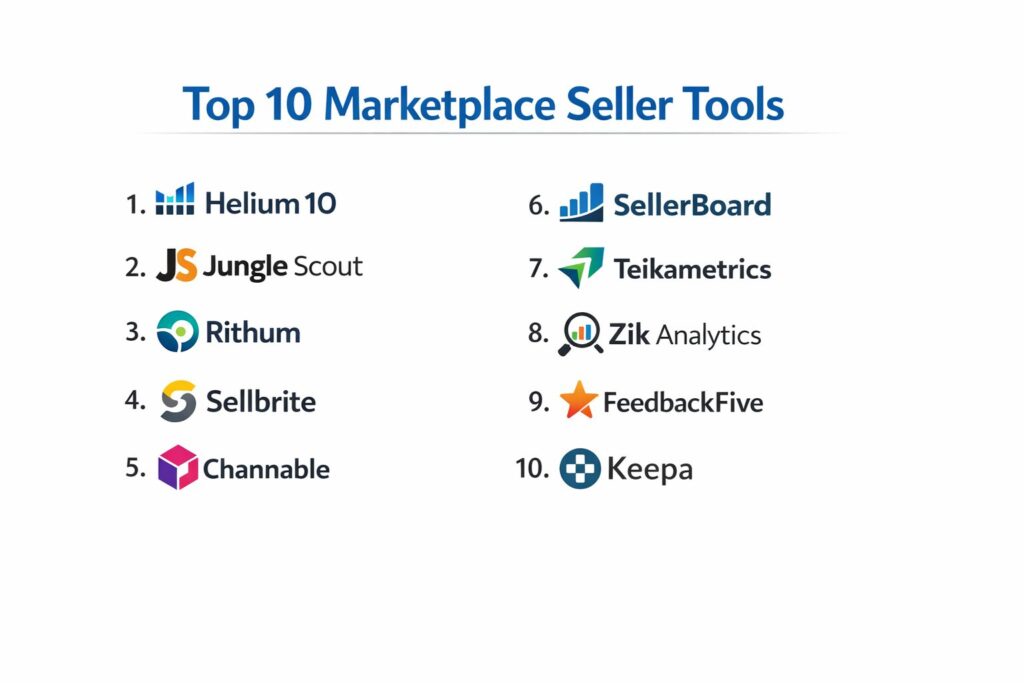
1. Helium 10
Helium 10 is widely considered the comprehensive “Swiss Army Knife” for marketplace sellers, particularly those focused on Amazon and Walmart. It offers an all-in-one suite of over thirty tools that cover every stage of the seller journey, from finding a profitable niche to managing complex PPC advertising campaigns.
Key Features
The platform features “Cerebro,” a reverse ASIN lookup tool that identifies the exact keywords competitors are ranking for. It includes “Black Box,” a product research engine that filters millions of items based on revenue and reviews. The suite offers “Adtomic,” an AI-powered advertising platform that optimizes bids to lower ACoS. It also provides an inventory management module that forecasts restocking needs based on sales velocity. A specialized “Refund Genie” tool automates the process of finding and claiming reimbursements for lost or damaged marketplace inventory.
Pros
It offers the most complete set of features in a single subscription, reducing the need for multiple tools. The data accuracy for sales estimations is among the highest in the industry.
Cons
The interface can be overwhelming for beginners due to the sheer volume of data and tools available. The higher-tier plans are quite expensive for smaller businesses.
Platforms and Deployment
Web-based (SaaS) with a robust Chrome extension and a mobile companion app.
Security and Compliance
SOC 2 Type II compliant with secure, encrypted API connections to marketplace developer accounts.
Integrations and Ecosystem
Direct native integrations with Amazon and Walmart, with expanded support for Shopify and various shipping tools.
Support and Community
Features the “Freedom Ticket” training program and one of the largest professional seller communities globally.
2. Jungle Scout
Jungle Scout is a pioneer in the product research space and has evolved into a full-scale management platform. It is known for its user-friendly interface and high-quality educational resources, making it a favorite for both new and experienced sellers.
Key Features
The standout feature is the “Supplier Database,” which helps sellers find verified global manufacturers. It includes “Opportunity Finder,” which identifies high-demand, low-competition niches using a proprietary “Opportunity Score.” The system features an automated “Review Automator” that sends TOS-compliant requests to buyers. It offers a “Sales Analytics” dashboard that tracks real-time profits and expenses. The platform also includes a “Rank Tracker” to monitor how keywords perform over time.
Pros
The interface is exceptionally clean and intuitive, making it very easy to navigate for non-technical users. It provides excellent educational content and market trend reports.
Cons
Some advanced features, like the supplier database, are limited on the basic plans. It is more heavily focused on Amazon compared to broader multi-channel tools.
Platforms and Deployment
Web-based SaaS and a popular browser extension.
Security and Compliance
Maintains high standards for data privacy and uses secure OAuth 2.0 for marketplace authorizations.
Integrations and Ecosystem
Strongest on Amazon but has expanded to include Walmart and some basic Shopify connections.
Support and Community
Known for world-class customer support and a vast library of “how-to” guides for e-commerce success.
3. Rithum (formerly ChannelAdvisor)
Rithum is an enterprise-grade platform designed for massive retailers and manufacturers who need to synchronize thousands of products across dozens of global marketplaces. It is built for scale and handles complex, high-volume operations with ease.
Key Features
The platform offers a “Global Marketplace” module that connects to over a hundred channels simultaneously. It features an advanced “Algorithmic Repricer” that adjusts prices in real-time to win the “Buy Box.” The system includes a sophisticated demand forecasting engine to prevent stock-outs across global warehouses. It provides high-level advertising automation for marketplaces and social channels. It also features a “Where to Buy” tool that directs website traffic to the best-performing retail partners.
Pros
It is the most powerful tool for global expansion, allowing for massive multi-channel management from one seat. The reporting for enterprise-level organizations is unparalleled.
Cons
The pricing is very high and usually involves a percentage of revenue, making it inaccessible for SMBs. The implementation process is long and requires technical expertise.
Platforms and Deployment
Cloud-native SaaS platform.
Security and Compliance
Full SOC 2 compliance and enterprise-level security protocols for sensitive corporate data.
Integrations and Ecosystem
Integrates with almost every major ERP, CRM, and logistics provider in the world.
Support and Community
Offers dedicated account management and professional services for enterprise-level clients.
4. Sellbrite
Sellbrite is a versatile multi-channel tool designed for small to mid-sized businesses that want to list and sync inventory across Amazon, eBay, Walmart, Etsy, and Shopify. It focuses on simplicity and speed of deployment.
Key Features
The platform features a centralized “Listing Manager” that allows you to create and edit listings for all channels in one place. It includes automatic inventory synchronization that updates all marketplaces every few minutes. The system provides a unified “Order Management” dashboard to see all sales from all sources. It offers discounted shipping labels through an integrated shipping module. The “FBA Integration” allows you to use Amazon’s fulfillment network to ship orders from other channels.
Pros
It is incredibly easy to set up, often allowing a seller to go multi-channel in a single afternoon. The pricing is very transparent and fair for growing businesses.
Cons
It lacks the deep product research and PPC optimization tools found in Helium 10 or Jungle Scout. The reporting is functional but lacks advanced AI insights.
Platforms and Deployment
Web-based SaaS.
Security and Compliance
Standard web security protocols and secure API integrations with all supported marketplaces.
Integrations and Ecosystem
Excellent connectivity with Shopify, BigCommerce, and various shipping platforms like ShipStation.
Support and Community
Provides a solid knowledge base and responsive email support for all subscription tiers.
5. Channable
Channable is a “Data Feed Management” specialist that excels at taking a single product list and transforming it into optimized feeds for thousands of marketplaces and ad channels. It is the go-to tool for sellers with complex data needs.
Key Features
The software features a “Rule-Based Engine” that allows you to filter and modify product data without coding. It includes a “Marketplace Integration” module that handles order synchronization and tracking info. The system provides an “Ad Generator” that builds dynamic Google and Facebook ads based on live inventory. It offers real-time inventory updates to ensure you never advertise out-of-stock items. It also features a “Quality Check” tool that flags missing data before it reaches the marketplace.
Pros
The level of control over product data is unmatched, allowing for hyper-optimized listings. It supports a staggering number of global advertising and retail channels.
Cons
The interface can be technical, and setting up the initial rules requires a logical mindset. It is a feed manager first, not a research or profit-tracking tool.
Platforms and Deployment
Web-based SaaS.
Security and Compliance
Adheres to strict GDPR standards and uses secure data transfer protocols for all feed exports.
Integrations and Ecosystem
Connects with over 2,500 channels, including major players and niche regional marketplaces.
Support and Community
Offers excellent technical documentation and localized support teams in several countries.
6. SellerBoard
SellerBoard is the industry leader for “Profit Analytics,” providing sellers with a real-time, granular view of their financial health. It is designed for those who want to know exactly how much money they are making after every single fee.
Key Features
The “Live Profit Dashboard” tracks every marketplace fee, shipping cost, and ad spend in real-time. It includes an “Inventory Planning” tool that calculates when to restock based on current sales velocity. The system features a “PPC Optimization” module that suggests bid changes to improve profit. It offers “Review Automation” and a specialized “Refunds for Lost Inventory” tool. It also allows you to track expenses outside of the marketplace, such as warehouse rent or staff costs.
Pros
It is the most accurate tool for understanding net profit, including the often-missed “hidden fees.” The pricing is very affordable compared to the value it provides.
Cons
The research and keyword tools are basic compared to specialized suites like Helium 10. The interface is data-dense and focuses purely on numbers rather than aesthetics.
Platforms and Deployment
Web-based SaaS with a mobile app for real-time profit tracking.
Security and Compliance
Uses secure Amazon and Walmart API tokens and maintains strict data privacy for user financial info.
Integrations and Ecosystem
Primary focus on Amazon and Walmart, with basic integrations for other channels through data imports.
Support and Community
Highly regarded for fast customer support and a focused community of “numbers-driven” sellers.
7. Teikametrics
Teikametrics is an AI-driven “Advertising Optimization” platform designed to help sellers maximize their ROI on marketplace ads. It uses machine learning to manage thousands of keywords and bids more efficiently than a human ever could.
Key Features
The “Flywheel” platform uses AI to adjust ad bids every hour based on performance and inventory levels. It includes a “Product-Level Profitability” view that shows which items are truly benefiting from ad spend. The system features “Automated Keyword Discovery” to find new search terms that competitors are missing. It offers high-level multi-channel ad management across Amazon and Walmart. It also provides “Goal-Based Automation” where you set an ACoS target and the AI handles the rest.
Pros
The automation is highly sophisticated, often saving sellers hours of manual bid management every week. It is excellent for larger brands with high ad spend.
Cons
The software is heavily focused on advertising and lacks generalist tools like product research or listing builders. The “percent of ad spend” pricing can become expensive at scale.
Platforms and Deployment
Cloud-based SaaS.
Security and Compliance
SOC 2 compliant and maintains enterprise-grade security for brand advertising data.
Integrations and Ecosystem
Deeply integrated with Amazon and Walmart ad APIs, with support for additional ad networks.
Support and Community
Offers a professional services tier for managed ad accounts and a wealth of data-science-focused content.
8. Zik Analytics
Zik Analytics is the premier research tool specifically for the eBay marketplace. While many tools focus on Amazon, Zik provides deep, eBay-specific data that helps sellers find what is currently “hot” on the world’s largest auction site.
Key Features
The “eBay Market Research” tool shows the sell-through rate and average price for any item over the last thirty days. It includes a “Competitor Research” module to see exactly what top eBay sellers are moving. The system features a “Title Builder” that uses actual eBay search data to create optimized listings. It offers a “Scanner” tool for dropshippers to find profitable items from other websites. It also provides a “Wholesale Supplier Search” to connect with bulk providers.
Pros
It is the undisputed king of eBay data, providing insights that generalist tools simply cannot match. The “Title Builder” is exceptionally effective at increasing search visibility.
Cons
It is strictly focused on the eBay ecosystem and is not useful for Amazon or Walmart sellers. The interface can feel a bit dated compared to modern SaaS platforms.
Platforms and Deployment
Web-based SaaS.
Security and Compliance
Standard web security and secure eBay API authorization for account syncing.
Integrations and Ecosystem
Works seamlessly with eBay and popular dropshipping tools like AutoDS and KalDrop.
Support and Community
Has a very active community of eBay sellers and offers excellent video tutorials on eBay-specific strategy.
9. FeedbackFive
FeedbackFive is a specialized tool dedicated entirely to “Reputation Management.” It helps sellers build social proof and high seller ratings through automated, policy-compliant review and feedback requests.
Key Features
The platform features an automated system that uses Amazon’s “Request a Review” button to ensure 100% compliance with marketplace rules. It includes “Negative Feedback Alerts” that notify you the moment a poor review is posted. The system provides a “Review Analytics” dashboard to see which products are getting the best feedback. It offers customizable email templates for marketplaces that still allow direct messaging. It also features a “Review Removal” workflow to help challenge unfair or policy-violating reviews.
Pros
It is the most reliable way to increase review counts without risking an account suspension. The alert system allows for immediate customer service intervention to “save” a negative experience.
Cons
It is a single-purpose tool, so you will still need other software for inventory and research. The value is dependent on having enough sales volume to generate significant review data.
Platforms and Deployment
Web-based SaaS.
Security and Compliance
Fully compliant with all Amazon communication policies and GDPR for handling buyer data.
Integrations and Ecosystem
Primary focus on Amazon, but supports global Amazon marketplaces across all regions.
Support and Community
The support team consists of marketplace policy experts who can guide sellers on the nuances of review rules.
10. Keepa
Keepa is the world’s most powerful “Price Tracking” and data-scraping tool. It is primarily used by professional arbitrageurs and brand managers to monitor price history and inventory levels for millions of products.
Key Features
The platform features “Price History Graphs” that show every price change for a product over its entire lifetime. It includes “Deal Alerts” that notify you when a specific product drops below a certain price. The “Data” module allows for advanced searches and exports of massive product lists based on criteria like “Sales Rank Drops.” The system provides “Stock Tracking” to see how many units a competitor has left in stock. It also offers an API for developers to build custom tools on top of Keepa’s data.
Pros
The level of historical data is unmatched, providing the “truth” behind seasonal price fluctuations. It is an essential tool for anyone doing wholesale or retail arbitrage.
Cons
The interface is extremely technical and lacks any of the “hand-holding” found in tools like Jungle Scout. It is a data tool, not a management or listing platform.
Platforms and Deployment
Web-based SaaS and an essential browser extension for most professional sellers.
Security and Compliance
Standard web security; the tool respects all marketplace robots.txt and data-scraping rules.
Integrations and Ecosystem
Its API is the foundation for dozens of other seller tools and custom internal dashboards.
Support and Community
Supported by a dedicated community of “data nerds” and power-sellers who share complex search queries.
Comparison Table
| Tool Name | Best For | Platform(s) Supported | Deployment | Standout Feature | Public Rating |
| 1. Helium 10 | All-in-One / Amazon | Amazon, Walmart | Web / Extension | Cerebro Keyword Research | 4.8/5 |
| 2. Jungle Scout | Beginners / Research | Amazon, Walmart | Web / Extension | Verified Supplier Database | 4.7/5 |
| 3. Rithum | Global Enterprise | 100+ Marketplaces | Cloud-Native | Algorithmic Repricer | 4.3/5 |
| 4. Sellbrite | SMB Multi-Channel | Amazon, eBay, Walmart | Web-Based | Multi-Channel Sync | 4.6/5 |
| 5. Channable | Data Feed Mastery | 2,500+ Channels | Web-Based | Rule-Based Data Engine | 4.7/5 |
| 6. SellerBoard | Profit Analytics | Amazon, Walmart | Web / Mobile | Live Profit Dashboard | 4.9/5 |
| 7. Teikametrics | AI Ad Optimization | Amazon, Walmart | Cloud-Based | Flywheel AI Bidding | 4.4/5 |
| 8. Zik Analytics | eBay Specialists | eBay | Web-Based | eBay Title Builder | 4.6/5 |
| 9. FeedbackFive | Review Management | Amazon | Web-Based | Review Automator | 4.5/5 |
| 10. Keepa | Price History Data | Amazon | Web / Extension | Historical Data Graphs | 4.8/5 |
Evaluation & Scoring of Marketplace Seller Tools
The scoring below is a comparative model intended to help shortlisting. Each criterion is scored from 1–10, then a weighted total from 0–10 is calculated using the weights listed. These are analyst estimates based on typical fit and common workflow requirements, not public ratings.
Weights:
- Core features – 25%
- Ease of use – 15%
- Integrations & ecosystem – 15%
- Security & compliance – 10%
- Performance & reliability – 10%
- Support & community – 10%
- Price / value – 15%
| Tool Name | Core (25%) | Ease (15%) | Integrations (15%) | Security (10%) | Performance (10%) | Support (10%) | Value (15%) | Weighted Total |
| 1. Helium 10 | 10 | 6 | 9 | 10 | 9 | 9 | 8 | 8.85 |
| 2. Jungle Scout | 9 | 9 | 8 | 9 | 9 | 10 | 8 | 8.80 |
| 3. Rithum | 10 | 3 | 10 | 10 | 10 | 9 | 5 | 8.10 |
| 4. Sellbrite | 7 | 10 | 9 | 8 | 9 | 8 | 9 | 8.45 |
| 5. Channable | 8 | 7 | 10 | 9 | 10 | 9 | 8 | 8.60 |
| 6. SellerBoard | 8 | 8 | 7 | 9 | 10 | 9 | 10 | 8.60 |
| 7. Teikametrics | 9 | 7 | 8 | 9 | 9 | 8 | 7 | 8.05 |
| 8. Zik Analytics | 8 | 8 | 6 | 8 | 9 | 8 | 9 | 7.95 |
| 9. FeedbackFive | 7 | 9 | 7 | 9 | 10 | 9 | 8 | 8.20 |
| 10. Keepa | 10 | 4 | 7 | 8 | 10 | 7 | 10 | 8.10 |
How to interpret the scores:
- Use the weighted total to shortlist candidates, then validate with a pilot.
- A lower score can mean specialization, not weakness.
- Security and compliance scores reflect controllability and governance fit, because certifications are often not publicly stated.
- Actual outcomes vary with assembly size, team skills, templates, and process maturity.
Which Marketplace Seller Tool Is Right for You?
Solo / Founder-Led
For a solo founder starting their first e-commerce venture, budget and education are the top priorities. You should look for a tool that offers “academy” style training alongside its software to help you avoid common beginner mistakes. A platform with a clean interface and essential product research tools will allow you to focus on finding your first winning product without getting lost in technical settings.
Small Nonprofit
Nonprofits selling mission-related merchandise should prioritize ease of use and automated inventory sync. Since e-commerce is likely not the core mission, you need a tool that runs in the background with minimal maintenance. A system that integrates directly with your existing website and handles order fulfillment automatically will save your team valuable hours for mission-critical work.
Mid-Market
Growing businesses with multiple staff members need to shift their focus toward profit analytics and ad optimization. At this scale, knowing your exact margins is more important than just growing revenue. You should look for tools that offer multi-user access and deep financial reporting to ensure that your scaling efforts are actually profitable.
Enterprise
Large-scale retailers require a system that acts as a robust data hub, connecting their ERP and logistics systems to a vast network of global marketplaces. Security, custom workflows, and the ability to handle millions of SKUs are non-negotiable. At this level, a tool that offers dedicated account management and custom API development is a vital technical asset.
Budget vs Premium
If budget is a major concern, there are “specialist” tools that offer deep functionality in one specific area for a very low price. However, premium all-in-one suites can often pay for themselves by replacing three or four separate subscriptions and providing more accurate data that leads to better inventory and pricing decisions.
Feature Depth vs Ease of Use
A powerful tool is only valuable if your team actually uses it. Highly complex systems offer more “knobs and dials” for optimization but can lead to “tool fatigue” if they are too difficult to master. Often, a slightly simpler tool with better visualization is the more effective choice for a fast-moving team.
Integrations & Scalability
Your seller tool must grow with you. Ensure that the tool you choose today can handle the marketplaces you plan to join tomorrow. The ability to integrate with third-party logistics and sophisticated accounting software is a critical long-term consideration to prevent a painful system migration later.
Security & Compliance Needs
Since these tools have full access to your marketplace accounts and financial data, security is a legal and operational necessity. Look for platforms with formal security certifications and a clear history of protecting user data. Compliance with international tax laws is also increasingly important for those selling across borders.
Frequently Asked Questions (FAQs)
1. What is the difference between a general CRM and a marketplace seller tool?
A general CRM tracks customer relationships for any business. A marketplace seller tool is built specifically for retail operations, managing SKU-level data, marketplace fees, “Buy Box” competition, and specific logistics like Amazon FBA.
2. Is it possible to manage all my marketplaces from one screen?
Yes, multi-channel tools allow you to list, sync inventory, and manage orders from Amazon, eBay, Walmart, and Shopify within a single dashboard, eliminating the need to log into each platform individually.
3. Why do some tools charge a percentage of my revenue?
Enterprise-grade tools often use this model because their infrastructure requirements scale with your volume. This “success-based” pricing ensures the tool provider is incentivized to help your business grow.
4. Can these tools help me find a product to sell?
Research tools use historical marketplace data to identify “gaps” in the market where demand is high but current competition is weak or has poor ratings, significantly increasing your chances of a successful launch.
5. How accurate are the sales estimates in these tools?
While no tool can see a marketplace’s private data, top-tier tools use billions of data points to estimate sales within a very high degree of accuracy, often within five to ten percent of the actual numbers.
6. Do I need a different tool for eBay and Amazon?
While some all-in-one tools support both, they are often stronger on one platform. Many professional sellers use a “best of breed” approach, using one tool for Amazon research and a specialized tool like Zik for eBay.
7. Will using these tools get my account suspended?
As long as you use tools that utilize official marketplace APIs and follow Terms of Service (TOS), your account is safe. All the reputable tools on this list are authorized developers for the platforms they support.
8. Can I use these tools to manage my ads?
Yes, several tools specialized in “PPC Optimization” use AI to manage your advertising bids and keywords, ensuring you spend your budget on the terms most likely to lead to a sale.
9. Do I really need an inventory management tool?
If you sell on more than one channel or have more than a dozen products, yes. It prevents “overselling” (selling an item you don’t have), which is a major cause of account penalties and poor customer experiences.
10. Can these platforms help with international tax?
Many professional seller tools now include modules or integrations for VAT and GST management, helping you stay compliant with local tax laws as you expand into European or Asian markets.
Conclusion
In the modern e-commerce landscape, a robust seller toolset is the digital foundation upon which a successful retail empire is built. Whether you are a solo entrepreneur launching your first product or a global brand managing thousands of SKUs, the ability to transform raw marketplace data into actionable intelligence is the key to long-term sustainability. By selecting a system that balances technical depth with operational ease, you empower your team to move away from administrative tasks and back to the strategic work that drives growth. The ideal platform is one that not only secures your current operations but also provides the scalable infrastructure and intelligent insights needed to dominate the future of digital retail.