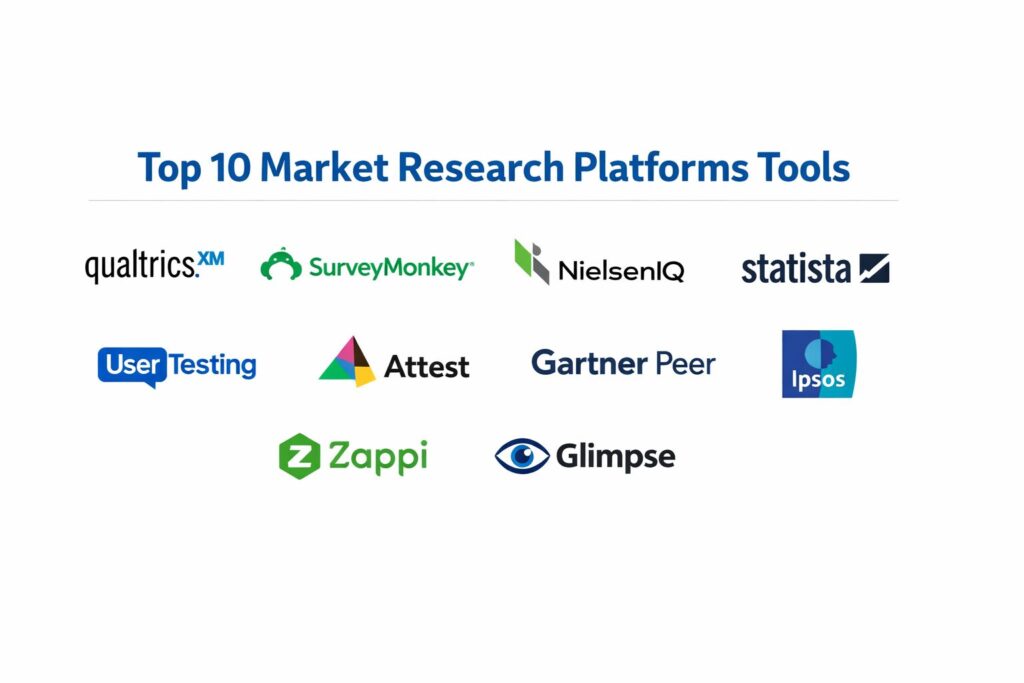
Introduction
Market research platforms have evolved from simple digital survey tools into sophisticated intelligence ecosystems that combine quantitative data, qualitative sentiment, and predictive modeling. In an era where consumer preferences shift with unprecedented speed, these platforms provide the “connective tissue” between a brand’s hypothesis and the reality of the marketplace. Unlike traditional consulting methods that take months to yield results, modern research technology allows organizations to tap into global respondent panels in real-time, providing an empirical basis for product development, brand positioning, and competitive strategy. For the modern enterprise, these systems are not merely data collectors; they are strategic navigation tools that reduce the risk of multi-million dollar business decisions.
The transition toward agile research has made it essential for platforms to offer high-speed data acquisition without compromising on the scientific rigor of the sample. Modern market research involves managing a complex flow of information—from longitudinal brand tracking and ad testing to ethnographic video feedback and automated sentiment analysis. As businesses face a “cookieless” future and stricter data privacy landscapes, the ability to collect first-party insights directly from a target audience has become a primary competitive differentiator. When evaluating these platforms, decision-makers must consider the breadth of the respondent pool, the sophistication of the automated analysis engine, the security of the data infrastructure, and the ease with which insights can be socialized across various departments.
Best for: Brand managers, product developers, UX researchers, and marketing executives who need validated consumer insights to drive innovation and ensure market fit for new initiatives.
Not ideal for: Organizations looking for basic internal employee polling without an external audience, or simple contact forms that do not require demographic targeting or statistical significance.
Key Trends in Market Research Platforms
Artificial Intelligence has fundamentally redefined the research lifecycle, moving from basic text categorization to full-scale “AI Co-pilots” that can draft scientifically sound survey questions and generate executive summaries from thousands of open-ended responses. We are seeing a significant rise in “synthetic respondents”—AI models trained on massive datasets that can predict how specific demographic segments might react to a concept before a single human is even surveyed. Real-time video research is also surging, as platforms now offer automated “highlight reels” where AI identifies key moments of emotional frustration or delight in user testing sessions, providing qualitative depth at quantitative speed.
Privacy-first research methodologies are now a core requirement rather than an optional feature, with platforms adopting zero-knowledge encryption and advanced anonymization to comply with global regulations. There is also a marked shift toward “Agile Insights,” where long, once-a-year brand health studies are being replaced by continuous, bite-sized “pulse” checks that allow for iterative adjustments to marketing campaigns. Furthermore, the integration of behavioral data with declared survey data is becoming more common, giving researchers a holistic view of what people say they will do versus what they actually do in digital environments.
How We Selected These Tools
Our selection process involved a rigorous evaluation of platform reliability and the quality of the underlying respondent ecosystems. We prioritized platforms that maintain a global reach with verified, high-quality panels to ensure that the data collected is representative and free from bot interference. A major criterion was “time-to-insight,” evaluating how quickly a platform can move from the initial research question to a finalized report. We looked for a balance between self-service flexibility for quick studies and deep, expert-level features for complex conjoint analysis or segmentation projects.
Scalability and integration were also critical factors; we selected platforms that can serve a single department while scaling to support a global organization’s entire research function. We scrutinized the depth of the built-in analytics suites, favoring those that provide automated statistical significance testing and advanced data visualization. Security certifications were heavily weighted, particularly for platforms handling sensitive consumer data across multiple jurisdictions. Finally, we assessed the total value proposition, including the cost of panel access and the quality of professional support services available to help users design and interpret their research effectively.
1. Qualtrics Strategy + Research
Qualtrics is an enterprise-grade experience management platform that sits at the top of the market for its sheer technical depth and sophisticated AI capabilities. It is designed for large organizations that require a unified system for complex market segmentation, product testing, and global brand tracking.
Key Features
The platform features “XM Directory,” a powerful system for managing a proprietary panel of respondents over time. It includes an AI-driven “Stats iQ” module that automatically performs complex statistical tests like regression and correlation analysis. The system offers advanced survey logic and randomization features that are essential for academic-grade research. It also provides a “Product Experience” suite specifically for conjoint analysis and MaxDiff studies. Additionally, its global audience service provides access to over 100 million respondents worldwide with granular targeting options.
Pros
The platform offers the most comprehensive set of analytical tools available in a SaaS format. It provides exceptional governance controls for large teams handling sensitive global data.
Cons
The pricing is significantly higher than most competitors and is typically geared toward large enterprise budgets. The interface has a steep learning curve for non-researchers.
Platforms and Deployment
Web-based SaaS with high-performance mobile apps for field research.
Security and Compliance
Industry leader with FedRAMP, SOC 2 Type II, ISO 27001, and HIPAA compliance.
Integrations and Ecosystem
Deep integrations with Salesforce, SAP, and various data visualization tools like Tableau.
Support and Community
Offers the “XM Academy” for professional certification and dedicated account management for enterprise clients.
2. SurveyMonkey (Momentive)
SurveyMonkey has transformed from a simple survey tool into a robust insights platform that balances extreme ease of use with professional-grade market research features. It is the go-to choice for teams that need to gather high-quality data quickly without a PhD in statistics.
Key Features
The platform features “SurveyMonkey Genius,” an AI assistant that scores survey quality and predicts completion rates before you launch. It includes “SurveyMonkey Audience,” a built-in panel of millions of respondents that can be targeted by demographics and interests. The system offers automated “Market Research Solutions” for concept testing and brand tracking that produce presentation-ready reports. It features a robust multilingual survey engine that automatically translates questions. It also includes advanced skip logic and piping features for a personalized respondent experience.
Pros
The interface is arguably the most intuitive in the industry, allowing anyone to launch a study in minutes. It offers excellent value for small to mid-sized teams needing fast feedback.
Cons
Some of the most advanced statistical features found in enterprise tools are missing. Customization options for branding and complex logic can be limited on lower tiers.
Platforms and Deployment
Web-based SaaS and highly rated mobile apps.
Security and Compliance
GDPR, HIPAA, and SOC 2 compliant, with robust encryption for data at rest and in transit.
Integrations and Ecosystem
Integrates with over 100 apps including Slack, Microsoft Teams, and HubSpot.
Support and Community
Provides extensive documentation and 24/7 email support, with priority phone support for enterprise users.
3. NielsenIQ (NIQ)
NielsenIQ is a global leader in retail and consumer intelligence, particularly for the Fast-Moving Consumer Goods (FMCG) sector. It provides a unique blend of “declared” survey data and “actual” purchase data from its massive global retail panels.
Key Features
The platform features “Consumer Intelligence,” which tracks actual purchase behavior across millions of households. It includes a robust “Innovation Suite” for testing new product concepts against historical success benchmarks. The system offers deep retail measurement services that track market share and distribution at the SKU level. It features advanced forecasting models that predict how a change in price or packaging will impact sales. The platform also provides specialized “Shopper Insights” to understand the path to purchase both online and in-store.
Pros
Provides access to real-world purchase data that surveys alone cannot capture. Its benchmarking data is considered the “gold standard” in the retail and consumer goods industries.
Cons
The platform is complex and often requires working with Nielsen analysts to get the most value. It is typically too expensive and specialized for non-retail organizations.
Platforms and Deployment
Enterprise cloud platform with specialized reporting interfaces.
Security and Compliance
Adheres to strict global data privacy standards and maintains enterprise-grade security for proprietary retail data.
Integrations and Ecosystem
Integrates with major retail supply chain and financial systems for a holistic view of performance.
Support and Community
Provides high-touch consulting and expert analyst support as part of its enterprise service model.
4. Statista
Statista is a unique market research platform that focuses on secondary research and data visualization. It acts as a massive global intelligence hub, consolidating data from thousands of sources into an easily searchable and digestible format.
Key Features
The platform features access to over 1 million statistics across 80,000 topics and 170 industries. It includes the “Global Consumer Survey,” a massive annual study that provides insights into consumer behavior and brand preferences worldwide. The system offers “Market Outlooks” that provide 5-year forecasts for thousands of product categories. It features a “Company Insights” tool for competitive analysis and benchmarking. Additionally, all data can be instantly exported into presentation-ready formats like PowerPoint, Excel, and PDF.
Pros
It is the fastest way to find validated market data and industry trends without running a primary study. The data visualization is exceptionally clean and ready for executive-level reports.
Cons
It is primarily a secondary research tool, meaning you cannot use it to run custom surveys with your own specific questions. Some data sources may have a slight lag.
Platforms and Deployment
Web-based platform accessible via browser.
Security and Compliance
Maintains high standards for data sourcing and is fully GDPR compliant.
Integrations and Ecosystem
Offers a specialized Google Chrome extension and various API options for enterprise data integration.
Support and Community
Provides a dedicated research desk to help users find specific data points and a comprehensive help center.
5. UserTesting
UserTesting is a specialized qualitative research platform that allows brands to see and hear how real people interact with their products, advertisements, or websites in real-time. It is the leader in “human insight” for UX and marketing teams.
Key Features
The platform features “Live Conversations,” allowing researchers to conduct 1-on-1 moderated interviews with target audiences. It includes “AI Insight Summary,” which automatically transcribes videos and identifies key themes and sentiments. The system offers a massive on-demand panel of respondents who record their screen and voice while completing tasks. It features “Test Templates” for various use cases like prototype testing or ad resonance. It also provides a “Mobile Recorder” for testing real-world experiences like unboxing a product.
Pros
Provides the “why” behind consumer behavior that quantitative surveys often miss. The speed of respondent recruitment is exceptionally fast, often providing results in under an hour.
Cons
The cost per respondent is higher than quantitative tools due to the video format. Managing large volumes of video data can be time-consuming without AI help.
Platforms and Deployment
Web-based SaaS with mobile recording apps for respondents.
Security and Compliance
SOC 2 Type II, GDPR, and HIPAA compliant, with advanced PII redaction features in videos.
Integrations and Ecosystem
Integrates with design and development tools like Figma, Jira, and Trello.
Support and Community
Offers “UserTesting University” and a dedicated professional services team for research design.
6. Attest
Attest is a modern consumer research platform designed for speed and “democratized” insights. It is built to help marketing and product teams run professional-grade research in-house without needing an external agency.
Key Features
The platform features a “Survey Builder” with built-in quality controls that flag biased or poorly worded questions. It includes access to a global audience of 125 million people across 58 markets with no hidden panel fees. The system offers an “Interactive Results” dashboard that allows for real-time filtering and cross-tabulation. It features automated “Brand Tracking” that monitors shifts in awareness and sentiment over time. It also provides a dedicated “Research Advice” team that reviews surveys before they go live.
Pros
The pricing model is transparent and offers high value for the quality of the audience. The platform is designed to be usable by non-researchers while still producing rigorous data.
Cons
The analytical tools are not as deep as enterprise-level systems like Qualtrics. It is primarily focused on quantitative research and lacks advanced qualitative tools.
Platforms and Deployment
Cloud-based SaaS.
Security and Compliance
ISO 27001 certified and fully compliant with GDPR and CCPA.
Integrations and Ecosystem
Provides a flexible API and integrations with various data and marketing platforms.
Support and Community
Known for having an exceptionally responsive “Customer Success” team and a rich library of research guides.
7. Gartner Peer Insights
Gartner Peer Insights is a specialized B2B market research platform that leverages the power of verified peer reviews to provide insights into the technology and services market. It is an essential tool for B2B buyers and product managers.
Key Features
The platform features a rigorous “Verification Process” that ensures every review comes from a real professional in a specific role. It includes “Voice of the Customer” reports that synthesize peer feedback into a comparative vendor landscape. The system offers deep demographic filtering, allowing users to see how companies of their specific size and industry view a product. It features “Lesson Learned” sections where users share actual implementation challenges. It also provides a “Market Compass” for navigating emerging technology categories.
Pros
Provides unbiased, professional-grade B2B insights that are difficult to find through traditional consumer surveys. It is an invaluable resource for vendor selection and competitive benchmarking.
Cons
It is strictly limited to B2B technology and services, making it irrelevant for consumer goods research. It relies on voluntary peer contributions which can vary in depth.
Platforms and Deployment
Web-based platform.
Security and Compliance
Maintains high standards for reviewer anonymity and data integrity, adhering to global privacy laws.
Integrations and Ecosystem
Part of the broader Gartner research ecosystem, providing links to analyst reports and Magic Quadrants.
Support and Community
Backed by Gartner’s global network of analysts and a massive community of IT and business professionals.
8. Ipsos (i-Say & KnowledgePanel)
Ipsos is one of the world’s most respected traditional market research firms, now offering a sophisticated digital platform that combines scientific sampling with modern data collection. It is the choice for high-stakes public opinion and strategic brand research.
Key Features
The platform features the “KnowledgePanel,” the oldest and largest probability-based online panel in the US, ensuring extremely high data accuracy. It includes a robust “Digital Diary” tool for longitudinal studies of consumer habits. The system offers specialized modules for “Media Measurement” and “Political Polling.” It features advanced AI analytics that cluster respondents into meaningful personas based on psychological drivers. It also provides a global dashboard for tracking cross-market sentiment in over 90 countries.
Pros
Offers the highest level of sampling rigor, making it suitable for academic or governmental research. The platform is backed by centuries of collective research expertise.
Cons
The digital interface can feel more formal and less “agile” than modern SaaS platforms. Projects often require more lead time due to the focus on data quality.
Platforms and Deployment
Web-based platform with specialized respondent portals.
Security and Compliance
Adheres to the highest international standards, including ISO 20252 and ISO 27001.
Integrations and Ecosystem
Designed for deep data export into specialized statistical software like SPSS and SAS.
Support and Community
Provides high-touch project management and expert consulting from world-class researchers.
9. Zappi
Zappi is an automated “ad and innovation” testing platform built specifically for high-growth brands. It focuses on providing rapid, standardized feedback on creative concepts and product ideas before they go to market.
Key Features
The platform features “Standardized Benchmarks,” allowing you to compare your results against industry averages or your own historical data. It includes an “Automated Reporting” engine that delivers a finalized analysis just hours after a study is launched. The system offers specialized tools for “Creative Testing” that measure emotional response and brand linkage. It features a “Global Audience” selector with pre-defined consumer segments. It also provides a “Strategic Guidance” layer where AI identifies the specific reasons a concept is failing or succeeding.
Pros
The speed of turnaround is exceptional, often providing full insights in under 24 hours. The focus on benchmarking makes it easy to explain results to non-technical stakeholders.
Cons
The standardized nature of the tests means you have less flexibility to ask highly unique or non-standard questions. It is less suited for broad, exploratory research.
Platforms and Deployment
Cloud-based SaaS.
Security and Compliance
Fully GDPR compliant with robust enterprise security for proprietary creative assets.
Integrations and Ecosystem
Strong integrations with marketing and project management tools used by creative agencies.
Support and Community
Offers a dedicated customer success model and a library of “Best Practice” guides for ad and product testing.
10. Glimpse
Glimpse is an AI-powered “trend and sentiment” platform that analyzes the digital conversation to identify emerging market opportunities. It is designed for researchers who need to understand the “signal” within the massive noise of the internet.
Key Features
The platform features “Search Volume Forecasting,” using AI to predict which trends will grow over the next 12 months. It includes “Sentiment Analysis” of millions of social media posts, reviews, and news articles. The system offers a “Topic Clustering” tool that identifies hidden connections between different consumer interests. It features real-time “Competitor Monitoring” to track shifts in brand perception compared to the market. It also provides an “AI Insight Generator” that writes brief summaries of why a specific trend is emerging.
Pros
It identifies trends months before they show up in traditional survey data. It is an excellent tool for front-end innovation and early-stage strategy development.
Cons
It analyzes existing digital behavior, meaning it cannot ask “what if” questions to a targeted group like a survey can. It requires some skill to filter out transient “fads” from real trends.
Platforms and Deployment
Web-based SaaS with browser-based extensions.
Security and Compliance
Utilizes aggregated, anonymous data and adheres to standard data privacy regulations.
Integrations and Ecosystem
Offers a powerful Google Sheets integration for automated data collection and analysis.
Support and Community
Provides a vibrant newsletter and educational content on trend analysis and signal processing.
Comparison Table
| Tool Name | Best For | Platform(s) Supported | Deployment | Standout Feature | Public Rating |
| 1. Qualtrics | Enterprise Strategy | Web, iOS, Android | Cloud SaaS | Stats iQ Analysis | 4.8/5 |
| 2. SurveyMonkey | Agile / Mid-Market | Web, iOS, Android | Cloud SaaS | AI Genius Assistant | 4.7/5 |
| 3. NielsenIQ | Retail / FMCG | Web-Based | Enterprise Cloud | Actual Purchase Data | 4.5/5 |
| 4. Statista | Secondary Research | Web-Based | Cloud Portal | 1M+ Data Points | 4.8/5 |
| 5. UserTesting | Qualitative / UX | Web, iOS, Android | Cloud SaaS | AI Video Highlights | 4.6/5 |
| 6. Attest | Consumer Direct | Web-Based | Cloud SaaS | 125M Global Audience | 4.7/5 |
| 7. Gartner Peer | B2B Technology | Web-Based | Web Platform | Verified Peer Reviews | 4.7/5 |
| 8. Ipsos | Strategic Rigor | Web-Based | Hybrid | KnowledgePanel Sampling | 4.4/5 |
| 9. Zappi | Ad / Innovation Test | Web-Based | Cloud SaaS | Industry Benchmarking | 4.6/5 |
| 10. Glimpse | Trend Forecasting | Web-Based | Cloud SaaS | AI Search Prediction | 4.7/5 |
Evaluation & Scoring of Market Research Platforms
The scoring below is a comparative model intended to help shortlisting. Each criterion is scored from 1–10, then a weighted total from 0–10 is calculated using the weights listed. These are analyst estimates based on typical fit and common workflow requirements, not public ratings.
Weights:
- Core features – 25%
- Ease of use – 15%
- Integrations & ecosystem – 15%
- Security & compliance – 10%
- Performance & reliability – 10%
- Support & community – 10%
- Price / value – 15%
| Tool Name | Core (25%) | Ease (15%) | Integrations (15%) | Security (10%) | Performance (10%) | Support (10%) | Value (15%) | Weighted Total |
| 1. Qualtrics | 10 | 4 | 10 | 10 | 9 | 9 | 6 | 8.35 |
| 2. SurveyMonkey | 8 | 10 | 9 | 9 | 9 | 9 | 9 | 8.80 |
| 3. NielsenIQ | 10 | 5 | 8 | 9 | 8 | 8 | 6 | 7.85 |
| 4. Statista | 9 | 9 | 7 | 8 | 9 | 8 | 9 | 8.45 |
| 5. UserTesting | 9 | 8 | 8 | 9 | 9 | 9 | 7 | 8.40 |
| 6. Attest | 8 | 9 | 8 | 9 | 9 | 10 | 9 | 8.65 |
| 7. Gartner Peer | 7 | 9 | 6 | 8 | 8 | 7 | 10 | 7.75 |
| 8. Ipsos | 10 | 4 | 7 | 9 | 8 | 9 | 7 | 7.90 |
| 9. Zappi | 8 | 8 | 7 | 9 | 9 | 8 | 8 | 8.10 |
| 10. Glimpse | 7 | 8 | 8 | 8 | 9 | 8 | 8 | 7.75 |
How to interpret the scores:
- Use the weighted total to shortlist candidates, then validate with a pilot.
- A lower score can mean specialization, not weakness.
- Security and compliance scores reflect controllability and governance fit, because certifications are often not publicly stated.
- Actual outcomes vary with assembly size, team skills, templates, and process maturity.
Which Market Research Platform Tool Is Right for You?
Solo / Founder-Led
For independent consultants or solo founders, the priority is high-speed data at a manageable cost. You need a platform that provides a “do-it-for-me” experience with pre-built templates and a built-in audience. Look for tools that allow you to pay per study rather than requiring a massive annual contract, ensuring that your research budget aligns with your immediate project needs.
Small Nonprofit
Organizations with limited resources should prioritize secondary research and simple, intuitive feedback tools. Accessing existing data libraries can provide the necessary market context for grant applications or donor reports without the expense of a custom study. When primary research is needed, a platform that prioritizes mobile-first, short-form surveys will ensure higher response rates from busy community members.
Mid-Market
Mid-sized companies should focus on brand tracking and concept validation. As you grow, you need to move beyond “gut feeling” and toward data-backed decisions. Platforms that offer automated benchmarking and AI-driven sentiment analysis will allow your marketing team to act as a sophisticated research department without the need for specialized data scientists.
Enterprise
Large organizations require a unified “Experience Management” strategy. This means selecting a platform that can handle complex data governance, multi-language support, and deep integrations with existing CRM and financial systems. The ability to manage proprietary respondent panels and perform advanced statistical modeling is essential for maintaining a global competitive edge and ensuring data sovereignty.
Budget vs Premium
Budget-conscious teams should leverage secondary research hubs or “agile” platforms that offer pay-as-you-go pricing. While these may lack the depth of custom statistical modeling, they provide more than enough data for standard marketing decisions. Premium platforms, conversely, offer “human-in-the-loop” expert support and proprietary panels that provide the highest level of data accuracy for high-stakes strategic shifts.
Feature Depth vs Ease of Use
If your team consists of trained researchers, a platform with infinite customization and deep coding capabilities is a major asset. However, if your goal is to empower product managers and designers to run their own quick tests, a simplified interface with “guardrails” is much more valuable to prevent the collection of biased or inaccurate data.
Integrations & Scalability
A market research tool is most powerful when it doesn’t live in a silo. Ensure the platform can push data into your visualization tools like Tableau or Power BI and pull customer segments from your CRM. Long-term technical health depends on selecting a tool that can grow from small-scale polling to an enterprise-wide insights engine.
Security & Compliance Needs
For organizations in regulated industries like healthcare or finance, security is the first checkbox. You must select a platform that offers the specific certifications required for your sector and region. The ability to redact PII automatically and manage data residency is not just a technical feature; it is a legal requirement for modern global operations.
Frequently Asked Questions (FAQs)
1. What is the difference between primary and secondary research?
Primary research involves collecting new, original data specifically for your project, such as through surveys or interviews. Secondary research involves analyzing existing data that has already been collected by others, such as industry reports, census data, or historical statistics.
2. How do I know if a survey sample is representative?
A representative sample matches the characteristics of your target population in terms of age, gender, location, and other key demographics. Modern platforms use “quotas” to ensure that the respondents reflect the larger group you are trying to understand.
3. Is it possible to conduct research in multiple languages?
Yes, professional market research platforms offer multilingual engines that allow you to program a single survey in multiple languages. Some platforms even offer AI-powered translation to speed up the setup process for global studies.
4. What is conjoint analysis and when should I use it?
Conjoint analysis is a statistical technique used to determine how people value different features of a product. It is best used when you need to make trade-offs, such as determining if customers prefer a lower price or a longer warranty.
5. How long does it take to get results from an online panel?
For standard demographic targeting, many platforms can provide hundreds of responses in just a few hours. More specialized B2B targeting or niche consumer segments may take several days to reach the desired sample size.
6. Can I use my own list of customers for research?
Almost all modern research platforms allow you to upload your own contact lists or embed a survey link on your website. This is often referred to as “first-party” research and is a cost-effective way to get feedback from existing supporters.
7. Is AI in market research reliable?
AI is exceptionally good at identifying themes and patterns in large amounts of text data, which would take humans days to analyze. However, it should be used as a “co-pilot” rather than a total replacement for human judgment in strategic decision-making.
8. What are “soft credits” in a market research context?
In broader CRM or relationship management, soft credits refer to recognizing an individual’s influence on a gift or transaction. In research, a similar concept is “influence tracking,” where you measure how one person’s opinion shifts the behavior of a larger group.
9. Why do some platforms charge per respondent?
Accessing a verified panel of real people requires significant investment in recruitment and incentives. Charging per respondent allows the platform to cover the cost of maintaining a high-quality, fraud-free audience for your specific study.
10. Do I need a specialized degree to use these platforms?
While a background in research or statistics is helpful for complex studies, many modern “Agile” platforms are designed with intuitive builders and automated analysis that make professional-grade research accessible to marketing and product professionals.
Conclusion
In a global economy defined by rapid digital transformation and shifting consumer values, a robust market research platform is the primary tool for organizational resilience. These systems have matured from simple data-gathering utilities into intelligent partners capable of predicting trends and validating multi-million dollar innovations. By centralizing consumer insights, organizations can move away from reactive decision-making and toward a proactive, “human-centric” strategy that ensures long-term market relevance. The ideal platform is one that not only provides the technical depth to answer complex questions but also the operational speed to keep pace with the modern market’s velocity.