Introduction
A Manufacturing Execution System (MES) is the software layer that sits between planning systems and the factory floor. It helps manufacturers track, control, and optimize production in real time by managing work orders, materials, machines, operators, and quality events. In simple terms, MES tells you what is happening in production right now, what should happen next, and what must be recorded for traceability. It matters because factories are under pressure to reduce scrap, improve delivery performance, increase uptime, and meet strict customer and regulatory requirements. When MES is done well, you get fewer surprises, faster decisions, and a more stable production output.
Common use cases include tracking production and downtime, enforcing standard work instructions, capturing genealogy and lot traceability, managing quality checks and deviations, and connecting machines for real-time performance monitoring. When selecting MES, buyers should evaluate production scheduling support, traceability depth, quality workflows, integration with ERP and shop-floor equipment, scalability across plants, reporting and analytics, role-based access control, implementation complexity, vendor support strength, and total cost of ownership.
Best for: discrete and process manufacturers, multi-site plants, regulated industries, and teams that need real-time visibility, traceability, and quality enforcement.
Not ideal for: very small workshops that only need simple job tracking, or teams looking only for high-level planning where ERP alone is sufficient.
Key Trends in Manufacturing Execution Systems (MES)
- Wider adoption of connected shop floors using industrial connectivity and data collection standards.
- Increased focus on end-to-end traceability, genealogy, and audit-ready digital records.
- More configurable workflows to reduce custom code and speed plant rollouts.
- Growing use of advanced analytics for downtime, yield, and quality root-cause analysis.
- Stronger alignment between MES and real-time production scheduling to reduce changeover waste.
- Expanding support for multi-site templates, centralized governance, and local flexibility.
- Security expectations rising, with stronger access controls and plant network segmentation practices.
- Better integration patterns with ERP, PLM, QMS, and industrial automation systems.
- More emphasis on operator experience, guided work instructions, and digital checklists.
- Scaling “paperless manufacturing” programs beyond pilots into full plant adoption.
How We Selected These Tools (Methodology)
- Chosen for credibility and adoption across major manufacturing segments.
- Selected to cover both discrete and process manufacturing needs.
- Evaluated for core MES capabilities: execution, traceability, quality, and performance.
- Considered integration depth with ERP, automation platforms, and plant systems.
- Included tools that scale well across multiple plants with governance and templates.
- Prioritized vendors with strong support ecosystems and implementation partners.
- Balanced enterprise leaders with modern MES specialists that perform strongly in production.
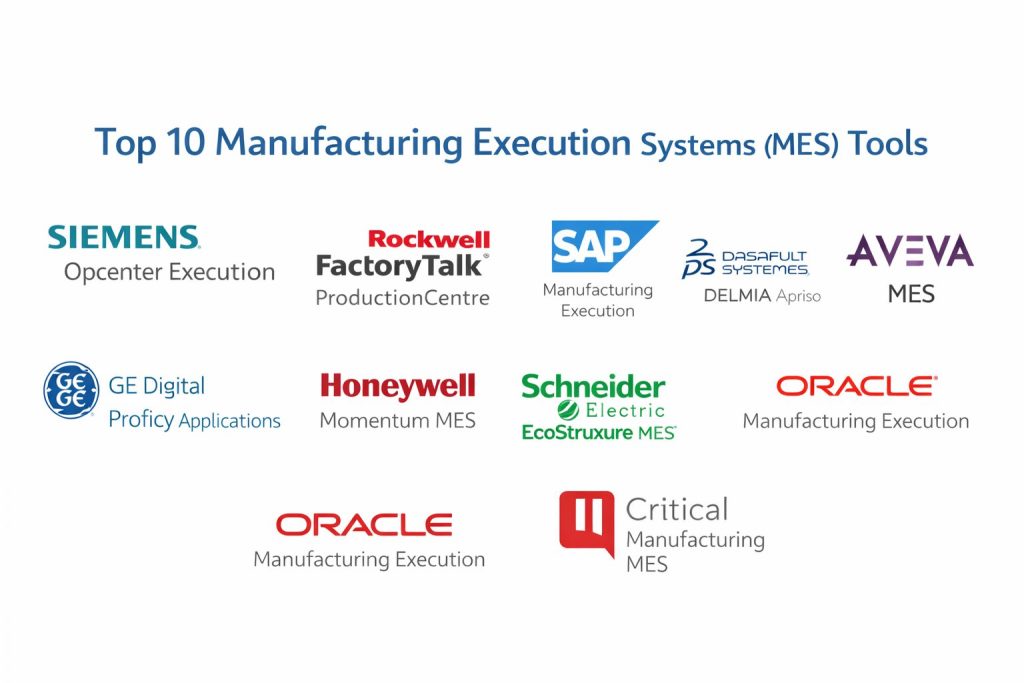
Top 10 Manufacturing Execution Systems (MES) Tools
1 — Siemens Opcenter Execution
A full-feature MES suite built for real-time production execution, traceability, and quality enforcement, often used in complex multi-plant environments.
Key Features
- Work order execution and shop-floor control
- Product genealogy, lot tracking, and traceability records
- Quality checks, deviation workflows, and hold management
- Operator guidance with digital instructions and confirmations
- Integration patterns for ERP and plant connectivity
Pros
- Strong execution and traceability depth for complex operations
- Scales well in multi-site standardization programs
Cons
- Implementation can be complex without strong process alignment
- Configuration and data modeling need careful governance
Platforms / Deployment
Varies / N/A
Security and Compliance
Not publicly stated
Integrations and Ecosystem
Commonly used with ERP, automation, and reporting layers where consistent data exchange is required.
- ERP integration for orders and inventory movements
- Plant connectivity through automation and middleware patterns
- Analytics connections for OEE, quality, and downtime insights
Support and Community
Enterprise support options and partner ecosystem strength varies by region and contract.
2 — Rockwell FactoryTalk ProductionCentre
An MES platform aligned closely with industrial automation environments, designed to manage execution, quality, and production data collection.
Key Features
- Execution workflows for production and operations tracking
- Data collection from machines and operators
- Quality inspection and non-conformance management
- Performance metrics and production reporting
- Strong alignment with automation-oriented environments
Pros
- Strong fit for plants standardized on automation ecosystems
- Solid operational visibility and reporting capabilities
Cons
- Complex rollouts can require experienced implementation resources
- Some advanced workflows may need careful configuration
Platforms / Deployment
Varies / N/A
Security and Compliance
Not publicly stated
Integrations and Ecosystem
Often chosen for factories where automation integration and shop-floor connectivity are critical.
- Connectivity patterns to shop-floor systems
- Integration with planning and reporting layers
- Partner ecosystem for plant-scale deployments
Support and Community
Strong industrial user base; support levels depend on enterprise plan and partners.
3 — SAP Manufacturing Execution
An MES approach that fits organizations that prioritize tight alignment with ERP and standardized production processes across sites.
Key Features
- Execution and confirmation of shop-floor activities
- Integration-friendly workflows aligned to business processes
- Quality checks and production documentation support
- Visibility into production status and exceptions
- Strong fit for standardized corporate reporting needs
Pros
- Good alignment when SAP-based business processes are central
- Strong governance and standardization potential
Cons
- Can be heavy for plants needing rapid, flexible workflows
- Implementation depends strongly on master data quality
Platforms / Deployment
Varies / N/A
Security and Compliance
Not publicly stated
Integrations and Ecosystem
Typically adopted where ERP alignment and enterprise governance are priorities.
- ERP-driven work orders and confirmations
- Integration patterns across finance, inventory, and procurement
- Reporting alignment with enterprise analytics structures
Support and Community
Large enterprise community and integrator ecosystem; support tiers vary.
4 — Dassault Systèmes DELMIA Apriso
A manufacturing operations platform used for execution, quality, traceability, and global standardization across many plants.
Key Features
- Production execution with configurable workflows
- Traceability, genealogy, and compliance-oriented records
- Quality management workflows and exception handling
- Multi-site templates and standardized deployment patterns
- Visibility across plants with consistent operational KPIs
Pros
- Strong multi-plant standardization capability
- Good depth for regulated and traceability-heavy industries
Cons
- Requires disciplined governance to avoid workflow sprawl
- Implementation complexity can be significant at scale
Platforms / Deployment
Varies / N/A
Security and Compliance
Not publicly stated
Integrations and Ecosystem
Often used in environments requiring strong operational governance and cross-site visibility.
- Integration with ERP for orders and inventory synchronization
- Links to PLM and quality processes depending on strategy
- Partner ecosystem for global rollouts
Support and Community
Enterprise-grade support typically available; partner strength depends on region.
5 — AVEVA MES
A MES approach frequently used in process and hybrid manufacturing, focusing on execution, performance tracking, and production visibility.
Key Features
- Production execution workflows and shift reporting
- Performance tracking and production analytics
- Quality checks and production event management
- Integration support for plant connectivity and reporting
- Practical support for continuous improvement programs
Pros
- Strong for production visibility and operational performance focus
- Good fit in process-oriented environments
Cons
- Feature fit varies by industry needs and module choices
- Implementation outcomes depend on standardization discipline
Platforms / Deployment
Varies / N/A
Security and Compliance
Not publicly stated
Integrations and Ecosystem
Often integrated with plant data systems, reporting tools, and enterprise planning layers.
- Plant connectivity and data capture patterns
- Reporting integration for OEE and performance dashboards
- Workflow integration with quality and maintenance programs
Support and Community
Support tiers vary; partner and integrator availability depends on region.
6 — GE Digital Proficy Plant Applications
A MES platform known for tracking production performance, downtime, and quality events with strong operational analytics emphasis.
Key Features
- OEE tracking and downtime analysis
- Production data collection and event management
- Quality workflows and scrap tracking
- Shift and line reporting for supervisors
- Practical visibility for continuous improvement teams
Pros
- Strong focus on performance monitoring and actionable analytics
- Useful for rapid visibility into downtime and yield issues
Cons
- Execution depth may vary by implementation approach
- Requires good data discipline to keep metrics trustworthy
Platforms / Deployment
Varies / N/A
Security and Compliance
Not publicly stated
Integrations and Ecosystem
Commonly used to connect shop-floor performance data with operations and reporting workflows.
- Data capture from machines and operator stations
- Integration to reporting and analytics layers
- Connection patterns to planning and maintenance processes
Support and Community
Established industrial user base; support depends on plan and services.
7 — Honeywell Momentum MES
A MES designed for manufacturing operations management, with strong relevance in regulated and traceability-driven environments.
Key Features
- Execution workflows for manufacturing operations
- Electronic batch records and process documentation support
- Quality events, deviations, and corrective workflows
- Traceability, genealogy, and audit-ready recordkeeping
- Operational reporting for production and compliance teams
Pros
- Strong fit for regulated operations needing strict records
- Helps enforce standard work and controlled processes
Cons
- Configuration needs careful governance to stay consistent
- Rollout complexity can be higher in multi-site environments
Platforms / Deployment
Varies / N/A
Security and Compliance
Not publicly stated
Integrations and Ecosystem
Often selected where compliance records, traceability, and operational discipline are key goals.
- Integration with enterprise planning and quality layers
- Connection patterns for production data capture
- Support for structured operational governance
Support and Community
Enterprise support available; community visibility varies by industry.
8 — Schneider Electric EcoStruxure MES
A MES approach aligned to connected operations, focusing on execution, visibility, and integration with industrial systems.
Key Features
- Production execution and shop-floor workflows
- Performance and production reporting
- Quality checks and exception tracking
- Connectivity patterns for industrial systems integration
- Support for multi-site standardization approaches
Pros
- Strong fit in connected operations environments
- Practical for plants seeking standardized execution visibility
Cons
- Feature coverage depends on chosen modules and architecture
- Implementation outcomes vary with integration complexity
Platforms / Deployment
Varies / N/A
Security and Compliance
Not publicly stated
Integrations and Ecosystem
Often used where connectivity, plant visibility, and operational standardization are priorities.
- Integration with planning and reporting layers
- Connectivity patterns for shop-floor data capture
- Partner support for plant implementations
Support and Community
Support tiers vary; partner ecosystem depends on region.
9 — Oracle Manufacturing Execution
A MES-aligned option for organizations that want execution workflows connected closely to broader enterprise operations.
Key Features
- Work order execution and production confirmations
- Quality checkpoints and exception tracking
- Traceability and production record capture patterns
- Reporting for production status and throughput
- Alignment with enterprise process governance needs
Pros
- Strong for organizations standardized on Oracle ecosystems
- Useful for enterprise reporting consistency and process control
Cons
- Fit depends strongly on enterprise architecture choices
- Plant flexibility can vary depending on configuration approach
Platforms / Deployment
Varies / N/A
Security and Compliance
Not publicly stated
Integrations and Ecosystem
Often implemented where broader enterprise process integration is a key goal.
- Integration with planning and inventory processes
- Reporting alignment with enterprise analytics
- Ecosystem fit depends on existing enterprise stack
Support and Community
Enterprise support available; implementation partners vary by region.
10 — Critical Manufacturing MES
A modern MES platform often recognized for flexibility, configurability, and strong fit for complex, high-mix manufacturing.
Key Features
- Configurable workflows for execution and routing control
- Traceability and genealogy suited for complex production
- Quality controls and exception management
- Operational dashboards and performance visibility
- Multi-site rollouts supported through templates and governance
Pros
- Strong fit for high-mix, complex manufacturing environments
- Good balance of depth and configurability
Cons
- Implementation still requires process clarity and governance
- Feature fit varies by industry and required modules
Platforms / Deployment
Varies / N/A
Security and Compliance
Not publicly stated
Integrations and Ecosystem
Often adopted where flexible execution and strong traceability are required, with integration as a core project focus.
- Integration to ERP for orders and materials movements
- Connectivity patterns for shop-floor equipment and data capture
- Extension options depend on deployment architecture
Support and Community
Strong enterprise focus; support levels vary by contract and region.
Comparison Table
| Tool Name | Best For | Platform(s) Supported | Deployment | Standout Feature | Public Rating |
|---|---|---|---|---|---|
| Siemens Opcenter Execution | Multi-site execution and traceability | Varies / N/A | Varies / N/A | Deep traceability and execution control | N/A |
| Rockwell FactoryTalk ProductionCentre | Automation-aligned shop-floor execution | Varies / N/A | Varies / N/A | Strong shop-floor integration patterns | N/A |
| SAP Manufacturing Execution | ERP-aligned execution governance | Varies / N/A | Varies / N/A | Standardization with enterprise processes | N/A |
| Dassault Systèmes DELMIA Apriso | Global MES standardization | Varies / N/A | Varies / N/A | Multi-site templates and governance | N/A |
| AVEVA MES | Process and hybrid manufacturing visibility | Varies / N/A | Varies / N/A | Production performance and visibility | N/A |
| GE Digital Proficy Plant Applications | OEE and downtime analytics | Varies / N/A | Varies / N/A | Strong performance monitoring focus | N/A |
| Honeywell Momentum MES | Regulated operations and controlled workflows | Varies / N/A | Varies / N/A | Compliance-ready operational recordkeeping | N/A |
| Schneider Electric EcoStruxure MES | Connected operations execution visibility | Varies / N/A | Varies / N/A | Integrated connected operations approach | N/A |
| Oracle Manufacturing Execution | Enterprise-aligned execution workflows | Varies / N/A | Varies / N/A | Enterprise process alignment | N/A |
| Critical Manufacturing MES | High-mix, traceability-heavy manufacturing | Varies / N/A | Varies / N/A | Flexible execution with strong traceability | N/A |
Evaluation and Scoring of Manufacturing Execution Systems (MES)
Weights
Core features 25 percent
Ease of use 15 percent
Integrations and ecosystem 15 percent
Security and compliance 10 percent
Performance and reliability 10 percent
Support and community 10 percent
Price and value 15 percent
| Tool Name | Core | Ease | Integrations | Security | Performance | Support | Value | Weighted Total |
|---|---|---|---|---|---|---|---|---|
| Siemens Opcenter Execution | 9.0 | 7.0 | 8.5 | 6.5 | 8.0 | 7.5 | 6.5 | 7.78 |
| Rockwell FactoryTalk ProductionCentre | 8.5 | 7.0 | 8.5 | 6.5 | 8.0 | 7.5 | 6.5 | 7.65 |
| SAP Manufacturing Execution | 8.5 | 6.5 | 8.0 | 6.5 | 7.5 | 7.5 | 6.0 | 7.38 |
| Dassault Systèmes DELMIA Apriso | 8.5 | 6.5 | 8.0 | 6.5 | 7.5 | 7.5 | 6.0 | 7.38 |
| AVEVA MES | 8.0 | 7.0 | 7.5 | 6.0 | 7.5 | 7.0 | 6.5 | 7.20 |
| GE Digital Proficy Plant Applications | 7.5 | 7.5 | 7.5 | 6.0 | 7.5 | 7.0 | 7.0 | 7.28 |
| Honeywell Momentum MES | 8.0 | 6.5 | 7.5 | 6.5 | 7.5 | 7.0 | 6.5 | 7.18 |
| Schneider Electric EcoStruxure MES | 7.5 | 7.0 | 7.5 | 6.0 | 7.5 | 7.0 | 6.5 | 7.05 |
| Oracle Manufacturing Execution | 7.5 | 6.5 | 7.5 | 6.0 | 7.0 | 7.0 | 6.5 | 6.93 |
| Critical Manufacturing MES | 8.5 | 7.0 | 8.0 | 6.5 | 7.5 | 7.0 | 6.5 | 7.43 |
How to interpret the scores
These scores are comparative and intended for shortlisting, not declaring a single winner. A tool with a slightly lower total can still be the best choice if it matches your manufacturing type, traceability needs, and integration priorities. Core features and integrations usually drive long-term fit, while ease of use impacts adoption speed on the shop floor. Security and compliance should be validated directly with vendors and your IT team because public details are often limited. Use the scores to narrow to two or three options and run a structured pilot.
Which Manufacturing Execution Systems (MES) Tool Is Right for You
Solo or Small Plant Team
If you have one plant and need fast operational visibility, start with a platform that can deliver quick wins in downtime tracking, quality events, and digital reporting. Focus on rapid deployment, operator usability, and clear reporting rather than complex global templates. In many cases, selecting a tool with strong local implementation support matters more than feature lists.
SMB
SMBs should prioritize practical execution, traceability that matches customer requirements, and integrations that do not become long custom projects. Choose a tool that supports your production style, provides configurable workflows, and has proven deployment approaches. Strong onboarding and training materials are key for operator adoption.
Mid-Market
Mid-market manufacturers usually need repeatable rollouts, consistent templates, and governance across lines or multiple plants. Look for tools that can standardize work order execution and quality workflows while allowing plant-level flexibility. Integration with ERP and reliable shop-floor data capture become essential at this stage.
Enterprise
Enterprises typically prioritize global standardization, strong traceability and audit readiness, and strong integration patterns across ERP, quality, maintenance, and analytics. Choose a platform that supports multi-site templates, centralized governance, and scalable operations reporting. Also prioritize vendor support strength and partner availability.
Budget vs Premium
Budget-focused programs should aim for strong execution and visibility with limited customization, then expand. Premium programs can invest in deeper traceability, broader integration, and multi-plant governance from the start, but must manage complexity carefully.
Feature Depth vs Ease of Use
If your shop-floor teams need fast adoption, choose a solution known for configurable workflows and strong operator experience. If your manufacturing is complex and regulated, prioritize feature depth and traceability even if training takes longer.
Integrations and Scalability
If you expect to connect MES with ERP, PLM, quality systems, and shop-floor automation, test integration patterns early. Scalability is less about raw features and more about templates, governance, master data discipline, and consistent rollout playbooks.
Security and Compliance Needs
MES often touches sensitive production data and quality records, so access control, auditing, and strong identity practices matter. Where public security details are limited, treat them as not publicly stated and validate directly. Ensure your IT team reviews plant network segmentation and device-level access practices.
Frequently Asked Questions
1. What does MES do that ERP does not
ERP plans and records business-level transactions, while MES runs and records what actually happens on the shop floor in real time. MES captures execution, quality events, and traceability at the operation level.
2. How long does MES implementation usually take
It varies widely based on scope, number of lines, integrations, and data readiness. A focused pilot can start small and expand, while multi-plant programs take longer due to governance and standardization.
3. What are the most common MES use cases to start with
Many teams start with production tracking, downtime reasons, quality checks, and traceability records. These create quick visibility and help stabilize processes before broader rollout.
4. What data must be clean before MES goes live
Work centers, routings, bills of materials, product definitions, and operator roles must be consistent. Poor master data leads to unreliable execution and inaccurate reporting.
5. How do you ensure operator adoption
Keep screens simple, enforce standard work, and train in short sessions. Also include supervisors early, because they drive daily habits and compliance on the floor.
6. How does MES support traceability and genealogy
MES captures what materials went into which lot or unit, which machines and operators were involved, and which quality checks were performed. This is crucial for recalls, audits, and customer compliance.
7. Can MES work without full machine connectivity
Yes. Many MES programs begin with operator input and manual data collection, then add machine connectivity over time. The key is consistent processes and clear accountability.
8. What are common mistakes when choosing an MES
Choosing based only on brand, skipping a pilot, underestimating integration complexity, and ignoring operator usability. Another mistake is adding too much customization early and losing standardization.
9. How do you measure MES success after go-live
Track improvements in OEE, scrap reduction, downtime reduction, schedule adherence, quality escapes, and faster investigation times. Also measure adoption metrics like completion rates and data accuracy.
10. How do you shortlist MES vendors effectively
Pick two or three options, run a pilot on a real line, test traceability and quality workflows, and validate integration needs early. Select the tool that performs best with your real constraints, not a demo scenario.
Conclusion
Manufacturing Execution Systems improve production control by making shop-floor work visible, measurable, and consistent. The right MES helps you execute orders reliably, capture traceability, enforce quality checks, reduce downtime, and support continuous improvement. However, the best MES is not the one with the longest feature list. It is the one that fits your manufacturing type, works with your master data maturity, integrates cleanly with ERP and shop-floor systems, and can be adopted by operators without friction. A practical next step is to shortlist two or three MES tools, define a tight pilot scope on one production line, validate traceability and quality workflows, test integration needs, and confirm rollout governance before scaling across plants.