Introduction
Machine learning platforms help teams build, train, deploy, and monitor machine learning models in a structured and repeatable way. Instead of stitching together many separate tools for data prep, experimentation, training, deployment, and governance, a platform brings these steps into one managed workflow. This matters because ML work is no longer limited to research teams. Today, product teams and business units want models in production that are reliable, explainable, cost-aware, and easy to update.
Real-world use cases include churn prediction in subscription businesses, fraud detection in payments, demand forecasting in retail and supply chain, personalized recommendations in apps, and automated document understanding in support or finance. When choosing a platform, evaluate data integration flexibility, experiment tracking, training scalability, deployment options, monitoring and drift detection, feature management, model governance, security controls, collaboration workflows, cost management, and vendor ecosystem fit.
Best for: data science teams, ML engineers, analytics leaders, and product teams that need repeatable ML delivery from idea to production.
Not ideal for: teams doing only small experiments or simple spreadsheet-based analytics where full platform setup adds overhead.
Key Trends in Machine Learning Platforms
- Unified workflows are replacing tool sprawl by combining notebooks, pipelines, registries, and monitoring in one place.
- Managed feature engineering and feature stores are becoming standard for reusable, production-grade ML.
- Automated ML is shifting from “quick models” to “guided automation” with stronger governance and control.
- Model monitoring is expanding beyond uptime into drift, bias signals, and data quality validation.
- Batch, real-time, and streaming deployment patterns are being supported together within the same platform.
- Cost governance is becoming a first-class feature as training and inference bills grow fast.
- Security expectations are rising, especially around access control, auditability, and sensitive data handling.
- Integration depth is becoming a differentiator, especially with data warehouses, lakehouses, and event systems.
How We Selected These Tools (Methodology)
- Chosen for strong adoption and credibility across enterprise and fast-growing teams.
- Selected platforms that cover end-to-end workflows from experiments to deployment and monitoring.
- Balanced cloud-managed services with open, flexible platform options.
- Prioritized platforms with strong ecosystem integrations and extensibility.
- Considered platform scalability for training, pipelines, and multi-team collaboration.
- Evaluated operational readiness features such as registries, governance, and reproducibility.
- Included both low-code friendly platforms and engineering-first platforms for variety of team styles.
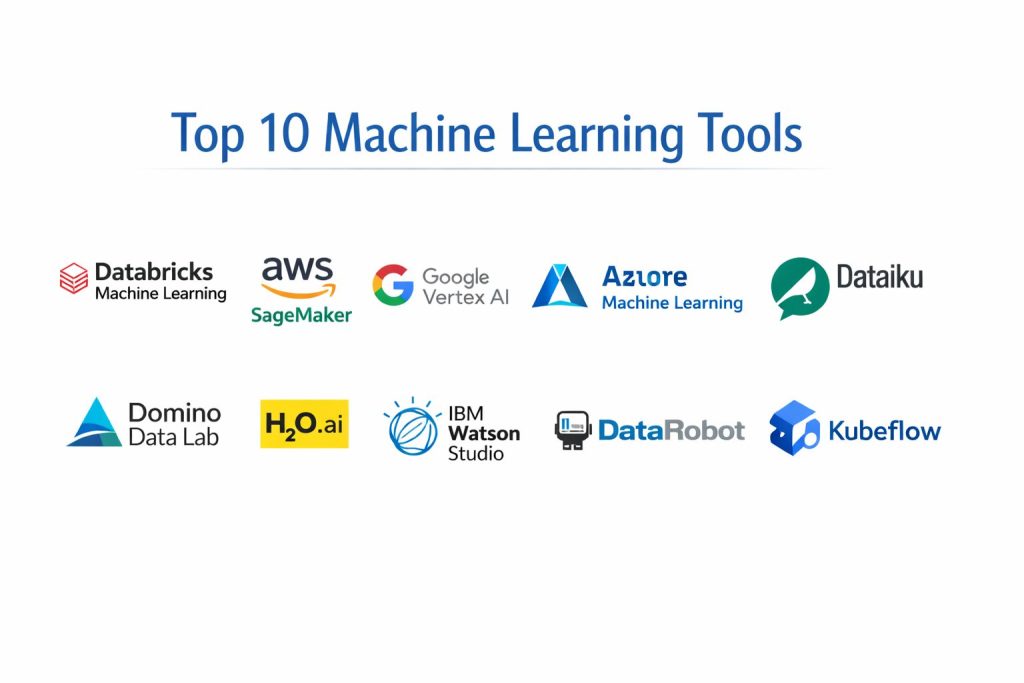
Top 10 Machine Learning Platforms Tools
1 — Databricks Machine Learning
A platform built around a lakehouse approach that supports ML experimentation, scalable training, model packaging, and production workflows for teams working on large datasets.
Key Features
- Integrated environment for data, analytics, and ML workflows
- Experiment tracking and model lifecycle management
- Scalable training with distributed compute patterns
- Collaboration features for teams working on shared data assets
- Strong workflow orchestration patterns for production ML
Pros
- Strong for teams combining data engineering and ML delivery
- Scales well for large data and multi-team workflows
Cons
- Platform complexity can require governance and standards
- Cost management needs discipline as usage scales
Platforms / Deployment
Cloud, Self-hosted options vary / Not publicly stated
Security and Compliance
Not publicly stated
Integrations and Ecosystem
Often fits best when your organization uses lakehouse-style data workflows and wants ML close to the data layer.
- Common integrations with data storage and processing stacks
- APIs and tooling for automation and deployment workflows
- Ecosystem fit depends on chosen cloud and data architecture
Support and Community
Strong adoption and community awareness; support depends on plan.
2 — AWS SageMaker
A managed ML service designed to support data preparation, training, deployment, and governance workflows with deep integration into the broader AWS ecosystem.
Key Features
- Managed training jobs and scalable model hosting
- Built-in tools for experiments and model management
- Deployment patterns for batch and real-time inference
- Workflow orchestration patterns for production ML
- Strong integration with AWS security and access controls
Pros
- Strong ecosystem fit for AWS-native organizations
- Scales well from prototypes to production workloads
Cons
- Can feel complex for small teams without ML ops maturity
- Cost can grow quickly without guardrails
Platforms / Deployment
Cloud
Security and Compliance
Not publicly stated
Integrations and Ecosystem
SageMaker is often chosen when AWS is already the core infrastructure for data, apps, and security controls.
- Tight integration with AWS services and data stores
- Automation patterns for CI style workflows vary by team
- Broad partner ecosystem for ML tooling
Support and Community
Large user base; support tiers vary.
3 — Google Vertex AI
A managed ML platform focused on the full ML lifecycle, including training, deployment, pipelines, and model governance, aligned with Google Cloud services.
Key Features
- Managed pipelines for reproducible training and deployment
- Model registry and lifecycle management workflows
- Support for multiple training and serving patterns
- Strong integration with Google data and analytics services
- Tools for monitoring and operational tracking patterns
Pros
- Strong for teams using Google Cloud data services
- Good structure for pipeline-driven ML delivery
Cons
- Learning curve for teams new to cloud-native ML workflows
- Ecosystem fit is strongest when committed to Google Cloud
Platforms / Deployment
Cloud
Security and Compliance
Not publicly stated
Integrations and Ecosystem
Vertex AI typically fits teams already using Google’s data and analytics stack for pipelines and governance.
- Integrations with Google data services and storage
- APIs for automation and ML workflow control
- Ecosystem value increases when standardizing on GCP tools
Support and Community
Strong documentation and growing community; support depends on plan.
4 — Azure Machine Learning
A managed ML platform designed for enterprise environments, combining ML lifecycle features with Azure security, identity, and governance patterns.
Key Features
- Workspace-based collaboration and experiment organization
- Managed training and deployment workflows
- Registry-style lifecycle management patterns
- Strong identity and access control alignment with Azure
- Supports structured pipeline approaches for production ML
Pros
- Strong for Microsoft-centric enterprises and governance needs
- Good fit for teams needing controlled collaboration workflows
Cons
- Can feel heavy for small teams without platform ownership
- Best results require standardization and consistent practices
Platforms / Deployment
Cloud
Security and Compliance
Not publicly stated
Integrations and Ecosystem
Azure ML fits best when Azure identity, governance, and data services are already central to the organization.
- Integration with Azure data, storage, and identity services
- Automation and deployment workflows depend on team setup
- Strong enterprise ecosystem alignment
Support and Community
Large enterprise adoption; documentation and support options vary.
5 — Dataiku
A collaborative analytics and ML platform that supports data preparation, feature engineering, modeling, and deployment workflows for mixed technical and business teams.
Key Features
- Visual workflows for data prep and feature engineering
- Collaboration features for cross-functional teams
- Supports multiple modeling approaches and deployment patterns
- Governance features for projects and reusable components
- Practical for teams blending low-code and code-based work
Pros
- Great for collaboration between data and business teams
- Helps standardize repeatable analytics and ML workflows
Cons
- Advanced customization may require strong platform ownership
- Costs can be significant at scale
Platforms / Deployment
Cloud / Self-hosted / Hybrid, Varies / Not publicly stated
Security and Compliance
Not publicly stated
Integrations and Ecosystem
Dataiku is often adopted where teams want a shared workspace for data-to-ML workflows with governance.
- Integrations with common data sources and warehouses
- Extensibility options depend on edition and setup
- Works well with standardized project templates
Support and Community
Strong enterprise presence; community strength varies by region.
6 — Domino Data Lab
A platform focused on enabling enterprise data science teams with reproducibility, collaboration, and governance around experiments and model delivery.
Key Features
- Centralized environment for experiments and collaboration
- Reproducibility tools for notebooks and runs
- Governance and access control patterns for enterprises
- Supports scalable training workflows depending on infrastructure
- Helps teams operationalize shared ML assets
Pros
- Strong for enterprise collaboration and reproducibility
- Good for teams managing many projects and shared standards
Cons
- Requires operational investment to get full value
- Ecosystem fit depends on your infrastructure choices
Platforms / Deployment
Cloud / Self-hosted / Hybrid, Varies / Not publicly stated
Security and Compliance
Not publicly stated
Integrations and Ecosystem
Domino often fits organizations that want controlled, reproducible data science environments at scale.
- Integrates with common compute and storage options
- Supports automation patterns based on team standards
- Best results come from consistent governance practices
Support and Community
Enterprise-focused support; community is more niche than hyperscalers.
7 — H2O.ai
A platform known for automated ML capabilities and enterprise-focused workflows that help teams build models faster while keeping control over deployment and governance.
Key Features
- Automated modeling workflows for faster baseline models
- Tools to accelerate feature engineering and training steps
- Supports deployment patterns depending on product configuration
- Practical for teams needing speed with governance
- Can reduce time-to-value for common ML use cases
Pros
- Strong for faster model development and baseline building
- Useful for teams with limited data science bandwidth
Cons
- Advanced or highly custom modeling may require extra tooling
- Best fit depends on exact product and deployment needs
Platforms / Deployment
Cloud / Self-hosted / Hybrid, Varies / Not publicly stated
Security and Compliance
Not publicly stated
Integrations and Ecosystem
H2O.ai is often used where automation and productivity are key, alongside existing data platforms.
- Connects to common enterprise data systems
- Automation can standardize repeatable modeling steps
- Ecosystem fit depends on integration needs and edition
Support and Community
Known brand with enterprise presence; support depends on plan.
8 — IBM Watson Studio
A platform designed for enterprise data science and ML workflows, typically used in organizations aligned with IBM data and governance ecosystems.
Key Features
- Collaborative tools for data science projects
- Managed workflows for building and testing models
- Integration patterns with IBM data services and governance tools
- Supports structured lifecycle approaches for enterprise teams
- Useful for teams that need centralized ML workspaces
Pros
- Fits enterprises already invested in IBM ecosystems
- Useful for governed, centralized data science workflows
Cons
- Ecosystem fit may be weaker outside IBM-aligned stacks
- Adoption can be slower without strong internal enablement
Platforms / Deployment
Cloud / Hybrid, Varies / Not publicly stated
Security and Compliance
Not publicly stated
Integrations and Ecosystem
Watson Studio typically pairs with IBM’s broader data and governance stack in larger organizations.
- Integrations align with IBM platform services
- Workflow patterns depend on internal standards
- Best results come from governance-driven adoption
Support and Community
Enterprise-focused support; community presence varies.
9 — DataRobot
A platform often associated with automated ML and enterprise deployment workflows, helping teams build models faster and operationalize them with governance.
Key Features
- Automation to speed up model development and selection
- Tools for operationalizing models with repeatable workflows
- Collaboration features for teams delivering models to production
- Monitoring patterns depending on configuration
- Useful for standardizing ML delivery across many use cases
Pros
- Strong for accelerating model development in enterprise settings
- Helps scale ML delivery when many teams need models
Cons
- Less ideal if you want full low-level control of every pipeline step
- Costs can be significant depending on usage and scale
Platforms / Deployment
Cloud / Self-hosted / Hybrid, Varies / Not publicly stated
Security and Compliance
Not publicly stated
Integrations and Ecosystem
DataRobot often sits between data sources and production apps, aiming to standardize model delivery patterns.
- Integrations with common enterprise data platforms
- Automation reduces repeated effort across projects
- Ecosystem fit depends on deployment and monitoring needs
Support and Community
Enterprise support model; community varies.
10 — Kubeflow
An open platform designed for running ML workflows on Kubernetes, enabling teams to build repeatable pipelines with strong control and portability.
Key Features
- Pipeline-based approach for reproducible ML workflows
- Runs on Kubernetes for scalable infrastructure control
- Modular components for training, serving, and orchestration
- Strong fit for engineering-first ML ops teams
- Portable patterns for multi-environment standardization
Pros
- High control and portability for Kubernetes-first organizations
- Strong for teams building standardized ML pipelines at scale
Cons
- Requires Kubernetes expertise and platform ownership
- Setup and maintenance overhead can be high
Platforms / Deployment
Self-hosted, Kubernetes-based
Security and Compliance
Not publicly stated
Integrations and Ecosystem
Kubeflow fits best when your organization is already strong in Kubernetes operations and wants ML workflows as pipelines.
- Integrations depend on your Kubernetes ecosystem choices
- Strong flexibility through modular components
- Best results require disciplined platform engineering
Support and Community
Strong open community; operational support depends on your internal team or service partners.
Comparison Table
| Tool Name | Best For | Platform(s) Supported | Deployment | Standout Feature | Public Rating |
|---|---|---|---|---|---|
| Databricks Machine Learning | Lakehouse-based ML at scale | Varies / N/A | Varies / Not publicly stated | ML close to large-scale data workflows | N/A |
| AWS SageMaker | Cloud-native ML lifecycle on AWS | Varies / N/A | Cloud | Deep integration with AWS services | N/A |
| Google Vertex AI | Pipeline-driven ML on Google Cloud | Varies / N/A | Cloud | Managed pipelines and lifecycle structure | N/A |
| Azure Machine Learning | Enterprise ML with Azure governance | Varies / N/A | Cloud | Strong enterprise identity alignment | N/A |
| Dataiku | Collaborative data-to-ML workflows | Varies / N/A | Varies / Not publicly stated | Visual collaboration and governance | N/A |
| Domino Data Lab | Reproducible enterprise data science | Varies / N/A | Varies / Not publicly stated | Reproducibility and collaboration focus | N/A |
| H2O.ai | Automated ML for faster delivery | Varies / N/A | Varies / Not publicly stated | Automation for quick baselines | N/A |
| IBM Watson Studio | IBM-aligned enterprise ML workspace | Varies / N/A | Varies / Not publicly stated | Enterprise workspace governance patterns | N/A |
| DataRobot | Enterprise automation and scaling ML | Varies / N/A | Varies / Not publicly stated | Standardized ML delivery acceleration | N/A |
| Kubeflow | Kubernetes-first ML pipelines | Varies / N/A | Self-hosted | Portable pipeline-driven ML ops | N/A |
Evaluation and Scoring of Machine Learning Platforms
Weights
Core features 25 percent
Ease of use 15 percent
Integrations and ecosystem 15 percent
Security and compliance 10 percent
Performance and reliability 10 percent
Support and community 10 percent
Price and value 15 percent
| Tool Name | Core | Ease | Integrations | Security | Performance | Support | Value | Weighted Total |
|---|---|---|---|---|---|---|---|---|
| Databricks Machine Learning | 9.0 | 7.5 | 9.0 | 6.5 | 8.5 | 8.0 | 7.0 | 8.18 |
| AWS SageMaker | 9.0 | 7.0 | 9.0 | 6.5 | 8.5 | 8.0 | 6.5 | 8.02 |
| Google Vertex AI | 8.5 | 7.0 | 8.5 | 6.5 | 8.0 | 7.5 | 6.5 | 7.73 |
| Azure Machine Learning | 8.5 | 7.0 | 8.5 | 6.5 | 8.0 | 7.5 | 6.5 | 7.73 |
| Dataiku | 8.0 | 8.0 | 8.0 | 6.0 | 7.5 | 7.5 | 6.5 | 7.60 |
| Domino Data Lab | 8.0 | 7.0 | 7.5 | 6.0 | 7.5 | 7.0 | 6.0 | 7.15 |
| H2O.ai | 7.5 | 8.0 | 7.0 | 5.5 | 7.0 | 6.5 | 7.5 | 7.28 |
| IBM Watson Studio | 7.5 | 7.0 | 7.0 | 6.0 | 7.0 | 6.5 | 6.0 | 6.93 |
| DataRobot | 8.0 | 8.0 | 7.5 | 6.0 | 7.5 | 7.0 | 6.0 | 7.48 |
| Kubeflow | 8.5 | 6.0 | 8.0 | 6.0 | 8.0 | 7.0 | 8.0 | 7.65 |
How to interpret the scores
These scores help compare tools using common buyer criteria and typical platform strengths. A slightly lower total can still be the best fit if it matches your team style, governance needs, and infrastructure reality. Core and integrations usually drive long-term success, while ease affects adoption speed and training effort. Security scores reflect what is publicly clear and what typically matters operationally, but you should validate with your own requirements. Use this table to shortlist, then run a pilot with real datasets and deployment constraints.
Which Machine Learning Platform Tool Is Right for You
Solo or Freelancer
If you want learning and experimentation with minimal overhead, choose a platform that reduces setup and lets you iterate fast. In many cases, managed services feel heavy, so your best move is to choose a platform that aligns with where your data already lives and keeps costs predictable. Dataiku and H2O.ai can work well when you want more guided workflows, while Kubeflow is usually too heavy unless you already manage Kubernetes.
SMB
Small and growing teams need fast results without building a huge ML ops team. Dataiku can help standardize workflows across mixed skill levels. H2O.ai and DataRobot can speed up baseline model delivery. If your company already runs on a specific cloud, choosing that cloud’s ML platform can simplify identity, storage, and deployment.
Mid-Market
Mid-market teams often need repeatability, governance, and pipelines that multiple squads can use. Databricks Machine Learning becomes strong when the organization wants ML close to a unified data layer. SageMaker, Vertex AI, or Azure Machine Learning can be strong when cloud alignment and managed scalability are priorities. Domino Data Lab can be valuable when reproducibility and controlled collaboration are top needs.
Enterprise
Enterprises need governance, reliability, access control, and cross-team standardization. Azure Machine Learning, SageMaker, Vertex AI, and Databricks are common choices depending on cloud and data strategy. DataRobot can help scale model delivery across many business units, but you should ensure it matches your governance expectations. Kubeflow fits best when platform engineering teams can support it as a shared service.
Budget vs Premium
Budget-sensitive teams should prioritize value and minimize operational overhead. Managed platforms can be efficient if they reduce staffing needs, but costs must be governed. Premium choices make sense when you need strong governance, scaling, and reliable production workflows across many teams.
Feature Depth vs Ease of Use
If your team wants maximum control and engineering-first pipelines, Kubeflow is powerful but demanding. If your team needs faster onboarding and guided workflows, Dataiku, DataRobot, and H2O.ai often reduce friction. Hyperscaler platforms provide depth, but require practice to use well.
Integrations and Scalability
Databricks is strong when you want ML tightly coupled with large-scale data workflows. Hyperscaler platforms are strong when your organization already uses that cloud for apps and data. Kubeflow is strong when you want portability and standardization on Kubernetes, but requires platform maturity.
Security and Compliance Needs
Most platforms can support enterprise controls when correctly configured, but what matters is your full operational setup. Focus on identity controls, role-based access, auditability, data governance, encryption practices, and controlled deployment pipelines. If details are not publicly stated, validate directly through your internal security team and vendor documentation during procurement.
Frequently Asked Questions
1. Do machine learning platforms replace data engineering tools
Not fully. Most platforms still rely on solid data pipelines and clean, reliable data sources. A platform helps manage ML workflows, but data engineering remains essential.
2. How long does it take to implement a machine learning platform
It depends on scope. A small pilot can be quick, but organization-wide rollout takes longer because it needs governance, standards, and enablement for teams.
3. What is the biggest reason ML projects fail in production
Poor data quality and lack of monitoring are common causes. Teams often focus on training but forget drift detection, retraining plans, and reliable pipelines.
4. Do I need a feature store
Not always, but it helps when multiple teams reuse features across models. It improves consistency between training and serving, and reduces repeated work.
5. How do I control costs in ML platforms
Use quotas, tagging, approval workflows, and right-sized compute. Also separate experimental environments from production, and monitor usage actively.
6. Is automated ML enough for real business use cases
It can produce strong baselines quickly, but you still need validation, monitoring, and governance. Many teams use automation to speed up iteration, then refine models with experts.
7. What is the safest way to deploy models
Start with batch scoring or shadow deployment, then move to real-time when confidence is high. Use versioning, rollback plans, and monitoring before scaling.
8. Can I switch platforms later
Yes, but switching is easier when you keep portable practices such as containerized training, standard data formats, and clear model packaging. Vendor lock-in risk depends on how deeply you use platform-specific features.
9. What skills do teams need to run a platform successfully
Data engineering, ML engineering, and governance skills matter. Even easy platforms need owners who define standards, templates, and best practices.
10. What is a simple next step to choose the right platform
Shortlist two or three options, run a pilot using the same dataset and success metrics, test deployment and monitoring, and measure effort required to operationalize.
Conclusion
Machine learning platforms are most valuable when they help your team move from experimentation to reliable production delivery without losing control over data, governance, and costs. The best choice depends on where your data lives, how your team works, and how strict your security and operational requirements are. Databricks Machine Learning is often strong when ML is closely tied to large-scale data workflows. SageMaker, Vertex AI, and Azure Machine Learning are strong when you want managed scaling in a specific cloud environment. Dataiku, DataRobot, and H2O.ai can speed up delivery and standardize workflows for mixed-skill teams. Kubeflow is powerful for engineering-first teams that want portability, but it needs platform maturity. Shortlist two or three tools, run a small pilot, validate integrations and monitoring, and choose the one your teams can sustain.