Introduction
Loan servicing software acts as the operational engine for financial institutions, managing the lifecycle of a loan after the initial disbursement. While loan origination systems (LOS) handle the “front-end” application and approval, servicing platforms manage the “back-end” activities: payment processing, escrow management, collections, investor reporting, and year-end tax documentation. In a modern financial landscape, these platforms have transitioned from simple ledgers to sophisticated, automated systems that must navigate a complex web of shifting regulatory requirements and borrower expectations.
As we look at the current market, the demand for “digital-first” servicing has never been higher. Borrowers now expect the same level of convenience in managing their debt as they do in retail banking, requiring platforms to offer robust self-service portals and real-time data access. For lenders, the focus has shifted toward hyper-automation—using technology to handle high-volume, repetitive tasks without human intervention—while maintaining a flawless audit trail for compliance.
Real-world use cases include:
- Mortgage Servicing: Managing complex escrow accounts, property taxes, and insurance for thousands of homeowners.
- Consumer Installment Loans: Automating recurring ACH payments and late-fee calculations for personal loans.
- Commercial Lending: Handling intricate interest structures and multi-party participation for large business assets.
- Auto Finance: Integrating with dealer networks to track collateral and manage high-volume monthly repayments.
- Default Management: Using automated workflows to guide borrowers through loss mitigation or loan restructuring during financial hardship.
What buyers should evaluate:
- Automation Depth: The ability to “set and forget” standard payment and notification workflows.
- Configurability: How easily the platform adapts to unique loan products without custom coding.
- Borrower Experience: The quality and intuitiveness of the mobile and web self-service portals.
- Compliance Safeguards: Built-in logic that prevents regulatory violations in real-time.
- Integration API: The openness of the architecture for connecting to credit bureaus, payment gateways, and core banking systems.
- Investor Reporting: The speed and accuracy of generating complex remittance reports for third-party stakeholders.
- Scalability: The system’s performance consistency when managing portfolios exceeding hundreds of thousands of active loans.
Best for: Banks, credit unions, non-banking financial companies (NBFCs), and fintech lenders who need to automate the high-volume management of debt portfolios while ensuring regulatory compliance.
Not ideal for: Simple one-off lending between individuals, very small portfolios that can be managed in a standard accounting tool, or organizations that only perform loan origination without a long-term servicing component.
Key Trends in Loan Servicing Platforms
- Generative AI for Customer Support: AI agents now handle the majority of routine servicing inquiries, from balance checks to payment deferral requests, using natural language processing.
- Hyper-Personalized Loss Mitigation: Systems use predictive analytics to identify “at-risk” borrowers before a missed payment occurs, offering tailored restructuring plans automatically.
- API-First “Headless” Servicing: Modern platforms are moving away from monolithic UIs, allowing lenders to build their own custom borrower interfaces on top of a powerful servicing API.
- Real-Time Payment Integration: Instant payment rails (like FedNow or RTP) are being integrated directly into servicing cores for immediate fund settlement and balance updates.
- Automated Regulatory Updates: Platforms now feature “compliance-as-a-service,” where state and federal law changes are pushed to the system logic automatically, reducing manual legal review.
- Blockchain for Investor Transparency: Some enterprise platforms are utilizing distributed ledgers to provide investors with real-time, immutable views of loan performance and cash flows.
- Voice-Activated Servicing: Integration with voice assistants allows borrowers to check balances or schedule payments through secure, biometric-authenticated voice commands.
How We Selected These Tools (Methodology)
Our selection of the top loan servicing platforms is based on a rigorous evaluation of their impact on operational efficiency and the borrower journey. We prioritized “market mindshare,” looking at platforms that are trusted by major financial institutions and high-growth fintechs alike. Feature completeness was a significant factor, specifically the ability to handle the entire lifecycle from boarding to payoff within a single unified interface.
We also analyzed the technical reliability of these platforms, favoring cloud-native architectures that offer 99.9% uptime and high-speed transaction processing. Security was non-negotiable; every tool on this list was vetted for its ability to handle sensitive financial data through encryption, multi-factor authentication, and robust role-based access controls. Finally, we looked at the strength of the integration ecosystem, ensuring these tools can act as a central hub in a modern financial technology stack.
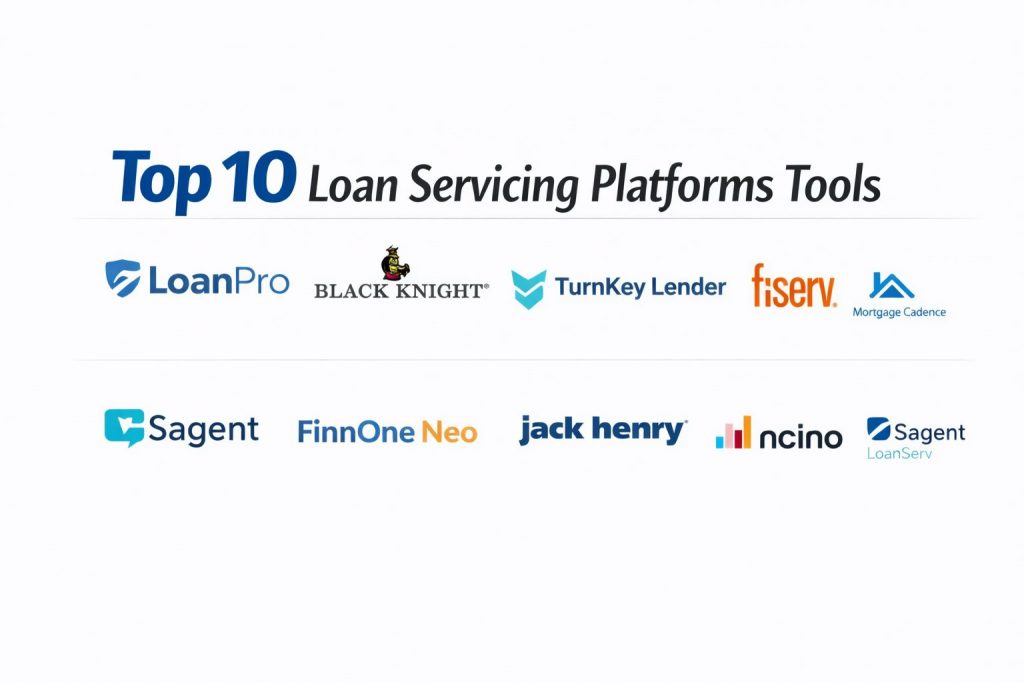
Top 10 Loan Servicing Platforms
1 LoanPro
LoanPro is a modern, API-first lending core designed to give lenders complete control over their loan lifecycle. It is highly favored by fintechs and digital-forward banks for its extreme configurability and automation-heavy approach to servicing.
Key Features
- Automation Engine: Allows users to build complex, event-driven workflows that trigger actions based on loan status changes.
- Compliance Safeguard: Built-in logic that automatically adjusts to state-by-state regulations for interest caps and late fees.
- Cloud-Native Architecture: Offers a highly scalable environment built on a modern tech stack for high-volume performance.
- Comprehensive API: Provides over 1,000 endpoints, making it one of the most flexible platforms for custom integrations.
- Built-in Accounting: Features a real-time ledger that ensures every penny is tracked with an immutable audit trail.
- Borrower Portal: An out-of-the-box, mobile-responsive portal that allows for self-service payments and document management.
Pros
- Unmatched flexibility for creating unique or “niche” loan products without developer intervention.
- Deep focus on transparency with detailed logs for every system action and calculation.
Cons
- The sheer number of options and configurations can be overwhelming for smaller, less technical teams.
- Implementation requires a solid understanding of API structures for those looking to maximize its potential.
Platforms / Deployment
- Web / Cloud-native
- SaaS (Vendor-hosted)
Security & Compliance
- Features: SSO/SAML, MFA, PCI-DSS Level 1, Encryption at rest and in transit.
- Compliance: SOC 1 Type 2, SOC 2 Type 2.
Integrations & Ecosystem
LoanPro is built to be a “connected core.” It integrates seamlessly with payment processors, communication tools, and data providers through its robust API and pre-built connectors:
- Plaid for bank verification.
- Twilio for automated SMS/Email communications.
- Various major payment gateways (ACH, Card, RTP).
Support & Community
Offers extensive technical documentation, a dedicated developer portal, and professional support tiers. The community is active among fintech developers and technical operations managers.
2 Black Knight MSP
Black Knight MSP is a legendary mortgage servicing platform used by many of the largest financial institutions in the world. It is the gold standard for high-volume mortgage portfolios, known for its deep regulatory coverage and institutional stability.
Key Features
- Mortgage Expertise: Specifically tailored to handle the nuances of escrow, P&I payments, and secondary market reporting.
- Scalability: Capable of managing millions of loans simultaneously without performance degradation.
- Loss Mitigation Tools: Advanced modules for managing delinquencies and guiding borrowers through workout options.
- Investor Reporting: Standardized reporting for Fannie Mae, Freddie Mac, and Ginnie Mae.
- Customer Service Desktop: A unified view for agents to resolve complex borrower issues with real-time data.
- Regulatory Compliance Engine: Deeply integrated logic that tracks and enforces federal and state mortgage laws.
Pros
- The most battle-tested platform for large-scale mortgage servicing in the industry.
- Unrivaled depth in regulatory reporting and investor remittance capabilities.
Cons
- The user interface can feel dated and “legacy” compared to modern fintech platforms.
- High cost and long implementation timelines make it unsuitable for small or agile lenders.
Platforms / Deployment
- Windows / Web
- Hybrid / Mainframe / Cloud
Security & Compliance
- Features: Robust RBAC, Audit logs, Encrypted data vaults.
- Compliance: ISO 27001, SOC 2, HIPAA (as applicable).
Integrations & Ecosystem
Black Knight offers a vast ecosystem of proprietary and third-party integrations:
- Deep integration with the Empower LOS.
- Connectivity to major property tax and insurance data providers.
- Export capabilities for major financial accounting systems.
Support & Community
Provides institutional-grade support with dedicated account managers and extensive on-site training. The community consists of thousands of mortgage professionals globally.
3 TurnKey Lender
TurnKey Lender provides an AI-driven lending platform that covers the entire lifecycle from origination to collections. It is best known for using machine learning to automate credit decisioning and servicing workflows for SMB and consumer lenders.
Key Features
- AI Decisioning: Uses alternative data and neural networks to predict borrower behavior and automate servicing actions.
- Unified Platform: Covers origination, underwriting, servicing, and collections in a single system.
- Intuitive UI: One of the most modern and user-friendly interfaces in the lending category.
- Risk Management: Real-time monitoring of portfolio health with automated alerts for high-risk accounts.
- Collateral Management: Built-in tools for tracking and managing assets tied to secured loans.
- Multi-Country Support: Configurable for different currencies, languages, and local tax regulations.
Pros
- Extremely fast to deploy compared to traditional enterprise systems.
- Strong “all-in-one” value proposition for lenders who don’t want to manage multiple vendors.
Cons
- Customizations beyond the standard configuration can become expensive.
- May lack the “deep-sea” complexity required by top-tier global mortgage banks.
Platforms / Deployment
- Web / Mobile
- Cloud (SaaS) / Private Cloud
Security & Compliance
- Features: MFA, Audit trails, RBAC, Data residency options.
- Compliance: SOC 2, GDPR.
Integrations & Ecosystem
TurnKey Lender features a robust marketplace of pre-built integrations:
- Major credit bureaus (Equifax, Experian, TransUnion).
- Digital signature providers (DocuSign, HelloSign).
- E-commerce platforms for “buy now, pay later” (BNPL) implementations.
Support & Community
Offers proactive customer success management and a well-organized knowledge base. The community is focused on fintech innovation and alternative lending.
4 Fiserv Loan Servicing
Fiserv is a global leader in financial technology, offering a robust servicing platform that caters to banks of all sizes. Its strength lies in its deep integration with core banking systems and its ability to handle a wide range of loan products.
Key Features
- Multi-Product Support: Manages mortgages, consumer loans, and commercial debt on a single core.
- Escrow Administration: Sophisticated tools for managing complex tax and insurance disbursements.
- Delinquency Management: Automated workflows for collections and legal tracking.
- Investor Accounting: Advanced capabilities for managing participation and syndicated loans.
- Core Banking Integration: Seamlessly connects with Fiserv’s widespread core banking platforms (DNA, Precision).
- High-Volume Processing: Designed to handle the transaction load of a national bank.
Pros
- Incredible stability and a proven track record within the traditional banking sector.
- Offers a “one-stop-shop” for institutions already using Fiserv for other banking needs.
Cons
- The implementation process is often long and requires significant internal resources.
- Customizing the software to fit a specific “fintech” workflow can be challenging.
Platforms / Deployment
- Windows / Web
- Cloud / On-premise (Hybrid)
Security & Compliance
- Features: Bank-grade encryption, Advanced threat monitoring, RBAC.
- Compliance: FFIEC regulated, SOC 1/2, PCI-DSS.
Integrations & Ecosystem
Fiserv has one of the largest integration networks in the world:
- Direct links to all major payment networks.
- Integrated document imaging and storage solutions.
- Financial reporting and general ledger bridges.
Support & Community
Institutional support with a global reach. The user community is vast, supported by regular user conferences and regional training sessions.
5 Mortgage Cadence
Mortgage Cadence, an Accenture company, provides a modern, cloud-native platform for mortgage lenders. It focuses on a streamlined user experience and high-speed processing to reduce the “cost to service.”
Key Features
- Adaptive Configuration: Allows lenders to adjust workflows and business rules without custom code.
- Intelligent Automation: Uses the “ACE” engine to automate repetitive document and data tasks.
- Integrated eClosing: A seamless transition from the “close” of a loan into the servicing core.
- Power BI Analytics: Deep, built-in data visualization for portfolio performance tracking.
- Vendor-Agnostic APIs: Designed to connect to any third-party service provider.
- Borrower Self-Service: A high-end portal that encourages borrowers to resolve issues online.
Pros
- Excellent user experience for both the lender’s staff and the end borrower.
- Strong focus on reducing the operational cost per loan through automation.
Cons
- Primarily focused on mortgage, making it less versatile for lenders with high-volume auto or personal loan portfolios.
- Requires a commitment to modern, digital-first workflows to see the full benefit.
Platforms / Deployment
- Web / Mobile
- Cloud (SaaS)
Security & Compliance
- Features: SSO, Advanced audit logging, Data encryption at rest.
- Compliance: ISO 27001, SOC 2.
Integrations & Ecosystem
- Deep integration with the Mortgage Cadence LOS.
- Open architecture for third-party appraisal and title services.
- Direct connection to Microsoft’s security and cloud ecosystem.
Support & Community
Provides professional services-led onboarding and ongoing technical support. The community is focused on the future of digital mortgage technology.
6 Sagent
Sagent is a specialized mortgage servicing platform that emphasizes a “consumer-first” experience. It aims to make homeownership simpler by providing transparent, real-time data to both lenders and borrowers.
Key Features
- Dara Platform: A unified platform that connects core, default, and consumer servicing.
- Real-Time Data: Unlike legacy batch systems, Sagent provides instant visibility into loan data.
- Loss Mitigation Workflows: Specialized tools for helping homeowners manage financial hardships.
- Mobile-First Consumer Experience: One of the highest-rated mobile portals in the servicing space.
- Automated Onboarding: Intelligent tools for boarding large portfolios of seasoned loans.
- Embedded Analytics: Real-time visibility into portfolio risk and performance.
Pros
- The modern, real-time data architecture eliminates the “overnight wait” for balance updates.
- Very strong borrower engagement and retention tools.
Cons
- As a specialized mortgage tool, it isn’t the right fit for general consumer lending (like credit cards).
- The transition from a legacy batch system to Sagent’s real-time environment requires a shift in internal processes.
Platforms / Deployment
- Web / iOS / Android
- Cloud (SaaS)
Security & Compliance
- Features: RBAC, MFA, Full audit trails, Automated compliance monitoring.
- Compliance: SOC 2, CFPB-aligned controls.
Integrations & Ecosystem
- Open-API ecosystem for third-party data and service providers.
- Direct connections to major GSEs (Fannie/Freddie).
- Integrations with major document management systems.
Support & Community
Highly responsive support with a focus on collaborative partnership. The community is active in mortgage innovation forums.
7 FinnOne Neo (Nucleus Software)
FinnOne Neo is a global leader in retail lending software, providing an enterprise-grade platform that handles everything from personal loans to complex commercial debt. It is known for its incredible depth and scalability.
Key Features
- Modular Design: Users can implement just the servicing module or the full lending suite.
- Zero-Code Engines: Allows business users to configure products and rules without IT help.
- Multilingual & Multi-Currency: Built for global institutions operating across different borders.
- Advanced Collections: One of the most sophisticated debt recovery modules in the market.
- Digital Onboarding: High-speed boarding for both new and acquired loan portfolios.
- Real-Time Dashboards: Executive-level visibility into lending operations and risk.
Pros
- Exceptionally deep feature set that can handle almost any loan structure imaginable.
- High scalability for global institutions managing diverse international portfolios.
Cons
- The implementation is complex and requires significant planning and resources.
- Can be “overkill” for smaller lenders who only need basic servicing functions.
Platforms / Deployment
- Web / Mobile / Windows
- Cloud / On-premise
Security & Compliance
- Features: Advanced RBAC, Secure API gateways, End-to-end encryption.
- Compliance: SOC 2, local regulatory readiness for 50+ countries.
Integrations & Ecosystem
- Features over 360 APIs for connecting to the global fintech ecosystem.
- Pre-built integrations with major core banking systems.
- Strong partnerships with cloud providers like AWS and Azure.
Support & Community
Provides world-class enterprise support and a dedicated center of excellence. The community consists of some of the world’s largest banks.
8 Jack Henry Loan Servicing
Jack Henry is a staple of the community banking and credit union world. Its servicing solutions are designed to help local institutions compete with national giants by providing high-tech tools with a “human-centric” feel.
Key Features
- Core Integration: Deeply embedded with Jack Henry’s core banking platforms (SilverLake, CIF 20/20).
- Borrower Self-Service: Intuitive tools that allow local customers to manage loans on their own terms.
- Automated Payments: Robust ACH and recurring payment management with real-time posting.
- Flexible Workflows: Designed to help small teams manage complex tasks with high efficiency.
- Commercial Support: Handles the specific needs of local business lending and participation.
- Escrow Management: Comprehensive tracking of taxes and insurance for community portfolios.
Pros
- Perfect for institutions that prioritize customer relationships and “local” service.
- Very strong support and training for community-sized institutions.
Cons
- Less suitable for high-growth, digital-only fintechs that require an “API-only” approach.
- Some features may feel less “innovative” compared to the newest silicon valley-style platforms.
Platforms / Deployment
- Web / Windows
- Cloud / Hybrid
Security & Compliance
- Features: FFIEC-compliant security, MFA, Secure document exchange.
- Compliance: SOC 1/2, FFIEC regulated.
Integrations & Ecosystem
- Integrated with the broader Jack Henry ecosystem (ProfitStars, JHA PayCenter).
- Connectivity to national credit bureaus and standard financial data providers.
Support & Community
Known for some of the highest-rated support in the banking industry. The user community is very collaborative and active.
9 nCino
nCino is a cloud-native platform built on Salesforce, transforming the way financial institutions manage the entire loan journey. Its servicing capabilities are designed for speed, transparency, and a seamless internal workflow.
Key Features
- Salesforce Integration: Leverages the power of the Salesforce CRM for a 360-degree view of the customer.
- Workflow Automation: Streamlines the movement of loans through different departments and tasks.
- Portfolio Analytics: Real-time data visualization and risk assessment built on Tableau.
- Document Management: Secure, centralized storage for all loan-related documents.
- Unified Platform: Servicing is integrated into the same environment as origination and credit analysis.
- Borrower Portal: A high-end, customizable portal that feels like a modern retail experience.
Pros
- Unrivaled for institutions already using Salesforce for their CRM needs.
- Excellent visibility for bank staff, reducing internal “silos” and communication gaps.
Cons
- Requires a Salesforce license, which adds to the total cost of ownership.
- Not as “deep” in specialized mortgage escrow tasks compared to Black Knight or Fiserv.
Platforms / Deployment
- Web / Mobile
- Cloud (Salesforce)
Security & Compliance
- Features: Salesforce Shield, Field-level security, MFA, Full audit logs.
- Compliance: SOC 2, HIPAA, GDPR.
Integrations & Ecosystem
- Access to the entire Salesforce AppExchange for thousands of third-party tools.
- Direct integrations with major credit and data providers.
- Open APIs for custom internal connections.
Support & Community
A very strong, developer-friendly community and world-class support. The “nCino University” provides extensive training paths.
10 agent LoanServ
Sagent LoanServ (formerly of Fiserv) is a real-time, multi-loan servicing platform that excels in handling high-volume consumer and mortgage portfolios with precision and speed.
Key Features
- Real-Time Data: Updates the system of record instantly as transactions occur.
- Multi-Product Core: Handles auto, mortgage, and consumer loans on one system.
- High Configurability: Allows lenders to define unique repayment and interest structures easily.
- Automated Quality Assurance: Built-in checks to ensure data integrity during loan boarding.
- Investor Waterfalls: Automated calculations for complex investor remittance and participation.
- Unified UX: A single dashboard that gives staff a complete view of the borrower’s history.
Pros
- Real-time architecture is a significant upgrade over traditional “batch” servicing systems.
- Strong mid-market and enterprise fit for lenders with diverse loan portfolios.
Cons
- Can be complex to set up for smaller lenders with very simple needs.
- Requires a commitment to high-speed, digital-first operational patterns.
Platforms / Deployment
- Web / Windows
- Cloud (SaaS)
Security & Compliance
- Features: MFA, SSO, Advanced encryption, Role-based permissions.
- Compliance: SOC 1/2, PCI-DSS.
Integrations & Ecosystem
- Broad vendor integrations for appraisals, title, and credit.
- Direct links to payment networks and bank account verification services.
- Open APIs for connecting to custom internal applications.
Support & Community
Professional support with a deep focus on mortgage and consumer finance domain expertise.
Comparison Table (Top 10)
| Tool Name | Best For | Platform(s) Supported | Deployment | Standout Feature | Public Rating |
| LoanPro | Fintech & Agility | Web / API | Cloud (SaaS) | Modern API-First Core | 4.8/5 |
| Black Knight MSP | Enterprise Mortgage | Win / Web | Hybrid / Cloud | Mortgage Institutional Depth | 4.4/5 |
| TurnKey Lender | AI-Driven SMB | Web / Mobile | Cloud (SaaS) | AI Decision Engine | 4.6/5 |
| Fiserv Servicing | Large Traditional Banks | Win / Web | Hybrid / Cloud | Deep Core Banking Link | 4.3/5 |
| Mortgage Cadence | Digital Mortgage | Web / Mobile | Cloud (SaaS) | ACE Automation Engine | 4.5/5 |
| Sagent | Real-Time Mortgage | Web / Mobile | Cloud (SaaS) | Real-Time Data Architecture | 4.7/5 |
| FinnOne Neo | Global Retail Banks | Web / Win | Cloud / On-prem | Modular Global Scalability | 4.5/5 |
| Jack Henry | Community Banks | Web / Win | Cloud / Hybrid | Human-Centric UI/Support | 4.6/5 |
| nCino | Salesforce Users | Web / Mobile | Cloud (SFDC) | 360-Degree CRM View | 4.7/5 |
| Sagent LoanServ | High-Volume Multi-Asset | Web / Win | Cloud (SaaS) | Instant Posting/Ledger | 4.4/5 |
Evaluation and Scoring of Loan Servicing Platforms
The scoring below is a comparative model intended to help shortlisting. Each criterion is scored from 1–10, then a weighted total from 0–10 is calculated using the weights listed. These are analyst estimates based on typical fit and common workflow requirements, not public ratings.
Weights:
Price / value – 15%
Core features – 25%
Ease of use – 15%
Integrations & ecosystem – 15%
Security & compliance – 10%
Performance & reliability – 10%
Support & community – 10%
| Tool Name | Core (25%) | Ease (15%) | Integrations (15%) | Security (10%) | Performance (10%) | Support (10%) | Value (15%) | Weighted Total |
| LoanPro | 10 | 6 | 10 | 9 | 10 | 8 | 8 | 8.70 |
| Black Knight | 10 | 3 | 7 | 10 | 10 | 8 | 5 | 7.70 |
| TurnKey Lender | 8 | 9 | 8 | 8 | 8 | 8 | 9 | 8.25 |
| Fiserv | 9 | 4 | 9 | 10 | 9 | 7 | 6 | 7.75 |
| Mortgage Cadence | 9 | 8 | 8 | 9 | 9 | 8 | 7 | 8.30 |
| Sagent | 9 | 8 | 9 | 9 | 10 | 8 | 8 | 8.70 |
| FinnOne Neo | 10 | 4 | 9 | 10 | 10 | 8 | 6 | 8.20 |
| Jack Henry | 8 | 8 | 8 | 9 | 8 | 10 | 8 | 8.30 |
| nCino | 8 | 8 | 10 | 10 | 9 | 9 | 7 | 8.55 |
| Sagent LoanServ | 9 | 6 | 8 | 9 | 10 | 8 | 7 | 8.05 |
How to interpret these scores:
- Weighted Total: Scores above 8.0 represent platforms that are highly recommended for modern production environments.
- Core vs. Ease: Specialized enterprise tools (Black Knight, FinnOne Neo) score lower in “Ease of Use” because they are professional platforms that require certified operators.
- Value: Tools like TurnKey Lender and LoanPro score higher here due to their flexible pricing models compared to traditional “mainframe” legacy systems.
Which Loan Servicing Software Tool Is Right for You?
Solo / Freelancer
For the small independent lender, TurnKey Lender offers a comprehensive “out-of-the-box” solution that is easy to manage without an IT team. Alternatively, if you have a developer on hand, LoanPro‘s lower tiers provide incredible flexibility for custom products.
SMB
Small to mid-sized lenders should prioritize platforms like Mortgage Cadence (if mortgage-focused) or nCino (if general banking). These tools offer a balance of enterprise power and modern ease of use that small teams can effectively manage.
Mid-Market
For lenders scaling into national territory, Sagent or LoanPro are the best choices. They provide the necessary performance and compliance depth to handle thousands of loans while remaining agile enough to launch new products quickly.
Enterprise
Global banks and top-tier mortgage servicers should look toward Black Knight MSP, Fiserv, or FinnOne Neo. These platforms are designed for the “heavy lifting” of millions of loans and the complex regulatory reporting required for high-volume institutional lending.
Budget vs Premium
- Budget: TurnKey Lender, LoanPro (Standard Tiers).
- Premium: Black Knight MSP, FinnOne Neo, nCino (due to Salesforce costs).
Feature Depth vs Ease of Use
If you need absolute depth for complex international banking, choose FinnOne Neo. If you need ease of use and a fast implementation for a digital startup, choose TurnKey Lender.
Integrations & Scalability
If your tech stack is built on Salesforce, nCino is the only logical choice. If you are building a proprietary mobile app and need a “headless” servicing core, LoanPro is the industry leader for API connectivity.
Security & Compliance Needs
Institutions under heavy FFIEC or global regulatory scrutiny should lean toward the legacy giants like Fiserv or Black Knight, which have decades of experience in maintaining institutional-grade security certifications and audit histories.
Frequently Asked Questions (FAQs)
What is the difference between a Loan Origination System (LOS) and a Servicing Platform?
An LOS is for the beginning of the loan—application, credit pull, and funding. A servicing platform takes over once the money has been sent to the borrower, managing the monthly payments and interest for the next several years.
Can these platforms handle multiple types of loans (Auto, Mortgage, Personal)?
Some platforms like Fiserv and LoanPro are “multi-asset,” meaning they can handle any loan type. Others, like Black Knight MSP, are specialized specifically for the high-complexity needs of mortgage servicing.
How do these systems handle late payments and collections?
Modern servicing tools have automated “collections modules.” They can automatically send SMS/email reminders, calculate late fees based on state laws, and even trigger loss mitigation workflows if a borrower is consistently delinquent.
Is cloud-based servicing safe for bank data?
Yes, in 2026, cloud-native platforms often have better security than on-premise servers. They use high-level encryption, real-time threat detection, and are hosted in highly secure data centers that meet SOC 2 and PCI-DSS standards.
How long does it take to implement a new servicing platform?
A modern SaaS platform like TurnKey Lender can be set up in 3–4 months. A massive enterprise migration for a national bank onto a platform like Black Knight can take 12–24 months due to the complexity of data migration.
What is “Real-Time Posting”?
Real-time posting means the moment a borrower makes a payment, the ledger is updated, and their outstanding balance decreases. Legacy systems often “batch” process, meaning the balance doesn’t update until the next day.
Do these tools integrate with credit bureaus?
Most professional platforms feature direct integrations with Equifax, Experian, and TransUnion. This allows the system to automatically report borrower payment history to help them build their credit scores.
Can a borrower see their own loan details?
Yes, almost all modern platforms include a “Borrower Portal.” This is a website or mobile app where the borrower can see their balance, make a payment, download tax forms (like 1098s), and update their contact info.
What is “Investor Reporting” in loan servicing?
When a bank sells a loan to an investor but continues to service it, they must report the performance and send the collected funds to that investor. Top platforms automate this complex accounting and remittance process.
How much does loan servicing software cost?
Pricing varies widely. Some platforms charge a flat monthly fee, while others charge a “per-loan” fee (e.g., $1.00 to $5.00 per active loan per month). Enterprise systems often involve high upfront implementation costs.
Conclusion
Selecting the right loan servicing platform is a critical long-term decision that dictates your operational cost and borrower satisfaction for years to come. In 2026, the market is split between “Institutional Giants” that offer unrivaled regulatory depth for mortgages and “Modern Innovators” that offer API-first flexibility for the fintech era. The “best” platform is the one that aligns with your specific asset class and your team’s technical capabilities.
Your next steps:
- Define your asset mix: Do you need specialized mortgage tools or a general-purpose consumer core?
- Audit your tech stack: If you use Salesforce, start with nCino. If you are building a custom app, start with LoanPro.
- Request a “Data Migration” briefing: The biggest hurdle in servicing is moving your existing loans; ensure your top 3 choices have a proven migration path.