Introduction
LLM orchestration frameworks help teams build, run, and improve applications that use large language models. In simple terms, they are the “control layer” that connects prompts, tools, data sources, memory, and model calls into a reliable workflow. This matters because LLM apps are no longer simple chat demos. They need routing, retries, guardrails, observability, cost control, and predictable outputs across many user requests. Common use cases include customer support agents, internal knowledge assistants, data-to-text reporting, document workflows, research copilots, and code assistants. When selecting a framework, evaluate agent and tool support, workflow control, retrieval and memory patterns, evaluation and testing, observability hooks, security controls, deployment flexibility, ecosystem maturity, scalability under load, and how easy it is to debug production issues.
Best for: product teams, platform teams, AI engineers, and startups building multi-step LLM workflows, agent systems, and reliable production assistants.
Not ideal for: teams doing single-prompt experiments, simple prototypes with no tools, or one-off scripts where a lightweight wrapper is enough.
Key Trends in LLM Orchestration Frameworks
- Shift from simple prompt chains to graph-based and stateful agent workflows.
- Stronger emphasis on reliability: retries, fallbacks, timeouts, and deterministic control points.
- Better observability: traces, spans, prompt/version tracking, and run-level debugging.
- Retrieval patterns getting more structured with chunking strategies, hybrid search, and re-ranking.
- Guardrails and policy layers becoming standard for safety and brand control.
- Evaluation moving earlier in development with test suites, golden sets, and regression checks.
- Cost management becoming a core requirement with caching, routing, and model selection logic.
- Deployment patterns expanding: local, self-hosted, managed services, and hybrid enterprise setups.
How We Selected These Tools (Methodology)
- Chosen for strong adoption and credibility in real LLM application building.
- Included frameworks that support multi-step workflows, tools, and retrieval patterns.
- Prioritized developer experience and practical debugging in production scenarios.
- Considered ecosystem maturity, community activity, and extensibility options.
- Included both code-first frameworks and builder-style platforms for faster delivery.
- Looked for patterns that scale: state management, concurrency support, and modular design.
- Balanced general-purpose orchestration with frameworks strong in retrieval and evaluation.
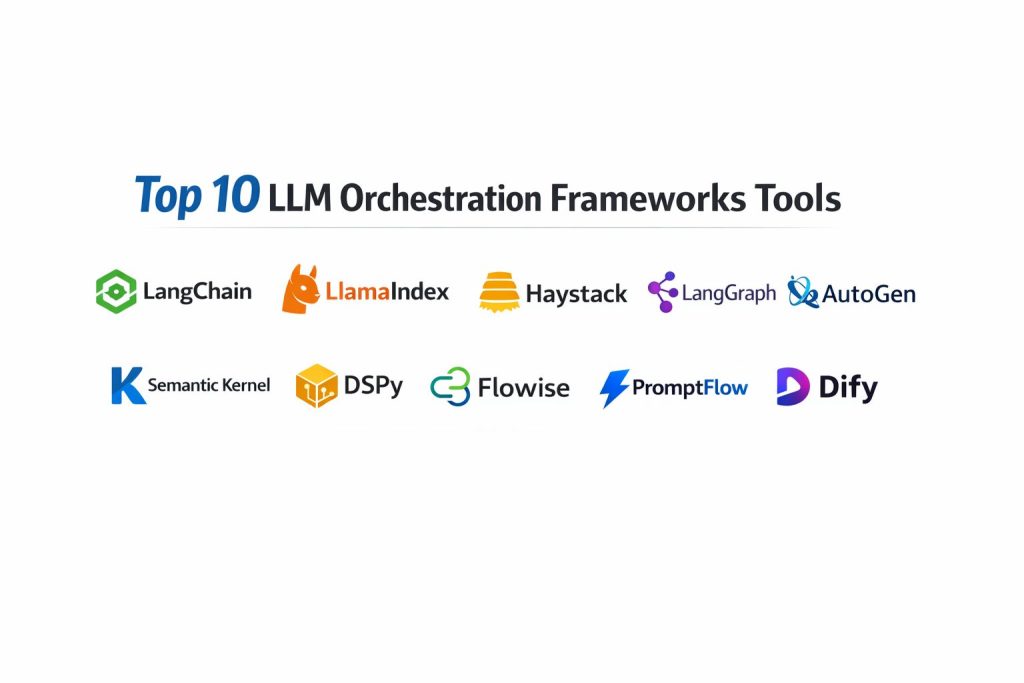
Top 10 LLM Orchestration Frameworks Tools
1 — LangChain
A popular framework for building LLM applications with chains, tools, agents, and integrations. It is often used as a general-purpose layer for connecting models, retrievers, and external actions.
Key Features
- Chain and agent patterns for multi-step execution
- Tool calling and function integration patterns
- Retrieval pipelines with loaders and vector store connectors
- Memory and conversation state patterns
- Large integration ecosystem across model and data providers
Pros
- Large community and many ready-to-use integrations
- Flexible for many LLM application styles
Cons
- Abstraction depth can make debugging harder if not structured well
- Teams often need standards to avoid “chain sprawl”
Platforms / Deployment
Windows / macOS / Linux, Cloud / Self-hosted / Hybrid
Security and Compliance
Not publicly stated
Integrations and Ecosystem
LangChain is often selected for its breadth of connectors and patterns for tooling and retrieval.
- Connectors for common vector databases and storage systems
- Model provider integration patterns
- Tool wrappers for APIs and internal services
- Extensible components for custom logic
Support and Community
Very strong community, extensive examples, and active ecosystem; support depends on usage approach.
2 — LlamaIndex
A framework focused on data-centric LLM applications, especially retrieval workflows, indexing, and structured context building for grounded responses.
Key Features
- Data ingestion and indexing components
- Retrieval patterns for grounded question answering
- Query routing and multi-retriever designs
- Structured context composition and response synthesis
- Evaluation helpers for retrieval quality iteration
Pros
- Strong fit for knowledge assistants and document Q and A
- Useful abstractions for retrieval and indexing design
Cons
- Less “general agent orchestration” than some alternatives
- Best results require careful tuning of data and chunking strategy
Platforms / Deployment
Windows / macOS / Linux, Cloud / Self-hosted / Hybrid
Security and Compliance
Not publicly stated
Integrations and Ecosystem
LlamaIndex is often used as the retrieval and knowledge layer inside broader LLM systems.
- Connectors to common data sources and vector stores
- Patterns for structured retrieval and response synthesis
- Extensibility for custom parsers and index strategies
Support and Community
Strong community and documentation; production quality depends on implementation discipline.
3 — Haystack
An orchestration framework widely used for search and retrieval-based AI systems, built for production use cases with structured pipelines.
Key Features
- Pipeline-based architecture for building retrieval workflows
- Modular components for indexing, retrieval, ranking, and generation
- Strong fit for document Q and A and search-driven apps
- Flexible deployment patterns for production services
- Tools for evaluation and pipeline inspection
Pros
- Pipeline approach helps keep systems organized and maintainable
- Good for teams focused on search-first AI experiences
Cons
- Less “agent-first” than some newer frameworks
- Setup can feel heavier for simple prototypes
Platforms / Deployment
Windows / macOS / Linux, Cloud / Self-hosted / Hybrid
Security and Compliance
Not publicly stated
Integrations and Ecosystem
Haystack commonly fits teams that treat retrieval as a core product capability.
- Connectors for common stores and search systems
- Structured pipelines for maintainable architecture
- Extensible components for custom ranking and generation
Support and Community
Solid open community and documentation; enterprise readiness depends on your deployment approach.
4 — LangGraph
A graph-based workflow framework designed to build stateful and controllable LLM agent systems with clear edges, nodes, and execution flow.
Key Features
- Graph-based orchestration for agent workflows
- Stateful execution with controlled transitions
- Better control over branching and tool routing
- Useful for multi-agent or multi-step flows
- Designed for more predictable orchestration patterns
Pros
- Clear structure helps debugging and reliability
- Strong fit for complex workflows with branching logic
Cons
- Requires design thinking; not as simple as basic chains
- Teams may need time to adopt graph modeling patterns
Platforms / Deployment
Windows / macOS / Linux, Cloud / Self-hosted / Hybrid
Security and Compliance
Not publicly stated
Integrations and Ecosystem
LangGraph is typically used when teams want control over state and workflow shape rather than free-form agent behavior.
- Fits well with tool calling patterns
- Useful with retrieval components and memory design
- Extensible nodes for custom logic and policy checks
Support and Community
Growing community; best practices are still maturing across teams.
5 — AutoGen
A framework oriented toward multi-agent collaboration patterns where different agents or roles coordinate to solve tasks through structured conversation and tool use.
Key Features
- Multi-agent patterns and role-based collaboration
- Tool and function calling integration patterns
- Conversation-based orchestration with controllable rules
- Good for complex tasks broken into sub-roles
- Extensible design for custom agents and coordinators
Pros
- Strong for multi-agent reasoning and task decomposition
- Useful for complex workflows requiring collaboration patterns
Cons
- Production hardening requires discipline and testing
- Debugging can be challenging without strong observability practices
Platforms / Deployment
Windows / macOS / Linux, Cloud / Self-hosted / Hybrid
Security and Compliance
Not publicly stated
Integrations and Ecosystem
AutoGen is often used where agent roles and collaboration are core to the application design.
- Tool integration patterns for external actions
- Extensible agent definitions for custom workflows
- Fits evaluation and logging layers added by the team
Support and Community
Active interest and growing community; support depends on internal standards.
6 — Semantic Kernel
A framework focused on integrating LLM capabilities into applications with structured planning, skills, and tool invocation patterns.
Key Features
- Skill-based design for reusable capabilities
- Planning patterns for tool and workflow execution
- Connectors for models and common integrations
- Strong fit for enterprise app integration scenarios
- Works well when LLM is one component among many services
Pros
- Good structure for application integration and reuse
- Useful for teams building repeatable “skills” and functions
Cons
- Requires good architecture decisions to avoid complexity
- Some advanced agent designs may need additional patterns
Platforms / Deployment
Windows / macOS / Linux, Cloud / Self-hosted / Hybrid
Security and Compliance
Not publicly stated
Integrations and Ecosystem
Semantic Kernel fits teams that want LLM functionality packaged into reusable modules.
- Skill patterns for consistent behavior
- Tool invocation for enterprise workflows
- Extensible connectors for different environments
Support and Community
Strong vendor-led ecosystem and documentation; community varies by language and use case.
7 — DSPy
A framework focused on programmatic prompting and optimization, helping teams build pipelines where prompts and modules can be tuned and evaluated.
Key Features
- Modular programming approach to LLM pipelines
- Prompt optimization and refinement workflows
- Evaluation-driven development patterns
- Structured composition of LLM calls into systems
- Helps reduce trial-and-error prompt changes
Pros
- Strong for teams who want measurable improvements and tuning
- Encourages evaluation-first workflow discipline
Cons
- Less “UI builder” friendly; more code-first
- Requires datasets and test thinking to use fully
Platforms / Deployment
Windows / macOS / Linux, Cloud / Self-hosted / Hybrid
Security and Compliance
Not publicly stated
Integrations and Ecosystem
DSPy is typically used by teams that treat prompt quality as an engineering problem and want repeatable optimization.
- Works well with evaluation pipelines
- Fits into broader orchestration layers as the tuning component
- Extensible modules for different tasks and constraints
Support and Community
Growing community; best results depend on rigorous testing practices.
8 — Flowise
A visual builder that helps teams create LLM workflows using drag-and-drop components, often used for quick prototypes and internal tools.
Key Features
- Visual workflow building with nodes and connectors
- Fast prototyping for chains and retrieval flows
- Useful for internal demos and early validation
- Supports integrations depending on your setup
- Helps non-experts collaborate on workflow design
Pros
- Very fast to prototype and share internally
- Good for teams that want a visual orchestration layer
Cons
- Long-term maintainability depends on governance and exports
- Advanced production patterns may require code-level control
Platforms / Deployment
Windows / macOS / Linux, Cloud / Self-hosted / Hybrid
Security and Compliance
Not publicly stated
Integrations and Ecosystem
Flowise is commonly used as a builder layer for teams that want speed and visibility.
- Visual connectors for common components
- Useful for prototyping retrieval and tool flows
- Often paired with separate observability and testing layers
Support and Community
Active community; support depends on deployment and project maturity.
9 — PromptFlow
A workflow framework designed for building, evaluating, and deploying LLM workflows with structured steps and testing patterns.
Key Features
- Workflow definitions for repeatable LLM pipelines
- Evaluation and testing support for workflow iterations
- Tool and component orchestration patterns
- Good for teams needing structured lifecycle and iteration
- Useful for moving from prototype to controlled deployment
Pros
- Strong for evaluation-driven workflow development
- Helps teams standardize repeatability and testing
Cons
- Fit depends on how your organization wants to manage pipelines
- Some advanced agent systems may need additional design layers
Platforms / Deployment
Windows / macOS / Linux, Cloud / Self-hosted / Hybrid
Security and Compliance
Not publicly stated
Integrations and Ecosystem
PromptFlow is often used when teams want workflow structure plus evaluation discipline.
- Component-based design for repeatable steps
- Supports tool and model integration patterns
- Works best with defined test sets and review process
Support and Community
Community and support vary by environment; documentation is generally strong.
10 — Dify
A platform for building LLM applications with orchestration features, commonly used to deliver internal assistants and workflow-based apps faster.
Key Features
- App building layer for assistant and workflow patterns
- Config-driven orchestration and prompt management
- Support for retrieval-driven assistants
- Useful controls for iteration and deployment
- Helps teams ship without writing everything from scratch
Pros
- Faster time-to-value for internal assistant use cases
- Helpful for teams that prefer config and platform approach
Cons
- Deep customization may require platform extensions
- Governance is important as multiple teams start using it
Platforms / Deployment
Windows / macOS / Linux, Cloud / Self-hosted / Hybrid
Security and Compliance
Not publicly stated
Integrations and Ecosystem
Dify is typically used as an application layer that connects models, data, and workflow logic into deployable assistants.
- Common integrations through connectors and APIs
- Fits retrieval patterns and tool workflows
- Often paired with enterprise authentication and logging systems
Support and Community
Growing community; support depends on deployment approach and plan.
Comparison Table
| Tool Name | Best For | Platform(s) Supported | Deployment | Standout Feature | Public Rating |
|---|---|---|---|---|---|
| LangChain | General LLM app orchestration | Windows, macOS, Linux | Cloud, Self-hosted, Hybrid | Broad connector ecosystem | N/A |
| LlamaIndex | Data and retrieval-centric assistants | Windows, macOS, Linux | Cloud, Self-hosted, Hybrid | Strong indexing and retrieval patterns | N/A |
| Haystack | Search-first AI and pipelines | Windows, macOS, Linux | Cloud, Self-hosted, Hybrid | Structured pipeline architecture | N/A |
| LangGraph | Stateful workflow control | Windows, macOS, Linux | Cloud, Self-hosted, Hybrid | Graph-based orchestration | N/A |
| AutoGen | Multi-agent collaboration | Windows, macOS, Linux | Cloud, Self-hosted, Hybrid | Role-based multi-agent patterns | N/A |
| Semantic Kernel | App integration and reusable skills | Windows, macOS, Linux | Cloud, Self-hosted, Hybrid | Skill and planning model | N/A |
| DSPy | Evaluation-driven prompt optimization | Windows, macOS, Linux | Cloud, Self-hosted, Hybrid | Programmatic optimization workflows | N/A |
| Flowise | Visual prototyping of workflows | Windows, macOS, Linux | Cloud, Self-hosted, Hybrid | Drag-and-drop builder | N/A |
| PromptFlow | Workflow plus evaluation discipline | Windows, macOS, Linux | Cloud, Self-hosted, Hybrid | Structured workflow testing | N/A |
| Dify | Platform-based assistant building | Windows, macOS, Linux | Cloud, Self-hosted, Hybrid | Config-driven app delivery | N/A |
Evaluation and Scoring of LLM Orchestration Frameworks
Weights
Core features 25 percent
Ease of use 15 percent
Integrations and ecosystem 15 percent
Security and compliance 10 percent
Performance and reliability 10 percent
Support and community 10 percent
Price and value 15 percent
| Tool Name | Core | Ease | Integrations | Security | Performance | Support | Value | Weighted Total |
|---|---|---|---|---|---|---|---|---|
| LangChain | 9.0 | 7.5 | 9.5 | 6.0 | 8.0 | 8.5 | 8.0 | 8.31 |
| LlamaIndex | 8.5 | 7.5 | 8.5 | 6.0 | 8.0 | 8.0 | 8.5 | 8.03 |
| Haystack | 8.0 | 7.0 | 8.0 | 6.5 | 8.0 | 7.5 | 7.5 | 7.61 |
| LangGraph | 8.5 | 7.0 | 8.0 | 6.0 | 8.0 | 7.5 | 8.0 | 7.87 |
| AutoGen | 8.0 | 6.5 | 7.5 | 6.0 | 7.5 | 7.0 | 8.5 | 7.45 |
| Semantic Kernel | 8.0 | 7.0 | 8.0 | 6.5 | 7.5 | 7.5 | 8.0 | 7.73 |
| DSPy | 7.5 | 6.5 | 7.0 | 6.0 | 7.5 | 6.5 | 8.5 | 7.20 |
| Flowise | 7.0 | 8.5 | 7.5 | 5.5 | 7.0 | 6.5 | 8.0 | 7.38 |
| PromptFlow | 8.0 | 7.5 | 7.5 | 6.5 | 7.5 | 7.0 | 8.0 | 7.68 |
| Dify | 7.5 | 8.0 | 7.5 | 6.0 | 7.0 | 6.5 | 8.0 | 7.45 |
How to interpret the scores
These numbers help you compare options using the same criteria, not declare a single winner. A slightly lower score can still be best if it matches your workflow style, team maturity, and delivery needs. Core and integrations influence long-term maintainability, while ease impacts onboarding speed and adoption. Security scores reflect what is commonly expected and what is clearly visible, so treat unknown areas as items to validate. Use the table to shortlist, then run a controlled pilot.
Which LLM Orchestration Framework Tool Is Right for You
Solo or Freelancer
If you want to move fast with code and examples, LangChain is often practical. If your core work is knowledge assistants and retrieval, LlamaIndex can reduce time spent building indexing and query patterns. If you want a visual builder for quick prototypes, Flowise can help you validate workflow ideas faster before you commit to a codebase.
SMB
SMBs often need speed plus maintainability. LangChain or Semantic Kernel can work well when you want a framework that supports tools and app integration. If retrieval is central, LlamaIndex or Haystack can help keep pipelines structured. If you want a platform approach for internal assistants, Dify can be a faster path for delivery.
Mid-Market
Mid-market teams often focus on reliability and standardized practices. LangGraph can help create more controllable workflows with clear branching and state. Haystack fits teams building search-first AI products with pipeline discipline. PromptFlow can work well if you want structured workflow building with evaluation habits baked in.
Enterprise
Enterprises typically care about standardization, governance, and predictable operations. Semantic Kernel is often a good fit when LLM features must integrate into existing services. LangGraph can help make orchestration more controlled and auditable. In many enterprises, a platform layer like Dify is useful when multiple teams need to ship assistants with shared governance and policy controls.
Budget vs Premium
Budget-focused teams often start with open frameworks and add structure as usage grows. Premium is less about licensing and more about operational maturity, observability, and governance. Choose tools that reduce your hidden costs: debugging time, flaky workflows, and inconsistent outputs.
Feature Depth vs Ease of Use
If you want deep control and flexible patterns, LangChain and LangGraph are strong options. If you want speed with visual design, Flowise or Dify can be easier to adopt. If you want optimization discipline, DSPy can be powerful but requires test sets and a tuning mindset.
Integrations and Scalability
LangChain is usually strong for breadth of integrations. Haystack scales well when you treat retrieval as a structured pipeline. For agent workflows that grow complex, LangGraph can help keep the system predictable. For platform-style scaling across teams, Dify can help, but governance becomes important as usage expands.
Security and Compliance Needs
Many frameworks do not publicly state full compliance details, so treat security as a system design responsibility. Focus on secrets handling, access control to tools and data, audit logs at the application layer, and strict policy checks around tool use. Validate identity integration needs early, especially when assistants can access internal systems.
Frequently Asked Questions
1. What is an LLM orchestration framework used for
It helps you connect prompts, tools, data retrieval, memory, and control logic into a repeatable workflow. This reduces fragile one-off scripts and improves reliability in real applications.
2. Do I always need agents to use orchestration
No. Many successful systems use structured workflows without autonomous agents. Agents are helpful when tasks need dynamic tool choices, but they add complexity.
3. Which tool is best for retrieval-based assistants
LlamaIndex and Haystack are strong choices when retrieval is core. They provide patterns for indexing, retrieval, and pipeline structure, which improves grounding and maintainability.
4. How do I reduce hallucinations in production
Use retrieval grounding, strict tool permissions, output validation rules, and clear prompts. Also add fallback behavior when confidence is low or data is missing.
5. What are common mistakes teams make
Overbuilding complex agents too early, skipping evaluation, and ignoring observability. Another mistake is giving tools too much permission without policy checks.
6. How do I choose between code-first and platform-first
Code-first gives flexibility and deeper customization, while platform-first gives faster delivery and easier onboarding. Your team skill mix and governance needs should drive this choice.
7. How important is evaluation and testing
It is critical because LLM behavior changes with prompts, models, and data. A simple regression set helps you detect quality drops before users do.
8. Can these frameworks scale to high traffic
Yes, but scaling depends on your application design, caching, concurrency controls, and model routing. Orchestration helps, but you still need solid engineering practices.
9. What should I log in an LLM workflow
Log inputs, tool calls, retrieved context references, outputs, latency, and error paths. This makes debugging possible and supports continuous improvement.
10. How do I run a pilot before choosing
Pick two or three tools and build the same workflow in each. Compare speed of development, clarity of debugging, stability under load, and how easy it is to add evaluation.
Conclusion
LLM orchestration frameworks are quickly becoming a required layer for teams that want reliable, production-ready LLM applications. The right choice depends on what you are building and how your team operates. If you want broad flexibility and many building blocks, LangChain is often a practical starting point. If your main problem is building grounded assistants over documents, LlamaIndex or Haystack can help you create cleaner retrieval pipelines. For controlled, stateful workflows, LangGraph can make complex systems easier to reason about and debug. If you are exploring multi-agent collaboration, AutoGen can help but needs stronger testing and observability discipline. A smart next step is to shortlist two or three tools, build a small pilot workflow, validate integration and governance needs, and then standardize on one approach.