Introduction
Kubernetes policy enforcement has evolved from a secondary security measure into a foundational requirement for production-grade container orchestration. As clusters scale and multi-tenancy becomes the norm, the complexity of managing resource quotas, security contexts, and network isolation manually becomes unsustainable. Policy enforcement tools act as automated guardrails, ensuring that every manifest submitted to the API server complies with organizational standards before it is ever persisted to the cluster state. This “governance-as-code” approach allows platform engineers to define high-level intent—such as “no privileged containers” or “mandatory resource limits”—and have the system programmatically reject or mutate any non-compliant requests.
In the current landscape, policy enforcement is not just about blocking “bad” configurations; it is about providing developer feedback loops and maintaining continuous compliance. By integrating with the Kubernetes Admission Control sub-system, these tools can validate, mutate, or even generate resources on the fly. This automation is critical for reducing the cognitive load on developers while simultaneously hardening the cluster against misconfigurations that could lead to security breaches or resource exhaustion. For any organization treating Kubernetes as a mission-critical platform, a robust policy engine is the primary mechanism for transforming abstract security requirements into verifiable, runtime realities.
Best for: Platform engineering teams, DevSecOps practitioners, and organizations operating in regulated industries (fintech, healthcare) that require strict governance and auditability across distributed Kubernetes clusters.
Not ideal for: Small, single-developer projects or non-production experimental clusters where the overhead of defining and maintaining complex policy sets might outweigh the immediate benefits of rapid iteration.
Key Trends in Kubernetes Policy Enforcement Tools
The most significant trend is the shift toward “Shift-Left” policy integration, where the same policies enforced in production are also run against local manifests and CI/CD pipelines. This ensures that developers receive immediate feedback in their IDE or pull request before a configuration ever reaches the cluster. Another major development is the rise of Cell-based Policy Language (CEL), which Kubernetes is adopting natively to simplify admission control without requiring external webhooks for simple validation logic. This is making policy enforcement faster and more resilient by reducing the reliance on out-of-cluster components.
Furthermore, we are seeing a convergence between runtime security and admission control. Modern tools are increasingly sharing policy definitions across the entire lifecycle—from the build phase to the active runtime—providing a “single source of truth” for security posture. Artificial intelligence is also entering the space, with engines beginning to offer AI-assisted policy generation that can analyze cluster history and suggest optimized guardrails based on actual usage patterns. Finally, as multi-cluster and edge computing expand, “policy federation” has become a priority, allowing a central governance team to push uniform security standards across hundreds of geographically dispersed clusters.
How We Selected These Tools
The selection process for these tools focused on their integration depth with the Kubernetes API and their ability to handle real-world scale. We prioritized tools that are either CNCF-hosted or have a massive community footprint, as these typically offer the best long-term stability and security auditing. Technical flexibility was a primary criterion; we looked for engines that support both “Validating” (blocking) and “Mutating” (auto-correcting) webhooks. This allows teams to not only enforce rules but also to automatically inject sidecars, labels, or security contexts to help developers comply with policies effortlessly.
We also evaluated the “language of choice” for defining policies. While some teams prefer the universality of Rego, others lean toward the simplicity of YAML-based definitions. Therefore, our list includes a mix of general-purpose engines and Kubernetes-native tools to suit different organizational skill sets. Performance was the final pillar of our evaluation—specifically the latency added to the API request path. We chose tools that demonstrate efficient processing of admission requests to ensure that security does not become a bottleneck for deployment velocity.
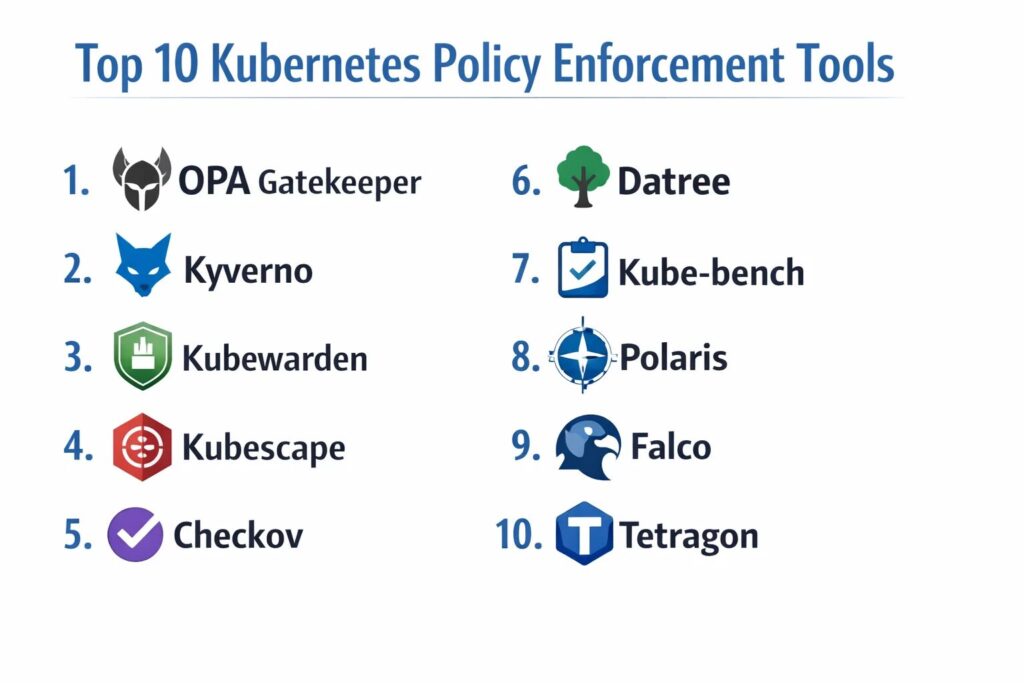
1. OPA Gatekeeper
OPA Gatekeeper is the heavyweight champion of Kubernetes policy enforcement, serving as the specialized implementation of the Open Policy Agent (OPA) for the Kubernetes ecosystem. It utilizes the Rego declarative language to define complex, high-granularity policies that go far beyond simple field checks. As a CNCF-graduated project, it is the industry standard for enterprise-grade governance.
Key Features
The platform introduces “ConstraintTemplates,” which allow users to define generic policy logic that can then be instantiated as specific “Constraints” across the cluster. It provides a robust audit functionality that continuously scans existing resources to identify those that have fallen out of compliance. Gatekeeper supports highly complex data-driven policies, such as checking if an Ingress hostname is already in use by another namespace. It also integrates with external data sources to make policy decisions based on information outside the cluster. Recent updates have focused on improving performance and reducing the memory footprint of the controller.
Pros
Extremely powerful and flexible, capable of expressing almost any logic imaginable. It has the largest ecosystem of pre-built community policies (the Gatekeeper Policy Library).
Cons
Rego has a steep learning curve compared to YAML. The architecture requires managing webhooks which can introduce complexity and latency if not tuned properly.
Platforms and Deployment
Kubernetes-native deployment via Helm or YAML manifests; works on all major cloud-managed K8s services.
Security and Compliance
Supports RBAC-based management and provides detailed audit logs for compliance reporting. Policies are version-controlled and auditable.
Integrations and Ecosystem
Seamlessly integrates with the wider OPA ecosystem and supports standard Kubernetes tooling like Kustomize and Helm.
Support and Community
Massive community support via CNCF, extensive documentation, and widespread adoption among Fortune 500 companies.
2. Kyverno
Kyverno is a CNCF-incubating project that was built specifically for Kubernetes, with the core philosophy that “policies should be managed like any other Kubernetes resource.” Unlike OPA, Kyverno uses familiar YAML syntax, making it the preferred choice for teams who want to avoid learning a new programming language.
Key Features
The platform can validate, mutate, generate, and even cleanup Kubernetes resources based on policy definitions. Its “Generate” feature is particularly unique, allowing for the automatic creation of resources like NetworkPolicies or ResourceQuotas whenever a new Namespace is created. It supports image verification using Sigstore/Cosign to ensure only signed and trusted images are deployed. Kyverno policies are defined as Custom Resource Definitions (CRDs), making them fully compatible with GitOps workflows and standard kubectl commands. It also includes a CLI tool for testing policies during development.
Pros
Extremely low barrier to entry for Kubernetes administrators already familiar with YAML. The resource generation and mutation capabilities are highly intuitive and powerful.
Cons
While very capable, it may struggle with certain extremely complex, multi-object logic that a general-purpose language like Rego can handle more elegantly.
Platforms and Deployment
Native Kubernetes deployment; optimized for modern cloud-native environments and GitOps.
Security and Compliance
Native integration with Kubernetes RBAC and support for advanced supply chain security features like image provenance.
Integrations and Ecosystem
Strong ties to the Sigstore project for image signing and native support for GitOps tools like Argo CD and Flux.
Support and Community
Rapidly growing community and excellent documentation with hundreds of ready-to-use policy examples.
3. Kubewarden
Kubewarden is a modern policy engine that leverages WebAssembly (Wasm) to execute policies. This unique approach allows developers to write policies in their favorite programming language (Go, Rust, Swift, etc.) and compile them into a secure, portable Wasm module that the cluster executes.
Key Features
The engine provides a sandboxed execution environment for policies, ensuring that a faulty policy cannot crash the admission controller. Because it uses Wasm, policies can be distributed and stored in standard container registries just like images. It supports both validating and mutating admission requests and can interact with the Kubernetes API to perform context-aware checks. The platform includes a “PolicyHub” where users can find and share pre-compiled policy modules. It is designed to be highly performant, with the Wasm runtime offering near-native execution speeds.
Pros
Language flexibility allows teams to use existing development skills to write complex policies. The distribution model via OCI registries simplifies policy lifecycle management.
Cons
Requires a shift in mindset to treat policies as compiled artifacts rather than simple text files. The ecosystem is younger than OPA or Kyverno.
Platforms and Deployment
Kubernetes-native; policies are deployed as Wasm modules.
Security and Compliance
Wasm sandboxing provides an extra layer of security for the policy engine itself. Supports secure policy distribution via signed OCI artifacts.
Integrations and Ecosystem
Compatible with any language that can compile to WebAssembly; integrates with standard OCI registries.
Support and Community
Active development by the SUSE team and a growing community of developers interested in Wasm-based infrastructure.
4. Kubescape
Kubescape is a comprehensive security platform that goes beyond simple admission control to offer end-to-end policy enforcement across the entire development lifecycle. It is a CNCF-incubating project known for its ability to scan for misconfigurations against multiple security frameworks simultaneously.
Key Features
The tool provides built-in support for frameworks like NSA-CISA, MITRE ATT&CK, and CIS Benchmarks. It offers a runtime security component that monitors for anomalies while also enforcing static policies at the admission level. Kubescape includes a powerful risk analysis engine that prioritizes vulnerabilities based on their actual exploitability in a specific cluster context. It features a unique “reachability” analysis that determines if a vulnerable library is actually being called by the application. The platform also provides a user-friendly dashboard for multi-cluster compliance visibility.
Pros
Offers a holistic view of security that combines configuration scanning, vulnerability management, and runtime protection. Excellent out-of-the-box framework support.
Cons
The breadth of features can make the initial configuration feel more complex than a single-purpose tool like Kyverno.
Platforms and Deployment
Available as a CLI tool, a cluster-resident operator, and integrated into CI/CD pipelines.
Security and Compliance
Directly maps cluster state to international security standards; provides comprehensive reporting for auditors.
Integrations and Ecosystem
Integrates with popular IDEs, CI tools, and features a robust API for exporting security data to SOC platforms.
Support and Community
Maintained by ARMO with a strong focus on open-source community growth and regular feature updates.
5. Checkov
Checkov is a static code analysis tool that enforces policies as code during the “Shift-Left” phase of the development cycle. While it is not a runtime admission controller itself, it is an essential part of the policy enforcement ecosystem for preventing bad configurations from ever reaching a cluster.
Key Features
The platform comes with over 1,000 pre-built policies covering Kubernetes, Terraform, CloudFormation, and Dockerfiles. It uses a graph-based analysis engine to understand the relationships between different resources, identifying complex security gaps that simple linters might miss. Checkov allows for the creation of custom policies using YAML or Python. It provides automated “fix” suggestions, where it can actually generate the corrected code for a developer. It is designed to run in CI/CD pipelines, blocking pull requests that violate security or operational policies.
Pros
Exceptional at catching issues early in the development cycle, which is significantly cheaper than fixing them in production. Supports a vast range of Infrastructure-as-Code (IaC) formats.
Cons
Cannot enforce policies at runtime; it relies on developers and CI pipelines to execute the checks before deployment.
Platforms and Deployment
CLI-based; natively integrates with GitHub Actions, GitLab CI, and other major pipelines.
Security and Compliance
Ensures that compliance standards (SCA, Secrets, Infrastructure) are met at the source code level.
Integrations and Ecosystem
Owned by Prisma Cloud; integrates deeply with the Bridgecrew platform and major developer workflows.
Support and Community
Very popular among DevOps and SRE teams with an active community contributing new policies daily.
6. Datree
Datree focuses on “the human element” of policy enforcement by providing a developer-centric experience for preventing Kubernetes misconfigurations. It is designed to be the “linter for Kubernetes” that educates developers as much as it enforces rules.
Key Features
The tool features a centralized policy management dashboard where admins can define rules that are then synchronized to every developer’s local environment. It provides highly readable error messages that explain why a policy failed and how to fix it, which is critical for developer adoption. Datree includes a “schema validation” engine that ensures manifests are technically valid for specific Kubernetes versions. It offers a specialized “Helm plugin” that can scan charts before they are packaged. The platform also includes a “policy-as-code” mode where policies themselves can be managed in Git.
Pros
The best user experience for developers; the clear documentation and educational feedback reduce friction between security and dev teams.
Cons
The runtime enforcement component is less mature than OPA or Kyverno, as the primary focus is on the pre-deployment phase.
Platforms and Deployment
CLI tool, CI integration, and an optional admission webhook for the cluster.
Security and Compliance
Helps maintain a consistent security posture across disparate teams and clusters through centralized rule management.
Integrations and Ecosystem
Native support for Helm, Kustomize, and major CI/CD providers.
Support and Community
Strong presence in the Kubernetes community with a focus on simplifying the “Day 0” security experience.
7. Kube-bench
Kube-bench is a specialized tool that enforces the CIS Kubernetes Benchmark, a set of industry-standard best practices for securing Kubernetes clusters. It acts as an automated auditor that checks the configuration of the control plane and worker nodes.
Key Features
The tool runs as a job within the cluster and performs dozens of checks against the host’s configuration files and API settings. It covers critical areas such as etcd security, API server encryption, and Kubelet configuration. Kube-bench provides a clear pass/fail report with specific remediation instructions for every failed check. It is designed to be highly extensible, allowing organizations to add their own custom CIS-style checks. The tool is updated regularly to reflect the latest versions of the CIS Benchmarks for different Kubernetes distributions (EKS, GKE, OpenShift).
Pros
The authoritative tool for ensuring a cluster meets industry-standard security baselines. Very lightweight and easy to run as a one-off audit or a scheduled task.
Cons
Limited to host and control plane configuration; it does not enforce policies on the workloads (Pods, Deployments) themselves.
Platforms and Deployment
Can be run as a container within a K8s job or as a standalone binary on the node.
Security and Compliance
Directly validates compliance with the Center for Internet Security (CIS) standards, a key requirement for many audits.
Integrations and Ecosystem
Created by Aqua Security; often used in tandem with other scanning tools to provide a complete security picture.
Support and Community
Widely recognized as the standard tool for CIS compliance with an active open-source contributor base.
8. Polaris
Polaris is an open-source tool that provides a “dashboard of shame” for Kubernetes clusters, highlighting where deployments are falling short of operational best practices. It excels at enforcing policies related to resource efficiency and reliability.
Key Features
The tool features a high-level dashboard that scores the health of a cluster based on categories like security, efficiency, and reliability. It can run in three modes: as a dashboard, as an admission controller, and as a CI/CD scanner. Polaris comes with a wide range of pre-configured checks, such as verifying that liveness/readiness probes are defined and that memory limits are not set too high. It provides a simple YAML-based configuration for enabling or disabling specific checks. The admission controller mode can be configured to “warn” developers without blocking, allowing for a gradual rollout of stricter policies.
Pros
Excellent for improving cluster reliability and cost-efficiency; the scoring system provides a tangible metric for improving infrastructure quality over time.
Cons
Its security policy depth is not as extensive as specialized tools like OPA or Kyverno.
Platforms and Deployment
Web-based dashboard and Kubernetes admission controller.
Security and Compliance
Focuses on operational security and resource governance, ensuring clusters remain stable and performant.
Integrations and Ecosystem
Maintained by Fairwinds; integrates well into platform engineering workflows focused on cost and reliability.
Support and Community
Strong community around Kubernetes managed services and reliability engineering.
9. Falco
Falco is the CNCF-graduated project for cloud-native runtime security. While most policy tools focus on the “Admission” phase (before a pod starts), Falco enforces policies during the “Runtime” phase (while the pod is running) by monitoring system calls.
Key Features
The engine uses eBPF (or a kernel module) to monitor every system call made by a container. It can detect and alert on unauthorized activities such as a shell being opened in a pod, a sensitive file being read, or an unexpected outbound network connection. Falco features a powerful rules engine that uses a flexible, YAML-like syntax to define security threats. It can be integrated with FalcoSidekick to trigger automated responses, such as killing a compromised pod or isolating a node. It provides deep visibility into the “who, what, and where” of any security incident.
Pros
Provides the final line of defense; if a malicious workload bypasses admission checks, Falco is what detects the actual attack in progress.
Cons
Does not “block” activity natively at the kernel level (it primarily alerts), although response engines can be added to provide enforcement.
Platforms and Deployment
Deployed as a DaemonSet across all nodes in a cluster.
Security and Compliance
Crucial for meeting SOC2 and HIPAA requirements for runtime monitoring and threat detection.
Integrations and Ecosystem
Deeply integrated with Kubernetes audit logs and cloud provider metadata; works with all major SIEM and alerting platforms.
Support and Community
The gold standard for runtime security with a massive community and extensive commercial support from Sysdig.
10. Cilium (Tetragon)
Cilium, primarily known as a networking solution, has introduced Tetragon to provide deep, eBPF-based security and policy enforcement at the kernel level. It represents the cutting edge of combining network and runtime policy.
Key Features
Tetragon enables “Security Observability” and runtime enforcement without changing any application code. It can enforce policies on file access, network activity, and process execution directly at the kernel level, allowing for real-time blocking of malicious system calls. It integrates natively with Cilium’s identity-aware network policies, providing a unified view of security from Layer 3 to Layer 7. The platform can detect privilege escalation attempts and prevent them before they succeed. It also provides high-performance auditing that is far more efficient than traditional logging methods.
Pros
Extremely high performance due to eBPF; provides true “active” enforcement at runtime rather than just alerting.
Cons
Requires a modern Linux kernel with eBPF support and carries a steeper technical overhead to manage alongside networking.
Platforms and Deployment
Integrated into the Cilium DaemonSet or as a standalone security agent.
Security and Compliance
Offers the most granular level of runtime control available in the Kubernetes ecosystem today.
Integrations and Ecosystem
Part of the broader Cilium/Isovalent ecosystem; works seamlessly with Hubble for network observability.
Support and Community
Backed by Isovalent (Cisco) and a very rapidly growing CNCF community.
Comparison Table
| Tool Name | Best For | Platform(s) Supported | Deployment | Standout Feature | Public Rating |
| 1. OPA Gatekeeper | Enterprise Governance | Kubernetes, Any Cloud | Webhook | Rego Language Power | 4.8/5 |
| 2. Kyverno | YAML-native DevOps | Kubernetes | Webhook | Resource Generation | 4.7/5 |
| 3. Kubewarden | Multi-language Teams | Kubernetes, Wasm | Webhook | Wasm-based Policies | 4.4/5 |
| 4. Kubescape | End-to-End Security | K8s, CI/CD, CLI | Operator | Framework Compliance | 4.6/5 |
| 5. Checkov | Shift-Left IaC | CI/CD, CLI, IDE | Scanner | 1,000+ Pre-built Rules | 4.7/5 |
| 6. Datree | Developer Education | CLI, CI/CD | Scanner | Dev-friendly Error Msgs | 4.5/5 |
| 7. Kube-bench | CIS Benchmarking | K8s Nodes/Host | Job | CIS Standard Audit | 4.8/5 |
| 8. Polaris | Cluster Reliability | Kubernetes | Webhook | Reliability Scoring | 4.3/5 |
| 9. Falco | Runtime Detection | K8s Nodes, Linux | DaemonSet | eBPF System Call Mon. | 4.9/5 |
| 10. Tetragon | Kernel Enforcement | K8s Nodes, eBPF | DaemonSet | Real-time Call Blocking | 4.7/5 |
Evaluation & Scoring of Kubernetes Policy Enforcement Tools
The scoring below is a comparative model intended to help shortlisting. Each criterion is scored from 1–10, then a weighted total from 0–10 is calculated using the weights listed. These are analyst estimates based on typical fit and common workflow requirements, not public ratings.
Weights:
- Core features – 25%
- Ease of use – 15%
- Integrations & ecosystem – 15%
- Security & compliance – 10%
- Performance & reliability – 10%
- Support & community – 10%
- Price / value – 15%
| Tool Name | Core (25%) | Ease (15%) | Integrations (15%) | Security (10%) | Performance (10%) | Support (10%) | Value (15%) | Weighted Total |
| 1. OPA Gatekeeper | 10 | 6 | 10 | 10 | 8 | 10 | 9 | 9.00 |
| 2. Kyverno | 9 | 10 | 9 | 9 | 9 | 9 | 10 | 9.25 |
| 3. Kubewarden | 8 | 7 | 8 | 9 | 10 | 7 | 8 | 8.05 |
| 4. Kubescape | 9 | 8 | 9 | 10 | 8 | 9 | 9 | 8.90 |
| 5. Checkov | 8 | 9 | 10 | 8 | 10 | 9 | 10 | 9.05 |
| 6. Datree | 7 | 10 | 9 | 7 | 10 | 8 | 8 | 8.30 |
| 7. Kube-bench | 10 | 9 | 7 | 10 | 10 | 9 | 10 | 9.50 |
| 8. Polaris | 7 | 9 | 8 | 7 | 9 | 8 | 8 | 7.80 |
| 9. Falco | 10 | 6 | 9 | 10 | 9 | 10 | 9 | 9.05 |
| 10. Tetragon | 10 | 5 | 8 | 10 | 10 | 8 | 9 | 8.70 |
How to interpret the scores:
- Use the weighted total to shortlist candidates, then validate with a pilot.
- A lower score can mean specialization, not weakness.
- Security and compliance scores reflect controllability and governance fit, because certifications are often not publicly stated.
- Actual outcomes vary with assembly size, team skills, templates, and process maturity.
Which Kubernetes Policy Enforcement Tool Is Right for You?
Solo / Freelancer
If you are managing a small cluster alone, simplicity is your best friend. Start with Kyverno for runtime enforcement because you can write policies in YAML without learning a new language. Combine it with Datree locally to catch mistakes before you run kubectl apply.
SMB
For small to medium-sized teams, Kyverno remains a strong contender, but you should also add Kube-bench to your monthly maintenance routine. This ensures that while your workloads are secure, your underlying nodes and control plane are also configured according to industry best practices.
Mid-Market
As you scale, you may need the cross-stack power of OPA Gatekeeper. If your organization uses OPA for API authorization or cloud infrastructure, using Gatekeeper for Kubernetes allows you to unify your policy language across the entire company. Adding Checkov to your CI/CD pipelines will also help “shift-left” the burden of security away from the platform team.
Enterprise
Enterprises with high-security requirements should deploy a defense-in-depth strategy. This includes OPA Gatekeeper for rigid admission control, Falco or Tetragon for deep runtime visibility, and Kubescape for multi-cluster compliance reporting. This multi-layered approach ensures that you are covered from the first line of code to the final system call.
Budget vs Premium
All of the tools listed have powerful open-source versions. The “premium” cost usually comes in the form of the time required to manage them. Kyverno is the “budget” choice in terms of engineering hours, while OPA requires a higher investment in training but provides a “premium” level of flexibility for complex requirements.
Feature Depth vs Ease of Use
OPA Gatekeeper and Tetragon represent the maximum feature depth but require significant expertise. On the other end of the spectrum, Polaris and Datree are incredibly easy to use but focus on a specific subset of operational and developer-centric policies.
Integrations & Scalability
If your primary concern is scaling policies across hundreds of clusters, look for tools with strong GitOps support like Kyverno or Kubescape. Their ability to treat policies as standard Kubernetes objects makes them much easier to manage using tools like Argo CD.
Security & Compliance Needs
For organizations driven by strict audit requirements (PCI-DSS, SOC2), Kubescape and Kube-bench are indispensable. They provide the automated mapping between technical configurations and regulatory requirements that auditors need to see.
Frequently Asked Questions (FAQs)
1. What is the difference between a Validating and Mutating webhook?
A Validating webhook simply says “Yes” or “No” to a request based on whether it meets the policy. A Mutating webhook can actually change the request—for example, automatically adding a specific label or injecting a security sidecar—to make it compliant before it is accepted.
2. Does policy enforcement slow down my cluster?
Any admission controller adds a small amount of latency to the API request path. However, for most production environments, this delay is measured in milliseconds and is negligible compared to the security benefits. Tools like Kyverno and Gatekeeper are highly optimized for performance.
3. Can I run multiple policy engines at the same time?
Yes, you can. It is common to run OPA for fine-grained admission control and Falco for runtime detection. However, be careful not to run two different engines that both attempt to “mutate” the same resource, as this can lead to unpredictable behavior.
4. What is “Policy-as-Code”?
Policy-as-Code is the practice of defining your security and operational rules in machine-readable files (YAML, Rego, etc.) that are stored in version control. This allows you to audit changes, collaborate on rules, and automate the deployment of policies using GitOps.
5. How do I start with zero-trust in Kubernetes?
A good first step is using a policy engine to enforce “Least Privilege.” This means blocking privileged containers, ensuring pods cannot run as root, and mandating that every namespace has a default-deny NetworkPolicy.
6. Is Rego really that hard to learn?
Rego is a powerful query language based on Datalog. For simple checks, it is straightforward, but for complex logic involving nested arrays or external data, it can be challenging. Many teams find that the initial learning curve is offset by the language’s incredible flexibility.
7. Can I enforce policies on Helm charts?
Yes, tools like Checkov, Datree, and the Kyverno CLI can scan Helm charts before they are rendered or deployed. This allows you to catch issues in the “template” phase rather than waiting for the final manifest to be submitted to the cluster.
8. What happens if the policy engine itself crashes?
Most policy engines are configured with a “Failure Policy.” You can choose “Fail Open” (let the request through) for non-critical environments, or “Fail Closed” (block all requests) for high-security environments. High availability (multiple replicas) is essential for production policy engines.
9. Do I still need NetworkPolicies if I have a policy engine?
Yes. A policy engine (like Kyverno) ensures that a NetworkPolicy exists, but the NetworkPolicy itself is what the Kubernetes networking layer uses to actually block or allow traffic between pods.
10. How do policies help with cost optimization?
By using a tool like Polaris or Kyverno, you can mandate that every pod must have “Resource Requests” and “Limits” defined. This prevents a single “greedy” pod from consuming all node resources and allows the cluster autoscaler to function more efficiently.
Conclusion
Navigating the landscape of Kubernetes policy enforcement requires a strategic shift from manual oversight to automated, declarative governance. The maturity of these tools has reached a point where “Security-by-Default” is an achievable reality rather than a conceptual goal. The decision of which tool to adopt should be driven by your team’s existing technical fluency and the specific phase of the application lifecycle you need to protect. Whether you lean toward the YAML-native simplicity of Kyverno, the enterprise-grade power of OPA Gatekeeper, or the kernel-level precision of Tetragon, the goal remains the same: creating an environment where developers can innovate safely within established guardrails. Implementing a robust policy framework is not just a security checklist item; it is an investment in the long-term reliability and scalability of your entire container platform. By codifying your organizational intent today, you eliminate the operational debt and security vulnerabilities of tomorrow.