Introduction
Kubernetes management platforms help teams deploy, operate, secure, and govern Kubernetes clusters across data centers, cloud, and edge. In simple words: they make Kubernetes easier to run at scale by adding tools for cluster lifecycle, policy, upgrades, access control, observability integration, and multi-cluster management.
Why this matters now: Kubernetes is everywhere, but running it reliably across many clusters is hard. Teams are managing more environments (dev, test, staging, prod), more clusters, more add-ons, and more security expectations. At the same time, modern platforms are adding automation for upgrades, stronger policy controls, better fleet visibility, and better integration with GitOps and security workflows.
Common use cases:
- Managing many clusters across cloud and on-prem in one place
- Standardizing cluster builds, upgrades, and add-on installation
- Enforcing security policies, access controls, and compliance guardrails
- Running Kubernetes at the edge with consistent lifecycle operations
- Providing self-service Kubernetes to internal teams with governance
What buyers should evaluate:
- Cluster lifecycle depth (provisioning, upgrades, scaling, backups, rollbacks)
- Multi-cluster visibility (inventory, health, drift detection, fleet operations)
- Policy and governance (RBAC, admission policies, guardrails, auditability)
- Security posture controls (identity integration, secrets approach, supply chain support)
- Integration with GitOps and CI/CD patterns
- Observability integrations (metrics, logs, traces) and troubleshooting workflows
- Support for hybrid and edge (on-prem, air-gapped, constrained environments)
- Compatibility with your Kubernetes distributions and cloud services
- Day-2 operations reliability (upgrades, patching, incident response readiness)
- Licensing and total cost (platform cost + operational effort + skills needed)
Best for: platform engineering teams, SRE/DevOps teams, IT operations, and security teams managing multiple Kubernetes clusters, multiple business units, or hybrid/edge setups.
Not ideal for: teams running a single small cluster with minimal governance needs; in that case, native cloud tooling or lightweight open-source workflows can be enough.
Key Trends in Kubernetes Management Platforms
- “Fleet management” becomes the default: many clusters, one control plane mindset
- Stronger push toward policy-as-code and automated guardrails
- Wider adoption of GitOps patterns as the safer “source of truth” for changes
- More focus on upgrade safety: prechecks, staged rollouts, and rollback planning
- Supply-chain security expectations rising (image controls, signing patterns, provenance)
- Increasing demand for air-gapped and regulated-environment readiness
- Edge Kubernetes growth: lightweight clusters with centralized lifecycle control
- Standardization of add-ons (ingress, DNS, CNI, monitoring) through curated catalogs
- Integration depth matters more than feature lists (identity, logging, ticketing, CMDB)
- Cost management becomes a platform feature: cluster sprawl visibility and utilization focus
How We Selected These Tools
- Chosen for broad recognition and real-world adoption in Kubernetes operations
- Included a balanced mix of enterprise, hybrid, and multi-cloud approaches
- Prioritized platforms that support day-2 operations (upgrades, policy, fleet health)
- Considered ecosystem fit: integrations, extension mechanisms, and operational patterns
- Looked for practical governance: RBAC, policy controls, audit visibility (where known)
- Considered reliability signals and the maturity of operational workflows
- Favored tools that can serve multiple segments: SMB, mid-market, and enterprise
- Avoided guessing certifications and public ratings; used “Not publicly stated” or “N/A” where unclear
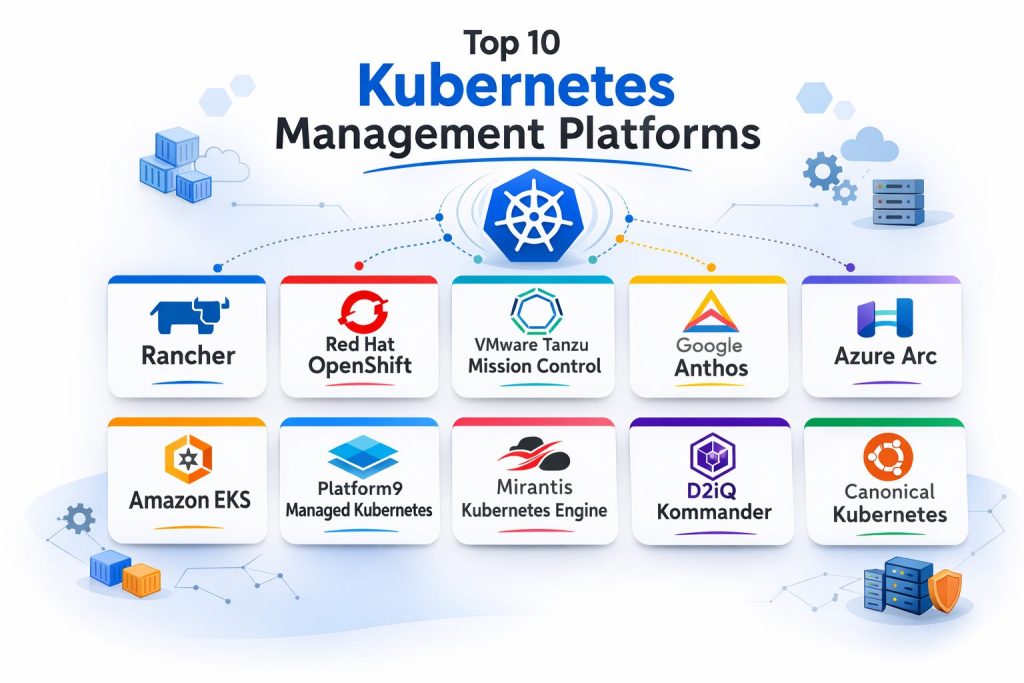
Top 10 Kubernetes Management Platforms Tools
1 — Rancher
A widely used platform for managing Kubernetes clusters across cloud and on-prem with a strong focus on multi-cluster operations, consistency, and centralized governance.
Key Features
- Centralized multi-cluster management and fleet visibility
- Cluster provisioning and lifecycle workflows (Varies by environment)
- Policy and access controls for teams and namespaces (Varies)
- App and add-on management patterns (catalog approach varies)
- Supports hybrid environments and diverse infrastructure
- Integrates with GitOps-style workflows (Varies)
- Strong UI for cluster operations and troubleshooting workflows
Pros
- Strong multi-cluster “single pane” experience
- Good fit for hybrid/on-prem teams standardizing Kubernetes operations
- Large ecosystem and broad community adoption
Cons
- Governance quality depends on how teams implement policies and processes
- Complex environments still require experienced platform engineering
- Some features depend on chosen integrations and setup choices
Platforms / Deployment
Web / Windows / macOS / Linux (management access varies)
Cloud / Self-hosted / Hybrid (Varies by architecture)
Security & Compliance
SSO/SAML, MFA, RBAC, audit logs: Varies / Not publicly stated (depends on configuration and integrations).
SOC 2 / ISO 27001 / HIPAA: Not publicly stated.
Integrations & Ecosystem
Rancher commonly connects with identity providers, GitOps tools, and observability stacks to create a consistent operating model.
- Identity providers (SSO patterns vary)
- GitOps tooling (Varies)
- Observability stacks (metrics/logs/traces)
- Policy tooling (Varies)
- Cloud and on-prem infrastructure integrations (Varies)
Support & Community
Strong community presence and documentation. Commercial support options vary by plan and vendor packaging.
2 — Red Hat OpenShift
An enterprise Kubernetes platform designed for standardized application delivery with governance and operational controls. Common in regulated and large enterprise environments.
Key Features
- Integrated platform experience for Kubernetes operations and apps
- Cluster lifecycle and upgrade workflows (Varies by deployment model)
- Strong role-based access and policy patterns (Varies)
- Built-in developer workflows and platform components (Varies)
- Hybrid and on-prem support with enterprise operational patterns
- Ecosystem alignment for enterprise integrations (Varies)
- Strong operational consistency when standardized across teams
Pros
- Enterprise-ready approach with consistent platform standards
- Strong fit for large organizations needing governance and support
- Mature ecosystem in enterprise environments
Cons
- Cost can be higher than lighter approaches
- Platform standardization requires planning and process maturity
- Some teams may find it heavy if needs are simple
Platforms / Deployment
Web / Windows / macOS / Linux (management access varies)
Cloud / Self-hosted / Hybrid (Varies by offering)
Security & Compliance
SSO/SAML, MFA, RBAC, audit logs: Varies / Not publicly stated (configuration-dependent).
SOC 2 / ISO 27001 / HIPAA: Not publicly stated.
Integrations & Ecosystem
OpenShift commonly integrates with enterprise identity, CI/CD, and security tooling to support a governed platform approach.
- Enterprise identity and RBAC integration patterns (Varies)
- CI/CD and GitOps workflows (Varies)
- Monitoring and logging stacks (Varies)
- Container registry and image governance patterns (Varies)
- ITSM and enterprise operations tooling (Varies)
Support & Community
Strong enterprise support structure and broad ecosystem. Community resources exist; support tiers depend on subscription.
3 — VMware Tanzu Mission Control
A management layer focused on multi-cluster governance and lifecycle patterns, often used by organizations standardizing operations across Kubernetes fleets.
Key Features
- Centralized multi-cluster management and fleet operations
- Policy and access control patterns across clusters (Varies)
- Lifecycle workflows and cluster visibility tooling
- Namespace and cluster-level governance approaches (Varies)
- Hybrid operational patterns (Varies by environment)
- Integrations into enterprise environments (Varies)
- Designed for consistent operations across teams
Pros
- Useful for fleet governance and centralized policy approaches
- Fits organizations already aligned with VMware ecosystem
- Supports consistent operations across multiple clusters
Cons
- Value depends on the broader environment and integration choices
- Can be complex for small teams with simple requirements
- Some capabilities vary by chosen Kubernetes and infrastructure approach
Platforms / Deployment
Web / Windows / macOS / Linux (access varies)
Cloud / Hybrid (Varies)
Security & Compliance
SSO/SAML, MFA, RBAC, audit logs: Not publicly stated (often configuration-dependent).
SOC 2 / ISO 27001 / HIPAA: Not publicly stated.
Integrations & Ecosystem
Commonly used with enterprise tooling and operational workflows to enforce consistent governance.
- Identity and access integration patterns (Varies)
- GitOps and CI/CD alignment (Varies)
- Observability tooling integrations (Varies)
- Policy tooling and cluster governance patterns (Varies)
- Enterprise infrastructure ecosystem fit (Varies)
Support & Community
Support tiers vary by plan. Community strength depends on ecosystem adoption and enterprise footprint.
4 — Google Anthos
A hybrid and multi-cloud platform approach that helps standardize Kubernetes operations and governance across environments, especially for organizations aligned with Google Cloud ecosystems.
Key Features
- Hybrid Kubernetes management approach across environments (Varies)
- Governance and policy patterns for fleets (Varies)
- Centralized visibility and configuration management patterns
- Support for consistent operations across multiple locations
- Integrations with cloud-native ecosystem tooling (Varies)
- Focus on standardization and operational consistency
- Designed for multi-environment enterprise use cases
Pros
- Strong fit for hybrid standardization initiatives
- Helpful when governance across environments is a top priority
- Aligns with modern platform engineering patterns
Cons
- Can be complex to adopt without platform engineering maturity
- Best value appears when standardizing at scale
- Some capabilities depend on environment and architecture choices
Platforms / Deployment
Web / Windows / macOS / Linux (access varies)
Hybrid (Varies)
Security & Compliance
SSO/SAML, MFA, RBAC, audit logs: Not publicly stated (configuration-dependent).
SOC 2 / ISO 27001 / HIPAA: Not publicly stated.
Integrations & Ecosystem
Typically used with identity, policy, and observability tooling to deliver consistent multi-cluster governance.
- Identity integration patterns (Varies)
- Policy and configuration management patterns (Varies)
- Observability and logging integrations (Varies)
- CI/CD and GitOps workflows (Varies)
- Multi-cloud and on-prem operational tooling (Varies)
Support & Community
Support depends on plan and enterprise relationship. Community information varies by region and adoption.
5 — Azure Arc
A hybrid management approach that extends Azure management capabilities to Kubernetes clusters running outside Azure, supporting governance and operational visibility.
Key Features
- Centralized management for Kubernetes across environments (Varies)
- Policy and governance patterns aligned with Azure management
- Inventory and visibility across clusters and resources
- Supports hybrid and edge operational models
- Integrations with Azure-native tooling (Varies)
- Helps standardize management across on-prem and cloud
- Works best in Azure-aligned enterprise environments
Pros
- Strong fit for organizations standardizing on Azure governance patterns
- Useful for hybrid environments that need centralized visibility
- Helps align operational policy across multiple clusters
Cons
- Most valuable when Azure governance is a key requirement
- Some scenarios require careful architecture and access planning
- Features vary depending on connected services and setup
Platforms / Deployment
Web / Windows / macOS / Linux (access varies)
Hybrid (Varies)
Security & Compliance
SSO/SAML, MFA, RBAC, audit logs: Not publicly stated (configuration-dependent).
SOC 2 / ISO 27001 / HIPAA: Not publicly stated.
Integrations & Ecosystem
Works well when your enterprise already uses Azure identity, policy, and operations tooling.
- Identity and access tooling alignment (Varies)
- Policy management patterns (Varies)
- Observability integrations (Varies)
- CI/CD and GitOps workflows (Varies)
- Enterprise governance and reporting patterns (Varies)
Support & Community
Support tiers vary by plan. Community and learning resources are broad but depend on use case.
6 — Amazon EKS
A managed Kubernetes service with strong operational tooling for clusters running in AWS, commonly used by teams that want managed control-plane operations and tight AWS ecosystem integration.
Key Features
- Managed Kubernetes control plane operations (service-managed)
- Integrations with AWS identity and network patterns (Varies)
- Add-on and cluster lifecycle approaches (Varies)
- Strong alignment with AWS infrastructure and services
- Scales for production workloads with managed service patterns
- Operational integration with AWS monitoring approaches (Varies)
- Fits teams that standardize primarily on AWS
Pros
- Reduces operational overhead for control-plane management
- Strong AWS ecosystem integration for networking and security patterns
- Scales well for many production workloads
Cons
- Primarily best when your workloads are AWS-centric
- Hybrid/on-prem management needs additional approaches
- Governance across many clusters still needs strong platform processes
Platforms / Deployment
Web / Windows / macOS / Linux (access varies)
Cloud (AWS-managed)
Security & Compliance
SSO/SAML, MFA, RBAC, audit logs: Not publicly stated (service + configuration dependent).
SOC 2 / ISO 27001 / HIPAA: Not publicly stated.
Integrations & Ecosystem
EKS commonly integrates with AWS-native tools and broader Kubernetes ecosystems for operations.
- AWS identity and access patterns (Varies)
- AWS networking and security integrations (Varies)
- Observability tooling integrations (Varies)
- CI/CD and GitOps workflows (Varies)
- Kubernetes add-on ecosystem (Varies)
Support & Community
Strong community and enterprise adoption. Support depends on AWS support plan and organizational setup.
7 — Platform9 Managed Kubernetes
A managed Kubernetes platform approach focused on simplifying cluster operations across different environments, often used by teams aiming for more consistent lifecycle management.
Key Features
- Multi-environment Kubernetes lifecycle management (Varies)
- Operational visibility and cluster health tooling
- Standardized cluster operations and upgrade patterns (Varies)
- Focus on reducing day-2 operational burden
- Fits hybrid and on-prem operational goals (Varies)
- Integrations with common operational tooling (Varies)
- Provides a managed operations experience (Varies by plan)
Pros
- Helpful for teams wanting managed-style operations outside a single cloud
- Supports standardization across mixed environments
- Can reduce operational burden for smaller platform teams
Cons
- Fit depends on infrastructure scope and requirements
- Advanced enterprise governance needs may require additional tooling
- Feature depth varies by deployment and plan
Platforms / Deployment
Web / Windows / macOS / Linux (access varies)
Cloud / Hybrid (Varies)
Security & Compliance
SSO/SAML, MFA, RBAC, audit logs: Not publicly stated.
SOC 2 / ISO 27001 / HIPAA: Not publicly stated.
Integrations & Ecosystem
Commonly integrates with identity and observability stacks to deliver a practical operations layer.
- Identity integrations (Varies)
- Monitoring and logging integrations (Varies)
- CI/CD and GitOps workflow alignment (Varies)
- Infrastructure integration patterns (Varies)
- Operational automation tooling (Varies)
Support & Community
Support depends on commercial plan. Community awareness varies by segment.
8 — Mirantis Kubernetes Engine
An enterprise Kubernetes platform used for managing Kubernetes in controlled environments, often aligned with organizations that need strong operational control and flexibility.
Key Features
- Kubernetes lifecycle management patterns (Varies)
- Focus on controlled operations in enterprise environments
- Works across diverse infrastructure scenarios (Varies)
- Supports standardization of cluster operations
- Integrates with enterprise tooling patterns (Varies)
- Suitable for organizations needing flexible deployment models
- Operational workflows depend on architecture choices
Pros
- Useful for enterprises running Kubernetes beyond a single cloud
- Flexible deployment patterns for controlled environments
- Good for teams that want deeper operational control
Cons
- Can require experienced operators for best results
- Ecosystem fit depends on your toolchain choices
- Implementation effort varies with environment complexity
Platforms / Deployment
Windows / macOS / Linux (management access varies)
Cloud / Self-hosted / Hybrid (Varies)
Security & Compliance
SSO/SAML, MFA, RBAC, audit logs: Not publicly stated (configuration-dependent).
SOC 2 / ISO 27001 / HIPAA: Not publicly stated.
Integrations & Ecosystem
Often integrated into enterprise operations stacks where governance and control matter.
- Identity and access tooling patterns (Varies)
- Observability stack integrations (Varies)
- CI/CD and GitOps workflows (Varies)
- Security tooling integrations (Varies)
- Infrastructure integrations (Varies)
Support & Community
Support tiers vary by plan. Community footprint varies by region and enterprise use.
9 — D2iQ Kommander
A Kubernetes management platform focused on multi-cluster operations and platform enablement, often used where centralized governance and consistency are priorities.
Key Features
- Multi-cluster operations and cluster fleet views
- Platform-level enablement patterns for teams (Varies)
- Policy and access control approaches (Varies)
- Add-on and application management patterns (Varies)
- Designed for consistency across clusters and environments
- Operational workflows depend on implementation choices
- Useful for teams building an internal platform layer
Pros
- Helpful for centralized governance and standardized operations
- Supports multi-cluster management patterns
- Good fit for platform engineering initiatives
Cons
- Requires planning to align with your operating model
- Value depends on adoption across teams and clusters
- Feature depth varies by environment and architecture
Platforms / Deployment
Web / Windows / macOS / Linux (access varies)
Cloud / Self-hosted / Hybrid (Varies)
Security & Compliance
SSO/SAML, MFA, RBAC, audit logs: Not publicly stated.
SOC 2 / ISO 27001 / HIPAA: Not publicly stated.
Integrations & Ecosystem
Designed to connect with common operational tooling to build a managed platform experience.
- Identity provider integrations (Varies)
- Observability and monitoring integrations (Varies)
- CI/CD and GitOps alignment (Varies)
- Policy tooling integrations (Varies)
- Infrastructure integrations (Varies)
Support & Community
Support depends on subscription. Community knowledge exists but varies by region and use case.
10 — Canonical Kubernetes
A Kubernetes distribution and platform approach that can be operated with strong automation and lifecycle control patterns, often used by teams that want predictable operations across environments.
Key Features
- Kubernetes distribution approach for controlled environments (Varies)
- Automation and lifecycle operations patterns (Varies)
- Supports hybrid and on-prem deployment goals (Varies)
- Designed for repeatable cluster operations and upgrades
- Ecosystem alignment for enterprise infrastructure tooling (Varies)
- Good fit for teams prioritizing operational consistency
- Works well when paired with strong platform practices
Pros
- Flexible for on-prem and controlled environment deployments
- Useful where automation and repeatability are priorities
- Can be cost-effective depending on support choices
Cons
- Requires solid operational discipline for best outcomes
- Some management capabilities depend on the chosen architecture
- Enterprise governance features vary by setup and integrations
Platforms / Deployment
Windows / macOS / Linux (management access varies)
Self-hosted / Hybrid (Varies)
Security & Compliance
SSO/SAML, MFA, RBAC, audit logs: Not publicly stated (configuration-dependent).
SOC 2 / ISO 27001 / HIPAA: Not publicly stated.
Integrations & Ecosystem
Typically integrated into infrastructure and operations tooling for consistent delivery and governance.
- Identity and access integrations (Varies)
- Observability stack integrations (Varies)
- CI/CD and GitOps workflows (Varies)
- Automation and configuration tooling (Varies)
- Infrastructure ecosystem integrations (Varies)
Support & Community
Strong Linux and infrastructure community presence. Commercial support options vary.
Comparison Table
| Tool Name | Best For | Platform(s) Supported | Deployment | Standout Feature | Public Rating |
|---|---|---|---|---|---|
| Rancher | Multi-cluster management across hybrid environments | Web (access varies), Windows / macOS / Linux | Cloud / Self-hosted / Hybrid (Varies) | Fleet management + centralized governance | N/A |
| Red Hat OpenShift | Enterprise Kubernetes standardization | Web (access varies), Windows / macOS / Linux | Cloud / Self-hosted / Hybrid (Varies) | Enterprise platform consistency | N/A |
| VMware Tanzu Mission Control | Central governance for Kubernetes fleets | Web (access varies), Windows / macOS / Linux | Cloud / Hybrid (Varies) | Central policy and fleet operations | N/A |
| Google Anthos | Hybrid standardization across environments | Web (access varies), Windows / macOS / Linux | Hybrid (Varies) | Multi-environment governance approach | N/A |
| Azure Arc | Azure-aligned hybrid Kubernetes governance | Web (access varies), Windows / macOS / Linux | Hybrid (Varies) | Extending Azure governance to clusters | N/A |
| Amazon EKS | Managed Kubernetes in AWS | Web (access varies), Windows / macOS / Linux | Cloud | AWS-native managed operations | N/A |
| Platform9 Managed Kubernetes | Simplified lifecycle operations across environments | Web (access varies), Windows / macOS / Linux | Cloud / Hybrid (Varies) | Managed-style operations layer | N/A |
| Mirantis Kubernetes Engine | Controlled enterprise Kubernetes operations | Windows / macOS / Linux (access varies) | Cloud / Self-hosted / Hybrid (Varies) | Flexible enterprise deployment patterns | N/A |
| D2iQ Kommander | Platform enablement and multi-cluster operations | Web (access varies), Windows / macOS / Linux | Cloud / Self-hosted / Hybrid (Varies) | Centralized platform management layer | N/A |
| Canonical Kubernetes | Automated, repeatable Kubernetes operations | Windows / macOS / Linux (access varies) | Self-hosted / Hybrid (Varies) | Automation-first operational model | N/A |
Evaluation & Scoring of Kubernetes Management Platforms
Scoring model
- Scale: 1–10 per criterion
- Weighted total: 0–10 using the weights below
- Scores are comparative within this shortlist and reflect typical operational fit
- Security scoring is conservative because outcomes depend on identity, policies, and governance choices
- Value scoring reflects expected return versus cost and operational effort (Varies by contracts and scale)
Weights
- Core features – 25%
- Ease of use – 15%
- Integrations & ecosystem – 15%
- Security & compliance – 10%
- Performance & reliability – 10%
- Support & community – 10%
- Price / value – 15%
| Tool Name | Core (25%) | Ease (15%) | Integrations (15%) | Security (10%) | Performance (10%) | Support (10%) | Value (15%) | Weighted Total (0–10) |
|---|---|---|---|---|---|---|---|---|
| Rancher | 9 | 8 | 8 | 7 | 8 | 8 | 9 | 8.30 |
| Red Hat OpenShift | 10 | 7 | 9 | 8 | 9 | 8 | 6 | 8.30 |
| VMware Tanzu Mission Control | 8 | 7 | 8 | 7 | 8 | 7 | 6 | 7.35 |
| Google Anthos | 9 | 6 | 9 | 8 | 8 | 7 | 5 | 7.55 |
| Azure Arc | 8 | 7 | 8 | 7 | 7 | 7 | 7 | 7.40 |
| Amazon EKS | 8 | 7 | 8 | 7 | 9 | 8 | 7 | 7.70 |
| Platform9 Managed Kubernetes | 8 | 8 | 7 | 7 | 7 | 7 | 7 | 7.40 |
| Mirantis Kubernetes Engine | 8 | 6 | 7 | 7 | 8 | 7 | 6 | 7.05 |
| D2iQ Kommander | 8 | 7 | 7 | 7 | 7 | 7 | 6 | 7.10 |
| Canonical Kubernetes | 7 | 7 | 6 | 7 | 7 | 7 | 8 | 7.00 |
How to interpret the scores:
- Use the weighted total to shortlist, then validate with a pilot in your real environment
- If governance is your top priority, focus on Security + Integrations + Core
- If you run many clusters, prioritize Core + Performance + Integrations
- If you want fast adoption, prioritize Ease + Support + Value
Which Kubernetes Management Platform Is Right for You?
Solo / Freelancer
Most solo users don’t need a full management platform unless they operate clusters for clients.
- If you manage client clusters: prefer a simpler operational approach that matches the client’s cloud
- If you want skills growth: focus on learning lifecycle basics, upgrades, RBAC, and GitOps patterns
Recommendation: avoid heavy platforms unless a real multi-cluster need exists.
SMB
SMBs need reliability without building a large platform team.
- If you are AWS-first: Amazon EKS is often the practical path
- If you are hybrid/on-prem: Rancher can help centralize cluster management
- If you need managed-style operations across environments: Platform9 Managed Kubernetes can be worth evaluating
Recommendation: choose the tool that reduces your day-2 burden the most.
Mid-Market
Mid-market teams often have multiple clusters, multiple teams, and growing governance needs.
- Hybrid governance: Rancher, Azure Arc, or Google Anthos (based on cloud alignment)
- If standardization and enterprise process matters: Red Hat OpenShift
- If you build an internal platform layer: D2iQ Kommander can be a fit depending on your goals
Recommendation: standardize upgrades, policies, and add-ons early to prevent cluster sprawl.
Enterprise
Enterprise teams need strong governance, support, and predictable operations across many teams.
- Enterprise standard platform: Red Hat OpenShift
- Large hybrid governance programs: Google Anthos or Azure Arc (based on enterprise alignment)
- Multi-cluster governance in VMware-heavy environments: VMware Tanzu Mission Control
Recommendation: treat platform selection as an operating model decision, not only a feature decision.
Budget vs Premium
- Budget-optimized: prioritize reducing operational headcount requirements and complexity
- Premium/enterprise: prioritize consistent governance, support, and standardized platform components
Recommendation: measure cost as “licenses + people + incident risk,” not licenses alone.
Feature Depth vs Ease of Use
- Deep enterprise platform approach: Red Hat OpenShift
- Practical hybrid management: Rancher
- Cloud-native managed operations: Amazon EKS
Recommendation: the right balance depends on how many clusters you run and how strict your governance needs are.
Integrations & Scalability
- AWS ecosystem depth: Amazon EKS
- Azure governance alignment: Azure Arc
- Multi-environment governance programs: Google Anthos
- Broad multi-cluster management: Rancher
Recommendation: prioritize the integrations you will actually operationalize: identity, GitOps, monitoring, and policy.
Security & Compliance Needs
Security outcomes depend on how you implement identity, policy, and audit workflows.
- If you need strict governance: pick a platform that supports strong RBAC and policy patterns, then enforce them
- If you operate regulated workloads: prioritize auditability, change control, and consistent upgrade processes
Recommendation: validate security controls in a pilot and map them to your internal compliance requirements.
Frequently Asked Questions
What is the main job of a Kubernetes management platform?
It helps you run Kubernetes at scale by standardizing provisioning, upgrades, policies, access control, add-ons, and fleet visibility across many clusters.
Do I need a platform if I use a managed cloud Kubernetes service?
Sometimes yes. Managed services reduce control-plane work, but governance across many clusters still needs policy, visibility, and operational consistency.
How do I avoid Kubernetes cluster sprawl?
Create standards for cluster creation, enforce policies, use GitOps for change control, and regularly review unused clusters and namespaces.
What is the biggest mistake teams make with Kubernetes management tools?
They buy a platform but don’t define an operating model: who owns upgrades, who approves changes, what policies are enforced, and how incidents are handled.
How should we evaluate a platform before committing?
Run a pilot with real clusters, test upgrades, validate identity integration, enforce a few policies, and confirm day-2 workflows like backup, restore, and incident response.
Can one platform manage on-prem, cloud, and edge clusters together?
Many platforms claim hybrid support, but actual capability varies by environment and architecture. Confirm with a pilot in your target environments.
What security features should we prioritize first?
RBAC with least privilege, strong authentication patterns, audit logs, policy guardrails, and controlled upgrade processes. Compliance claims should be treated as “Not publicly stated” unless verified.
How important is GitOps for Kubernetes management?
Very important for stability at scale. GitOps helps make changes auditable, repeatable, and safer, especially when multiple teams share clusters.
How hard is it to migrate from one management platform to another?
It can be difficult due to differences in cluster build standards, policies, add-ons, and workflows. Migration is easier when clusters are standardized and changes are controlled.
What is a safe next step if we are unsure which platform fits?
Shortlist 2–3 options, run a structured pilot, validate integrations and upgrades, then choose the platform that best reduces day-2 risk for your environment.
Conclusion
Kubernetes management platforms exist to make Kubernetes operationally sustainable. The “best” choice depends on your environment, cloud alignment, governance needs, and the size of your cluster fleet. If you are hybrid and want centralized fleet visibility, Rancher is commonly evaluated. If you need enterprise standardization and support-driven operations, Red Hat OpenShift is often a strong contender. If you are cloud-centric, services like Amazon EKS can reduce operational overhead, while governance layers like Azure Arc or Google Anthos can help standardize hybrid operation