Introduction
IT Service Management (ITSM) tools are specialized software platforms designed to help organizations manage the end-to-end delivery of IT services to their customers and employees. This involves a set of policies, processes, and procedures for creating, planning, delivering, and supporting IT services. In the current landscape, ITSM has evolved from simple ticketing systems into AI-driven “Service Experience” platforms that prioritize automation, predictive analytics, and seamless employee self-service.
Modern ITSM tools are now the central nervous system of the enterprise, integrating deeply with DevOps, security operations (SecOps), and HR workflows. They utilize machine learning to resolve common incidents before they reach a human agent and provide real-time visibility into the health of digital infrastructure.
Real-World Use Cases:
- Incident Management: Rapidly restoring service after an unplanned interruption.
- Change Enablement: Minimizing risks when introducing new software or hardware updates.
- Asset Management: Tracking the lifecycle of hardware and software licenses across the organization.
- Service Request Fulfillment: Automating the onboarding process for new employees.
- Problem Management: Identifying the root causes of recurring incidents to prevent future downtime.
Evaluation Criteria for Buyers:
- ITIL Alignment: Does the tool support ITIL 4 frameworks natively?
- AI/AIOps Capabilities: Can it automate ticket categorization and routing?
- Ease of Implementation: How long is the time-to-value for deployment?
- Integration Ecosystem: Does it connect with your existing Jira, Slack, or Azure environment?
- Self-Service Portal: Is the interface intuitive enough for non-technical employees?
- Scalability: Can the platform support global operations with complex security needs?
Mandatory Paragraph
- Best for: Enterprise IT departments, Managed Service Providers (MSPs), and organizations undergoing digital transformation that require structured service delivery.
- Not ideal for: Very small teams with under 5 employees who only need basic task tracking, or companies without any formal IT processes.
Key Trends in ITSM Software
- AIOps Integration: Using artificial intelligence to correlate events and predict outages.
- Shift-Left Automation: Empowering users to solve their own issues via AI-powered chatbots and knowledge bases.
- Enterprise Service Management (ESM): Expanding ITSM principles to non-IT departments like HR, Facilities, and Legal.
- Experience Level Agreements (XLAs): Moving beyond technical SLAs to measure actual employee satisfaction and productivity.
- Low-Code/No-Code Customization: Allowing IT managers to build workflows without writing extensive code.
- Hyper-Automation: The use of robotic process automation (RPA) to handle repetitive service requests.
How We Selected These Tools (Methodology)
- Market Adoption: We focused on tools with significant market share and proven reliability in the enterprise space.
- Feature Completeness: Only platforms offering a full suite of ITIL-aligned modules were considered.
- Security Posture: Evaluation of built-in security features and enterprise-grade compliance.
- Integration Maturity: Priority was given to tools with robust API ecosystems and native connectors.
- User Feedback: Consideration of professional reviews and community sentiment regarding ease of use.
- Future-Proofing: Analysis of the vendor’s roadmap regarding AI and cloud-native features.
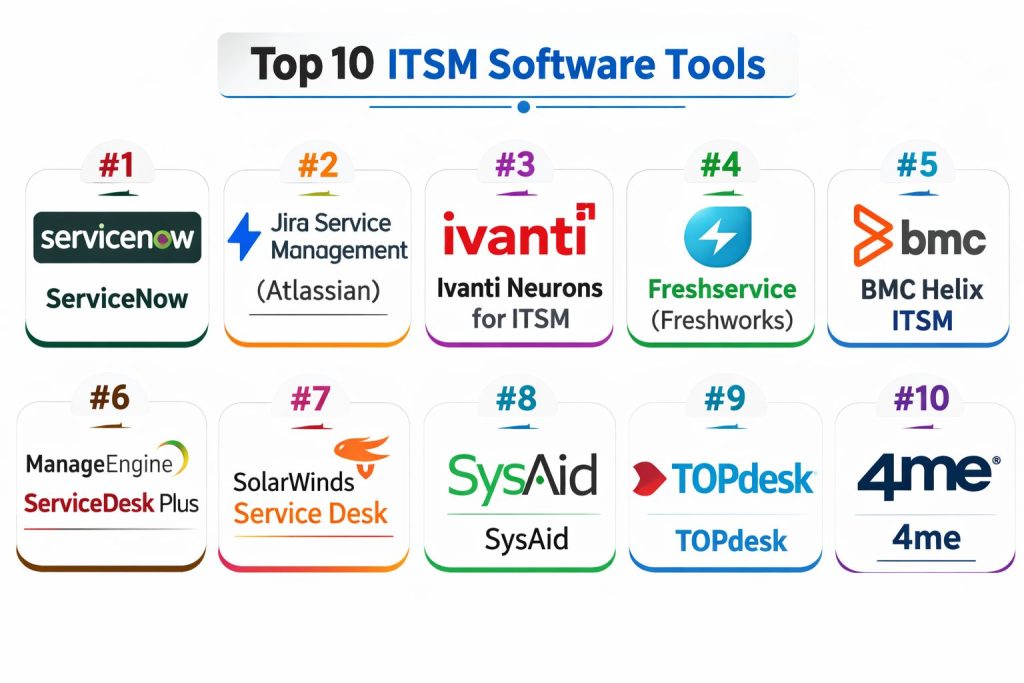
Top 10 ITSM Software Tools
#1 — ServiceNow
The industry leader in enterprise service management, providing a highly scalable cloud platform for complex organizational workflows.
Key Features
- Predictive Intelligence: AI-driven incident categorization and routing.
- Now Assist: Generative AI for summarizing tickets and generating knowledge articles.
- Configuration Management Database (CMDB): A single system of record for all IT assets.
- Service Mapping: Real-time visibility into how infrastructure impacts business services.
- Flow Designer: A low-code environment for building cross-departmental automations.
Pros
- Unmatched scalability for global enterprises.
- Extensive ecosystem of third-party integrations and developers.
Cons
- Extremely high total cost of ownership.
- Significant complexity requires specialized administrators.
Platforms / Deployment
- Web / Windows / macOS / iOS / Android
- Cloud / Hybrid
Security & Compliance
- SSO/SAML, MFA, RBAC, Encryption
- SOC 2, ISO 27001, HIPAA, FedRAMP
Integrations & Ecosystem
ServiceNow functions as a “platform of platforms,” connecting almost every enterprise application.
- Microsoft Azure
- Jira
- Slack
- Salesforce
Support & Community
World-class enterprise support and an enormous global community of certified professionals.
#2 — Jira Service Management (Atlassian)
A high-velocity ITSM tool built on the Jira platform, designed to bridge the gap between development and IT operations.
Key Features
- DevOps Integration: Native connection to Jira Software for seamless incident-to-dev workflows.
- Asset & Configuration Management: Integrated tracking of equipment and licenses.
- Automation Engine: Powerful “if-this-then-that” rules for ticket handling.
- Form Builder: Low-code forms for customized service requests.
- Knowledge Management: Powered by Confluence integration.
Pros
- Excellent value for teams already using Atlassian products.
- Faster deployment compared to traditional enterprise suites.
Cons
- Can become cluttered as the number of projects grows.
- Advanced features often require additional Atlassian subscriptions.
Platforms / Deployment
- Web / Windows / macOS / iOS / Android
- Cloud / Self-hosted (Data Center)
Security & Compliance
- SSO/SAML, MFA, RBAC
- SOC 2, ISO 27001, GDPR
Integrations & Ecosystem
Strongest in the developer ecosystem, leveraging the Atlassian Marketplace.
- Bitbucket
- GitHub
- Jenkins
- Opsgenie
Support & Community
Very strong community support via Atlassian University and online forums.
#3 — Ivanti Neurons for ITSM
A robust platform focusing on automation and self-healing capabilities for the “Everywhere Workplace.”
Key Features
- Neurons for Healing: Bots that detect and resolve endpoint issues proactively.
- Voice Automation: Integrated phone support with automated ticket creation.
- Discovery: Automated scanning of all network-connected assets.
- Patch Management: Integrated security patching within the ITSM workflow.
- AI Chatbots: Sophisticated virtual assistants for employee self-service.
Pros
- Exceptional focus on security and endpoint management.
- High degree of flexibility in workflow design.
Cons
- The interface can feel dated compared to newer competitors.
- Implementation can be resource-intensive.
Platforms / Deployment
- Web / Windows / iOS / Android
- Cloud / Self-hosted / Hybrid
Security & Compliance
- SSO/SAML, MFA, RBAC
- SOC 2, HIPAA
Integrations & Ecosystem
Focuses heavily on IT operations and security toolsets.
- Microsoft Endpoint Manager
- Splunk
- Okta
Support & Community
Strong professional services and a dedicated global user base.
#4 — Freshservice (Freshworks)
A modern, user-friendly ITSM solution designed for fast time-to-value and high employee adoption.
Key Features
- Freddy AI: An AI suite for agent productivity and conversational support.
- Service Catalog: A visually appealing “shopping” experience for IT services.
- Release Management: Tools for planning and tracking software releases.
- Sandbox Environment: Test changes safely before pushing to production.
- Gamification: Mechanics to encourage agent performance and ticket resolution.
Pros
- Very easy to set up and use.
- Highly intuitive interface for end-users.
Cons
- May lack some of the deep customization required by massive enterprises.
- Reporting features are less advanced than ServiceNow.
Platforms / Deployment
- Web / iOS / Android
- Cloud
Security & Compliance
- SSO/SAML, MFA, RBAC
- ISO 27001, HIPAA, GDPR
Integrations & Ecosystem
Strong library of “out-of-the-box” connectors for SMB and Mid-market tools.
- Slack
- Microsoft Teams
- Zoom
Support & Community
Highly rated for customer support and simplified onboarding.
#5 — BMC Helix ITSM
A cognitive service management platform that integrates AI and machine learning into the entire service lifecycle.
Key Features
- Cognitive Service Management: Automated classification and resolution of tickets.
- Multi-Cloud Management: Visibility across AWS, Azure, and Google Cloud.
- Digital Workplace: A unified portal for all corporate services.
- Smart Reporting: Advanced analytics powered by AI.
- Live Chat: Seamless transition from bot to human agents.
Pros
- Extremely powerful for complex, multi-cloud environments.
- Deeply rooted in ITIL best practices.
Cons
- High learning curve for administrators.
- Expensive licensing.
Platforms / Deployment
- Web / Windows / macOS / iOS / Android
- Cloud / Hybrid
Security & Compliance
- SSO/SAML, MFA, RBAC
- FedRAMP, SOC 2
Integrations & Ecosystem
Well-suited for enterprise-grade hardware and software stacks.
- SAP
- Oracle
- Microsoft 365
Support & Community
Extensive documentation and long-standing presence in the IT industry.
#6 — ManageEngine ServiceDesk Plus
A comprehensive ITSM suite that offers a balanced mix of features and affordability for mid-sized organizations.
Key Features
- Zia AI: An AI assistant for ticket analysis and user interactions.
- Project Management: Integrated modules for managing IT projects.
- Enterprise Service Management: Quick deployment for HR or Facilities.
- Asset Discovery: Scans Windows, Linux, and macOS devices automatically.
- Visual Workflow Builder: Drag-and-drop tool for designing ITIL processes.
Pros
- Very cost-effective compared to enterprise leaders.
- Extensive range of built-in modules without needing external plugins.
Cons
- User interface can be cluttered.
- Cloud version and on-premise version features can differ significantly.
Platforms / Deployment
- Web / Windows / Linux / iOS / Android
- Cloud / Self-hosted
Security & Compliance
- SSO/SAML, MFA, RBAC
- Not publicly stated
Integrations & Ecosystem
Deeply integrated with the broader ManageEngine and Zoho ecosystems.
- Desktop Central
- OpManager
- Zoho CRM
Support & Community
Active community forums and extensive video tutorial libraries.
#7 — SolarWinds Service Desk
A cloud-native ITSM platform designed to provide quick resolution through strong asset integration and smart ticket routing.
Key Features
- Smart Ticketing: AI suggests relevant knowledge articles to agents.
- Risk Detection: Automatically identifies potential risks in the CMDB.
- Service Portal: Customizable interface for employee requests.
- Employee Sentiment: Tracks user satisfaction trends over time.
- Mobile App: Full agent capabilities on mobile devices.
Pros
- Strongest asset management features in its class.
- Modern, clean, and fast interface.
Cons
- Pricing can escalate quickly based on the number of managed assets.
- Lacks some advanced ESM capabilities of larger platforms.
Platforms / Deployment
- Web / iOS / Android
- Cloud
Security & Compliance
- SSO/SAML, MFA, RBAC
- SOC 2
Integrations & Ecosystem
Connects well with common IT monitoring and management tools.
- SolarWinds Orion
- Microsoft Teams
- Jira
Support & Community
SolarWinds “THWACK” community is one of the largest IT forums in the world.
#8 — SysAid
An ITSM tool that emphasizes automation and generative AI to reduce the workload on IT agents.
Key Features
- SysAid Copilot: Generative AI for ticket summaries and resolution suggestions.
- One-Click Password Reset: Integrated automation for a common service request.
- Asset Management: Hardware and software inventory with monitoring.
- Workflow Automation: Visual designer for complex service paths.
- Built-in Remote Control: Direct access to user machines for troubleshooting.
Pros
- Strong emphasis on “practical” automation that saves time daily.
- Good all-in-one feature set for the price.
Cons
- Customization can be limited compared to ServiceNow.
- Some users find the interface less modern than Freshservice.
Platforms / Deployment
- Web / Windows / iOS / Android
- Cloud / Self-hosted
Security & Compliance
- SSO/SAML, MFA, RBAC
- ISO 27001
Integrations & Ecosystem
Covers the essentials for mid-market IT environments.
- Microsoft 365
- Azure AD
- TeamViewer
Support & Community
Strong customer success programs and a dedicated user community.
#9 — TOPdesk
A modular ITSM solution with a focus on ease of use and departmental collaboration.
Key Features
- Self-Service Portal: Highly praised for its simplicity and user adoption.
- Shift-Left Focus: Extensive tools for knowledge-centered service.
- Modular Design: Buy only the modules you need (Incident, Asset, etc.).
- Change Management: Visual timelines for planning IT changes.
- Operations Management: Tracking physical assets alongside digital ones.
Pros
- Excellent for organizations starting their ITSM journey.
- Highly collaborative for non-IT departments.
Cons
- Lacks the deep AIOps features of ServiceNow or BMC.
- Not as widely used in the US market as European markets.
Platforms / Deployment
- Web / iOS / Android
- Cloud / Self-hosted
Security & Compliance
- SSO/SAML, RBAC
- ISO 27001, GDPR
Integrations & Ecosystem
Open API allows for flexible connections with European software ecosystems.
- Microsoft Teams
- Outlook
- Power BI
Support & Community
Known for personalized support and high customer satisfaction ratings.
#10 — 4me
A unique ITSM platform designed specifically for “Service-Oriented Enterprises” that manage multiple internal and external service providers.
Key Features
- Service Hierarchy: Native support for managing outsourced providers.
- Real-time SLA Tracking: Monitors performance across all vendors.
- Collaboration Bridge: Allows different organizations using 4me to connect.
- Auto-Discovery: Low-impact asset scanning.
- Clean UI: A minimalist approach to the agent interface.
Pros
- The best tool for companies with many outsourced IT vendors.
- Transparent pricing and easy maintenance.
Cons
- The unique “bridge” architecture has a learning curve.
- Smaller third-party plugin marketplace.
Platforms / Deployment
- Web / iOS / Android
- Cloud
Security & Compliance
- SSO/SAML, MFA, RBAC
- SOC 2, ISO 27001
Integrations & Ecosystem
Focused on connecting different service silos.
- SAP
- Microsoft Azure
- ServiceNow (via bridge)
Support & Community
Dedicated support with a focus on professional service providers.
Comparison Table (Top 10)
| Tool Name | Best For | Platform(s) Supported | Deployment | Standout Feature | Public Rating |
| ServiceNow | Global Enterprise | Win, Mac, iOS, Android | Hybrid | AI Generative Summaries | 4.8 |
| Jira Service Mgmt | DevOps Teams | Win, Mac, iOS, Android | Cloud/Self-hosted | Native Jira Integration | 4.7 |
| Ivanti Neurons | Endpoint Security | Win, iOS, Android | Hybrid | Self-Healing Bots | 4.5 |
| Freshservice | Mid-Market/Ease of Use | iOS, Android | Cloud | Freddy AI Bot | 4.6 |
| BMC Helix | Multi-Cloud Complexity | Win, Mac, iOS, Android | Hybrid | Cognitive Service Mgmt | 4.4 |
| ManageEngine | Cost-Effective ITIL | Win, Linux, iOS, Android | Cloud/Self-hosted | Unified Asset Discovery | 4.3 |
| SolarWinds SD | Asset-Centric IT | iOS, Android | Cloud | Integrated Risk Detection | 4.5 |
| SysAid | Practical Automation | Win, iOS, Android | Cloud/Self-hosted | SysAid Copilot | 4.4 |
| TOPdesk | Collaborative Service | iOS, Android | Cloud/Self-hosted | Knowledge-First Portal | 4.5 |
| 4me | Vendor Management | iOS, Android | Cloud | Multi-Provider Bridge | 4.6 |
Evaluation & Scoring of ITSM Tools
| Tool Name | Core (25%) | Ease (15%) | Integrations (15%) | Security (10%) | Performance (10%) | Support (10%) | Value (15%) | Weighted Total |
| ServiceNow | 10 | 5 | 10 | 10 | 9 | 9 | 5 | 8.20 |
| Jira Service Mgmt | 8 | 8 | 10 | 8 | 9 | 8 | 9 | 8.45 |
| Ivanti Neurons | 9 | 6 | 8 | 9 | 8 | 8 | 7 | 7.75 |
| Freshservice | 8 | 10 | 8 | 8 | 9 | 9 | 8 | 8.45 |
| BMC Helix | 10 | 5 | 9 | 9 | 9 | 8 | 6 | 8.00 |
| ManageEngine | 8 | 7 | 8 | 7 | 8 | 8 | 9 | 7.85 |
| SolarWinds SD | 8 | 9 | 8 | 8 | 8 | 8 | 7 | 8.00 |
| SysAid | 8 | 8 | 7 | 8 | 8 | 8 | 8 | 7.85 |
| TOPdesk | 7 | 9 | 7 | 8 | 8 | 9 | 8 | 7.75 |
| 4me | 8 | 8 | 9 | 9 | 9 | 8 | 8 | 8.35 |
The scoring provided is comparative. A high score in “Core” reflects deep ITIL feature sets, while “Ease” measures the user experience for both agents and employees.
Which ITSM Tool Is Right for You?
Solo / Freelancer
ITSM tools are generally designed for teams, but if you manage external clients, a light version of Freshservice or ManageEngine can help organize your tickets efficiently without high costs.
SMB
For small businesses, Freshservice offers the most modern and approachable interface. If you are already in the Atlassian ecosystem, Jira Service Management is a logical and cost-effective extension.
Mid-Market
Mid-market companies with complex assets will find the best balance in SolarWinds Service Desk or SysAid. These tools provide enterprise-grade features without the administrative overhead of ServiceNow.
Enterprise
ServiceNow remains the gold standard for large-scale enterprise automation. However, if your enterprise is primarily cloud-focused and relies heavily on external vendors, 4me offers a compelling alternative.
Budget vs Premium
ManageEngine ServiceDesk Plus is the go-to budget-friendly option. ServiceNow and BMC Helix are the premium offerings, carrying price tags that reflect their massive feature sets and integration capabilities.
Feature Depth vs Ease of Use
Houdini-like depth is found in ServiceNow, but it requires a full-time staff to manage. TOPdesk and Freshservice prioritize ease of use, making them better for organizations without a dedicated ITSM team.
Integrations & Scalability
Jira Service Management leads in integration flexibility for technical teams. ServiceNow remains the most scalable platform for global corporations with tens of thousands of employees.
Security & Compliance Needs
For highly regulated industries (Finance, Gov, Healthcare), ServiceNow, BMC Helix, and Ivanti provide the most robust compliance certifications and security auditing tools.
Frequently Asked Questions (FAQs)
What is the difference between ITSM and a Help Desk?
A help desk is a subset of ITSM focused on fixing problems (“break-fix”). ITSM is a broader framework that includes planning, managing, and improving the entire lifecycle of IT services.
How long does it take to implement an ITSM tool?
Deployment can range from a few weeks for tools like Freshservice to 6–18 months for a full-scale ServiceNow implementation at a large enterprise.
Are these tools ITIL 4 compliant?
Most leading tools are built around ITIL 4 principles, but compliance depends on how you configure the workflows within the software.
Can ITSM tools be used for non-IT departments?
Yes, this is called Enterprise Service Management (ESM). Many organizations use these tools for HR onboarding, facilities maintenance, and legal document tracking.
What is a CMDB and why do I need one?
A Configuration Management Database (CMDB) is a repository that acts as a data warehouse for your IT environment, showing the relationships between all your hardware and software assets.
How does AI improve ITSM?
AI improves ITSM by automating ticket routing, providing instant answers to users through chatbots, and predicting potential system failures before they occur.
What is the “Shift-Left” strategy?
Shift-left involves moving ticket resolution as close to the user as possible through self-service and automation, reducing the burden on high-level IT staff.
Can I switch between ITSM tools easily?
Switching is a major project that involves migrating the CMDB and historical ticket data. Most tools offer migration APIs, but it requires careful planning.
Is cloud or on-premise better for ITSM?
Cloud is now the standard for ITSM due to faster updates and lower maintenance, though some highly regulated industries still prefer self-hosted models for data control.
How do I measure the success of my ITSM tool?
Success is typically measured via Key Performance Indicators (KPIs) like First Response Time, Mean Time to Resolve (MTTR), and Employee Satisfaction (CSAT) scores.
Conclusion
Selecting an ITSM tool requires balancing the need for advanced AI automation with the practical reality of your team’s size and budget. ServiceNow continues to define the enterprise space, while Jira Service Management and Freshservice offer high-velocity alternatives that are easier to deploy. We recommend defining your core ITIL requirements first, then shortlisting two tools for a focused pilot program to evaluate their real-world impact on your service delivery.