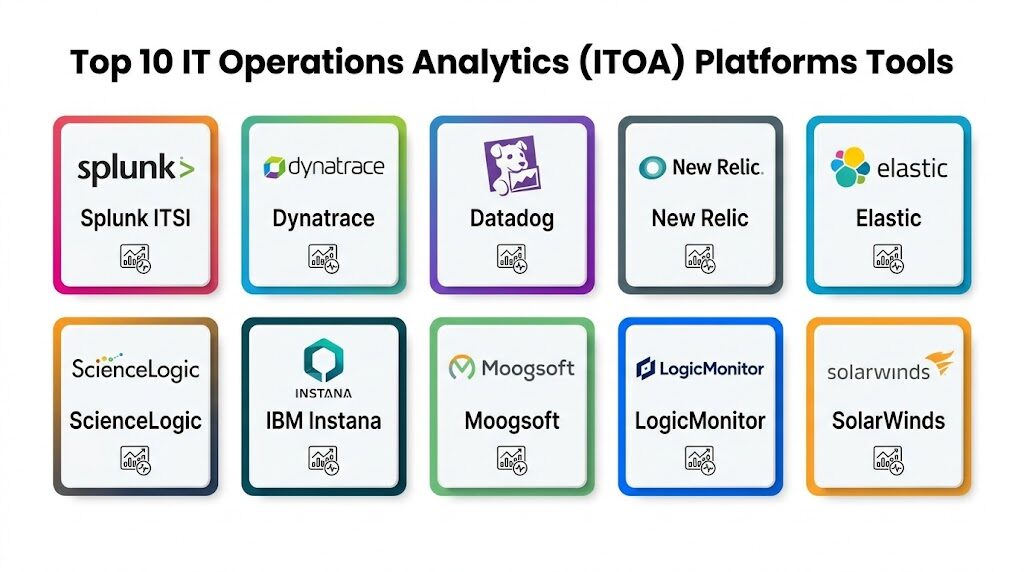
Introduction
IT Operations Analytics (ITOA) serves as the primary intelligence layer for modern digital enterprises, transforming vast streams of raw telemetry into actionable operational insights. As infrastructure scales into highly distributed microservices and hybrid cloud environments, the sheer volume of logs, metrics, and traces exceeds human capacity for manual correlation. ITOA platforms utilize advanced mathematical models and machine learning to identify patterns, detect anomalies, and predict potential system failures before they impact the end-user. By centralizing data from disparate silos—including compute, storage, networking, and application layers—these platforms provide a unified “single pane of glass” for Site Reliability Engineering (SRE) and DevOps teams to maintain high availability and performance.
The transition from reactive monitoring to proactive analytics is the hallmark of a mature IT organization. Modern ITOA tools go beyond simple threshold-based alerting; they employ sophisticated root-cause analysis engines that map dependencies across complex stacks. This systemic visibility is critical for reducing Mean Time to Resolution (MTTR) and optimizing resource allocation. In an era where digital experience is synonymous with brand reputation, ITOA platforms act as a strategic safeguard, ensuring that the underlying technical complexity remains transparent and resilient. Selecting the right platform requires a deep understanding of your data ingestion requirements, the existing architectural landscape, and the specific automation goals of your operations team.
Best for: Enterprise IT departments, SRE teams, and Managed Service Providers (MSPs) who manage complex, high-transaction environments and require automated, data-driven decision-making to maintain system reliability.
Not ideal for: Small businesses with static, low-complexity local networks where the cost and configuration overhead of a dedicated analytics engine may outweigh the operational benefits.
Key Trends in IT Operations Analytics Platforms
The defining trend in 2026 is the mainstreaming of Agentic AIOps, where platforms no longer just alert on problems but deploy autonomous “agents” to perform initial triage and remediation. These AI agents can summarize complex incident logs, suggest specific code fixes, and even roll back problematic deployments without human intervention. This shift is accompanied by a massive movement toward OpenTelemetry (OTel) as the standard for data collection, providing organizations with the flexibility to switch analytics backends without re-instrumenting their entire application stack.
Sustainability and “GreenOps” have also entered the ITOA sphere, with platforms now providing detailed analytics on the carbon footprint of cloud workloads and suggesting optimizations to reduce energy consumption. Furthermore, there is a significant push toward “Edge Analytics,” where data is processed locally at the edge of the network rather than being backhauled to a central cloud. This reduces latency for real-time decision-making in IoT-heavy industries. Lastly, governance and explainability are becoming mandatory; as AI takes a larger role in operations, IT leaders are demanding “Glass Box” AI that provides clear, auditable reasons for every automated action and alert.
How We Selected These Tools
Our selection process focused on platforms that demonstrate technical excellence in handling the “Four V’s” of big data: Volume, Velocity, Variety, and Veracity. We prioritized tools that offer native, deep-learning-based anomaly detection rather than those relying purely on manual rule sets. The robustness of the integration ecosystem was a primary criterion, as an ITOA tool is only as effective as the data it can ingest from the broader environment. We specifically looked for platforms that bridge the gap between traditional “bare metal” infrastructure and modern serverless or Kubernetes-based workloads.
Security posture and compliance were heavily weighted, particularly the ability of the platform to handle sensitive log data while maintaining GDPR and SOC 2 standards. We also evaluated “Time-to-Value,” favoring platforms that offer auto-discovery of assets and pre-built analytics dashboards that allow teams to get started quickly. Finally, we considered the financial sustainability of each tool’s pricing model, looking for transparent, predictable costs that do not penalize organizations for the natural growth of their telemetry data.
1. Splunk IT Service Intelligence (ITSI)
Splunk ITSI is a premium analytics solution built on top of the industry-standard Splunk Enterprise platform. It is designed for large-scale environments that require deep historical investigation and complex event correlation across diverse data sources.
Key Features
The platform features “Adaptive Thresholding,” which uses machine learning to calculate what “normal” looks like based on historical trends rather than static numbers. It provides a Service Health Score that aggregates data from multiple KPIs into a single, high-level metric for business leaders. The “Event Analytics” engine automatically groups related alerts into “Episodes,” significantly reducing alert noise. It includes a deep library of pre-built “Content Packs” for specific technologies like Microsoft 365 or VMware. Additionally, its “Glass Tables” feature allows for the creation of custom, real-time visualizations that map technical performance to business outcomes.
Pros
Unmatched power for deep-dive log analysis and historical forensic investigation. The platform is highly extensible, allowing for the creation of virtually any custom analytics workflow.
Cons
The pricing model (often referred to as the “Splunk Tax”) can become extremely expensive as data ingestion grows. It has a steep learning curve and often requires dedicated certified administrators.
Platforms and Deployment
Available as a managed SaaS (Splunk Cloud) or as an on-premises installation for air-gapped environments.
Security and Compliance
Fully compliant with FedRAMP, SOC 2 Type II, HIPAA, and GDPR, providing granular role-based access controls.
Integrations and Ecosystem
Extensive ecosystem with thousands of “Apps” available via Splunkbase to connect almost any data source.
Support and Community
Offers world-class enterprise support and a massive “Splunk Answers” community forum for peer-to-peer troubleshooting.
2. Dynatrace
Dynatrace is an AI-first observability platform that focuses on full-stack automation. It is unique in its “OneAgent” technology, which automatically discovers and instruments every component of the application environment without manual configuration.
Key Features
The core of the platform is “Davis,” a deterministic AI engine that performs precise root-cause analysis by mapping every transaction across the entire stack. It features “Grail,” a data lakehouse architecture that enables massive scale for logs and events with massively parallel processing. The platform provides automated “Cloud Automation” workflows that can trigger “self-healing” actions. It offers deep Kubernetes-native monitoring, providing context for containerized workloads. The system also includes “Digital Experience Monitoring” (DEM) to correlate technical issues with actual user frustration and business impact.
Pros
The “Davis” AI provides causation-based insights rather than just correlation, leading to much faster resolution of complex issues. The automation of deployment and discovery is among the best in the industry.
Cons
The cost per host is generally higher than basic monitoring tools. Some users find the interface highly dense, requiring time to navigate effectively.
Platforms and Deployment
Cloud-native SaaS platform with options for managed private cloud deployments.
Security and Compliance
Adheres to ISO 27001, SOC 2, and is FedRAMP authorized for government-grade security needs.
Integrations and Ecosystem
Strong native integrations with all major cloud providers and CI/CD tools, emphasizing the “automated” DevOps lifecycle.
Support and Community
Provides high-touch enterprise support and a comprehensive documentation portal for technical teams.
3. Datadog
Datadog is a cloud-native observability and analytics platform that has become the preferred choice for modern DevOps teams. It is known for its agility, ease of use, and its ability to unify metrics, traces, and logs in a single, cohesive interface.
Key Features
The platform offers “Watchdog,” an AI engine that automatically surfaces anomalies and outliers across metrics and logs. It features a “Service Map” that visualizes the dependencies between different microservices in real-time. The “Log Management” module allows for cost-efficient log ingestion with the ability to “rehydrate” archived logs for later analysis. It includes “Continuous Profiling” to identify code-level performance bottlenecks that consume excessive CPU or memory. The platform also integrates security signals, allowing operations teams to see how security threats impact system performance.
Pros
Extremely fast to set up with hundreds of pre-built integrations that work out of the box. The unified interface makes it very easy to jump from a high-level dashboard to a specific log line.
Cons
The modular pricing can lead to “bill shock” if a team enables multiple features (APM, Logs, Security, Synthetics) across a large fleet. It is less robust for legacy, on-premises mainframe environments.
Platforms and Deployment
Pure SaaS-based platform with light agents for data collection across cloud and hybrid environments.
Security and Compliance
Compliant with HIPAA, GDPR, and SOC 2, offering features like sensitive data masking for log ingestion.
Integrations and Ecosystem
Boasts over 600 integrations, covering almost every modern cloud service, database, and infrastructure tool.
Support and Community
Very active community, a wealth of online learning resources, and responsive 24/7 technical support for premium tiers.
4. New Relic
New Relic is a pioneer in the Application Performance Monitoring (APM) space that has evolved into a comprehensive “Data-for-Engineers” platform. It centers on a single telemetry data platform that stores all metrics, events, logs, and traces.
Key Features
The platform features “New Relic AI,” which uses machine learning to correlate and prioritize incidents, reducing alert fatigue. It provides a “Workloads” view that lets teams group related components (e.g., frontend, backend, database) to monitor them as a single entity. The “Errors Inbox” consolidates errors from across the stack into a prioritized list for developers. It features a powerful “Query Language” (NRQL) for creating highly customized analytics and dashboards. The platform also offers “Pathpoint,” a business-process monitoring tool that visualizes how technical steps relate to a customer’s journey.
Pros
Offers a very generous free tier and a simplified pricing model based on data ingest and per-user seats. The developer-focused features, like the Errors Inbox, are highly effective for engineering teams.
Cons
The user interface can occasionally feel fragmented as the company migrates between different product generations. Its log management, while functional, is often viewed as less powerful than Splunk or Elastic.
Platforms and Deployment
Cloud-based SaaS platform with support for OpenTelemetry and native agents.
Security and Compliance
Maintains ISO 27001 and SOC 2 certifications, with a focus on high-availability data centers.
Integrations and Ecosystem
Robust integration with the entire DevOps stack and a strong commitment to the OpenTelemetry ecosystem.
Support and Community
Features the “Explorers Hub” community and provides tiered support levels for enterprise customers.
5. Elastic (Elastic Stack for Observability)
The Elastic Stack (ELK) is an open-source-based analytics platform that is world-renowned for its search and log analysis capabilities. It is the go-to choice for organizations that want maximum flexibility and search-driven analytics.
Key Features
The platform is built on Elasticsearch, providing lightning-fast search capabilities across petabytes of operational data. It includes “Machine Learning” features that automatically detect unusual patterns in time-series data without requiring manual configuration. “Kibana” serves as the visualization layer, allowing for the creation of intricate, interactive dashboards. The platform uses “Beats” and “Logstash” for flexible data ingestion and transformation. It also features a native “APM” solution that integrates directly with the log and metric data for a unified observability experience.
Pros
Unrivaled flexibility; if you can ingest the data, you can search and analyze it. The strong open-source heritage means there is a massive amount of community knowledge and custom scripts available.
Cons
Managing your own Elastic cluster at scale can be a significant operational burden. The advanced ITOA features often require the paid “Elastic Cloud” or enterprise subscription.
Platforms and Deployment
Available as a managed service (Elastic Cloud), on-premise, or as a self-managed installation in any cloud.
Security and Compliance
Provides robust security features, including document-level security, encryption at rest, and compliance with SOC 2 and GDPR.
Integrations and Ecosystem
Extensive library of “integrations” that simplify the process of ingesting data from systems like NGINX, AWS, and Docker.
Support and Community
Massive global community and professional enterprise support provided by Elastic NV.
6. ScienceLogic SL1
ScienceLogic SL1 is an AIOps-driven platform designed to provide visibility across modern, hybrid, and legacy IT environments. It excels at mapping complex relationships between infrastructure and business services.
Key Features
The platform uses “PowerMap” to automatically discover and map dependencies across the entire environment in real-time. It features “PowerSync,” which allows for the synchronization of data and workflows between SL1 and other IT tools like ServiceNow. The “Behavioral Correlation” engine identifies the root cause of issues by analyzing how different components act in relation to each other. It provides a dedicated “AIOps” dashboard that prioritizes incidents based on their impact on business services. The platform also includes automated “Runbook Actions” for rapid incident remediation.
Pros
Excellent for large, “messy” enterprise environments that have a mix of cloud, on-premise, and legacy hardware. The service-mapping capabilities are among the strongest in the market.
Cons
The user interface can feel more traditional or “legacy” compared to newer SaaS-first tools. Initial configuration often requires professional services for complex environments.
Platforms and Deployment
Can be deployed as a SaaS, on-premises, or in a hybrid configuration.
Security and Compliance
Highly secure, featuring multi-tenancy for service providers and adherence to federal security standards.
Integrations and Ecosystem
Strong focus on ITSM integrations, particularly with ServiceNow, Cherwell, and Jira Service Management.
Support and Community
Offers dedicated technical account management and professional services for enterprise-wide deployments.
7. IBM Instana
Instana, now part of IBM, is a fully automated Enterprise Observability platform designed for cloud-native and microservice architectures. It focuses on high-fidelity data and one-second granularity.
Key Features
The platform features “AutoTrace” technology, which captures a trace for every single request with no sampling, ensuring no errors are missed. It uses “Dynamic Graph” to model the relationships between all components of the application in real-time. The “Context Guide” allows users to click on any component and immediately see all its upstream and downstream dependencies. It includes an AI-based “Incident Identification” system that automatically groups anomalies into high-level incidents. The platform also provides “Pipeline Feedback,” showing how code changes impact application performance over time.
Pros
The one-second data granularity and “zero sampling” provide a level of detail that is critical for troubleshooting transient issues. It is highly automated and requires almost no manual setup for microservices.
Cons
It is less robust in traditional “bare metal” or legacy mainframe environments compared to older IBM tools. The visualization options are not as flexible as those in Datadog or Grafana.
Platforms and Deployment
Primarily a SaaS platform, but also offers on-premises deployment options for regulated industries.
Security and Compliance
Compliant with major standards like SOC 2, and benefits from IBM’s enterprise-wide security and privacy frameworks.
Integrations and Ecosystem
Deeply integrated with the IBM automation portfolio and supports a wide range of open-source technologies like Kubernetes and Docker.
Support and Community
Backed by IBM’s global support infrastructure, providing 24/7 assistance and professional training.
8. Moogsoft (by Dell Technologies)
Moogsoft is a specialized AIOps platform focused on incident management and alert noise reduction. It is often used as a manager-of-managers (MoM) to correlate data from multiple other monitoring tools.
Key Features
The platform uses patented AI and machine learning algorithms to reduce alert noise by up to 99%. It features “Situation Manager,” which groups related alerts from different tools into a single actionable incident. The “Probable Root Cause” engine highlights the most likely source of a problem within a cluster of alerts. It provides a “Collaborative Workflow” environment where different teams can work together on the same incident. The platform’s “Correlation Engine” works across both structured and unstructured data, allowing it to ingest logs and metrics simultaneously.
Pros
Unrivaled at solving “alert fatigue” in noisy enterprise environments with many disparate tools. It doesn’t require replacing your existing tools; it makes them smarter and more efficient.
Cons
It is primarily an “intelligence layer” and may require other tools for the actual data collection and deep forensic log storage. It can be complex to tune the correlation algorithms for unique environments.
Platforms and Deployment
Primarily delivered as a cloud-native SaaS platform.
Security and Compliance
Maintains SOC 2 compliance and provides secure API-based data ingestion.
Integrations and Ecosystem
Integrates with all major monitoring tools (Splunk, AppDynamics, SolarWinds) and ITSM platforms like ServiceNow.
Support and Community
Provides dedicated support for high-volume enterprise users and has a strong presence in the AIOps community.
9. LogicMonitor
LogicMonitor is an agentless, SaaS-based infrastructure monitoring and analytics platform. It is highly regarded for its “fast time-to-value” and its ability to monitor hybrid environments with ease.
Key Features
The platform features “LM Envision,” which provides a unified view of hybrid infrastructure from on-prem to cloud. It uses “Dynamic Thresholds” to detect anomalies based on historical performance patterns. The “Early Warning System” identifies signs of performance degradation before they cross critical thresholds. It features “Topology Mapping” that automatically visualizes the connections between network devices and servers. The platform also includes a large library of over 2,000 “LogicModules” that provide pre-configured monitoring for almost any hardware or software asset.
Pros
The agentless collection method makes it incredibly fast to discover and monitor thousands of devices. It is excellent for hybrid environments where legacy hardware must be managed alongside cloud assets.
Cons
Its APM capabilities are not as deep or mature as those of Dynatrace or New Relic. The “per-device” pricing can sometimes be less flexible than consumption-based cloud models.
Platforms and Deployment
Pure SaaS platform that uses a lightweight “Collector” installed within the customer’s network.
Security and Compliance
Compliant with SOC 2, HIPAA, and GDPR, featuring encrypted communication between the Collector and the SaaS backend.
Integrations and Ecosystem
Broad integration with IT infrastructure vendors, cloud providers, and alerting tools like PagerDuty.
Support and Community
Offers a strong technical support team and an extensive “support portal” with detailed configuration guides.
10. SolarWinds Hybrid Cloud Observability
SolarWinds has evolved its classic monitoring tools into a modern observability platform designed for the hybrid enterprise. It focuses on providing “full-stack” visibility from the network layer up to the application.
Key Features
The platform features “Perfusion” technology, which correlates data from across the stack to identify performance bottlenecks. it provides “Network Insights” for deep visibility into complex network devices like firewalls and load balancers. The “AIOps” engine reduces noise by identifying related events and predicting potential issues. It features “Configuration Management” to track how changes to the environment impact performance. The platform also includes “PerfStack,” which allows users to drag and drop disparate metrics onto a single timeline for visual correlation.
Pros
Offers some of the deepest network-layer visibility in the industry, making it ideal for organizations with complex on-premise infrastructure. The interface is familiar to the millions of IT pros who have used SolarWinds tools.
Cons
The platform is in the process of transitioning from a legacy codebase to a modern SaaS architecture, which can lead to UI inconsistencies. It historically faced a major security breach, though it has since significantly rebuilt its security posture.
Platforms and Deployment
Available as both an on-premises installation and a modern SaaS offering.
Security and Compliance
Includes the “Secure by Design” initiative, featuring a triple-build process and enhanced code-signing security.
Integrations and Ecosystem
Strongest in the IT infrastructure and networking space, with expanding support for cloud-native technologies.
Support and Community
Supported by the “THWACK” community, one of the largest and most active online forums for IT professionals.
Comparison Table
| Tool Name | Best For | Platform(s) Supported | Deployment | Standout Feature | Public Rating |
| 1. Splunk ITSI | Deep Log Analytics | Web, iOS, Android | Hybrid | Adaptive Thresholding | 4.6/5 |
| 2. Dynatrace | Autonomous Ops | Web, Managed | SaaS/Private | Davis Causation AI | 4.7/5 |
| 3. Datadog | DevOps Teams | Web, Mobile | SaaS | Cloud-First Agility | 4.5/5 |
| 4. New Relic | Developer Teams | Web, Mobile | SaaS | NRDB Unified Lake | 4.3/5 |
| 5. Elastic | Search-Driven Ops | Web, API | SaaS/On-Prem | Search-Based Analytics | 4.6/5 |
| 6. ScienceLogic | Hybrid Enterprise | Web, API | Hybrid | PowerMap Discovery | 4.2/5 |
| 7. IBM Instana | Microservices | Web, On-Prem | SaaS/On-Prem | 1-Second Granularity | 4.4/5 |
| 8. Moogsoft | Noise Reduction | Web, API | SaaS | Situation Manager | 4.1/5 |
| 9. LogicMonitor | Agentless Monitoring | Web, SaaS | SaaS | 2,000+ LogicModules | 4.5/5 |
| 10. SolarWinds | Network/Hybrid Ops | Web, On-Prem | Hybrid | PerfStack Correlation | 4.0/5 |
Evaluation & Scoring of IT Operations Analytics Platforms
The scoring below is a comparative model intended to help shortlisting. Each criterion is scored from 1–10, then a weighted total from 0–10 is calculated using the weights listed. These are analyst estimates based on typical fit and common workflow requirements, not public ratings.
Weights:
- Core features – 25%
- Ease of use – 15%
- Integrations & ecosystem – 15%
- Security & compliance – 10%
- Performance & reliability – 10%
- Support & community – 10%
- Price / value – 15%
| Tool Name | Core (25%) | Ease (15%) | Integrations (15%) | Security (10%) | Performance (10%) | Support (10%) | Value (15%) | Weighted Total |
| 1. Splunk ITSI | 10 | 6 | 10 | 9 | 9 | 10 | 6 | 8.65 |
| 2. Dynatrace | 10 | 8 | 9 | 10 | 10 | 9 | 7 | 9.05 |
| 3. Datadog | 9 | 10 | 10 | 9 | 9 | 9 | 8 | 9.15 |
| 4. New Relic | 8 | 9 | 9 | 9 | 8 | 8 | 9 | 8.55 |
| 5. Elastic | 9 | 7 | 9 | 9 | 10 | 8 | 8 | 8.50 |
| 6. ScienceLogic | 9 | 6 | 8 | 9 | 8 | 9 | 7 | 8.05 |
| 7. IBM Instana | 8 | 9 | 8 | 9 | 10 | 8 | 8 | 8.50 |
| 8. Moogsoft | 7 | 8 | 8 | 8 | 8 | 8 | 7 | 7.60 |
| 9. LogicMonitor | 8 | 9 | 9 | 9 | 8 | 9 | 8 | 8.50 |
| 10. SolarWinds | 8 | 7 | 8 | 7 | 8 | 8 | 8 | 7.70 |
How to interpret the scores:
- Use the weighted total to shortlist candidates, then validate with a pilot.
- A lower score can mean specialization, not weakness.
- Security and compliance scores reflect controllability and governance fit, because certifications are often not publicly stated.
- Actual outcomes vary with assembly size, team skills, templates, and process maturity.
Which IT Operations Analytics Platform Tool Is Right for You?
Solo / Freelancer
For the individual consultant or small developer, New Relic or Datadog are the best starting points. Their generous free tiers and low initial seat costs allow you to gain professional-grade observability on your projects without a significant financial commitment.
SMB
Small and medium-sized businesses should look toward LogicMonitor. Its agentless collection and massive library of pre-built “LogicModules” mean you can get a comprehensive view of your infrastructure in minutes, which is vital for teams with limited IT staff.
Mid-Market
Organizations with growing microservice architectures will find the most value in IBM Instana or Datadog. These tools are designed to handle the complexity of containers and cloud services while providing the automation necessary to keep a lean operations team effective.
Enterprise
Large enterprises with legacy debt and a move toward the cloud need the heavy-hitting power of Splunk ITSI or ScienceLogic. These platforms are built to map the intricate dependencies of a global organization and provide the auditability required for highly regulated industries.
Budget vs Premium
If budget is the primary driver, the Elastic Stack (self-managed) offers the most power for the least software cost, though it requires significant human expertise. On the premium end, Dynatrace and Splunk provide a complete “out-of-the-box” experience but at a significantly higher price point.
Feature Depth vs Ease of Use
Datadog is the clear winner for ease of use and modern UI, making it a favorite for fast-moving teams. Conversely, Splunk offers the most feature depth and customizability but requires a dedicated specialist to unlock its full potential.
Integrations & Scalability
Dynatrace and Datadog are the current leaders in cloud-native scalability, handling petabytes of data across tens of thousands of hosts. Their integration ecosystems are specifically tuned for the ephemeral nature of modern cloud computing.
Security & Compliance Needs
For organizations with strict government or financial compliance needs, Dynatrace and Splunk ITSI are the standard-bearers, offering FedRAMP authorization and deep security controls that are often missing from “lighter” monitoring tools.
Frequently Asked Questions (FAQs)
1. What is the difference between Monitoring and Analytics?
Monitoring tells you if a system is up or down using thresholds. Analytics uses mathematical models to tell you why it happened, what else it might affect, and predicts when it might happen again based on historical data patterns.
2. Can I use ITOA tools for security (DevSecOps)?
Yes, many modern platforms like Datadog and Splunk now include security modules that use the same operational telemetry to detect threats, creating a more efficient bridge between the operations and security teams.
3. Does ITOA require me to replace my existing tools?
Not necessarily. Platforms like Moogsoft are designed to sit on top of your existing tools, ingesting their alerts and using AI to correlate them into a single coherent story, thereby preserving your previous investments.
4. How does AIOps differ from ITOA?
ITOA is the broader category of using data to analyze operations. AIOps is a specific subset that focuses on using Artificial Intelligence and Machine Learning specifically to automate the detection and remediation of IT incidents.
5. What is “Sampling” in the context of ITOA?
Sampling is when a tool only records a percentage of your data (e.g., 1 out of every 10 traces) to save on costs. While this saves money, it can lead to “missing” rare but critical errors. Tools like Instana pride themselves on “Zero Sampling.”
6. Is OpenTelemetry (OTel) important when choosing a platform?
Highly important. Choosing a tool that supports OpenTelemetry ensures that you are not “locked in” to a single vendor’s agent, making it much easier to switch platforms in the future if your needs change.
7. How much data should I ingest for effective analytics?
Ideally, you should ingest enough to have a representative view of your “Four Golden Signals”: Latency, Traffic, Errors, and Saturation. However, focus first on the data that directly impacts your most critical business services.
8. Can ITOA tools help with cloud cost management?
Yes, several platforms now include “Cloud Cost” or “FinOps” modules that correlate your infrastructure performance with your cloud billing, helping you identify over-provisioned resources that are wasting money.
9. How long does it take for the AI to “learn” my environment?
Most machine-learning-based tools require 7 to 14 days of data to establish a baseline for normal behavior, though they can start providing value through basic correlation almost immediately.
10. Do ITOA platforms support “Edge Computing”?
Leading platforms are increasingly supporting Edge Computing by deploying lightweight collectors or “Edge Agents” that can process data locally, which is essential for low-latency environments like smart factories or retail stores.
Conclusion
The evolution of IT Operations Analytics represents a fundamental shift in how digital infrastructure is managed and secured. As we navigate the complexities of 2026, the reliance on human intuition for system maintenance has become an obsolete strategy; instead, the most resilient organizations are those that treat operational telemetry as a first-class business asset. By choosing an ITOA platform that aligns with your technical stack and operational maturity, you empower your teams to move beyond “firefighting” and into a state of continuous improvement and proactive innovation. The right platform doesn’t just provide charts and alerts—it provides a clear, data-driven map of your entire digital ecosystem, enabling you to deliver superior user experiences with mathematical certainty. Investing in these tools is no longer an optional luxury but a mandatory foundation for any enterprise that wishes to thrive in an increasingly automated and interconnected global economy.