Introduction
IT Financial Management (ITFM) tools are specialized software solutions designed to align technology spending with business value. These platforms provide deep visibility into the complex layers of an organization’s technology budget, encompassing hardware, software licenses, cloud services, and human capital. By moving beyond traditional spreadsheets, ITFM tools enable Chief Information Officers and Finance Directors to track, analyze, and optimize every dollar spent on digital infrastructure. The core function of these tools is to provide transparency, allowing organizations to move from reactive expense tracking to proactive strategic investment. Through sophisticated cost-allocation engines, these platforms ensure that IT costs are accurately charged back or shown back to the specific business units consuming those resources.
The modern business environment demands extreme financial agility. As organizations shift toward hybrid cloud models and agile development, IT spending has become more fragmented and dynamic. ITFM tools are now essential for managing the transition from capital expenditure (CapEx) to operational expenditure (OpEx), providing the guardrails needed to prevent budget overruns in fluctuating cloud environments. Evaluation of these platforms should focus on their ability to ingest data from diverse sources—such as ERPs, CMDBs, and cloud providers—and their capacity to translate technical jargon into financial insights that stakeholders can understand. A robust ITFM implementation doesn’t just save money; it transforms the IT department from a perceived cost center into a strategic partner that drives corporate growth.
Best for: Large-scale enterprises, government agencies, and mid-to-large market companies with complex IT infrastructures and significant cloud footprints.
Not ideal for: Small startups with minimal IT assets or companies where technology spend is simple enough to be managed through standard accounting software.
Key Trends in IT Financial Management Tools
A major shift in the industry is the convergence of ITFM with FinOps, creating a unified discipline that manages both traditional on-premises costs and variable cloud spending. Artificial intelligence and machine learning are being integrated to provide predictive forecasting, identifying potential budget variances before they occur by analyzing historical spending patterns. There is also an increased focus on “Total Cost of Ownership” (TCO) for digital products, where tools automatically calculate the end-to-end cost of a business service, including support and maintenance, rather than just the initial purchase price.
Automation of data ingestion is a critical trend, with modern platforms utilizing pre-built connectors to pull financial data directly from major cloud providers and enterprise resource planning systems without manual intervention. We are also seeing a rise in “Value Stream Management” within these tools, linking IT spending directly to specific business outcomes and KPIs. Sustainability reporting is another emerging feature, where platforms help organizations track the carbon footprint of their IT operations alongside their financial costs, aligning technology management with corporate environmental goals.
How We Selected These Tools
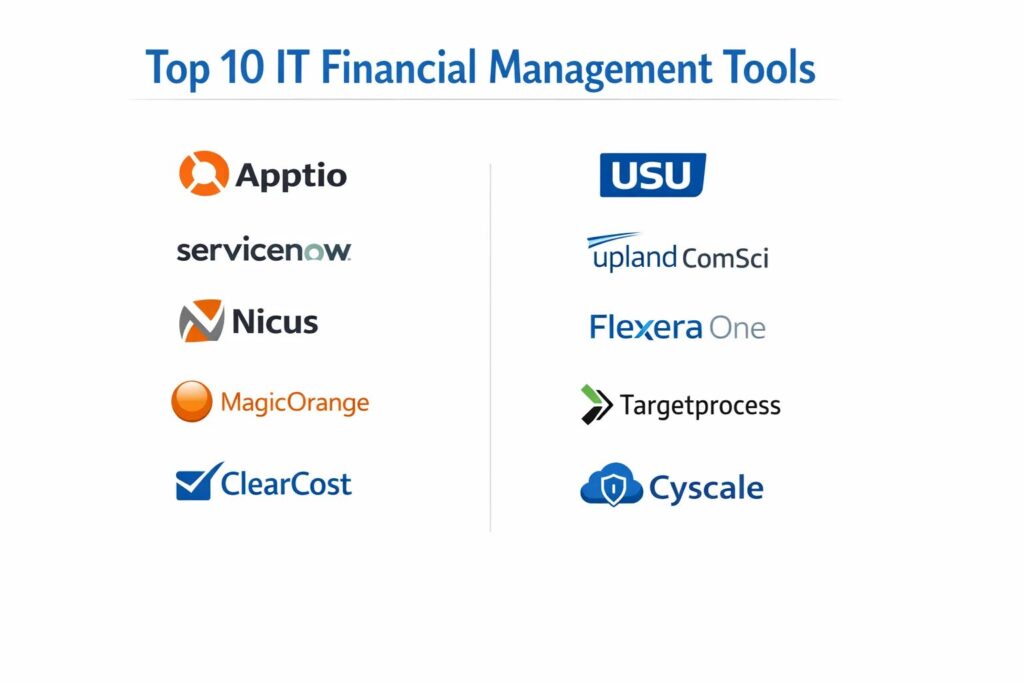
The selection of these top ten platforms was based on a comprehensive evaluation of their market presence, technical capability, and user reliability. We prioritized tools that demonstrate high performance in complex, multi-vendor environments and those that offer a clear path to achieving the Technology Business Management (TBM) standard. Market adoption was a significant signal, as tools with extensive user communities often provide more mature best-practice templates and reporting modules.
Technical robustness was assessed by looking at the software’s ability to handle massive datasets and its flexibility in creating custom cost-allocation models. We also evaluated the security posture of each platform, prioritizing those that offer enterprise-grade encryption, multi-factor authentication, and compliance with global data privacy regulations. Finally, we considered the user experience for both financial analysts and non-technical business leaders, ensuring the chosen tools can bridge the communication gap between the server room and the boardroom.
1. Apptio
Apptio is widely regarded as the market leader in IT Financial Management and is a primary driver behind the Technology Business Management (TBM) framework. The platform provides a comprehensive suite of applications designed to manage the entire lifecycle of IT spending, from budgeting and forecasting to cloud cost optimization and value tracking.
Key Features
The platform utilizes a sophisticated cost-modeling engine that automatically maps technical expenses to business services. It provides a dedicated module for managing public cloud spend across multiple providers, offering granular optimization recommendations. Its automated data engine cleanses and categorizes financial data from disparate sources like GLs and CMDBs. Users can create high-level executive dashboards that visualize the business value of IT investments. It also includes deep forecasting tools that allow teams to model “what-if” scenarios for major digital transformations.
Pros
It offers the most comprehensive set of features in the industry and is built on the widely accepted TBM standard. The community of certified professionals is extensive, making it easier to find skilled users.
Cons
The platform is highly complex and requires a significant investment in time and training to implement correctly. The pricing is positioned at the premium end of the market.
Platforms and Deployment
SaaS / Cloud-based.
Security and Compliance
SOC 2 Type II, ISO 27001, and GDPR compliant. It offers robust RBAC and SSO integrations.
Integrations and Ecosystem
Extensive connectors for major ERPs (SAP, Oracle), cloud providers (AWS, Azure, GCP), and ITSM tools (ServiceNow).
Support and Community
Offers a professional community (TBM Council), extensive documentation, and tiered enterprise support.
2. ServiceNow IT Financial Management
ServiceNow integrates financial management directly into its broader IT Service Management (ITSM) platform. This allows organizations to link financial data directly to the assets and services they are already managing within the ServiceNow ecosystem.
Key Features
The tool provides a structured workbench for cost transparency, allowing for the allocation of costs to specific business applications. It leverages the platform’s existing CMDB to provide highly accurate service-costing data. Users can manage budgets and track actual spend in real-time against planned targets. It features automated chargeback and showback capabilities to drive financial accountability. The platform also includes a portfolio management module to align technology projects with financial constraints.
Pros
Ideal for organizations already using ServiceNow, as it eliminates the need for separate data silos. The integration between service health and financial cost is seamless.
Cons
Can feel less robust for pure financial modeling compared to standalone ITFM specialists. Requires a well-maintained CMDB to provide maximum value.
Platforms and Deployment
SaaS / Cloud-based.
Security and Compliance
High-level government and enterprise certifications including FedRAMP (in specific instances) and SOC 2.
Integrations and Ecosystem
Native integration within the ServiceNow platform and extensive third-party API support.
Support and Community
Massive global user community and a highly structured professional support network.
3. Nicus
Nicus is a dedicated ITFM specialist known for its flexibility and ability to handle complex, bespoke cost-allocation models that do not always fit into rigid industry frameworks.
Key Features
The platform offers a modular approach, allowing organizations to start with cost transparency and scale to full planning and benchmarking. It features a powerful data ingestion engine that handles messy or unstructured data with ease. Its “What-If” analysis tool is highly regarded for long-term strategic planning. The system automates the billing process for internal chargebacks, reducing administrative overhead. It also provides specialized modules for labor and project tracking.
Pros
Offers a high degree of flexibility for organizations with unique financial structures. The implementation process is often faster than larger, more rigid competitors.
Cons
The user interface can feel more technical compared to some modern SaaS platforms. It has a smaller global footprint than the market leaders.
Platforms and Deployment
Cloud / SaaS / Hybrid.
Security and Compliance
Standard enterprise security protocols including data encryption and secure access controls.
Integrations and Ecosystem
Open API architecture that supports integration with various financial and technical data sources.
Support and Community
Highly rated for personalized customer service and direct access to product experts.
4. MagicOrange
MagicOrange is a cloud-native ITFM and shared services costing solution that focuses on simplicity and rapid time-to-value. It is particularly strong in helping organizations implement complex chargeback models.
Key Features
The tool features a guided modeling process that helps users build cost-allocation trees without advanced technical knowledge. It provides a clean, modern interface for executive reporting and departmental showback. The platform automates the consolidation of data from various business units into a single source of truth. It includes specific templates for different industries to speed up initial setup. Its cloud cost management module provides visibility into hybrid infrastructure spending.
Pros
Known for a modern, intuitive user experience that lowers the barrier to entry for business users. Excellent for organizations looking for a faster, cloud-native implementation.
Cons
May lack some of the deepest enterprise-scale features found in older, more established platforms. The ecosystem of third-party consultants is still growing.
Platforms and Deployment
SaaS / Cloud-based.
Security and Compliance
SOC 2 compliant and utilizes modern cloud security best practices.
Integrations and Ecosystem
Strong connectors for major cloud providers and standard financial systems.
Support and Community
Provides dedicated customer success managers and a growing online knowledge base.
5. ClearCost
ClearCost is a veteran in the ITFM space, focusing on providing a pragmatic approach to cost transparency and benchmarking. It is designed to bridge the gap between technical operations and financial reporting.
Key Features
The platform offers a structured data repository that serves as a single source of truth for all IT assets. It includes built-in benchmarking tools to compare internal costs against industry standards. Its automated allocation engine supports complex multi-step distributions. It features a robust budgeting and forecasting module specifically tailored for IT cycles. The tool also provides detailed labor and resource tracking to manage human capital costs.
Pros
Very stable and proven platform with deep roots in traditional IT financial management. The benchmarking data is highly valuable for identifying cost-saving opportunities.
Cons
The interface and reporting can feel less “modern” than newer SaaS-first competitors. It is heavily focused on traditional ITFM rather than specialized FinOps.
Platforms and Deployment
Cloud / SaaS / On-premises options.
Security and Compliance
Standard enterprise security including SSO and data encryption.
Integrations and Ecosystem
Supports standard integrations with common ERP and ITSM systems.
Support and Community
Offers direct professional support and a long history of industry expertise.
6. USU (formerly basicIT)
USU provides a suite of tools for IT management, with their financial management module focusing on the commercial control of IT services. It is particularly strong in the European market.
Key Features
The system focuses on the entire service lifecycle, from price calculation to billing. It provides a clear visualization of the “value chain” of IT services. Its automated billing engine supports multi-currency and complex international tax structures. The platform includes a comprehensive service catalog that links directly to financial data. It also provides tools for managing software license costs in conjunction with ITFM.
Pros
Excellent for service providers and organizations that treat IT as a series of commercial products. Strong compliance with European financial standards.
Cons
The full power of the tool is often tied to using other USU modules. Lesser known in the North American market.
Platforms and Deployment
Cloud / SaaS / On-premises.
Security and Compliance
GDPR compliant with high-level European data center certifications.
Integrations and Ecosystem
Deeply integrated within the USU product family and supports external data connectors via API.
Support and Community
Strong European presence with localized support and professional services.
7. Upland ComSci
Upland ComSci is an enterprise-class ITFM solution that focuses on demand management and driving behavioral change through transparent showback.
Key Features
The platform excels at detailed bill presentation, showing business users exactly what they are consuming. It features a robust demand-planning tool that helps IT align capacity with business needs. Its allocation engine can handle extremely granular data at high volumes. It includes a specialized portal for business unit managers to review and dispute their IT charges. The system also provides comprehensive executive dashboards for tracking IT investment ROI.
Pros
Particularly strong at driving accountability within business units through clear, detailed billing. Backed by the larger Upland software ecosystem.
Cons
Implementation can be complex due to the level of granularity available. The UI has a more traditional corporate aesthetic.
Platforms and Deployment
SaaS / Cloud-based.
Security and Compliance
SOC 2 compliant with standard enterprise-grade security features.
Integrations and Ecosystem
Standard integrations with financial systems and various IT monitoring tools.
Support and Community
Professional support provided through the Upland global service network.
8. Flexera One
Flexera One is a comprehensive platform that combines ITFM, SAM (Software Asset Management), and FinOps. It is designed for organizations that want to manage their entire technology estate—from desktop to cloud—in one place.
Key Features
The tool provides deep visibility into software license spend and compliance. It features a highly advanced cloud cost optimization engine for hybrid environments. Its ITFM module aggregates these costs into a unified financial view. It provides automated recommendations for reducing wasted spend on idle cloud resources. The platform also helps manage the risk and cost associated with end-of-life technology.
Pros
Unrivaled for organizations looking to combine financial management with software license optimization. Provides a truly holistic view of the “entire” technology spend.
Cons
The scope of the platform can be overwhelming for teams only looking for simple budgeting. Pricing reflects its status as a broad enterprise suite.
Platforms and Deployment
SaaS / Cloud-based.
Security and Compliance
ISO 27001, SOC 2, and high-level data privacy certifications.
Integrations and Ecosystem
Widest range of inventory and discovery connectors in the market.
Support and Community
Global support organization with extensive online training and user forums.
9. TargetProcess (Apptio/IBM)
While often categorized as an Agile management tool, TargetProcess (now part of the Apptio/IBM ecosystem) is increasingly used for “Lean Portfolio Management” and the financial tracking of agile development teams.
Key Features
The tool links financial budgets directly to agile work items and epics. It provides a visual way to track “capitalization” of labor in software development. Users can see the financial burn rate of different value streams in real-time. It integrates with Apptio to provide a complete view of both “Run” and “Change” costs. The platform allows for flexible financial reporting across teams, programs, and portfolios.
Pros
The best choice for organizations that have moved toward a modern, product-centric, agile delivery model. Bridges the gap between development velocity and financial spend.
Cons
Not a standalone ITFM tool for managing infrastructure or hardware; it is focused on project and labor finance.
Platforms and Deployment
SaaS / Cloud-based.
Security and Compliance
Enterprise-grade security backed by IBM’s compliance infrastructure.
Integrations and Ecosystem
Deeply integrated with Jira and other development tools, as well as the Apptio suite.
Support and Community
Professional support provided through the IBM and Apptio networks.
10. Cyscale
Cyscale is a modern, security-focused FinOps and IT management platform that specifically targets cloud-native and high-growth organizations looking to align security posture with financial management.
Key Features
The platform focuses on “Security-aware” FinOps, showing the cost impact of security configurations. It provides automated multi-cloud inventory and cost tracking. Users can set up financial guardrails and receive alerts for cost spikes. It features a clean, developer-friendly interface for tracking cloud resource consumption. The tool also provides automated compliance mapping for financial and security standards.
Pros
Excellent for modern DevOps teams who need to manage cloud costs without leaving their security and operational workflows. Very fast to deploy in cloud-native environments.
Cons
Lacks the traditional on-premises and labor-costing features found in legacy ITFM tools. Focused primarily on the cloud.
Platforms and Deployment
SaaS / Cloud-native.
Security and Compliance
Strong focus on security with built-in compliance dashboards for GDPR, HIPAA, and more.
Integrations and Ecosystem
Native connectors for AWS, Azure, GCP, and Kubernetes.
Support and Community
Responsive digital support and a growing community of cloud-native professionals.
Comparison Table
| Tool Name | Best For | Platform(s) Supported | Deployment | Standout Feature | Public Rating |
| 1. Apptio | TBM Standard / Enterprise | Web | SaaS | TBM Unified Model | 4.6/5 |
| 2. ServiceNow | Integrated ITSM Users | Web | SaaS | CMDB Integration | 4.4/5 |
| 3. Nicus | Custom Cost Modeling | Web | Hybrid | Flexible Data Ingestion | 4.5/5 |
| 4. MagicOrange | Rapid Time-to-Value | Web | SaaS | Intuitive Modeling UI | 4.7/5 |
| 5. ClearCost | Benchmarking / Stability | Web | Hybrid | Industry Benchmarks | 4.2/5 |
| 6. USU | European Service Providers | Web | Hybrid | Service Value Chain | 4.3/5 |
| 7. Upland ComSci | Demand Management | Web | SaaS | Detailed Showback Bill | 4.1/5 |
| 8. Flexera One | SAM / FinOps Hybrid | Web | SaaS | License Optimization | 4.5/5 |
| 9. TargetProcess | Agile Portfolio Finance | Web | SaaS | Lean Portfolio Finance | 4.4/5 |
| 10. Cyscale | Cloud-Native Security | Web | SaaS | Security-aware FinOps | N/A |
Evaluation & Scoring of IT Financial Management Tools
The scoring below is a comparative model intended to help shortlisting. Each criterion is scored from 1–10, then a weighted total from 0–10 is calculated using the weights listed. These are analyst estimates based on typical fit and common workflow requirements, not public ratings.
Weights:
- Core features – 25%
- Ease of use – 15%
- Integrations & ecosystem – 15%
- Security & compliance – 10%
- Performance & reliability – 10%
- Support & community – 10%
- Price / value – 15%
| Tool Name | Core (25%) | Ease (15%) | Integrations (15%) | Security (10%) | Performance (10%) | Support (10%) | Value (15%) | Weighted Total |
| 1. Apptio | 10 | 4 | 10 | 9 | 9 | 9 | 6 | 8.35 |
| 2. ServiceNow | 8 | 7 | 9 | 9 | 9 | 9 | 7 | 8.05 |
| 3. Nicus | 9 | 6 | 8 | 8 | 8 | 9 | 8 | 8.00 |
| 4. MagicOrange | 8 | 9 | 8 | 8 | 8 | 8 | 9 | 8.25 |
| 5. ClearCost | 8 | 6 | 7 | 8 | 7 | 8 | 7 | 7.20 |
| 6. USU | 8 | 7 | 8 | 9 | 8 | 8 | 8 | 8.00 |
| 7. Upland ComSci | 8 | 6 | 7 | 8 | 8 | 7 | 7 | 7.25 |
| 8. Flexera One | 10 | 5 | 9 | 9 | 9 | 8 | 7 | 8.30 |
| 9. TargetProcess | 7 | 8 | 8 | 9 | 8 | 8 | 8 | 7.85 |
| 10. Cyscale | 6 | 8 | 8 | 9 | 9 | 7 | 8 | 7.45 |
How to interpret the scores:
- Use the weighted total to shortlist candidates, then validate with a pilot.
- A lower score can mean specialization, not weakness.
- Security and compliance scores reflect controllability and governance fit, because certifications are often not publicly stated.
- Actual outcomes vary with assembly size, team skills, templates, and process maturity.
Which IT Financial Management Tool Is Right for You?
Solo / Freelancer
Individual consultants specializing in ITFM or FinOps will find the most value in cloud-native platforms like Cyscale or the modular options of MagicOrange. These tools allow for quick setup and clear visualization of data without the need for a massive enterprise infrastructure.
SMB
Small to medium-sized businesses should prioritize ease of use and rapid deployment. MagicOrange is a strong candidate here, as it offers a modern UI and guided workflows that don’t require a dedicated team of financial analysts to maintain.
Mid-Market
Organizations in the mid-market benefit from tools that offer a balance of power and flexibility. Nicus and ClearCost are excellent choices for this segment, providing professional-grade allocation models and benchmarking without the extreme complexity of the largest suites.
Enterprise
For global organizations with multi-million dollar budgets, Apptio and ServiceNow are the industry standards. These platforms offer the robust security, global support, and deep technical capabilities required to manage complex technology estates at scale.
Budget vs Premium
If budget is the primary concern, focusing on cloud-native or newer market entrants like Cyscale can provide high value. However, the premium cost of Apptio or Flexera One is often justified by the millions of dollars they can identify in wasted spend through their advanced optimization engines.
Feature Depth vs Ease of Use
Houdini-level depth can be found in Apptio, but it comes with a high management burden. For those prioritizing ease of use, MagicOrange and TargetProcess offer more intuitive interfaces that business leaders can engage with directly.
Integrations & Scalability
Large enterprises with diverse software stacks should look at Flexera One or ServiceNow, as their pre-built integration ecosystems significantly reduce the work required to maintain data accuracy.
Security & Compliance Needs
Organizations in highly regulated industries like finance or healthcare should prioritize ServiceNow or Apptio, as they carry the most extensive list of international security certifications and offer the most granular access controls.
Frequently Asked Questions (FAQs)
1. What is the difference between ITFM and FinOps?
ITFM is a broad discipline covering all technology costs, including on-premises hardware and labor. FinOps is a specialized subset focused specifically on managing and optimizing the variable, consumption-based costs of public cloud services.
2. How long does a typical ITFM tool implementation take?
A basic implementation can take 3 to 6 months, while a full enterprise-wide rollout with complex chargeback models can take over a year. The timeline depends heavily on the quality and accessibility of existing data.
3. Do I need to be a finance expert to use these tools?
While a financial background is helpful, modern tools are designed with “Business Intelligence” interfaces that allow technical managers to understand and manage their budgets without being accounting specialists.
4. Can ITFM tools help with software audits?
Yes, platforms that include SAM features, like Flexera One, are specifically designed to manage license compliance and can provide the data needed to defend against vendor audits.
5. What is “Chargeback” vs “Showback”?
Showback is the process of informing business units of their IT costs to drive awareness. Chargeback goes a step further by actually deducting those costs from the business unit’s budget and transferring them back to IT.
6. How do these tools ingest data from different sources?
Most platforms use a combination of pre-built API connectors, scheduled file imports (CSV/Excel), and direct database connections to pull data from ERP, ITSM, and cloud provider systems.
7. Can ITFM tools track the cost of human labor?
Yes, most enterprise ITFM platforms have modules for labor tracking, allowing organizations to allocate the cost of employee time and contractors to specific projects or services.
8. Is the TBM framework mandatory for ITFM?
It is not mandatory, but the Technology Business Management (TBM) framework provides a standardized taxonomy that makes it much easier to categorize and compare IT costs across different industries.
9. Can these tools help reduce cloud “waste”?
Absolutely. Specialized cloud modules in tools like Flexera One and Apptio identify idle or oversized resources and provide automated recommendations for resizing or turning them off.
10. What is the ROI of an ITFM tool?
Most organizations see an ROI through identified cost savings (typically 5-15% of the total IT budget), improved budget accuracy, and the ability to reallocate funds from “running” the business to “growing” it.
Conclusion
Navigating the complexities of technology spending in a hybrid-cloud world requires more than just fiscal discipline; it requires the right technical infrastructure to translate operational data into financial intelligence. The Top 10 IT Financial Management tools listed here represent the pinnacle of this capability, offering varying degrees of depth, automation, and strategic insight. Selecting the right platform depends on your organizational maturity, your specific mix of on-premises and cloud assets, and your ultimate goals for financial transparency. Whether you are aiming for basic cost visibility or a fully automated, value-driven chargeback model, these tools provide the necessary framework to ensure IT remains a catalyst for business success. The ultimate next step for any leader is to validate the quality of their current data before running a pilot with one of these leading solutions.