Introduction
Intellectual Property (IP) management software has become the backbone of modern innovation, transforming how corporations and law firms protect their most valuable intangible assets. These platforms automate the complex lifecycle of patents and trademarks—from the initial “lightbulb moment” in an invention disclosure to the final maintenance fee or renewal. Managing IP is no longer just about meeting legal deadlines; it is about leveraging data-driven insights to align a global portfolio with overarching business goals and competitive market shifts.
The shift toward AI-integrated IP management has replaced the era of manual spreadsheets with “intelligent docketing” systems that sync directly with global patent offices like the USPTO, EPO, and WIPO. These tools reduce the risk of catastrophic human error, such as missing a statutory deadline, which could result in the loss of millions of dollars in exclusive rights. For decision-makers, these platforms provide a “single source of truth,” allowing them to visualize their technological footprint and identify high-value assets that can be monetized through licensing or enforcement.
Real-World Use Cases
- Global Trademark Portfolio Audits: Legal teams use these platforms to instantly map their trademark coverage across 180+ jurisdictions, identifying gaps where their brand is vulnerable to infringement.
- Predictive Patent Maintenance: IP managers use cost-forecasting modules to predict exactly how much it will cost to maintain a patent family over the next ten years, allowing for data-backed pruning of underperforming assets.
- Invention Disclosure Workflows: Engineers and scientists submit new ideas through centralized portals, where the software automatically initiates a vetting process and checks for prior art before a single dollar is spent on filing.
- Competitor Intelligence Tracking: Advanced platforms monitor the filing activities of rival companies, alerting the IP team the moment a competitor files a patent in a core technology area.
- Automated Correspondence Processing: Firms use AI-powered intake tools to read incoming mail from patent offices, extract the relevant dates, and automatically update the docket without manual data entry.
Buyer Evaluation Criteria
- Docketing Automation Accuracy: Look for platforms that offer direct, real-time synchronization with major IP offices to ensure that deadlines are generated and updated automatically without human intervention.
- Multi-Jurisdictional Support: Ensure the software can handle the specific rules and laws of all countries where you hold IP, including local holiday calendars and statutory period variations.
- Integration with Search & Analytics: The best tools don’t just store data; they integrate with global patent databases to provide “semantic search” and landscape analysis directly within the management dashboard.
- Financial and Annuity Management: Evaluate the platform’s ability to handle global patent renewals and trademark renewals, preferably with integrated payment services and accurate currency conversion.
- Invention Disclosure Portal: Check if the tool offers a user-friendly interface for non-legal staff (like engineers) to submit and track their ideas, fostering a culture of innovation within the company.
- Security and Data Privacy: IP data is highly sensitive. The platform must offer enterprise-grade security features like SOC 2 compliance, multi-factor authentication, and encrypted document storage.
- Customization and Scalability: As your portfolio grows, the software must allow you to create custom fields, workflows, and reporting templates without requiring expensive custom coding from the vendor.
- Collaborative Ecosystem: The platform should facilitate easy communication between in-house teams and external counsel, providing secure access and “version control” for legal documents.
- AI-Assisted Drafting and Review: Modern tools now offer Generative AI capabilities to help draft patent claims, compare similar trademarks, or summarize complex legal office actions.
- Mobile and Remote Access: Ensure the platform is fully cloud-native and provides a responsive experience on mobile devices, allowing attorneys to check deadlines and approve filings from anywhere.
Best for: Global enterprises, research institutions, and specialized IP law firms managing thousands of active files and seeking to automate high-risk administrative tasks.
Not ideal for: Small startups with fewer than five trademarks or patents, where simple calendar alerts and manual tracking via a standard legal practice management tool might suffice.
Key Trends in IP Management Software
- Agentic AI Legal Assistants: AI “agents” within IP software can now perform initial freedom-to-operate (FTO) searches and draft response templates for common office actions autonomously.
- Blockchain Evidence Locking: Some platforms now use blockchain to create a “timestamped” record of invention disclosures and trade secrets, providing an unalterable audit trail for litigation.
- Holistic Innovation Management: The industry is moving from “IP management” to “innovation management,” where R&D and legal data are unified to show the direct ROI of every research project.
- Standardized IP Data (Global Exchange): New international standards for IP data sharing are making it easier to migrate portfolios between software vendors without losing historical records.
- Hyper-Personalized Dashboards: Executives now use natural language queries to generate instant visualizations of their “patent strength” relative to the market.
- Unified Patent Court (UPC) Specialization: Modern platforms have built-in workflows specifically designed to manage the complexities of the European UPC, including simplified opting-out procedures.
- Sustainable IP Portfolios: There is a growing focus on “Green IP,” with platforms offering filters to highlight patents that contribute to environmental, social, and governance (ESG) goals.
- Direct PTO Filing Integrations: We are seeing more platforms move beyond tracking to allow for direct electronic filing (e-filing) into multiple national patent offices from a single interface.
How We Selected These Tools (Methodology)
Our selection for the top 10 IP management platforms focused on tools that demonstrate a balance between legal reliability and technological innovation. We prioritized platforms that have successfully integrated AI into the docketing workflow and those with the highest customer satisfaction ratings for global support.
- Office Connectivity: We analyzed the number of direct API connections to national and international IP offices to ensure maximum data accuracy for the “docketing” function.
- Innovation Intake Sophistication: Each tool was graded on its ability to support the “pre-filing” stage, specifically its invention disclosure portals and early-stage vetting workflows.
- Global Presence and Support: We prioritized vendors with a global footprint, ensuring they can provide local legal updates and support across different time zones.
- Security Posture: Only platforms with a proven track record of data security (SOC 2, ISO 27001) were considered, given the sensitive nature of patent “prior art” and trade secrets.
- User Experience (UX): We evaluated the complexity of the interface, selecting tools that offer a modern, intuitive experience for both legal professionals and R&D contributors.
- Integration Ecosystem: We looked for platforms that play well with others, offering native connectors for ERP systems (SAP/Oracle), Document Management (iManage), and Billing tools.
- Value for Scale: The list includes a range of tools suitable for different budgets, from solo-practitioner trademark tools to massive enterprise-grade patent management systems.
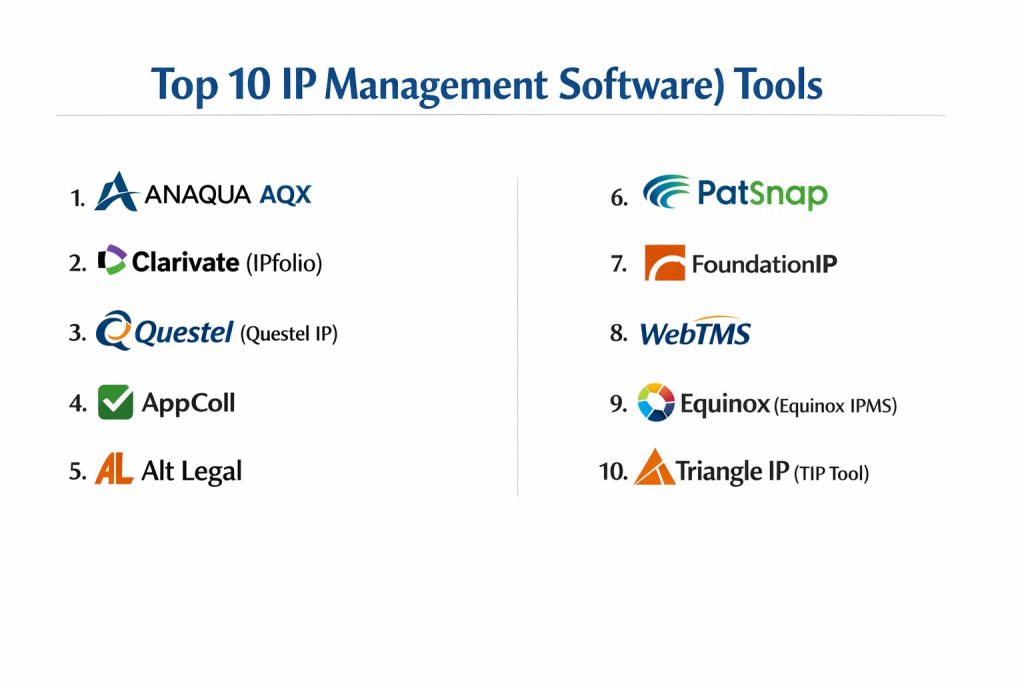
Top 10 IP Management (Patents/Trademarks) Software
1 Anaqua (AQX)
Anaqua is widely considered the “gold standard” for enterprise-grade IP management. Its AQX platform is a comprehensive, end-to-end solution that integrates every stage of the IP lifecycle—from early-stage idea capture to global portfolio strategy and monetization—making it the top choice for Fortune 500 companies.
Key Features
- AQX Innovation Portal: A streamlined environment for inventors to submit ideas, collaborate with legal teams, and track the progress of their disclosures in real-time.
- Intelligent Docketing: Uses a sophisticated “Law Engine” that automatically applies global IP laws and holiday calendars to calculate thousands of critical deadlines.
- Integrated Patent Analytics: Provides live data visualization and landscape analysis directly within the portfolio management dashboard, powered by AcclaimIP.
- Global Annuity Management: A fully integrated service for paying patent maintenance fees and trademark renewals, providing cost transparency and risk reduction.
- External Counsel Collaboration: A secure hub that allows shippers to assign tasks to outside firms while maintaining a single, unified “source of truth” for the entire portfolio.
- Financial Management & Forecasting: Advanced tools for budgeting, tracking legal spend, and predicting future portfolio maintenance costs years in advance.
- Standardized Workflows: Pre-configured templates for patents, trademarks, designs, and trade secrets that can be tailored to match the organization’s specific SOPs.
Pros
- Offers the most robust and feature-rich environment for large-scale IP departments managing complex, global portfolios.
- Deeply integrated analytics allow for “strategic” IP management rather than just administrative tracking.
- High degree of customization, allowing companies to mold the system to their specific internal legal processes.
Cons
- The platform’s extreme depth and complexity come with a significant learning curve for new users.
- One of the most expensive options on the market, making it unsuitable for small firms or companies with limited IP activity.
- Implementation projects can be long and resource-intensive, requiring a dedicated internal team or consultant.
Platforms / Deployment
- Web / Cloud-based SaaS
- On-premise options for highly regulated industries
Security & Compliance
- SOC 2 Type II, SOC 3, and ISO 27001 certified.
- Comprehensive GDPR and CCPA compliance for global data residency.
Integrations & Ecosystem
Anaqua is designed to be the central hub for all legal and R&D activity.
- Native connectors for document management systems like iManage and NetDocuments.
- Integration with major ERP and Finance systems (SAP, Oracle, Workday).
- Connectivity with Thomson Reuters Legal Tracker for spend management.
- Open API for custom enterprise application and reporting development.
Support & Community
Anaqua offers 24/7 global support and has built a strong “Anaqua Academy” for user training. Their annual user conference is a major gathering for the world’s leading IP professionals.
2 Clarivate (IPfolio)
IPfolio, part of the massive Clarivate ecosystem, is a modern, cloud-native IP management platform built on the Salesforce architecture. It is known for its agility, ease of use, and deep integration with Clarivate’s world-leading patent and trademark data sources.
Key Features
- Salesforce-Built Architecture: Leverages the power and security of the Salesforce platform, allowing for immense flexibility and “best-in-class” reporting capabilities.
- Direct IPSync: Automatically synchronizes USPTO and global office data with your internal records, flagging any discrepancies for immediate review.
- Integrated IP Intelligence: Provides direct access to the Derwent World Patent Index (DWPI) and CompuMark trademark data for enhanced decision-making.
- Automated Task Management: A highly visual task and deadline manager that ensures critical dates are never missed across the entire legal team.
- Beautiful Dashboards: Offers some of the most intuitive and visually appealing reporting tools in the industry, making it easy to present IP status to executives.
- Collaborative Inventor Portal: A simplified interface that encourages scientists and engineers to participate in the IP process from anywhere in the world.
- Flexible Field Configuration: Allows administrators to easily add custom fields and tags to categorize their portfolio by product line, business unit, or technology area.
Pros
- Incredibly fast implementation times compared to other enterprise-level systems due to its Salesforce-based design.
- The user interface is one of the most modern and “consumer-grade” in the IP space, leading to very high user adoption.
- Beneficiary of Clarivate’s massive data resources, ensuring high-fidelity patent and trademark information.
Cons
- Advanced customization and some document management features can sometimes require additional third-party Salesforce apps (like Conga).
- While highly flexible, the system may lack some of the “built-in” deep legal nuance found in legacy on-premise platforms.
- Pricing is competitive but can scale quickly as more advanced data and analytics modules are added.
Platforms / Deployment
- Web / iOS / Android
- Cloud-based SaaS (Salesforce Lightning)
Security & Compliance
- Inherits the world-class security posture of Salesforce (SOC 2, ISO 27001).
- HIPAA, GDPR, and FedRAMP compliant.
Integrations & Ecosystem
Because it is built on Salesforce, IPfolio has access to a massive ecosystem of business apps.
- Native integration with the entire Clarivate suite (Derwent Innovation, Darts-ip).
- Seamless connections to Salesforce CRM for companies that link IP to their sales and marketing efforts.
- Integration with Microsoft 365 and Google Workspace.
- Hundreds of AppExchange connectors for e-signature, billing, and document management.
Support & Community
Clarivate provides 24/7 global technical support and a dedicated “Success Manager” for their IPfolio clients. They have a global network of consultants and regular training webinars for their user community.
3 Questel (Questel IP)
Questel provides a holistic “Innovation & IP” ecosystem that combines software with deep professional services. Their platform is highly regarded for its “R&D-to-Legal” integration, helping companies move seamlessly from initial research to global IP protection and asset monetization.
Key Features
- Unified Innovation Platform: Combines patent searching, analysis, and management in a single interface to reduce data silos between R&D and legal departments.
- Orbit Intelligence Integration: Native connection to Questel’s world-class patent database for instant prior art searches and competitor benchmarking.
- AI-Driven Drafting Tools: Offers emerging capabilities for semi-automated patent drafting and claim generation, significantly speeding up the filing process.
- Centralized Foreign Filing: A specialized service that simplifies the process of filing patents internationally through a vetted network of local agents.
- Cost Management Dashboards: Provides real-time visibility into patent and trademark spending, including automated invoice auditing and payment.
- Strategic Portfolio Analysis: Advanced visualization tools that rank patents by “strength” and “relevance” to help prioritize maintenance and pruning.
- Direct Office Action Intake: Uses AI to scan and categorize incoming correspondence from patent offices, automatically updating the relevant dockets.
Pros
- Unmatched integration between “Searching” and “Managing,” making it ideal for companies with large R&D pipelines.
- Very strong European and Asian presence, with localized support and deep knowledge of regional IP laws.
- High-quality professional services team that can assist with complex portfolio migrations and data auditing.
Cons
- The user interface is powerful but can feel more “technical” and less “polished” than some of the newer cloud-based competitors.
- Some users report that the system’s performance can lag when managing extremely large, global portfolios with millions of data points.
- The high-end search and analytics features are often priced separately from the core management software.
Platforms / Deployment
- Web / Cloud-based SaaS
- On-premise and Private Cloud options available
Security & Compliance
- ISO 27001 and SOC 2 Type II certified.
- Strong focus on data residency compliance for European and Asian markets.
Integrations & Ecosystem
Questel is built to be an all-in-one solution but offers robust bridges to other enterprise tools.
- Direct integration with https://www.google.com/search?q=Orbit.com for global patent and trademark data.
- Connectors for major DMS (iManage, NetDocuments) and Finance systems.
- API for exporting IP metrics into company-wide Business Intelligence (BI) tools like Tableau.
- Partnerships with global patent agents for seamless foreign filing workflows.
Support & Community
Questel offers localized support in over 20 countries and hosts regular “Orbit User Meetings” and innovation summits worldwide. They provide a comprehensive training portal with video guides for all modules.
4 AppColl
AppColl is the go-to choice for small to mid-sized law firms and corporate IP departments that prioritize simplicity and efficiency. It is famous for its “clean” interface and its ability to automate the bulk of the administrative work associated with patent and trademark prosecution without the high cost of enterprise systems.
Key Features
- Automated Data Validation: Frequently syncs with the USPTO and Espacenet to ensure all patent numbers, dates, and statuses are 100% accurate and up-to-date.
- Workflow Task Automation: Automatically generates a cascade of tasks and reminders for every new filing, based on customizable “best practice” templates.
- Simplified Billing & Invoicing: Includes a built-in module for tracking time, managing expenses, and generating professional legal invoices.
- Letter and Form Generation: Uses “merge codes” to automatically create client letters and official forms with one click, reducing manual typing errors.
- Bulk Data Import/Export: Makes it incredibly easy to migrate entire portfolios into the system using simple CSV files.
- Inventor Portal: A basic but effective portal that allows external inventors to submit disclosures and track their status.
- Role-Based Access Control: Simple but effective permissions that allow you to give clients and external counsel secure access to specific parts of the portfolio.
Pros
- Extremely easy to learn and use; most staff can be productive on the platform within a few hours.
- Highly cost-effective with a “no long-term contract” model that is perfect for growing boutique firms.
- Exceptional customer support, with a reputation for being responsive and knowledgeable about the needs of small practices.
Cons
- Lacks the advanced “strategic” analytics and competitive intelligence features found in enterprise tools like Anaqua or PatSnap.
- The reporting engine is powerful but can be less intuitive for users who want complex, “multi-layered” data visualizations.
- Not designed for massive, global corporations that require deep integration with complex ERP or procurement systems.
Platforms / Deployment
- Web-based SaaS
- Mobile-optimized browser access
Security & Compliance
- Standard cloud security protocols with regular data backups and encryption.
- GDPR ready for firms with European clients.
Integrations & Ecosystem
AppColl is designed as a standalone “productivity suite” but offers key connections to the IP world.
- Direct sync with USPTO Private PAIR and TSDR.
- Integration with major document storage providers like Box and Dropbox.
- Support for industry-standard CSV imports/exports for data sharing.
- Basic integration with email systems for automated docketing reminders.
Support & Community
AppColl provides free, live webinars and a high-quality knowledge base. They are highly regarded for their one-on-one training sessions for new firm implementations.
5 Alt Legal
Alt Legal is a specialized, modern trademark management platform that has redefined ease of use in the IP space. It is specifically designed to handle the unique workflows of trademark attorneys, offering deep automation that essentially replaces a traditional “docketing department.”
Key Features
- Trademarks-First Design: Unlike “general” IP tools, Alt Legal is built specifically for trademark prosecution and maintenance, resulting in a cleaner, more focused experience.
- One-Click Reporting: Allows users to generate beautifully formatted Excel or PDF reports for clients in seconds, with zero manual data manipulation required.
- Daily USPTO/CIPO Sync: Automatically updates records and creates new deadlines by pulling data directly from the USPTO and Canadian IP Office every day.
- Smart Email Templates: Recommends the correct template based on the status of the trademark and auto-populates all the case data for instant client communication.
- Trademark Watch Integration: Includes built-in tools to monitor the USPTO for new filings that may conflict with your existing portfolio.
- Calendar Sync: Seamlessly pushes all critical IP deadlines onto your personal Outlook or Google calendar.
- Intake Forms: Customizable, branded forms that allow clients to submit all the necessary trademark details directly into the platform.
Pros
- The most intuitive user interface in the entire IP software market, making it a favorite for solo practitioners and small to mid-sized firms.
- Unbeatable “Time-to-Value”; you can have a full portfolio imported and automated in less than 24 hours.
- Transparent pricing that includes all features, support, and data migrations in a single, predictable monthly fee.
Cons
- It is a specialist tool; it does not handle complex patent portfolios or invention disclosures.
- Advanced “business intelligence” analytics (like trademark valuation) are not as deep as high-end brand management platforms.
- Integration with enterprise-level financial systems (like SAP) is limited compared to general IP suites.
Platforms / Deployment
- Web-based SaaS
- Mobile-responsive interface
Security & Compliance
- Modern cloud security with end-to-end encryption.
- Regular third-party security audits and full GDPR compliance.
Integrations & Ecosystem
Alt Legal focuses on the tools that legal professionals already use every day.
- Deep, native integration with Clio, the leading legal practice management software.
- Direct connection to USPTO Trademark Center and CIPO databases.
- Seamless sync with Google Calendar and Microsoft Outlook.
- Basic API access for custom internal data needs.
Support & Community
Alt Legal is famous for its exceptional customer service and its “Alt Legal Connect” community events. They offer a comprehensive “Trademark Academy” and provide free, white-glove data migration for every new client.
6 PatSnap
PatSnap is the global leader in “Innovation Intelligence.” While it includes powerful portfolio management tools, its primary strength lies in its AI-powered patent search and analytics engine, which helps R&D teams “see” the future of their industry.
Key Features
- Connected Innovation Intelligence: Unified search and management that connects patent data with scientific literature, news, and market intelligence.
- AI-Powered Semantic Search: Allows users to search for patents using natural language, identifying “conceptually” similar patents that traditional keyword searches might miss.
- Visual Patent Landscaping: Automatically generates interactive 3D maps and charts that visualize technology trends and competitor “hot spots.”
- Patent Valuation Engine: Uses proprietary AI to assign a financial and “quality” score to every patent, helping teams identify their most valuable assets.
- Invention Disclosure & Review: A specialized module for capturing ideas and evaluating them against the global patent landscape in a single workflow.
- Competitor Monitoring: Advanced alerting system that tracks every new filing, legal status change, or citation related to specific competitors.
- Translation Support: Flawless English translations for millions of patents from China, Japan, and Korea, providing true global visibility.
Pros
- Unmatched search and analytics capabilities; it is the most powerful “discovery” tool on this list.
- Exceptional for R&D-heavy companies that need to justify their IP spend with market data and competitive trends.
- The user interface is highly modern and built for speed, allowing for the rapid generation of complex reports.
Cons
- The platform can be very expensive, especially if you add on specialized modules like Chemical Sequences or Litigation data.
- The “management” and “docketing” side of the platform is slightly less developed than dedicated legal suites like Anaqua.
- The advanced search syntax and analytics filters require significant training to master.
Platforms / Deployment
- Web / Cloud-based SaaS
- Mobile App for on-the-go alerts
Security & Compliance
- SOC 2 Type II and ISO 27001 certified.
- Strong focus on IP confidentiality and secure data hosting.
Integrations & Ecosystem
PatSnap is designed to be a “knowledge engine” that feeds into other parts of the business.
- API access for feeding patent analytics into internal R&D dashboards.
- Integrations with major document management and collaboration tools.
- Partnership with leading IP management systems to serve as their data search engine.
- Direct export of high-quality charts and data into PowerPoint and Excel.
Support & Community
PatSnap provides 24/7 global support and has a massive “Help Center” with extensive video tutorials. They are a prominent voice in “Innovation Strategy” and frequently host webinars with industry experts.
7 FoundationIP
FoundationIP, another flagship product from Clarivate, is a proven and highly stable IP management platform. It is known for its reliability and its “process-centric” design, making it a favorite for law firms and corporate teams that prioritize structured, high-volume docketing.
Key Features
- Global Docketing Engine: A highly structured and mature system for tracking patent and trademark deadlines across virtually every jurisdiction in the world.
- Automated USPTO Integration: Seamlessly pulls office actions and status updates from USPTO Private PAIR, reducing manual entry by up to 80%.
- Standardized Workflow Templates: Includes hundreds of pre-configured “country laws” that automatically adjust your docket based on local rules and regulations.
- Integrated Document Management: A robust system for storing, categorizing, and retrieving all legal documents associated with a case.
- Renewals & Annuities Hub: Direct integration with Clarivate’s global renewal services for simplified maintenance fee management.
- Client & Counselor Portals: Provides secure, real-time access to specific parts of the portfolio for outside counsel or internal stakeholders.
- Comprehensive Reporting: A powerful, if traditional, reporting engine that can generate detailed audits and portfolio summaries.
Pros
- Extremely stable and reliable; it is a “battle-tested” platform used by over 600 of the world’s most innovative organizations.
- Excellent data quality due to its long history and integration with Clarivate’s global data cleaning services.
- Offers a very clear, structured approach to IP management that is easy for professional paralegals and docketing staff to navigate.
Cons
- The user interface can feel somewhat “legacy” compared to modern, AI-first platforms like IPfolio or Alt Legal.
- Customizing advanced workflows or adding complex new modules can sometimes be less intuitive than in newer systems.
- Implementation can be a significant undertaking, often requiring formal data auditing and cleanup.
Platforms / Deployment
- Web-based SaaS
- Hosted environment
Security & Compliance
- SOC 2 Type II certified.
- Enterprise-grade encryption and standard global data privacy compliance.
Integrations & Ecosystem
FoundationIP is part of the broader Clarivate ecosystem, providing unmatched “data-to-software” synergy.
- Native integration with Derwent for patent search and analytics.
- Direct bridge to Clarivate’s Patent Annuities and Trademark Renewal services.
- Supports standard EDI and API connections for external data exchange.
- Integration with major email systems for automated alert delivery.
Support & Community
FoundationIP provides a very stable, corporate support structure with 24/7 technical assistance. They have a massive, global user base and host regular training sessions and user group meetings.
8 WebTMS
WebTMS is a world-class trademark management system that offers a highly flexible and intuitive platform for brand owners and attorneys. It is particularly well-regarded for its customer support and its ability to handle the specific needs of massive, global trademark portfolios.
Key Features
- Automated Trademark Diary: A sophisticated task manager that ensures all filing and renewal deadlines are tracked across 180+ countries.
- Email & Document Integration: Allows users to send template-based emails to clients and save incoming correspondence directly into the case file.
- Customizable Dashboards: Users can create personalized “landing pages” that show their most urgent tasks, recently updated marks, and upcoming costs.
- Trademark Watch & Enforcement: Built-in tools for monitoring for potential infringements and managing opposition and cancellation proceedings.
- Integrated Cost Tracking: Allows for the management of legal fees and official office fees, with the ability to generate simple financial reports.
- Search & Clearance Hub: Provides easy access to trademark searching tools to check availability before filing a new mark.
- Multi-Language Support: The platform is accessible in multiple languages, making it a strong choice for international teams.
Pros
- Highly intuitive and “friendly” user interface that focuses on providing the most relevant information at a glance.
- One of the best support teams in the industry, with a reputation for being exceptionally fast and helpful.
- Very flexible pricing model that allows companies to only pay for the specific modules and features they need.
Cons
- While it handles patents, its primary strength and focus are clearly on trademarks and brand management.
- The reporting engine, while powerful, can have a steeper learning curve for users who want to create highly complex custom reports.
- Integration with non-legal enterprise systems (like SAP) is not as deeply established as some of the larger suites.
Platforms / Deployment
- Web-based SaaS
- On-premise options available
Security & Compliance
- SOC 2 compliant.
- Standard data encryption and privacy protocols for global legal practice.
Integrations & Ecosystem
WebTMS focuses on being the “best-of-breed” tool for trademarks while connecting to the wider IP world.
- Direct integration with various trademark search and watch data providers.
- Support for standard document management systems.
- API available for custom data exports and internal system bridges.
- Native integration with major trademark renewal service providers.
Support & Community
WebTMS provides 24/7 global support and is famous for its helpful user webinars and training sessions. They maintain a very active user community and frequently update the platform based on direct user feedback.
9 Equinox (Equinox IPMS)
Equinox is a modern, high-growth IP management platform that has gained significant traction by offering a highly automated and AI-assisted experience. It is designed to be a “digital workspace” that brings together documents, communication, and docketing in one seamless flow.
Key Features
- AI-Assisted Case Management: Uses AI to help with drafting, document analysis, and comparing similar claims across the portfolio.
- Automated Workflows: Features a powerful “Process” engine that automates sequences of tasks, reminders, and documents based on the type of case.
- Secure Client Portal: A modern, customizable portal where clients can view their portfolio, download documents, and approve new filings.
- Integrated Time & Billing: Captures time logged on tasks automatically, allowing for seamless invoicing and profitability tracking.
- Direct Office Sync: Automatically pulls data and status changes from IP law portals, ensuring the docket is always up-to-the-minute.
- Batch Operations: Allows for the bulk creation of cases and the management of large patent and trademark “families” with a few clicks.
- Scheduled Reporting: Allows users to build custom reports once and have them automatically delivered to stakeholders on a set schedule.
Pros
- Exceptionally clean and modern design that minimizes the administrative burden on attorneys and paralegals.
- Strong “AI-first” roadmap, with some of the most advanced automated drafting and analysis features in the mid-market.
- Excellent “out-of-the-box” setup that allows firms to get up and running quickly with pre-configured IP law layouts.
Cons
- As a newer and more agile platform, it may lack some of the deepest enterprise-level financial integrations found in legacy tools.
- The platform can occasionally experience performance slowdowns when processing massive, automated data updates.
- It does not currently offer a native mobile app, though the web interface is fully responsive.
Platforms / Deployment
- Web-based SaaS
- Accessible on Mac, Windows, Linux, and Chromebooks
Security & Compliance
- Modern cloud security with advanced user permissions and RBAC.
- GDPR compliant and focused on high-level data encryption.
Integrations & Ecosystem
Equinox is designed to sit at the center of the modern law firm’s technology stack.
- Native integration with Microsoft Office 365 (via a dedicated plugin).
- Connectors for Markify (trademark searching) and Billtrader (international payments).
- Integration with Xero for accounting and financial management.
- API for connecting with other specialized legal tech tools.
Support & Community
Equinox provides a dedicated help desk, a comprehensive knowledge base, and phone support. They are known for their “continuous improvement” philosophy, releasing frequent software updates based on user requests.
10 Triangle IP (The TIP Tool)
The TIP Tool (Triangle IP) is a unique, “innovation-focused” platform designed to bridge the massive gap between R&D and legal departments. It focuses heavily on the “pre-patent” stage, providing a collaborative environment for idea generation and objective vetting.
Key Features
- Invention Disclosure Portal: A highly user-friendly, drag-and-drop interface that makes it easy for engineers to submit and track their ideas.
- Objective Idea Vetting: Uses data-driven criteria to help teams prioritize which ideas should be filed as patents and which should be kept as trade secrets.
- Patent Prosecution Tracking: Provides a clear, visual view of every patent application as it moves through the drafting, filing, and review stages.
- Cost & Risk Visibility: Offers transparent tracking of legal spend and predicts future costs to help manage the R&D budget.
- AI Search Integration: Includes built-in AI search tools to help inventors and legal teams find prior art at the very beginning of the innovation cycle.
- Collaborative Review Flows: Allows for cross-functional teams (legal, engineering, business) to comment on and rank ideas in a central hub.
- Outcome Analytics: Tracks the success rate of patent filings, helping organizations improve their “patent quality” over time.
Pros
- The most effective tool for fostering a “culture of innovation” by making the IP process accessible and transparent for non-lawyers.
- Proven to increase patent allowance rates and reduce prosecution costs by vetting ideas more thoroughly before filing.
- Very easy to implement and use, focusing on the specific pain points of R&D-driven companies.
Cons
- Not a full-scale legal docketing suite; it is meant to complement, not replace, a high-end legal prosecution system.
- The trademark management features are currently more limited compared to the patent-focused innovation tools.
- Advanced enterprise financial management (like global annuity payments) is not the core focus of the platform.
Platforms / Deployment
- Web-based SaaS
- Mobile-responsive interface
Security & Compliance
- Modern cloud security with a focus on invention disclosure confidentiality.
- Standard data privacy and protection protocols.
Integrations & Ecosystem
The TIP Tool is designed to “plug in” to the existing R&D and legal ecosystem.
- Syncs smoothly with major legal docketing systems to reduce duplicate data entry.
- Integrates with common collaboration tools used by engineering teams.
- Open API for connecting with corporate innovation and strategy dashboards.
- Support for standardized data imports from other IP tools.
Support & Community
Triangle IP offers localized support and provides extensive training materials for both R&D and legal users. They are a leader in the “Invention Management” space and host regular webinars for innovation leaders.
Comparison Table (Top 10)
| Tool Name | Best For | Platform(s) Supported | Deployment | Standout Feature |
| Anaqua (AQX) | Enterprise IP Departments | Web, Mobile | Cloud / On-Prem | Strategic Innovation Hub |
| Clarivate (IPfolio) | Salesforce-Centric Firms | Web, iOS, Android | Cloud (SaaS) | Salesforce Lightning Sync |
| Questel (Questel IP) | R&D and Strategic Search | Web, Mobile | Cloud / On-Prem | Orbit Search Integration |
| AppColl | SMB Law Firms | Web | Cloud (SaaS) | Automated PTO Validation |
| Alt Legal | Trademark Specialist Firms | Web | Cloud (SaaS) | One-Click Client Reporting |
| PatSnap | Patent Analytics & Intelligence | Web, Mobile | Cloud (SaaS) | AI Visual Landscaping |
| FoundationIP | Process-Heavy IP Groups | Web | Cloud (SaaS) | Mature Docketing Engine |
| WebTMS | Global Trademark Portfolios | Web | Cloud / On-Prem | Global Trademark Diary |
| Equinox (Equinox IPMS) | Modern, AI-First Firms | Web (Responsive) | Cloud (SaaS) | AI-Assisted Case Drafting |
| Triangle IP (TIP Tool) | R&D & Inventor Collaboration | Web | Cloud (SaaS) | Invention Intake Portal |
Evaluation & Scoring of IP Management Software
Weights
Core features 25 percent
Ease of use 15 percent
Integrations and ecosystem 15 percent
Security and compliance 10 percent
Performance and reliability 10 percent
Support and community 10 percent
Price and value 15 percent
| Tool Name | Docketing Automation (25%) | Analytics Depth (20%) | Integrations (15%) | AI Capabilities (15%) | Ease of Use (10%) | Security (15%) | Weighted Total |
| Anaqua (AQX) | 10 | 10 | 9 | 9 | 6 | 10 | 9.2 |
| Clarivate (IPfolio) | 9 | 9 | 10 | 9 | 9 | 9 | 9.1 |
| Questel (Questel IP) | 9 | 10 | 8 | 9 | 7 | 9 | 8.7 |
| AppColl | 9 | 5 | 7 | 6 | 10 | 8 | 7.4 |
| Alt Legal | 10 | 6 | 8 | 7 | 10 | 9 | 8.4 |
| PatSnap | 7 | 10 | 8 | 10 | 8 | 9 | 8.5 |
| FoundationIP | 10 | 7 | 8 | 6 | 7 | 9 | 8.1 |
| WebTMS | 9 | 7 | 7 | 7 | 9 | 8 | 8.1 |
| Equinox | 9 | 7 | 8 | 9 | 9 | 9 | 8.5 |
| Triangle IP | 7 | 8 | 8 | 9 | 10 | 8 | 8.0 |
Which IP Management Platform Is Right for You?
Solo Practitioners & Small Trademark Firms
If your primary business is trademark prosecution and you need to look like a high-tech firm to your clients, Alt Legal is the clear winner. Its one-click reporting and automated USPTO sync will save you hours of administrative work every week.
High-Growth Tech Startups
Startups that need to quickly build a patent portfolio while keeping engineers engaged should look at Triangle IP (The TIP Tool) for idea capture or IPfolio for its modern, easy-to-scale Salesforce architecture.
Global Mid-Market Law Firms
For firms that manage a mix of patents and trademarks and need a modern “digital office,” Equinox or AppColl offer the best balance of feature depth and day-to-day efficiency.
Fortune 500 & Massive R&D Groups
Organizations with thousands of patents and a need for deep strategic analysis must choose between Anaqua (AQX) or Questel. These tools provide the “executive-level” visibility required to manage a global business asset of this scale.
Intelligence & Strategy Leaders
If your goal is to “invent better” by analyzing what your competitors are doing, PatSnap is an essential addition to your toolkit. It is often used alongside a standard docketing tool as a specialized “innovation engine.”
Process-Focused IP Departments
If your team values stability, standardized workflows, and a mature, proven engine that has managed global IP for decades, FoundationIP is the most reliable choice.
Frequently Asked Questions (FAQs)
What is “automated docketing” and why is it important?
Automated docketing allows the software to pull status changes and deadlines directly from IP offices (like the USPTO). This is critical because manual data entry is the number one cause of missed deadlines in the IP industry.
Can I manage trademarks and patents in the same software?
Most platforms on this list (like Anaqua, IPfolio, and Equinox) are “multi-modal” and can handle patents, trademarks, designs, and copyrights. However, tools like Alt Legal are specialized for trademarks.
How does AI improve IP management?
AI is used to draft initial patent claims, summarize complex office actions, predict the likelihood of a patent being allowed by a specific examiner, and autonomously audit portfolio data for errors.
What is an “Invention Disclosure Portal”?
It is a simplified interface designed for non-lawyers (engineers/scientists) to submit their new ideas. Tools like The TIP Tool and Anaqua use these portals to move ideas from the lab to the legal department more efficiently.
Is cloud-based IP software secure enough for trade secrets?
Yes, modern SaaS providers use military-grade encryption and hold certifications like SOC 2 Type II and ISO 27001, which often provide higher security levels than a standard firm’s internal on-premise servers.
How much does IP management software typically cost?
Pricing varies wildly. Specialist tools for small firms (like Alt Legal) may cost $50–$200 per month, while enterprise-grade systems (like Anaqua) can cost tens of thousands of dollars in annual licensing and implementation fees.
Can I migrate my old spreadsheet data into these tools?
Almost every modern IP tool offers data migration services. Platforms like AppColl allow for simple CSV imports, while enterprise vendors provide “white-glove” migration to ensure historical data is mapped correctly.
Does the software handle patent renewal payments?
Many of the top platforms (like Questel and Clarivate) have built-in “annuity” services that allow you to approve and pay global maintenance fees directly from the software interface.
What is the difference between IP management and IP analytics?
IP management (e.g., FoundationIP) focuses on the administrative tasks of tracking and filing. IP analytics (e.g., PatSnap) focuses on analyzing the data within the patents to find trends and business opportunities.
How often do these systems sync with the USPTO?
Most modern platforms sync at least once every 24 hours. Some high-end tools offer “live” updates that reflect status changes within minutes of them appearing on the official government portals.
Conclusion
The selection of an IP management platform is a strategic decision that bridges the gap between legal protection and business growth. While Anaqua and Clarivate remain the titans of the enterprise world, the rise of agile, specialized tools like Alt Legal and The TIP Tool has democratized high-level IP management for firms of all sizes. The ultimate goal of any platform is to remove the “administrative noise” of docketing, allowing IP professionals to focus on what matters most: protecting and leveraging the innovations that will define the future of their industry.