Introduction
Influencer marketing platforms are specialized software solutions designed to help brands discover, manage, and analyze partnerships with social media creators. In simple terms, these platforms act as a bridge between companies looking to promote their products and influencers who have built loyal communities on apps like TikTok, Instagram, and YouTube. They replace messy spreadsheets and endless email threads with a centralized hub where you can find the right voices, track their performance, and handle payments in one place.
These platforms have become essential for any digital-first business. The “creator economy” has professionalized, and audiences now demand authentic, high-quality content over traditional advertisements. With social commerce hitting full adoption, influencer marketing is no longer just about “likes”—it is a direct driver of sales and customer acquisition. Brands that fail to use specialized software often find themselves struggling with “influencer fraud,” unorganized workflows, and an inability to prove the actual return on their investment.
Real-world use cases include:
- Product Launches: Identifying a cluster of 50 micro-influencers to create a viral “unboxing” wave on launch day.
- Affiliate Programs: Tracking exactly how many sales each creator generates through unique discount codes and links.
- Brand Awareness: Partnering with industry experts to build trust and authority in a specific niche like B2B SaaS or healthcare.
- User-Generated Content (UGC): Using platforms to collect high-quality videos from creators for use in the brand’s own paid advertisements.
What buyers should evaluate:
- Database Size & Quality: Does the platform cover the specific regions and niches you care about?
- AI Search Capabilities: Can it find influencers based on visual content style or audience sentiment?
- Fraud Detection: How accurately does it flag fake followers and “bot” engagement?
- CRM Features: Does it keep a full history of your conversations and relationship scores with each creator?
- Payment Processing: Can it handle global payments, tax compliance, and multi-currency transactions?
- Performance Attribution: Does it connect directly to your Shopify or Google Analytics to show real sales data?
- Content Approval Workflows: Is there a clear way for your team to review and approve drafts before they go live?
- Scalability: Can the tool handle a small test of 5 influencers as easily as an enterprise campaign with 500?
Best for: E-commerce brands, marketing agencies, consumer electronics companies, and any business looking to scale their social presence through authentic human connections.
Not ideal for: B2B companies with hyper-niche, non-digital sales cycles or small businesses that only want to work with one or two local creators a year.
Key Trends in Influencer Marketing Platforms
- AI-Native Discovery: Platforms now use computer vision to “watch” videos and find creators who naturally use certain products, even if they haven’t tagged them.
- Predictive ROI Modeling: Advanced tools can now predict a campaign’s sales performance before you spend a single dollar, based on historical creator data.
- Social Commerce Integration: Seamless “one-click” buying directly from influencer content is now a standard feature in high-end platforms.
- Synthetic & Virtual Influencers: Software now includes categories for AI-generated influencers, allowing brands to manage digital avatars alongside human creators.
- Automated Compliance Monitoring: AI “agents” scan every post for proper legal disclosures (like #ad) and brand safety violations in real-time.
- Hyper-Local Targeting: The shift toward nano-influencers has led to search filters that can find creators in specific neighborhoods or tier-2 cities.
- Unified Creator Wallets: Built-in financial tools that manage not just payments, but also tax forms, product gifting logistics, and insurance.
- Zero-Party Data Collection: Platforms are helping brands use influencers to run surveys and polls that gather direct customer preferences.
How We Selected These Tools (Methodology)
To select the top 10 platforms, we applied a comprehensive methodology focused on modern marketing needs:
- Database Authenticity: We prioritized tools that offer deep “bot” detection and verified audience demographic data.
- Workflow Automation: We looked for platforms that significantly reduce manual work in outreach and contract management.
- E-commerce Connectivity: Priority was given to software that integrates directly with major stores like Shopify and Amazon.
- Real-Time Analytics: We evaluated how quickly and accurately the software reports on engagement and conversion metrics.
- User Experience: We considered the ease of use for both the marketing team and the creators themselves.
- Global Reach: The ability to find and pay influencers across multiple countries and languages was a key factor.
- Compliance Standards: We checked for SOC 2 readiness and GDPR-friendly data handling.
- Price-to-Value Ratio: We compared the feature sets against the total cost of ownership for different business sizes.
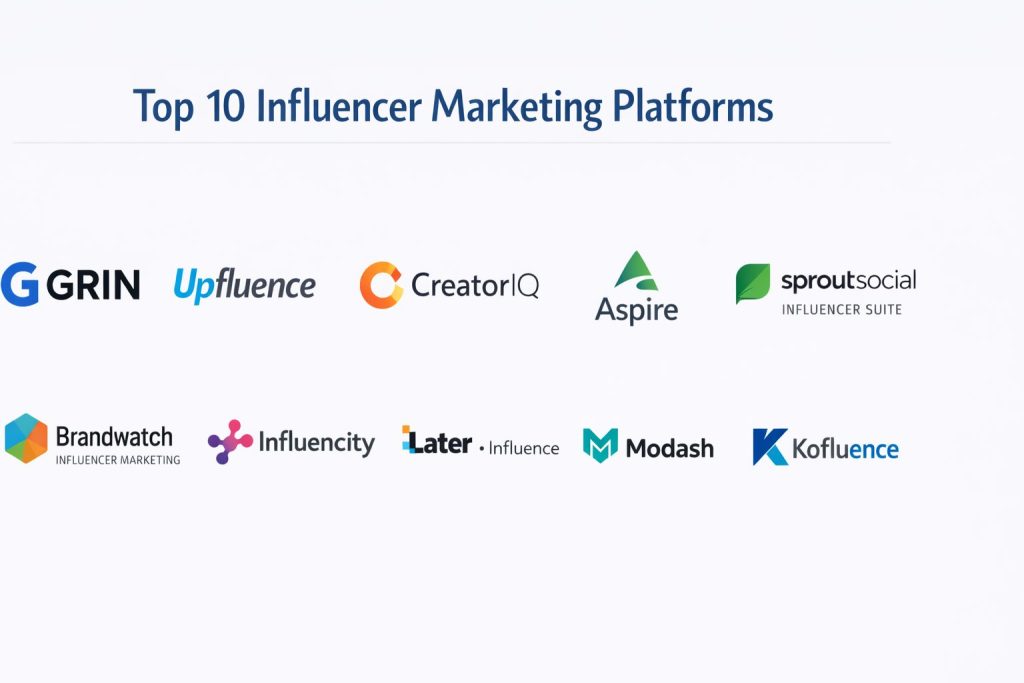
Top 10 Influencer Marketing Software Tools
#1 — GRIN
A leading creator management platform specifically built for e-commerce and D2C brands. It is designed to act as a CRM for your influencer relationships.
Key Features
- Product Seeding: Automated logistics for sending physical products to hundreds of creators at once.
- Relationship CRM: A centralized hub that looks and feels like a sales CRM, but for influencers.
- E-commerce Integration: Deep links with Shopify, Magento, and WooCommerce to track sales and ROI.
- Affiliate Management: Built-in tools for managing commissions and tracking unique discount codes.
- Content Library: Automatically pulls and stores every piece of content creators make for your brand.
Pros
- Best-in-class for brands that focus on physical product gifting.
- Eliminates the “middleman” by allowing direct communication from your own email.
Cons
- High entry price point that is often out of reach for small startups.
- Steep learning curve for teams not used to a CRM-style workflow.
Platforms / Deployment
- Web / Cloud-based
- SaaS
Security & Compliance
- SSO/SAML, MFA
- SOC 2 Type II, GDPR Compliant
Integrations & Ecosystem
GRIN thrives on its connectivity to the e-commerce world.
- Shopify / Shopify Plus
- Klaviyo
- Gorgias
- Google Analytics 4
Support & Community
Known for high-touch customer success and “GRIN University,” which offers extensive training for e-commerce marketers.
#2 — Upfluence
An all-in-one platform that focuses on “influential customers.” It helps brands find people who already love them.
Key Features
- Influential Customer Identification: Scans your own customer database to see who has a large social following.
- Live Capture: A tool that gathers social data from visitors as they browse your website.
- One-Click Outreach: Send bulk emails that feel personalized using dynamic variables.
- Campaign Workflow: Visual pipelines to move creators from “pitched” to “paid.”
- Global Search: Access to millions of profiles across Instagram, TikTok, and Twitch.
Pros
- Excellent for turning existing customers into brand ambassadors.
- Very strong filtering for audience demographics like location and age.
Cons
- The database can sometimes feel overwhelming for first-time users.
- Pricing can escalate quickly as you add more features or seats.
Platforms / Deployment
- Web / Cloud-based
- SaaS
Security & Compliance
- GDPR Compliant
- ISO 27001 (Internal infrastructure)
Integrations & Ecosystem
Upfluence is highly integrated with digital marketing stacks.
- PayPal (for easy payments)
- Gmail / Outlook
- Zapier
- HubSpot
Support & Community
Provides a dedicated account manager for most tiers and a robust library of webinars on scaling ambassador programs.
#3 — CreatorIQ
The enterprise-standard platform for large global brands. It is built to manage massive, multi-market creator programs.
Key Features
- Enterprise Creator Cloud: A private, white-labeled portal where your creators sign up and view their tasks.
- AI-Powered Discovery: Uses predictive analytics to suggest which creators are likely to trend.
- Advanced Compliance: Built-in legal and tax workflows for international campaigns.
- Fraud Detection: Deep-level auditing of follower growth and engagement patterns.
- Custom Reporting: Build complex, boardroom-ready reports that show the impact on brand sentiment.
Pros
- The most secure and compliant platform for large corporations.
- Handles “celebrity-level” influencers and complex contracts with ease.
Cons
- Requires a significant budget and a dedicated team to manage.
- Can be “too much software” for small businesses with simple needs.
Platforms / Deployment
- Web / Cloud-based
- Enterprise SaaS
Security & Compliance
- SOC 2 Type II, GDPR, HIPAA (where applicable)
- Full audit logs and RBAC
Integrations & Ecosystem
- Salesforce
- Adobe Experience Cloud
- NetSuite
- Workday
Support & Community
Offers 24/7 global support and a prestigious “CreatorIQ Academy” for enterprise-level marketing certification.
#4 — Aspire
A community-focused platform that excels at managing long-term partnerships and UGC at scale.
Key Features
- Creator Marketplace: An inbound “help wanted” board where creators apply to work with you.
- Automated Briefing: AI-generated templates to help you write clear, effective project briefs.
- Content Approval: A streamlined mobile-friendly interface for reviewing creator drafts.
- Influencer CRM: Tracks relationship health and communication history.
- Payment Automation: Handles large-scale payouts and tax forms (W-9/1099) automatically.
Pros
- The most user-friendly interface for both brands and creators.
- Excellent for brands that want to run “always-on” ambassador programs.
Cons
- The marketplace model can sometimes lead to lower-quality inbound applications.
- Less focus on deep social listening compared to tools like Brandwatch.
Platforms / Deployment
- Web / Cloud-based
- SaaS
Security & Compliance
- SSO, MFA
- GDPR Compliant
Integrations & Ecosystem
- Shopify
- WooCommerce
- TikTok Shop
Support & Community
Highly rated for their “human” support team and an active community of D2C founders who share best practices.
#5 — Sprout Social (Influencer Suite)
A major social media management tool that recently integrated deep influencer marketing capabilities.
Key Features
- Unified Inbox: Manage your brand’s social mentions and influencer DMs in one place.
- Influencer Discovery: Integrated search to find creators who are already talking about your brand.
- Performance Benchmarking: Compare your influencer results against your organic social performance.
- Listening Integration: Use social listening to find trending topics for your influencers to cover.
- Automated Reporting: “Presentation-ready” reports that combine organic and influencer data.
Pros
- Best choice for teams that already use Sprout for social media management.
- Simplifies the workflow by keeping everything in a single tab.
Cons
- Influencer search database is not as deep as specialized tools like CreatorIQ.
- Less robust for complex e-commerce tracking (Shopify).
Platforms / Deployment
- Web / iOS / Android
- SaaS
Security & Compliance
- SOC 2, ISO 27001
- GDPR and CCPA compliant
Integrations & Ecosystem
- Salesforce
- Zendesk
- Canva
- Microsoft Dynamics
Support & Community
World-class documentation and a massive professional network of social media managers.
#6 — Brandwatch (Influencer Marketing)
A platform that combines deep social intelligence with influencer management.
Key Features
- Sentiment Analysis: See how people actually feel about a creator before you hire them.
- Competitive Intelligence: Track which influencers your competitors are working with.
- Trend Detection: Identify emerging social trends before they go mainstream.
- Audience Overlap: Check if two influencers share too many of the same followers.
- End-to-End Management: Discovery, outreach, and payment in one tool.
Pros
- Unmatched data for understanding brand perception and market share.
- Excellent for research-heavy marketing teams.
Cons
- Can feel overly complex for a simple “product seeding” campaign.
- Primarily focused on data, so the “creative” workflow is less intuitive.
Platforms / Deployment
- Web / Cloud-based
- SaaS
Security & Compliance
- GDPR Compliant
- SOC 2 Type II
Integrations & Ecosystem
- Hootsuite
- Slack
- Google Data Studio
- Tableau
Support & Community
Exceptional for data-driven teams; offers extensive white papers and industry-specific benchmark reports.
#7 — Influencity
A flexible, mid-market platform known for its powerful database and precise audience analytics.
Key Features
- Audience Quality Score: Detailed breakdown of “real” vs “fake” followers for any profile.
- Stackable Filters: Combine 20+ different filters to find the exact creator niche.
- Campaign Simulation: See estimated reach and engagement before you start the campaign.
- Personalized IRM: A customizable Influencer Relationship Management system.
- Multi-Platform Coverage: Strong tools for Instagram, TikTok, and YouTube.
Pros
- Very high accuracy in audience demographics and location data.
- More affordable for agencies managing multiple client accounts.
Cons
- No built-in payment processing (requires third-party tools).
- Less focus on “automated” logistics for physical product shipping.
Platforms / Deployment
- Web / Cloud-based
- SaaS
Security & Compliance
- GDPR Compliant
- Not publicly stated (for SOC 2)
Integrations & Ecosystem
- Gmail
- Outlook
- Hubspot (via API)
Support & Community
Excellent self-service documentation and very responsive technical support for agency teams.
#8 — Later (Later Influence)
A visual-first platform that is perfect for Instagram and TikTok-focused brands.
Key Features
- Visual Content Calendar: Schedule brand posts and influencer posts in a single view.
- Creator Discovery: Find creators based on their visual “aesthetic” and style.
- Performance Dashboard: Clear, easy-to-read metrics on likes, comments, and saves.
- UGC Library: Easily collect and republish content creators make for you.
- Linkin.bio Integration: Drive traffic from influencer posts to a shoppable link.
Pros
- The easiest tool to use for small teams focusing on visual social media.
- Very affordable entry-level pricing for startups.
Cons
- Limited features for B2B or complex simulations.
- Analytics are less “deep” than enterprise tools like Traackr or Brandwatch.
Platforms / Deployment
- Web / iOS / Android
- SaaS
Security & Compliance
- GDPR Compliant
- SSO available on top tiers
Integrations & Ecosystem
- Instagram / TikTok / Pinterest
- Shopify
- Canva
Support & Community
Known for a massive blog and educational community that teaches the “basics” of social growth very well.
#9 — Modash
A specialized discovery tool that claims to have a database of every creator with 1,000+ followers.
Key Features
- Massive Database: Access to 250M+ profiles across multiple social networks.
- Fake Follower Audit: Quickly see the percentage of “suspicious” followers for any creator.
- Ad-Hoc Search: Find creators without needing to build a formal campaign first.
- Contact Info Finder: Automatically scrapes email addresses for outreach.
- Content Monitoring: Tells you every time an influencer mentions your brand.
Pros
- The most comprehensive database for finding “long-tail” micro-influencers.
- No-nonsense interface that focuses purely on discovery and vetting.
Cons
- Does not handle payments or advanced contract management natively.
- Less of a “full-lifecycle” tool compared to GRIN or Aspire.
Platforms / Deployment
- Web / Cloud-based
- SaaS
Security & Compliance
- GDPR Compliant
- Not publicly stated
Integrations & Ecosystem
- Google Sheets (for easy export)
- Gmail
- Slack
Support & Community
Strong community of performance marketers who value speed and data over complex workflows.
#10 — Kofluence
An AI-powered platform with a strong focus on the Indian and Southeast Asian markets.
Key Features
- AI Matching: Uses proprietary algorithms to match brand values with creator personas.
- Marketplace Model: Encourages creators to “pitch” creative ideas to brands.
- Regional Niche Targeting: Strong filtering for regional languages and tier-2 city creators.
- Performance Attribution: Tracks clicks and conversions specifically for the Asian e-commerce landscape.
- Managed Services: Offers a “done-for-you” option for large-scale local campaigns.
Pros
- The best data for brands targeting the Indian subcontinent.
- Excellent for high-volume campaigns with thousands of nano-influencers.
Cons
- Less effective for global campaigns centered in North America or the EU.
- Interface can feel localized specifically for the Indian marketing ecosystem.
Platforms / Deployment
- Web / Android / iOS
- SaaS / Managed Service
Security & Compliance
- GDPR compliant for international clients
- Local Indian data privacy standards
Integrations & Ecosystem
- Local e-commerce players (Flipkart, Myntra)
- WhatsApp for Business (for creator comms)
- Google Ads
Support & Community
Highly active in the Indian startup ecosystem with strong local support teams and networking events.
Comparison Table (Top 10)
| Tool Name | Best For | Platform(s) Supported | Deployment | Standout Feature | Public Rating |
| GRIN | E-commerce ROI | Web | Cloud | Product Seeding | 4.7/5 |
| Upfluence | Customer Advocacy | Web | Cloud | Customer Scanning | 4.6/5 |
| CreatorIQ | Global Enterprise | Web | Cloud | White-label Portal | 4.8/5 |
| Aspire | UGC & Community | Web | Cloud | Creator Marketplace | 4.7/5 |
| Sprout Social | Unified Social | Web, iOS, Android | Cloud | Unified Social Inbox | 4.5/5 |
| Brandwatch | Market Intelligence | Web | Cloud | Sentiment Analysis | 4.6/5 |
| Influencity | Agency Campaigns | Web | Cloud | Performance Simulation | 4.4/5 |
| Later | Visual Content | Web, iOS, Android | Cloud | Visual Calendar | 4.5/5 |
| Modash | Massive Discovery | Web | Cloud | Fake Follower Audit | 4.3/5 |
| Kofluence | Asian Market | Web, Mobile | Hybrid | AI Persona Matching | N/A |
Evaluation & Scoring of Influencer Marketing Software
The table below provides a weighted score (0–10) based on how these tools perform across critical business dimensions.
| Tool Name | Core (25%) | Ease (15%) | Integrations (15%) | Security (10%) | Performance (10%) | Support (10%) | Value (15%) | Weighted Total |
| CreatorIQ | 10 | 5 | 10 | 10 | 9 | 9 | 6 | 8.4 |
| GRIN | 9 | 7 | 9 | 8 | 10 | 8 | 7 | 8.3 |
| Upfluence | 8 | 8 | 8 | 7 | 8 | 8 | 8 | 7.9 |
| Aspire | 8 | 9 | 8 | 7 | 8 | 9 | 7 | 7.9 |
| Sprout Social | 7 | 9 | 9 | 9 | 7 | 9 | 7 | 7.8 |
| Brandwatch | 9 | 6 | 8 | 8 | 8 | 8 | 6 | 7.5 |
| Influencity | 8 | 7 | 7 | 6 | 8 | 8 | 8 | 7.5 |
| Later | 6 | 10 | 7 | 6 | 7 | 8 | 9 | 7.4 |
| Modash | 9 | 8 | 6 | 5 | 9 | 7 | 7 | 7.3 |
| Kofluence | 7 | 7 | 6 | 6 | 8 | 7 | 8 | 7.0 |
How to interpret these scores:
- 8.0 – 10.0: Elite category. These tools are the best for scaling large, complex programs without losing data integrity.
- 7.0 – 7.9: Excellent. Strong tools that provide high value for specific market segments like SMBs or agencies.
- Below 7.0: Specialized. These tools are great for specific tasks (like discovery or local markets) but may lack a complete end-to-end feature set.
Which Influencer Marketing Software Tool Is Right for You?
Solo / Freelancer
If you are managing influencer campaigns as a one-person show, Later or Modash is your best bet. They are affordable, don’t require complex onboarding, and give you just the data you need to find creators and prove your value to clients.
SMB
For small but growing brands, Aspire or Upfluence offer the best balance. They allow you to automate the “boring” parts of the job (like finding emails and tracking links) so you can spend your time actually building relationships with creators.
Mid-Market
Agencies and companies with a dedicated influencer manager will find Influencity or Sprout Social to be the most efficient. These tools provide professional-grade analytics that are easy to present to stakeholders and help justify larger budgets.
Enterprise
If you are a global corporation, CreatorIQ is non-negotiable. The security certifications, multi-brand management, and ability to coordinate hundreds of international campaigns from one dashboard are essential for risk management and scale.
Budget vs Premium
- Budget: Modash and Later (Affordable monthly fees).
- Premium: CreatorIQ and GRIN (High annual contracts and onboarding fees).
Feature Depth vs Ease of Use
If you want the most data possible, go with Brandwatch. If you want a tool that your whole team can learn in a single afternoon, go with Aspire.
Integrations & Scalability
GRIN and CreatorIQ lead the pack here. They are designed to sit at the center of your marketing tech stack and scale as you grow from a few thousand dollars in monthly spend to millions.
Security & Compliance Needs
For brands in highly regulated industries like finance or healthcare, CreatorIQ and Sprout Social provide the best security frameworks, including SSO, MFA, and SOC 2 compliance.
Frequently Asked Questions (FAQs)
1. How much do these platforms usually cost?
Pricing is a wide range. Simple discovery tools like Modash start around $100/month. Mid-market tools range from $500 to $2,000/month, while enterprise suites like CreatorIQ can exceed $25,000 annually. Many require a 12-month commitment.
2. Do these tools find influencers automatically?
Yes, most use AI to scan millions of profiles based on your specific keywords, audience interests, or visual style. Some even use “predictive matching” to suggest creators who have worked successfully with brands similar to yours.
3. How do I avoid “fake” influencers?
Modern platforms like Influencity and HypeAuditor (integrated into many tools) analyze follower growth patterns. If an influencer has sudden spikes in followers or a very high number of “empty” accounts, the software will flag them with a low authenticity score.
4. Can these platforms handle payments?
Yes, premium tools like GRIN, Aspire, and CreatorIQ have built-in payment engines. They handle the transaction, collect the necessary tax documents (like W-9s), and provide you with a single invoice for your entire campaign.
5. What is the difference between a marketplace and a CRM?
A marketplace (like Aspire’s board) is where creators apply to your projects. A CRM (like GRIN) is a tool where you manage your existing relationships and outreach. Most top-tier tools now combine both features.
6. Do I need to be a big brand to use these?
Not at all. While some tools are built for enterprises, many (like Later or Modash) are specifically designed for small businesses and solo creators. They help you look more professional even if you only have a small budget.
7. How do I track the actual sales from an influencer?
The best way is through e-commerce integrations. The software generates unique affiliate links or discount codes for each creator. When a customer buys using those, the platform records the sale and attributes it to that specific influencer.
8. Is influencer marketing still effective?
It is more effective than ever. Traditional ads are increasingly ignored, but audiences still trust recommendations from people they follow. The “social commerce” revolution has made it easier for people to buy directly from their favorite creators.
9. Can I use these for B2B marketing?
Yes, but you have to choose the right tool. Software like Brandwatch or Upfluence is great for finding industry experts on LinkedIn and YouTube, whereas tools like Later are more focused on B2C platforms like TikTok.
10. How long does it take to set up a platform?
Basic tools can be ready in minutes. Enterprise platforms often have a 2-4 week “onboarding” period where a dedicated specialist helps you import your data, set up your legal contracts, and train your team.
Conclusion
The era of “guessing” which influencers are right for your brand is over. The best influencer marketing platforms provide the data, automation, and security required to turn social partnerships into a predictable revenue stream.
The right choice for your business depends on your specific goals—whether that is high-volume product seeding with GRIN, global enterprise management with CreatorIQ, or visual growth with Later. Your next step should be to shortlist three platforms from this list and request a demo to see their discovery tools in action using your own niche keywords.