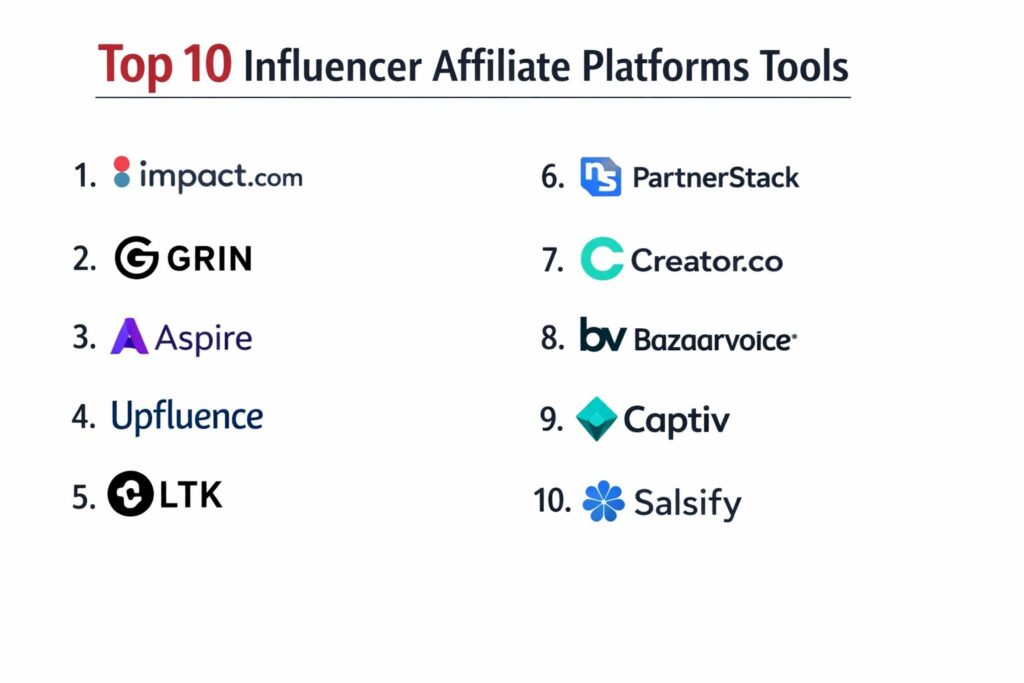
Introduction
Influencer affiliate platforms represent the critical convergence of relationship-based marketing and performance-driven sales tracking. Unlike traditional affiliate networks that often prioritize coupon sites and search arbitrage, these specialized platforms are engineered to handle the “creator-first” economy. They provide a unified infrastructure where brands can discover high-affinity content creators, manage complex legal contracts, and track multi-channel conversions through personalized links or promo codes. These systems act as a bridge between the qualitative world of brand storytelling and the quantitative requirements of return-on-investment (ROI) reporting. For organizations looking to scale their social commerce efforts, these tools are the primary engine for turning likes into measurable revenue.
In the contemporary digital landscape, the shift toward “authentic commerce” has made these platforms indispensable. Standard advertising is seeing diminishing returns, leading brands to rely on trusted voices to drive purchasing decisions. A robust influencer affiliate platform must manage thousands of micro-relationships simultaneously, automating the tedious aspects of gifting, content approval, and global payouts. When selecting a platform, businesses must evaluate the depth of the creator database, the precision of the attribution modeling, and the ease of the influencer-facing interface. A successful implementation ensures that influencers are treated as long-term partners rather than temporary media buys, fostering a sustainable ecosystem of brand advocates.
Best for: E-commerce brands, direct-to-consumer (DTC) startups, global retail corporations, and digital marketing agencies that need to manage large-scale creator programs with a focus on performance-based compensation.
Not ideal for: B2B companies with highly technical sales cycles, local service providers with no online checkout, or brands looking for one-off celebrity endorsements without a desire for long-term tracking or data-driven optimization.
Key Trends in Influencer Affiliate Platforms
The integration of artificial intelligence has moved beyond simple search filters to predictive performance modeling, where platforms can now forecast the potential revenue of a creator before a contract is signed. We are seeing a significant trend toward “social-to-cart” integrations, where affiliate links are replaced by seamless, in-app shopping experiences that reduce friction for the consumer. Real-time attribution is also evolving to account for “dark social”—the untrackable shares in private messages and groups—using sophisticated fingerprinting and probabilistic modeling to ensure creators are fairly compensated for their influence.
Another dominant trend is the rise of the “internal marketplace,” where brands can convert their own customers into affiliates directly through the platform. This moves the strategy away from high-cost mega-influencers toward a high-volume army of brand loyalists. There is also a heightened focus on global compliance, as platforms adopt automated tax documentation and multi-currency payout systems to support international creator networks. Finally, the shift toward “modular ecosystems” allows brands to plug their affiliate data directly into broader business intelligence tools, ensuring that influencer performance is viewed alongside traditional search and social ad spend.
How We Selected These Tools
Our selection process involved a comprehensive audit of the partnership automation landscape, specifically focusing on platforms that bridge the gap between influencer management and affiliate tracking. We prioritized tools that offer “full-funnel” visibility, from initial creator discovery to the final click-to-purchase. A key criterion was the strength of the attribution engine, evaluating how each platform handles cross-device tracking and cookie duration in an increasingly privacy-conscious web environment. We looked for systems that balance powerful enterprise features with a user-friendly “creator portal” to ensure high adoption rates among influencers.
Scalability was a major factor; we selected platforms that can support a brand’s journey from a handful of brand ambassadors to tens of thousands of global affiliates. Security and data privacy were scrutinized to ensure compliance with international standards such as GDPR and SOC 2, which are essential for brands handling sensitive customer and creator data. We also assessed the quality of the technical support and the breadth of the integration marketplace, ensuring that these tools can sit at the center of a modern marketing technology stack. Finally, we looked at the transparency of the reporting and the reliability of the automated payment systems.
1. Impact.com
Impact.com is a global leader in partnership automation, offering a heavy-duty platform that treats influencers as one part of a broader affiliate and partnership ecosystem. It is designed for enterprise brands that require sophisticated tracking and a centralized hub for managing diverse partner types at a massive scale.
Key Features
The platform features a massive global marketplace with hundreds of thousands of vetted partners, ranging from micro-influencers to major media publishers. It includes a “Contracting & Negotiation” module that allows for highly custom commission structures based on specific performance goals. The “Data Lab” provides advanced analytics that can track multi-touch attribution across different devices and channels. It offers automated fraud detection to ensure that affiliate traffic is genuine and high-quality. The system also supports automated, multi-currency payouts and complex tax compliance workflows for international programs.
Pros
The platform offers the most advanced tracking and attribution capabilities in the industry, making it ideal for data-driven teams. It allows for the management of all partner types in one single interface.
Cons
The interface is extremely dense and has a steep learning curve for those who are new to affiliate marketing. Pricing is custom and generally targets mid-to-large enterprises.
Platforms and Deployment
Web-based (SaaS) with a dedicated mobile app for partners to manage their links and earnings.
Security and Compliance
Industry-leading security including SOC 2 Type II, ISO 27001, and PCI-DSS compliance for payment security.
Integrations and Ecosystem
Extensive integration marketplace with deep links to Salesforce, HubSpot, Shopify, and various big-data analytics tools.
Support and Community
Offers a professional training academy and dedicated success managers for higher-tier enterprise accounts.
2. Grin
Grin is a creator management platform that emphasizes the “relationship” aspect of influencer marketing. It is built as a specialized CRM that integrates directly with e-commerce stores to provide a seamless workflow for gifting products and tracking affiliate sales.
Key Features
The software includes a powerful “Email Integration” that allows brands to communicate with influencers directly through their own inbox while keeping records in the CRM. It features an automated “Product Gifting” workflow that syncs with your e-store to handle inventory and shipping. The “Content Library” automatically aggregates all social posts created by your influencers for easy review and repurposing. It offers clear ROI tracking by generating unique affiliate links and promo codes for every partner. The platform also includes a “Creator Portal” where influencers can see their performance and manage their own details.
Pros
The user interface is exceptionally clean and intuitive, often described as the best “CRM for creators.” Its deep e-commerce integrations make product-based campaigns very easy to manage.
Cons
The platform focuses exclusively on social creators, so it is not suitable for brands looking to manage traditional non-social affiliates. It requires influencers to opt-in to see certain private data.
Platforms and Deployment
Web-based SaaS.
Security and Compliance
SOC 2 Type II and GDPR compliant, utilizing high-level encryption for all constituent and financial data.
Integrations and Ecosystem
Native, deep-level integrations with Shopify, Magento, WooCommerce, and various communication tools like Slack.
Support and Community
Known for having a highly responsive support team and a strong community of modern social marketers.
3. Aspire
Aspire is an influencer marketing platform that stands out for its “inbound” marketplace approach. It is designed for brands that want to build a community of brand advocates by allowing creators to apply directly to join their affiliate programs.
Key Features
The platform features a “Creator Marketplace” where brands can post campaign briefs and receive applications from interested influencers. It includes a robust “Relationship Management” system that tracks every interaction from initial outreach to final payment. The software offers automated content rights management, ensuring that brands have the legal permission to reuse creator content. It features integrated affiliate tracking that supports both link-based and code-based conversions. The system also includes an “Automated Workflow” engine that triggers tasks and emails based on campaign milestones.
Pros
The inbound model is excellent for identifying influencers who are already fans of the brand. Its community-building features help in creating long-term brand ambassador programs.
Cons
The outbound discovery tools are powerful but can sometimes feel secondary to the inbound marketplace. Pricing is premium and typically requires an annual commitment.
Platforms and Deployment
Web-based SaaS.
Security and Compliance
SOC 2 Type II certified and compliant with GDPR and CCPA, maintaining rigorous data privacy standards.
Integrations and Ecosystem
Strong integrations with Shopify, Refersion, and various social media advertising platforms for boosting creator content.
Support and Community
Offers a wealth of educational resources and strategy webinars through its “Modern Marketer” community.
4. Upfluence
Upfluence is an e-commerce-centric platform that combines a massive influencer search engine with sophisticated affiliate tracking. It is particularly known for its ability to identify influencers who are already among a brand’s existing customer base.
Key Features
The “Live Capture” tool allows brands to identify influential customers as they visit their website or purchase products. It features a database of millions of creators with deep filters for niche, location, and audience demographics. The platform includes a full-featured “Affiliate Management” suite that handles link generation and commission tracking. It offers an automated “Email Outreach” system with customizable templates and sequence tracking. The software also provides a high-level “Dashboard” for comparing the ROI of different influencer segments against each other.
Pros
The ability to turn existing customers into affiliates is a unique and highly effective feature. The database is one of the largest and most detailed in the industry.
Cons
The sheer volume of data and features can make the interface feel overwhelming for smaller teams. The pricing is on the higher end of the market.
Platforms and Deployment
Web-based SaaS and a Chrome extension for analyzing social profiles directly in the browser.
Security and Compliance
SOC 2 compliant and GDPR ready, with secure SSO options for enterprise teams.
Integrations and Ecosystem
Seamlessly integrates with Shopify, Klaviyo, and various PayPal-based payment systems for creator payouts.
Support and Community
Provides high-quality onboarding and a massive library of social commerce educational resources.
5. LTK (Formerly rewardStyle)
LTK is a specialized affiliate platform built specifically for the lifestyle, fashion, and beauty industries. It operates a closed ecosystem that connects brands with a highly curated network of influential “shoppable” content creators.
Key Features
The platform is centered around the “LTK App,” a consumer-facing shopping destination where followers can buy products directly from creator posts. It features a “Creator Casting” tool that helps brands find influencers who are proven to drive sales in specific niches. The system provides “Granular Sales Data” that tracks individual item performance across the entire network. It includes an automated “Collaboration” workflow for managing paid campaigns and gifting. The platform also offers a managed service option for brands that want LTK experts to run their campaigns.
Pros
It is the gold standard for high-conversion fashion and lifestyle affiliate marketing. The closed network ensures that you are working with creators who are professionally dedicated to driving sales.
Cons
The platform is very niche-focused and is not suitable for brands outside of lifestyle and consumer goods. It offers less control over individual influencer relationships compared to a CRM like Grin.
Platforms and Deployment
Web-based for brands and a highly popular mobile app for both creators and consumers.
Security and Compliance
Maintains standard industry encryption and privacy policies, fully compliant with GDPR for its global user base.
Integrations and Ecosystem
Focused on its own proprietary ecosystem but integrates with major retail platforms for catalog syncing.
Support and Community
Known for hosting massive industry events and providing extensive education for its curated creator network.
6. PartnerStack
PartnerStack is an all-in-one partnership platform designed primarily for B2B and SaaS brands. It excels at managing complex affiliate programs where the goal is driving recurring subscriptions and high-value software leads.
Key Features
The platform features a “Partner Marketplace” that connects SaaS brands with vetted B2B influencers and software resellers. It includes “First-Party Tracking” that uses server-side cookies to ensure accurate attribution even in privacy-restricted browsers. The software offers a “Partner Portal” where affiliates can access branded marketing materials and track their earnings. It features automated “Commission Rules” that can handle one-time payments or recurring percentages. The system also includes a “Learning Management” module to train and certify partners on your product.
Pros
It is the best choice for software companies that need to track recurring revenue. The automated onboarding and training features save a massive amount of administrative time.
Cons
The platform is less focused on B2C social media “lifestyle” influencers and more on technical referrers. The setup process for complex recurring commissions can be technical.
Platforms and Deployment
Web-based SaaS.
Security and Compliance
SOC 2 Type II compliant and GDPR ready, with a focus on enterprise-grade data handling for SaaS companies.
Integrations and Ecosystem
Deep integrations with Stripe, Salesforce, and various subscription management platforms.
Support and Community
Offers a dedicated customer success model and a library of resources on B2B partnership growth.
7. Creator.co
Creator.co is a versatile platform that caters to small and mid-sized brands looking for a balance between manual control and automated campaign execution. It provides a unique “Community” model where brands can grow their affiliate network alongside managed services.
Key Features
The software includes an “Open Network” discovery engine with access to over 400 million creator profiles. It features a “Collaboration Dashboard” where brands and creators can manage briefs, content approvals, and links in one place. The platform offers a “Deep Shopify Integration” for automated product gifting and sales tracking. It includes a “Managed Services” option where the platform’s team handles the outreach and management for you. The reporting suite provides clear data on engagement, reach, and affiliate-driven revenue.
Pros
The platform is very accessible for smaller brands that don’t have the budget for enterprise-grade tools. The combination of self-serve and managed services is very flexible.
Cons
The interface is functional but lacks some of the high-end aesthetic and UX refinements of premium competitors. Discovery features can sometimes feel less precise for very niche markets.
Platforms and Deployment
Web-based SaaS.
Security and Compliance
Standard encryption protocols and GDPR compliance for data protection.
Integrations and Ecosystem
Strong connections with Shopify and major affiliate networks like Impact and CJ.
Support and Community
Known for being very user-friendly with a vibrant community and fast customer support response times.
8. Bazaarvoice
Bazaarvoice is a comprehensive platform that focuses on user-generated content (UGC) and ratings to drive affiliate sales. It is designed for large retailers and brands that want to integrate influencer content directly into the shopping experience on their own sites.
Key Features
The platform features a “Review Syndication” system that pushes influencer and customer reviews to major retail sites. It includes “Sampling Campaigns” where influencers receive products in exchange for honest reviews and social content. The “Affiliate Tracking” module connects these reviews to direct sales outcomes. It offers advanced “Data Veracity” tools to ensure that all reviews and content are authentic and compliant. The software also provides a “Brand Response” portal for engaging directly with the creators and customers who are talking about your products.
Pros
It is the industry leader for review syndication, helping brands increase credibility across the web. It perfectly bridges the gap between social influence and on-site conversion.
Cons
The platform is highly complex and usually requires a significant investment and dedicated staff to manage. It is more of a “conversion tool” than a traditional “influencer search engine.”
Platforms and Deployment
Web-based SaaS.
Security and Compliance
Maintains high data veracity standards and is fully compliant with GDPR and consumer protection regulations.
Integrations and Ecosystem
Unrivaled network of retail partners and deep integrations with enterprise e-commerce platforms.
Support and Community
Provides extensive professional services and a comprehensive knowledge base for enterprise users.
9. Captiv8
Captiv8 is an enterprise-grade influencer marketing platform that offers sophisticated data science and competitive intelligence. It is designed for large agencies and global brands that need to track complex multi-channel affiliate campaigns across the world.
Key Features
The software features “Global Brand Mentions” and competitive tracking to see how your affiliate performance compares to rivals. It includes an “AI-Powered Filtering” system that identifies the most authentic creators based on audience quality scores. The platform offers a “Unified Payments” system that handles complex creator payouts across different countries and currencies. It features deep “Social Commerce” integrations with Shopify and Refersion for accurate revenue tracking. The reporting engine allows for “Drag-and-Drop” custom report creation for different stakeholders.
Pros
The competitive intelligence tools are some of the best in the market, providing a broad view of the industry landscape. It offers very deep analytics that go beyond simple sales tracking.
Cons
The pricing is very high and requires an annual commitment, making it inaccessible for smaller businesses. Some users report that the interface can be buggy due to the high density of features.
Platforms and Deployment
Web-based SaaS.
Security and Compliance
Enterprise-grade security and full compliance with global privacy regulations like GDPR and CCPA.
Integrations and Ecosystem
Strong API for custom connections and a wide array of native integrations with major social networks.
Support and Community
Offers dedicated account management and professional training for large agency teams.
10. Salsify (PXM)
Salsify is a Product Experience Management (PXM) platform that includes a robust module for managing influencer and affiliate content at the product level. It is ideal for manufacturers and large brands that need to keep their product data consistent across a massive affiliate network.
Key Features
The platform features a “Brand Portal” where affiliates can download approved product data, images, and marketing copy. It includes “Data Governance” tools to ensure that all affiliate content meets brand and legal standards. The “Syndication” module pushes updated product info to all your partners simultaneously. It offers “Workflow Management” for assigning tasks to creators and approving their content. The system also includes “Performance Analytics” to see which products are most successful within your influencer network.
Pros
It ensures absolute brand consistency across thousands of different affiliate touchpoints. The platform is highly scalable for organizations with massive product catalogs.
Cons
It is a technical tool and may lack the “creative” focus of specialized influencer platforms like Grin. The reporting is more focused on product performance than individual creator relationship depth.
Platforms and Deployment
Web-based SaaS.
Security and Compliance
Strong data governance and security protocols, meeting standard enterprise compliance requirements.
Integrations and Ecosystem
Integrates seamlessly with ERP systems, PIM databases, and all major e-commerce platforms.
Support and Community
Offers a high-quality “Academy” and a dedicated success team for enterprise onboarding.
Comparison Table
| Tool Name | Best For | Platform(s) Supported | Deployment | Standout Feature | Public Rating |
| 1. Impact.com | Global Enterprise | Web, iOS, Android | Cloud SaaS | Multi-Channel Attribution | 4.6/5 |
| 2. Grin | Relationship CRM | Web-Based | Cloud SaaS | Deep E-store Integration | 4.8/5 |
| 3. Aspire | Inbound Scaling | Web-Based | Cloud SaaS | Creator Marketplace | 4.7/5 |
| 4. Upfluence | Social Commerce | Web, Chrome | Cloud SaaS | Live Customer Capture | 4.5/5 |
| 5. LTK | Fashion / Lifestyle | Web, iOS, Android | Closed Network | Consumer Shopping App | 4.8/5 |
| 6. PartnerStack | B2B / SaaS Brands | Web-Based | Cloud SaaS | Recurring Commissions | 4.7/5 |
| 7. Creator.co | Mid-Market Growth | Web-Based | Cloud SaaS | Managed Services Option | 4.5/5 |
| 8. Bazaarvoice | Retail / UGC | Web-Based | Cloud SaaS | Review Syndication | 4.3/5 |
| 9. Captiv8 | Data Intelligence | Web-Based | Cloud SaaS | Competitive Tracking | 4.6/5 |
| 10. Salsify | Product Consistency | Web-Based | Cloud SaaS | Centralized Brand Portal | 4.4/5 |
Evaluation & Scoring of Influencer Affiliate Platforms
The scoring below is a comparative model intended to help shortlisting. Each criterion is scored from 1–10, then a weighted total from 0–10 is calculated using the weights listed. These are analyst estimates based on typical fit and common workflow requirements, not public ratings.
Weights:
- Core features – 25%
- Ease of use – 15%
- Integrations & ecosystem – 15%
- Security & compliance – 10%
- Performance & reliability – 10%
- Support & community – 10%
- Price / value – 15%
| Tool Name | Core (25%) | Ease (15%) | Integrations (15%) | Security (10%) | Performance (10%) | Support (10%) | Value (15%) | Weighted Total |
| 1. Impact.com | 10 | 4 | 10 | 10 | 9 | 9 | 6 | 8.35 |
| 2. Grin | 9 | 9 | 10 | 8 | 9 | 10 | 7 | 8.85 |
| 3. Aspire | 9 | 8 | 9 | 9 | 9 | 9 | 8 | 8.70 |
| 4. Upfluence | 8 | 7 | 8 | 8 | 8 | 8 | 7 | 7.70 |
| 5. LTK | 7 | 10 | 6 | 8 | 10 | 9 | 9 | 8.20 |
| 6. PartnerStack | 9 | 8 | 9 | 9 | 9 | 9 | 8 | 8.70 |
| 7. Creator.co | 7 | 9 | 7 | 8 | 8 | 9 | 10 | 8.15 |
| 8. Bazaarvoice | 9 | 5 | 9 | 10 | 8 | 8 | 5 | 7.60 |
| 9. Captiv8 | 9 | 6 | 8 | 9 | 9 | 8 | 6 | 7.75 |
| 10. Salsify | 8 | 7 | 10 | 9 | 8 | 8 | 7 | 8.05 |
How to interpret the scores:
- Use the weighted total to shortlist candidates, then validate with a pilot.
- A lower score can mean specialization, not weakness.
- Security and compliance scores reflect controllability and governance fit, because certifications are often not publicly stated.
- Actual outcomes vary with assembly size, team skills, templates, and process maturity.
Which Influencer Affiliate Platform Tool Is Right for You?
Solo / Founder-Led
For founders running their own outreach, look for a tool that offers “tip-based” or low-cost entry plans. Your priority is automated link generation and simple tracking so you can focus on building the initial 10-20 relationships that will prove your affiliate concept.
Small Nonprofit
Organizations with limited staff should prioritize platforms with built-in marketplaces. You need a tool where influencers are already looking for missions to support, reducing the time your team spends on cold outreach and complex campaign management.
Mid-Market
Mid-sized brands should focus on CRM-style tools that integrate deeply with their e-commerce store. At this stage, automating product gifting and having a clear view of which influencers are actually driving revenue is essential for sustainable scaling.
Enterprise
Large corporations require platforms with robust security, multi-user permissions, and global payout capabilities. You need a system that can handle complex multi-channel attribution and integrate directly into your enterprise resource planning (ERP) software.
Budget vs Premium
If budget is the primary concern, modular tools or those with revenue-based pricing allow you to start small. Premium platforms, however, offer the advanced data science and competitive intelligence that can provide a much higher return on investment for high-spend teams.
Feature Depth vs Ease of Use
Highly technical platforms offer infinite data possibilities but can slow down a team if they are too difficult to navigate. Often, a “friendlier” tool that the whole marketing department actually enjoys using will lead to better campaign results than a “perfect” technical system.
Integrations & Scalability
Your platform must talk to your e-commerce engine and your marketing automation tools. As you grow, the ability to add thousands of partners without a total system migration is a vital consideration for the long-term health of your affiliate program.
Security & Compliance Needs
If you handle international payments or work with high-profile creators, security is a legal necessity. Ensure the provider has the specific certifications like SOC 2 or GDPR compliance required for your specific operational region and data type.
Frequently Asked Questions (FAQs)
1. What is the difference between an influencer platform and an affiliate network?
An influencer platform focuses on the relationship, content approval, and social growth of a creator. An affiliate network focuses primarily on the technical tracking of clicks and the financial distribution of commissions to a wide range of referrers.
2. How do these platforms track sales accurately?
Most use a combination of first-party cookies, unique promo codes, and probabilistic modeling. This ensures that even if a user switches devices, the original influencer can often still be credited for the sale.
3. Is it possible to manage global payouts automatically?
Yes, most professional platforms integrate with payment processors like PayPal or Tipalti to handle multi-currency payments and automatically generate the necessary tax forms for different countries.
4. Can I find influencers directly within these tools?
Yes, most of these platforms include a searchable database or a marketplace where you can filter creators by niche, audience size, engagement rate, and geographic location.
5. Why do some platforms charge a percentage of sales?
This is a performance-based pricing model. It aligns the platform’s success with your own; the more revenue you generate through your affiliates, the more the platform earns for providing the infrastructure.
6. Do these tools help with legal contracts?
Almost all enterprise-grade platforms include digital contract management, allowing you to send standardized or custom agreements that influencers can sign electronically before starting a campaign.
7. How does product gifting work through a platform?
The platform syncs with your e-commerce store (like Shopify). When you approve a creator for a gift, the system creates an order in your store, handles the shipping data, and tracks when the creator receives the item.
8. Can I see the performance of individual influencer posts?
Yes, these platforms aggregate data from social media APIs to show you exactly how many likes, shares, and clicks each specific post generated, alongside the final revenue figures.
9. Is data security a major concern for these platforms?
Absolutely. Because these systems handle sensitive financial data and personal contact information, they must adhere to high-level security standards like SOC 2 and GDPR to prevent data breaches.
10. Do these platforms support micro-influencer scaling?
Yes, the primary value of these tools is their ability to automate the management of hundreds or thousands of micro-influencers, which would be impossible to do manually through spreadsheets.
Conclusion
In the current era of social-driven commerce, an influencer affiliate platform is the essential infrastructure for any brand seeking measurable growth. The transition from manual, spreadsheet-based tracking to a unified automated system allows marketing teams to focus on the creative partnerships that drive genuine engagement. By selecting a platform that balances deep technical attribution with an intuitive relationship management interface, you secure a scalable path to revenue that bypasses the limitations of traditional advertising. The right tool not only protects your data and ensures fair compensation for your creators but also provides the actionable insights needed to dominate your market.