Introduction
Identity resolution is the technical process of linking disparate data fragments—such as email addresses, device IDs, physical addresses, and behavioral signals—to create a single, unified view of an individual. In an era where consumers interact with brands across multiple touchpoints and privacy regulations like GDPR and CCPA are strictly enforced, maintaining a “Golden Record” is a critical requirement for any data-driven organization. These platforms utilize deterministic and probabilistic matching algorithms to stitch together fragmented data points into a persistent identity graph. By resolving these identities, enterprises can ensure high-fidelity personalization, accurate marketing attribution, and robust compliance across their entire digital and physical ecosystem.
From a strategic perspective, identity resolution serves as the foundational layer for modern Customer Data Platforms (CDPs) and clean room environments. It allows organizations to move beyond siloed data by reconciling “anonymous” web traffic with “known” customer records, effectively closing the loop on the customer journey. As third-party cookies continue to be phased out, the reliance on first-party identity resolution has become a non-negotiable component of a mature data stack. A reliable identity spine does more than just improve marketing efficiency; it protects brand integrity by ensuring that consent preferences are honored universally across all systems and interactions.
Best for: Large-scale enterprises, retail and e-commerce brands, financial services, and media companies managing massive, fragmented datasets across global jurisdictions.
Not ideal for: Small businesses with single-channel marketing strategies or organizations with low data maturity where the complexity of identity stitching outweighs the immediate ROI.
Key Trends in Identity Resolution Platforms
The most significant trend currently is the shift toward “Real-Time Stitching,” where identities are resolved the instant a new signal is captured, rather than through traditional nightly batch processing. This enables hyper-personalized experiences, such as updating a website’s layout based on a user’s very last interaction on a mobile app. Another major development is the rise of Data Clean Rooms, which allow different organizations to collaborate and match identities in a secure, privacy-safe environment without ever exposing raw personally identifiable information (PII).
Artificial intelligence and machine learning have also become the primary engines for probabilistic matching. These models can now account for “messy” data—such as typos in names or shared household devices—with much higher accuracy than traditional rules-based systems. Furthermore, there is a growing move toward “Universal IDs” and decentralized identity frameworks as the industry seeks alternatives to the crumbling cookie-based ecosystem. Organizations are now prioritizing platforms that can integrate with multiple identity spines to maintain reach and measurement across diverse advertising environments.
How We Selected These Tools
Our selection process focused on the technical robustness of the underlying identity graph and the platform’s ability to handle scale. We prioritized vendors that offer a balance between deterministic matching (exact matches like an email) and probabilistic matching (high-probability links based on patterns). Market longevity and reputation were significant factors, as identity resolution relies heavily on access to authoritative, multi-sourced datasets that only established players can provide.
We also evaluated these platforms based on their “privacy-by-design” architecture. In the current regulatory climate, a tool must not only resolve identities but also manage consent and pseudonymization at the core. Technical performance, specifically API latency and the speed of profile unification, was a key differentiator. Finally, we looked for an ecosystem fit, selecting tools that integrate seamlessly with major cloud data warehouses like Snowflake, BigQuery, and Databricks, as well as the broader MarTech and AdTech stack.
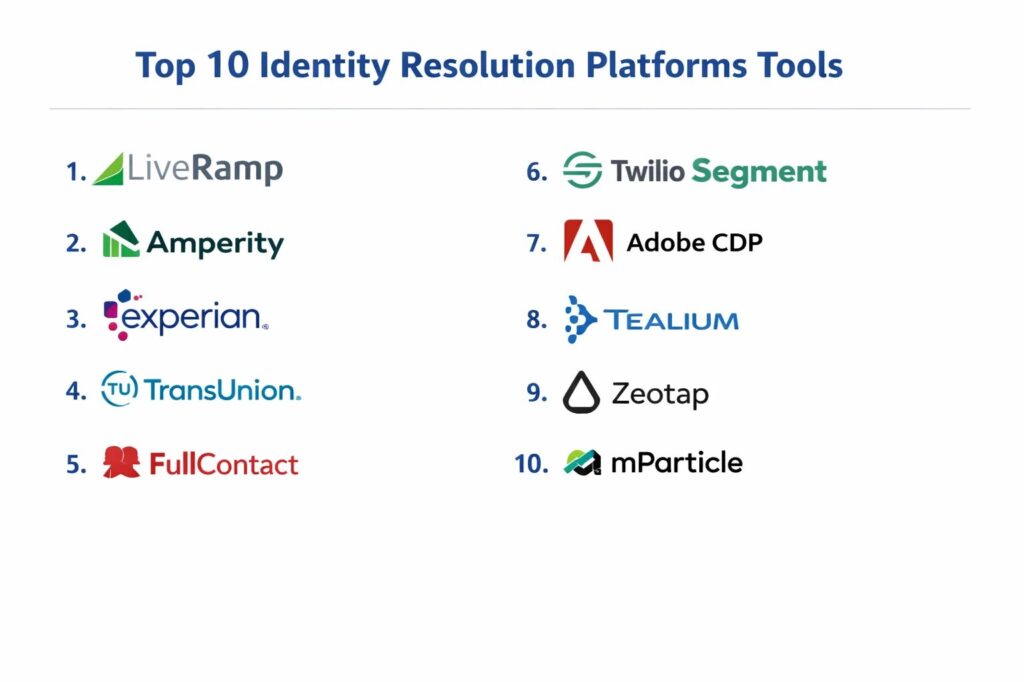
1. LiveRamp
LiveRamp is widely regarded as the gold standard in the identity resolution space. It operates one of the world’s most extensive identity graphs, known for its ability to connect offline data with digital identifiers in a privacy-safe manner. It is the go-to choice for enterprises that require a “neutral” identity spine to power their marketing and measurement across the entire open web.
Key Features
The platform utilizes a proprietary “RampID” which serves as a persistent, person-based identifier that replaces cookies. It offers an advanced “Embedded Identity” feature that allows users to resolve data directly within their own cloud environment (like Snowflake) to minimize data movement. The system includes robust data clean room capabilities for secure multi-party collaboration. It supports both deterministic and probabilistic matching at a global scale. Additionally, it provides a comprehensive suite of tools for audience activation and cross-screen measurement.
Pros
Unrivaled global scale and the most established identity ecosystem in the industry. Excellent “offline-to-online” matching capabilities that are vital for multi-channel retailers.
Cons
The pricing structure is often prohibitive for mid-market companies. The complexity of the platform can require specialized knowledge to fully utilize.
Platforms and Deployment
Cloud-native SaaS platform with deep integrations for Snowflake, AWS, and GCP.
Security and Compliance
Industry-leading security with SOC 2, HIPAA, and GDPR compliance; specialized in pseudonymization.
Integrations and Ecosystem
Integrates with virtually every major DSP, SSP, and CRM, acting as a central hub for the advertising industry.
Support and Community
Provides dedicated account management and a vast library of technical documentation for developers.
2. Amperity
Amperity is a leader in AI-driven identity resolution, famous for its “AmpID” technology. It excels at taking massive amounts of “messy” and disconnected first-party data and turning it into clean, unified customer profiles using sophisticated machine learning models.
Key Features
The platform features a “Patented Stitching Engine” that can reconcile records even when common identifiers like emails are missing or misspelled. It provides a visual interface for managing identity rules, allowing data teams to see exactly why two records were merged. It offers “Customer 360” views that include calculated attributes like lifetime value and churn risk. The system is designed for high-speed processing, handling billions of records with ease. It also includes built-in tools for data governance and automated PII masking.
Pros
Exceptional at handling legacy data silos and inconsistent formatting that traditional tools struggle with. High transparency in its matching logic compared to “black box” AI competitors.
Cons
Implementation can be time-consuming due to the depth of data mapping required. It is primarily focused on the merchant’s first-party data rather than third-party ecosystem matching.
Platforms and Deployment
Web-based enterprise SaaS platform.
Security and Compliance
Fully compliant with SOC 2, HIPAA, and GDPR; includes enterprise-grade encryption for data at rest and in transit.
Integrations and Ecosystem
Strong native connectors for Shopify, Salesforce, and major data warehouses.
Support and Community
Known for “white-glove” customer success teams and professional services for enterprise onboarding.
3. Experian Marketing Services
Experian leverages its history as a credit bureau to provide an identity resolution service built on authoritative, verified consumer data. It is a top choice for highly regulated industries like finance and healthcare where accuracy and data lineage are paramount.
Key Features
The platform centers around a “Persistent Identity Link” that stays with a consumer even as they change addresses or email accounts. It offers unique “Household-Level” resolution, allowing brands to understand relationships between individuals living at the same address. It provides deep demographic enrichment, adding hundreds of attributes to unified profiles. The system includes a dedicated “Identity Risk” score to help prevent fraud during the resolution process. It also supports seamless onboarding of offline mailing lists into digital advertising segments.
Pros
Access to highly accurate, verified offline data that few other providers can match. Strong focus on “Total Identity,” bridging the gap between credit-world data and marketing-world data.
Cons
Can feel less “agile” for modern, digital-only startups compared to newer SaaS-first competitors. The data-heavy nature of the tool can lead to higher latency in real-time use cases.
Platforms and Deployment
Cloud-based enterprise API and batch processing interface.
Security and Compliance
Top-tier security standards as a regulated data provider, including ISO 27001 and SOC 2.
Integrations and Ecosystem
Deeply integrated with the traditional agency ecosystem and enterprise CRM systems.
Support and Community
Offers extensive consulting and professional services to help enterprises structure their data strategy.
4. TransUnion (TruAudience)
TransUnion, particularly through its TruAudience platform (which incorporates Neustar technology), offers a powerful identity resolution engine focused on omnichannel marketing and attribution. It is designed for brands that need to understand the “why” behind consumer behavior across devices.
Key Features
The platform utilizes a “OneID” identity graph that is continuously updated using telecom-grade data assets. It excels in “Cross-Device” linking, connecting mobile, desktop, and connected TV (CTV) signals. It features advanced “Multi-Touch Attribution” (MTA) tools that rely on a resolved identity spine. The system provides “Marketplace” access to thousands of third-party audience segments. It also includes specific tools for call centers to resolve identities in real-time during customer support interactions.
Pros
Superior performance in the CTV and streaming media space. The use of authoritative telco data provides a high level of confidence in digital-to-physical matches.
Cons
The transition from Neustar to TransUnion has caused some platform complexity during integration. It is a very complex tool that typically requires a dedicated data science team.
Platforms and Deployment
Enterprise cloud platform with robust API access.
Security and Compliance
Maintains rigorous standards including ISO 27001, HIPAA, and GDPR.
Integrations and Ecosystem
Highly connected to the programmatic advertising landscape and media buying platforms.
Support and Community
Provides high-level strategic support and detailed technical training for enterprise users.
5. FullContact
FullContact is a developer-friendly identity resolution platform known for its powerful and easy-to-implement API. It is designed for businesses that want to build identity resolution directly into their own applications and workflows.
Key Features
The platform offers an “Identity Map” API that can resolve an identity from a single fragment, like an old email or a phone number. It provides “Real-Time Enrichment,” adding social profiles and professional data to a record instantly. It includes a unique “Person-Centered” approach that prioritizes the individual’s privacy preferences across all links. The system supports “Private Identity Cloud” deployments for companies that want to host their own identity graph. It also features a “Resolve” product that identifies anonymous website visitors in real-time.
Pros
Extremely easy to integrate for developers with clean, well-documented REST APIs. Offers a high degree of flexibility for custom use cases outside of traditional marketing.
Cons
The scale of the identity graph, while large, may not match the massive “spine” of a LiveRamp for global enterprise needs. It is less of a “full-suite” marketing tool and more of a technical component.
Platforms and Deployment
API-first delivery with web dashboard management.
Security and Compliance
SOC 2 Type II, GDPR, CCPA, and HIPAA compliant.
Integrations and Ecosystem
Broad support for Zapier, Segment, and custom-built developer environments.
Support and Community
Excellent developer documentation and a highly responsive technical support team.
6. Twilio Segment (Identity Resolution)
As part of the world’s leading CDP, Segment’s identity resolution capabilities (Unify) are designed to provide a real-time, event-driven view of the customer. It is the preferred choice for digital-native companies that prioritize “event-level” data.
Key Features
The platform features “Profile API,” which allows developers to pull a unified customer profile into any application in milliseconds. It uses a “Rules-Based” identity resolution framework that gives engineers precise control over how identities are stitched. It provides a “Personas” tool for building audiences based on resolved, real-time data. The system automatically handles “Identity Merging” when an anonymous user logs in, combining their past behavior with their known profile. It also includes robust data governance tools to ensure only clean data enters the identity graph.
Pros
The tight integration with the Segment CDP makes it incredibly powerful for real-time personalization. It has a massive library of 700+ destination integrations.
Cons
It can become very expensive as the volume of “Monthly Tracked Users” (MTUs) grows. Identity resolution is primarily limited to the data that flows through the Segment platform.
Platforms and Deployment
Cloud-native SaaS platform.
Security and Compliance
Highly secure with SOC 2, GDPR, and ISO 27001 certifications.
Integrations and Ecosystem
Unmatched integration library for MarTech, AdTech, and analytics tools.
Support and Community
Large, active developer community and extensive documentation at the “Segment University.”
7. Adobe Real-Time CDP
Adobe’s identity resolution is built into its Experience Platform (AEP), serving as the foundation for its “Real-Time Customer Profile.” It is designed for massive global brands that are already deeply invested in the Adobe Creative and Experience Clouds.
Key Features
The platform features “Identity Services,” which manage the complex relationship between various identity namespaces (like CRMs and cookies). It uses “Adobe Sensei” (AI) to automate profile unification and predict customer intent. It supports “B2B Identity Resolution,” allowing companies to resolve both individual people and account-level structures. The system provides a “Private Graph” capability, ensuring a brand’s data is never shared with competitors. It also offers real-time activation to Adobe Target and other experience-delivery tools.
Pros
Seamlessly connects with the rest of the Adobe suite for a unified marketing workflow. Excellent at handling complex, multi-national data residency requirements.
Cons
Implementation is an enterprise-scale project that often requires months of specialized consulting. It is most effective when used within the Adobe ecosystem.
Platforms and Deployment
Enterprise cloud platform (Adobe Experience Platform).
Security and Compliance
Government-grade security standards with full GDPR and CCPA toolsets.
Integrations and Ecosystem
Native integrations across all Adobe tools and major external advertising channels.
Support and Community
Extensive enterprise support and a large network of certified implementation partners.
8. Tealium (AudienceStream)
Tealium is known for its “Real-Time CDP” capabilities and a vendor-neutral approach to identity resolution. It is ideal for companies with complex, multi-vendor stacks that need a “traffic cop” to manage identity across different tools.
Key Features
The platform features “Real-Time Stitching,” which merges profiles the literal second a new identifier is captured during a live session. It provides a “Visitor Stitching” dashboard to visualize the growth of the identity graph over time. It includes a strong focus on “Consent Orchestration,” ensuring that privacy preferences are resolved alongside identity. The system is designed to handle “Zero-Party Data,” helping brands resolve identities based on direct customer input. It also offers “Predictive Scoring” based on unified profile behavior.
Pros
The vendor-neutral stance means it integrates equally well with any tool in your stack. The real-time nature of the platform is among the fastest in the market.
Cons
The interface can be highly technical and may have a steeper learning curve for marketing users. Can require significant initial setup to define complex stitching rules.
Platforms and Deployment
Cloud-based web interface with a focus on edge computing.
Security and Compliance
HIPAA, SOC 2, ISO 27001, and GDPR compliant.
Integrations and Ecosystem
Over 1,300 pre-built integrations, making it one of the most connected platforms available.
Support and Community
Highly rated “Tealium Learning Center” and a proactive customer success team.
9. Zeotap
Zeotap is a high-growth platform that has gained significant traction, especially in the European market, due to its “privacy-first” DNA and its certified identity graph. It is a top choice for brands operating in jurisdictions with the strictest data laws.
Key Features
The platform features “EuroPriSe” certified identity resolution, providing a unique level of regulatory assurance. It utilizes a “Multi-ID” approach, supporting various universal identifiers like UID 2.0 and ID5. It offers a “360-degree Customer View” that incorporates both online and offline data points. The system includes “AI-Driven Segmentation” that works directly on top of the resolved identity spine. It also provides a “Data Clean Room” solution for secure collaboration between brands and publishers.
Pros
The strongest choice for European compliance and GDPR-heavy environments. The platform is highly “agile” and often faster to deploy than legacy enterprise competitors.
Cons
Its presence and dataset in the North American market, while growing, is not as deep as LiveRamp or Experian. The product catalog is more focused on marketing than broader business identity use cases.
Platforms and Deployment
SaaS cloud platform.
Security and Compliance
ISO 27001, CSA STAR, and GDPR “EuroPriSe” certified.
Integrations and Ecosystem
Strong links to the global advertising ecosystem and major European media houses.
Support and Community
Excellent multi-lingual support and personalized onboarding for enterprise clients.
10. mParticle
mParticle is a customer data infrastructure platform that provides a sophisticated and flexible identity framework called “IDSync.” it is built for mobile-first and omnichannel brands that require high-precision data control.
Key Features
The platform features “IDSync,” a rules-based framework that allows brands to define exactly how different identifiers should be prioritized. It provides “Cross-Platform Stitching,” which is specifically optimized for mobile apps and OTT devices. It includes “Data Master,” a tool for ensuring data quality and schema enforcement before resolution. The system supports “Real-Time Profile Access,” allowing external systems to query a resolved identity instantly. It also features a “Shield” product for advanced fraud detection and data privacy automation.
Pros
The level of control over the identity “rules” is unmatched for technical teams. Outstanding performance for high-traffic mobile applications.
Cons
The technical nature of the tool means it is less accessible for non-technical marketing users. It requires a clear data strategy before implementation to be effective.
Platforms and Deployment
Cloud-native platform with SDKs for all major mobile and web environments.
Security and Compliance
SOC 2, HIPAA, GDPR, and ISO 27001 compliant.
Integrations and Ecosystem
Deep integrations with mobile measurement partners (MMPs) and analytics tools.
Support and Community
White-glove enterprise support and extremely detailed technical API documentation.
Comparison Table
| Tool Name | Best For | Platform(s) Supported | Deployment | Standout Feature | Public Rating |
| 1. LiveRamp | Large Enterprises | Web, Cloud | Hybrid | Global Identity Spine | 4.7/5 |
| 2. Amperity | Messy/Legacy Data | Web, API | Cloud | AI-Driven Stitching | 4.8/5 |
| 3. Experian | Regulated Industries | API, Batch | Cloud | Verified Bureau Data | 4.4/5 |
| 4. TransUnion | Omnichannel MTA | Web, API | Cloud | Telco-Verified Graph | 4.5/5 |
| 5. FullContact | Developer Customization | API, Web | Cloud | Real-Time Enrichment | 4.6/5 |
| 6. Twilio Segment | Digital-Native Brands | Web, API | Cloud | Real-Time Profile API | 4.6/5 |
| 7. Adobe CDP | Adobe Ecosystem | Web, API | Cloud | Unified Experience Graph | 4.3/5 |
| 8. Tealium | Vendor-Neutral Stacks | Web, Edge | Cloud | 1,300+ Integrations | 4.5/5 |
| 9. Zeotap | EU Privacy/GDPR | Web, API | Cloud | EuroPriSe Certification | 4.4/5 |
| 10. mParticle | Mobile-First Brands | Web, Mobile SDKs | Cloud | IDSync Rules Engine | 4.7/5 |
Evaluation & Scoring of Identity Resolution Platforms
The scoring below is a comparative model intended to help shortlisting. Each criterion is scored from 1–10, then a weighted total from 0–10 is calculated using the weights listed. These are analyst estimates based on typical fit and common workflow requirements, not public ratings.
Weights:
- Core features – 25%
- Ease of use – 15%
- Integrations & ecosystem – 15%
- Security & compliance – 10%
- Performance & reliability – 10%
- Support & community – 10%
- Price / value – 15%
| Tool Name | Core (25%) | Ease (15%) | Integrations (15%) | Security (10%) | Performance (10%) | Support (10%) | Value (15%) | Weighted Total |
| 1. LiveRamp | 10 | 6 | 10 | 10 | 9 | 9 | 7 | 8.85 |
| 2. Amperity | 10 | 8 | 8 | 9 | 9 | 10 | 8 | 9.00 |
| 3. Experian | 9 | 6 | 8 | 10 | 8 | 8 | 8 | 8.15 |
| 4. TransUnion | 9 | 6 | 9 | 9 | 9 | 8 | 8 | 8.25 |
| 5. FullContact | 8 | 9 | 9 | 9 | 10 | 9 | 9 | 8.80 |
| 6. Twilio Segment | 9 | 9 | 10 | 9 | 10 | 8 | 7 | 8.85 |
| 7. Adobe CDP | 9 | 5 | 8 | 10 | 9 | 9 | 6 | 7.90 |
| 8. Tealium | 9 | 7 | 10 | 9 | 10 | 9 | 8 | 8.75 |
| 9. Zeotap | 8 | 8 | 8 | 10 | 8 | 9 | 8 | 8.35 |
| 10. mParticle | 9 | 7 | 9 | 9 | 10 | 9 | 8 | 8.60 |
How to interpret the scores:
- Use the weighted total to shortlist candidates, then validate with a pilot.
- A lower score can mean specialization, not weakness.
- Security and compliance scores reflect controllability and governance fit, because certifications are often not publicly stated.
- Actual outcomes vary with assembly size, team skills, templates, and process maturity.
Which Identity Resolution Platform Tool Is Right for You?
Solo / Freelancer
Most independent operators do not require a full-scale identity resolution platform. Instead, they should focus on basic CRM tools or built-in analytics features. However, if you are a developer building a custom app, FullContact’s API is the most accessible entry point.
SMB
Small to medium businesses should look for platforms that offer identity resolution as a built-in feature of their marketing stack. Tools like Twilio Segment or even some advanced CRM plugins can handle the resolution needs of a smaller dataset without the six-figure price tags of enterprise engines.
Mid-Market
For growing brands with fragmented data across a few channels, Amperity or mParticle offer the best balance of power and agility. These tools allow you to clean up “messy” data and scale your identity graph as your customer base expands.
Enterprise
Global enterprises with massive offline and online footprints are best served by LiveRamp or Experian. These providers have the required “heft”—in both data assets and regulatory compliance—to manage millions of identities across different continents and advertising ecosystems.
Budget vs Premium
If budget is the primary concern, focusing on “rules-based” resolution within a CDP like Segment or Tealium is often more cost-effective. The “premium” cost of LiveRamp or Adobe is only justified when you need access to their exclusive identity networks and ecosystem-wide matching.
Feature Depth vs Ease of Use
FullContact and Segment win on ease of use and developer experience. In contrast, LiveRamp and TransUnion offer incredible feature depth and data authoritative-ness but require a much higher level of technical and operational overhead.
Integrations & Scalability
Tealium and Segment lead in terms of the sheer number of pre-built integrations. However, for scalability within a specific ecosystem, Adobe and LiveRamp are designed to handle the highest possible data volumes without performance degradation.
Security & Compliance Needs
For companies with heavy EU traffic, Zeotap’s EuroPriSe certification is a significant advantage. For US-based financial or healthcare firms, Experian’s history as a regulated data handler provides a level of security and audit-readiness that is hard to match.
Frequently Asked Questions (FAQs)
1. What is the difference between deterministic and probabilistic matching?
Deterministic matching uses exact identifiers like an email or SSN to link records with 100% certainty. Probabilistic matching uses statistical models to link records based on a high likelihood, such as two different devices sharing the same IP address and behavior patterns.
2. How does identity resolution work without third-party cookies?
It relies on “first-party identifiers” like hashed email addresses, phone numbers, and login IDs. Platforms stitch these together into a persistent “ID” that can be recognized across different sites and apps that also use that identity framework.
3. Do I need a CDP to do identity resolution?
Not necessarily. While many CDPs include identity resolution as a feature, you can use standalone engines like LiveRamp or FullContact to resolve identities and then push that data into your existing CRM or data warehouse.
4. How long does it take to build an identity graph?
Initial setup can take 2 to 6 months depending on the volume and “messiness” of your data. However, once the rules are defined, the platform can typically process new data and update the graph in near real-time or through scheduled batches.
5. Is identity resolution legal under GDPR?
Yes, provided you have a legal basis (usually consent) and the platform provides tools for pseudonymization and honoring “Right to be Forgotten” requests. Choosing a platform with high compliance certifications is essential for staying legal.
6. Can identity resolution track users across different devices?
Yes, that is one of its primary functions. By linking a mobile ID and a desktop browser to the same hashed email or login event, the platform can recognize that those two “anonymous” devices belong to the same person.
7. Does identity resolution help with data cleaning?
Absolutely. By identifying that “Jon Doe” and “John Doe” at the same address are the same person, these tools help remove duplicates and ensure your marketing spend isn’t wasted by sending multiple messages to the same individual.
8. What is a “Golden Record”?
A Golden Record is the final, unified customer profile that contains the most accurate and up-to-date information about an individual, resolved from all available data sources into a single source of truth.
9. Can I resolve identities for anonymous website visitors?
Some platforms offer “Identity Resolution at the Edge,” which matches anonymous signals against a massive third-party graph to identify the person even before they log in, though this is subject to specific privacy regulations.
10. How much does an identity resolution platform cost?
Enterprise solutions typically start at $50,000 to $100,000 per year and can scale into the millions based on data volume, the number of records, and the level of identity enrichment required.
Conclusion
Navigating the complexities of identity resolution is no longer just a marketing exercise; it is a fundamental requirement for the modern data-driven enterprise. The ability to maintain a persistent, privacy-compliant view of the customer is what separates market leaders from those struggling with fragmented silos. The platforms highlighted here represent the pinnacle of data engineering, offering the tools necessary to bridge the gap between anonymous signals and deep customer understanding. Whether you prioritize AI-driven stitching, global ecosystem reach, or a developer-first API, the right choice depends on your organization’s specific data maturity and long-term strategic goals. Investing in a robust identity spine today ensures that your brand remains relevant, personalized, and compliant in an increasingly cookieless and privacy-conscious world.