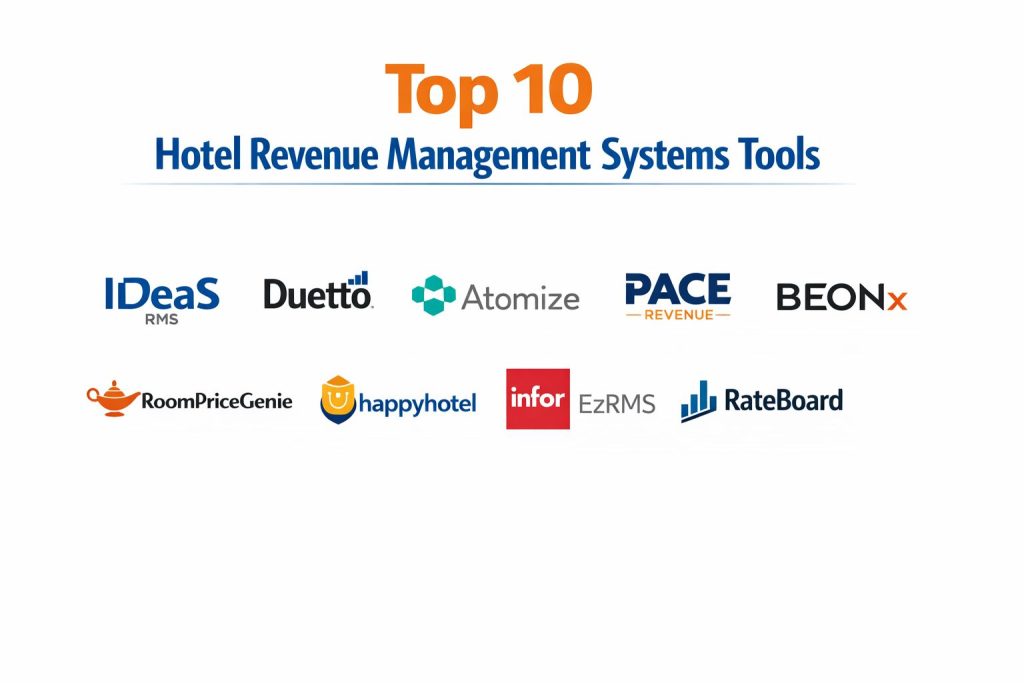
Introduction
Hotel Revenue Management Systems help hotels set better room prices, forecast demand, and improve revenue decisions across dates, room types, and channels. In simple terms, these tools combine booking pace, market signals, competitor pricing, inventory behavior, and historical performance to recommend or automate pricing actions. Modern hotel teams use them to improve occupancy, ADR, RevPAR, and overall profitability while reducing manual spreadsheet work. Industry overviews and vendor pages consistently describe core capabilities such as forecasting, dynamic pricing, and optimization workflows for hospitality revenue teams.
Common use cases include transient pricing, group displacement analysis, restrictions and controls, multi-property optimization, and revenue planning across seasonal demand patterns. When evaluating a system, buyers should focus on forecast quality, automation controls, override flexibility, PMS/CRS/channel integrations, reporting clarity, multi-property support, deployment fit, onboarding quality, and total value over time.
Best for: independent hotels, hotel groups, resorts, branded properties, serviced apartments, and revenue teams handling dynamic pricing, forecasting, and commercial planning.
Not ideal for: very small properties with highly stable demand and low rate complexity, especially if manual pricing is still sufficient and integration costs outweigh gains.
Key Trends in Hotel Revenue Management Systems
- More AI-assisted pricing recommendations and automation settings for faster rate decisions
- Stronger focus on profit optimization, not only occupancy or room revenue
- Better forecasting granularity by segment, room type, length of stay, and channel
- Integration depth expanding across PMS, CRS, channel manager, business intelligence, and market intelligence tools
- Increased demand for multi-property dashboards and cluster-level decision support
- More revenue teams using scenario planning and what-if simulation before applying pricing changes
- Wider adoption of cloud-first deployment models with remote access for distributed teams
- Greater emphasis on explainable recommendations so teams trust automated changes
- Faster decision loops with intraday updates in highly dynamic markets
- Growing expectations for role-based access, audit visibility, and governance in enterprise environments
How We Selected These Tools (Methodology)
- Chose widely recognized hotel revenue management platforms with strong hospitality relevance
- Prioritized tools known for pricing optimization, forecasting, and practical hotel workflows
- Included a balanced mix for independent hotels, groups, and enterprise hospitality organizations
- Considered market mindshare, buyer visibility, and recurring presence in hotel software shortlists
- Evaluated likely fit across property sizes, operational complexity, and revenue team maturity
- Assessed ecosystem fit based on typical hospitality stack integration needs
- Favored tools with clear positioning in revenue management rather than generic analytics only
- Scored tools comparatively using a practical rubric, not marketing claims or guessed ratings
Top 10 Hotel Revenue Management Systems
1) IDeaS RMS
A well-known hospitality revenue management platform used by many hotels and groups for forecasting, pricing recommendations, and commercial decision support. It is often considered a strong fit for complex operations and larger portfolios. Vendor positioning highlights AI-powered forecasting and hospitality-specific optimization.
Key Features
- Demand forecasting and pricing optimization for hotel revenue teams
- Rate recommendation workflows with user control and override options
- Support for single-property and multi-property operational needs
- Reporting and insight tools for performance and forecast review
- Commercial planning alignment across departments (varies by deployment scope)
- Hospitality-focused decision logic built for revenue workflows
- Enterprise-oriented implementation options (varies)
Pros
- Strong reputation in hotel revenue management and forecasting depth
- Suitable for complex properties and larger organizations
Cons
- Can be more than some small properties need
- Implementation and onboarding may require dedicated process discipline
Platforms / Deployment
- Cloud / Varies / N/A
Security & Compliance
- SSO/SAML, MFA, encryption, audit logs, RBAC: Not publicly stated
- SOC 2, ISO 27001, GDPR, HIPAA: Not publicly stated
Integrations & Ecosystem
IDeaS is commonly considered in hotel tech stacks where PMS, CRS, channel, and reporting handoffs matter. Integration depth depends on the hotel environment and vendor agreements.
- PMS integrations: Varies / N/A
- CRS and channel integrations: Varies / N/A
- Business intelligence handoffs: Varies / N/A
- Multi-property reporting workflows: Varies / N/A
Support & Community
Strong enterprise presence and hospitality expertise signal mature support structures, though exact support tiers and onboarding models vary by contract.
2) Duetto
A cloud-based hotel revenue management and revenue strategy platform focused on pricing, forecasting, and demand insights. Duetto emphasizes real-time decision support and open pricing approaches for hotel and casino environments.
Key Features
- Dynamic pricing and forecasting workflows for hospitality revenue teams
- Real-time insights for demand and pricing adjustments
- Open pricing style approach for flexible rate optimization
- Multi-property and enterprise-friendly operational use cases (varies)
- Cloud-based access for distributed teams
- Revenue strategy support beyond simple rate recommendations
- Reporting and performance analysis tools (varies)
Pros
- Strong cloud-first positioning and real-time pricing focus
- Popular choice in many hotel shortlists and commercial teams
Cons
- Best value often appears when teams actively use advanced features
- May require change management for teams moving from manual processes
Platforms / Deployment
- Cloud
Security & Compliance
- SSO/SAML, MFA, encryption, audit logs, RBAC: Not publicly stated
- SOC 2, ISO 27001, GDPR, HIPAA: Not publicly stated
Integrations & Ecosystem
Duetto is typically evaluated as part of a broader hotel commercial stack with PMS, CRS, and market data dependencies.
- PMS integrations: Varies / N/A
- CRS integrations: Varies / N/A
- Channel manager connectivity: Varies / N/A
- Data import/export workflows: Varies / N/A
Support & Community
Well-known hospitality vendor with broad market visibility. Support experience and onboarding depth vary by property size and contract scope.
3) Atomize
A hotel revenue management system focused on AI-driven pricing, forecasting, and automation. Vendor materials emphasize real-time pricing, future-looking optimization, and operational efficiency for hotel revenue teams.
Key Features
- AI-driven pricing recommendations and automation capabilities
- Forecasting workflows designed for dynamic hotel demand changes
- Real-time pricing adjustments and market-driven optimization
- Multi-property support for groups and operators (vendor claims)
- Reporting and pricing insight tools
- Restriction and pricing strategy support (varies)
- Cloud-based operational model
Pros
- Clear focus on automation and day-to-day pricing efficiency
- Useful for teams aiming to reduce manual rate management workload
Cons
- Hotels must still validate strategy rules and governance internally
- Advanced automation requires trust and disciplined oversight
Platforms / Deployment
- Cloud
Security & Compliance
- SSO/SAML, MFA, encryption, audit logs, RBAC: Not publicly stated
- SOC 2, ISO 27001, GDPR, HIPAA: Not publicly stated
Integrations & Ecosystem
Atomize is typically part of a connected stack where pricing decisions depend on PMS and market data flows.
- PMS integrations: Varies / N/A
- Channel and distribution data inputs: Varies / N/A
- Reporting and analytics exports: Varies / N/A
- Multi-property operational workflows: Varies / N/A
Support & Community
Vendor-led onboarding and support are important for success. Community visibility is growing, while exact support models vary by agreement.
4) Pace Revenue
A hotel revenue platform designed to support pricing decisions, forecasting, and commercial planning with modern workflows. It is often considered by teams that want stronger data-driven revenue operations and actionable insights.
Key Features
- Forecasting and pricing optimization support for hotel teams
- Revenue planning and strategy workflows (varies)
- Dashboard-driven visibility into demand and pricing performance
- Collaborative use across commercial and revenue stakeholders
- Cloud-based operational access
- Scenario analysis and decision support patterns (varies)
- Support for portfolio use cases (varies)
Pros
- Appeals to teams seeking modern, data-led revenue workflows
- Can support stronger decision consistency across properties
Cons
- Feature depth and fit should be validated by hotel type and process maturity
- Teams may need process changes to fully benefit
Platforms / Deployment
- Cloud / Varies / N/A
Security & Compliance
- SSO/SAML, MFA, encryption, audit logs, RBAC: Not publicly stated
- SOC 2, ISO 27001, GDPR, HIPAA: Not publicly stated
Integrations & Ecosystem
Pace Revenue is generally evaluated for how well it fits existing hotel systems and reporting flows.
- PMS integrations: Varies / N/A
- Channel and market data connectivity: Varies / N/A
- BI and reporting exports: Varies / N/A
- API and ecosystem extensibility: Varies / N/A
Support & Community
Support quality depends on rollout scope and vendor engagement. Teams should validate onboarding process, timeline, and support responsiveness during evaluation.
5) BEONx
A hospitality revenue management platform used by hotels seeking pricing optimization and revenue performance improvements. It is often considered by properties that want automated recommendations with operational visibility.
Key Features
- Automated pricing and revenue optimization workflows
- Forecasting support for demand-led hotel decisions
- Performance dashboards and reporting visibility
- Multi-property support options (varies)
- Cloud-oriented usage model (varies)
- Revenue strategy support for hotel commercial teams
- Practical controls for user validation and adjustments (varies)
Pros
- Useful for teams that want stronger automation without losing oversight
- Can fit independent and group hotel revenue workflows
Cons
- Integration coverage should be checked against local property stack needs
- Buyer fit varies by property complexity and team maturity
Platforms / Deployment
- Cloud / Varies / N/A
Security & Compliance
- SSO/SAML, MFA, encryption, audit logs, RBAC: Not publicly stated
- SOC 2, ISO 27001, GDPR, HIPAA: Not publicly stated
Integrations & Ecosystem
BEONx should be evaluated primarily on PMS/channel connectivity and data refresh reliability for each property environment.
- PMS integrations: Varies / N/A
- Channel manager integrations: Varies / N/A
- Data import/export options: Varies / N/A
- Reporting ecosystem fit: Varies / N/A
Support & Community
Vendor support experience may vary by region and hotel portfolio size. Ask for onboarding examples from similar properties.
6) RoomPriceGenie
A hotel revenue management system commonly discussed for independent and smaller hotels that want accessible revenue optimization. Industry shortlist pages frequently mention it for smaller property segments and independent operators.
Key Features
- Automated pricing recommendations for hotel room rates
- Simpler operational workflows suited to lean revenue teams
- Demand-aware pricing support with user override controls
- Multi-property support options for smaller groups (varies)
- Reporting dashboards for tracking pricing outcomes (varies)
- Cloud-based access for remote management
- Hospitality-focused setup with practical usability emphasis
Pros
- Often attractive for smaller hotels looking for approachable RMS adoption
- Can reduce spreadsheet dependency for day-to-day pricing decisions
Cons
- Complex enterprise needs may require broader capability validation
- Advanced customization depth may vary by property requirements
Platforms / Deployment
- Cloud
Security & Compliance
- SSO/SAML, MFA, encryption, audit logs, RBAC: Not publicly stated
- SOC 2, ISO 27001, GDPR, HIPAA: Not publicly stated
Integrations & Ecosystem
RoomPriceGenie fit depends heavily on supported PMS and channel connections for the target hotel stack.
- PMS integrations: Varies / N/A
- Channel manager connectivity: Varies / N/A
- Reporting exports: Varies / N/A
- Group portfolio workflows: Varies / N/A
Support & Community
Often considered by properties that value straightforward onboarding. Buyers should verify onboarding effort and support quality for their region.
7) happyhotel
A hotel revenue management solution used by hoteliers seeking dynamic pricing support and operational revenue guidance. It appears in industry shortlists alongside established RMS vendors for hotel use cases.
Key Features
- Revenue optimization and dynamic pricing support for hotels
- Forecasting and recommendation workflows (varies)
- User-friendly operational tools for hotel revenue tasks (varies)
- Reporting visibility for pricing and demand trends (varies)
- Cloud-based access model (varies)
- Support for independent hotels and groups (varies)
- Override and control workflows for revenue teams
Pros
- Can be a practical option for hotels seeking focused RMS capabilities
- Useful for teams wanting guided pricing support without heavy manual effort
Cons
- Fit should be checked carefully for enterprise complexity or advanced needs
- Integration and regional support depth may vary
Platforms / Deployment
- Cloud / Varies / N/A
Security & Compliance
- SSO/SAML, MFA, encryption, audit logs, RBAC: Not publicly stated
- SOC 2, ISO 27001, GDPR, HIPAA: Not publicly stated
Integrations & Ecosystem
happyhotel should be evaluated based on PMS/channel compatibility, data quality, and operational handoff reliability.
- PMS integrations: Varies / N/A
- Channel manager integrations: Varies / N/A
- Reporting and export options: Varies / N/A
- Multi-property support patterns: Varies / N/A
Support & Community
Support quality can depend on region and hotel segment. Validate response times and training approach before rollout.
8) Infor EzRMS
A long-recognized hospitality revenue management solution often considered by hotels and groups looking for established RMS functionality. It is commonly discussed in hospitality technology conversations for pricing and forecasting use cases.
Key Features
- Forecasting and pricing optimization workflows for hotels
- Revenue recommendations and decision support tools
- Multi-property and chain-oriented use cases (varies)
- Reporting and analytics for performance review
- Hospitality-specific RMS focus for room revenue decisions
- Operational controls and overrides for users
- Integration-led deployment potential within hotel tech environments
Pros
- Established RMS option with hospitality relevance
- Suitable for organizations that prefer mature vendor ecosystems
Cons
- Buyer experience may vary depending on implementation scope and legacy stack
- Modern usability expectations should be tested during demos
Platforms / Deployment
- Cloud / Varies / N/A
Security & Compliance
- SSO/SAML, MFA, encryption, audit logs, RBAC: Not publicly stated
- SOC 2, ISO 27001, GDPR, HIPAA: Not publicly stated
Integrations & Ecosystem
Infor EzRMS evaluation should focus on hospitality stack compatibility and deployment fit for the property environment.
- PMS and CRS integrations: Varies / N/A
- Data exchange workflows: Varies / N/A
- Reporting ecosystem connections: Varies / N/A
- Multi-property rollout support: Varies / N/A
Support & Community
Support and onboarding are typically contract-driven. Ask for hospitality-specific references and implementation timelines.
9) RateBoard
A hotel revenue management system positioned for pricing optimization and forecasting support, often considered by hotels seeking practical revenue automation and market-responsive pricing.
Key Features
- Dynamic pricing and rate recommendation support
- Demand forecasting workflows for hotel revenue decisions
- Dashboard and reporting views for performance monitoring
- Revenue optimization tools for day-to-day pricing operations
- Cloud-oriented deployment model (varies)
- Support for independent hotels and groups (varies)
- User controls for oversight and manual adjustments
Pros
- Can support teams moving from manual pricing to structured RMS workflows
- Useful for operational pricing discipline and consistency
Cons
- Integration fit and advanced feature depth should be validated per property
- Enterprise-scale requirements may need closer review
Platforms / Deployment
- Cloud / Varies / N/A
Security & Compliance
- SSO/SAML, MFA, encryption, audit logs, RBAC: Not publicly stated
- SOC 2, ISO 27001, GDPR, HIPAA: Not publicly stated
Integrations & Ecosystem
RateBoard should be judged on data connectivity, update reliability, and ease of fit within the hotel’s operating stack.
- PMS integrations: Varies / N/A
- Channel and market data inputs: Varies / N/A
- Reporting exports: Varies / N/A
- Portfolio workflows: Varies / N/A
Support & Community
Support quality and onboarding approach vary by vendor engagement and property type. Buyers should ask for implementation examples.
10) REVCONTROL
A hotel revenue management system focused on automated pricing and revenue optimization for hotel operations. It is often considered by properties seeking RMS capabilities with a hospitality-specific workflow focus.
Key Features
- Automated pricing recommendations for hotel rooms
- Forecasting and revenue optimization support
- User controls and override options for pricing teams
- Reporting and monitoring tools for pricing performance
- Support for hotel revenue workflows and operational decision-making
- Cloud-based or hosted deployment patterns (varies)
- Potential fit for portfolio use cases (varies)
Pros
- Useful for hotels seeking focused revenue automation support
- Can help standardize rate decision processes
Cons
- Feature depth and integration coverage should be validated carefully
- Best fit may depend on property size and revenue team maturity
Platforms / Deployment
- Cloud / Varies / N/A
Security & Compliance
- SSO/SAML, MFA, encryption, audit logs, RBAC: Not publicly stated
- SOC 2, ISO 27001, GDPR, HIPAA: Not publicly stated
Integrations & Ecosystem
REVCONTROL should be evaluated based on compatibility with your PMS, channel, and reporting ecosystem.
- PMS integrations: Varies / N/A
- Channel manager connectivity: Varies / N/A
- Data import/export workflows: Varies / N/A
- Multi-property support: Varies / N/A
Support & Community
Support experience may vary by region and customer segment. Confirm onboarding scope, training, and response SLAs during evaluation.
Comparison Table
| Tool Name | Best For | Platform(s) Supported | Deployment | Standout Feature | Public Rating |
|---|---|---|---|---|---|
| IDeaS RMS | Complex hotels and enterprise portfolios | Varies / N/A | Cloud / Varies | Advanced forecasting and optimization | N/A |
| Duetto | Cloud-first revenue strategy teams | Web / Varies / N/A | Cloud | Real-time pricing and open pricing approach | N/A |
| Atomize | Automation-focused hotel revenue teams | Web / Varies / N/A | Cloud | AI-driven pricing automation | N/A |
| Pace Revenue | Data-led commercial planning and pricing teams | Web / Varies / N/A | Cloud / Varies | Revenue planning and analytics-oriented workflows | N/A |
| BEONx | Hotels wanting automated pricing with operational oversight | Web / Varies / N/A | Cloud / Varies | Automated pricing and revenue visibility | N/A |
| RoomPriceGenie | Independent and smaller hotels adopting RMS | Web / Varies / N/A | Cloud | Accessible RMS adoption for lean teams | N/A |
| happyhotel | Hotels needing focused pricing optimization support | Web / Varies / N/A | Cloud / Varies | Practical dynamic pricing workflow | N/A |
| Infor EzRMS | Established hotel groups and mature RMS buyers | Varies / N/A | Cloud / Varies | Mature hospitality RMS functionality | N/A |
| RateBoard | Hotels moving from manual pricing to RMS | Web / Varies / N/A | Cloud / Varies | Structured dynamic pricing support | N/A |
| REVCONTROL | Hotels seeking focused automated revenue decisions | Web / Varies / N/A | Cloud / Varies | Automated pricing recommendations | N/A |
Evaluation & Scoring of Hotel Revenue Management Systems
Weights used in this comparative model: Core features 25%, Ease of use 15%, Integrations 15%, Security 10%, Performance 10%, Support 10%, Value 15%.
| Tool Name | Core (25%) | Ease (15%) | Integrations (15%) | Security (10%) | Performance (10%) | Support (10%) | Value (15%) | Weighted Total (0–10) |
|---|---|---|---|---|---|---|---|---|
| IDeaS RMS | 9.5 | 7.5 | 8.5 | 6.5 | 8.5 | 8.5 | 7.0 | 8.13 |
| Duetto | 9.0 | 8.0 | 8.5 | 6.5 | 8.5 | 8.0 | 7.5 | 8.15 |
| Atomize | 8.5 | 8.5 | 7.5 | 6.0 | 8.0 | 7.5 | 8.0 | 7.90 |
| Pace Revenue | 8.0 | 8.0 | 7.5 | 6.0 | 8.0 | 7.5 | 7.5 | 7.65 |
| BEONx | 8.0 | 8.0 | 7.0 | 6.0 | 7.5 | 7.5 | 7.5 | 7.48 |
| RoomPriceGenie | 7.5 | 9.0 | 7.0 | 6.0 | 7.5 | 8.0 | 8.5 | 7.78 |
| happyhotel | 7.5 | 8.0 | 6.5 | 6.0 | 7.5 | 7.5 | 8.0 | 7.38 |
| Infor EzRMS | 8.5 | 7.0 | 8.0 | 6.5 | 8.0 | 7.5 | 7.0 | 7.73 |
| RateBoard | 7.5 | 8.0 | 6.5 | 6.0 | 7.5 | 7.0 | 8.0 | 7.33 |
| REVCONTROL | 7.5 | 7.5 | 6.5 | 6.0 | 7.5 | 7.0 | 7.5 | 7.15 |
This scoring is comparative, not absolute. A higher total suggests broader strength across common hotel RMS buying criteria, but not a universal winner. Smaller properties may prefer easier adoption and stronger value over enterprise-level feature depth. Security scores are conservative because many formal disclosures are not publicly stated in an easily comparable way. Always run a pilot using your own PMS, channel setup, room types, and revenue processes before final selection.
Which Hotel Revenue Management System Is Right for You?
Solo Property / Independent Hotel
If your team is small and you need fast adoption with limited time for heavy configuration, prioritize usability, onboarding quality, and integration simplicity. RoomPriceGenie is often considered by independent hotels looking for an approachable RMS path, while Atomize can be attractive for teams ready to adopt more automation. The right choice depends on your PMS fit and how much control you want over recommendations versus automated actions.
Small Hotel Group
For small groups, consistency across properties matters as much as pricing quality. Look for multi-property dashboards, portfolio-level visibility, and easy override workflows at property level. Atomize, BEONx, and Pace Revenue can be strong candidates for groups wanting modern workflows without immediately moving into the most complex enterprise implementations.
Mid-Market Hotel Portfolio
Mid-market operators should focus on integration depth, pricing governance, role-based workflows, and reporting standardization. Duetto and IDeaS RMS are common shortlist candidates when a group wants stronger forecasting and commercial discipline across properties. Infor EzRMS may also be worth considering for organizations that prefer established hospitality vendors and structured deployment processes.
Enterprise / Branded Hotels / Complex Operations
Large portfolios and branded environments usually need stronger governance, operational controls, and enterprise-grade rollout support. IDeaS RMS and Duetto are often evaluated for these scenarios due to broad market visibility and advanced revenue workflow positioning. Enterprise buyers should also validate auditability, access controls, and implementation support across regions and brands before committing.
Budget vs Premium
Budget-sensitive hotels should optimize for speed-to-value, simplicity, and low operational overhead. Premium buyers can prioritize forecast sophistication, scenario planning, and cross-property revenue governance. A lower-cost system that the team actually uses consistently can outperform a powerful platform that remains underused.
Feature Depth vs Ease of Use
Some systems offer richer strategy and enterprise workflows, while others win on straightforward execution. If your team is new to RMS, choose a platform with clear recommendations, strong onboarding, and practical dashboards. If you already have experienced revenue managers, deeper forecasting and planning workflows may produce better long-term gains.
Integrations & Scalability
Do not choose based only on demos. Validate PMS, CRS, channel manager, and reporting integrations with real property data flows. Check update frequency, failure handling, manual override logging, and how quickly rates appear across distribution channels. Scalability is not only about number of hotels; it is also about how well teams can govern decisions across brands and property types.
Security & Compliance Needs
Revenue systems influence pricing and connect with core hotel systems, so governance matters. Even when compliance details are not publicly stated, hotels should ask about access control, user permissions, logging, data handling, and vendor security practices during procurement. Enterprise buyers should include IT and security teams early in the evaluation process.
Frequently Asked Questions
1. What does a hotel revenue management system actually do?
It helps hotels forecast demand, optimize prices, and improve revenue decisions using booking trends, market signals, and historical performance. It can also reduce manual pricing work and improve consistency.
2. Is an RMS only useful for large hotel chains?
No. Independent hotels and small groups can also benefit, especially when pricing changes frequently and manual spreadsheets are slowing decisions. The key is choosing a tool that matches team size and complexity.
3. Can an RMS replace a revenue manager?
Usually no. It supports decision-making and automation, but human oversight remains important for strategy, exceptions, local events, and unusual demand shifts.
4. What should I check first before buying an RMS?
Start with integration fit: PMS, CRS, channel manager, and reporting needs. If the system does not fit your hotel stack reliably, even strong pricing logic may not deliver results.
5. How long does implementation usually take?
It varies by property complexity, integration requirements, and internal readiness. A single property may move faster than a multi-brand portfolio with layered approval processes.
6. Should I choose automation or manual control?
Most hotels need both. Good RMS use usually combines automated recommendations with clear user controls, approval rules, and override workflows based on team maturity.
7. What metrics should we track after implementation?
Focus on occupancy, ADR, RevPAR, rate competitiveness, forecast accuracy, and how often the team follows or overrides recommendations. Also track operational time saved.
8. Is a cloud RMS always better than a locally hosted system?
Not always. Cloud deployment often helps with accessibility and updates, but the best choice depends on your IT policies, integration environment, and vendor support model.
9. What common mistakes do hotels make with RMS adoption?
Common mistakes include poor integration validation, weak data quality, unclear pricing governance, and expecting instant results without process changes or training.
10. How many tools should we shortlist for a pilot?
Shortlist two or three tools, then test them using your real hotel data, workflows, and approval process. This gives a realistic comparison without dragging evaluation too long.
Conclusion
Choosing the right Hotel Revenue Management System is not about picking the most famous name; it is about selecting the platform your team can trust, adopt, and use consistently. Some hotels need advanced forecasting and enterprise governance, while others need a simpler system that improves pricing discipline without adding operational burden. IDeaS RMS and Duetto are often strong options for complex environments, while Atomize, RoomPriceGenie, and other focused platforms may fit teams that value speed and usability. The smartest next step is to shortlist two or three tools, verify integrations with your actual hotel stack, run a pilot with real scenarios, and compare outcomes using the same success metrics across all options.