Introduction
A Hospital Information System (HIS) is an integrated software ecosystem designed to manage the clinical, administrative, and financial aspects of a healthcare facility. These platforms serve as the digital nervous system of modern medicine, centralizing patient data to ensure that life-critical information is accessible to the right provider at the right time. By automating complex workflows—from electronic health records (EHR) and laboratory results to billing and pharmacy inventory—HIS solutions reduce the risk of human error and significantly improve the quality of patient care.
In the current global health landscape, the shift toward value-based care has transformed these systems from simple databases into sophisticated decision-support engines. Modern HIS platforms now leverage advanced interoperability standards and artificial intelligence to predict patient outcomes and optimize resource allocation. Selecting the appropriate system is no longer just a technical requirement but a strategic imperative that dictates a hospital’s ability to remain compliant, secure, and operationally efficient in a data-driven world.
Best for: Large-scale medical centers, multi-specialty clinics, and regional health networks requiring unified patient records and robust revenue cycle management.
Not ideal for: Solo practitioners with very basic needs or facilities lacking the IT infrastructure to support high-performance database environments and real-time data sync.
Key Trends in Hospital Information Systems
- Ambient Clinical Intelligence: Systems are increasingly integrating voice-recognition AI that listens to patient-doctor interactions and automatically generates clinical notes in real-time.
- FHIR and Open Interoperability: The universal adoption of Fast Healthcare Interoperability Resources (FHIR) allows disparate systems to share data seamlessly across different health networks.
- Predictive Patient Analytics: HIS platforms now include machine learning modules that analyze historical data to identify patients at high risk for readmission or specific clinical deteriorations.
- Cloud-Native Scalability: A transition away from on-premise servers toward hybrid and multi-cloud environments ensures zero downtime and faster deployment of critical security patches.
- Patient-Centric Portals: Engagement tools have evolved into comprehensive health hubs where patients can manage their own records, schedule appointments, and pay bills from mobile devices.
- Integrated Telehealth Workflows: Virtual care is no longer a separate add-on; it is now natively embedded within the HIS, allowing for seamless transitions between in-person and remote visits.
- Blockchain for Data Security: Emerging models are using distributed ledger technology to secure patient consent and ensure the absolute integrity of medical records against cyber threats.
How We Selected These Tools (Methodology)
The methodology for selecting the top 10 Hospital Information Systems involved a comprehensive analysis of market performance, technological innovation, and clinical reliability. We focused on platforms that demonstrate a high degree of “clinical agility,” evaluating how effectively the software adapts to various medical specialties without requiring extensive manual reconfiguration. A key metric was the system’s ability to handle high volumes of concurrent users while maintaining data integrity and system speed during peak hours.
Furthermore, we examined the “interoperability score” of each tool, prioritizing systems that can easily communicate with third-party laboratory, radiology, and pharmacy networks. Security and regulatory compliance were non-negotiable criteria, with a focus on how each platform manages data encryption and audit trails. Finally, we weighted user satisfaction and support responsiveness heavily, ensuring that the selected tools provide the necessary training and technical assistance required for successful long-term implementation in high-pressure environments.
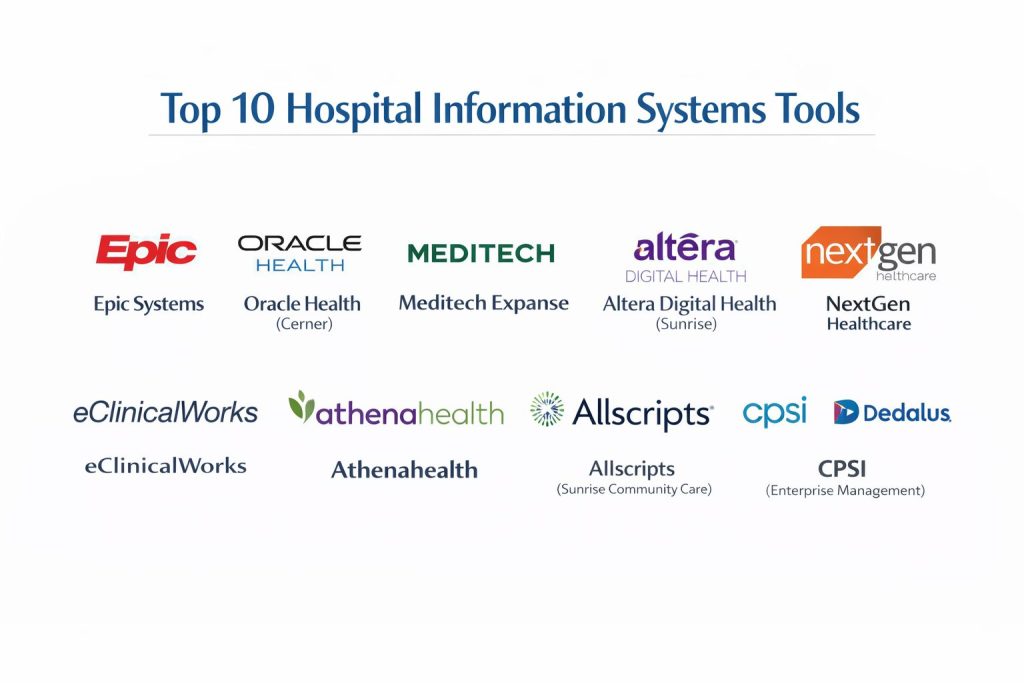
Top 10 Hospital Information Systems
1. Epic Systems
Epic Systems is a market leader known for its comprehensive and highly integrated health records platform. It is the preferred choice for major academic medical centers and large health systems that require a robust, all-in-one solution for inpatient and outpatient care.
Key Features
- Care Everywhere: An industry-leading interoperability tool that allows for the secure exchange of patient data across different organizations globally.
- MyChart: A sophisticated patient portal that provides users with access to their medical records, lab results, and secure messaging with providers.
- Cosmos: A massive, de-identified research database that allows clinicians to compare patient cases with millions of others to improve treatment plans.
- Willow: A specialized pharmacy module that integrates directly with the clinical record to prevent medication errors.
- Beaker: A fully integrated laboratory information system that automates the tracking and reporting of clinical specimens.
- Lucid: An AI-driven dashboard that highlights critical patient alerts and potential diagnostic oversights in real-time.
Pros
- Offers the most complete and seamless integration across all hospital departments and specialties.
- High levels of user adoption among the world’s most prestigious medical institutions.
Cons
- Implementation is notoriously expensive and requires a significant amount of time and specialized IT staff.
- The user interface can feel cluttered and overwhelming due to the sheer volume of features and data points.
Platforms / Deployment
- Windows / macOS / Web / Mobile
- Hybrid Cloud / On-Premise
Security & Compliance
- Features: Advanced role-based access control, full audit trails, and end-to-end data encryption.
- Compliance: HIPAA, GDPR, and ONC Certified.
Integrations & Ecosystem
Epic features a massive “App Orchard” marketplace where third-party developers can build and integrate niche applications that work natively within the Epic environment.
Support & Community
The company provides intensive training and a dedicated support team for every implementation. The user community is vast and highly collaborative through various annual conferences and forums.
2. Oracle Health (Cerner)
Oracle Health, formerly known as Cerner, provides a highly scalable and flexible HIS that is utilized by hospitals of all sizes around the world. Since the Oracle acquisition, the platform has seen increased investment in cloud infrastructure and AI capabilities.
Key Features
- Millennium: The core electronic health record architecture designed to support a longitudinal view of the patient’s health history.
- HealtheIntent: A population health management platform that aggregates data from multiple sources to identify health trends across communities.
- Real-Time Health System: Tools that track hospital operations, bed availability, and patient flow in real-time to maximize efficiency.
- PowerChart: A specialized clinical interface that allows doctors and nurses to document care and view results through customizable views.
- I-Aware: A sophisticated dashboard that prioritizes clinical data based on the severity of the patient’s condition.
- Ambient Clinical Intelligence: Integrated voice-to-text tools that automate the creation of clinical documentation during patient exams.
Pros
- Exceptional scalability, making it suitable for both small community hospitals and massive international networks.
- Strong focus on population health and data analytics through its integrated cloud platform.
Cons
- Users have reported that some workflows require an excessive number of clicks to complete simple tasks.
- Customer support response times can be inconsistent following the transition to Oracle’s corporate structure.
Platforms / Deployment
- Windows / Web / Mobile
- Cloud (Oracle Cloud Infrastructure) / Hybrid
Security & Compliance
- Features: Multi-factor authentication, enterprise-grade encryption, and secure cloud storage.
- Compliance: HIPAA, ISO 27001, and SOC 2.
Integrations & Ecosystem
The platform is built on an open architecture that supports a wide range of third-party integrations via FHIR and proprietary APIs.
Support & Community
Oracle provides a global support network with a strong emphasis on cloud-based troubleshooting and continuous software updates.
3. Meditech Expanse
Meditech Expanse is a modern, web-based HIS designed to provide a mobile-first experience for clinicians. It focuses on reducing the technical burden on doctors, allowing them to focus more on patient interaction.
Key Features
- Web-Based Interface: A fully responsive design that allows clinicians to access the complete record from any device with a browser.
- Surveillance: A real-time monitoring tool that alerts staff to potential issues like sepsis or changing vitals.
- Expanse Patient Connect: A mobile app and portal that simplifies communication and scheduling for patients.
- Physician Assistant: A personalized tool that organizes a doctor’s daily tasks, rounds, and outstanding documentation in one view.
- Traverse: An interoperability tool that pulls in data from outside facilities to provide a more complete patient picture.
- Revenue Cycle Management: An integrated billing and financial suite designed to maximize reimbursement and minimize denials.
Pros
- One of the most user-friendly and modern interfaces in the HIS market, designed for speed and mobility.
- Highly cost-effective for mid-sized hospitals compared to larger enterprise competitors.
Cons
- May lack some of the deepest specialized features found in high-end systems like Epic.
- The reporting tools can be less flexible than those offered by some purely analytics-focused competitors.
Platforms / Deployment
- Windows / macOS / Web / Mobile
- Cloud / On-Premise
Security & Compliance
- Features: Secure single sign-on (SSO) and automated data backup and recovery.
- Compliance: HIPAA and ONC Certified.
Integrations & Ecosystem
Expanse is designed to be highly interoperable, supporting standard data exchange protocols to connect with labs and external health networks.
Support & Community
Meditech is known for having a very loyal customer base and providing a high level of personalized technical support and training.
4. Altera Digital Health (Sunrise)
Altera Digital Health offers the Sunrise platform, a highly configurable HIS that emphasizes clinical decision support and workflow automation. It is designed to adapt to the specific needs of high-acuity environments like ICUs and emergency departments.
Key Features
- Sunrise Clinical Manager: A unified clinical record that provides specialized workflows for nursing, pharmacy, and physicians.
- Knowledge-Based Charting: Uses logic-based templates that prompt clinicians for relevant information based on the patient’s diagnosis.
- dbMotion: An advanced interoperability engine that harmonizes data from disparate systems into a single view.
- Sunrise Financial Manager: A comprehensive revenue cycle tool that links clinical actions directly to billing codes.
- Health Gorilla Integration: Enhanced diagnostic data access through integrated clinical network partnerships.
- Mobile MD: Secure mobile access for physicians to review charts, sign orders, and communicate with the care team.
Pros
- Highly customizable, allowing hospitals to tailor the software to their specific clinical protocols.
- Strong reputation for clinical depth and supporting complex, high-stakes medical decisions.
Cons
- The high level of customizability can lead to a more complex and longer implementation process.
- The interface can feel dated in certain modules compared to newer web-native platforms.
Platforms / Deployment
- Windows / Web / Mobile
- Cloud (Azure) / On-Premise
Security & Compliance
- Features: Robust identity management and automated encryption for data at rest and in transit.
- Compliance: HIPAA and GDPR compliant.
Integrations & Ecosystem
Altera places a heavy emphasis on “open health,” providing numerous APIs and pre-built connectors for a wide range of third-party healthcare apps.
Support & Community
The company offers professional services for custom development and a structured support program focused on clinical optimization.
5. eClinicalWorks
eClinicalWorks is a widely used platform that bridges the gap between large-scale hospital operations and outpatient ambulatory care. It is particularly effective for health systems that manage a large network of satellite clinics.
Key Features
- AI Virtual Assistant: A built-in AI tool that helps staff with scheduling, patient reminders, and data retrieval.
- Healow: A comprehensive patient engagement suite that includes a mobile app, wearable device integration, and telemedicine.
- Cloud-Based EHR: A lightweight yet powerful clinical record that works across all care settings.
- V12 Interface: A redesigned user experience that uses color-coding and simplified navigation to reduce fatigue.
- Interoperability Hub: Direct access to the CommonWell and Carequality networks for nationwide record sharing.
- Prisma: A search-engine-style tool that allows clinicians to quickly find specific information across a massive patient record.
Pros
- Exceptional patient engagement tools that help improve satisfaction and retention.
- Very cost-effective for smaller hospitals and integrated outpatient networks.
Cons
- Customer support has received mixed reviews, particularly regarding the speed of ticket resolution.
- The system can experience performance lag when handling extremely large datasets in real-time.
Platforms / Deployment
- Windows / macOS / Web / Mobile
- Cloud-Native
Security & Compliance
- Features: Multi-layered security protocols and regular third-party security audits.
- Compliance: HIPAA, SOC 2, and ONC Certified.
Integrations & Ecosystem
eClinicalWorks is one of the most connected platforms in the industry, featuring deep links to thousands of pharmacies, labs, and diagnostic centers.
Support & Community
The company offers a massive online training portal and a large user community that shares best practices for template customization.
6. NextGen Healthcare
NextGen Healthcare focuses on providing an integrated HIS that emphasizes ease of use and automated administrative tasks. It is a top choice for specialty hospitals and multi-practice groups that value efficient patient management.
Key Features
- NextGen Ambient Assist: An AI-powered tool that automatically drafts SOAP notes by listening to the patient encounter.
- Specialty-Specific Templates: Includes pre-built workflows for over 25 medical specialties, reducing the need for custom builds.
- NextGen Share: A centralized hub for exchanging clinical data with other providers regardless of their EHR system.
- Financial Suite: An automated billing system that uses AI to identify coding errors before claims are submitted.
- Patient Engagement: Tools for online check-in, digital intake forms, and automated text reminders.
- Mobile Office: Allows clinicians to manage their entire day, from charting to lab review, from a smartphone or tablet.
Pros
- The AI-driven documentation tools significantly reduce the administrative burden on clinical staff.
- Highly flexible templates make it easy for different departments to work within their own specialized workflows.
Cons
- The initial onboarding and training process can be intensive and time-consuming.
- Some users have noted that system updates can occasionally disrupt customized workflows.
Platforms / Deployment
- Windows / Web / Mobile
- Cloud / Hybrid
Security & Compliance
- Features: Advanced encryption and secure API access for third-party integrations.
- Compliance: HIPAA and ISO 27001 compliant.
Integrations & Ecosystem
NextGen offers a robust API that supports a wide range of third-party healthcare applications and medical device integrations.
Support & Community
The company provides comprehensive technical support and a dedicated success manager for larger hospital clients.
7. Athenahealth
Athenahealth provides a cloud-native HIS that is unique for its “athenaOne” model, which combines software with managed services to handle a hospital’s back-office and billing operations.
Key Features
- athenaOne EHR: A unified, cloud-based clinical record that is updated continuously with no downtime.
- Managed Billing Services: A dedicated team from Athenahealth monitors and manages claims to ensure maximum reimbursement.
- AthenaCoordinator: A referral management tool that streamlines the process of sending patients to specialists.
- Epocrates Integration: Direct access to one of the world’s most trusted medical reference and drug interaction databases.
- Voice Solutions: Integrated dictation and voice commands to speed up documentation and order entry.
- Centralized Patient Portal: A high-performing mobile and web experience for patient scheduling and payments.
Pros
- The cloud-native design means that users are always on the latest version of the software without needing manual updates.
- The managed services model significantly reduces the administrative staff requirements for the hospital.
Cons
- The pricing model, based on a percentage of collections, can be expensive for high-revenue facilities.
- Limited on-site technical support as the service is primarily cloud-based and remote.
Platforms / Deployment
- Web / Mobile
- Cloud-Native (SaaS)
Security & Compliance
- Features: Centralized security monitoring and automatic threat detection across the entire network.
- Compliance: HIPAA and SOC 2 Type II.
Integrations & Ecosystem
Athenahealth features an extensive marketplace of pre-integrated apps and service providers that extend the platform’s core functionality.
Support & Community
Users benefit from a large knowledge base and proactive support that identifies billing and clinical trends across the entire user network.
8. Allscripts (Sunrise Community Care)
Allscripts provides the Sunrise Community Care suite, which is tailored specifically for community and rural hospitals. It provides enterprise-level clinical power without the complexity of systems designed for massive metropolitan centers.
Key Features
- Sunrise Community Care: A streamlined version of the enterprise platform that prioritizes core clinical and financial tasks.
- Open Platform: An architecture that allows hospitals to easily add their own custom features and integrations.
- FollowMyHealth: A market-leading patient engagement platform that supports mobile health and remote monitoring.
- 2bPrecise: A specialized module for integrating genomic data into the clinical workflow for precision medicine.
- Clinical Decision Support: A rules-based engine that provides real-time guidance based on the latest medical evidence.
- Integrated E-Prescribing: A robust tool for sending prescriptions and checking insurance eligibility in real-time.
Pros
- Provides a very high level of clinical sophistication that is specifically optimized for smaller hospital environments.
- The “open” philosophy makes it much easier to integrate with existing legacy systems than some closed competitors.
Cons
- Numerous company acquisitions have occasionally led to a fragmented feel across different product modules.
- The cost of ongoing maintenance and upgrades can be high for smaller community budgets.
Platforms / Deployment
- Windows / Web / Mobile
- Cloud / Hybrid
Security & Compliance
- Features: Secure messaging, data masking, and multi-factor authentication.
- Compliance: HIPAA and ONC Certified.
Integrations & Ecosystem
Allscripts is a founding member of many interoperability initiatives, ensuring that its users can connect with almost any other health system.
Support & Community
The company has a long history in the market and offers an extensive library of educational resources and professional consulting.
9. CPSI (Evident)
CPSI, through its Evident division, focuses exclusively on rural and community hospitals. Their HIS is designed to handle the unique financial and clinical challenges of facilities with smaller budgets and fewer IT resources.
Key Features
- Thrive: An EHR platform built specifically for the workflows of community and rural healthcare settings.
- TruBridge: A fully integrated revenue cycle management service that handles everything from coding to collections.
- Multiview Charts: Allows clinicians to view multiple patient charts and data points on a single screen for faster auditing.
- Point-of-Care Documentation: Tools specifically designed for nurses and therapists to document care directly at the bedside.
- Patient Portal: A simple, intuitive interface for rural populations to access their health information.
- Regulatory Compliance Engine: Automatically updates clinical templates to ensure compliance with changing state and federal laws.
Pros
- Excellent understanding of the specific billing and regulatory needs of rural and critical access hospitals.
- Very responsive customer support team that often acts as an extension of the hospital’s own IT department.
Cons
- The user interface is significantly more dated and “clunky” compared to high-end web platforms.
- Limited customization options for hospitals that have very unique or non-standard workflows.
Platforms / Deployment
- Windows / Web / Mobile
- Cloud / On-Premise
Security & Compliance
- Features: SQL-compliant database security and automated reporting for regulatory audits.
- Compliance: Meaningful Use and ONC Certified.
Integrations & Ecosystem
While it supports basic interoperability standards, it can be more challenging to integrate with niche third-party applications compared to larger platforms.
Support & Community
CPSI is highly regarded for its “white-glove” support model, providing significant hands-on training for staff in rural communities.
10. Dedalus (Enterprise Management)
Dedalus is a global leader in health information systems, particularly dominant in the European and international markets. Their platform is designed to connect the entire healthcare web across large geographical areas.
Key Features
- Digital Connect 4 Health (DC4H): An open platform that integrates data from both new and legacy systems into a unified care record.
- Identity Management: A robust system that ensures consistent patient records across massive enterprise networks, preventing duplication.
- Financial Control Module: Powerful revenue management tools that integrate with clinical data for accurate, real-time billing.
- Staff Scheduling: Built-in tools for managing personnel availability and optimizing hospital operations.
- Structured Care Documentation: Specialized modules for complex disciplines including maternity, oral health, and pediatrics.
- FHIR-Based Architecture: Uses modern standards to ensure that data is contextual, actionable, and easy to share.
Pros
- Unmatched experience in managing multi-national health networks and large-scale regional data sharing.
- Strong focus on future-proofing through a commitment to the latest open healthcare standards.
Cons
- The platform’s massive scope can make it overly complex for single-site hospitals or small clinics.
- Documentation and training resources may be less localized for North American users compared to European ones.
Platforms / Deployment
- Windows / Web / Mobile
- Cloud / Hybrid / On-Premise
Security & Compliance
- Features: Comprehensive RBAC, SSO, and advanced identity safeguarding.
- Compliance: GDPR, HIPAA, and ISO 27001.
Integrations & Ecosystem
Dedalus is designed to be a “connective tissue” platform, offering an extensive library of pre-existing integrations with global medical devices and software.
Support & Community
The company provides professional enterprise services for large-scale digital transformations and maintains a significant global R&D presence.
Comparison Table (Top 10)
| Tool Name | Best For | Platform(s) Supported | Deployment | Standout Feature | Public Rating |
| 1. Epic Systems | Large Enterprises | Win, Mac, Web, Mob | Hybrid/On-Prem | Care Everywhere | 4.7/5 |
| 2. Oracle Health | All Hospital Sizes | Win, Web, Mobile | Cloud/Hybrid | HealtheIntent | 4.3/5 |
| 3. Meditech Expanse | Mid-Size / Mobile | Win, Mac, Web, Mob | Cloud/On-Prem | Web-Native UI | 4.5/5 |
| 4. Altera Digital | High-Acuity / ICU | Win, Web, Mobile | Cloud/On-Prem | dbMotion | 4.1/5 |
| 5. eClinicalWorks | Outpatient Networks | Win, Mac, Web, Mob | Cloud-Native | Healow Patient App | 4.4/5 |
| 6. NextGen | Specialist Groups | Win, Web, Mobile | Cloud/Hybrid | Ambient AI Assist | 4.2/5 |
| 7. Athenahealth | Managed Services | Web, Mobile | Cloud-Native | Managed Billing | 4.6/5 |
| 8. Allscripts | Community/Rural | Win, Web, Mobile | Cloud/Hybrid | Open Platform API | 4.0/5 |
| 9. CPSI (Evident) | Rural/Crit. Access | Win, Web, Mobile | Cloud/On-Prem | TruBridge Revenue | 3.8/5 |
| 10. Dedalus | International Orgs | Win, Web, Mobile | Cloud/Hybrid | DC4H Interop | 4.2/5 |
Evaluation & Scoring of Hospital Information Systems
The scoring below is a comparative model intended to help shortlisting. Each criterion is scored from 1–10, then a weighted total from 0–10 is calculated using the weights listed. These are analyst estimates based on typical fit and common workflow requirements, not public ratings.
Weights:
Price / value – 15%
Core features – 25%
Ease of use – 15%
Integrations & ecosystem – 15%
Security & compliance – 10%
Performance & reliability – 10%
Support & community – 10%
| Tool Name | Core (25%) | Ease (15%) | Integrations (15%) | Security (10%) | Performance (10%) | Support (10%) | Value (15%) | Weighted Total |
| 1. Epic Systems | 10 | 4 | 10 | 10 | 9 | 9 | 5 | 8.20 |
| 2. Oracle Health | 9 | 6 | 9 | 9 | 8 | 7 | 7 | 7.85 |
| 3. Meditech Expanse | 8 | 9 | 8 | 8 | 9 | 8 | 8 | 8.25 |
| 4. Altera Digital | 9 | 5 | 8 | 8 | 8 | 7 | 6 | 7.30 |
| 5. eClinicalWorks | 8 | 8 | 9 | 8 | 7 | 6 | 9 | 7.75 |
| 6. NextGen | 8 | 7 | 8 | 9 | 8 | 7 | 8 | 7.70 |
| 7. Athenahealth | 7 | 9 | 9 | 9 | 9 | 8 | 7 | 8.15 |
| 8. Allscripts | 7 | 6 | 9 | 8 | 7 | 7 | 7 | 7.10 |
| 9. CPSI (Evident) | 6 | 7 | 6 | 8 | 7 | 9 | 8 | 6.95 |
| 10. Dedalus | 9 | 5 | 10 | 9 | 8 | 7 | 7 | 7.80 |
How to interpret the scores:
- Use the weighted total to shortlist candidates, then validate with a pilot.
- A lower score can mean specialization, not weakness.
- Security and compliance scores reflect controllability and governance fit, because certifications are often not publicly stated.
- Actual outcomes vary with assembly size, team skills, templates, and process maturity.
Which Hospital Information System Is Right for You?
Large Academic / Enterprise Systems
For massive organizations with deep budgets, Epic Systems remains the gold standard. Its ability to unify hundreds of departments into a single source of truth is unmatched, despite the high cost and complexity of the implementation.
Mid-Market / Community Hospitals
Meditech Expanse is the ideal choice for mid-sized hospitals that want to modernize their workflow without the extreme overhead of Epic. Its mobile-first, web-native approach is highly popular among clinicians who are tired of legacy interfaces.
Small Clinics & Ambulatory Networks
Health systems that are primarily focused on outpatient care should prioritize eClinicalWorks or Athenahealth. These platforms offer superior patient engagement tools and are designed for the high-volume, quick-turnaround nature of clinic visits.
Rural & Critical Access Facilities
CPSI (Evident) and Allscripts (Sunrise Community Care) are the top candidates for rural facilities. They specialize in the unique reimbursement models and staffing challenges of smaller hospitals and provide hands-on support that larger vendors often lack.
Global / Regional Networks
Organizations operating across multiple countries or large regions will find the greatest success with Dedalus. Its emphasis on regional interoperability and diverse clinical disciplines makes it the strongest candidate for large-scale healthcare digital transformations.
AI & Automation Seekers
If reducing clinician burnout through automation is a top priority, NextGen Healthcare stands out. Its ambient AI documentation tools and specialty-specific templates are designed specifically to give time back to doctors and nurses.
Managed Service Preference
Hospitals that prefer to outsource their billing and administrative operations to the software vendor should choose Athenahealth. Their model allows the hospital to focus almost exclusively on clinical care while the vendor handles the financial lifecycle.
High-Security / Multi-Cloud Strategy
For institutions with strict data sovereignty or multi-cloud requirements, Oracle Health is the best fit. Leveraging Oracle’s global cloud infrastructure ensures high availability and enterprise-grade security for the most sensitive medical data.
Frequently Asked Questions (FAQs)
What is the average time to implement a new HIS?
Implementation can take anywhere from 6 months for cloud-native platforms like Athenahealth to over 2 years for complex enterprise systems like Epic Systems. The timeline depends on the number of departments and the amount of data being migrated.
How do these systems handle power or internet outages?
Most modern systems use a hybrid cloud approach, where critical clinical data is cached locally to allow for “offline mode” charting. Once the connection is restored, the data automatically synchronizes with the main cloud database.
Can a hospital use multiple systems for different departments?
While possible, it is not recommended. Using an “integrated” system like Epic or Cerner ensures that a patient’s lab results, pharmacy orders, and doctor’s notes are all in one place, significantly reducing the risk of medical errors.
Are these platforms compliant with international data laws?
Top-tier vendors like Dedalus and Epic are built to be compliant with both US HIPAA and European GDPR standards. However, hospitals must still configure the software correctly to meet their specific local legal requirements.
Do doctors really like using these systems?
User satisfaction varies. While newer systems like Meditech Expanse are praised for their modern look, older platforms often receive criticism for being “click-heavy.” However, the addition of AI ambient listening is beginning to improve satisfaction by reducing typing time.
Is patient data shared between different hospitals?
Yes, through tools like Epic’s Care Everywhere or the CommonWell Health Alliance, hospitals can securely request and view records from other facilities if the patient has provided consent.
How much do these systems cost?
Costs vary wildly. Large systems can cost hundreds of millions of dollars over a decade, while cloud-based “software as a service” models often charge a monthly fee per provider or a percentage of the hospital’s revenue.
What happens to old records during a transition?
Old records are typically migrated into the new system through a process called “data conversion.” Records that are not moved are often archived in a secure, searchable “legacy viewer” that clinicians can still access.
Can patients see their records in real-time?
In most modern systems, yes. Features like Epic’s MyChart or eClinicalWorks’ Healow allow patients to see their test results and doctor’s notes as soon as they are finalized in the system.
Does the software help with medical billing?
Absolutely. Most HIS platforms include a “Revenue Cycle Management” (RCM) module that automatically turns clinical actions into insurance claims, helping hospitals get paid faster and with fewer errors.
Conclusion
The evolution of Hospital Information Systems has reached a point where the software is no longer just a digital filing cabinet, but a critical partner in the delivery of healthcare. Whether it is through the enterprise-wide integration of Epic Systems, the cloud-native managed services of Athenahealth, or the rural-focused support of CPSI, the right HIS can transform a struggling facility into a model of efficiency and safety. As we move further into a future defined by AI and decentralized data, the ability of these systems to provide actionable insights will be the primary factor in improving patient outcomes worldwide.
When selecting a system, hospitals must look beyond the feature list and evaluate the vendor’s long-term roadmap, their commitment to security, and their history of successful implementations in similar environments. The decision made today will define the clinical workflow and financial health of the institution for the next decade.