Introduction
Homomorphic Encryption (HE) represents a paradigm shift in data security, moving beyond protecting data at rest or in transit to protecting data during computation. In a traditional digital environment, data must be decrypted before it can be processed, creating a “window of vulnerability” where sensitive information is exposed to the server’s memory. Homomorphic Encryption toolkits eliminate this risk by allowing mathematical operations to be performed directly on ciphertexts, yielding an encrypted result that, when decrypted, matches the output of operations performed on the original plaintext. This “holy grail” of cryptography enables a future where cloud service providers can process medical records, financial transactions, and proprietary algorithms without ever “seeing” the underlying data.
As we navigate the complexities of 2026, the demand for Privacy-Preserving Machine Learning (PPML) and secure multi-party computation has pushed HE from theoretical research into production-ready software. Modern toolkits have made significant strides in addressing the historical “noise” overhead and computational latency associated with lattice-based cryptography. By leveraging advanced schemes like BFV, BGV, and CKKS, these toolkits allow for both exact integer arithmetic and approximate floating-point calculations on encrypted tensors. For organizations handling highly regulated data, these toolkits are no longer just academic curiosities; they are foundational infrastructure for maintaining compliance in a zero-trust world.
Best for: Security architects, data scientists, and software engineers building privacy-first cloud applications, confidential smart contracts, or collaborative research environments.
Not ideal for: Latency-critical applications requiring microsecond response times (e.g., high-frequency trading) or developers looking for a “plug-and-play” replacement for standard AES encryption without understanding the underlying performance trade-offs.
Key Trends in Homomorphic Encryption Toolkits
The most significant trend in the current HE landscape is the transition from manual “circuit building” to automated “FHE Compilers.” Historically, developers had to manually manage the “noise” level of ciphertexts—a byproduct of HE operations that, if left unchecked, would render the data undecryptable. Modern toolkits now feature sophisticated transpilers and compilers that automatically insert “bootstrapping” operations (the process of refreshing a ciphertext to reduce noise) and optimize the execution graph for specific hardware. This has drastically lowered the barrier to entry, allowing C++ or Rust developers to write standard code that is automatically converted into an encrypted-ready format.
Hardware acceleration has also become a standard feature across the top toolkits. Developers are no longer restricted to CPU-only execution; many libraries now offer native support for GPUs through CUDA or specialized FHE accelerators like FPGAs and ASICs. This hardware-software co-design has reduced the performance gap between encrypted and unencrypted computation from several orders of magnitude to a manageable overhead for batch processing. Additionally, the rise of “Threshold FHE” is enabling decentralized trust models where the decryption key is split among multiple parties, ensuring that no single entity can ever access the raw data, even if they have physical control over the server.
How We Selected These Tools
Our selection process for the top homomorphic encryption toolkits focused on three primary pillars: cryptographic rigor, developer usability, and performance scalability. We prioritized libraries that implement standardized, peer-reviewed schemes such as BFV, CKKS, and TFHE. A critical factor was the maturity of the documentation and the availability of “battle-tested” examples, as the complexity of HE makes it easy for developers to inadvertently introduce security vulnerabilities or performance bottlenecks without proper guidance.
We also evaluated the toolkits based on their support for modern programming ecosystems. While C++ remains the industry standard for performance, the inclusion of Rust, Go, and Python bindings was heavily weighted to reflect the needs of contemporary data science and cloud-native development. Furthermore, we looked for toolkits that are actively maintained by reputable research institutions or specialized cybersecurity firms, ensuring that the libraries are kept up-to-date with the latest cryptanalytic findings and hardware optimizations. Finally, we assessed the versatility of each toolkit, favoring those that can handle a wide range of tasks from simple boolean logic to complex neural network inference.
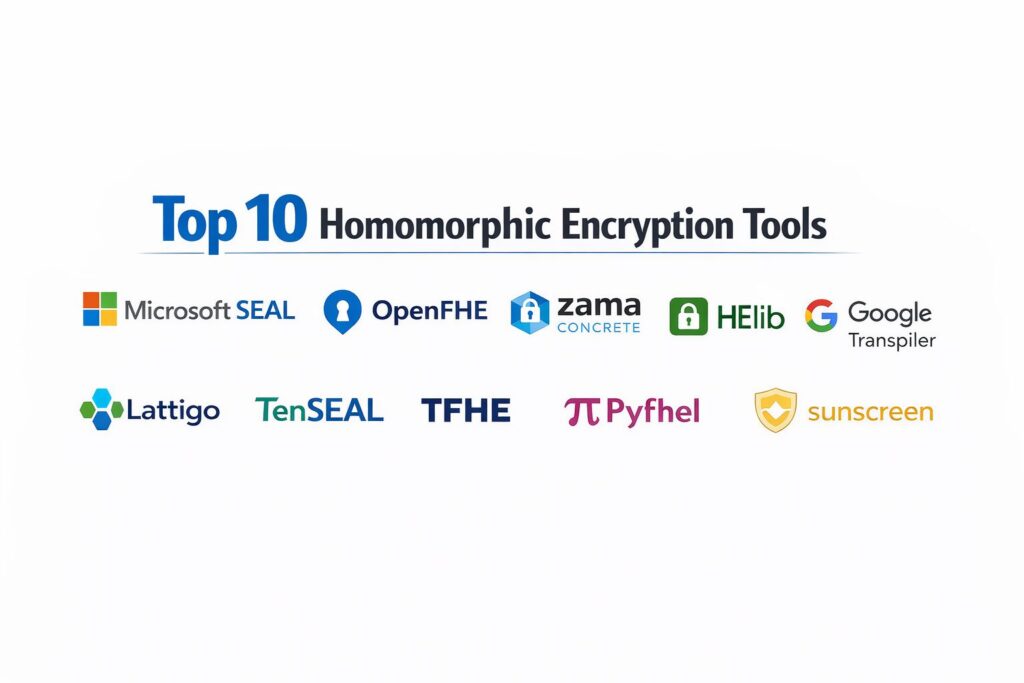
1. Microsoft SEAL (Simple Encrypted Arithmetic Library)
Microsoft SEAL is perhaps the most widely recognized library in the HE space, known for its focus on providing a clean, accessible API for software developers. Developed by Microsoft Research, it is a highly optimized C++ library that implements the BFV and CKKS homomorphic encryption schemes.
Key Features
The platform features a highly modular design that allows developers to choose between exact integer arithmetic (BFV) and approximate real-number arithmetic (CKKS). It includes comprehensive “Microsoft SEAL Examples” that serve as a tutorial for understanding noise management and parameter selection. The library features a specialized .NET wrapper, making it the premier choice for developers in the Microsoft ecosystem. It also supports automated “RLWE” parameter generation to ensure a specific security level (e.g., 128-bit or 256-bit). Additionally, it provides robust serialization features for moving encrypted objects across networks.
Pros
It offers an exceptional balance between performance and ease of use, with some of the best documentation in the field. The library is highly stable and has been audited extensively for production use.
Cons
It does not natively support “bootstrapping” for the BFV scheme, which limits the depth of computations unless parameters are set very high. It lacks built-in hardware acceleration for GPUs.
Platforms and Deployment
C++ with native wrappers for .NET (C#) and Python; runs on Windows, Linux, and macOS.
Security and Compliance
Adheres strictly to the security standards defined by HomomorphicEncryption.org.
Integrations and Ecosystem
Widely used as the backend for other privacy tools and integrated into various Microsoft Azure confidential computing services.
Support and Community
Maintained by a dedicated team at Microsoft Research with an active GitHub community and extensive academic documentation.
2. OpenFHE
OpenFHE is a universal, open-source FHE library that represents a collaboration between the creators of several predecessor libraries including PALISADE, HElib, and HEAAN. It is designed to be the “one-stop shop” for all major FHE schemes.
Key Features
The platform features support for the widest array of FHE schemes in a single library, including BGV, BFV, CKKS, and TFHE. It includes a sophisticated Hardware Abstraction Layer (HAL) that allows it to leverage Intel HEXL and other hardware accelerators seamlessly. The system offers “Scheme Switching,” which allows developers to convert data between different encryption formats (e.g., from CKKS for math to TFHE for logic) mid-computation. It features advanced multi-party and threshold encryption capabilities. Additionally, it provides a “User-Friendly Mode” that handles noise management and bootstrapping automatically.
Pros
It is incredibly versatile and future-proof, allowing developers to experiment with different schemes without changing libraries. The modular architecture makes it easy to integrate with specialized hardware.
Cons
The sheer breadth of the library makes it more complex to master than more focused toolkits like SEAL. The documentation, while extensive, can be overwhelming for beginners.
Platforms and Deployment
C++ library with official bindings for Python and Rust; cross-platform support.
Security and Compliance
Complies with the HomomorphicEncryption.org standards and is designed for post-quantum security.
Integrations and Ecosystem
Supported by a consortium including Intel and Duality Technologies; integrated with the Google FHE Transpiler.
Support and Community
Highly active community with regular webinars, a dedicated Discourse forum, and enterprise support options through partner organizations.
3. Zama Concrete
Zama Concrete is a developer-first FHE toolkit built on the TFHE (Torus Fully Homomorphic Encryption) scheme. It is specifically designed to make encrypted computation as easy as writing standard Python or Rust code, with a heavy focus on Machine Learning.
Key Features
The platform features a custom “FHE Compiler” that automatically converts high-level code into optimized FHE circuits. It includes “Concrete-ML,” a specialized framework that allows data scientists to use scikit-learn and XGBoost models on encrypted data without changing their workflow. The system features high-speed bootstrapping, allowing for an infinite number of operations without noise failure. It provides native support for both integer and boolean arithmetic. It also includes “TFHE-rs,” a pure Rust implementation optimized for security and performance on modern CPUs and GPUs.
Pros
It offers the best developer experience for data scientists who want to integrate FHE into ML pipelines. The “infinite computation” capability provided by TFHE bootstrapping is a major technical advantage.
Cons
The TFHE scheme can be slower than CKKS for high-precision floating-point operations. It is relatively new compared to SEAL or HElib, though it is evolving rapidly.
Platforms and Deployment
Pure Rust implementation with a highly polished Python API (Concrete-ML).
Security and Compliance
Fully open-source and audited, focusing on high-security parameter sets.
Integrations and Ecosystem
Strong ties to the Web3 and Blockchain community for private smart contracts (FHEVM).
Support and Community
Excellent documentation, a vibrant community forum, and a “Bounty Program” to encourage open-source contributions.
4. HElib (by IBM Research)
HElib is one of the oldest and most mature homomorphic encryption libraries, developed by IBM Research. It focuses on the BGV and CKKS schemes and is particularly optimized for “ciphertext packing” and batched operations.
Key Features
The platform features advanced “Ciphertext Packing” techniques that allow thousands of data points to be processed in a single SIMD (Single Instruction, Multiple Data) operation. It includes a robust implementation of “Bootstrapping” for the BGV scheme, which IBM pioneered. The system features “Static Noise Estimation,” helping researchers predict how many operations can be performed before decryption fails. It provides specialized algorithms for encrypted matrix multiplication and sorting. Additionally, it includes a “Circuit Compiler” for transforming logical gates into homomorphic operations.
Pros
It is arguably the most mathematically sophisticated library, offering deep optimizations for researchers. Its maturity means it has been used in a vast number of academic studies.
Cons
The API is notoriously difficult for non-cryptographers to use. The library has many external dependencies, which can make the build process cumbersome on certain systems.
Platforms and Deployment
C++ library primarily focused on Linux-based high-performance computing (HPC) environments.
Security and Compliance
Maintained by IBM with a focus on enterprise-grade security and academic rigor.
Integrations and Ecosystem
Part of IBM’s broader “Trustworthy AI” initiative and integrated into various IBM Cloud research projects.
Support and Community
Significant academic support and historical documentation, though the community is more research-focused than developer-focused.
5. Google FHE Transpiler
The Google FHE Transpiler is a high-level tool that bridges the gap between standard software engineering and complex cryptography. It allows developers to write code in C++ and automatically “transpile” it into a version that runs on encrypted data using backends like TFHE or OpenFHE.
Key Features
The platform features a connection to Google’s “XLS” (High-Level Design toolset), which treats FHE as a hardware-like circuit. It includes a “Multi-core Interpreter” that can speed up encrypted execution by parallelizing independent gates. The system features a modular backend, allowing users to switch between different FHE libraries without rewriting their application logic. It supports the translation of standard C++ control structures, like loops and if-statements, into “constant-time” encrypted equivalents. It also provides a set of “Transpiled Examples” for common tasks like string manipulation and simple math.
Pros
It is the most successful attempt at making FHE “invisible” to the developer. It handles the low-level cryptographic heavy lifting, allowing for rapid prototyping of privacy-preserving apps.
Cons
It is still considered an “experimental proof-of-concept” and may not be ready for high-stakes production environments. The transpilation process can introduce performance overhead compared to hand-optimized code.
Platforms and Deployment
C++ based tool primarily supported on Linux with Bazel build system.
Security and Compliance
Relies on the security of the underlying backends (like OpenFHE) but adds a layer of “correct-by-construction” logic.
Integrations and Ecosystem
Deeply integrated with Google’s open-source security tools and the XLS hardware synthesis ecosystem.
Support and Community
Open-source project on GitHub with contributions from Google’s security and research teams.
6. Lattigo
Lattigo is a high-performance, lattice-based cryptographic library implemented in Go. It is designed for researchers and developers who need a modern, concurrent-friendly toolkit for building secure microservices and cloud-native applications.
Key Features
The platform features a pure Go implementation, making it uniquely suited for integration into Kubernetes-based environments. It includes full support for BFV, BGV, and CKKS schemes, including their multi-party (MHE) variants. The system features an “Efficient Parallelization” engine that takes full advantage of Go’s goroutines. It provides advanced threshold encryption features, allowing for collaborative decryption protocols. It also includes a specialized “Lattice Estimator” integration to help users select parameters that meet specific security requirements.
Pros
It offers the best performance for Go developers and is much easier to deploy in modern containerized environments than C++ libraries. The multi-party features are among the most advanced available.
Cons
The community and ecosystem are smaller than those of C++ based toolkits like SEAL or OpenFHE. It may lack some of the specialized hardware optimizations found in older libraries.
Platforms and Deployment
Pure Go implementation; ideal for Linux, macOS, and cloud-native deployments.
Security and Compliance
Provides IND-CPA security by default and includes API features to mitigate reaction-based attacks.
Integrations and Ecosystem
Used as the foundational library for several commercial privacy-preserving platforms and specialized blockchain projects.
Support and Community
Maintained by TuneInsight with an active presence on GitHub and a focus on industrial research.
7. TenSEAL
TenSEAL is a specialized library built on top of Microsoft SEAL, designed specifically for homomorphic encryption operations on tensors. It is the core tool for the OpenMined community’s efforts in Privacy-Preserving Machine Learning.
Key Features
The platform features a highly optimized Python API that wraps Microsoft SEAL’s C++ core for maximum performance. It includes native support for “Encrypted Tensor Operations,” such as vector-matrix multiplication and convolutions. The system features seamless integration with the “PySyft” ecosystem for federated learning and remote data science. It provides built-in “Serialization” to facilitate the movement of encrypted weights and data between clients and servers. It also features a simplified “context management” system for handling encryption keys and parameters.
Pros
It is the easiest way for a Python developer to perform linear algebra on encrypted data. It abstracts the complexity of SEAL while maintaining its underlying speed and security.
Cons
It is narrower in scope than a general-purpose toolkit, focusing almost exclusively on data science and ML use cases. It inherits any limitations present in the underlying SEAL library.
Platforms and Deployment
Python library with a C++ core; works anywhere Python is supported.
Security and Compliance
Inherits the strong security profile of Microsoft SEAL and the HomomorphicEncryption.org standards.
Integrations and Ecosystem
Primary tool for the OpenMined community; works closely with PyTorch and other data science libraries.
Support and Community
Backed by the large and passionate OpenMined community with extensive tutorials and open-source support.
8. TFHE (Torus Fully Homomorphic Encryption)
TFHE is a specialized library focused on the Torus Fully Homomorphic Encryption scheme, which is famous for its “fast bootstrapping.” It is the foundation for many modern high-speed HE toolkits and is optimized for boolean circuits.
Key Features
The platform features a “Bootstrapping” time of less than 0.1 seconds, which was a revolutionary breakthrough in the field. It includes a lightweight C/C++ implementation that can be easily integrated into other projects. The system features exact results for boolean gates, making it ideal for simulating standard computer logic on encrypted bits. It provides an “infinite gate” capability, meaning the circuit depth is not limited by noise accumulation. It also features a “multi-key” variant that allows for computation on data encrypted by different users.
Pros
It is the fastest library for gate-by-gate encrypted logic. The ability to perform an unlimited number of operations makes it technically “fully” homomorphic in a way that leveled schemes are not.
Cons
It is less efficient than CKKS or BFV for large-scale numerical arithmetic and matrix operations. The original C library is quite low-level and requires significant expertise.
Platforms and Deployment
C/C++ library; highly portable to various operating systems.
Security and Compliance
Open-source and based on the standard LWE (Learning With Errors) problem.
Integrations and Ecosystem
Serves as the low-level engine for Zama Concrete and the Google FHE Transpiler.
Support and Community
Strong academic backing and a well-documented mathematical foundation, though developer support is mostly through derived toolkits.
9. Pyfhel (Python For Homomorphic Encryption Libraries)
Pyfhel is a versatile Python wrapper that provides a unified interface for several major C++ backends, including Microsoft SEAL and PALISADE. It is designed for rapid prototyping and educational purposes.
Key Features
The platform features a “Single API” for multiple backends, allowing users to switch between different libraries with minimal code changes. It includes built-in support for BFV and CKKS schemes. The system features “Pythonic Syntax” for homomorphic addition, multiplication, and rotations (e.g., using standard + and * operators). It provides simplified “Key Generation” and “Context Setup” routines. It also includes comprehensive tutorials for implementing common algorithms like the “Average” or “Standard Deviation” on encrypted lists.
Pros
It is the most user-friendly entry point for anyone familiar with Python. It allows developers to test the performance of different backends side-by-side.
Cons
As a wrapper, it can introduce a small amount of overhead compared to native C++ implementations. It may not always support the very latest features added to the underlying libraries immediately.
Platforms and Deployment
Python package available via pip; cross-platform compatibility.
Security and Compliance
Security depends on the selected backend (SEAL or PALISADE), both of which are industry leaders.
Integrations and Ecosystem
Widely used in academic settings and for proof-of-concept development in data science.
Support and Community
Maintained by a dedicated developer with a focus on usability and academic accessibility.
10. Sunscreen
Sunscreen is a modern FHE toolkit and compiler focused on the Web3 and decentralized application (dApp) ecosystem. It aims to provide “verifiable hidden state” for blockchains using a developer-friendly Rust-based compiler.
Key Features
The platform features the “Parasol Compiler,” which allows developers to write programs in a subset of C and automatically generates the FHE parameters. It includes native integration with Zero-Knowledge Proof (ZKP) compilers, ensuring that encrypted inputs are valid without revealing them. The system features a “Secure Processing Framework” designed for private shared state in decentralized environments. It provides specialized support for the BFV scheme. It also features an “FHE Grants Program” to foster innovation in private decentralized finance (DeFi).
Pros
It is the only toolkit specifically optimized for the intersection of FHE and Web3. The integration with ZKPs solves a major hurdle in decentralized privacy.
Cons
It is highly specialized for blockchain use cases and may be less applicable for traditional enterprise cloud tasks. The ecosystem is still in its early growth phase.
Platforms and Deployment
Rust-based ecosystem; designed for integration with various blockchain protocols.
Security and Compliance
Focuses on “verifiable privacy,” combining FHE for computation and ZKPs for integrity.
Integrations and Ecosystem
Strong focus on the Ethereum and broader L2 ecosystem for private transactions and voting.
Support and Community
Backed by specialized venture funding and a growing community of “privacy-first” blockchain developers.
Comparison Table
| Tool Name | Best For | Platform(s) Supported | Deployment | Standout Feature | Public Rating |
| 1. Microsoft SEAL | General Software Dev | C++, C#, Python | Cross-Platform | Clean, Stable API | 4.9/5 |
| 2. OpenFHE | Universal Flexibility | C++, Rust, Python | Cross-Platform | Scheme Switching | 4.8/5 |
| 3. Zama Concrete | Data Science / ML | Rust, Python | Cloud-Native | Automated FHE Compiler | 4.8/5 |
| 4. HElib | Academic Research | C++ | Linux / HPC | Advanced BGV Packing | 4.3/5 |
| 5. Google Transpiler | Rapid Prototyping | C++ / Linux | Experimental | C++ to FHE Transpilation | 4.5/5 |
| 6. Lattigo | Microservices / Go | Go | Kubernetes | Native Go Concurrency | 4.7/5 |
| 7. TenSEAL | Encrypted Tensors | Python / C++ | Cloud SaaS | PySyft Integration | 4.7/5 |
| 8. TFHE | Boolean Logic | C/C++ | Portable | Sub-0.1s Bootstrapping | 4.4/5 |
| 9. Pyfhel | Education / Prototyping | Python | Cross-Platform | Multi-Backend Wrapper | 4.6/5 |
| 10. Sunscreen | Web3 / Blockchain | Rust | Decentralized | FHE + ZKP Integration | 4.5/5 |
Evaluation & Scoring of Homomorphic Encryption Toolkits
The scoring below is a comparative model intended to help shortlisting. Each criterion is scored from 1–10, then a weighted total from 0–10 is calculated using the weights listed. These are analyst estimates based on typical fit and common workflow requirements, not public ratings.
Weights:
- Core features – 25%
- Ease of use – 15%
- Integrations & ecosystem – 15%
- Security & compliance – 10%
- Performance & reliability – 10%
- Support & community – 10%
- Price / value – 15%
| Tool Name | Core (25%) | Ease (15%) | Integrations (15%) | Security (10%) | Performance (10%) | Support (10%) | Value (15%) | Weighted Total |
| 1. Microsoft SEAL | 10 | 9 | 9 | 10 | 8 | 9 | 9 | 9.15 |
| 2. OpenFHE | 10 | 6 | 10 | 10 | 9 | 9 | 9 | 9.00 |
| 3. Zama Concrete | 9 | 10 | 8 | 9 | 9 | 9 | 9 | 9.00 |
| 4. HElib | 10 | 3 | 7 | 10 | 8 | 7 | 7 | 7.70 |
| 5. Google Transpiler | 7 | 9 | 8 | 8 | 6 | 8 | 8 | 7.60 |
| 6. Lattigo | 9 | 8 | 9 | 9 | 9 | 8 | 9 | 8.75 |
| 7. TenSEAL | 8 | 9 | 10 | 9 | 8 | 9 | 9 | 8.85 |
| 8. TFHE | 8 | 5 | 7 | 9 | 10 | 7 | 8 | 7.70 |
| 9. Pyfhel | 7 | 10 | 8 | 9 | 7 | 8 | 10 | 8.15 |
| 10. Sunscreen | 7 | 8 | 9 | 9 | 7 | 8 | 8 | 7.95 |
How to interpret the scores:
- Use the weighted total to shortlist candidates, then validate with a pilot.
- A lower score can mean specialization, not weakness.
- Security and compliance scores reflect controllability and governance fit, because certifications are often not publicly stated.
- Actual outcomes vary with assembly size, team skills, templates, and process maturity.
Which Homomorphic Encryption Toolkit Is Right for You?
Solo / Freelancer
If you are just beginning your journey into the world of encrypted computing, ease of use and high-level abstraction are your best friends. Start with Pyfhel or TenSEAL; these tools allow you to experiment with homomorphic addition and multiplication using familiar Python syntax without getting bogged down in the C++ build errors or complex lattice mathematics. They are perfect for small-scale projects or educational demonstrations of how privacy-preserving algorithms work in practice.
SMB
For teams focused on deploying Machine Learning models to the cloud while maintaining user privacy, Zama Concrete is the standout choice. Its ability to take a standard scikit-learn model and “compile” it into a secure FHE version is a massive productivity booster. It eliminates the need for your data scientists to become cryptography experts, allowing them to focus on model accuracy while the toolkit handles the underlying security guarantees and performance optimizations.
Mid-Market
Large-scale organizations building long-term infrastructure should look toward Microsoft SEAL or OpenFHE. These toolkits offer the highest levels of stability, extensive auditing, and broad scheme support. If your stack is primarily .NET based, SEAL is the natural fit. If you require the flexibility to switch between approximate arithmetic and boolean logic within a single application, OpenFHE’s modular “Scheme Switching” is an invaluable asset for building complex, future-proof systems.
Enterprise
If you are developing a microservice architecture where performance and concurrency are paramount, Lattigo is the premier choice. Its native Go implementation avoids the “CGO” overhead often found when wrapping C++ libraries and fits perfectly into the Kubernetes and Docker ecosystem. Its threshold encryption features also make it ideal for building decentralized key management services where trust is distributed across multiple nodes or cloud regions.
Budget vs Premium
Researchers who need to push the absolute limits of “ciphertext packing” and batched integer operations will find the most depth in HElib. While the learning curve is steep, the mathematical optimizations available in HElib for SIMD-style operations are unmatched for large-scale data processing tasks. Similarly, if your project is restricted to boolean logic and requires an infinite number of operations, the raw TFHE library remains the speed king for encrypted gate evaluation.
Feature Depth vs Ease of Use
For those building the next generation of private decentralized applications, Sunscreen provides the necessary tools to combine FHE computation with Zero-Knowledge proofs. This combination is essential for “dark pools,” private voting, and confidential smart contracts where you must prove that a transaction is valid without revealing its contents. It bridges the gap between the transparency of the blockchain and the privacy requirements of real-world finance.
Frequently Asked Questions (FAQs)
1. What is the difference between “Fully” and “Leveled” Homomorphic Encryption?
Leveled HE allows a specific number of operations before the “noise” makes the data unreadable. Fully HE (FHE) includes a “bootstrapping” process that cleans the noise, allowing for an infinite number of operations. Most modern toolkits support both, depending on the scheme selected.
2. How much slower is HE compared to normal computation?
Depending on the operation and the toolkit, HE can be anywhere from 10x to 1,000,000x slower than unencrypted computation. However, with modern hardware acceleration and batched processing, this overhead is becoming manageable for background cloud tasks.
3. Does HE protect against all types of cyberattacks?
HE protects data while it is being processed, which is a major security gap. However, it does not replace the need for traditional encryption at rest (like AES) or secure communication protocols (like TLS). It is one part of a comprehensive “Defense in Depth” strategy.
4. Can I run any Python code on encrypted data?
Not exactly. While toolkits like Zama Concrete automate much of the process, FHE code cannot have “data-dependent branches” (like if x > 5:) because the server doesn’t know the value of x. Code must be converted into “constant-time” circuits.
5. Which scheme should I use for Machine Learning?
The CKKS scheme is generally preferred for Machine Learning because it is designed for approximate arithmetic, which is ideal for the floating-point calculations found in neural networks and linear regression.
6. Do I need a GPU to use these toolkits?
No, all the toolkits listed run on standard CPUs. However, toolkits like OpenFHE and Zama Concrete can significantly speed up computation if a compatible GPU (like those from NVIDIA) is available.
7. Is Homomorphic Encryption “Post-Quantum”?
Yes, the lattice-based mathematics (LWE and RLWE) used by these toolkits are currently believed to be resistant to attacks from future quantum computers, unlike standard RSA or ECC encryption.
8. Can I use HE to search an encrypted database?
Yes, this is a common use case. However, searching involves comparing an encrypted query to every record in the database, which can be slow. Optimized toolkits use “Private Information Retrieval” (PIR) techniques to make this more efficient.
9. What is “Noise” in the context of HE?
Noise is a mathematical error term added to the ciphertext to ensure security. Every time you perform an operation (like multiplication), the noise grows. If it gets too large, the decryption will fail, which is why “bootstrapping” is used to refresh it.
10. Are there any commercial products already using these toolkits?
Yes, several specialized firms and cloud providers use these toolkits for “Confidential Computing” services, private genomics research, and secure financial auditing for global banks.
Conclusion
The rapid maturation of homomorphic encryption toolkits has transformed a once-theoretical concept into a practical pillar of modern cybersecurity. As data privacy regulations tighten and the value of collaborative data analysis grows, the ability to compute on encrypted information is becoming a prerequisite for digital trust. These toolkits provide the essential building blocks for a future where sensitive information can be shared and analyzed without the risk of exposure. While performance overhead remains a factor, the ongoing integration of hardware acceleration and automated compilers ensures that FHE will continue its trajectory toward becoming a standard feature of the global cloud infrastructure.