Introduction
Homeowners Association (HOA) and Condo management software have become the digital backbone of modern community governance, shifting from optional administrative aids to essential operational infrastructure. In a landscape defined by rising regulatory requirements and increasing homeowner expectations for transparency, these platforms provide a centralized environment for financial oversight, architectural reviews, and automated communication. Unlike general property management tools, HOA-specific software is engineered to handle “fund accounting” and the nuances of board-led governance, ensuring that every violation notice, assessment payment, and meeting minute is recorded in a legally defensible audit trail. For volunteer boards and professional management companies alike, this technology reduces the friction of daily operations while shielding the association from the risks of manual record-keeping.
The transition toward digital community management has accelerated as boards seek to eliminate paper-heavy processes and move toward cashless operations. Modern residents expect high-performance mobile portals where they can pay dues, book amenities, and track maintenance requests with the same ease they experience in retail banking. For the management team, the primary value lies in workflow automation—specifically in the areas of CC&R (Covenants, Conditions, and Restrictions) enforcement and architectural change requests. As cybersecurity threats specifically target community financial data, the move toward enterprise-grade, cloud-based software ensures that sensitive resident information is protected by modern encryption and role-based access controls, replacing vulnerable spreadsheets and physical filing cabinets.
Best for: HOA board members, community association managers (CAMs), and self-managed condo associations who need to automate dues collection, enforce community rules, and maintain transparent financial records.
Not ideal for: Individual landlords managing a single rental unit or commercial property owners who do not have a board structure or shared community assets to manage.
Key Trends in HOA/Condo Management Software
Artificial Intelligence is making its way into the boardroom, seeing a surge in AI-powered documentation tools that can automatically generate meeting minutes and track action items from recorded board sessions. There is also a significant shift toward “Integrated Finance,” where software now connects directly to association-specific banks to provide real-time reconciliation and near-instant financial dashboards for treasurers. This eliminates the “month-end lag” that has historically plagued volunteer boards, allowing for more agile budgeting and reserve fund management. Digital governance is also evolving, with secure, blockchain-verified voting becoming a standard feature for annual meetings and budget ratifications to ensure high participation and undisputed results.
Another dominant trend is the “Amenity-as-a-Service” model, where management software integrates with smart-lock technology and IoT sensors to manage physical assets like gyms, pools, and guest parking without on-site staff. We are also seeing a heavy emphasis on “Compliance Automation,” particularly in regions like Florida and California where new safety and reserve funding laws require precise, frequent reporting. Platforms are now building localized compliance modules that flag upcoming legal deadlines and ensure that document storage meets specific state retention mandates. Lastly, the “Mobile-First” experience is no longer a secondary feature; it is the primary interface, with geofencing technology allowing managers to log violations and take photos directly from the field while patrolling the community.
How We Selected These Tools
Our selection process prioritized platforms that demonstrate a deep understanding of association-specific accounting and board transparency. We focused on tools that offer “Fund Accounting” rather than simple business accounting, as this is critical for managing reserves and operating budgets separately. A major criterion was the “Board Experience”—we evaluated how easily a non-technical volunteer can navigate financial reports and approve architectural requests without needing extensive training. We also heavily weighted the quality of the resident portal, looking for high mobile app ratings and intuitive payment workflows that have a proven track record of reducing delinquency rates.
Scalability was another critical factor; we looked for software that can serve a small 20-unit condo as effectively as a massive master-planned community with thousands of homes. We scrutinized the security infrastructure of each platform, favoring those with SOC 2 compliance and robust data privacy protocols to protect resident PII. Finally, we assessed the vendor’s commitment to innovation, specifically looking for recent updates in AI-driven automation and localized compliance tools. The final list represents a balanced mix of “all-in-one” enterprise systems for professional management firms and “simplified” platforms designed specifically for self-managed boards.
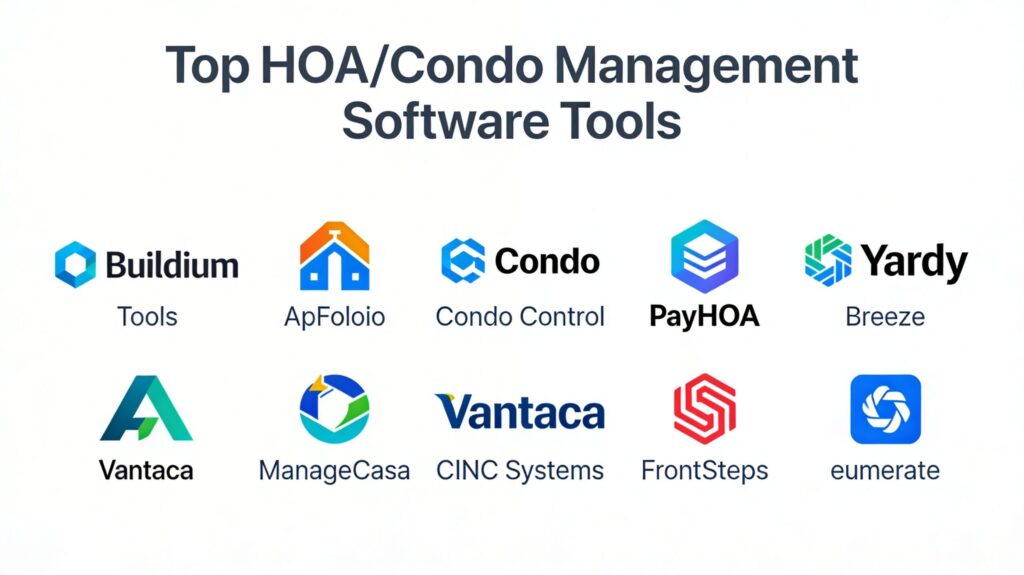
1. Buildium
Buildium is a veteran in the space that has successfully bridged the gap between rental management and community association needs. It is widely recognized for its robust accounting engine and its ability to scale with management companies that handle a mix of rental and HOA portfolios.
Key Features
The platform features a “Resident Center” that allows homeowners to pay dues, submit maintenance requests, and access community documents via a high-rated mobile app. It includes a dedicated “Violation Tracking” module that lets managers log issues in the field and automatically send out notices with photos. The system offers specialized “HOA Accounting” with automated bank reconciliation and a variety of board-ready financial reports. It also features a “Marketplace” that integrates with various third-party services for insurance tracking and background checks. Additionally, its “Board Member Portals” provide transparent access to financials and task statuses to keep volunteers informed.
Pros
Offers one of the most comprehensive accounting suites on the market with high professional trust. The platform provides excellent educational resources and a very responsive support team.
Cons
The pricing structure can be complex for very small associations due to per-unit fees. Some of the board-specific governance tools, like digital voting, require third-party integrations.
Platforms and Deployment
Web-based SaaS with native iOS and Android apps for both managers and residents.
Security and Compliance
Maintains high-level security with regular audits and is fully compliant with modern data privacy standards.
Integrations and Ecosystem
A vast marketplace of integrations including AllPropertyManagement and various specialized financial tools.
Support and Community
Features the “Buildium Academy” for user training and a robust community forum for sharing best practices.
2. AppFolio Property Manager
AppFolio is a modern, high-growth platform that leans heavily into AI and automation to streamline community management. It is designed for professional management companies that want a “slick,” intuitive interface that minimizes manual data entry.
Key Features
The platform features “AppFolio Stack,” an integration marketplace that allows for deep customization of the software ecosystem. It includes an AI assistant named “Lisa” that can handle routine communication and maintenance scheduling. The system offers “Architectural Review” workflows that automate the submission and approval process for homeowners. It features a robust “Board Member Portal” where volunteers can view real-time financial dashboards and approve invoices digitally. It also provides advanced “Reporting and Analytics” that can be customized for specific board requirements.
Pros
The user interface is exceptionally clean and modern, leading to high adoption rates among residents. The AI features significantly reduce the time spent on repetitive administrative tasks.
Cons
The per-unit pricing can be higher than competitors, making it more suitable for growing management firms than tiny self-managed HOAs. It lacks some of the niche “fund accounting” depth found in older legacy systems.
Platforms and Deployment
Cloud-native SaaS with a strong focus on the mobile experience for all user types.
Security and Compliance
Enterprise-grade security with multi-factor authentication and SOC 2 Type II compliance.
Integrations and Ecosystem
Offers a curated list of high-quality integrations through the AppFolio Stack program.
Support and Community
Provides dedicated account managers for larger portfolios and extensive online training through AppFolio University.
3. Condo Control
Condo Control is a specialized platform built from the ground up to handle the unique day-to-day operational needs of high-rise condos and gated communities. It excels in “Building Operations” and resident engagement rather than just back-office accounting.
Key Features
The platform features “Amenity Booking” with integrated payment and digital access control for shared spaces. It includes a “Visitor Management” system that allows residents to pre-authorize guests and receive notifications upon their arrival. The system offers “Digital Voting and Proxies” that are legally compliant for annual meetings and board elections. It features a “Package Tracking” module for concierges to manage resident deliveries efficiently. It also provides a “Service Request” system that tracks maintenance from the initial report to vendor payment.
Pros
It is the most feature-rich option for physical building management and security-focused communities. The digital voting feature is highly rated for its ease of use and legal auditability.
Cons
While it integrates with major accounting software, its native accounting features are not as deep as a platform like Buildium. The interface can feel “busy” due to the high number of operational modules.
Platforms and Deployment
Web-based SaaS with highly functional mobile apps for residents and security staff.
Security and Compliance
Focuses heavily on secure access control and maintains high data protection standards for resident records.
Integrations and Ecosystem
Integrates with major accounting platforms like QuickBooks, Yardi, and TOPS to provide a holistic solution.
Support and Community
Known for a very hands-on onboarding process and 24/7 support for critical building operations.
4. PayHOA
PayHOA is the leading “simplified” platform designed specifically for self-managed homeowners associations. It prioritizes ease of use and affordability, making it the top choice for volunteer boards that want to professionalize their operations.
Key Features
The platform features a “Payments-First” design that makes dues collection and automated late fee assessment effortless. It includes a “Website Builder” that allows associations to create a public-facing community site in minutes. The system offers “Broadcast Messaging” via email, text, and automated voice calls to ensure residents are always informed. It features a simplified “General Ledger” that doesn’t require an accounting degree to manage. It also provides “Violation Management” with the ability to print and mail physical letters directly from the platform.
Pros
Exceptional value for small to mid-sized associations with transparent, flat-rate pricing tiers. The software is incredibly intuitive, requiring almost no learning curve for new board members.
Cons
It lacks the enterprise-level “workflow engine” and advanced reporting found in platforms like Vantaca or CINC. It is not designed for management companies juggling hundreds of different portfolios.
Platforms and Deployment
Web-based SaaS that is fully responsive for mobile browser use.
Security and Compliance
Uses bank-level encryption for all financial transactions and follows standard data privacy practices.
Integrations and Ecosystem
Offers direct integration with Stripe for payments and Plaid for bank syncing.
Support and Community
Provides a comprehensive help center and very responsive email and chat support.
5. Yardi Breeze Premier
Yardi is a titan in the real estate software world, and Yardi Breeze Premier is its “agile” solution for small to mid-market associations. It provides enterprise-level power in a simplified, cloud-based package.
Key Features
The platform features “CondoCafe,” a premium resident portal for payments, document access, and maintenance tracking. It includes specialized “HOA Violation” tools that allow for custom categories and automated escalation paths. The system offers “Job Costing” and “Purchase Order” management for large-scale community renovation projects. It features an “Automated Accounting” engine that is built on Yardi’s world-class financial framework. It also provides “Board Approval” workflows for invoices and architectural requests directly within the portal.
Pros
Users benefit from the same high-end financial accuracy that Yardi’s enterprise clients use. It is very easy to set up with no onboarding fees and a “single sign-on” for all management tasks.
Cons
The platform can feel a bit “rigid” in its workflows compared to newer, more flexible SaaS startups. Some advanced features are only available in the “Premier” tier.
Platforms and Deployment
Cloud-based SaaS accessible from any device with a modern web browser.
Security and Compliance
Backed by Yardi’s massive security infrastructure, ensuring the highest levels of uptime and data protection.
Integrations and Ecosystem
Part of the broader Yardi ecosystem, allowing for easy transitions to more complex Yardi products if the portfolio grows.
Support and Community
Offers unlimited live chat support and a dedicated account manager for every client.
6. Vantaca
Vantaca is a “workflow-first” platform designed specifically for professional HOA management companies. It focuses on extreme automation and “business intelligence” to help firms scale their operations without adding staff.
Key Features
The platform features a “Workflow Engine” that can automate almost any business process, from board approvals to vendor payments. It includes “Vantaca IQ,” a business intelligence tool that provides real-time data on employee performance and association health. The system offers “Integrated Banking” that connects directly with partner banks for real-time fund management. It features a “Management Dashboard” that gives executives a bird’s-eye view of their entire portfolio. It also provides “Mobile Field Apps” that allow managers to work efficiently while on-site.
Pros
It offers the most powerful automation capabilities in the industry, significantly reducing “administrative drag.” The data-driven approach allows for very precise operational scaling.
Cons
The system is highly complex and requires a significant investment in time and training to set up correctly. It is generally too powerful (and expensive) for self-managed associations.
Platforms and Deployment
Web-based SaaS with specialized mobile applications for field staff.
Security and Compliance
Features advanced role-based access controls and detailed audit logs for every action taken in the system.
Integrations and Ecosystem
Built on a modern API that allows for deep integrations with various financial and insurance providers.
Support and Community
Provides high-touch implementation services and ongoing professional consulting for management firms.
7. ManageCasa
ManageCasa is a modern, intuitive platform that emphasizes “board transparency” and ease of use. It is positioned as the bridge between simple payment tools and complex enterprise management systems.
Key Features
The platform features “HOA-Specific Fund Accounting” that keeps operating and reserve funds strictly separated. It includes a “Global Search” functionality that makes finding documents or resident history nearly instant. The system offers “Integrated Tenant Screening” and “Architectural Reviews” within a single workflow. It features “Real-Time Financial Dashboards” designed to be understood by volunteer board members. It also provides a “Task Management” system that allows boards to assign and track progress on community projects.
Pros
Balances deep functionality with an interface that feels as easy to use as a consumer app. The onboarding process is notably faster than most enterprise-grade competitors.
Cons
While growing rapidly, it doesn’t yet have the massive “third-party marketplace” of competitors like AppFolio. Some specialized B2B reporting features are still in development.
Platforms and Deployment
Cloud-based SaaS with a fully responsive mobile experience.
Security and Compliance
Adheres to strict global privacy standards and offers robust encryption for all sensitive documents.
Integrations and Ecosystem
Integrates with Stripe for payments and TransUnion for resident screening services.
Support and Community
Offers excellent one-on-one training and a wealth of blog content focused on HOA management best practices.
8. CINC Systems
CINC Systems is an “accounting-first” platform that was one of the first to offer a fully integrated cloud solution for the association management industry. It is a powerhouse for firms that manage thousands of units.
Key Features
The platform features “Massive Scale Accounting” capable of handling the most complex community associations. It includes “Direct Bank Integration” with over 30 association-specialized banks for seamless financial flows. The system offers “Resident and Board Portals” that are fully customizable to the association’s brand. It features a “Work Order” management system that connects managers, residents, and vendors in one loop. It also provides “Collections Automation” that manages the legal escalation process for delinquent accounts.
Pros
Its financial modules are considered among the most “bulletproof” in the industry for large-scale operations. The deep banking partnerships provide significant efficiency gains for accounting teams.
Cons
The user interface can feel dated and “spreadsheet-like” compared to modern SaaS startups. The learning curve for new staff is significant due to the software’s depth.
Platforms and Deployment
Web-based SaaS with mobile portals for resident interactions.
Security and Compliance
Maintains rigorous SOC compliance and provides detailed audit trails for all financial movements.
Integrations and Ecosystem
Highly focused on banking and financial integrations to drive back-office efficiency.
Support and Community
Offers a dedicated implementation team and annual user conferences for networking and training.
9. FrontSteps
FrontSteps is a community engagement platform that focuses on the “resident experience” and security. It is best known for its ability to combine management tools with physical access control and community websites.
Key Features
The platform features “FrontSteps Secure,” a module for managing gate access, visitor logs, and telephone entry systems. It includes “Public & Private Websites” that serve as the digital hub for all community information and documents. The system offers “Digital Voting” for board elections and governing document changes. It features “Payments and Accounting” integrations that allow residents to pay dues directly through the community site. It also provides “Community Calendars” and “Classifieds” to foster a sense of neighborhood connection.
Pros
Excellent for gated communities or high-security condos that want to manage physical access and community life in one tool. The website templates are modern and very professional.
Cons
The core accounting features are often handled via integration rather than being native, which can lead to data silos. Some modules can be expensive if added individually.
Platforms and Deployment
Web-based SaaS with native mobile apps focused on resident engagement.
Security and Compliance
A leader in physical and digital security integration, prioritizing the safety of resident data and assets.
Integrations and Ecosystem
Integrates with major accounting back-ends like Caliber and TOPS to provide a unified experience.
Support and Community
Provides extensive training on their security hardware and a dedicated support portal for community admins.
10. Enumerate (formerly TOPS/Watchknot)
Enumerate is a consolidated platform that brings together decades of association management expertise into a modern, cloud-based “Central” system. It is designed for companies that need absolute control over their association data.
Key Features
The platform features “Enumerate Central,” a cloud-based hub for all accounting, management, and resident engagement tasks. It includes “SmartWebs” integration for advanced, mobile-friendly violation and architectural tracking. The system offers “Enumerate Payments,” a built-in solution for automated dues collection and vendor AP. It features “Precision Reporting” with hundreds of pre-built templates for every possible board scenario. It also provides “Resident Engagement” tools that include surveys, SMS alerts, and community forums.
Pros
Offers a very “stable” and proven framework that has been refined over decades. The integration of SmartWebs makes it a top choice for compliance-heavy communities.
Cons
The rebranding and consolidation of multiple products can occasionally lead to a fragmented user experience. The pricing is geared toward professional firms rather than small self-managed boards.
Platforms and Deployment
Cloud-native SaaS with various mobile-optimized tools for field and resident use.
Security and Compliance
Maintains enterprise-grade security protocols and a focus on keeping associations “audit-ready” at all times.
Integrations and Ecosystem
A strong ecosystem of owned and third-party tools specifically for the HOA market.
Support and Community
Offers a deep knowledge base and professional services for data migration and system optimization.
Comparison Table
| Tool Name | Best For | Platform(s) Supported | Deployment | Standout Feature | Public Rating |
| 1. Buildium | Mixed Portfolios | Web, iOS, Android | Cloud SaaS | Fund Accounting Engine | 4.7/5 |
| 2. AppFolio | Large Firms | Web, iOS, Android | Cloud SaaS | AI-Driven Automation | 4.8/5 |
| 3. Condo Control | High-Rise/Security | Web, iOS, Android | Cloud SaaS | Digital Voting/Proxies | 4.6/5 |
| 4. PayHOA | Self-Managed Boards | Web-Based | Cloud SaaS | Simplified Ledger | 4.8/5 |
| 5. Yardi Breeze | SMB Management | Web-Based | Cloud SaaS | No-Cost Onboarding | 4.7/5 |
| 6. Vantaca | Workflow Automation | Web, Mobile | Cloud SaaS | Vantaca IQ Analytics | 4.4/5 |
| 7. ManageCasa | Board Transparency | Web-Based | Cloud SaaS | 1-Click Financials | 4.7/5 |
| 8. CINC Systems | Banking Integration | Web, Mobile | Cloud SaaS | 30+ Bank Integrations | 4.5/5 |
| 9. FrontSteps | Gated Communities | Web, iOS, Android | Cloud SaaS | Gate Access Control | 4.5/5 |
| 10. Enumerate | Compliance Focus | Web, Mobile | Cloud SaaS | SmartWebs Integration | 4.6/5 |
Evaluation & Scoring of HOA/Condo Management Software
The scoring below is a comparative model intended to help shortlisting. Each criterion is scored from 1–10, then a weighted total from 0–10 is calculated using the weights listed. These are analyst estimates based on typical fit and common workflow requirements, not public ratings.
Weights:
- Core features – 25%
- Ease of use – 15%
- Integrations & ecosystem – 15%
- Security & compliance – 10%
- Performance & reliability – 10%
- Support & community – 10%
- Price / value – 15%
| Tool Name | Core (25%) | Ease (15%) | Integrations (15%) | Security (10%) | Performance (10%) | Support (10%) | Value (15%) | Weighted Total |
| 1. Buildium | 9 | 8 | 9 | 9 | 9 | 9 | 8 | 8.75 |
| 2. AppFolio | 9 | 10 | 10 | 9 | 9 | 8 | 7 | 8.85 |
| 3. Condo Control | 8 | 8 | 8 | 9 | 9 | 9 | 8 | 8.35 |
| 4. PayHOA | 7 | 10 | 7 | 8 | 9 | 9 | 10 | 8.55 |
| 5. Yardi Breeze | 8 | 9 | 8 | 10 | 9 | 9 | 9 | 8.80 |
| 6. Vantaca | 10 | 5 | 8 | 9 | 9 | 8 | 6 | 7.95 |
| 7. ManageCasa | 8 | 9 | 8 | 9 | 9 | 9 | 9 | 8.70 |
| 8. CINC Systems | 10 | 6 | 8 | 9 | 8 | 8 | 7 | 8.10 |
| 9. FrontSteps | 7 | 8 | 8 | 10 | 9 | 8 | 7 | 8.00 |
| 10. Enumerate | 9 | 7 | 9 | 9 | 8 | 8 | 7 | 8.25 |
How to interpret the scores:
- Use the weighted total to shortlist candidates, then validate with a pilot.
- A lower score can mean specialization, not weakness.
- Security and compliance scores reflect controllability and governance fit, because certifications are often not publicly stated.
- Actual outcomes vary with assembly size, team skills, templates, and process maturity.
Which HOA/Condo Management Tool Is Right for You?
Solo /Freelancer
If you are an independent community manager starting your own firm, you need a tool that handles everything from marketing your services to automated accounting without a massive upfront cost. Look for platforms that offer a “pay-per-unit” model and strong mobile apps, allowing you to manage your properties from the field and maintain a professional image to your boards from day one.
SMB
For volunteer boards managing their own small community, simplicity is the absolute priority. You need a platform that replaces spreadsheets with a “check-book” style interface and handles the complexity of dues collection and late fees automatically. Avoiding enterprise-grade tools will save you thousands in training costs and prevent “volunteer burnout” caused by overly complex software.
Mid-Market Management
Management companies with a portfolio of 50 to 100 associations should focus on efficiency and “time-to-onboard.” You need a system that can quickly migrate data from legacy tools and provides a standardized workflow for your property managers. Platforms with integrated “Architectural Review” and “Violation Management” will allow your team to manage more units per person without sacrificing service quality.
Enterprise Portfolios
Large-scale management firms require a “Business Intelligence” layer. At this level, you aren’t just managing properties; you are managing a data-driven business. You need advanced reporting that tracks staff productivity, collection effectiveness across the entire portfolio, and deep banking integrations that allow your accounting team to handle thousands of invoices with minimal manual entry.
Budget vs Premium
Budget-conscious boards should look for “flat-fee” platforms that include essential features like document storage and payment processing without a per-unit surcharge. Premium platforms, while more expensive, often pay for themselves through automated “Revenue Sharing” on screening fees or by significantly reducing the need for administrative staff through high-level AI automation.
Feature Depth vs Ease of Use
If your board is highly technical or you have a dedicated CPA, prioritizing a “feature-heavy” accounting tool is a smart move. However, for most volunteer boards, “Ease of Use” is a strategic asset. A tool that residents find easy to use for payments will directly lead to better cash flow and fewer late-night phone calls for board members.
Integrations & Scalability
Your software should be able to “play well” with others. Ensure the platform integrates with your existing bank, your preferred security hardware, and your community’s website. Long-term scalability means choosing a platform that can handle the addition of new amenities, more units, or transition from self-management to professional management without a complete data overhaul.
Security & Compliance Needs
In states with strict disclosure and safety laws, your software must be a “compliance shield.” Look for platforms that offer specialized modules for reserve study tracking and localized legal disclosures. Furthermore, with the rise of cyber-fraud in the real estate sector, multi-factor authentication and bank-level encryption are non-negotiable requirements for any platform handling community funds.
Frequently Asked Questions (FAQs)
1. Is HOA software different from regular rental management software?
Yes. HOA software must handle “Fund Accounting,” which separates operating funds from long-term reserves, and manage board-specific tasks like architectural reviews and meeting minutes, which are not typically required for rental properties.
2. Can we use the software for digital board elections?
Most premium platforms offer legally compliant digital voting and proxy management modules. These tools ensure that only verified owners can vote and provide a secure, auditable trail that is essential for annual meetings and budget approvals.
3. How does the software handle residents who don’t use computers?
The best platforms allow for “Hybrid Communication,” meaning you can generate and send digital notices while also having the system automatically print and mail physical letters to residents who prefer traditional communication methods.
4. What is a “Board Member Portal”?
A Board Member Portal is a restricted access area where volunteer leaders can view real-time financial dashboards, approve vendor invoices, track architectural requests, and access confidential association documents without seeing sensitive resident-level details.
5. How long does it take to move our data to a new platform?
For small associations, basic data migration can take as little as a few days. For large management firms with complex portfolios, the process can take several weeks and usually involves a dedicated “onboarding specialist” to ensure data integrity.
6. Does the software integrate with our existing bank?
Many platforms offer “Bank Syncing” through services like Plaid, but enterprise-grade tools often have direct, deeper integrations with association-specific banks like Alliance Association Bank to provide real-time reconciliation and automated AP/AR.
7. Can residents pay their dues using a credit card?
Yes, most platforms integrate with payment processors like Stripe or specialized property payment providers. They typically offer options for ACH (e-check), credit cards, and even physical retail payment locations.
8. What happens to our data if we decide to cancel the service?
Standard SaaS agreements ensure that you own your data. Most reputable platforms allow you to export all your resident records, financial ledgers, and document history into common formats like Excel or PDF before you close your account.
9. Can we track violations using a mobile phone?
Modern “Mobile-First” platforms allow managers to take photos of violations in the field, geolocate the unit, and instantly log the issue. The system can then automatically trigger a notice to the resident based on pre-defined community rules.
10. Do we need to install any hardware to use this software?
No. Almost all modern HOA and Condo management tools are “Cloud-Based,” meaning they run in your web browser and on mobile apps. There is no software to install on your computer and no server to maintain.
Conclusion
Selecting the right HOA or Condo management software is one of the most consequential decisions a community board or management firm will make, impacting everything from financial stability to resident satisfaction. The shift toward integrated AI, automated compliance, and seamless mobile experiences is no longer a luxury but a baseline requirement for effective governance. These platforms do more than just collect dues; they build a culture of transparency and efficiency that protects the association’s assets and its leaders’ reputations. By investing in a platform that aligns with your specific portfolio size and governance model, you are not just buying software—you are building a more resilient and connected community for the future.