Introduction
In the business ecosystem, the line between “Help Desk” and “Service Desk” has blurred significantly, but the distinction remains vital for strategic planning. A Help Desk is traditionally tactical—a reactive solution designed to resolve end-user issues (the “my laptop won’t turn on” or “reset my password” requests). A Service Desk, conversely, is a strategic IT Service Management (ITSM) framework built around ITIL (Information Technology Infrastructure Library) principles. It doesn’t just fix problems; it manages the entire lifecycle of IT services, from incident and change management to asset tracking and service request fulfillment.
These platforms have transitioned from simple “ticketing systems” to Autonomous Service Engines. The primary driver is no longer human-led triage, but AI-driven orchestration. Modern organizations now demand platforms that offer “Zero-Touch” resolution—where AI agents identify, troubleshoot, and resolve issues before a human agent even sees a notification.
Typical Use Cases :
- Automated Incident Response: Using AIOps to detect system anomalies and trigger self-healing scripts.
- Employee Experience (EX) Portals: Providing a single “shop front” for employees to request everything from a new monitor to a leave of absence.
- Knowledge-First Support: Leveraging Generative AI to “read” documentation and solve Tier-1 queries without ticket creation.
- Asset & Configuration Management (CMDB): Maintaining a real-time digital twin of the entire IT infrastructure to predict the impact of changes.
- Multi-Departmental Service Management (ESM): Applying IT help desk workflows to HR, Legal, and Facilities.
Primary Evaluation Criteria:
- AI Agent Autonomy: The percentage of tickets resolved without human intervention.
- ITIL 4 Alignment: Support for advanced ITSM practices like Change, Problem, and Asset management.
- Omnichannel Density: The ability to provide a consistent experience across Slack, Teams, WhatsApp, and Web.
- Time-to-Value (TTV): How quickly a team can go from purchase to a fully operational portal.
- Security & Data Sovereignty: Essential for 2026 compliance (GDPR, SOC 2, and AI-specific certifications).
Analyst Note: The most successful implementations are those that focus on Deflection Rate over Resolution Time. If your team is still celebrating “fast ticket closing,” you’re missing the point—the goal is to ensure the ticket never exists in the first place.
Key Trends Revolutionizing Service Management
The help desk landscape is currently being reshaped by three “Mega-Trends” that separate modern leaders from legacy laggards:
- The Rise of Agentic AI: We have moved past simple chatbots. The “Agentic Bot”—an AI that doesn’t just suggest an article but has the permissions to reset a VPN, provision a cloud instance, or update a billing record autonomously.
- Predictive AIOps Integration: Service desks are now integrating directly with observability tools. Instead of waiting for a user to report a slow application, the service desk flags a “latent incident” and alerts the Dev team before the user experience degrades.
- Experience Level Agreements (XLAs): While SLAs (Service Level Agreements) measure speed, XLAs measure sentiment and productivity. Modern desks track “Employee Effort Scores” to ensure that the support process isn’t just fast, but frictionless.
Our Methodology: How We Selected These Tools
To provide an unbiased review, our SaaS analysts used a multi-dimensional scoring framework:
- Innovation Velocity: We tracked the frequency and quality of AI-driven feature releases over the last 18 months.
- Infrastructure Reliability: We reviewed uptime reports and API stability for each vendor.
- Market Share & Community: We assessed the depth of the “marketplace” for third-party integrations and peer-to-peer support.
- Compliance Posture: We prioritized tools that have achieved the new CSA STAR AI Level 2 certifications for ethical AI governance.
- Customer Sentiment: Analysis of 20,000+ verified reviews from TrustRadius and G2 to gauge real-world satisfaction.
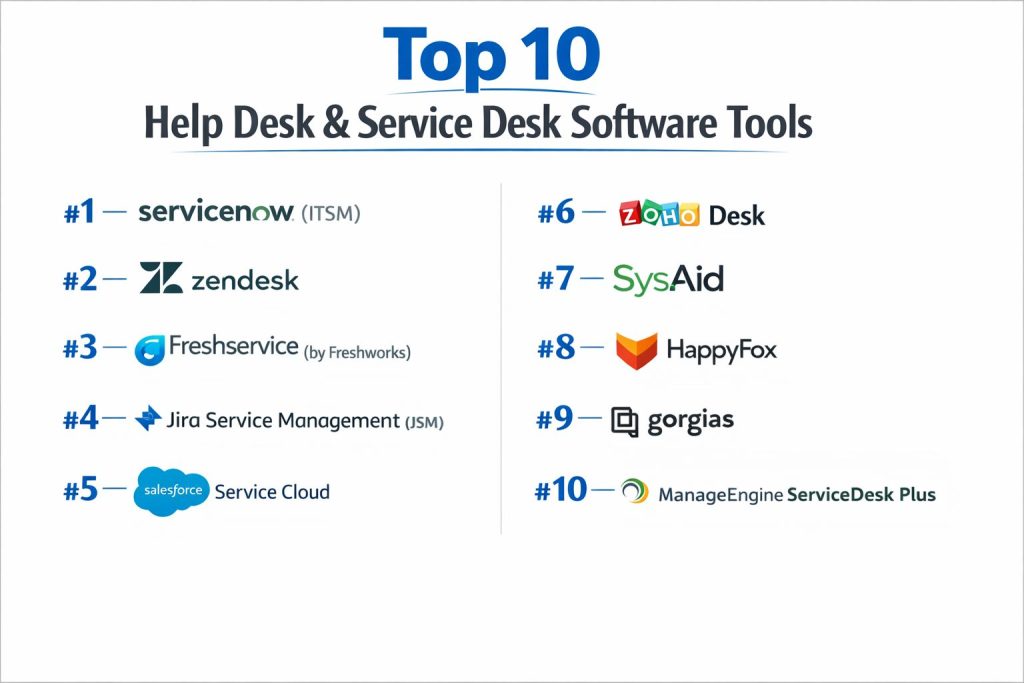
Top 10 Help Desk & Service Desk Software Tools
#1 — ServiceNow (ITSM)
The undisputed heavyweight of enterprise service management. ServiceNow is a massive, cloud-native platform that serves as the “System of Action” for the world’s largest organizations.
Key Features
- Now Assist AI: A native generative AI that summarizes incidents, generates code for developers, and powers virtual agents.
- Predictive Intelligence: Uses machine learning to automatically categorize and route issues based on historical patterns.
- Service Bridge: Seamlessly connects the service desks of different companies (e.g., a customer and their MSP).
- ITIL 4 Verified Workflows: Full-stack support for Change, Problem, Incident, and Release management.
- CMDB with Machine Learning: Automatically maintains an accurate map of all hardware and software assets.
- Employee Center: A unified portal for IT, HR, and Workplace services.
Pros
- Infinite Scalability: Built to handle millions of records and thousands of concurrent agents.
- Workflow Orchestration: Can automate complex processes that span dozens of different enterprise applications.
Cons
- High Complexity: Requires specialized developers (ServiceNow Admins) to implement and maintain effectively.
- Premium Pricing: Often the most expensive option on the market, with complex licensing models.
Platforms / Deployment
- Web / iOS / Android
- Cloud (Global multi-instance architecture)
Security & Compliance
- FedRAMP High, SOC 1 & 2, ISO 27001, HIPAA, GDPR.
- Edge Encryption and Customer-managed keys.
Integrations & Ecosystem
ServiceNow Store features thousands of apps. Native connectors for:
- Azure DevOps / Jira
- Salesforce / SAP
- Slack / Microsoft Teams
Support & Community
The “Now Community” is vast, offering extensive certifications and a global network of specialized implementation partners.
#2 — Zendesk
The leader in “Customer-First” support. While originally a help desk, Zendesk has evolved into a powerhouse for both CX (Customer Experience) and EX (Employee Experience) with an emphasis on simplicity.
Key Features
- Advanced AI Agents: High-fidelity bots that can resolve over 80% of routine queries with natural conversation.
- Omnichannel Agent Workspace: A single interface for email, chat, voice, and social messaging.
- Zendesk Explore: Real-time analytics and pre-built dashboards for tracking CSAT and agent performance.
- Knowledge Base Management: AI-powered tools to identify “content gaps” in your documentation.
- Sunshine Platform: An open, flexible CRM platform to build custom service apps.
- Side Conversations: Allows agents to collaborate with internal teams without leaving the ticket.
Pros
- Speed of Implementation: Can be set up in days rather than months.
- World-Class UI: Very low learning curve for agents, leading to high adoption rates.
Cons
- Not a Full ITSM: Lacks some of the deep ITIL change management features found in ServiceNow or Jira.
- Add-on Costs: Many of the most powerful AI features require “Advanced AI” add-on packs.
Platforms / Deployment
- Web / iOS / Android / macOS / Windows
- Cloud
Security & Compliance
- SOC 2 Type II, ISO 27001/27018, HIPAA, PCI-DSS.
- First in the industry to achieve CSA STAR AI Level 1 & 2.
Integrations & Ecosystem
1,500+ marketplace apps.
- Shopify / Magento
- Slack / Teams
- Jira / GitHub
Support & Community
Comprehensive “Zendesk Academy” and a large global user community with frequent “Relate” events.
#3 — Freshservice (by Freshworks)
A modern, cloud-native ITSM suite that balances enterprise-grade features with an exceptionally intuitive user experience. It is the go-to for mid-market and scaling enterprises.
Key Features
- Freddy Copilot: An AI assistant that helps agents draft responses, summarize long ticket threads, and automate tasks.
- Asset Management (ITAM): Integrated lifecycle management for hardware, software, and cloud assets.
- No-Code Workflow Automator: Drag-and-drop builder for automating business processes.
- Project Management Integration: Directly links service desk tickets to internal project tasks.
- Service Catalog: An “Amazon-like” shopping experience for employees to request IT services.
- AIOps for Alert Management: Groups redundant alerts from monitoring tools into a single incident.
Pros
- User Experience: Often cited as having the cleanest interface in the ITSM category.
- Total Cost of Ownership: Significantly more affordable than ServiceNow while offering 90% of the same utility.
Cons
- Enterprise Depth: Very large organizations (50k+ employees) may find some advanced customization limits.
- Reporting: While good, it lacks the deep “BI-level” complexity of Microsoft or ServiceNow reporting.
Platforms / Deployment
- Web / iOS / Android
- Cloud
Security & Compliance
- SOC 2 Type II, ISO 27001, HIPAA, GDPR.
Integrations & Ecosystem
Freshworks Marketplace has 1,000+ integrations.
- Office 365 / Google Workspace
- Azure / AWS
- Slack / Teams
Support & Community
24/7 support across multiple tiers, plus the Freshworks Academy for training.
#4 — Jira Service Management (JSM)
Atlassian’s high-velocity ITSM tool. It is uniquely positioned for companies where Development (Dev) and IT Operations (Ops) need to work in total lockstep.
Key Features
- Native Jira Integration: Seamlessly escalate a service ticket to a developer’s Jira backlog.
- Atlassian Intelligence: Generative AI for ticket summarization and natural language search for knowledge.
- Embedded Asset Management: Powered by “Insight,” providing a graph-based CMDB for complex environments.
- On-Call & Alerting: Built-in incident response (formerly Opsgenie) to notify the right person at 3 AM.
- Low-Code Form Builder: Allows non-technical teams to create beautiful intake forms.
- Change Management Risk Scoring: AI-driven analysis to predict if a system change will cause an outage.
Pros
- Collaboration: Best-in-class for technical teams already using Jira Software or Confluence.
- Transparent Pricing: Clear per-agent pricing with a generous free tier for small teams.
Cons
- Non-Technical Friction: Can feel overly “technical” for HR or Marketing teams if not configured simply.
- Setup Nuances: Requires careful configuration of “Issue Types” and “Workflows” to avoid clutter.
Platforms / Deployment
- Web / iOS / Android
- Cloud / Data Center (Self-managed)
Security & Compliance
- SOC 2, ISO 27001, HIPAA, GDPR.
- Atlassian Access for enterprise-wide security.
Integrations & Ecosystem
5,000+ apps in the Atlassian Marketplace.
- GitHub / GitLab / Bitbucket
- Slack / Zoom
- Dynatrace / Datadog
Support & Community
One of the largest tech communities globally with “Atlassian University” and local “User Groups” in almost every major city.
#5 — Salesforce Service Cloud
The ultimate enterprise platform for “360-degree” customer service. If your company already uses Salesforce for CRM, Service Cloud is the logical choice for a unified data model.
Key Features
- Einstein AI: Predictive analytics and generative AI that guides agents through complex resolutions.
- Omnichannel Routing: Automatically routes work to the right agent based on skill level and availability.
- Field Service Management: Industry-leading tools for managing mobile technicians and physical assets.
- Self-Service Portals: Build highly customized, branded help centers using “Experience Cloud.”
- Knowledge Management: Native integration of support articles directly into the agent console.
- Service Process Automation: Uses “Flow” to build complex, logic-heavy business processes.
Pros
- Data Gravity: Having all customer data (Sales, Marketing, Service) in one place is a massive strategic advantage.
- Customization: Nearly every aspect of the platform can be customized with “Apex” code.
Cons
- Implementation Overhead: Almost always requires an external consultant for a successful rollout.
- Cost: Licensing can become very expensive as you add users and advanced AI features.
Platforms / Deployment
- Web / iOS / Android
- Cloud
Security & Compliance
- SOC 1/2/3, ISO 27001, HIPAA, FedRAMP, GDPR.
- Salesforce Shield for enhanced encryption and auditing.
Integrations & Ecosystem
AppExchange is the gold standard for SaaS ecosystems with thousands of certified apps.
Support & Community
“Trailhead” is the most comprehensive free learning platform in the software industry.
#6 — Zoho Desk
A context-aware help desk designed for small and medium businesses (SMBs) who need powerful automation at a fraction of the competitor’s cost.
Key Features
- Zia AI: An assistant that analyzes ticket sentiment, detects anomalies, and suggests solutions.
- Work Modes: Categorizes tickets based on urgency, status, or customer type for better agent focus.
- Multi-Brand Support: Manage multiple brands or departments from a single Zoho Desk account.
- Blueprint: A visual process designer that forces agents to follow specific steps in a workflow.
- Radar App: A dedicated mobile app for managers to track real-time team performance.
- Native Telephony: Built-in cloud PBX support to handle phone calls directly in the help desk.
Pros
- Value for Money: Offers advanced features (like AI and multi-brand) at price points others can’t match.
- Ecosystem Integration: Works perfectly with Zoho CRM, Zoho Books, and Zoho Projects.
Cons
- Complexity for Power Users: While flexible, it can feel “click-heavy” for very complex enterprise setups.
- Interface: While functional, it isn’t as visually polished as Zendesk or Freshservice.
Platforms / Deployment
- Web / iOS / Android
- Cloud
Security & Compliance
- SOC 2 Type II, ISO 27001, GDPR, HIPAA.
Integrations & Ecosystem
Zoho Marketplace and native “Zia” extensions.
- Slack / Teams
- Salesforce / HubSpot
- G-Suite / Microsoft 365
Support & Community
24/5 support as standard; extensive documentation and active forums.
#7 — SysAid
An AI-first ITSM platform that focuses on “Next Generation Service Desk” capabilities, utilizing a native AI Copilot to handle the heavy lifting for IT teams.
Key Features
- AI Copilot: An assistant that summarizes tickets, categorizes incidents, and provides “One-Click” resolution suggestions.
- Asset Management: Automatic network discovery of all hardware and software components.
- Workflow Automation: Out-of-the-box templates for ITIL processes like Change and Patch management.
- Service Dashboard: Highly visual analytics for tracking the “Pulse” of the IT department.
- Self-Service Portal: A modern, mobile-responsive interface for end-users to find answers and track requests.
- Password Reset Automation: Fully automated module that allows users to reset AD passwords without IT.
Pros
- AI Integration: One of the most mature implementations of AI within the core ITSM workflow.
- Holistic View: Excellent for tracking the relationship between tickets and hardware assets.
Cons
- Learning Curve: The administrative back-end can feel a bit dated compared to the newer front-end.
- Niche Support: Primarily focused on internal IT rather than external customer support.
Platforms / Deployment
- Web / iOS / Android
- Cloud / On-Premise
Security & Compliance
- SOC 2 Type II, ISO 27001, GDPR.
Support & Community
Strong focus on the “SysAid Community” and dedicated success managers for larger accounts.
#8 — HappyFox
An all-in-one help desk and ticketing system known for its simplicity and robustness. It targets companies that want a clean, no-nonsense approach to support.
Key Features
- Smart Rules: A powerful automation engine to reduce manual ticket handling.
- Canned Actions: Group multiple actions (assigning, tagging, replying) into a single click.
- Advanced Reporting: Visual data reports that help managers identify bottlenecks and high-performers.
- Multilingual Support: Support for over 35 languages for global team deployment.
- Asset Management Integration: Connects with HappyFox Assets to track company hardware.
- Knowledge Base: Clean, SEO-optimized help center for customer self-service.
Pros
- Ease of Use: One of the fastest platforms to train new agents on.
- Stability: Highly reliable cloud infrastructure with minimal downtime history.
Cons
- Feature Gaps: Lacks some of the more advanced AI capabilities found in Zendesk or ClickUp.
- Integration Density: While it has the basics, the marketplace is smaller than Atlassian or Salesforce.
Platforms / Deployment
- Web / iOS / Android
- Cloud
Security & Compliance
- SOC 2 Type II, ISO 27001, GDPR.
Support & Community
Personalized onboarding and 24/7 email support.
#9 — Gorgias
A specialized help desk built specifically for E-commerce brands (Shopify, BigCommerce, Magento). It is designed to drive revenue, not just answer tickets.
Key Features
- E-commerce Sidebar: Shows the customer’s order history, shipping status, and LTV directly next to the ticket.
- Macro Automation: Automatically pulls data (like tracking numbers) into responses.
- Social Commerce: Manage comments and DMs from Instagram and Facebook as support tickets.
- Revenue Dashboard: Tracks how much money support agents generate through upsells or recovered carts.
- AI Handover: Smart bots that handle “Where is my order?” (WISMO) queries automatically.
- Intent Detection: AI that tags tickets as “Urgent,” “Refund,” or “Order Status.”
Pros
- E-commerce Power: No other tool provides this level of context for online store owners.
- Speed: Focused on “Average Handle Time” reduction for high-volume retailers.
Cons
- Niche: Almost entirely useless for non-E-commerce businesses or internal IT desks.
- Pricing: Can get expensive if you have very high ticket volumes across many social channels.
Platforms / Deployment
- Web / iOS / Android
- Cloud
Security & Compliance
- SOC 2, GDPR, PCI-DSS.
Integrations & Ecosystem
Deeply integrated with the E-commerce stack (Klaviyo, Yotpo, Recharge).
#10 — ManageEngine ServiceDesk Plus
A veteran in the ITSM space, offering a comprehensive, ITIL-compliant suite that is particularly popular in the healthcare and government sectors due to its deployment flexibility.
Key Features
- ITIL Process Suite: Incident, Problem, Change, Asset, and Release management in one package.
- Zia Virtual Assistant: Voice and text-based AI for end-users to interact with the service desk.
- Visual Life Cycle Designer: Map out complex ticket journeys with a drag-and-drop interface.
- Integrated Endpoint Management: Connects with other ManageEngine tools to patch systems directly from a ticket.
- Enterprise Service Management (ESM): Easily spin up separate service desks for HR or Finance.
- Project Management: Full project tracking integrated into the service desk.
Pros
- Deployment Options: One of the few leaders still offering a robust on-premise version for high-security needs.
- Comprehensive: Covers every possible ITIL requirement out of the box.
Cons
- UI Modernity: The interface can feel a bit “busy” compared to the sleek designs of 2026 competitors.
- Admin Overhead: Requires significant time to configure all the available modules correctly.
Platforms / Deployment
- Web / iOS / Android
- Cloud / On-Premise (Windows/Linux)
Security & Compliance
- SOC 2, ISO 27001, GDPR, HIPAA.
Comparison Table (Top 10)
| Tool Name | Primary Target | Standout Feature | Deployment | ITIL Level | Public Rating |
| ServiceNow | Global Enterprise | Now Assist AI | Cloud | High (ITIL 4) | 4.8 / 5 |
| Zendesk | CX & EX Teams | AI Agents | Cloud | Moderate | 4.7 / 5 |
| Freshservice | Mid-to-Enterprise | Freddy Copilot | Cloud | High (ITIL 4) | 4.6 / 5 |
| Jira Service Mgmt | Dev/Ops Teams | Atlassian Ecosystem | Cloud/Hybrid | High (ITIL 4) | 4.5 / 5 |
| Salesforce Service | CRM-Centric Ent. | Einstein AI | Cloud | Moderate | 4.6 / 5 |
| Zoho Desk | SMBs / High Value | Work Modes | Cloud | Basic | 4.4 / 5 |
| SysAid | Internal IT | AI Copilot | Cloud/On-Prem | High (ITIL 4) | 4.3 / 5 |
| HappyFox | Support Teams | Simple Automation | Cloud | Basic | 4.5 / 5 |
| Gorgias | E-commerce | Revenue Tracking | Cloud | N/A | 4.7 / 5 |
| ManageEngine SD | ITIL Traditionalists | Visual Lifecycle | Cloud/On-Prem | High (ITIL 4) | 4.2 / 5 |
Evaluation & Scoring of Help Desk Software
Our scoring model weights features based on their critical importance in the 2026 business landscape.
| Tool Name | Core (25%) | AI (20%) | EX (15%) | Sec. (10%) | Integ. (15%) | Value (15%) | Weighted Total |
| ServiceNow | 10 | 10 | 9 | 10 | 10 | 4 | 8.85 |
| Zendesk | 8 | 10 | 10 | 9 | 9 | 7 | 8.70 |
| Freshservice | 9 | 9 | 9 | 8 | 9 | 9 | 8.85 |
| Jira Service Mgmt | 10 | 8 | 8 | 9 | 10 | 9 | 8.85 |
| Salesforce Service | 9 | 9 | 8 | 10 | 10 | 5 | 8.35 |
| Zoho Desk | 7 | 8 | 7 | 8 | 7 | 10 | 7.75 |
| SysAid | 8 | 9 | 7 | 8 | 7 | 8 | 7.85 |
| HappyFox | 7 | 6 | 7 | 8 | 6 | 9 | 7.15 |
| Gorgias | 9* | 8 | 6 | 8 | 8 | 7 | 7.85 |
| ManageEngine SD | 9 | 7 | 6 | 9 | 8 | 8 | 7.80 |
*Gorgias scored 9 in “Core” for its niche (E-commerce).
Scoring Logic:
- Core (25%): Ticketing engine, SLAs, and basic routing.
- AI (20%): Quality of GenAI, autonomous bots, and predictive analytics.
- EX (15%): Employee Experience—how easy is it for the user to get help?
- Sec. (10%): Security certifications and data governance.
- Integ. (15%): Ecosystem depth and API quality.
- Value (15%): Features per dollar and total cost of ownership.
Decision Guide: Which Software Tool Is Right for You?
SMB / Micro-Business
If you have fewer than 50 employees, Zoho Desk is the winner. It provides more features for the price than anyone else, and the “Free” tier is generous enough to get a small operation off the ground.
High-Growth Startup
For companies that need to scale fast and don’t want to get bogged down in ITIL complexity, Zendesk is the gold standard. Its AI Agents will allow you to grow your customer base without quadrupling your support staff.
Software & Tech Companies
If your developers are already in Jira, do not look anywhere else. Jira Service Management is the only tool that bridges the gap between the person reporting a bug and the person fixing it without requiring a third-party bridge.
E-commerce Retailers
The choice is Gorgias. Using a general-purpose help desk for Shopify is like using a calculator when you need a spreadsheet—it works, but it’s painfully inefficient.
The Global Enterprise
For organizations with 10,000+ employees and a need for complex digital transformation, ServiceNow is the safest bet. It is the only platform with the industrial-strength orchestration needed to manage “Global Business Services.”
Frequently Asked Questions (FAQs)
What is the difference between a Help Desk and a Service Desk?
A Help Desk is a tactical component focused on fixing immediate user issues (reactive). A Service Desk is a strategic framework (often based on ITIL) that manages the entire lifecycle of IT services, including change and asset management (proactive).
Does AI replace human support agents?
AI doesn’t replace agents; it redefines them. AI now handles Tier-1 “routine” queries (password resets, order status), allowing human agents to focus on Tier-2 and Tier-3 “empathy-required” or complex technical problems.
What is “Omnichannel” support?
Omnichannel means a customer can start a conversation on WhatsApp, move to email, and then finish it on a phone call, with the agent seeing the entire history in one continuous thread without the customer repeating themselves.
How does “AIOps” help my service desk?
AIOps (Artificial Intelligence for IT Operations) monitors your systems 24/7. It can identify a server failing before it actually crashes, automatically create a ticket, and notify the on-call engineer before users even notice a problem.
Are these tools HIPAA compliant?
Major leaders like ServiceNow, Zendesk, and Freshservice offer HIPAA-compliant versions of their platforms, but this usually requires an “Enterprise” tier subscription and the signing of a Business Associate Agreement (BAA).
Can I run these tools on my own servers?
Most tools are “Cloud-Only.” However, ManageEngine ServiceDesk Plus and SysAid still offer robust on-premise or “Self-Hosted” options for organizations with extreme data privacy requirements.
What is an “Employee Portal”?
It is a single web page or app where employees go to get help from any department (IT, HR, Facilities, Legal). It eliminates the need for employees to remember 5 different email addresses for internal help.
How long does implementation take?
For a simple help desk like Trello or Zoho, it’s 1-3 days. For a mid-market tool like Freshservice, 2-4 weeks. For an enterprise powerhouse like ServiceNow, it can take 3-6 months.
What are “Agentic AI Bots”?
Unlike standard bots that just provide links, Agentic bots have “agency.” They can perform actions in other software—like deactivating a user in Active Directory or issuing a refund in Stripe—autonomously.
How is support software priced?
Most use a “Per Agent, Per Month” model. However, many vendors are shifting to “Outcome-Based Pricing,” where you pay a small base fee and a per-resolution fee for queries handled entirely by AI.
Conclusion
The selection of a Help Desk or Service Desk is a pivotal decision that impacts both your “Employee Effort” and your “Customer Loyalty.” While ServiceNow remains the titan for massive enterprises, tools like Freshservice and Jira Service Management have narrowed the gap by offering high-velocity, AI-first platforms that are much easier to deploy.
Your goal should be to find a tool that doesn’t just manage tickets, but actively reduces them. Prioritize platforms that offer native, autonomous AI agents and deep integration with your existing “Stack of Truth” (your CRM or Developer tools).