Introduction
FinOps chargeback tools are essential specialized instruments within the cloud financial management ecosystem, designed to transform a monolithic cloud invoice into a granular, department-level financial report. Chargeback refers to the formal process of recovering cloud costs from the business units, products, or teams that consumed the resources, effectively shifting the cloud bill from a central IT expense to a distributed operational cost. These platforms utilize advanced tagging metadata, resource labels, and sophisticated allocation engines to attribute 100% of cloud spend—including complex shared services like data transfer, support fees, and containerized workloads—to the appropriate internal cost centers. By establishing a direct link between consumption and accountability, these tools empower finance and engineering leaders to speak the same language.
The strategic necessity of these tools has intensified as organizations move away from simple “lift and shift” migrations toward complex, multi-cloud and microservices architectures. Without a robust chargeback mechanism, organizations face the “black box” spending problem, where cloud costs spiral without clear ownership or business context. In a professional FinOps practice, these tools enable the transition from “Showback” (reporting only) to “Chargeback” (actual budget transfer), which is the hallmark of a mature financial culture. When evaluating these platforms, buyers must prioritize their ability to handle untagged resources, the accuracy of their automated mapping rules, and the seamlessness of their integration with corporate Enterprise Resource Planning (ERP) systems.
Best for: Large-scale enterprises with complex organizational structures, SaaS companies needing to track cost-per-customer, and organizations operating at a high level of FinOps maturity that require automated financial reconciliation.
Not ideal for: Early-stage startups with a single cloud account and minimal team separation, where manual spreadsheet tracking or native cloud consoles are sufficient for basic cost awareness.
Key Trends in FinOps Chargeback Tools
The industry is rapidly shifting toward “Automated Unit Economics,” where tools don’t just show total spend but calculate the exact cost of a single business transaction, such as a user login or a specific API call. There is also a massive move toward “Virtual Tagging,” a technology that allows finance teams to retroactively organize and allocate costs through the tool’s interface without requiring engineers to manually update tags in the cloud environment. AI-driven anomaly detection has become a standard requirement, providing real-time alerts when a specific department’s spend deviates from historical patterns, allowing for immediate corrective action before the monthly billing cycle ends.
Shared cost allocation has become significantly more sophisticated, moving beyond simple even splits to consumption-based distribution. For instance, the cost of a shared Kubernetes cluster or a central security service can now be divided based on the actual CPU and memory usage of each individual team’s microservices. Furthermore, transparency in “Carbon Footprint Tracking” is being integrated into chargeback reports, allowing organizations to allocate environmental impact alongside financial costs, meeting the growing demand for corporate sustainability reporting.
How We Selected These Tools
Our selection process focused on identifying tools that provide more than just visibility; we prioritized platforms that facilitate the “Act” phase of the FinOps lifecycle. We looked for solutions that offer high precision in cost attribution, especially for “un-allocatable” costs like idle resources and shared support tiers. Market presence and enterprise-grade reliability were key factors, as these tools often handle sensitive financial data and must integrate with secure accounting workflows.
We evaluated each tool’s ability to normalize data across multiple cloud providers (AWS, Azure, GCP) and third-party SaaS services to provide a “Single Pane of Glass” view. The robustness of the reporting engine was scrutinized to ensure it could generate executive-ready dashboards as well as granular developer-level views. Finally, we considered the ease of implementation, looking for platforms that provide a rapid “time-to-value” by automating the discovery and mapping of existing infrastructure.
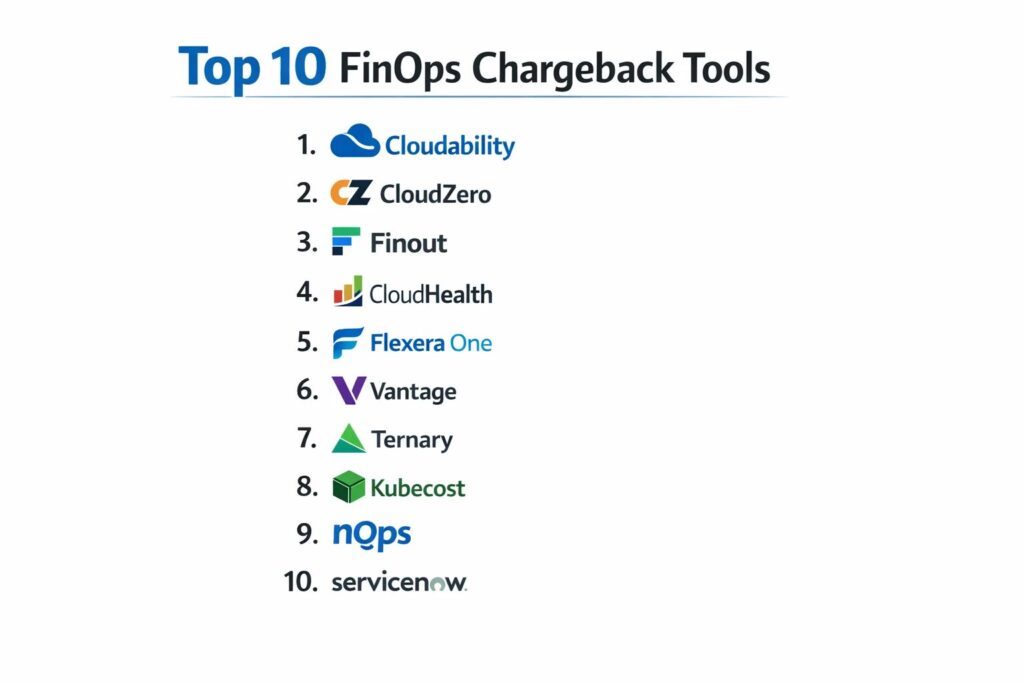
1. Apptio Cloudability (IBM)
Apptio Cloudability is an enterprise-grade platform specifically built for complex financial modeling and large-scale cloud cost management. Now backed by IBM, it offers some of the most sophisticated chargeback and budgeting workflows in the market, making it the preferred choice for Fortune 500 companies that need to align cloud spend with strict corporate accounting standards.
Key Features
The platform features a world-class cost allocation engine that uses a tagging-based framework to map every cloud dollar to a business unit or project. It provides advanced forecasting models that help finance teams predict future spend with high accuracy. Its “True Cost” feature incorporates amortized reserved instances and savings plans into the chargeback reports for precise financial reconciliation. It also offers a specialized Kubernetes cost attribution module that breaks down cluster costs by namespace and label. The reporting suite is highly customizable, allowing for the creation of persona-based dashboards for different stakeholders.
Pros
It offers unparalleled depth in financial reporting and TBM (Technology Business Management) alignment. Its ability to manage complex multi-cloud and hybrid environments is industry-leading.
Cons
The platform is expensive and can be overly complex for smaller organizations. It typically requires a significant time investment to set up the initial allocation rules.
Platforms and Deployment
SaaS-based web platform with deep API integrations for enterprise financial systems.
Security and Compliance
Holds SOC 2 Type II certification and offers enterprise-grade security features including single sign-on and role-based access control.
Integrations and Ecosystem
Deeply integrated with all major cloud providers and enterprise financial tools like SAP and Oracle.
Support and Community
Offers dedicated account management and professional consulting services, supported by a global user community.
2. CloudZero
CloudZero is a modern cost intelligence platform that focuses on “Unit Economics.” It is designed to help software-driven organizations understand the business context behind their cloud spend, such as the cost to support a specific customer or feature, rather than just service-level totals.
Key Features
The platform utilizes a unique “telemetry-driven” approach to cost allocation, allowing it to attribute spend without relying solely on perfect tagging. It features a “Cost per Unit” dashboard that connects cloud infrastructure costs directly to business activity. Its automated anomaly detection uses machine learning to identify spend spikes at the team or project level instantly. The tool also provides a developer-centric interface that helps engineers see the cost impact of their code changes in real-time. It supports multi-cloud environments and includes specialized views for Snowflake and Kubernetes costs.
Pros
The “Virtual Tagging” capability solves the common problem of incomplete resource tagging. It provides excellent visibility into the actual profitability of specific products and features.
Cons
It is less focused on traditional IT budgeting and more on engineering-driven cost awareness. The unit economics approach may require a shift in organizational thinking to fully utilize.
Platforms and Deployment
SaaS platform with rapid onboarding through cloud-native API connections.
Security and Compliance
Maintains high security standards for data ingestion and provides secure, encrypted access for all users.
Integrations and Ecosystem
Strongest on AWS but provides good multi-cloud support and integrates with DevOps tools like Slack for alerting.
Support and Community
Provides high-touch customer success and a wealth of educational resources on the FinOps lifecycle.
3. Finout
Finout markets itself as the “MegaBill” platform, aiming to provide a unified view of all technology spending, including cloud providers and SaaS tools like Datadog, Snowflake, and OpenAI. It is built for the modern, multi-cloud stack where infrastructure and software-as-a-service costs are deeply intertwined.
Key Features
The standout feature is the “MegaBill,” which normalizes data from disparate sources into a single dashboard. It offers a “CostGuard” feature that proactively monitors for budget overruns across all integrated services. Its virtual tagging layer allows for retroactive cost allocation across untagged resources using custom logic like API hits or seat counts. It supports a comprehensive “Showback and Chargeback” workflow, enabling the fair distribution of shared costs. The platform also includes a “Unit Economics” module to tie total tech spend to revenue metrics like ARPU.
Pros
It is one of the only tools that can combine cloud infrastructure and SaaS costs into one chargeback report. The interface is intuitive and requires very little training to navigate.
Cons
As a newer platform, it may lack some of the deep legacy enterprise features found in Apptio. Integrating niche SaaS providers may require custom work.
Platforms and Deployment
Web-based SaaS dashboard with a focus on ease of setup.
Security and Compliance
Adheres to standard data privacy regulations and ensures secure handling of billing data through encrypted connections.
Integrations and Ecosystem
Extensive list of integrations including AWS, GCP, Azure, Kubernetes, Snowflake, and Datadog.
Support and Community
Highly responsive support team and a growing community of FinOps professionals.
4. CloudHealth (VMware by Broadcom)
CloudHealth is a veteran in the cloud cost management space, known for its robust policy-driven governance and broad visibility across multi-cloud environments. It is a staple for large enterprises and Managed Service Providers (MSPs) that need a reliable, high-scale platform for cost allocation.
Key Features
The platform uses “Perspectives” to organize cloud resources into logical groups like departments, environments, or projects. It features a powerful policy engine that can automate governance, such as shutting down idle resources or sending alerts when budgets are exceeded. It provides detailed chargeback reporting that can be exported directly to financial systems. Its multi-cloud support is extensive, covering AWS, Azure, GCP, and Oracle Cloud. The tool also includes specialized features for managing cloud reservations and savings plans at scale.
Pros
The “Perspectives” feature is extremely flexible for complex organizational mapping. It is a highly stable and proven platform used by some of the world’s largest cloud consumers.
Cons
The user interface can feel dated compared to newer, cloud-native entrants. Recent ownership changes have led to some uncertainty regarding the future roadmap and pricing.
Platforms and Deployment
Enterprise SaaS platform with support for large, complex account hierarchies.
Security and Compliance
Meets rigorous enterprise security standards and is widely used in highly regulated industries.
Integrations and Ecosystem
Deeply integrated with the VMware ecosystem and all major public cloud providers.
Support and Community
Backed by Broadcom’s enterprise support structure and a massive global user base.
5. Flexera One
Flexera One is a comprehensive IT management suite that includes a powerful Cloud Financial Management module. It is uniquely positioned for organizations that manage not only cloud infrastructure but also large portfolios of on-premises software and SaaS licenses.
Key Features
The platform offers a unified view of hybrid IT spend, from the data center to the public cloud. It features an automated “Cloud Cost Optimization” engine that identifies waste and provides actionable recommendations. Its chargeback module supports complex allocation rules for shared services and enterprise license agreements. It includes a unique sustainability module that tracks the carbon footprint associated with cloud resources. The system also integrates with Flexera’s broader IT Asset Management (ITAM) tools for a complete view of technology governance.
Pros
Excellent for organizations with significant hybrid cloud and on-premises footprints. It provides a holistic view of both infrastructure costs and software licensing.
Cons
The platform is very broad, and users only interested in cloud chargeback might find it unnecessarily large. Implementation can be complex due to its wide scope.
Platforms and Deployment
Modular SaaS platform that can be tailored to specific enterprise needs.
Security and Compliance
Strong focus on governance and compliance, making it suitable for government and large corporate sectors.
Integrations and Ecosystem
Integrates with major clouds, IT Service Management (ITSM) tools like ServiceNow, and diverse SaaS platforms.
Support and Community
Offers professional services and a structured support model for enterprise clients.
6. Vantage
Vantage is a user-friendly FinOps platform designed for modern engineering and finance teams. It is known for its “zero-configuration” approach, automatically discovering resources and providing immediate visibility into costs and optimization opportunities.
Key Features
The platform provides a “Cost Report” builder that allows users to create granular chargeback views with simple filters. It features an “Autopilot” tool that automatically manages cloud commitments to maximize savings. It offers a natural language “FinOps AI” that allows users to ask questions like “Why did our database costs increase?” and receive a detailed analysis. The tool provides deep visibility into Kubernetes, Snowflake, and over 20 other services. It also includes a “Virtual Tagging” system to fix missing or incorrect tags without changing the infrastructure.
Pros
It is incredibly fast to set up and offers one of the best user experiences in the category. The automated commitment management can pay for the tool’s cost through savings alone.
Cons
It may lack some of the rigid, “old-school” financial control features required by traditional accounting departments. The pricing can scale quickly as cloud spend grows.
Platforms and Deployment
SaaS-based with a focus on developer ease-of-use.
Security and Compliance
SOC 2 compliant with secure, read-only access to billing data.
Integrations and Ecosystem
Excellent integration with AWS, Azure, GCP, and a wide range of modern data and observability platforms.
Support and Community
Highly active community and a support team that is deeply technical.
7. Ternary
Ternary is a FinOps-native platform built specifically around the three phases of the FinOps lifecycle: Inform, Optimize, and Operate. It focuses heavily on cost allocation and fostering collaboration between finance and engineering teams.
Key Features
The platform provides a robust “Cost Allocation” engine that handles the attribution of shared costs and credits. It features an “Internal Billing” workflow designed to support formal chargeback processes. It offers specialized optimization recommendations for Google Cloud, AWS, and Azure. The tool includes a “Workflows” module that allows teams to track the implementation of cost-saving recommendations. It also provides granular visibility into Kubernetes costs, breaking down spend by labels and namespaces.
Pros
It is built from the ground up on FinOps principles, making it very aligned with the FinOps Foundation framework. It excels at managing shared cost distribution fairly.
Cons
While it supports multi-cloud, its depth on certain providers may vary. It is a more specialized tool that focuses strictly on cloud finance rather than broader IT management.
Platforms and Deployment
Cloud-native SaaS platform.
Security and Compliance
Maintains standard security certifications and focuses on secure data handling for financial reporting.
Integrations and Ecosystem
Strongest ties with Google Cloud but provides robust support for AWS and Azure.
Support and Community
Active in the FinOps community and provides structured onboarding for new teams.
8. Kubecost
Kubecost is the industry standard for granular cost allocation and chargeback within Kubernetes environments. While many other tools include a Kubernetes module, Kubecost is built specifically for the containerized world, providing deep technical insights that generalist tools often miss.
Key Features
The platform provides real-time cost visibility down to the individual container, pod, and namespace level. It includes a “Unified Cost” view that combines Kubernetes spend with out-of-cluster cloud costs (like RDS or S3). It features a “Savings” module that identifies over-provisioned clusters and provides rightsizing recommendations. The tool can be deployed entirely on-premises for maximum data privacy. It also supports “Network Cost” monitoring to show which microservices are driving expensive data transfer fees.
Pros
It is the most accurate tool for Kubernetes chargeback, handling ephemeral resources perfectly. It offers a free tier for small clusters, making it very accessible.
Cons
It is highly specialized for Kubernetes; organizations with significant non-containerized spend will still need a generalist FinOps tool.
Platforms and Deployment
Can be deployed as a SaaS or self-hosted within your own Kubernetes clusters.
Security and Compliance
The self-hosted option provides maximum security, as billing data never has to leave your infrastructure.
Integrations and Ecosystem
Native integration with all major Kubernetes distributions (EKS, GKE, AKS) and integrated with Prometheus/Grafana.
Support and Community
Massive open-source community support and dedicated enterprise support for the paid version.
9. nOps
nOps is an AI-powered platform that focuses on automating the “Optimize” phase of FinOps while providing the visibility needed for chargeback. It is particularly strong for organizations running primarily on AWS that want a “set it and forget it” approach to cost reduction.
Key Features
The platform features an “AI Agent” that automatically manages spot instances and commitments to lower costs. It provides “Business Context” reports that allocate 100% of the cloud bill based on custom rules and tags. It includes an automated “Rightsizing” engine that doesn’t just suggest changes but can also implement them. The tool offers deep visibility into Kubernetes and container-level spend. It also provides a “Security and Compliance” module that ties cost optimization to infrastructure best practices.
Pros
The level of automation is among the highest in the industry, significantly reducing manual work for FinOps teams. It offers a unique “savings-based” pricing model.
Cons
The platform is heavily optimized for AWS; multi-cloud features are present but may not be as deep as those for AWS.
Platforms and Deployment
SaaS dashboard with rapid AWS integration.
Security and Compliance
Strong focus on AWS Well-Architected frameworks and secure data processing.
Integrations and Ecosystem
Deeply integrated with the AWS ecosystem and modern DevOps tools.
Support and Community
Provides expert-led onboarding and a strong community presence in the AWS ecosystem.
10. ServiceNow Cloud Cost Management
ServiceNow offers a Cloud Cost Management module within its broader IT Business Management (ITBM) suite. This is the ideal solution for enterprises that already use ServiceNow for their IT workflows, change management, and service catalogs.
Key Features
The platform integrates cloud spend data directly into existing ServiceNow “Workflows,” allowing for automated approvals of cloud resource requests. It provides a “Budgetary Control” feature that links cloud chargeback to corporate budget lines. It features an automated “Cloud Governance” engine that enforces policies through the standard ServiceNow service portal. The tool provides visibility across AWS, Azure, and GCP. It also leverages ServiceNow’s Configuration Management Database (CMDB) to ensure costs are mapped to the correct business owners.
Pros
It provides the best integration between cloud finance and broader IT operations and change management. It is highly effective for organizations with mature ITSM processes.
Cons
It is a heavy-weight solution that requires a broader ServiceNow deployment to be effective. The interface is more corporate-focused than developer-focused.
Platforms and Deployment
Modular extension of the ServiceNow enterprise platform.
Security and Compliance
Inherits the high-level security and compliance certifications of the ServiceNow platform.
Integrations and Ecosystem
Perfectly integrated with the ServiceNow ITSM suite and major cloud providers.
Support and Community
Backed by ServiceNow’s global enterprise support and an enormous network of certified partners.
Comparison Table
| Tool Name | Best For | Platform(s) Supported | Deployment | Standout Feature | Public Rating |
| 1. Apptio Cloudability | Enterprise Finance | Multi-Cloud | SaaS | TBM Alignment | 4.6/5 |
| 2. CloudZero | Unit Economics | Multi-Cloud + SaaS | SaaS | Cost-per-Customer | 4.7/5 |
| 3. Finout | SaaS + Cloud Unified | Multi-Cloud + SaaS | SaaS | MegaBill Normalization | 4.8/5 |
| 4. CloudHealth | Policy Governance | Multi-Cloud | SaaS | Perspectives Engine | 4.5/5 |
| 5. Flexera One | Hybrid IT/License MGMT | Hybrid Cloud | SaaS | ITAM/FinOps Synergy | 4.4/5 |
| 6. Vantage | Developer Experience | Multi-Cloud + SaaS | SaaS | AI FinOps Agent | 4.9/5 |
| 7. Ternary | FinOps Workflow | Multi-Cloud | SaaS | Shared Cost Allocation | 4.5/5 |
| 8. Kubecost | Kubernetes Native | K8s / Multi-Cloud | Hybrid | Container-level Precision | 4.8/5 |
| 9. nOps | AWS Automation | AWS (Primary) | SaaS | Autonomous Optimization | 4.7/5 |
| 10. ServiceNow CCM | ITSM Integration | Multi-Cloud | SaaS | Workflow-based Approvals | 4.3/5 |
Evaluation & Scoring of FinOps Chargeback Tools
The scoring below is a comparative model intended to help shortlisting. Each criterion is scored from 1–10, then a weighted total from 0–10 is calculated using the weights listed. These are analyst estimates based on typical fit and common workflow requirements, not public ratings.
Weights:
- Core features – 25%
- Ease of use – 15%
- Integrations & ecosystem – 15%
- Security & compliance – 10%
- Performance & reliability – 10%
- Support & community – 10%
- Price / value – 15%
| Tool Name | Core (25%) | Ease (15%) | Integrations (15%) | Security (10%) | Performance (10%) | Support (10%) | Value (15%) | Weighted Total |
| 1. Cloudability | 10 | 5 | 10 | 10 | 9 | 10 | 6 | 8.60 |
| 2. CloudZero | 9 | 8 | 9 | 9 | 10 | 9 | 8 | 8.85 |
| 3. Finout | 9 | 9 | 10 | 8 | 9 | 9 | 9 | 9.05 |
| 4. CloudHealth | 8 | 7 | 9 | 9 | 8 | 8 | 7 | 7.90 |
| 5. Flexera One | 9 | 5 | 8 | 10 | 8 | 9 | 7 | 7.85 |
| 6. Vantage | 9 | 10 | 10 | 9 | 10 | 10 | 8 | 9.45 |
| 7. Ternary | 8 | 8 | 8 | 9 | 8 | 9 | 8 | 8.15 |
| 8. Kubecost | 10 | 7 | 7 | 10 | 9 | 8 | 9 | 8.60 |
| 9. nOps | 8 | 9 | 8 | 9 | 10 | 9 | 10 | 8.80 |
| 10. ServiceNow | 7 | 4 | 10 | 10 | 8 | 10 | 6 | 7.50 |
How to interpret the scores:
- Use the weighted total to shortlist candidates, then validate with a pilot.
- A lower score can mean specialization, not weakness.
- Security and compliance scores reflect controllability and governance fit, because certifications are often not publicly stated.
- Actual outcomes vary with assembly size, team skills, templates, and process maturity.
Which FinOps Chargeback Tool Is Right for You?
Solo / Freelancer
For individuals or small teams, the native tools provided by the cloud vendors (AWS Cost Explorer or Azure Cost Management) are usually the best starting point. They are free and provide enough visibility to manage a small number of accounts without the need for a separate chargeback platform.
SMB
Small to medium businesses benefit from tools that are easy to set up and provide immediate “low-hanging fruit” optimizations. Vantage or nOps are excellent choices here because they offer automated features that reduce the need for a dedicated FinOps staff member.
Mid-Market
Mid-market companies often have growing Kubernetes usage and multiple teams. Finout or CloudZero provide the right balance between advanced unit economics and ease of use, helping these companies understand their margins as they scale.
Enterprise
For large organizations with complex financial requirements and thousands of cloud accounts, Apptio Cloudability or CloudHealth by VMware remain the gold standard. They provide the deep governance, security, and auditability that enterprise finance departments require.
Budget vs Premium
If the goal is to minimize spending on the tool itself, Kubecost (free tier) or native cloud tools are the best options. Premium tools like Apptio require a larger investment but often pay for themselves by uncovering millions of dollars in wasted cloud spend.
Feature Depth vs Ease of Use
Vantage is the clear winner for ease of use and modern UX, while Cloudability offers the greatest feature depth for technical financial modeling. The choice depends on whether the primary users are engineering teams or corporate finance professionals.
Integrations & Scalability
Finout stands out for its ability to integrate SaaS and cloud costs, making it the most scalable for companies with a modern tech stack. For those deep in the ITSM world, ServiceNow provides the most seamless integration with existing business processes.
Security & Compliance Needs
Organizations in highly regulated sectors like banking or healthcare should look toward Flexera One or the self-hosted version of Kubecost, which offer the highest levels of data control and compliance mapping.
Frequently Asked Questions (FAQs)
1. What is the difference between Showback and Chargeback?
Showback is the process of reporting cloud costs to teams for awareness purposes only, while Chargeback involves an actual transfer of funds or budget between departments in the company’s financial system.
2. Can I do chargeback without resource tagging?
While tagging is the foundation, modern tools like CloudZero and Finout use “Virtual Tagging” and telemetry to allocate costs even when resources are missing tags, though a good tagging strategy is still recommended for accuracy.
3. How do these tools handle shared costs like support fees?
Most chargeback tools allow you to create custom “Allocation Rules” that split shared costs either evenly, proportionally based on spend, or based on actual resource consumption metrics like CPU usage.
4. Are these tools expensive to run?
Pricing usually follows a percentage-of-spend model (typically between 1% and 3%) or a tiered subscription based on managed costs. In most cases, the savings uncovered by the tool significantly outweigh its subscription cost.
5. How often is the cost data updated?
Most third-party tools sync with the cloud providers multiple times a day, providing “near real-time” visibility, although final reconciled data usually follows the cloud provider’s 24-hour billing cycle update.
6. Can these tools manage hybrid cloud (on-premises) costs?
A few tools like Flexera One and Apptio are designed for hybrid environments, but many of the newer cloud-native FinOps tools focus exclusively on public cloud and major SaaS providers.
7. Do I need a dedicated FinOps team to use these tools?
While the tools automate much of the work, achieving the best results usually requires at least one person focused on “FinOps” who can interpret the data and drive the necessary cultural and technical changes.
8. Can I use these tools for Kubernetes only?
Yes, Kubecost is the leading choice if your primary goal is Kubernetes cost management. However, if you have other cloud spend, you will eventually want a tool that can provide a unified view of both.
9. Do these tools help with Reserved Instance and Savings Plan purchases?
Yes, most of these platforms include a “Commitment Manager” that analyzes your historical usage and recommends the optimal mix of discounts to lower your overall cloud rate.
10. How do these tools integrate with my company’s ERP (like SAP)?
Enterprise-grade tools provide APIs or direct file exports (like CSV or JSON) that can be imported into your company’s financial system to complete the final stage of the chargeback process.
Conclusion
Implementing a formal FinOps chargeback process is a transformative step that shifts cloud cost management from a technical task to a core business strategy. By choosing a tool that aligns with your organization’s technical stack and financial maturity, you move beyond simple cost-cutting toward a model of “Value Realization.” The top platforms in the market today offer more than just dashboards; they provide the automation and intelligence needed to foster a culture where every engineer understands the financial impact of their architecture and every finance leader understands the business value of the cloud. As cloud environments continue to grow in complexity, the ability to accurately attribute every dollar spent will remain the defining characteristic of a high-performing digital organization.