Introduction
A feature store platform is the system that helps teams create, manage, share, and serve machine learning features in a consistent way. It connects data engineering and model development so the same feature definitions can be used for training and for real-time or batch inference. This matters because many ML projects fail due to mismatched features, slow rework, duplicate pipelines, and unreliable production serving. Common use cases include fraud detection, recommendations, churn prediction, demand forecasting, credit risk, and personalization. When evaluating a feature store, focus on feature definitions and reuse, offline and online serving, point-in-time correctness, lineage and governance, streaming support, latency and throughput, integrations with data warehouses and lakehouses, deployment flexibility, access control, monitoring, and how easy it is to operationalize across teams.
Best for: data science and ML teams, ML engineers, platform teams, and analytics engineers at companies that run multiple models and need shared feature consistency across training and inference.
Not ideal for: teams with only one small model in experimentation, or cases where features are purely static and can be managed inside a single pipeline without reuse, versioning, or real-time serving needs.
Key Trends in Feature Store Platforms
- Stronger governance expectations: lineage, approvals, access control, and audit readiness
- More focus on point-in-time correctness and backfill safety to reduce training-serving skew
- Real-time and streaming feature pipelines becoming common for personalization and fraud
- Standardized feature definitions and contracts for cross-team reuse and reduced duplication
- Tight coupling with lakehouse and warehouse ecosystems for offline feature computation
- Increased emphasis on low-latency online serving with predictable performance under load
- Better support for feature monitoring and drift signals through ecosystem integrations
- Broader integration with orchestration, CI-style workflows, and model lifecycle tooling
- Growing preference for platform patterns that support both batch and near-real-time use
- More “developer experience” features: SDK consistency, templates, and easier local testing
How We Selected These Tools (Methodology)
- Included a balanced mix of managed and open options used in real production pipelines
- Prioritized platforms that support both offline and online feature workflows
- Looked for proven interoperability with common ML stacks and data ecosystems
- Considered scalability signals: handling many entities, features, and high request volume
- Assessed operational readiness: versioning, lineage hooks, access patterns, deployment fit
- Considered team fit across segments: solo/SMB through enterprise platform teams
- Included tools that support feature reuse and consistency, not only storage
- Used a comparative scoring rubric based on core capability, usability, integrations, and value
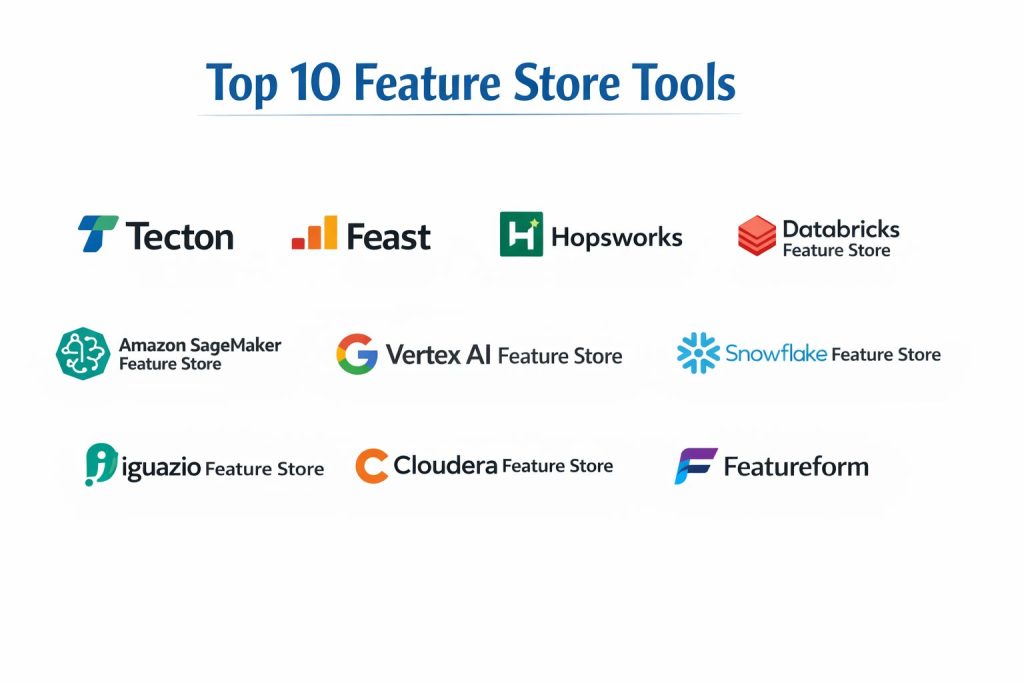
Top 10 Feature Store Platforms
1 — Tecton
A feature store platform focused on production-grade feature pipelines with strong support for real-time and batch needs. Often chosen by teams that need consistent definitions, low latency, and scale across many models.
Key Features
- Unified feature definitions for training and serving consistency
- Online and offline serving patterns for batch and real-time use
- Support for streaming and near-real-time feature computation (setup dependent)
- Feature versioning and management workflows for iterative teams
- Controls for point-in-time correctness patterns (capability depends on configuration)
- Performance-oriented serving architecture for low-latency use cases
- Strong integration patterns across common ML ecosystems (varies by stack)
Pros
- Strong fit for real-time personalization and risk/fraud pipelines
- Designed for production workflows across many models and teams
Cons
- Platform adoption can require dedicated ML platform ownership
- Cost and complexity may be high for small teams with simple pipelines
Platforms / Deployment
- Varies / N/A
- Cloud / Hybrid (varies by offering)
Security & Compliance
- SSO/SAML, MFA, encryption, audit logs, RBAC: Not publicly stated
- SOC 2, ISO 27001, GDPR, HIPAA: Not publicly stated
Integrations & Ecosystem
Tecton typically integrates with common data stores for offline computation and a serving layer for online access.
- Batch compute and orchestration: Varies / N/A
- Streaming sources: Varies / N/A
- Model serving and inference services: Varies / N/A
- SDK and API usage patterns for feature retrieval
- Monitoring and governance tools: Varies / N/A
Support & Community
Enterprise-style support is common; community presence exists but is smaller than open projects. Documentation depth is typically strong for platform users.
2 — Feast
An open feature store used by teams that want flexibility and control. Often selected when teams prefer open architecture, configurable backends, and the ability to fit into custom pipelines.
Key Features
- Feature definitions that can be reused across training and inference workflows
- Pluggable storage and serving backends (depends on configuration)
- Support for offline and online stores through selectable backends
- Entity-based feature retrieval patterns
- Python-oriented developer experience for feature engineering workflows
- Works well with a wide range of infrastructure choices
- Community-driven ecosystem and extensibility
Pros
- Strong flexibility and deployment control
- Cost-effective for teams with platform engineering capability
Cons
- More operational responsibility for setup, scaling, and governance
- Some enterprise governance needs may require additional surrounding tools
Platforms / Deployment
- Windows / macOS / Linux (developer workflows vary)
- Self-hosted / Hybrid (depends on backends)
Security & Compliance
- SSO/SAML, MFA, encryption, audit logs, RBAC: Varies / N/A
- SOC 2, ISO 27001, GDPR, HIPAA: Not publicly stated
Integrations & Ecosystem
Feast integrates through connectors and compatible backends chosen by the team.
- Offline stores: Varies / N/A
- Online stores: Varies / N/A
- Orchestration tools: Varies / N/A
- Model training and inference stacks via SDK usage
- Extensible architecture for custom connectors
Support & Community
Strong open community and learning resources. Support depends on internal ownership or external vendors.
3 — Hopsworks
A feature store platform designed for end-to-end feature management with a focus on collaboration, governance patterns, and production use. Often used by teams that want a structured platform experience.
Key Features
- Central feature registry and feature group management
- Offline and online feature access patterns (deployment dependent)
- Feature pipelines and reuse workflows for multi-team environments
- Metadata and management capabilities for feature lifecycle control
- Support for model development workflows within a broader platform experience
- Governance-oriented capabilities (details vary by deployment and edition)
- Scalable patterns for many features and entities
Pros
- Strong platform orientation for teams that want structured workflows
- Suitable for organizations scaling feature reuse across multiple projects
Cons
- Platform setup can be heavier than minimal feature-store patterns
- Some integrations depend on the chosen deployment architecture
Platforms / Deployment
- Varies / N/A
- Cloud / Self-hosted / Hybrid (varies by offering)
Security & Compliance
- SSO/SAML, MFA, encryption, audit logs, RBAC: Not publicly stated
- SOC 2, ISO 27001, GDPR, HIPAA: Not publicly stated
Integrations & Ecosystem
Hopsworks typically integrates with data platforms for offline computation and a serving layer for online retrieval.
- Data storage integrations: Varies / N/A
- Compute and orchestration: Varies / N/A
- Model training and serving: Varies / N/A
- APIs and SDK usage for feature reads
- Monitoring integrations: Varies / N/A
Support & Community
Documentation is generally solid; support tiers vary by plan. Community presence exists and is platform-focused.
4 — Databricks Feature Store
A feature store capability designed to work within a lakehouse-style platform. Often selected by teams already standardizing on Databricks for data and ML workflows.
Key Features
- Feature management integrated with lakehouse workflows
- Offline feature computation patterns aligned with platform data processing
- Reuse and sharing workflows across teams within the platform
- Governance patterns tied to platform access controls (varies by setup)
- Integration with ML development and model lifecycle features (platform dependent)
- Batch-first workflows with options for serving patterns (capability varies)
- Strong fit for organizations centralizing data and ML on one platform
Pros
- Smooth adoption for teams already using Databricks
- Strong interoperability with lakehouse data processing workflows
Cons
- Less ideal if you want an infrastructure-agnostic feature store
- Online serving requirements may need additional architectural planning
Platforms / Deployment
- Varies / N/A
- Cloud (platform dependent)
Security & Compliance
- SSO/SAML, MFA, encryption, audit logs, RBAC: Not publicly stated
- SOC 2, ISO 27001, GDPR, HIPAA: Not publicly stated
Integrations & Ecosystem
Databricks Feature Store typically integrates tightly with data pipelines and ML workflows within the same ecosystem.
- Lakehouse data processing and scheduling: Varies / N/A
- Model training and tracking in the ecosystem: Varies / N/A
- Serving patterns: Varies / N/A
- API/SDK access for feature retrieval
- Governance via platform controls (varies by setup)
Support & Community
Strong enterprise support and broad ecosystem adoption; community resources are widely available.
5 — Amazon SageMaker Feature Store
A managed feature store designed for teams building on AWS. Often chosen when the organization wants managed operations and consistent integration with AWS ML workflows.
Key Features
- Managed feature groups and retrieval patterns for training and inference
- Online and offline access patterns (service dependent)
- Integration with AWS data and ML services (usage dependent)
- Feature versioning and lifecycle patterns (capability varies by implementation)
- Scales with managed service patterns for operational workloads
- Typical fit for teams running models and inference inside AWS
- Monitoring and governance possibilities via surrounding AWS services (varies)
Pros
- Strong fit for AWS-centered environments with managed operations preference
- Easier operational posture than fully self-managed stacks
Cons
- Can be less portable across non-AWS infrastructure
- Cost and service complexity can grow with scale and usage patterns
Platforms / Deployment
- Varies / N/A
- Cloud
Security & Compliance
- SSO/SAML, MFA, encryption, audit logs, RBAC: Not publicly stated
- SOC 2, ISO 27001, GDPR, HIPAA: Not publicly stated
Integrations & Ecosystem
SageMaker Feature Store commonly integrates with AWS data ingestion, processing, training, and inference patterns.
- AWS data services integration: Varies / N/A
- Training and inference ecosystem: Varies / N/A
- IAM-based access patterns and governance via surrounding services
- APIs for feature retrieval and pipeline integration
Support & Community
Strong documentation and enterprise support via AWS plans; community resources are broad.
6 — Google Vertex AI Feature Store
A managed feature store for teams building on Google’s ML platform ecosystem. Often chosen for tight integration with Google-managed pipelines and ML services.
Key Features
- Managed feature storage and retrieval patterns
- Offline and online access patterns (service dependent)
- Integrations with broader Vertex AI workflows (platform dependent)
- Scalable serving patterns for online inference (usage dependent)
- Feature management and reuse workflows across teams
- Integration with data processing services in the ecosystem (varies)
- Suitable for organizations standardizing on Google-managed ML services
Pros
- Simplifies adoption for teams already using the platform
- Managed operations reduce platform maintenance burden
Cons
- Less portable if you need multi-cloud neutrality
- Some advanced governance needs may require surrounding architecture
Platforms / Deployment
- Varies / N/A
- Cloud
Security & Compliance
- SSO/SAML, MFA, encryption, audit logs, RBAC: Not publicly stated
- SOC 2, ISO 27001, GDPR, HIPAA: Not publicly stated
Integrations & Ecosystem
Vertex AI Feature Store typically connects to the broader Google data and ML stack for ingest, compute, and serving.
- Data ingestion and processing: Varies / N/A
- Training and inference: Varies / N/A
- Access control via platform identity and policy systems (varies)
- APIs for feature reads and pipeline integration
Support & Community
Strong platform documentation and enterprise support options; community resources depend on team stack choices.
7 — Snowflake Feature Store
A feature store capability aligned with warehouse-first ML workflows. Often used by teams that want offline feature creation close to governed analytics data and predictable batch pipelines.
Key Features
- Offline feature creation patterns close to warehouse data
- Reuse and sharing patterns for features across teams (capability varies)
- Governance alignment with data access controls (setup dependent)
- Works well for batch inference and training workflows
- Collaboration patterns within a data platform environment
- Integration with external serving layers when needed (architecture dependent)
- Strong fit for organizations already standardizing on Snowflake
Pros
- Great for warehouse-centered feature creation and governance
- Smooth fit for batch-first ML workflows
Cons
- Online low-latency serving may require additional components
- Feature store capabilities can vary by edition and surrounding tooling
Platforms / Deployment
- Varies / N/A
- Cloud
Security & Compliance
- SSO/SAML, MFA, encryption, audit logs, RBAC: Not publicly stated
- SOC 2, ISO 27001, GDPR, HIPAA: Not publicly stated
Integrations & Ecosystem
Snowflake Feature Store commonly integrates with warehouse data workflows and external ML services for training and inference.
- Data processing and transformation: Varies / N/A
- Model training toolchains: Varies / N/A
- Serving layer integration patterns: Varies / N/A
- APIs and SDK usage: Varies / N/A
Support & Community
Strong enterprise support and broad adoption in analytics communities; ML-specific community depth varies by team patterns.
8 — Iguazio Feature Store
A feature store platform often positioned for real-time and operational ML needs. Commonly used where teams require streaming, low-latency access, and production integration.
Key Features
- Feature definitions aligned with production serving needs
- Online access patterns suitable for low-latency inference (setup dependent)
- Support for streaming pipelines (capability depends on architecture)
- Feature lifecycle management within a broader ML platform approach
- Integrates with orchestration and pipeline patterns (varies)
- Supports multi-team usage with shared feature reuse patterns
- Operational focus on reliability and production readiness
Pros
- Strong for real-time feature access in production systems
- Platform orientation helps standardize feature reuse
Cons
- Platform adoption can be heavier than minimal stacks
- Integration breadth depends on the chosen deployment pattern
Platforms / Deployment
- Varies / N/A
- Cloud / Self-hosted / Hybrid (varies by offering)
Security & Compliance
- SSO/SAML, MFA, encryption, audit logs, RBAC: Not publicly stated
- SOC 2, ISO 27001, GDPR, HIPAA: Not publicly stated
Integrations & Ecosystem
Iguazio Feature Store typically connects to streaming, data processing, and serving layers in operational ML stacks.
- Streaming sources: Varies / N/A
- Data processing and orchestration: Varies / N/A
- Training and inference toolchains: Varies / N/A
- API-based feature retrieval patterns
Support & Community
Support is typically enterprise-oriented; community presence exists but is smaller than open alternatives.
9 — Cloudera Feature Store
A feature store capability designed for organizations using Cloudera-based data platforms. Often selected by teams that want feature reuse within enterprise data governance structures.
Key Features
- Feature management aligned with enterprise data platform workflows
- Offline feature computation patterns within platform processing tools
- Reuse and sharing for multi-team environments (capability varies)
- Governance alignment with platform access controls (setup dependent)
- Integration with model development workflows in the ecosystem (varies)
- Scales for enterprise data and ML workloads (architecture dependent)
- Designed to fit regulated and controlled enterprise environments
Pros
- Good fit for Cloudera-centered enterprises
- Governance alignment can reduce friction for controlled environments
Cons
- Less ideal if you want a lightweight, standalone feature store
- Integrations may be strongest inside the Cloudera ecosystem
Platforms / Deployment
- Varies / N/A
- Cloud / Self-hosted / Hybrid (varies by offering)
Security & Compliance
- SSO/SAML, MFA, encryption, audit logs, RBAC: Not publicly stated
- SOC 2, ISO 27001, GDPR, HIPAA: Not publicly stated
Integrations & Ecosystem
Cloudera Feature Store typically integrates with platform-native processing and ML tools, with options to connect to external serving patterns as needed.
- Data processing ecosystem: Varies / N/A
- Training and inference tooling: Varies / N/A
- Governance integration via platform controls (varies)
- APIs for feature access and reuse patterns
Support & Community
Enterprise support is strong via vendor channels; community resources vary by platform adoption.
10 — Featureform
A feature store framework focused on helping teams define, manage, and serve features using familiar developer workflows. Often selected by teams that want a flexible architecture with feature definition discipline.
Key Features
- Feature definition and registry patterns for consistent reuse
- Support for offline and online feature workflows (backend dependent)
- Integrates with common data tooling through configuration patterns
- Developer-friendly approach for teams that prefer code-first workflows
- Supports feature lifecycle practices like versioning patterns (implementation dependent)
- Designed to fit existing data stacks rather than force a single ecosystem
- Useful for teams building internal ML platforms
Pros
- Flexible, code-oriented approach that fits many stacks
- Helps enforce feature consistency without heavy platform lock-in
Cons
- Requires platform ownership to deploy and operate well at scale
- Governance and monitoring may require additional surrounding tooling
Platforms / Deployment
- Varies / N/A
- Self-hosted / Hybrid (backend dependent)
Security & Compliance
- SSO/SAML, MFA, encryption, audit logs, RBAC: Not publicly stated
- SOC 2, ISO 27001, GDPR, HIPAA: Not publicly stated
Integrations & Ecosystem
Featureform commonly integrates by connecting to the team’s selected offline compute and online serving backends.
- Offline stores and compute: Varies / N/A
- Online stores: Varies / N/A
- Orchestration: Varies / N/A
- APIs and SDK patterns for feature reads
- Extensible configuration-based integrations
Support & Community
Community presence exists and is growing; support options depend on how teams adopt and operationalize it.
Comparison Table (Top 10)
| Tool Name | Best For | Platform(s) Supported | Deployment (Cloud/Self-hosted/Hybrid) | Standout Feature | Public Rating |
|---|---|---|---|---|---|
| Tecton | Real-time feature pipelines at scale | Varies / N/A | Cloud / Hybrid | Production-grade feature serving focus | N/A |
| Feast | Flexible open feature store builds | Windows, macOS, Linux | Self-hosted / Hybrid | Pluggable backends and openness | N/A |
| Hopsworks | Platform-style feature governance | Varies / N/A | Cloud / Self-hosted / Hybrid | Structured feature registry workflows | N/A |
| Databricks Feature Store | Lakehouse-centered feature reuse | Varies / N/A | Cloud | Tight alignment with lakehouse workflows | N/A |
| Amazon SageMaker Feature Store | AWS-managed feature workflows | Varies / N/A | Cloud | Managed integration for AWS ML stacks | N/A |
| Google Vertex AI Feature Store | Google-managed ML feature serving | Varies / N/A | Cloud | Managed feature access in platform stack | N/A |
| Snowflake Feature Store | Warehouse-first batch feature pipelines | Varies / N/A | Cloud | Governed offline feature creation close to data | N/A |
| Iguazio Feature Store | Operational ML and low-latency serving | Varies / N/A | Cloud / Self-hosted / Hybrid | Real-time orientation for production systems | N/A |
| Cloudera Feature Store | Enterprise platform-governed feature reuse | Varies / N/A | Cloud / Self-hosted / Hybrid | Alignment with enterprise data governance | N/A |
| Featureform | Code-first feature definition discipline | Varies / N/A | Self-hosted / Hybrid | Flexible architecture around existing stacks | N/A |
Evaluation & Scoring of Feature Store Platforms
Weights: Core features 25%, Ease 15%, Integrations 15%, Security 10%, Performance 10%, Support 10%, Value 15%.
| Tool Name | Core (25%) | Ease (15%) | Integrations (15%) | Security (10%) | Performance (10%) | Support (10%) | Value (15%) | Weighted Total (0–10) |
|---|---|---|---|---|---|---|---|---|
| Tecton | 9.5 | 7.5 | 8.5 | 6.5 | 9.0 | 8.0 | 6.5 | 8.17 |
| Feast | 8.0 | 7.0 | 8.0 | 5.5 | 7.5 | 8.5 | 9.5 | 7.88 |
| Hopsworks | 8.5 | 7.5 | 8.0 | 6.0 | 8.0 | 7.5 | 7.5 | 7.82 |
| Databricks Feature Store | 8.0 | 8.0 | 8.5 | 6.5 | 8.0 | 8.0 | 7.0 | 7.78 |
| Amazon SageMaker Feature Store | 8.0 | 7.5 | 8.5 | 6.5 | 8.0 | 8.0 | 6.5 | 7.65 |
| Google Vertex AI Feature Store | 8.0 | 7.5 | 8.0 | 6.5 | 8.0 | 8.0 | 6.5 | 7.58 |
| Snowflake Feature Store | 7.5 | 8.0 | 7.5 | 6.5 | 7.5 | 8.0 | 7.0 | 7.45 |
| Iguazio Feature Store | 8.0 | 7.0 | 7.5 | 6.0 | 8.5 | 7.5 | 6.5 | 7.45 |
| Cloudera Feature Store | 7.5 | 7.0 | 7.5 | 6.5 | 7.5 | 7.5 | 6.5 | 7.18 |
| Featureform | 7.5 | 7.0 | 7.0 | 5.5 | 7.0 | 7.0 | 8.5 | 7.10 |
How to interpret the scores
- These scores compare tools within this list, not the entire market.
- A higher total suggests broader strength across many scenarios, not universal best fit.
- If real-time serving is critical, pay extra attention to performance and core capability.
- If adoption speed matters, prioritize ease and integration fit with your current stack.
- Always validate via a pilot using your real entities, pipelines, and inference path.
Which Feature Store Platform Is Right for You?
Solo / Freelancer
If you are building a single project or a small portfolio, start with a flexible and lightweight approach. Feast or Featureform can work well if you can operate the infrastructure and want control. If your workflow is batch-first and tied closely to a single data platform, staying native to that platform can reduce setup overhead.
SMB
Small teams should prioritize adoption speed and reliable serving patterns. If you already run your data and ML inside a major cloud, a managed option like Amazon SageMaker Feature Store or Google Vertex AI Feature Store can reduce maintenance. If you need more control and want to avoid platform lock-in, Feast or Featureform can work, but budget time for operations and governance.
Mid-Market
Mid-market teams often need feature reuse across multiple products and squads. Databricks Feature Store is a strong fit for lakehouse-centered teams. Hopsworks can also work when a structured registry and standardized workflows are important. If real-time features power core product experiences, Tecton or Iguazio Feature Store can be a better fit, depending on how your serving layer is designed.
Enterprise
Enterprises typically care most about governance, standardization, and predictable operations. Platform-aligned options like Databricks Feature Store, Snowflake Feature Store, or Cloudera Feature Store can reduce friction with existing governance. If real-time feature serving is mission-critical, Tecton or Iguazio Feature Store can be compelling, but require strong platform ownership and clear operating standards.
Budget vs Premium
Budget-sensitive teams often prefer open and flexible tools like Feast or Featureform, accepting more operational work. Premium platform choices can reduce operational burden but may increase cost and lock-in. Choose based on whether time saved offsets platform spend.
Feature Depth vs Ease of Use
If your team wants maximum control and flexibility, open options can win, but you will build more around them. If your team wants faster adoption, managed platform options reduce operational tasks and simplify onboarding, especially when your data stack already matches the vendor ecosystem.
Integrations & Scalability
Pick the option that matches your main data backbone. If your offline features are computed in a lakehouse, warehouse, or distributed processing stack, choose a feature store that integrates cleanly with it. For online features, validate latency and throughput early, and confirm how updates, backfills, and entity joins behave under load.
Security & Compliance Needs
Because formal disclosures vary, treat unknown compliance claims as not publicly stated. Focus on practical controls: RBAC, auditability, encryption posture, and how secrets and identities are managed in your environment. In regulated settings, align the feature store with your existing governance and access systems.
Frequently Asked Questions (FAQs)
1. What problem does a feature store solve first?
It reduces training-serving mismatch by making features consistent across training and inference. It also prevents duplicated pipelines by enabling reuse across teams.
2. Do I need both offline and online features?
Not always. Batch inference pipelines can run with offline features only, while real-time personalization and fraud detection often require online access.
3. What is point-in-time correctness and why does it matter?
It ensures training uses only data that would have been available at that moment, preventing leakage. Without it, models can look better in training and fail in production.
4. How long does it take to adopt a feature store?
Small teams can pilot quickly, but full adoption depends on data readiness, governance needs, and serving requirements. Many organizations start with a limited set of shared features.
5. What is a common mistake during adoption?
Trying to migrate every feature at once. A better approach is to start with one or two models, standardize definitions, and prove the serving path end to end.
6. How do I decide between managed and self-managed options?
Managed options reduce operational work and speed adoption in matching ecosystems. Self-managed options give flexibility but require platform ownership and reliability engineering.
7. What should I test in a pilot?
Test feature freshness, backfill behavior, point-in-time joins, online latency under realistic load, access control behavior, and how easy it is to add new features safely.
8. Can a warehouse-centric approach work for real-time inference?
It can for some near-real-time patterns, but true low-latency inference usually needs an online store or serving layer designed for fast key-based retrieval.
9. How should teams organize ownership?
Treat the feature store as a platform capability with clear ownership. Data teams often own offline pipelines, while ML platform teams own online serving and reliability.
10. What is the simplest path to long-term success with a feature store?
Standardize feature definitions early, enforce review and naming conventions, and measure adoption through reuse. Keep the serving path observable and build a clear lifecycle for deprecations and changes.
Conclusion
A feature store platform becomes valuable when you are building more than one model, sharing features across teams, or serving predictions in production where consistency is non-negotiable. The strongest choice depends on your data backbone, your real-time needs, and how much platform ownership you can commit. Managed options like Amazon SageMaker Feature Store and Google Vertex AI Feature Store can reduce operational work in cloud-centered stacks, while Databricks Feature Store and Snowflake Feature Store align well with lakehouse or warehouse-first patterns. Open options like Feast and Featureform offer flexibility when you want control and portability. A sensible next step is to shortlist two or three tools, run a small pilot with your real entities, validate offline-to-online consistency, and confirm reliability and access control before scaling adoption.