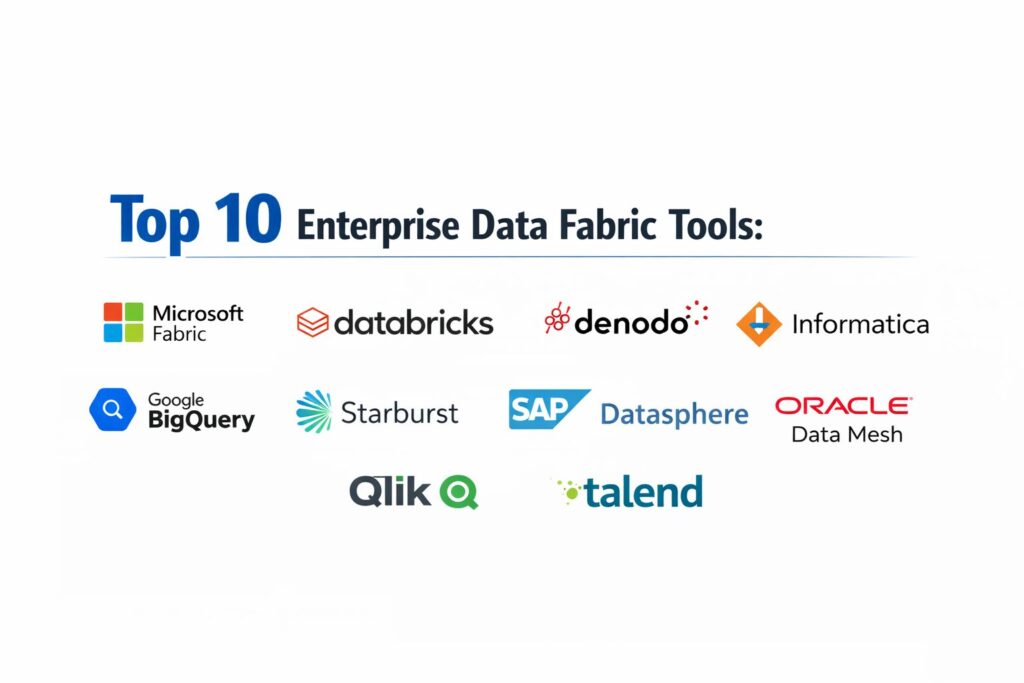
Introduction
The modern enterprise is no longer defined by a single data center but by a sprawling ecosystem of hybrid clouds, legacy on-premises databases, and distributed edge environments. This fragmentation has given rise to the Data Fabric—a design architecture that serves as an integrated layer of data and connecting processes. Unlike traditional data warehouses that require centralizing data, a fabric utilizes “active metadata” to continuously analyze existing data use patterns, automating the discovery, orchestration, and governance of information wherever it resides. It acts as a digital connective tissue that allows organizations to move from reactive data management to an autonomous, “zero-copy” environment where data is accessible and governed in real-time.
Strategically, the implementation of a data fabric is a response to the “data silo” crisis that hampers AI readiness and executive decision-making. By creating a unified virtual access layer, the fabric eliminates the need for expensive and error-prone ETL (Extract, Transform, Load) processes. Instead, it provides a “logical” view of the enterprise’s information assets, ensuring that security policies and data definitions remain consistent across the entire organization. For the DevOps and DataOps professional, this architecture represents the pinnacle of platform engineering, offering a scalable foundation that supports everything from hyper-personalized customer experiences to mission-critical regulatory compliance in highly regulated sectors.
Best for: Large-scale organizations with heterogeneous data environments, multi-cloud strategies, and a critical need for unified governance and automated data integration to support advanced AI initiatives.
Not ideal for: Small businesses or startups with centralized, single-cloud data architectures where the overhead of a metadata-driven fabric may exceed the operational benefits of simpler data management tools.
Key Trends in Enterprise Data Fabric Platforms
The primary shift is the convergence of “Agentic AI” and data fabric architectures. Modern platforms are now deploying autonomous data stewards—AI agents that monitor data quality, automatically fix broken pipelines, and suggest new semantic relationships between disparate datasets without human intervention. This shift toward “Autonomous Data Fabrics” allows organizations to maintain high-speed data delivery even as the complexity of their underlying infrastructure grows. Furthermore, we are seeing the rise of “Sovereign Data Fabrics,” which allow global enterprises to enforce regional data residency and localized security policies automatically, a critical feature in the face of evolving global privacy regulations.
Another significant trend is the move toward “Zero-Copy Federation.” Leading platforms are increasingly enabling users to query data across different clouds and storage types (like Snowflake, Databricks, and S3) as if they were a single database, without ever moving the physical bits. This is complemented by the “Semantic Web” evolution, where data is no longer stored just as rows and columns but as interconnected business concepts. This allows non-technical executives to query the data fabric using natural language, receiving answers that are contextually aware of the business’s specific taxonomies and KPIs.
How We Selected These Tools
The selection of these ten platforms was driven by an analysis of their ability to handle the “three Vs” of enterprise data—Volume, Velocity, and Variety—while maintaining a robust “Active Metadata” layer. We prioritized solutions that offer “logical” virtualization, meaning they can provide a unified view of data without requiring mass migration. Market leadership as defined by current industry benchmarks for 2026 was a key factor, as was the platform’s ability to integrate with the modern “AI Supercomputing” stack. We specifically looked for tools that demonstrate high “Completeness of Vision” in their roadmap for autonomous operations.
Technical evaluation focused on the platform’s support for open standards (such as Apache Iceberg and Delta Lake) and the sophistication of their built-in governance engines. Security was a paramount criterion; we selected platforms that offer “Zero Trust” data access, granular row/column-level security, and automated lineage tracking. Finally, we considered the “Time to Value”—how quickly an enterprise can stitch together its existing silos into a functional fabric. The following platforms represent the state-of-the-art in enterprise data management for 2026.
1. Microsoft Fabric
Microsoft Fabric is a unified SaaS analytics platform that consolidates data engineering, warehousing, and real-time intelligence into a single experience on Azure. It is built on “OneLake,” a multi-cloud data lake that acts as a single system of record for the entire organization, eliminating the need for data duplication across different teams.
Key Features
The platform features “Copilot for Fabric,” an AI assistant that builds data pipelines and generates reports using natural language. It utilizes “Direct Lake” mode, allowing Power BI to analyze massive datasets without importing or duplicating them. It includes a comprehensive “Real-Time Intelligence” engine for processing high-velocity streaming data from IoT devices. The “Purview” integration provides automated governance and lineage tracking across all data items. Additionally, it supports a “Zero-Copy” sharing model, enabling secure data collaboration between different business units or external partners without moving files.
Pros
Deep integration with the Microsoft 365 and Azure ecosystems provides a seamless user experience for existing customers. The SaaS model significantly reduces the “hidden” costs of infrastructure management and scaling.
Cons
The platform is heavily optimized for the Azure environment, which may present challenges for enterprises pursuing a strictly cloud-neutral strategy. Some advanced customization options are more restricted compared to open-source alternatives.
Platforms and Deployment
Native Azure SaaS platform with mobile management capabilities.
Security and Compliance
Features “OneLake Security” with native RLS/CLS and is compliant with HIPAA, GDPR, and FedRAMP standards.
Integrations and Ecosystem
Seamlessly integrated with Power BI, Dynamics 365, and the broader Azure data services stack.
Support and Community
Offers 24/7 enterprise support and access to a massive global network of certified implementation partners.
2. Databricks Intelligence Platform
Databricks has evolved its pioneered “Lakehouse” architecture into a full-scale Intelligence Platform. It combines the performance of a data warehouse with the flexibility of a data lake, now powered by a “Mosaic AI” engine that treats data management as a unified AI problem.
Key Features
The platform is built on the “Unity Catalog,” which provides a single governance layer for files, tables, and AI models across multi-cloud environments. It features “Lakeflow,” an automated service for building and operating production-grade data pipelines with minimal code. The system supports “Delta Sharing,” the industry’s first open protocol for secure data sharing across organizations. It includes native support for Apache Spark 4.0, providing industry-leading performance for large-scale data processing. It also offers “Serverless SQL,” allowing users to run warehouse-grade queries without managing any underlying compute clusters.
Pros
Highly flexible and “open” by design, supporting a wide range of third-party tools and open-source standards. It is widely considered the gold standard for high-performance ML and AI workloads.
Cons
The platform can be technically complex, often requiring a highly skilled DataOps team to optimize performance and costs. Pricing can become unpredictable if compute resources are not strictly governed.
Platforms and Deployment
Multi-cloud deployment on AWS, Azure, and Google Cloud.
Security and Compliance
Unified governance through Unity Catalog with robust audit trails and SOC 2 Type II compliance.
Integrations and Ecosystem
Excellent support for the modern data stack, including dbt, Tableau, and a vast array of open-source ML libraries.
Support and Community
Active developer community and enterprise-grade support with dedicated technical account managers.
3. Denodo Platform
Denodo is the market’s leading data virtualization platform, built on the “logical data fabric” philosophy. It allows users to access and integrate data from any source—on-prem, cloud, or SaaS—without moving it, creating a single virtual layer for all enterprise data.
Key Features
The platform utilizes an “AI-powered Query Optimizer” that automatically routes queries to the most efficient source, significantly reducing network latency. It features a “Data Catalog” that uses machine learning to automatically tag and document data assets based on usage patterns. The system supports “Dynamic Data Masking,” ensuring sensitive information is protected in real-time based on user roles. It provides a unified “Global Security” layer that enforces access policies across all underlying data sources. It also includes “Notebook” capabilities for data scientists to explore virtualized data using SQL, Python, or R.
Pros
Eliminates the cost and complexity of data movement and duplication, providing the fastest “time-to-data” for new projects. It is highly effective in hybrid-cloud environments where data residency is a concern.
Cons
Performance is dependent on the speed of the underlying source systems and network connectivity. It requires careful architecture to ensure the virtualization layer does not become a bottleneck.
Platforms and Deployment
Available as a cloud service (SaaS), on-premise software, or via containerized deployment (Docker/Kubernetes).
Security and Compliance
Centralized access control with full support for Kerberos, SAML, and OAuth, ensuring GDPR and CCPA compliance.
Integrations and Ecosystem
Connects to over 150+ data sources, including legacy mainframes, modern NoSQL databases, and cloud storage.
Support and Community
Strong enterprise support and a well-regarded “Denodo University” for technical certification and training.
4. Informatica IDMC
Informatica Intelligent Data Management Cloud (IDMC) is a comprehensive, metadata-driven platform that spans integration, quality, governance, and privacy. It is designed to manage the “entire data lifecycle” across multi-cloud and hybrid environments.
Key Features
The platform is powered by “CLAIRE,” an advanced AI engine that automates thousands of manual data management tasks, from mapping to data quality checks. It features a “Cloud Data Governance and Catalog” that provides a 360-degree view of all data assets and their lineage. The system includes “Cloud Data Integration” with thousands of pre-built connectors for both legacy and modern systems. It offers a specialized “Master Data Management” (MDM) module for creating a single “golden record” for customers or products. It also provides “Data Privacy” tools that automatically identify and protect sensitive data across the fabric.
Pros
Offers the most comprehensive suite of data management capabilities in a single integrated platform. Its long history in the enterprise market ensures high reliability for mission-critical operations.
Cons
The platform’s sheer breadth can make it feel fragmented and overwhelming for smaller teams. Implementation and licensing costs are typically at the higher end of the market.
Platforms and Deployment
Cloud-native platform available on all major hyper-scalers (AWS, Azure, GCP).
Security and Compliance
Enterprise-grade security with deep support for global privacy regulations and automated compliance reporting.
Integrations and Ecosystem
Widest range of connectors in the industry, bridging the gap between 40-year-old mainframes and modern AI tools.
Support and Community
Top-tier global support organization and a vast ecosystem of consultants and systems integrators.
5. IBM Cloud Pak for Data
IBM Cloud Pak for Data is a modular platform that integrates data management, governance, and AI. It is built on Red Hat OpenShift, providing a consistent “data fabric” experience across any cloud or on-premises environment.
Key Features
The platform features “watsonx.data,” a fit-for-purpose data store built on open lakehouse architecture to scale AI workloads. It includes “Knowledge Accelerators” that provide pre-defined industry glossaries and taxonomies for banking, healthcare, and retail. The system utilizes “AutoSQL,” a high-performance distributed query engine that can query data across different sources without movement. It offers “AI Governance” tools to monitor and mitigate bias in ML models deployed within the fabric. It also supports “Multi-cloud Data Orchestration,” allowing for seamless data movement and synchronization between disparate regions.
Pros
The “build once, run anywhere” flexibility of OpenShift is a major advantage for organizations with complex hybrid-cloud requirements. Strong focus on “Explainable AI” and governance.
Cons
The platform can be resource-intensive to run and manage, particularly in on-premises configurations. Navigating the broader IBM software portfolio for add-ons can be complex.
Platforms and Deployment
Runs on Red Hat OpenShift, supported on AWS, Azure, GCP, IBM Cloud, and on-prem.
Security and Compliance
Highly secure architecture with “Guardium” integration for data activity monitoring and compliance auditing.
Integrations and Ecosystem
Deep integration with IBM’s Watson AI suite and open-source standards like Apache Iceberg.
Support and Community
World-class enterprise support and a long-standing reputation for supporting regulated industries.
6. Google BigQuery (with Vertex AI)
Google BigQuery has transitioned from a serverless warehouse to a central pillar of an AI-ready data fabric. By integrating directly with Vertex AI, it allows enterprises to activate their data where it lives, using Google’s planetary-scale infrastructure.
Key Features
The platform features “BigQuery Omni,” which allows users to analyze data residing in AWS S3 or Azure Data Lake Storage without any data movement. It includes “BigQuery ML,” enabling users to build and deploy machine learning models using standard SQL. The “Vertex AI” integration provides an end-to-end platform for generative AI, including access to Google’s Gemini models. It uses the “Dremel” execution engine to provide sub-second query performance on petabyte-scale datasets. Additionally, it offers “Data Clean Rooms,” allowing multiple parties to analyze sensitive data together while maintaining strict privacy.
Pros
The serverless, “zero-ops” architecture is the best in class for minimizing administrative overhead. It offers the fastest path for enterprises to leverage high-end generative AI capabilities.
Cons
Strong gravity toward the Google Cloud ecosystem, though Omni is helping to bridge this gap. Costs can scale rapidly for highly complex, ad-hoc query patterns.
Platforms and Deployment
Fully managed SaaS platform on Google Cloud.
Security and Compliance
Built-in encryption at rest and in transit, with deep integration into GCP’s IAM and security command center.
Integrations and Ecosystem
Native integration with the entire Google Cloud stack, plus strong support for Looker and various open-source data tools.
Support and Community
Excellent documentation and 24/7 support, backed by Google’s global engineering expertise.
7. Starburst (Enterprise Trino)
Starburst is the commercial distribution of Trino (formerly PrestoSQL), the open-source distributed SQL engine. It is designed to act as a “single point of access” for the entire enterprise, querying data across 50+ source types simultaneously.
Key Features
The platform features “Starburst Stargate,” which enables high-speed, cross-cloud analytics by minimizing data transfer and latency between regions. It includes a “Built-in Security” layer that provides fine-grained access control (RBAC) across all connected data sources. The system supports “Warp Speed,” an autonomous indexing and caching layer that accelerates query performance by up to 7x. It offers a “Data Product” builder, allowing teams to package and share datasets as governed, reusable products. It also provides a “Managed Service” (Galaxy) for organizations that want to avoid managing the Trino infrastructure themselves.
Pros
Unbeatable performance for “federated” queries across massive, distributed datasets. It is highly cost-effective as it does not require data to be stored twice.
Cons
It is primarily a “query” engine, meaning it lacks the broader “data quality” and “MDM” features found in platforms like Informatica. It requires a solid underlying data storage strategy.
Platforms and Deployment
Cloud-native (Galaxy) or self-managed on Kubernetes (any cloud or on-prem).
Security and Compliance
Integration with Apache Ranger and Okta for enterprise-grade security and localized data access policies.
Integrations and Ecosystem
Connects to almost everything, from traditional RDBMS to modern NoSQL and cloud data lakes.
Support and Community
Backed by the original creators of Trino with deep expertise in large-scale distributed systems.
8. SAP Datasphere
SAP Datasphere is the successor to SAP Data Warehouse Cloud, designed to provide a “business data fabric.” It focuses on preserving the “business context” of data as it moves from SAP ERP systems into the broader enterprise analytics landscape.
Key Features
The platform features “Business Semantic Modeling,” which allows users to define data in business terms (e.g., “Gross Margin”) that remain consistent across all reports. It includes “Data Federation” capabilities to access non-SAP data without movement. The system utilizes “Just-In-Time Data Integration,” ensuring that analytics always reflect the latest transactional data. It offers a “Marketplace” where users can discover and subscribe to internal and external data products. It also provides “Analytic Models” that are optimized for high-performance consumption by SAP Analytics Cloud and other BI tools.
Pros
The absolute best choice for organizations where SAP is the core operational system, as it preserves complex ERP logic. It simplifies the integration of “O-Data” (Operational) and “X-Data” (Experience).
Cons
Its value proposition is significantly diminished for organizations that do not run a heavy SAP footprint. The licensing model can be complex and expensive.
Platforms and Deployment
Native SaaS platform on SAP Business Technology Platform (BTP).
Security and Compliance
Strong enterprise security heritage with built-in governance and compliance for regulated global markets.
Integrations and Ecosystem
Native integration with SAP S/4HANA, BW, and SuccessFactors, plus growing support for non-SAP sources.
Support and Community
Comprehensive SAP support ecosystem and a massive global base of SAP-specialized consultants.
9. Oracle Cloud Infrastructure (OCI) Data Mesh
Oracle’s approach to the data fabric is built on its “Autonomous Database” technology and a “Data Mesh” philosophy. It focuses on decentralizing data ownership while maintaining a unified management and security plane.
Key Features
The platform features “OCI GoldenGate,” providing real-time data mesh and fabric capabilities for data in motion. It utilizes “Autonomous Data Warehouse” (ADW) for self-healing and self-tuning data storage. The system includes “OCI Data Catalog” for metadata harvesting and unified search across the enterprise. It offers “Stream Analytics” for building real-time event-driven data fabrics. It also provides “API-led Integration,” allowing data services to be exposed as governed APIs for application developers. Additionally, it supports “Global Data Distribution,” ensuring data is available in the right region at the right time.
Pros
Extreme performance and reliability for database-heavy workloads. The “autonomous” features significantly reduce the operational burden on DBA and DataOps teams.
Cons
Best value is found within the OCI ecosystem; cross-cloud performance can be more complex to configure than competitors. Market mindshare for “fabric” is still growing compared to traditional DB dominance.
Platforms and Deployment
OCI native service with support for “Cloud@Customer” (on-prem OCI).
Security and Compliance
Industry-leading security with “Data Safe” for risk assessment and automated security patching.
Integrations and Ecosystem
Strongest for Oracle-to-Oracle and Oracle-to-Cloud migrations, with expanding third-party support.
Support and Community
Premier enterprise support with a focus on mission-critical stability and performance.
10. Qlik Talend Data Fabric
Following the merger of Qlik and Talend, the platform provides an end-to-end “Data Fabric” that spans from raw data integration and quality to real-time analytics and visualization.
Key Features
The platform features “Talend Trust Score,” which uses AI to automatically assess and report on the “health” and reliability of every dataset. It includes “Data Stitch,” a specialized service for high-volume ELT into cloud data warehouses. The system utilizes “Qlik Cloud Data Integration” for real-time change data capture (CDC) from operational databases. It offers a “Unified Catalog” that brings together metadata from both Talend’s integration jobs and Qlik’s analytics apps. It also provides “No-Code” data preparation tools for business users to clean and transform data themselves.
Pros
A truly holistic solution that covers the entire “data to insight” journey in a single vendor relationship. The focus on “Data Trust” is a unique and valuable differentiator.
Cons
The integration of the two legacy product lines (Qlik and Talend) is still an ongoing process, which can lead to occasional UI inconsistencies. Some features require separate modules.
Platforms and Deployment
Cloud-SaaS first, with flexible options for hybrid and on-premise execution.
Security and Compliance
Robust security features with a strong focus on data quality as a component of governance and compliance.
Integrations and Ecosystem
Extensive support for all major cloud warehouses and a wide variety of on-prem sources.
Support and Community
Very active user community and a strong global support organization with specialized data integration expertise.
Comparison Table
| Tool Name | Best For | Core Architecture | Primary Feature | AI/Automation Engine | Public Rating |
| 1. Microsoft Fabric | Microsoft-Centric Enterprises | SaaS / OneLake | Copilot Integration | Copilot for Fabric | 4.8/5 |
| 2. Databricks | High-Performance AI/ML | Lakehouse | Unity Catalog | Mosaic AI | 4.7/5 |
| 3. Denodo | Virtualization / Zero-Move | Logical Fabric | Distributed Query | AI Query Optimizer | 4.6/5 |
| 4. Informatica | Comprehensive Management | Metadata-Driven | Data Quality / MDM | CLAIRE | 4.5/5 |
| 5. IBM Cloud Pak | Hybrid/Regulated Industries | OpenShift / Modular | watsonx.data | watsonx | 4.4/5 |
| 6. Google BigQuery | Serverless / Cloud-Native | BigQuery Omni | Multi-cloud Analytics | Vertex AI / Gemini | 4.7/5 |
| 7. Starburst | Federated SQL Queries | Distributed Trino | Cross-cloud Stargate | Warp Speed | 4.5/5 |
| 8. SAP Datasphere | SAP-Driven Business Data | Semantic Fabric | Business Context | BW Integration | 4.3/5 |
| 9. Oracle Data Mesh | Autonomous DB Workloads | Mesh / Autonomous | Real-time GoldenGate | Autonomous Engine | 4.4/5 |
| 10. Qlik Talend | End-to-End Trust/Analytics | Integration-Led | Talend Trust Score | Qlik AutoML | 4.4/5 |
Evaluation & Scoring of Enterprise Data Fabric Platform
The scoring below is a comparative model intended to help shortlisting. Each criterion is scored from 1–10, then a weighted total from 0–10 is calculated using the weights listed. These are analyst estimates based on typical fit and common workflow requirements, not public ratings.
Weights:
- Core features – 25%
- Ease of use – 15%
- Integrations & ecosystem – 15%
- Security & compliance – 10%
- Performance & reliability – 10%
- Support & community – 10%
- Price / value – 15%
| Tool Name | Metadata (25%) | Virtualization (15%) | Governance (15%) | AI/Auto (10%) | Performance (10%) | Security (10%) | Multi-Cloud (15%) | Weighted Total |
| 1. Microsoft Fabric | 10 | 8 | 9 | 10 | 9 | 9 | 7 | 9.00 |
| 2. Databricks | 9 | 7 | 10 | 10 | 10 | 9 | 9 | 9.10 |
| 3. Denodo | 10 | 10 | 9 | 8 | 8 | 9 | 10 | 9.25 |
| 4. Informatica | 10 | 7 | 10 | 9 | 8 | 10 | 9 | 9.15 |
| 5. IBM Cloud Pak | 9 | 8 | 10 | 8 | 8 | 10 | 9 | 8.85 |
| 6. Google BigQuery | 8 | 9 | 8 | 10 | 10 | 9 | 8 | 8.80 |
| 7. Starburst | 8 | 10 | 7 | 8 | 10 | 8 | 10 | 8.60 |
| 8. SAP Datasphere | 10 | 8 | 9 | 7 | 8 | 9 | 6 | 8.25 |
| 9. Oracle Data Mesh | 8 | 8 | 9 | 9 | 10 | 10 | 7 | 8.65 |
| 10. Qlik Talend | 9 | 7 | 9 | 8 | 8 | 9 | 8 | 8.40 |
How to interpret the scores:
- Use the weighted total to shortlist candidates, then validate with a pilot.
- A lower score can mean specialization, not weakness.
- Security and compliance scores reflect controllability and governance fit, because certifications are often not publicly stated.
- Actual outcomes vary with assembly size, team skills, templates, and process maturity.
Which Enterprise Data Fabric Platform Tool Is Right for You?
Solo / Freelancer
For organizations with decades of technical debt and critical on-premises mainframes, Informatica IDMC or IBM Cloud Pak for Data are the most reliable options. They provide the depth of “legacy-to-cloud” connectivity and governance required for such a high-stakes transition.
SMB
If your strategy is to avoid vendor lock-in and operate seamlessly across AWS, Azure, and GCP, Starburst or Denodo are the strongest choices. Their ability to treat the entire cloud ecosystem as a single, logical database is unmatched.
Mid-Market
Enterprises that are building custom AI models and need a high-performance feature store should look no further than Databricks. Its Lakehouse architecture is fundamentally designed to feed high-velocity data into ML pipelines with minimal friction.
Enterprise
For companies already deeply invested in Power BI, Teams, and Azure, Microsoft Fabric is the logical choice. It offers the lowest “learning curve” for the existing workforce and the most integrated security model within the Microsoft tenant.
Budget vs Premium
If your primary pain point is “dirty data” that nobody trusts, Qlik Talend Data Fabric provides the most explicit tools for measuring and improving “Data Trust Scores” before the data ever reaches a dashboard.
Feature Depth vs Ease of Use
Google BigQuery and Oracle Data Mesh offer the most robust “serverless” and API-driven experiences, making them ideal for engineering-led teams that want to build custom data applications on top of a highly scalable, managed backend.
Frequently Asked Questions (FAQs)
1. What is the difference between a Data Fabric and a Data Mesh?
A Data Fabric is an architectural layer that uses AI and metadata to automate data integration. A Data Mesh is a decentralized organizational philosophy where individual “domains” (like Finance or Sales) own their data as a product. Modern platforms often support both.
2. Does a Data Fabric replace my Data Warehouse?
Not necessarily. A Data Fabric sits above your warehouses and lakes, connecting them. It can allow you to keep your warehouse for static reporting while using the fabric for real-time, cross-platform analysis.
3. How does “Active Metadata” work?
Active metadata doesn’t just describe the data; it observes how it is used. For example, if it sees a specific table is queried every Monday at 9 AM, it can automatically cache that data or alert a steward if the quality drops before the query runs.
4. Is Data Virtualization the same as Data Fabric?
Virtualization is a core technology used by a Data Fabric to access data without moving it. A Data Fabric is a more comprehensive architecture that also includes governance, quality, and automated integration.
5. How does a Data Fabric help with GDPR compliance?
By providing a single “governance plane,” a fabric allows you to set a policy (like “mask all PII”) once, and have it automatically enforced across all connected databases and cloud storage locations.
6. Can a Data Fabric connect to legacy mainframes?
Yes, platforms like Informatica and IBM have specialized connectors for COBOL, DB2, and other legacy systems, allowing them to appear as modern SQL tables within the fabric.
7. What is “Zero-Copy” data sharing?
It is a technology where you grant another user access to your data in place. They can query your data using their own compute resources, but no physical copy of the file is ever created or sent to them.
8. How long does a Data Fabric implementation take?
While a basic pilot can be set up in weeks using SaaS tools like Microsoft Fabric, a full-scale enterprise rollout typically takes 6–18 months to fully integrate legacy silos and establish governance.
9. Do I need a specialized team to run a Data Fabric?
Yes, it typically requires a “Platform Engineering” or “DataOps” team that understands metadata management, distributed systems, and cloud-native security.
10. Is Data Fabric worth the investment for smaller companies?
Usually no. If you only have one or two data sources on a single cloud, the complexity and cost of a metadata-driven fabric will likely outweigh the benefits of a simple central warehouse.
Conclusion
The transition to an enterprise data fabric is a fundamental evolution in how large-scale organizations treat their information as a strategic asset. The ability to unify fragmented data environments while maintaining autonomous governance is the primary differentiator between organizations that struggle with AI and those that lead with it. A data fabric is not merely a tool purchase; it is a commitment to a “metadata-first” culture that values transparency, accessibility, and security. By selecting a platform that aligns with your specific infrastructure strategy—whether that is the “OneLake” simplicity of Microsoft or the “Logical” agility of Denodo—you are building a future-proof foundation that can scale with the unpredictable demands of the global digital economy. The ultimate goal is a “self-driving” data environment where the infrastructure handles the logistics, leaving your teams to focus entirely on the insights that drive revenue and innovation.