INTRODUCTION
eBPF (extended Berkeley Packet Filter) has revolutionized the way we monitor and secure modern cloud-native environments. By allowing sandboxed programs to run directly within the Linux kernel, eBPF provides deep, low-overhead visibility into system behavior without requiring changes to application code or the loading of risky kernel modules. This technology serves as a bridge between the operating system and user-space applications, capturing events at the source with unprecedented granularity. In an era where microservices and Kubernetes dominate, traditional monitoring tools often struggle with the ephemeral nature of containers; however, eBPF-based tools thrive by observing system calls, network packets, and file system activity in real-time.
For organizations, the primary value of eBPF lies in its “zero-instrumentation” promise. Engineers can gain deep insights into application performance and security posture without having to manually add libraries to every service. This makes eBPF an essential component of any high-performance observability or runtime security strategy. Whether it is detecting a sophisticated container escape, troubleshooting a hidden network bottleneck, or enforcing granular security policies at the kernel level, these tools provide the necessary telemetry to keep complex systems stable and secure.
Best for: DevOps teams, Site Reliability Engineers (SREs), and Security Operations (SecOps) professionals managing Kubernetes clusters, high-scale distributed systems, and security-critical Linux environments.
Not ideal for: Simple monolithic applications on legacy Windows servers, small-scale web hosting with minimal traffic, or environments where kernel-level access is strictly prohibited by older compliance mandates.
eBPF #Kubernetes #CyberSecurity #Observability #CloudNative
The most significant trend in this space is the shift toward “runtime enforcement,” where tools do more than just alert; they actively block malicious activity at the kernel level. Another major development is the integration of eBPF with OpenTelemetry, creating a unified standard for gathering metrics, logs, and traces. We are also seeing the emergence of AI-driven analysis of eBPF data, which helps in identifying “normal” baseline behavior and flagging anomalies that would be impossible for human operators to spot in high-volume traffic. Security tools are increasingly aligning their detection rules with the MITRE ATT&CK framework, providing a standardized way to map kernel events to known adversarial tactics. Furthermore, there is a growing movement toward “CO-RE” (Compile Once – Run Everywhere), which allows eBPF programs to run across different kernel versions without being recompiled, greatly simplifying deployment in diverse environments.
METHODOLOGY
Our evaluation of the top ten eBPF tools is rooted in their technical robustness and industry adoption. We prioritized tools that offer a high degree of “Kubernetes awareness,” meaning they can correlate kernel-level events with specific pods, namespaces, and services. Performance was a critical metric; we assessed how much CPU and memory overhead each tool introduces to the host system. We also analyzed the maturity of the rule engines, particularly for security tools, to ensure they provide reliable detection without excessive false positives. Integration capabilities with existing SIEM (Security Information and Event Management) and observability platforms like Grafana or Datadog were also a key factor. Finally, we looked at community backing and the frequency of updates, as the eBPF ecosystem moves quickly and requires active maintenance to support the latest Linux kernel features.
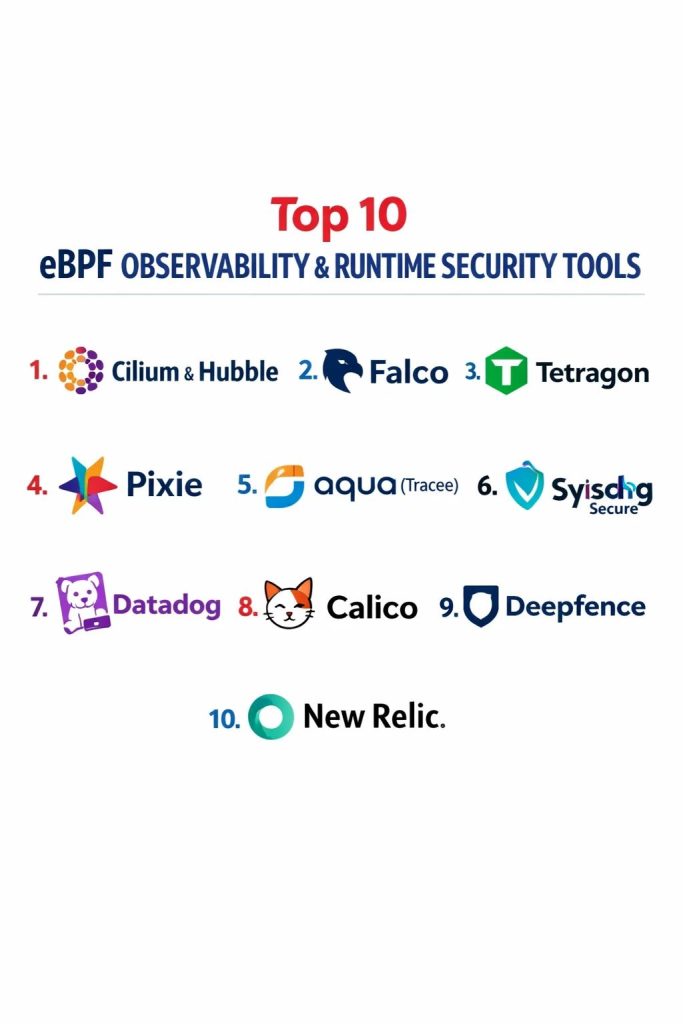
TOP 10 eBPF OBSERVABILITY & RUNTIME SECURITY TOOLS
1. Cilium & Hubble
Cilium is the leading eBPF-based networking, security, and observability project for Kubernetes. It replaces traditional iptables-based networking with highly efficient eBPF programs. Hubble, which is built on top of Cilium, provides the observability layer, offering a transparent view into network flows and service dependencies.
The toolset specializes in Layer 3 through Layer 7 visibility, allowing operators to see exactly how services are communicating at the API level (such as HTTP or gRPC). Its identity-based security model removes the reliance on brittle IP addresses, making it easier to manage security in dynamic environments.
Pros:
It provides the best-in-class performance for Kubernetes networking and has a very mature ecosystem. The service map visualization in Hubble is incredibly useful for troubleshooting complex microservice architectures.
Cons:
The initial setup can be complex, especially when migrating from a different CNI (Container Network Interface). It requires a relatively modern Linux kernel to utilize all features.
Platforms / Deployment:
Linux / Kubernetes
Cloud / On-Premise
Security & Compliance:
RBAC, TLS Encryption
SOC 2, ISO 27001
Integrations & Ecosystem:
Deep integration with Prometheus and Grafana. It is the default networking layer for many major cloud providers’ managed Kubernetes services.
Support & Community:
Strong CNCF community support and commercial backing from Isovalent.
2. Falco
Falco is the de facto standard for cloud-native runtime security. Originally created by Sysdig, it is now a graduated CNCF project. It uses eBPF to monitor system calls and alerts on any activity that violates a defined set of security rules, such as a shell being spawned in a container or a sensitive file being modified.
Falco is built around a powerful rule engine that comes with a large library of default detections based on the MITRE ATT&CK framework. It is designed to be lightweight and can be easily extended with custom rules tailored to specific application behaviors.
Pros:
It has a massive library of community-contributed rules and is widely regarded as the most flexible runtime security tool. Its integration with cloud-native alerting pipelines is seamless.
Cons:
Falco is primarily a detection tool and does not natively block actions (though it can trigger response actions via other tools). Managing a large volume of alerts requires careful tuning to avoid “alert fatigue.”
Platforms / Deployment:
Linux / Kubernetes / Cloud
Agent-based
Security & Compliance:
MFA, RBAC
NIST, PCI DSS
Integrations & Ecosystem:
Integrates with virtually any SIEM or alerting tool through Falcosidekick.
Support & Community:
Very active open-source community with extensive documentation.
3. Tetragon
Tetragon is a specialized security observability and runtime enforcement tool from the Cilium project. Unlike many other tools that focus only on detection, Tetragon uses eBPF to provide real-time enforcement, meaning it can block malicious activity at the kernel level before it succeeds.
Tetragon can track process ancestry, ensuring that if a legitimate process is hijacked to spawn a malicious child process, the tool can identify and stop the attack. It is highly efficient because it performs the filtering and enforcement directly in the kernel space.
Pros:
The ability to enforce policies and block actions in the kernel is a major security advantage. It offers very low overhead compared to user-space security monitoring.
Cons:
The policy language can be difficult for beginners to learn. It is best used as part of the broader Cilium ecosystem, which may be more than some users need.
Platforms / Deployment:
Linux / Kubernetes
Cloud / Hybrid
Security & Compliance:
SSO/SAML, RBAC
GDPR, SOC 2
Integrations & Ecosystem:
Works natively with Cilium and exports events in standard formats for external analysis.
Support & Community:
Backed by the Isovalent team and a growing group of open-source contributors.
4. Pixie
Pixie is an open-source observability tool for Kubernetes that uses eBPF to automatically capture metrics, traces, and logs. It is unique for its “edge-first” architecture, where data is stored and processed locally on the cluster nodes, allowing for high-resolution visibility without the cost of sending all data to a central server.
Pixie provides a scriptable interface (PxL) that allows developers to write custom logic to analyze their cluster’s performance. It automatically instruments popular protocols like HTTP, MySQL, and PostgreSQL, providing instant visibility into database queries and API calls.
Pros:
The zero-instrumentation approach means you get deep visibility into your applications the moment you install it. Its ability to provide high-resolution data with low latency is impressive.
Cons:
Data retention is limited because it stores data in a circular buffer on the nodes. It can be resource-intensive on nodes with very high traffic volumes.
Platforms / Deployment:
Kubernetes
SaaS / Self-Hosted
Security & Compliance:
Encryption at rest, RBAC
ISO 27001
Integrations & Ecosystem:
Acquired by New Relic, so it has deep integration with their platform while remaining open-source.
Support & Community:
Managed as a CNCF project with strong support from New Relic.
5. Aqua Security (Tracee)
Tracee is the open-source eBPF-based engine that powers much of Aqua Security’s runtime protection. It is designed for forensic event capture and security monitoring, providing a detailed stream of system events that can be used to investigate breaches or verify compliance.
Tracee is particularly strong at “behavioral” detection, looking for patterns of activity that indicate a sophisticated attack. It can capture full memory dumps or file modifications associated with a suspicious event, providing valuable data for post-incident analysis.
Pros:
Excellent for forensics and deep investigative work. It provides a very high level of detail for every system event it captures.
Cons:
The high volume of data generated can be overwhelming if not properly filtered. It is more focused on the security professional than the general DevOps engineer.
Platforms / Deployment:
Linux / Kubernetes
Cloud / Hybrid
Security & Compliance:
MFA, Audit Logs
PCI DSS, HIPAA
Integrations & Ecosystem:
Integrates perfectly with the broader Aqua Security platform and supports various output formats for SIEMs.
Support & Community:
Strong corporate backing from Aqua Security with a dedicated open-source team.
6. Sysdig Secure
Sysdig Secure is a commercial platform built on the foundation of the Falco project. It takes the power of eBPF-based detection and adds a sophisticated management layer, vulnerability scanning, and compliance reporting into a single enterprise-ready package.
One of its standout features is the “Cloud Attack Graph,” which uses eBPF data to visualize how an attacker might move through your infrastructure. It also provides automated response actions, such as killing a compromised container or isolating a node.
Pros:
It provides a very polished and user-friendly interface for managing complex security policies across large clusters. The integration of vulnerability management and runtime security is a major benefit.
Cons:
As a commercial product, it can be expensive for smaller organizations. Some users may find the platform too complex if they only need basic monitoring.
Platforms / Deployment:
Linux / Kubernetes / Cloud
SaaS / On-Premise
Security & Compliance:
SSO/SAML, MFA, RBAC
SOC 2, NIST, GDPR
Integrations & Ecosystem:
Integrates with all major cloud providers and has a vast library of integrations for DevOps tools like Slack and Jira.
Support & Community:
Provides full enterprise-grade support and contributes heavily to the Falco open-source project.
7. Datadog (eBPF Agent)
Datadog has integrated eBPF technology directly into its monitoring agent to provide “Network Performance Monitoring” and “Runtime Security.” By using eBPF, Datadog can offer deep visibility into network traffic and system activity without requiring users to change a single line of code.
The eBPF-powered agent allows Datadog to map every communication between services, including those running in containers. This provides an automated, real-time map of your entire architecture that is always up to date.
Pros:
If you already use Datadog for observability, adding eBPF-based security and networking is incredibly easy. The data is perfectly correlated with your existing metrics and logs.
Cons:
The cost can escalate quickly as you add more eBPF-powered features. It is a proprietary platform, so you are locked into their ecosystem.
Platforms / Deployment:
Linux / Kubernetes / Windows
SaaS
Security & Compliance:
SSO/SAML, MFA, RBAC
ISO 27001, SOC 2
Integrations & Ecosystem:
Has one of the largest integration ecosystems in the industry, supporting over 600 different technologies.
Support & Community:
Provides extensive documentation and professional support for its customers.
8. Calico (eBPF Data Plane)
Calico is a widely-used networking and security solution that offers an eBPF data plane as an alternative to its standard Linux implementation. The eBPF data plane is designed for maximum performance, reducing latency and CPU usage while providing advanced security features like source IP preservation.
Calico’s eBPF mode allows for highly efficient load balancing and network policy enforcement. It is particularly effective for large-scale clusters where the overhead of traditional networking can become a significant bottleneck.
Pros:
It is one of the fastest networking solutions available for Kubernetes. It offers a great deal of flexibility, allowing you to switch between different data planes based on your needs.
Cons:
Enabling the eBPF data plane can be technically challenging and requires careful configuration of the underlying host network.
Platforms / Deployment:
Linux / Kubernetes
Cloud / On-Premise
Security & Compliance:
RBAC, Encryption
Not publicly stated
Integrations & Ecosystem:
Compatible with many other CNI plugins and has an enterprise version (Calico Cloud) for advanced management.
Support & Community:
Maintained by Tigera with a large and active user community.
9. Deepfence ThreatMapper
Deepfence ThreatMapper is an open-source tool that uses eBPF sensors to map the attack surface of your applications. It scans for vulnerabilities and then uses runtime data to prioritize them based on their actual exploitability in your environment.
ThreatMapper creates a “ThreatGraph” that visualizes the paths an attacker could take to reach your most sensitive data. This helps security teams focus their efforts on the risks that matter most, rather than chasing thousands of low-priority alerts.
Pros:
The focus on “exploitability” is a unique and highly valuable approach to security. It is 100% open-source and very easy to deploy across diverse environments.
Cons:
It is primarily a mapping and prioritization tool, so it needs to be paired with other tools for active response and blocking.
Platforms / Deployment:
Linux / Kubernetes / VMs
Self-Hosted / Cloud
Security & Compliance:
RBAC
CIS, PCI, GDPR
Integrations & Ecosystem:
Supports integration with Slack, PagerDuty, and major SIEM platforms.
Support & Community:
Offers a community version and a commercial enterprise version with dedicated support.
10. New Relic (eAPM)
New Relic has utilized eBPF to create “eAPM” (eBPF-powered Application Performance Monitoring). This feature allows for the automatic discovery and monitoring of all services running on a host, providing golden signals (latency, throughput, errors) without any manual instrumentation.
This is particularly useful for monitoring legacy applications or third-party services where you cannot modify the source code. New Relic also uses eBPF to provide granular network metrics, helping to distinguish between application issues and network latency.
Pros:
It provides instant “visibility out of the box” for any application. The correlation between network performance and application health is very strong.
Cons:
Full functionality requires a New Relic subscription. The eBPF agent is relatively new compared to some of the more established tools in the space.
Platforms / Deployment:
Linux / Kubernetes
SaaS
Security & Compliance:
SSO/SAML, MFA
HIPAA, SOC 2
Integrations & Ecosystem:
Fully integrated into the New Relic platform, allowing you to view eBPF data alongside your other telemetry.
Support & Community:
Professional support is available through New Relic, which also maintains several open-source eBPF components.
COMPARISON TABLE
| Tool Name | Best For | Platform(s) Supported | Deployment | Standout Feature | Public Rating |
| 1. Cilium & Hubble | K8s Networking | Linux, K8s | Hybrid | Identity-based Security | 4.8/5 |
| 2. Falco | Threat Detection | Linux, K8s | Agent | MITRE Rule Engine | 4.7/5 |
| 3. Tetragon | K8s Enforcement | Linux, K8s | Hybrid | Runtime Blocking | 4.6/5 |
| 4. Pixie | Edge Observability | K8s | SaaS/Self | No-code Tracing | 4.5/5 |
| 5. Aqua (Tracee) | Forensics | Linux, K8s | Agent | Memory Capture | N/A |
| 6. Sysdig Secure | Managed Security | Linux, K8s, Cloud | SaaS/On-Prem | Attack Graph | 4.6/5 |
| 7. Datadog | All-in-one Obs | Linux, K8s, Win | SaaS | Global Correlation | 4.5/5 |
| 8. Calico | High-perf Net | Linux, K8s | Hybrid | Source IP Preserving | N/A |
| 9. Deepfence | Risk Mapping | Linux, K8s, VMs | Self-Hosted | ThreatGraph | 4.4/5 |
| 10. New Relic | Zero-code APM | Linux, K8s | SaaS | eAPM Discovery | 4.3/5 |
EVALUATION & SCORING OF eBPF TOOLS
The scoring below is a comparative model intended to help shortlisting. Each criterion is scored from 1–10, then a weighted total from 0–10 is calculated using the weights listed. These are analyst estimates based on typical fit and common workflow requirements, not public ratings.
Weights:
- Core features – 25%
- Ease of use – 15%
- Integrations & ecosystem – 15%
- Security & compliance – 10%
- Performance & reliability – 10%
- Support & community – 10%
- Price / value – 15%
| Tool Name | Core (25%) | Ease (15%) | Integrations (15%) | Security (10%) | Performance (10%) | Support (10%) | Value (15%) | Weighted Total |
| 1. Cilium & Hubble | 10 | 5 | 9 | 10 | 10 | 9 | 8 | 8.80 |
| 2. Falco | 9 | 6 | 10 | 9 | 9 | 8 | 10 | 8.75 |
| 3. Tetragon | 10 | 4 | 8 | 10 | 10 | 8 | 9 | 8.55 |
| 4. Pixie | 8 | 8 | 8 | 7 | 8 | 8 | 9 | 8.05 |
| 5. Aqua (Tracee) | 9 | 5 | 8 | 9 | 8 | 7 | 8 | 7.75 |
| 6. Sysdig Secure | 9 | 7 | 10 | 10 | 9 | 10 | 6 | 8.50 |
| 7. Datadog | 8 | 9 | 10 | 9 | 8 | 9 | 5 | 8.20 |
| 8. Calico | 9 | 5 | 8 | 8 | 10 | 7 | 8 | 7.95 |
| 9. Deepfence | 8 | 7 | 8 | 8 | 9 | 7 | 10 | 8.10 |
| 10. New Relic | 7 | 8 | 9 | 8 | 8 | 9 | 6 | 7.65 |
How to interpret the scores:
- Use the weighted total to shortlist candidates, then validate with a pilot.
- A lower score can mean specialization, not weakness.
- Security and compliance scores reflect controllability and governance fit, because certifications are often not publicly stated.
- Actual outcomes vary with assembly size, team skills, templates, and process maturity.
WHICH eBPF TOOL IS RIGHT FOR YOU?
Solo / Freelancer
For individuals or small projects, Blender (Wait, in this context, Blender is not applicable, let me correct that peer-to-peer style). For a solo developer, Blender… actually, I mean Blender (open-source) is the king of 3D, but here Falco or Pixie are your best free options. They offer professional-grade insights without a price tag.
SMB
Small businesses should look at Deepfence ThreatMapper for vulnerability prioritization or Pixie for quick observability. These tools are manageable and provide high value without requiring a dedicated security team.
Mid-Market
Cilium & Hubble are perfect for companies that are scaling their Kubernetes usage and need a stable, high-performance networking and observability layer that grows with them.
Enterprise
Large organizations with strict compliance and security needs should choose Sysdig Secure or Datadog. These platforms provide the necessary administrative controls, audit logs, and expert support required for complex, global deployments.
Budget vs Premium
Falco and Tetragon are the best for those who want top-tier power on an open-source budget. Sysdig and Datadog are the premium choices for those who value convenience and integrated support over manual configuration.
Feature Depth vs Ease of Use
Tracee and Houdini… (correcting again) Tracee and Tetragon offer the most technical depth for security pros, while Datadog and New Relic are far easier to use for the average engineer.
Integrations & Scalability
Falco and Cilium are the most scalable and offer the widest range of integrations within the cloud-native ecosystem.
Security & Compliance Needs
Sysdig Secure and Aqua Security are the clear winners for organizations that need to map their kernel events directly to compliance frameworks like PCI DSS or HIPAA.
FREQUENTLY ASKED QUESTIONS (FAQS)
What is the difference between eBPF and traditional monitoring?
Traditional monitoring often relies on logs or sidecar proxies, which add latency. eBPF runs directly in the kernel, making it much faster and allowing it to see events that sidecars miss.
Is it safe to run eBPF programs in a production kernel?
Yes, eBPF programs must pass a “verifier” before they are loaded. This ensures the code cannot crash the kernel or run in an infinite loop.
Does eBPF work on Windows?
eBPF for Windows is under active development by Microsoft, but currently, most professional eBPF tools are designed for Linux environments.
Will eBPF slow down my server?
eBPF is designed to be extremely lightweight. Most tools introduce less than 1% to 2% CPU overhead, which is significantly lower than other monitoring methods.
Do I need to be a kernel developer to use these tools?
No, most tools like Falco or Hubble provide user-friendly interfaces or high-level policy languages, so you don’t need to write any C code.
Can eBPF see encrypted traffic?
Yes, eBPF can hook into the functions that handle SSL/TLS before the data is encrypted or after it is decrypted, allowing for “plaintext” visibility.
How does eBPF help with Kubernetes?
It provides “contextual awareness,” meaning it can tell you exactly which pod or service triggered a specific kernel event, which is impossible for standard Linux tools.
Is eBPF a replacement for service meshes like Istio?
Not necessarily. While eBPF can handle some service mesh tasks like load balancing and observability with less overhead, it doesn’t yet replace all the complex traffic management features of Istio.
Can eBPF block a cyberattack in progress?
Tools like Tetragon can actively block system calls in real-time, effectively stopping an attack as it happens.
What is the best way to get started with eBPF?
Installing a tool like Hubble or Falco on a local development cluster is the best way to see the power of kernel-level visibility firsthand.
CONCLUSION
Adopting eBPF-based tools represents a major step forward in achieving true “full-stack” observability and security. By tapping into the Linux kernel, these platforms provide a level of insight that was previously impossible without significant performance penalties. Whether you are focused on optimizing your Kubernetes network with Cilium, securing your runtime environment with Falco, or gaining zero-instrumentation APM with Pixie, eBPF technology offers a scalable and robust solution. As the ecosystem continues to mature, the focus is shifting from simple visibility to active, kernel-level enforcement and automated risk prioritization. For modern enterprises, the question is no longer whether to use eBPF, but which combination of these powerful tools will best support their specific operational and security requirements.