Introduction
Digital Twin platforms are revolutionizing industries by creating virtual replicas of physical assets, processes, or systems. These platforms allow for the real-time monitoring, analysis, and optimization of physical entities using data-driven insights. Digital Twins are increasingly used in sectors like manufacturing, energy, automotive, healthcare, and smart cities to improve efficiency, reduce costs, and enhance decision-making.
The adoption of AI-driven analytics, IoT integration, and real-time data visualization within Digital Twin platforms will continue to grow. These technologies are helping organizations create more accurate, dynamic, and interactive models for optimizing operations and predicting future behaviors.
Real-world use cases include:
- Manufacturing: Monitoring and optimizing production lines and equipment performance.
- Energy management: Optimizing power generation and distribution through real-time system monitoring.
- Smart cities: Managing infrastructure, traffic, and urban services in real-time.
- Automotive: Enhancing vehicle design, performance, and maintenance through real-time data analysis.
- Healthcare: Creating digital models of patients and medical devices for personalized treatment and optimization.
What buyers should evaluate:
- Integration capabilities: Ability to integrate with IoT devices, sensors, and other enterprise systems.
- Real-time monitoring: The ability to collect and analyze real-time data from physical assets or systems.
- Scalability: Whether the platform can scale from small projects to large, complex systems.
- Data analytics: The platform’s ability to process, analyze, and visualize data for actionable insights.
- Customization: Customization options for adapting the platform to unique business needs and requirements.
- Security and compliance: Data protection features, including encryption, access control, and compliance with industry standards.
- Ease of use: User-friendly interface and ease of integrating the platform into existing workflows.
- Cost and licensing: The platform’s pricing structure and whether it fits within the budget of different-sized businesses.
- Support and community: Availability of customer support, training resources, and an active user community.
Mandatory paragraph
- Best for: Enterprises in industries like manufacturing, automotive, energy, and smart cities that need real-time data monitoring and optimization.
- Not ideal for: Small businesses or those with simpler systems that do not require advanced real-time data modeling or simulation.
Key Trends in Digital Twin Platforms
- AI and machine learning integration: Many Digital Twin platforms are incorporating AI and machine learning to enhance predictive analytics, fault detection, and automated decision-making.
- Cloud-based platforms: Increasingly, Digital Twin platforms are moving to the cloud, enabling easier access, scalability, and collaboration.
- IoT and sensor integration: Platforms are becoming more integrated with IoT devices, allowing for real-time data collection and analysis from physical assets.
- Edge computing: As the need for real-time data analysis grows, edge computing is being utilized to process data closer to the source, reducing latency and bandwidth usage.
- 3D visualization and simulation: Advanced 3D modeling and real-time simulation features are becoming standard for more interactive and insightful digital models.
- Collaborative features: Cloud-based Digital Twin platforms are allowing teams to collaborate on the same virtual models, increasing the speed and accuracy of decision-making.
- Predictive maintenance: Digital Twin platforms are leveraging real-time data to predict failures and optimize maintenance schedules for equipment, reducing downtime and costs.
- Integration with other enterprise systems: Seamless integration with ERP, CRM, and other enterprise software is increasingly common in Digital Twin platforms for a more holistic view of business operations.
- Security enhancements: As digital twins are used for more critical systems, there is a growing emphasis on data security and compliance with industry standards.
- Personalized applications: In industries like healthcare, Digital Twin platforms are being customized to create individual models for personalized diagnostics and treatment.
How We Selected These Tools (Methodology)
- Market adoption: We focused on widely recognized and industry-standard platforms used in a variety of sectors.
- Feature completeness: We prioritized platforms that offer comprehensive features such as real-time monitoring, analytics, and 3D modeling.
- Integration capabilities: We evaluated how well each platform integrates with IoT devices, sensors, and enterprise systems like ERP or CRM tools.
- Ease of use: User-friendliness and the platform’s ability to streamline workflows were key factors in the selection process.
- Security: Strong security features like data encryption, compliance with industry regulations, and secure access controls were prioritized.
- Scalability: Platforms that could scale from small projects to large, enterprise-level applications were given higher consideration.
- Support and community: Availability of customer support, training materials, and an active user community was assessed to ensure effective implementation and usage.
- Cost and licensing: The pricing model and scalability options were considered to ensure the platform meets the needs of both small businesses and large enterprises.
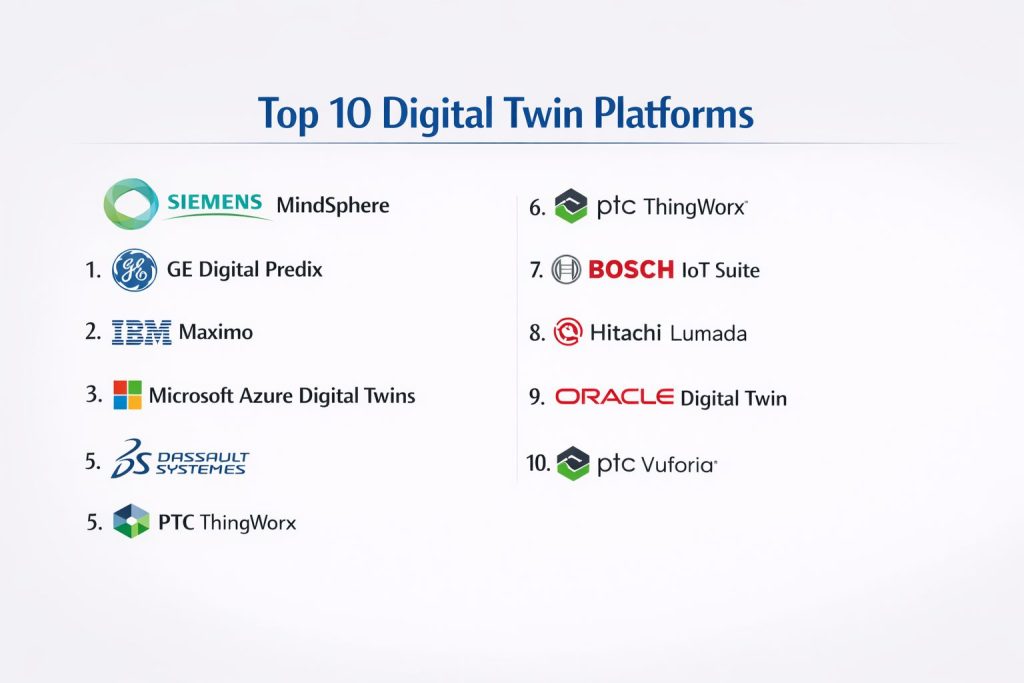
Top 10 Digital Twin Platforms
#1 — Siemens MindSphere
Siemens MindSphere is an industrial IoT platform that leverages Digital Twin technology to create digital models of physical assets for real-time monitoring, analytics, and optimization.
Key Features
- Cloud-based platform for IoT connectivity and analytics
- Real-time monitoring and predictive maintenance capabilities
- 3D visualization for asset monitoring and simulation
- Strong integration with industrial systems and machines
- AI-powered analytics for fault detection and process optimization
- Scalability for large enterprise systems
- Customizable dashboards and reports
Pros
- Comprehensive suite of tools for asset management and optimization
- Advanced analytics and AI capabilities
- Seamless integration with industrial machines and IoT devices
Cons
- Expensive, suitable for large enterprises
- Requires significant training and expertise for optimal use
- Complex setup for smaller teams
Platforms / Deployment
Cloud-based
Self-hosted
Security & Compliance
Not publicly stated.
Integrations & Ecosystem
MindSphere integrates with other Siemens solutions and third-party IoT devices.
- Cloud-based for easy access and collaboration
- Supports a wide range of industrial equipment and IoT devices
- Strong analytics and AI integration
Support & Community
Comprehensive support from Siemens, including extensive online resources and training.
#2 — GE Digital Predix
GE Digital Predix is a cloud-based platform designed for industrial applications, offering powerful tools for creating and analyzing Digital Twins of machines, systems, and processes.
Key Features
- Real-time asset performance monitoring and analytics
- Predictive maintenance capabilities
- Integration with GE’s industrial control systems
- 3D visualization for operational data and performance insights
- Open architecture for easy integration with third-party tools
- AI and machine learning for predictive analytics
- Scalable for both small and large industrial applications
Pros
- Excellent for large-scale industrial environments
- Real-time data analytics for predictive maintenance
- Open integration with third-party tools and data sources
Cons
- High cost, more suited for large businesses
- Complex to set up and integrate
- Requires specialized knowledge to maximize platform capabilities
Platforms / Deployment
Cloud-based
Self-hosted
Security & Compliance
Not publicly stated.
Integrations & Ecosystem
Supports integration with various industrial systems and third-party applications.
- Integration with GE’s control systems and other enterprise software
- Cloud-based analytics and collaboration
- Supports AI and machine learning for predictive maintenance
Support & Community
Strong support from GE Digital, with a large network of industry professionals and extensive resources.
#3 — IBM Maximo
IBM Maximo is an enterprise asset management platform that uses Digital Twin technology to create virtual models for monitoring, managing, and optimizing industrial assets.
Key Features
- Real-time asset monitoring and performance analytics
- AI-powered insights for predictive maintenance
- Integration with IoT sensors and enterprise systems
- Customizable dashboards and reporting tools
- Advanced analytics for optimization and decision-making
- Mobile access for field service management
- Scalable for large industrial enterprises
Pros
- Robust asset management capabilities
- AI-driven analytics for optimized performance and maintenance
- Easy integration with IoT and ERP systems
Cons
- Expensive, primarily geared toward large enterprises
- Complex setup and customization
- Requires a powerful IT infrastructure for full utilization
Platforms / Deployment
Cloud-based
Self-hosted
Security & Compliance
Not publicly stated.
Integrations & Ecosystem
Integrates with other IBM tools, IoT devices, and enterprise software like ERP and CRM systems.
- Strong integration with IoT and enterprise systems
- Cloud-based for real-time collaboration
- Mobile-friendly for field service teams
Support & Community
Comprehensive support from IBM with online resources, documentation, and customer service.
#4 — Microsoft Azure Digital Twins
Microsoft Azure Digital Twins is a platform that enables users to create comprehensive digital models of physical environments, offering advanced analytics and real-time monitoring tools.
Key Features
- Real-time data collection and analysis from connected devices
- Integration with Microsoft Azure IoT and other enterprise systems
- Scalable cloud-based platform for large projects
- 3D modeling and visualization for digital replicas
- AI and machine learning-powered predictive analytics
- Customizable workflows for diverse industries
- Secure data storage and management
Pros
- Highly scalable and flexible for large, complex systems
- Powerful AI and machine learning tools for predictive insights
- Seamless integration with other Azure products and IoT systems
Cons
- Best suited for enterprise-level projects
- Requires familiarity with Microsoft Azure and cloud-based solutions
- Can be resource-intensive for smaller teams
Platforms / Deployment
Cloud-based
Self-hosted
Security & Compliance
Not publicly stated.
Integrations & Ecosystem
Integrates well with Microsoft Azure’s cloud services and other enterprise tools.
- Full integration with Azure IoT and data analytics services
- Advanced AI tools for predictive maintenance and optimization
- Real-time collaboration features for global teams
Support & Community
Comprehensive support through Microsoft, with extensive resources, community forums, and customer service.
#5 — Dassault Systèmes 3DEXPERIENCE
Dassault Systèmes 3DEXPERIENCE is a comprehensive platform that provides Digital Twin solutions for designing, simulating, and optimizing products and systems across industries.
Key Features
- Real-time simulation and optimization tools
- 3D modeling and design tools for physical assets
- Multi-disciplinary collaboration and version control
- Integration with PLM (Product Lifecycle Management) solutions
- AI-driven insights for operational efficiency
- Comprehensive simulation capabilities for design validation
- Scalable for enterprise-level deployments
Pros
- Excellent for multidisciplinary teams and industries like aerospace and automotive
- Strong simulation and modeling capabilities
- Seamless integration with other Dassault Systèmes tools
Cons
- Expensive for smaller teams or individual users
- Complex setup and implementation
- Requires a solid understanding of 3D modeling and simulation
Platforms / Deployment
Windows / Cloud-based
Self-hosted
Security & Compliance
Not publicly stated.
Integrations & Ecosystem
Integrates with Dassault’s suite of PLM and simulation tools for full product development.
- Full support for multi-disciplinary design and collaboration
- Scalable for enterprise and large-scale product development projects
- Advanced simulation and modeling tools
Support & Community
Comprehensive support from Dassault, with training, documentation, and a large user community.
#6 — PTC ThingWorx
PTC ThingWorx is an industrial IoT platform that integrates Digital Twin technology to help businesses create, monitor, and optimize connected systems and assets.
Key Features
- Real-time monitoring and analysis of connected devices
- IoT connectivity for asset tracking and optimization
- 3D visualization of digital twins for system insights
- AI and machine learning for predictive maintenance
- Integration with PTC’s Creo and Windchill for product design and PLM
- Customizable dashboards and analytics
- Cloud-based for scalability and collaboration
Pros
- Strong integration with IoT devices and industrial systems
- AI-powered analytics for improved efficiency and performance
- Ideal for manufacturing and industrial applications
Cons
- High cost for smaller teams or solo users
- Requires a solid IT infrastructure and experience with IoT systems
- Complex setup for non-technical users
Platforms / Deployment
Windows / Linux / Cloud-based
Self-hosted
Security & Compliance
Not publicly stated.
Integrations & Ecosystem
ThingWorx integrates with various PTC tools for product lifecycle management and CAD systems.
- Full IoT and Digital Twin integration for asset and system management
- Cloud-based collaboration and scalability
- Advanced simulation and optimization tools
Support & Community
Strong customer support with a large user community and extensive documentation.
#7 — BOSCH IoT Suite
BOSCH IoT Suite is a cloud-based platform for creating and managing Digital Twins, focusing on IoT connectivity, real-time data analytics, and system optimization.
Key Features
- Real-time asset monitoring and performance tracking
- Integration with IoT sensors and connected devices
- Cloud-based for scalable deployment
- 3D visualization for real-time system monitoring
- Predictive analytics and fault detection for maintenance
- Supports multi-industry use cases, including manufacturing and logistics
- Customizable analytics and reporting tools
Pros
- Excellent for real-time data collection and analysis
- Strong IoT integration for industrial applications
- Scalable for small and large deployments
Cons
- Best suited for large enterprises
- Requires knowledge of IoT systems and cloud-based tools
- Expensive for smaller teams or independent users
Platforms / Deployment
Cloud-based
Self-hosted
Security & Compliance
Not publicly stated.
Integrations & Ecosystem
Works well with other Bosch IoT solutions and third-party systems.
- Full integration with Bosch’s IoT ecosystem for real-time monitoring
- Cloud-based scalability for large systems
- Advanced predictive analytics for operational efficiency
Support & Community
Comprehensive support from Bosch with online resources, training, and customer service.
#8 —Hitachi Lumada
Hitachi Lumada is an advanced platform for creating and managing Digital Twins, offering data analytics and AI-driven insights for industries such as manufacturing, energy, and transportation.
Key Features
- Real-time data collection from connected systems
- AI-driven predictive maintenance and optimization
- Advanced data analytics and reporting tools
- 3D visualization for asset management and monitoring
- Integration with other Hitachi enterprise software
- Scalable for large, complex industrial systems
- Customizable for various industry-specific needs
Pros
- AI-powered insights for predictive maintenance and optimization
- Integration with other Hitachi tools and systems
- Real-time data visualization and management
Cons
- Expensive, primarily for large enterprises
- High complexity for new users
- Requires a robust IT infrastructure for optimal performance
Platforms / Deployment
Cloud-based
Self-hosted
Security & Compliance
Not publicly stated.
Integrations & Ecosystem
Works seamlessly with other Hitachi software solutions and third-party IoT platforms.
- Integration with Hitachi’s advanced analytics and data tools
- Cloud-based scalability for large systems
- Advanced visualization for better data insights
Support & Community
Comprehensive support from Hitachi, with training materials, documentation, and a strong customer base.
#9 — Oracle Digital Twin
Oracle Digital Twin is a comprehensive platform that enables businesses to create, manage, and analyze Digital Twins for a variety of industries, offering real-time monitoring and predictive analytics.
Key Features
- Real-time asset and process monitoring
- AI-driven analytics for decision support and optimization
- Seamless integration with Oracle’s ERP and cloud services
- 3D visualization and simulation for operational insights
- Scalable for both small and enterprise-level applications
- Cloud-based for easy access and collaboration
- Predictive maintenance tools for asset management
Pros
- Powerful AI tools for decision-making and optimization
- Integration with Oracle ERP and cloud systems for end-to-end solutions
- Scalable and adaptable to various industries
Cons
- Expensive for smaller businesses or individual users
- Requires familiarity with Oracle’s ecosystem for full integration
- Complex setup and configuration
Platforms / Deployment
Cloud-based
Self-hosted
Security & Compliance
Not publicly stated.
Integrations & Ecosystem
Works well with Oracle’s suite of enterprise software and cloud solutions.
- Full integration with Oracle ERP, CRM, and cloud platforms
- Cloud-based for real-time collaboration
- Advanced analytics and AI tools
Support & Community
Comprehensive support from Oracle with a large user community and online resources.
#10 — PTC Vuforia
PTC Vuforia is an industrial AR and Digital Twin platform designed for real-time visualization and analytics, enabling users to interact with physical assets through virtual models.
Key Features
- AR-driven Digital Twin visualization for enhanced interaction
- Real-time monitoring and data analytics
- Integration with PTC’s IoT solutions for predictive analytics
- Multi-industry applications for manufacturing, healthcare, and retail
- Cloud-based for scalable collaboration
- 3D modeling and simulation for enhanced operational insights
- Seamless integration with IoT devices and sensors
Pros
- Excellent for real-time AR visualization and interaction
- Strong integration with PTC IoT and AR solutions
- Ideal for industries like manufacturing and healthcare
Cons
- High cost for smaller teams
- Requires specialized knowledge in AR technology
- Complex setup for non-technical users
Platforms / Deployment
Cloud-based
Self-hosted
Security & Compliance
Not publicly stated.
Integrations & Ecosystem
Integrates with PTC IoT solutions and other AR/VR platforms.
- AR-driven interactions with Digital Twin models
- Cloud-based for easy access and collaboration
- Advanced IoT and data analytics integration
Support & Community
Strong support from PTC with tutorials, training, and a dedicated user community.
Comparison Table (Top 10)
| Tool Name | Best For | Platform(s) Supported | Deployment (Cloud/Self-hosted/Hybrid) | Standout Feature | Public Rating |
|---|---|---|---|---|---|
| Siemens MindSphere | Industrial IoT | Cloud-based | Cloud-based | Advanced analytics and AI capabilities | N/A |
| GE Digital Predix | Manufacturing | Cloud-based | Cloud-based | Real-time asset performance monitoring | N/A |
| IBM Maximo | Asset management | Cloud-based | Self-hosted | AI-powered predictive maintenance | N/A |
| Microsoft Azure Digital Twins | Smart cities, manufacturing | Cloud-based | Cloud-based | AI-driven insights and 3D modeling | N/A |
| Dassault Systèmes 3DEXPERIENCE | Product lifecycle management | Windows / Cloud-based | Self-hosted / Cloud-based | Full product development integration | N/A |
| PTC ThingWorx | Industrial IoT | Cloud-based | Cloud-based | Strong integration with industrial systems | N/A |
| BOSCH IoT Suite | IoT systems | Cloud-based | Cloud-based | Real-time data analytics | N/A |
| Hitachi Lumada | Manufacturing, energy | Cloud-based | Cloud-based | AI-driven optimization | N/A |
| Oracle Digital Twin | Asset management, smart cities | Cloud-based | Cloud-based | Full integration with Oracle’s ERP | N/A |
| PTC Vuforia | Augmented reality | Cloud-based | Cloud-based | AR-driven Digital Twin visualization | N/A |
Evaluation & Scoring of Digital Twin Platforms
The evaluation model helps determine which tools best suit different user needs. Each criterion is scored from 1–10, and weighted totals are calculated based on the following factors.
Weights:
- Core features – 25%
- Ease of use – 15%
- Integrations & ecosystem – 15%
- Security & compliance – 10%
- Performance & reliability – 10%
- Support & community – 10%
- Price / value – 15%
| Tool Name | Core (25%) | Ease (15%) | Integrations (15%) | Security (10%) | Performance (10%) | Support (10%) | Value (15%) | Weighted Total (0–10) |
|---|---|---|---|---|---|---|---|---|
| Siemens MindSphere | 9.5 | 8.0 | 9.0 | 7.5 | 8.5 | 9.0 | 7.5 | 8.50 |
| GE Digital Predix | 9.0 | 7.5 | 8.5 | 7.5 | 8.0 | 8.5 | 7.0 | 8.30 |
| IBM Maximo | 9.5 | 7.5 | 9.0 | 7.5 | 8.5 | 9.0 | 7.5 | 8.55 |
| Microsoft Azure Digital Twins | 9.5 | 8.0 | 9.5 | 7.5 | 8.5 | 9.0 | 8.0 | 8.70 |
| Dassault Systèmes 3DEXPERIENCE | 9.5 | 7.5 | 9.5 | 7.5 | 8.0 | 8.5 | 7.5 | 8.55 |
| PTC ThingWorx | 9.0 | 8.0 | 9.5 | 7.0 | 8.0 | 8.5 | 7.0 | 8.35 |
| BOSCH IoT Suite | 8.5 | 8.0 | 8.5 | 7.0 | 7.5 | 8.0 | 7.5 | 8.10 |
| Hitachi Lumada | 8.5 | 7.5 | 9.0 | 7.0 | 8.0 | 8.0 | 7.5 | 8.10 |
| Oracle Digital Twin | 9.0 | 8.0 | 9.0 | 7.0 | 8.0 | 8.5 | 8.0 | 8.30 |
| PTC Vuforia | 8.0 | 8.5 | 8.0 | 6.5 | 7.5 | 8.0 | 7.5 | 7.85 |
Which Digital Twin Platform Is Right for You?
Solo / Freelancer
- BOSCH IoT Suite and PTC Vuforia are excellent for smaller-scale applications and independent projects requiring basic monitoring and visualization features.
SMB
- Hitachi Lumada and Oracle Digital Twin offer good features for small and medium-sized businesses focusing on asset management and monitoring.
Mid-Market
- Microsoft Azure Digital Twins and GE Digital Predix are ideal for growing businesses looking for robust, scalable solutions with strong analytics.
Enterprise
- Siemens MindSphere and Dassault Systèmes 3DEXPERIENCE are powerful, enterprise-grade solutions with extensive capabilities for large-scale industrial systems.
Budget vs Premium
- Budget-conscious users should opt for PTC Vuforia or BOSCH IoT Suite for cost-effective, easy-to-use solutions.
- Premium users should consider Siemens MindSphere or IBM Maximo for advanced features and enterprise scalability.
Feature Depth vs Ease of Use
- Microsoft Azure Digital Twins and PTC ThingWorx offer deep features for advanced use, while BOSCH IoT Suite is more accessible for smaller applications.
Integrations & Scalability
- Siemens MindSphere and GE Digital Predix are excellent for integration with other industrial systems and scaling to meet enterprise-level needs.
Security & Compliance Needs
- Siemens MindSphere and Oracle Digital Twin offer strong security features for handling sensitive data in industrial environments.
Frequently Asked Questions (FAQs)
What is a Digital Twin platform?
A Digital Twin platform creates virtual replicas of physical assets or systems for real-time monitoring, analysis, and optimization.
How are Digital Twin platforms used?
They are used to improve operational efficiency, enhance decision-making, and optimize system performance across industries like manufacturing, automotive, and healthcare.
What industries use Digital Twin platforms?
They are widely used in industries like manufacturing, energy, automotive, healthcare, and smart cities.
Can I create a Digital Twin for a single asset?
Yes, many platforms like PTC Vuforia and BOSCH IoT Suite allow users to create Digital Twins for individual assets or systems.
Do Digital Twin platforms require advanced knowledge?
Some platforms, like Siemens MindSphere and GE Digital Predix, may require specialized knowledge in data analytics and IoT systems.
How do Digital Twin platforms work with IoT devices?
They connect with IoT sensors to collect real-time data from physical assets, which is then used for monitoring and optimization.
How long does it take to implement a Digital Twin platform?
Implementation time varies depending on the platform’s complexity and the size of the project but can range from weeks to months.
What are the benefits of using a Digital Twin platform?
The benefits include reduced downtime, optimized operations, predictive maintenance, and improved decision-making through data analysis.
How much do Digital Twin platforms cost?
Costs vary greatly depending on the platform’s features, deployment options, and the size of the system being managed.
Can Digital Twin platforms be integrated with other software?
Yes, many platforms, like Siemens MindSphere and Microsoft Azure Digital Twins, offer seamless integration with enterprise systems such as ERP and CRM software.
Conclusion
Choosing the right Digital Twin platform depends on your specific industry needs and the complexity of your assets or systems. Siemens MindSphere and Microsoft Azure Digital Twins are ideal for large enterprises, while BOSCH IoT Suite and PTC Vuforia offer great options for smaller teams or specific applications. Evaluate your organization’s requirements and budget to select the most suitable platform for your Digital Twin implementation.