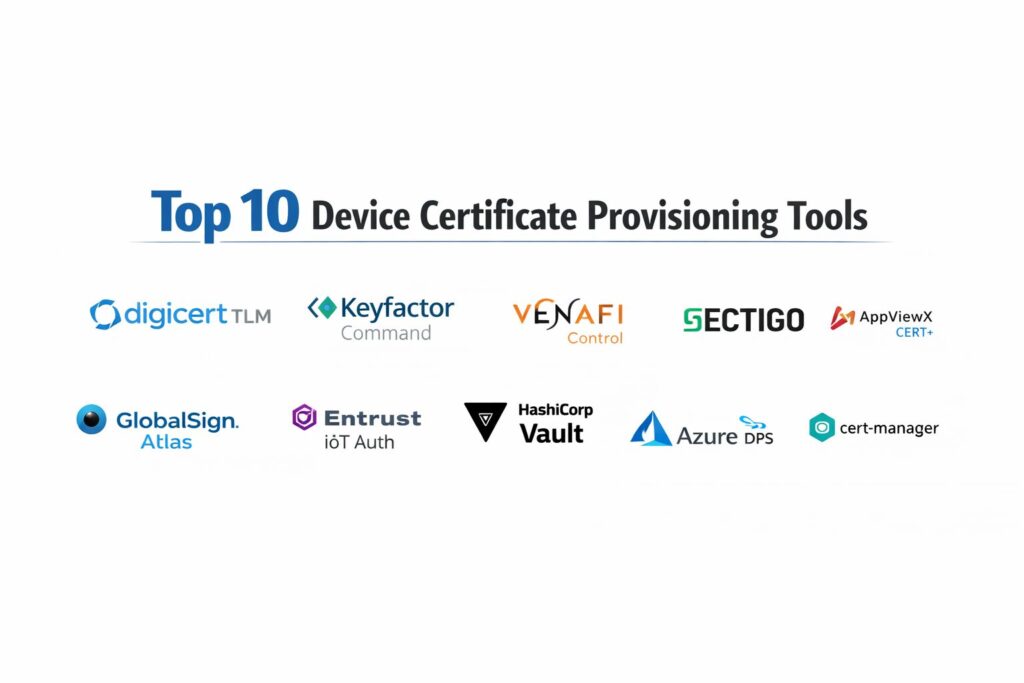
Introduction
In the modern landscape of distributed infrastructure and the Internet of Things (IoT), the establishment of a robust machine identity is no longer optional. Device certificate provisioning is the technical process of automatically issuing, deploying, and managing digital certificates—typically X.509 standards—to physical hardware, virtual machines, and edge devices. This process forms the “Root of Trust” necessary for mutual TLS (mTLS) authentication, ensuring that only authorized devices can communicate with a central network or cloud backend. As organizations transition toward Zero Trust architectures, the ability to provision unique, short-lived identities at scale becomes the primary defense against credential spoofing and unauthorized data exfiltration.
The complexity of provisioning lies in the “Last Mile” problem: the physical act of getting a unique cryptographic key and signed certificate onto a piece of hardware that may be in a remote location or on a factory floor. Modern provisioning tools address this through standardized protocols like SCEP, EST, and ACME, or through specialized cloud-based services that handle “Zero-Touch” enrollment. By automating the entire lifecycle—from initial bootstrap to automated renewal before expiration—these tools eliminate the manual overhead and human error that lead to catastrophic security outages. For the DevOps and Security professional, choosing the right provisioning tool is a foundational decision that impacts everything from manufacturing throughput to long-term operational resilience.
Best for: Security architects, IoT platform engineers, and DevSecOps teams who need to manage tens of thousands of unique device identities across diverse geographic and network environments.
Not ideal for: Small-scale web application developers who only need a single SSL certificate for a website, or organizations with purely static, internal-only server environments that do not involve external hardware.
Key Trends in Device Certificate Provisioning Tools
The industry is currently undergoing a massive shift toward “Crypto-Agility,” where provisioning tools must be capable of swapping out underlying cryptographic algorithms (such as moving to Post-Quantum Cryptography) without manual intervention on the device itself. This is driven by the realization that many IoT devices remain in the field for decades, far outliving the security of current RSA or ECC keys. Another significant trend is the rise of “Identity of Things” (IDoT) platforms, which treat the device identity not just as a security credential, but as a core metadata attribute that links the device to its owner, location, and operational state.
Furthermore, we are seeing a move away from long-lived certificates (valid for years) toward extremely short-lived certificates (valid for days or hours). This reduces the “blast radius” of a compromised key, as the certificate will naturally expire and become useless before an attacker can fully exploit it. This trend necessitates highly performant and reliable provisioning APIs that can handle hundreds of thousands of renewal requests per second. Finally, the integration of Hardware Security Modules (HSMs) and Trusted Platform Modules (TPMs) into the provisioning workflow has become standard, ensuring that the private keys never leave the secure silicon of the device.
How We Selected These Tools
The selection of these tools was based on their ability to handle the “Zero-Touch” provisioning requirements of modern enterprise and industrial environments. We prioritized platforms that support a “CA-Agnostic” approach, meaning they can work with multiple Certificate Authorities simultaneously to avoid vendor lock-in. Market presence and proven scalability were critical; we selected tools that are currently used to manage millions of active identities in production environments. We also looked for diverse deployment models, including cloud-native SaaS for rapid startup and on-premise appliances for high-security, air-gapped industrial facilities.
Technical evaluation focused on protocol support—specifically looking for tools that natively handle SCEP (Simple Certificate Enrollment Protocol), EST (Enrollment over Secure Transport), and CMP (Certificate Management Protocol). Security was assessed by looking at how the tools handle the “Initial Secret” during bootstrapping and their ability to integrate with hardware-based roots of trust like TPM 2.0. Finally, we considered the developer experience, valuing platforms with robust REST APIs and clear documentation that allow for seamless integration into existing CI/CD and manufacturing execution systems (MES).
1. DigiCert Trust Lifecycle Manager
DigiCert Trust Lifecycle Manager is a unified solution that combines the power of a global public CA with a sophisticated private PKI and certificate lifecycle management (CLM) engine. It is designed to provide complete visibility across an organization’s entire certificate estate, regardless of the issuing authority.
Key Features
The platform features “Smart Discovery,” which scans the network to find every existing certificate, including those on unmanaged devices. It provides a specialized “IoT Trust” module that handles high-volume provisioning during the manufacturing process. It supports a wide range of protocols, including ACME, SCEP, and EST, for automated deployment to routers, cameras, and industrial sensors. The dashboard offers real-time analytics on certificate health and impending expirations. Additionally, it integrates with major MDM/UEM solutions like Microsoft Intune and Jamf to handle enterprise mobile device provisioning.
Pros
Offers a true “single pane of glass” for both public and private certificates. The backend infrastructure is globally distributed, providing extremely high availability and low-latency issuance.
Cons
The enterprise-grade pricing and feature set may be overkill for smaller organizations. Full implementation of the discovery features can be complex in highly segmented networks.
Platforms and Deployment
Available as a cloud-based SaaS platform with local discovery agents for hybrid environments.
Security and Compliance
FIPS 140-2 Level 3 certified infrastructure; compliant with SOC 2, HIPAA, and GDPR standards.
Integrations and Ecosystem
Strong native integrations with AWS, Azure, GCP, ServiceNow, and various DevOps orchestration tools.
Support and Community
Premium 24/7 technical support and a wealth of whitepapers and implementation guides for various industry verticals.
2. Keyfactor Command
Keyfactor Command is a highly flexible certificate lifecycle automation platform that is frequently praised for its “Crypto-Agility.” It allows organizations to manage their internal and external certificates through a centralized, policy-driven interface.
Key Features
The platform uses a unique “Orchestrator” architecture to push and pull certificates from diverse endpoints without requiring agents on every device. It includes a built-in “CA Gateway” that allows it to manage certificates from any public or private CA. It features a powerful “Post-Quantum Readiness” assessment tool that helps organizations identify vulnerable keys. The system supports automated “one-click” renewal and revocation across thousands of devices simultaneously. It also includes the EJBCA (Enterprise Java Bean Certificate Authority) engine for those who want to run a powerful, localized private CA.
Pros
Extremely cost-effective compared to other enterprise competitors at a similar scale. The “PKI-as-a-Service” model allows organizations to outsource the complexity of CA management entirely.
Cons
The visual interface, while powerful, has a steeper learning curve for users who are not familiar with PKI concepts. Deeper legacy system integrations may require custom development work.
Platforms and Deployment
Available as SaaS, on-premise software, or a managed service.
Security and Compliance
FIPS-validated Bouncy Castle cryptographic libraries and SOC 2 Type II compliance.
Integrations and Ecosystem
Integrated with HashiCorp Vault, Kubernetes, and popular load balancers like F5 and Citrix.
Support and Community
Offers a dedicated “Keyfactor Academy” and an active community of users through the open-source EJBCA project.
3. Venafi Control Plane
Venafi is the pioneer of the “Machine Identity Management” category. Its Control Plane is designed for the modern, cloud-native enterprise that needs to manage identities across Kubernetes clusters, cloud workloads, and traditional hardware.
Key Features
The platform focuses on “TLS Protect” and “IoT Protect” modules to secure various machine types. It features “Firefly,” a lightweight identity provider for cloud-native workloads that creates short-lived certificates. It provides a “Policy Engine” that allows security teams to set strict standards for key length and algorithm type across the entire company. The system includes “V-Cert,” a command-line tool that makes it easy for developers to request certificates within their scripts. It also offers deep visibility into certificate-related risks, such as self-signed certificates or weak ciphers.
Pros
The most comprehensive integration catalog in the industry, with hundreds of pre-built connectors. It is the gold standard for large-scale enterprise compliance and governance.
Cons
Pricing is at the top of the market, which can be a barrier for mid-market companies. The platform’s complexity often requires a dedicated administrator to manage effectively.
Platforms and Deployment
Available as a cloud-hosted platform or an on-premise “Trust Protection Platform” (TPP).
Security and Compliance
Strong emphasis on governance; supports FIPS 140-2 and meets the most stringent financial and federal security requirements.
Integrations and Ecosystem
Native integration with cert-manager for Kubernetes and broad support for CI/CD pipelines.
Support and Community
Excellent enterprise support and the “Venafi Warrior” community for peer-to-peer knowledge sharing.
4. Sectigo Certificate Manager (SCM)
Sectigo SCM is a cloud-native platform that prides itself on being CA-agnostic and easy to deploy. It is designed to simplify the management of all types of digital certificates, including SSL, S/MIME, and Code Signing.
Key Features
The platform provides a centralized dashboard for managing certificates from multiple vendors, not just Sectigo. It features “Bulk Enrollment” tools that are highly efficient for IoT manufacturers. It supports the ACME protocol for automated web server renewals and SCEP for mobile device enrollment. The “Private CA” feature allows users to set up an internal hierarchy in minutes without managing any infrastructure. It also includes an automated scanning tool to discover “shadow” certificates that were purchased outside of official channels.
Pros
Very fast time-to-value; many organizations can get up and running within a few weeks. The pricing model is flexible and scales well for growing organizations.
Cons
While it supports multi-CA, its deepest features are still optimized for the Sectigo ecosystem. The reporting tools are functional but less customizable than Keyfactor or Venafi.
Platforms and Deployment
Primarily a cloud-native SaaS platform.
Security and Compliance
Maintains AICPA SOC 2 compliance and follows WebTrust principles for CAs.
Integrations and Ecosystem
Integrates with Active Directory, Intune, and various cloud load balancers.
Support and Community
Standard 24/7 technical support and a library of automated deployment scripts for developers.
5. AppViewX CERT+
AppViewX CERT+ is a leader in “Certificate Orchestration,” focusing on a low-code approach to automating the certificate lifecycle. It is designed for IT operations teams who need to manage security without deep cryptographic expertise.
Key Features
The standout feature is the “Visual Workflow Builder,” a drag-and-drop tool that allows users to design complex automation flows. It provides a “Smart Discovery” engine that identifies certificates across cloud, on-prem, and hybrid environments. The platform includes a self-service portal where authorized users can request certificates that are automatically validated against company policy. It supports “Role-Based Access Control” (RBAC) that is granular enough to allow different teams to manage their own certificates. The system also features automated SSH key management alongside X.509 certificates.
Pros
The low-code interface significantly reduces the technical barrier to entry for certificate automation. It is excellent for “Service Orchestration,” linking certificate updates to load balancer configuration changes.
Cons
The platform can be resource-intensive if deployed on-premise. Some advanced custom integrations require a deep understanding of the platform’s proprietary workflow logic.
Platforms and Deployment
Available as a cloud-based service or an on-premise virtual appliance.
Security and Compliance
Supports HSM integration and provides a comprehensive audit trail for all certificate actions.
Integrations and Ecosystem
Strong partnerships with F5, NetScaler, and ServiceNow for automated ITSM ticket resolution.
Support and Community
Offers proactive 24/7 support and a “Developer Hub” for custom workflow creation.
6. GlobalSign Atlas
GlobalSign Atlas is a high-speed, cloud-based certificate issuance engine designed specifically for automation. It is built for high-throughput environments where devices need identities in milliseconds.
Key Features
The platform is built on a RESTful API architecture, making it a favorite for developers. It features “IoT Edge Enroll,” which allows for secure, decentralized provisioning of IoT devices. It supports multiple protocols including EST, SCEP, and ACME. The system allows for “Flexible Validity” periods, enabling the issuance of certificates that last for only a few minutes or several years. It provides a centralized dashboard for monitoring all issuance activity and managing revocation lists (CRLs). Additionally, it offers a managed “Private CA” that eliminates the need for on-premise PKI hardware.
Pros
Engineered for extreme scalability, making it ideal for large-scale manufacturing lines. The API-first design simplifies integration into existing automated workflows.
Cons
It is primarily a GlobalSign-focused tool and does not offer the same level of CA-agnosticism as Keyfactor or AppViewX. The UI is focused more on issuance than on deep network discovery.
Platforms and Deployment
A pure cloud-native SaaS platform.
Security and Compliance
WebTrust-certified and compliant with global standards for public and private trust.
Integrations and Ecosystem
Strong integration with Microsoft Active Directory and various IoT hardware platforms.
Support and Community
Provides extensive developer documentation and professional services for custom PKI design.
7. Entrust IoT Authority
Entrust IoT Authority is a purpose-built identity platform designed specifically for the IoT ecosystem. It focuses on the secure lifecycle management of devices from the factory floor to retirement.
Key Features
The platform provides a “Secure Root of Trust” that can be injected during the chip-making or device manufacturing stage. It features “Managed PKI” specifically tuned for the constraints of IoT devices (low power, intermittent connectivity). It supports automated “Zero-Touch” provisioning once the device connects to the internet for the first time. The system includes a “Device Lifecycle Management” dashboard that tracks the health and security status of every field device. It also supports “Secure Boot” and firmware signing to ensure that only authorized code runs on the device.
Pros
The deep focus on hardware-level security and the manufacturing process makes it a top choice for industrial and medical device manufacturers. It offers very high assurance for sensitive deployments.
Cons
It is less of a general-purpose enterprise CLM and more of a specialized IoT security tool. Implementation usually requires coordination with hardware supply chain partners.
Platforms and Deployment
Cloud-based SaaS with optional on-premise components for factory integration.
Security and Compliance
Built on FIPS-certified Entrust HSMs and compliant with stringent industrial security standards.
Integrations and Ecosystem
Integrates with major IoT cloud platforms like AWS IoT and Azure IoT Hub.
Support and Community
High-touch enterprise support with a focus on manufacturing and supply chain security consulting.
8. HashiCorp Vault (PKI Secrets Engine)
HashiCorp Vault is a ubiquitous secret management tool that includes a powerful PKI secrets engine. It is the preferred choice for DevOps teams who want to treat certificates as dynamic secrets.
Key Features
The PKI engine allows for the “On-the-Fly” generation of X.509 certificates via API. It focuses on “Short-Lived Certificates” that reduce the need for revocation management. The system is entirely API-driven, allowing it to fit perfectly into Terraform and Nomad workflows. It can act as an intermediate CA, delegating issuance from a more secure, offline root. It supports “Role-Based Issuance,” where specific applications are only allowed to request certificates for specific domains. The “Identity Secrets Engine” can link certificates to existing LDAP or GitHub identities.
Pros
Completely free to start with the open-source version. It provides the most seamless experience for developers working in cloud-native and containerized environments.
Cons
Does not include a built-in GUI for certificate discovery or “Last Mile” hardware provisioning protocols like SCEP/EST out of the box. Managing a highly available Vault cluster requires significant DevOps expertise.
Platforms and Deployment
Runs on any major OS; available as self-hosted software or a managed “HCP Vault” service.
Security and Compliance
Features robust encryption for the storage backend and supports HSM-based master key wrapping.
Integrations and Ecosystem
Unmatched integration with the modern DevOps stack (Kubernetes, Terraform, Consul, etc.).
Support and Community
Massive global community and professional support available through HashiCorp’s Enterprise tier.
9. Microsoft Azure IoT Hub (Device Provisioning Service)
Azure DPS is a helper service for IoT Hub that enables zero-touch, just-in-time provisioning to the right IoT hub without human intervention.
Key Features
The service supports “Group Enrollment” for devices sharing a common root certificate or “Individual Enrollment” for higher security. It provides a “Selection Policy” that determines which IoT hub a device should be assigned to based on location or capacity. It integrates natively with Azure Sphere for silicon-to-cloud security. The provisioning process includes an “Attestation” phase where the device proves its identity using a TPM, X.509 certificate, or symmetric key. It also handles “Reprovisioning,” allowing devices to be moved between hubs or owners securely.
Pros
Deeply integrated with the Azure ecosystem, making it the natural choice for Microsoft-centric organizations. It is highly scalable and handles millions of device connections with ease.
Cons
Locked into the Azure cloud; not suitable for multi-cloud or on-premise-only environments. The focus is strictly on IoT devices, not general enterprise servers or users.
Platforms and Deployment
Managed cloud service within the Microsoft Azure portal.
Security and Compliance
Inherits the full suite of Azure compliance certifications (SOC, ISO, HIPAA).
Integrations and Ecosystem
Perfect integration with Azure IoT Hub, Azure Monitor, and Azure Functions for custom logic.
Support and Community
Supported by Microsoft’s global enterprise support team and an extensive library of documentation and YouTube tutorials.
10. cert-manager (by Jetstack/Venafi)
Originally an open-source project, cert-manager is now the “de facto” standard for certificate management within Kubernetes. It is a cloud-native tool that automates the issuance and renewal of certificates for containerized workloads.
Key Features
The tool acts as a Kubernetes “Controller” that watches for specific resources (Certificates and Issuers). It supports multiple issuers simultaneously, including Let’s Encrypt, Vault, and Venafi. It automatically handles the “Challenge” process (DNS-01 or HTTP-01) for validating domain ownership. It ensures that certificates are renewed before they expire, updating the corresponding Kubernetes Secrets automatically. It can manage certificates for ingress controllers, service meshes (like Istio), and internal pod-to-pod communication.
Pros
Completely open-source and natively speaks the language of Kubernetes (YAML). It has become the industry standard for securing containerized microservices.
Cons
Limited to the Kubernetes ecosystem; it cannot provision certificates to legacy servers or physical IoT devices directly. Requires a high level of Kubernetes technical knowledge.
Platforms and Deployment
Deployed as a set of containers within a Kubernetes cluster.
Security and Compliance
Security depends on the configuration and the choice of backend issuer; follows CNCF best practices.
Integrations and Ecosystem
Integrates with almost every major Kubernetes tool and all significant public/private Certificate Authorities.
Support and Community
Massive GitHub community and commercial “Enterprise” support available through Jetstack (owned by Venafi).
Comparison Table
| Tool Name | Best For | Platform(s) Supported | Deployment | Standout Feature | Public Rating |
| 1. DigiCert TLM | Global Enterprise | Cloud, Hybrid | SaaS | Unified Public/Private View | 4.7/5 |
| 2. Keyfactor Command | Multi-CA Automation | Cloud, On-Prem | Hybrid | Crypto-Agility Dashboard | 4.6/5 |
| 3. Venafi Control | Cloud-Native Gov | Cloud, SaaS | Hybrid | Machine Identity Focus | 4.6/5 |
| 4. Sectigo SCM | Rapid Deployment | Web, Cloud | SaaS | Automated Discovery Scan | 4.5/5 |
| 5. AppViewX CERT+ | IT Operations | Web, On-Prem | Hybrid | Visual Workflow Builder | 4.4/5 |
| 6. GlobalSign Atlas | High-Volume Mfg | API, Cloud | SaaS | IoT Edge Enroll Protocol | 4.3/5 |
| 7. Entrust IoT Auth | Hardware Security | Cloud, Mfg Line | Hybrid | Factory Root Injection | 4.5/5 |
| 8. HashiCorp Vault | DevOps / Secrets | OS-Agnostic | On-Prem/SaaS | Dynamic API Generation | 4.8/5 |
| 9. Azure DPS | Azure IoT Ecosystem | Azure Cloud | SaaS | Zero-Touch Hub Routing | 4.4/5 |
| 10. cert-manager | Kubernetes Clusters | Kubernetes | Container | K8s-Native Automation | 4.9/5 |
Evaluation & Scoring of Device Certificate Provisioning Tools
The scoring below is a comparative model intended to help shortlisting. Each criterion is scored from 1–10, then a weighted total from 0–10 is calculated using the weights listed. These are analyst estimates based on typical fit and common workflow requirements, not public ratings.
Weights:
- Core features – 25%
- Ease of use – 15%
- Integrations & ecosystem – 15%
- Security & compliance – 10%
- Performance & reliability – 10%
- Support & community – 10%
- Price / value – 15%
| Tool Name | Core (25%) | Ease (15%) | Integrations (15%) | Security (10%) | Performance (10%) | Support (10%) | Value (15%) | Weighted Total |
| 1. DigiCert TLM | 10 | 8 | 9 | 10 | 9 | 9 | 7 | 8.95 |
| 2. Keyfactor Command | 9 | 7 | 10 | 9 | 8 | 9 | 9 | 8.75 |
| 3. Venafi Control | 10 | 6 | 10 | 10 | 9 | 10 | 6 | 8.70 |
| 4. Sectigo SCM | 8 | 9 | 8 | 9 | 8 | 8 | 9 | 8.40 |
| 5. AppViewX CERT+ | 9 | 8 | 9 | 8 | 8 | 8 | 8 | 8.40 |
| 6. GlobalSign Atlas | 8 | 7 | 8 | 9 | 10 | 8 | 8 | 8.15 |
| 7. Entrust IoT Auth | 9 | 6 | 7 | 10 | 9 | 9 | 7 | 8.15 |
| 8. HashiCorp Vault | 8 | 6 | 10 | 10 | 10 | 7 | 10 | 8.60 |
| 9. Azure DPS | 8 | 8 | 6 | 9 | 9 | 9 | 8 | 8.05 |
| 10. cert-manager | 7 | 5 | 10 | 9 | 10 | 6 | 10 | 8.05 |
How to interpret the scores:
- Use the weighted total to shortlist candidates, then validate with a pilot.
- A lower score can mean specialization, not weakness.
- Security and compliance scores reflect controllability and governance fit, because certifications are often not publicly stated.
- Actual outcomes vary with assembly size, team skills, templates, and process maturity.
Which Device Certificate Provisioning Tool Is Right for You?
Solo / Freelancer
If you are a solo developer working on Kubernetes or cloud-native projects, cert-manager is the clear winner. It is free, powerful, and integrates perfectly with Let’s Encrypt to give you automated, valid certificates with zero cost and minimal effort.
SMB
For small to medium businesses that have a growing number of web servers and a few hundred devices, Sectigo SCM or DigiCert TLM (at lower tiers) offers a balance of professional-grade security and ease of use. These platforms provide a user-friendly dashboard that doesn’t require a full-time PKI expert to manage.
Mid-Market
Organizations with more complex hybrid environments and a mix of CA vendors will find the best value in Keyfactor Command. Its CA-agnostic approach and competitive pricing make it ideal for companies that are scaling fast and want to avoid the high costs associated with the largest enterprise players.
Enterprise
Large-scale enterprises with strict compliance requirements (such as banking or healthcare) should look toward Venafi or DigiCert. These platforms offer the depth of governance, discovery, and professional services required to manage tens of thousands of certificates across global business units while ensuring audit readiness.
Budget vs Premium
HashiCorp Vault and cert-manager represent the “budget” (open-source) end of the spectrum, though they require high technical expertise to maintain. On the premium end, Venafi and DigiCert offer white-glove service and comprehensive feature sets that justify their higher price points for high-stakes environments.
Feature Depth vs Ease of Use
AppViewX CERT+ wins on ease of use due to its visual workflow builder, allowing non-specialists to automate complex tasks. In contrast, tools like Entrust IoT Authority or HashiCorp Vault offer extreme feature depth but require a much deeper understanding of the underlying technology to use effectively.
Integrations & Scalability
If your primary concern is integrating with a diverse manufacturing supply chain, Entrust or GlobalSign Atlas are the specialized tools for the job. If your ecosystem is purely containerized, cert-manager is the standard that provides the best scalability within a cluster.
Security & Compliance Needs
For organizations needing the highest levels of hardware-backed security (FIPS 140-2 Level 3), DigiCert and Entrust lead the market. Their history in the CA and HSM space ensures that their provisioning workflows are built on the most secure foundations available today.
Frequently Asked Questions (FAQs)
1. What is the difference between PKI and certificate provisioning?
PKI (Public Key Infrastructure) is the entire system of hardware, software, and policies used to manage digital identities. Certificate provisioning is the specific technical act of delivering and installing those identities onto a device or server.
2. Why can’t I just use self-signed certificates for my devices?
Self-signed certificates offer no centralized way to revoke a compromised key and no “chain of trust” that a third party can verify. In a large-scale environment, using self-signed certs leads to “certificate hell,” where manual management becomes impossible and security risks skyrocket.
3. What is SCEP and why is it important for devices?
SCEP (Simple Certificate Enrollment Protocol) is a legacy but widely supported protocol that allows devices like routers and mobile phones to automatically request certificates from a CA using a shared secret. It is a cornerstone of automated device provisioning.
4. Can I provision certificates to devices that are not always online?
Yes, but it requires a strategy for handling expirations. Many tools allow you to issue certificates with longer validity for offline devices or use a “proxy” that handles the renewal process as soon as the device reconnects to the network.
5. How does Zero-Touch Provisioning (ZTP) work?
ZTP allows a device to be shipped from the factory with a “bootstrap” identity. When the end-user powers it on, it contacts a pre-defined provisioning service (like Azure DPS) which then automatically installs the final, unique operational certificate without any manual configuration.
6. Do I need a Hardware Security Module (HSM) for provisioning?
While not strictly required for the software to work, an HSM is a best practice for securing the “Root CA” key. It ensures that the most important key in your organization cannot be stolen or copied, even if the server it lives on is compromised.
7. Is it better to have one global CA or multiple small ones?
Modern best practices suggest a “Root CA” that remains offline, with several “Issuing CAs” dedicated to specific tasks (e.g., one for IoT devices, one for internal servers). This limits the impact if one issuing CA is compromised.
8. How do short-lived certificates improve security?
Short-lived certificates (valid for hours) drastically reduce the “window of opportunity” for an attacker. If a key is stolen, it will naturally expire very quickly, often before the attacker can even begin to use it for data exfiltration.
9. Can I manage SSH keys with these provisioning tools?
Some platforms, like AppViewX and Venafi, offer integrated SSH key management. This allows you to apply the same lifecycle policies (rotation, discovery, and auditing) to SSH keys as you do to X.509 certificates.
10. What happens if a certificate expires on a device in the field?
If a certificate expires, the device will typically fail its mTLS handshake and lose connectivity to the network. This can cause “bricking” of the device if it doesn’t have a secondary, non-certificate-based way to receive a new identity.
Conclusion
In a world defined by the proliferation of edge computing and the necessity of Zero Trust, device certificate provisioning has evolved from a niche IT task into a critical pillar of enterprise security. The tools analyzed here represent the pinnacle of cryptographic automation, each solving the “Last Mile” identity problem through different architectural philosophies. For the DevOps professional, the mission is to move away from the fragility of manual certificate management toward a future of automated, crypto-agile workflows. By selecting a platform that aligns with your specific infrastructure—be it Kubernetes-native, cloud-centric, or hardware-heavy—you ensure that every machine in your estate possesses a verifiable, secure, and manageable identity. The ultimate goal is an invisible security layer where certificates are provisioned, renewed, and retired without human intervention, allowing your teams to focus on innovation rather than troubleshooting outages.