Introduction
Demand planning tools are specialized software solutions designed to help organizations predict future customer demand and align their supply chain operations accordingly. In the high-velocity market, these tools have moved far beyond simple statistical forecasting, integrating advanced artificial intelligence (AI) and machine learning (ML) to process vast amounts of internal and external data. By synthesizing signals from sales history, market trends, weather patterns, and even social sentiment, demand planning software enables businesses to minimize stockouts, reduce excess inventory, and optimize working capital.
Modern demand planning is no longer an isolated function but a core component of Integrated Business Planning (IBP). These platforms provide the analytical “brain” that connects sales, marketing, and finance with procurement and manufacturing. For global enterprises and scaling mid-market firms alike, the ability to run real-time “what-if” scenarios has become a critical competitive advantage, allowing leaders to navigate global supply chain disruptions with data-driven confidence rather than intuition.
Best for: Supply chain managers, demand planners, and S&OP leaders in retail, manufacturing, and distribution who require high-accuracy forecasting and inventory optimization.
Not ideal for: Very small businesses with low SKU counts (under 100), or organizations that lack the data infrastructure to support automated predictive modeling.
Key Trends in Demand Planning Software
- Agentic AI & GenAI Copilots: 2026 marks the rise of “planning agents” that autonomously detect demand anomalies and suggest corrective actions through natural language interfaces.
- Demand Sensing: Moving beyond historical data, tools now use real-time “sensing” from POS data, IoT sensors, and external market shifts to adjust short-term forecasts instantly.
- Probabilistic Forecasting: Instead of providing a single “point” forecast, modern tools offer a range of possible outcomes with associated probabilities to better manage risk.
- Knowledge Graphs: Advanced platforms utilize Enterprise Knowledge Graphs (EKG) to map the complex, non-linear relationships between products, suppliers, and customers.
- ESG-Integrated Planning: Demand plans are now automatically analyzed for their carbon footprint and sustainability impact, aligning procurement with corporate green goals.
- Digital Twins: Platforms create virtual replicas of the entire supply chain to simulate the impact of demand spikes on logistics and warehouse capacity before they occur.
- Hyper-Automation: AI-driven workflows now automate 80-90% of routine forecasting tasks, allowing human planners to focus solely on high-value strategic exceptions.
How We Selected These Tools (Methodology)
Our selection methodology for the top demand planning tools focuses on a balance of technical innovation, market reliability, and integration depth. We analyzed the “Forecasting Precision Index,” which measures the software’s ability to reduce error rates across volatile product categories compared to traditional spreadsheets. We prioritized platforms that demonstrate native support for Open-API architectures and seamless connectivity with major ERP systems like SAP, Oracle, and Microsoft Dynamics.
Security and compliance were weighted heavily, specifically looking for SOC 2 Type II certification and adherence to the new ISO 42001 standard for AI management. We also evaluated the “Time-to-Value” (TTV) for each tool, favoring those with rapid deployment capabilities and pre-built industry templates. Finally, user experience (UX) and the quality of the vendor’s professional services were considered to ensure that these complex systems remain accessible to standard business users.
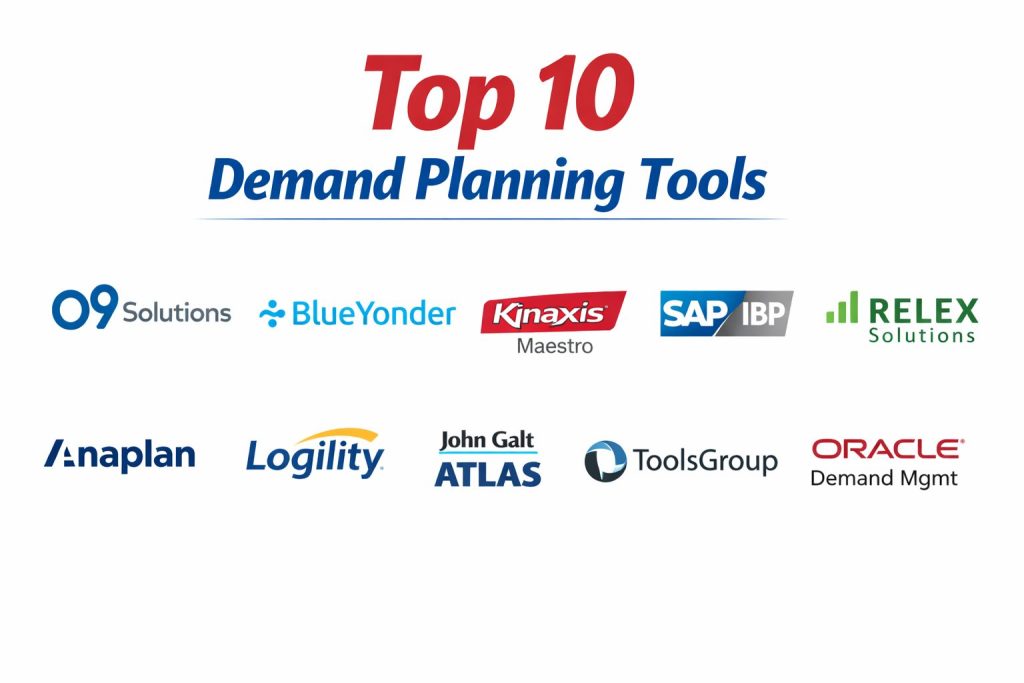
Top 10 Demand Planning Tools
1 o9 Solutions (Digital Brain)
o9 Solutions is a visionary AI-powered platform designed for large-scale digital transformation. Its “Digital Brain” leverages a knowledge graph to unify demand, supply, and financial planning into a single, high-fidelity model that adapts to market changes in real-time.
Key Features
- Enterprise Knowledge Graph (EKG): Maps multi-dimensional relationships across the entire supply chain network.
- Neuro-Symbolic AI: Combines the learning power of neural networks with strict business logic constraints.
- Post-Game Analysis (PGA): Automatically diagnoses why actual performance deviated from the plan to improve future models.
- Market Intelligence Integration: Pulls in external data like macroeconomic indicators and competitor pricing automatically.
- Collaborative S&OP: Provides a unified workspace for sales, finance, and operations to align on a single demand plan.
- AI Agents: Embedded digital co-workers that actively recommend actions to capture emerging market opportunities.
Pros
- Exceptional at handling extreme complexity for global enterprises with thousands of SKUs.
- Highly flexible architecture allows for deep customization of planning logic and workflows.
Cons
- Requires significant internal data maturity and analytical staff to manage the platform.
- The implementation process is complex and demands a high level of organizational commitment.
Platforms / Deployment
- Cloud (SaaS) / Hybrid
- Web-based / Mobile
Security & Compliance
- Features: End-to-end encryption, RBAC, and automated audit trails.
- Compliance: SOC 2 Type II, ISO 27001, GDPR, ISO 42001.
Integrations & Ecosystem
o9 features a “composable” approach with pre-built connectors for SAP, Oracle, and specialized data providers. Its ecosystem is supported by a large network of global consulting partners.
Support & Community
o9 offers a dedicated customer success model and extensive training through the o9 Academy. The community is focused on high-level supply chain thought leadership.
2 Blue Yonder (Luminate Planning)
Blue Yonder is a global leader in supply chain software, offering a comprehensive suite that bridges the gap between planning and execution. It is particularly strong in the retail and CPG sectors, where its probabilistic forecasting models excel.
Key Features
- Probabilistic Forecasting: Generates a range of potential outcomes to help planners prepare for volatility.
- Luminate Control Tower: Provides end-to-end visibility and real-time alerts for supply chain disruptions.
- Inventory Ops Agent: An AI digital assistant that proactively identifies mismatches between supply and demand.
- Omnichannel Optimization: Specifically designed to manage demand across physical stores and e-commerce channels.
- Knowledge Graph: Accelerates decision-making by correlating disparate data points into actionable insights.
- Azure-Native: Built on Microsoft Azure for high scalability and advanced data processing capabilities.
Pros
- Unmatched experience in retail and manufacturing, with deep industry-specific functionality.
- Seamlessly integrates planning with warehouse (WMS) and transportation (TMS) execution systems.
Cons
- High investment costs make it less accessible for mid-sized or smaller organizations.
- Some users report a steep learning curve for the more advanced AI-driven modules.
Platforms / Deployment
- Cloud (SaaS)
- Windows / Web
Security & Compliance
- Features: Enterprise-grade security protocols backed by Microsoft Azure.
- Compliance: SOC 2, ISO 27001, GDPR, FedRAMP.
Integrations & Ecosystem
Blue Yonder integrates deeply with the Microsoft ecosystem and various ERPs. It features an extensive marketplace of third-party apps and specialized extensions.
Support & Community
The company provides professional enterprise support and a robust user community. Extensive documentation and “Blue Yonder University” offer thorough training resources.
3 Kinaxis Maestro
Kinaxis (formerly RapidResponse) is renowned for its “concurrency” engine, which allows users to see the ripple effects of a demand change across the entire supply chain instantly. It is a top choice for organizations prioritizing agility and fast scenario modeling.
Key Features
- Concurrent Planning: Synchronizes demand shifts with supply constraints across the entire enterprise in seconds.
- Maestro Agents: AI-driven digital co-workers that autonomously detect anomalies and recommend prescriptive actions.
- Planning.AI: Blends traditional heuristics with advanced machine learning for highly accurate demand sensing.
- What-If Simulations: Allows planners to run unlimited scenarios without affecting the “live” production environment.
- Self-Healing Supply Chain: Automatically adjusts plans based on real-time data from logistics and manufacturing.
- Unified Data Model: Eliminates data silos by housing all planning data in a single, high-performance repository.
Pros
- Extremely fast at calculating the impact of disruptions, making it ideal for volatile markets.
- Highly intuitive “Excel-like” interface that is easier for traditional planners to adopt.
Cons
- The statistical forecasting capabilities may require external integration for very specialized modeling.
- License costs are high, and implementation requires a disciplined approach to data quality.
Platforms / Deployment
- Cloud (SaaS)
- Web-based / Desktop
Security & Compliance
- Features: Multi-factor authentication, secure data isolation, and encrypted data at rest.
- Compliance: SOC 2 Type II, ISO 27001, GDPR, HIPAA.
Integrations & Ecosystem
Kinaxis has robust native connectors for SAP and Oracle ERP systems. It is part of a broad ecosystem that includes major global systems integrators.
Support & Community
Kinaxis offers high-touch technical support and an active peer community. The “Kinaxis Learning Center” provides structured certification paths for planners.
4 SAP IBP (Integrated Business Planning)
SAP IBP is the go-to solution for organizations already running on the SAP S/4HANA ecosystem. It offers a deeply integrated, cloud-native platform that covers demand, supply, inventory, and sales and operations planning.
Key Features
- Demand Sensing: Uses machine learning to refine short-term forecasts based on real-time daily data.
- Fiori User Experience: Provides a modern, browser-based interface that is consistent across the SAP ecosystem.
- Integrated S&OP: Facilitates a unified process to align financial targets with operational capabilities.
- Supply Chain Control Tower: Offers real-time monitoring and visibility into global supply chain health.
- Excel Add-in: Allows planners to work in a familiar Excel environment while interacting directly with the IBP database.
- Advanced Analytics: Includes pre-built dashboards for tracking forecast accuracy and bias.
Pros
- Best-in-class integration for companies using SAP ERP, ensuring a “single source of truth.”
- Highly scalable and robust, capable of supporting the world’s largest global corporations.
Cons
- Can be very complex to configure and customize outside of standard SAP workflows.
- Requires specialized SAP consultants for implementation, leading to higher total costs.
Platforms / Deployment
- Cloud (SaaS)
- Web-browser / Excel Add-in
Security & Compliance
- Features: Comprehensive security via SAP Cloud Platform; safe scene script execution.
- Compliance: SOC 2, ISO 27001, GDPR, TISAX.
Integrations & Ecosystem
Designed to live within the SAP ecosystem, it integrates natively with S/4HANA, BW/4HANA, and Ariba. It has the largest global network of certified consultants.
Support & Community
SAP offers world-wide 24/7 support and a massive community of users and developers. “SAP Learning Hub” provides exhaustive resources for all levels.
5 RELEX Solutions
RELEX is a specialist in retail and consumer goods planning, known for its ability to handle extreme complexity in perishable goods and high-frequency promotions. Its AI-driven platform focus heavily on granular store-level optimization.
Key Features
- Living Retail Platform: A unified system that links demand planning with store space and labor optimization.
- Automated Replenishment: Uses high-frequency demand data to automate ordering at the SKU-store level.
- Fresh Food Optimization: Specialized algorithms to reduce waste and spoilage in grocery and food service.
- Promotion Planning: Analyzes the historical impact of promotions to predict future uplift with high precision.
- Sustainability Focus: Tools to reduce carbon emissions by optimizing transport and reducing product waste.
- Mobile-First Execution: Provides store managers with mobile tools to adjust local demand signals on the fly.
Pros
- Exceptional at store-level forecasting and handling high-volume retail environments.
- Strong focus on sustainability and waste reduction, providing clear ESG reporting metrics.
Cons
- Primarily focused on retail and CPG; may not be as suitable for industrial manufacturing.
- Implementation can be data-intensive, requiring high-quality POS data from all locations.
Platforms / Deployment
- Cloud (SaaS)
- Web / Mobile (iOS & Android)
Security & Compliance
- Features: Encrypted data pipelines and secure multi-tenant architecture.
- Compliance: SOC 2 Type II, GDPR, ISO 27001.
Integrations & Ecosystem
RELEX integrates with most major retail ERPs and POS systems. They offer specialized retail expertise through a high-touch customer success model.
Support & Community
The company is known for its localized retail expertise and proactive support. The community is tight-knit, focusing on retail innovation and efficiency.
6 Anaplan
Anaplan is a flexible, cloud-native “Connected Planning” platform that allows users to build highly customized demand models. Its “Hyperblock” engine enables massive calculations across complex multidimensional data sets.
Key Features
- Hyperblock Engine: Allows for real-time calculation of complex models with millions of cells.
- Scenario Modeling: Exceptionally strong at “what-if” analysis for financial and operational planning.
- App Hub: Features hundreds of pre-built planning models for various industries and use cases.
- Collaborative Workflow: Enables multiple departments to contribute to a shared plan in real-time.
- Custom Modeling: Allows users to build their own forecasting logic without writing traditional code.
- Native SAP Integration: Features high-speed data bridges to pull data from legacy ERP systems.
Pros
- Unmatched flexibility to create bespoke planning models tailored to unique business processes.
- Breaks down silos by connecting demand plans directly to financial P&L and workforce planning.
Cons
- Requires intensive training and often third-party consultants for initial model building.
- Implementation in complex environments can be time-consuming, sometimes exceeding 12 months.
Platforms / Deployment
- Cloud (SaaS)
- Web-based / Mobile
Security & Compliance
- Features: SSO, encryption, and granular access controls.
- Compliance: ISO 27001, SOC 2, HIPAA, GDPR.
Integrations & Ecosystem
Anaplan has a massive partner network and a vibrant “Anaplan Community.” It integrates with Salesforce, Workday, and major ERP systems via standard APIs.
Support & Community
Offers tiered professional support and an extensive library of best practices. The “Anaplan Academy” is the primary source for user certification.
7 Logility (Digital Supply Chain Platform)
Logility offers a mature, AI-driven platform that balances advanced functionality with a user-friendly experience. It is particularly well-regarded for its “Demand Sensing” and “Demand Shaping” capabilities for mid-market and enterprise firms.
Key Features
- AI-Driven Demand Sensing: Captures short-term market changes to refine immediate production schedules.
- Demand Shaping: Helps marketing and sales teams understand how to influence demand to match supply.
- S&OP Optimization: Provides clear visualizations to align executive strategy with daily execution.
- Multi-Echelon Inventory Optimization (MEIO): Balances inventory levels across the entire distribution network.
- Visual Supply Chain: Offers highly intuitive dashboards and map-based visualizations of demand.
- Logility University: An integrated learning platform that helps users master advanced features.
Pros
- Offers a great balance between sophisticated AI capabilities and overall usability.
- Strong functional scope that covers everything from product lifecycle to retail optimization.
Cons
- The transition of legacy modules to a fully cloud-hosted architecture can be progressive.
- Pricing is enterprise-level and can be a significant investment for smaller mid-market firms.
Platforms / Deployment
- Cloud (SaaS) / Hybrid
- Windows / Web
Security & Compliance
- Features: Standard enterprise encryption and safe scene script execution.
- Compliance: ISO 27001, SOC 2, GDPR.
Integrations & Ecosystem
Logility has a long history of integrating with various ERPs and legacy systems. It offers a solid global support presence and a well-established partner network.
Support & Community
Known for strong expert-led support and professional training services. The community is focused on supply chain reliability and long-term planning excellence.
8 John Galt (Atlas Planning Platform)
John Galt Solutions provides the Atlas Planning Platform, which is highly scalable and known for its “resilient” approach to planning. It is a favorite for mid-market companies that need a partner to help them scale into enterprise-grade operations.
Key Features
- Atlas Planning Platform: A unified environment for demand, supply, and inventory planning.
- Demand Sensation: Uses machine learning to identify and react to external demand drivers.
- Collaborative Demand: Streamlines the process of collecting input from sales and field teams.
- Auto-ML Forecasting: Automatically selects the best statistical or ML model for each individual SKU.
- Replenishment Planning: Synchronizes demand with procurement and manufacturing schedules.
- Strategic S&OP: Provides executive-level dashboards for long-range planning and goal setting.
Pros
- Highly scalable solution that can grow with a company from mid-market to global enterprise.
- Excellent customer success reputation, with a focus on long-term partnership and TTV.
Cons
- The user interface, while functional, may not feel as modern as newer entrants like o9.
- Advanced AI features may require additional configuration and data preparation.
Platforms / Deployment
- Cloud (SaaS)
- Windows / Web
Security & Compliance
- Features: High-standard encryption and SOC 2 verified infrastructure.
- Compliance: SOC 2, GDPR.
Integrations & Ecosystem
Atlas integrates with all major ERPs including Microsoft Dynamics, NetSuite, and SAP. They offer a strong support system for mid-market clients.
Support & Community
John Galt is recognized for its high-touch support and training programs. The community is active and focused on practical planning improvements.
9 ToolsGroup (Service Optimizer 99+)
ToolsGroup is a leader in “probabilistic” demand planning, specifically designed for companies dealing with high SKU complexity and intermittent demand. It is the tool of choice for organizations that prioritize high service levels and low inventory.
Key Features
- Service Optimizer 99+ (SO99+): A core engine focused on achieving specific service level targets.
- Probabilistic Forecasting: Effectively handles the “long tail” of products with irregular sales patterns.
- MEIO: Optimizes inventory across multiple levels of the supply chain simultaneously.
- Demand Collaboration: A web-based tool for gathering and reconciling demand signals from various partners.
- Promotion Impact Analysis: Uses AI to separate base demand from promotional spikes.
- Digital Twin Capability: Allows for the simulation of various supply chain configurations to test resilience.
Pros
- Unmatched at handling intermittent and “slow-moving” demand with extreme precision.
- Focuses on service-level outcomes, making it easy to align planning with customer satisfaction goals.
Cons
- The interface can be technical and may require specialized training for optimal use.
- Less focus on “demand shaping” compared to marketing-centric tools like Logility.
Platforms / Deployment
- Cloud (SaaS) / On-premises
- Windows / Web
Security & Compliance
- Features: Standard secure license activation and data encryption.
- Compliance: SOC 2, GDPR, ISO 27001.
Integrations & Ecosystem
ToolsGroup has strong integrations with Microsoft and SAP ecosystems. They feature a growing community of “reliability-focused” planners.
Support & Community
Offers expert-led technical support and structured training programs. The community is highly specialized in inventory optimization and statistical planning.
10 Oracle Demand Management Cloud
Oracle’s solution is a native part of the Oracle SCM Cloud, designed for enterprises that need high-scale forecasting integrated with a global supply chain. It excels at multi-level forecasting and real-time analytics.
Key Features
- AI-Powered Demand Sensing: Automatically incorporates external signals into short-term forecasts.
- Multi-Level Forecasting: Allows for planning across various hierarchies, from product categories to regions.
- Integrated S&OP: Connects demand plans directly to Oracle’s financial and supply modules.
- Predictive Analytics: Uses advanced statistical models to identify future trends and risks.
- Scenario Modeling: Enables rapid “what-if” analysis to assess the impact of demand changes.
- Native ERP Integration: Seamlessly shares data with Oracle ERP and SCM Cloud.
Pros
- Provides a highly cohesive experience for organizations already utilizing the Oracle Cloud suite.
- Powerful at managing massive, multi-tier global supply chains with high data volume.
Cons
- Can be very expensive and complex for mid-sized firms to implement.
- Customization options may be more constrained compared to specialized platforms like o9.
Platforms / Deployment
- Cloud (SaaS)
- Web-browser / Mobile
Security & Compliance
- Features: Oracle Cloud Infrastructure (OCI) security including 24/7 monitoring and data isolation.
- Compliance: SOC 2, ISO 27001, GDPR, FedRAMP, HIPAA.
Integrations & Ecosystem
As a core Oracle product, it features deep native integrations and is supported by a global network of specialized Oracle partners.
Support & Community
Oracle provides global enterprise support and an extensive library of documentation. The community is massive, spanning across all major global industries.
Comparison Table (Top 10)
| Tool Name | Best For | Platform(s) Supported | Deployment | Standout Feature | Public Rating |
| o9 Solutions | Global Enterprise | Web, Mobile | Cloud / Hybrid | Knowledge Graph | 4.7/5 |
| Blue Yonder | Retail & CPG | Win, Web | Cloud (SaaS) | Probabilistic Forecast | 4.5/5 |
| Kinaxis Maestro | Agility / S&OP | Web, Desktop | Cloud (SaaS) | Concurrency Engine | 4.6/5 |
| SAP IBP | SAP Ecosystem | Web, Excel | Cloud (SaaS) | S/4HANA Integration | 4.4/5 |
| RELEX Solutions | Grocery / Retail | Web, Mobile | Cloud (SaaS) | Fresh Food Opt. | 4.8/5 |
| Anaplan | Custom Modeling | Web, Mobile | Cloud (SaaS) | Hyperblock Engine | 4.6/5 |
| Logility | Visual SCM | Win, Web | Cloud / Hybrid | Demand Shaping | 4.4/5 |
| John Galt (Atlas) | Scaling Mid-Market | Win, Web | Cloud (SaaS) | Auto-ML Selection | 4.5/5 |
| ToolsGroup | Long-Tail / Service | Win, Web | Cloud / On-prem | SO99+ Engine | 4.6/5 |
| Oracle Demand Mgmt | Oracle Ecosystem | Web, Mobile | Cloud (SaaS) | Multi-level Forecast | 4.2/5 |
Evaluation & Scoring of Demand Planning Tools
The following scores represent a comparative analysis based on the requirements of a modern supply chain as of early 2026.
| Tool Name | Core (25%) | Ease (15%) | Integrations (15%) | Security (10%) | Performance (10%) | Support (10%) | Value (15%) | Weighted Total |
| o9 Solutions | 10 | 4 | 10 | 10 | 10 | 8 | 6 | 8.25 |
| Blue Yonder | 9 | 6 | 9 | 9 | 9 | 9 | 6 | 8.05 |
| Kinaxis Maestro | 9 | 8 | 9 | 9 | 10 | 9 | 7 | 8.60 |
| SAP IBP | 8 | 5 | 10 | 9 | 8 | 9 | 6 | 7.70 |
| RELEX Solutions | 10 | 8 | 8 | 9 | 9 | 9 | 8 | 8.80 |
| Anaplan | 8 | 6 | 9 | 9 | 10 | 8 | 7 | 7.85 |
| Logility | 8 | 8 | 8 | 8 | 8 | 8 | 8 | 8.00 |
| John Galt (Atlas) | 7 | 8 | 8 | 8 | 8 | 9 | 9 | 7.85 |
| ToolsGroup | 9 | 6 | 8 | 8 | 8 | 8 | 7 | 7.70 |
| Oracle Demand Mgmt | 8 | 5 | 10 | 10 | 9 | 8 | 6 | 7.65 |
How to interpret these scores:
- Weighted Total: A score of 8.0+ represents a world-class platform capable of anchoring a global supply chain.
- Core vs. Ease: Specialized platforms like o9 Solutions offer unrivaled power (10) but require expert handling (4), whereas tools like RELEX balance both.
- Performance: High scores in performance (like Kinaxis or Anaplan) reflect the software’s ability to recalculate massive data sets in near real-time.
Which Demand Planning Tool Is Right for You?
SMB / Early Mid-Market
Companies that have outgrown Excel but aren’t ready for a multi-million dollar SAP implementation should look at John Galt (Atlas) or Logility. These tools offer a faster “Time-to-Value” and are designed to scale as the business grows without requiring a massive IT department.
Global Enterprise (Complex)
For corporations with complex, multi-national supply chains, o9 Solutions is the most visionary choice due to its knowledge graph architecture. If the primary need is extreme speed and immediate reaction to disruptions, Kinaxis Maestro is the industry benchmark for concurrent planning.
Retail & Grocery Specialists
If your business deals with perishable goods, massive seasonal promotions, or high-frequency store-level replenishment, RELEX Solutions is the clear winner. Its ability to reduce waste and optimize store space is tailored specifically for the retail landscape.
Ecosystem Loyalists
For organizations already heavily invested in SAP or Oracle, using their respective Demand Management clouds is often the most cost-effective path. The native integration reduces data latency and implementation risks, even if the user interface is more traditional.
Custom Workflow Seekers
If your business has a highly unique planning process that doesn’t fit into “standard” boxes, Anaplan provides the building blocks to create a bespoke platform. It is ideal for linking demand planning directly with complex financial models.
Long-Tail & Spare Parts
Companies dealing with a “long tail” of products that have irregular or intermittent sales should prioritize ToolsGroup. Their probabilistic engine is specifically tuned for these difficult-to-forecast items, ensuring high service levels with minimal stock.
Frequently Asked Questions (FAQs)
1 Is demand planning the same as forecasting?
No. Forecasting is the statistical prediction of future sales, while demand planning is a broader process that includes reconciling those forecasts with inventory, production, and financial goals to create an actionable plan.
2 Can AI completely replace my demand planners?
AI replaces the “grunt work” of data entry and cleaning. It allows planners to shift from being data crunchers to strategic decision-makers who oversee AI suggestions and handle complex exceptions.
3 How long does it take to implement these tools?
Implementation varies significantly: mid-market tools like John Galt can be live in 3-5 months, while massive enterprise suites like SAP IBP or o9 Solutions often require 12-18 months for a full global rollout.
4 Do I need a data scientist to run AI demand planning software?
Most modern tools like Blue Yonder or Kinaxis have “Auto-ML” features that handle the complex math behind the scenes, making them usable by standard planners. However, a basic understanding of data is helpful.
5 Will these tools integrate with my current ERP?
Yes, most top-tier tools are designed to sit on top of ERPs like NetSuite, SAP, or Microsoft Dynamics. They use standard APIs to pull transactional data and push back optimized plans.
6 How much accuracy improvement can I expect?
According to industry benchmarks, moving from spreadsheets to an AI-driven tool can reduce forecasting errors by 20% to 50%, which typically leads to a 10% to 30% reduction in inventory costs.
7 What is “Demand Sensing”?
Demand sensing is the use of real-time data (like current weather, social media trends, or today’s POS data) to make immediate, short-term adjustments to a forecast, rather than relying solely on historical averages.
8 Are these tools cloud-based or on-premises?
By 2026, the industry has shifted almost entirely to Cloud (SaaS) models. This allows for better collaboration, easier updates, and the massive computing power needed for real-time AI calculations.
9 Is my data safe in a cloud demand planning tool?
Top vendors adhere to strict security standards like SOC 2 and ISO 27001. Because these tools handle sensitive financial and supply data, they often have higher security than traditional internal servers.
10 Can these tools handle “Black Swan” events?
While no software can predict a global pandemic, tools with strong scenario modeling (like Kinaxis or Anaplan) allow you to quickly simulate the “what-if” impact of such events and pivot your strategy in hours instead of weeks.
Conclusion
The demand planning landscape of current is defined by a shift from reactive, spreadsheet-based forecasting to proactive, AI-driven decision intelligence. Selecting the right tool—whether it is the retail precision of RELEX, the concurrent agility of Kinaxis, or the enterprise-wide “Digital Brain” of o9 Solutions—is the foundation of a resilient supply chain. As market volatility continues to rise, the ability to sense demand shifts and respond with high-fidelity simulations has become the primary driver of profitability and customer satisfaction.
Ultimately, the most successful organizations will be those that view these tools not just as software, but as the connective tissue for their entire business strategy. By breaking down the silos between departments and leveraging the power of hyper-automation, companies can ensure they are always ready for the market of tomorrow.